

New Rules for Non Profits:

   Tips for Navigating a Changed World


                                    Linda Ziskind
Brother, can you
spare $11.32 billion?*
*According to a report from the Giving USA Foundation, total charitable
giving fell to $303.76 billion in 2009, down from $315.08 billion in 2008.
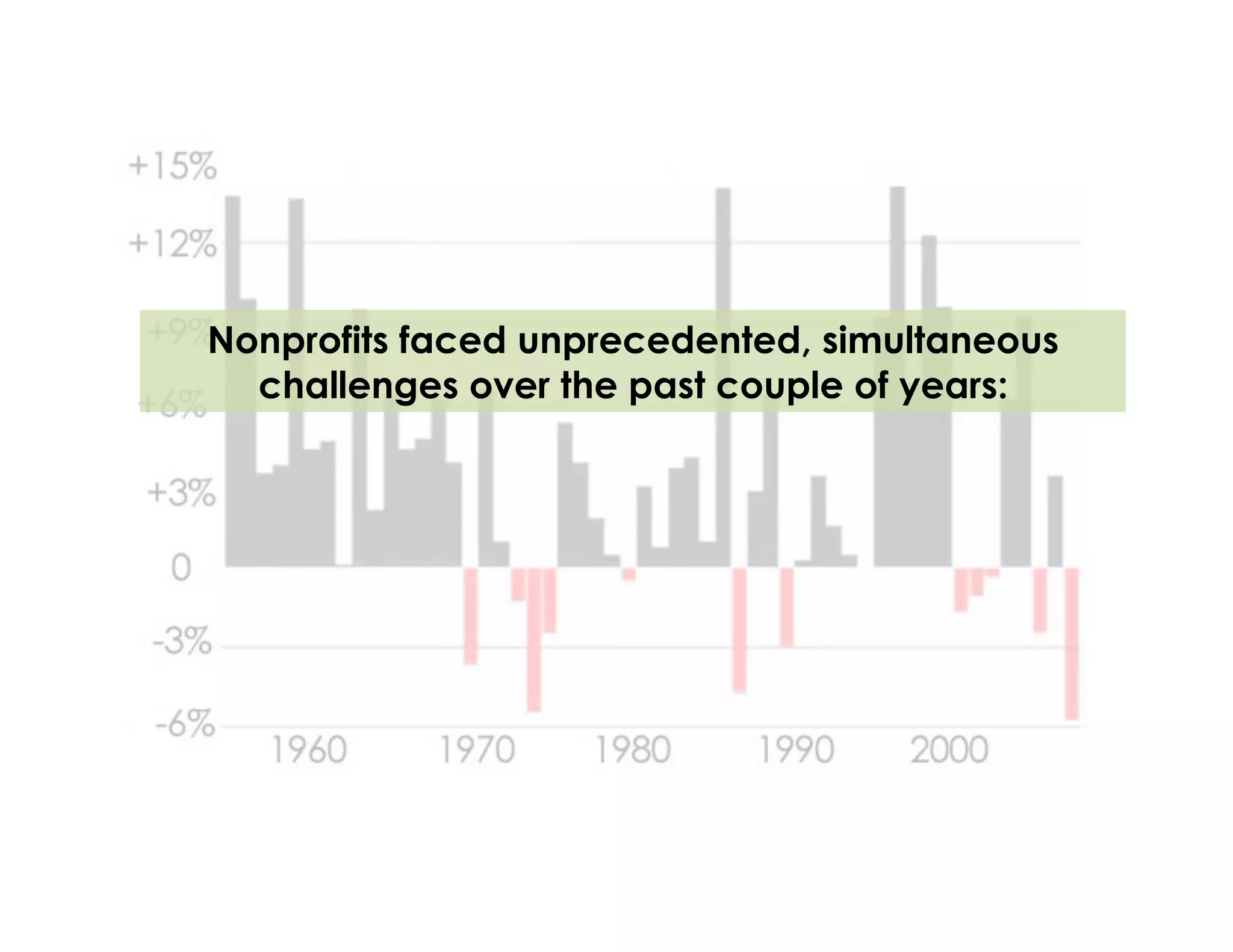
Nonprofits faced unprecedented, simultaneous
  challenges over the past couple of years:
Nonprofits faced unprecedented, simultaneous
   challenges over the past couple of years:

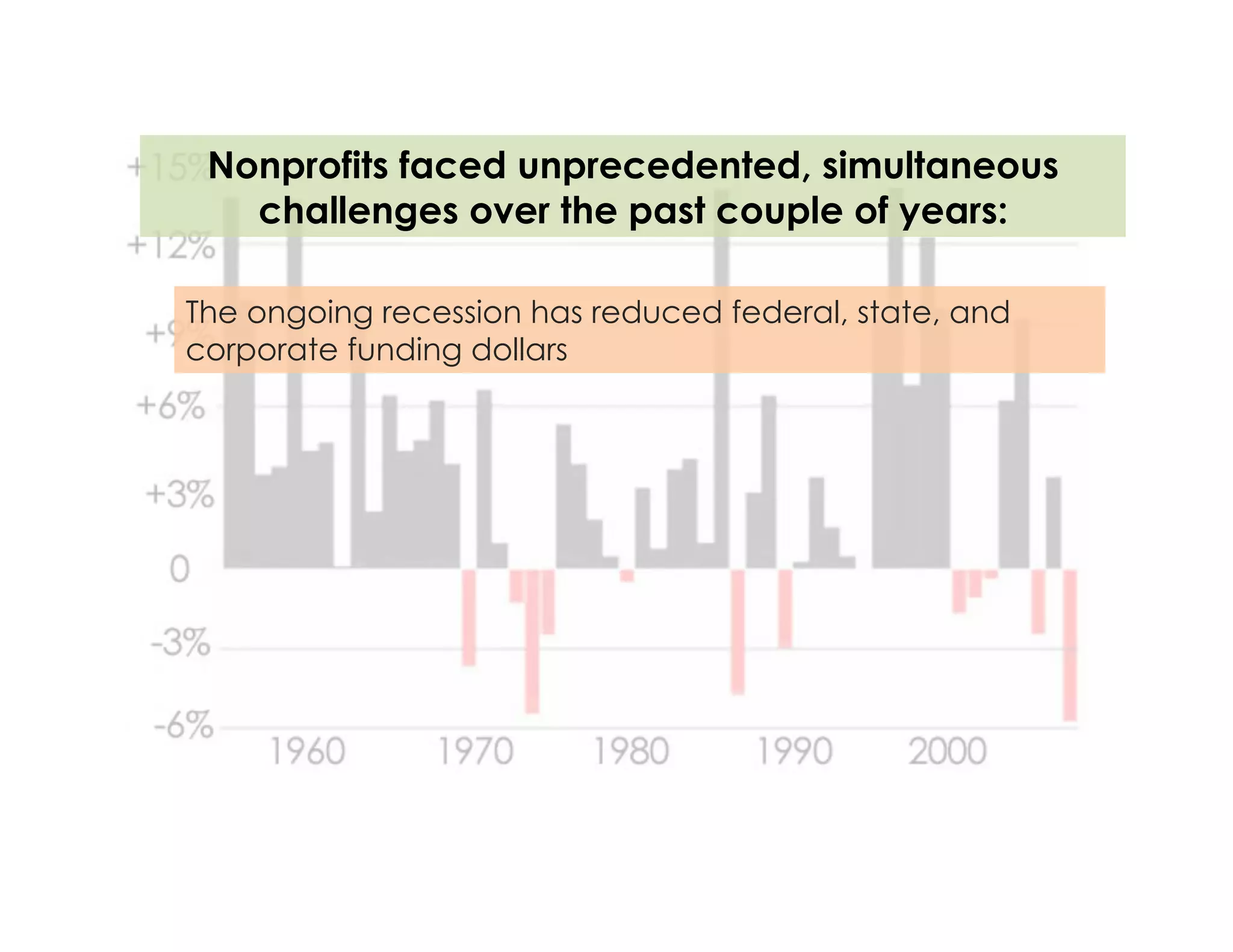
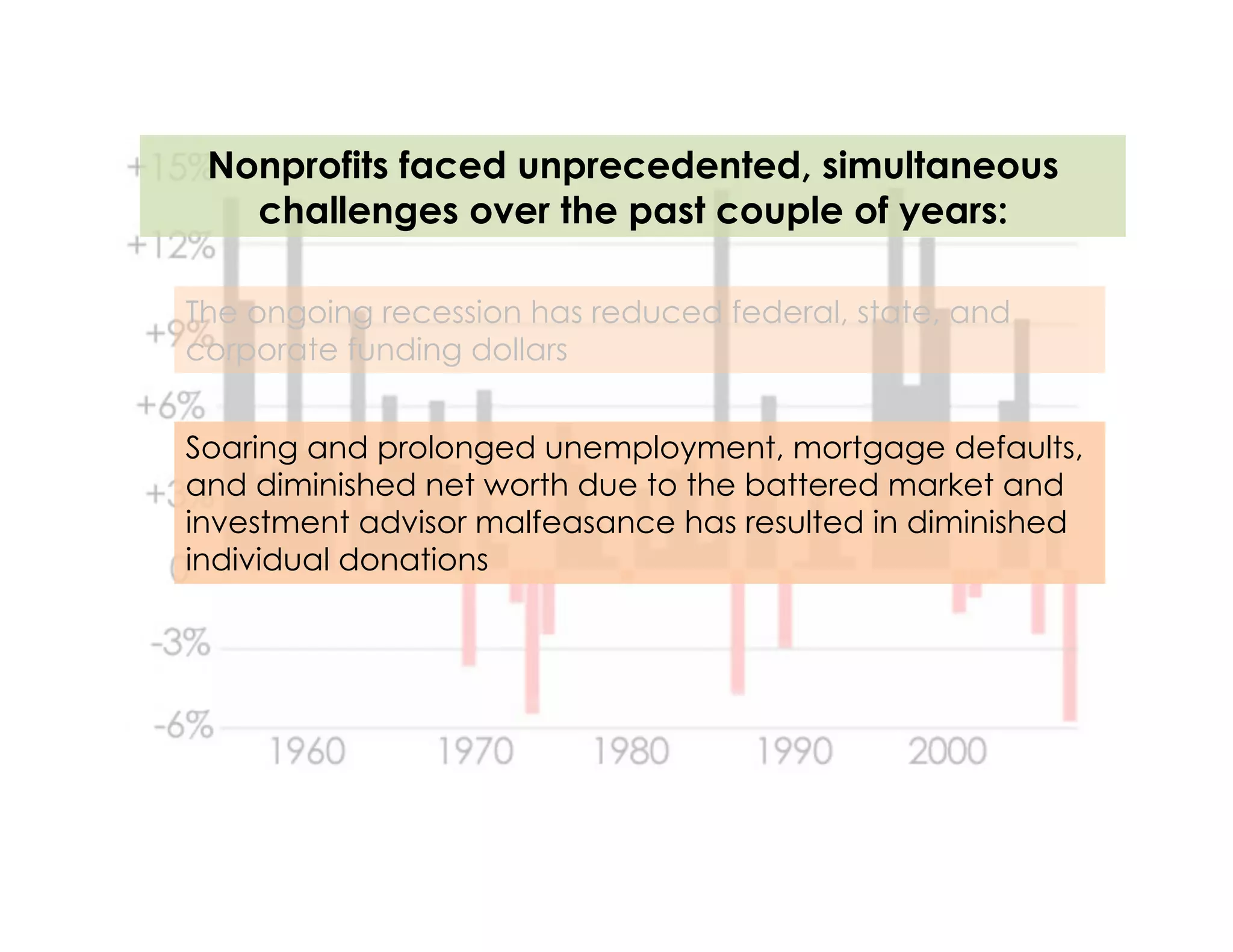
The ongoing recession has reduced federal, state, and
corporate funding dollars
Nonprofits faced unprecedented, simultaneous
   challenges over the past couple of years:

The ongoing recession has reduced federal, state, and
corporate funding dollars


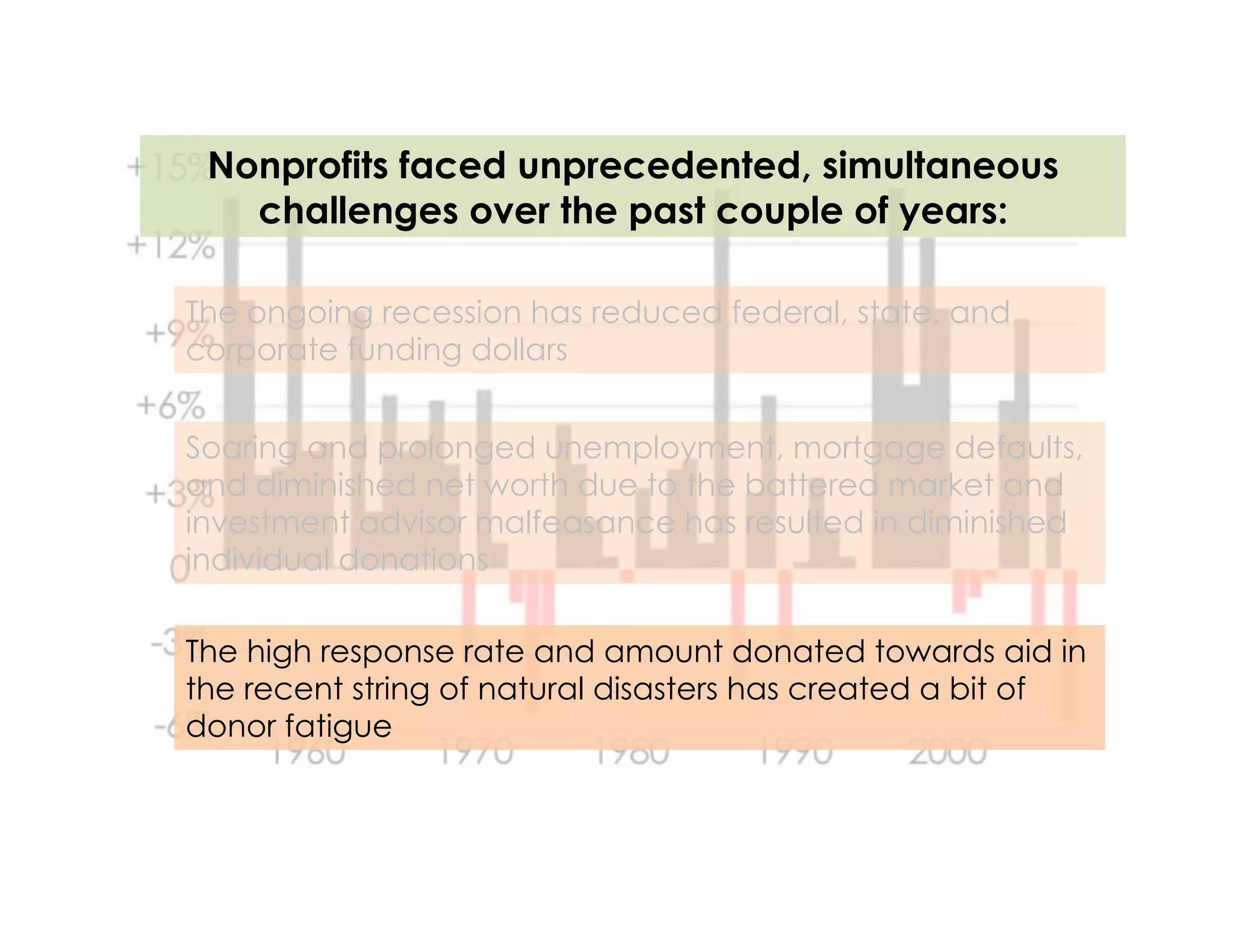
Soaring and prolonged unemployment, mortgage defaults,
and diminished net worth due to the battered market and
investment advisor malfeasance has resulted in diminished
individual donations
Nonprofits faced unprecedented, simultaneous
   challenges over the past couple of years:

The ongoing recession has reduced federal, state, and
corporate funding dollars


Soaring and prolonged unemployment, mortgage defaults,
and diminished net worth due to the battered market and
investment advisor malfeasance has resulted in diminished
individual donations

The high response rate and amount donated towards aid in
the recent string of natural disasters has created a bit of
donor fatigue
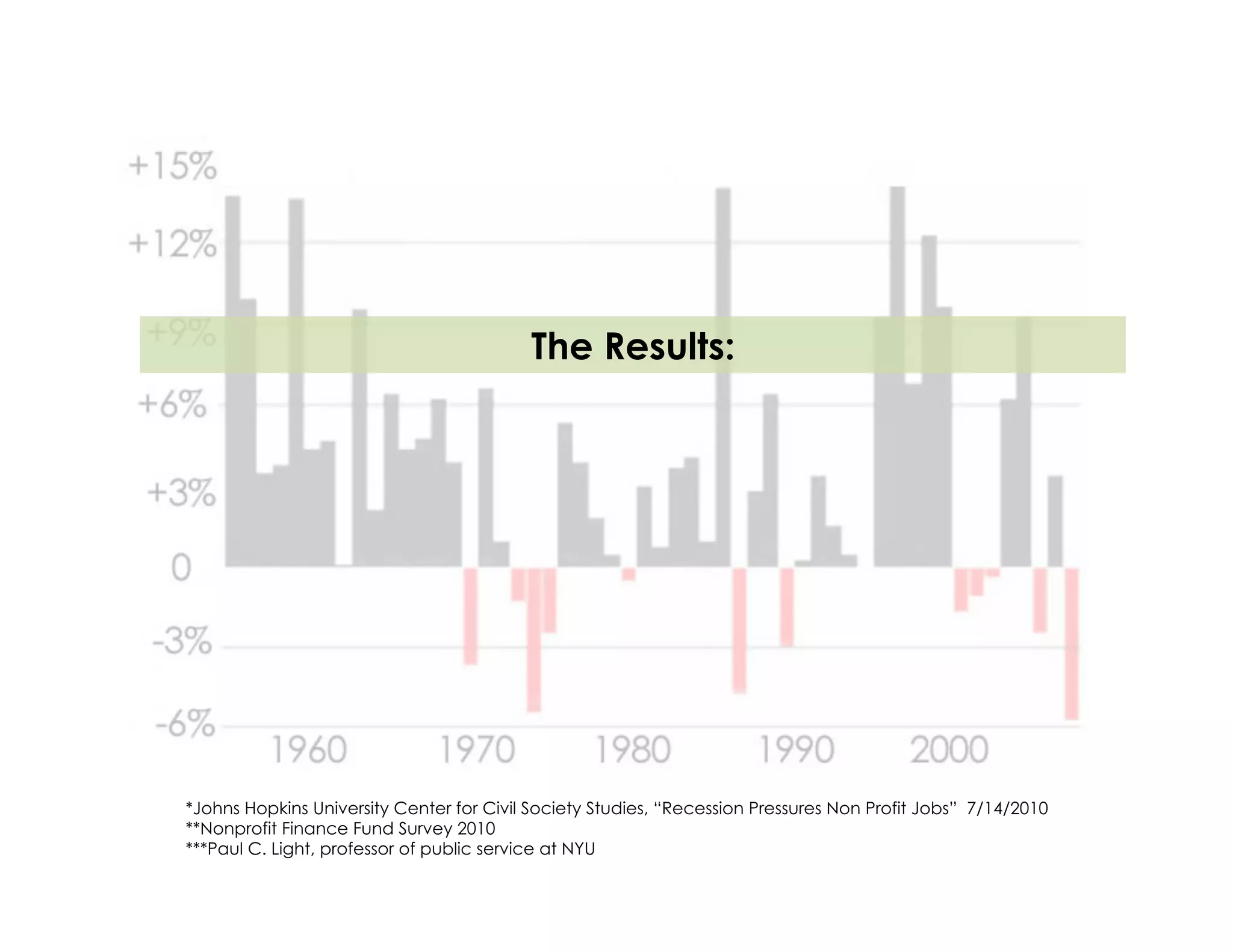
The Results:


*Johns Hopkins University Center for Civil Society Studies, “Recession Pressures Non Profit Jobs” 7/14/2010
**Nonprofit Finance Fund Survey 2010
***Paul C. Light, professor of public service at NYU
The Results:


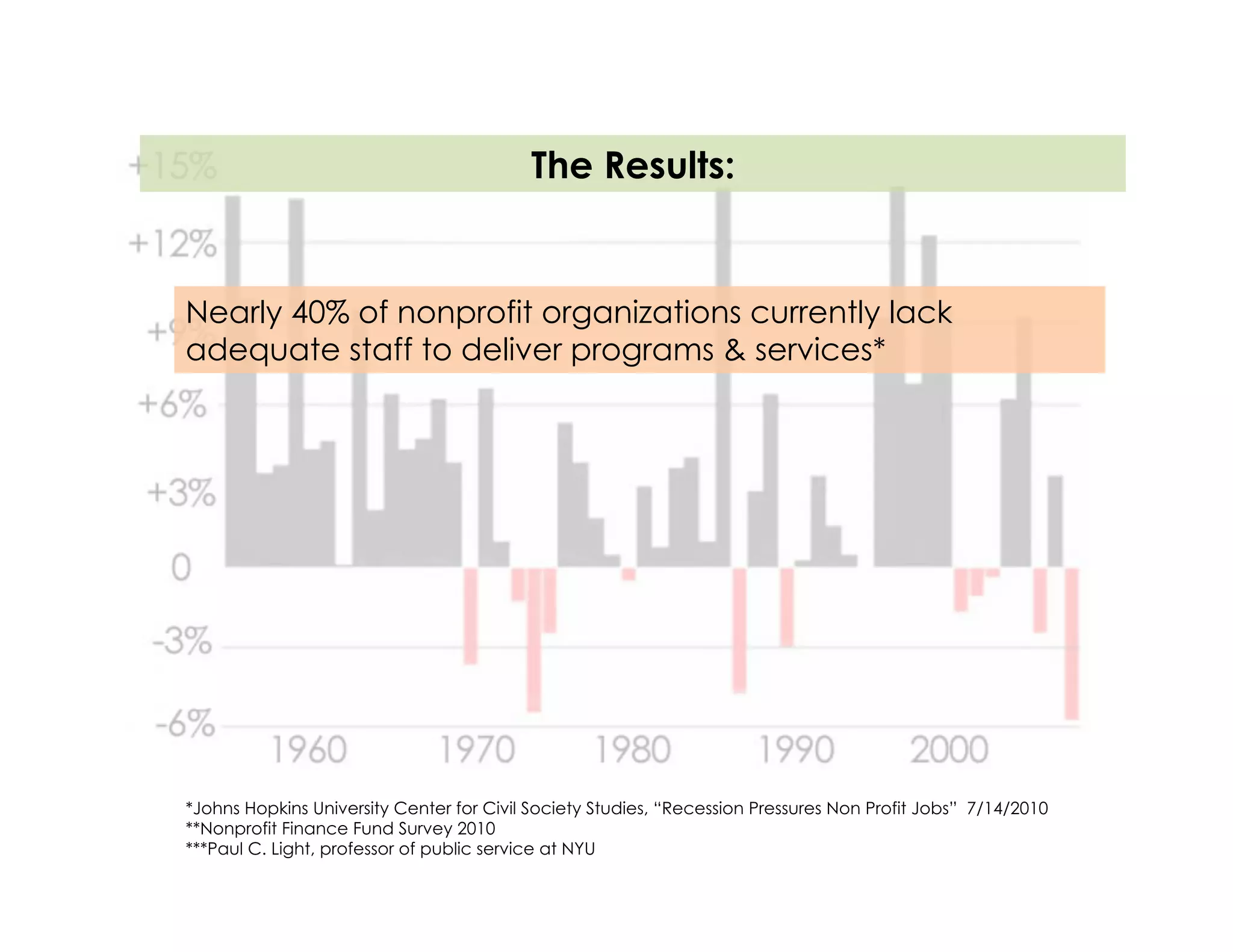
Nearly 40% of nonprofit organizations currently lack
adequate staff to deliver programs & services*


*Johns Hopkins University Center for Civil Society Studies, “Recession Pressures Non Profit Jobs” 7/14/2010
**Nonprofit Finance Fund Survey 2010
***Paul C. Light, professor of public service at NYU
The Results:


Nearly 40% of nonprofit organizations currently lack
adequate staff to deliver programs & services*


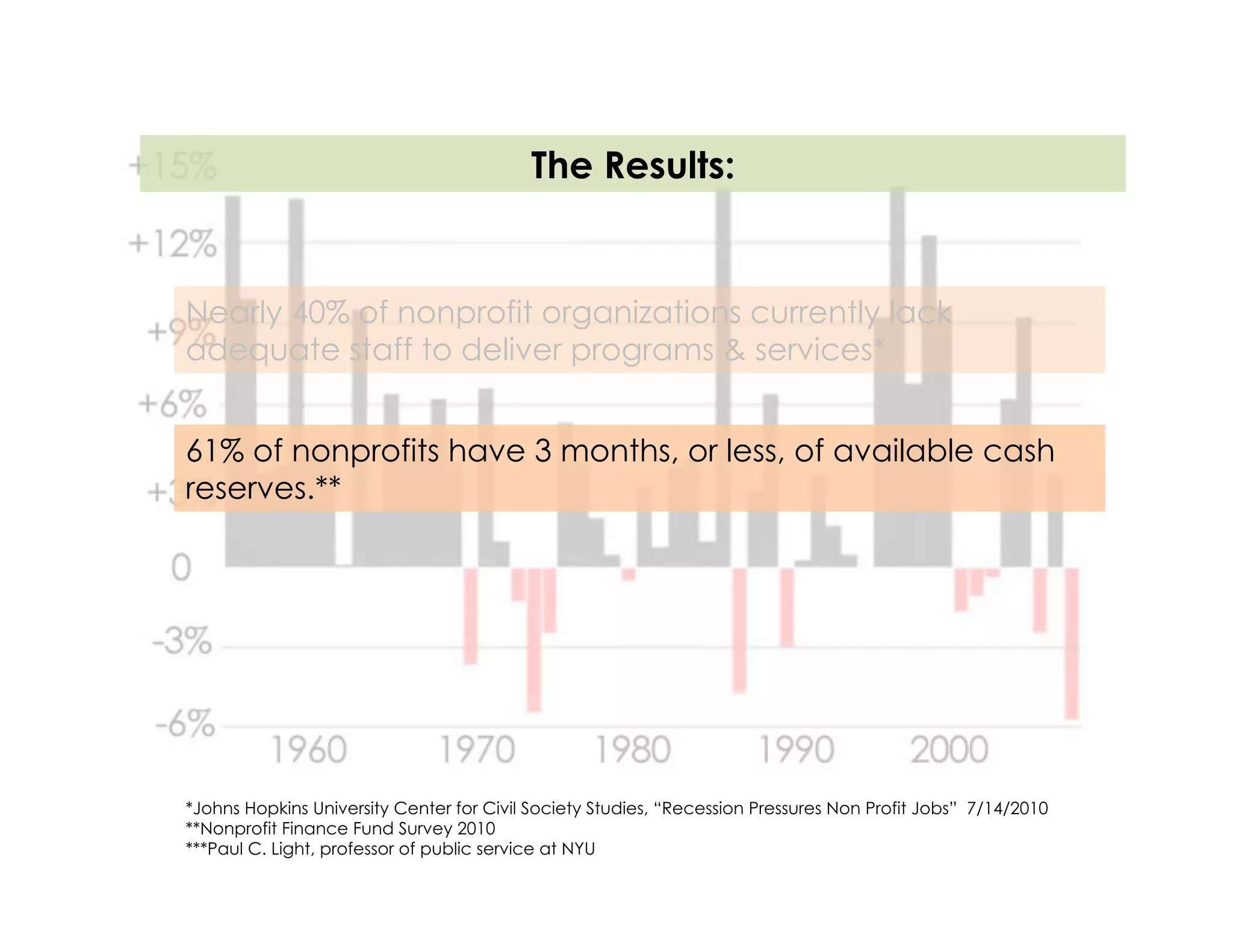
61% of nonprofits have 3 months, or less, of available cash
reserves.**


*Johns Hopkins University Center for Civil Society Studies, “Recession Pressures Non Profit Jobs” 7/14/2010
**Nonprofit Finance Fund Survey 2010
***Paul C. Light, professor of public service at NYU
The Results:


Nearly 40% of nonprofit organizations currently lack
adequate staff to deliver programs & services*


61% of nonprofits have 3 months, or less, of available cash
reserves.**


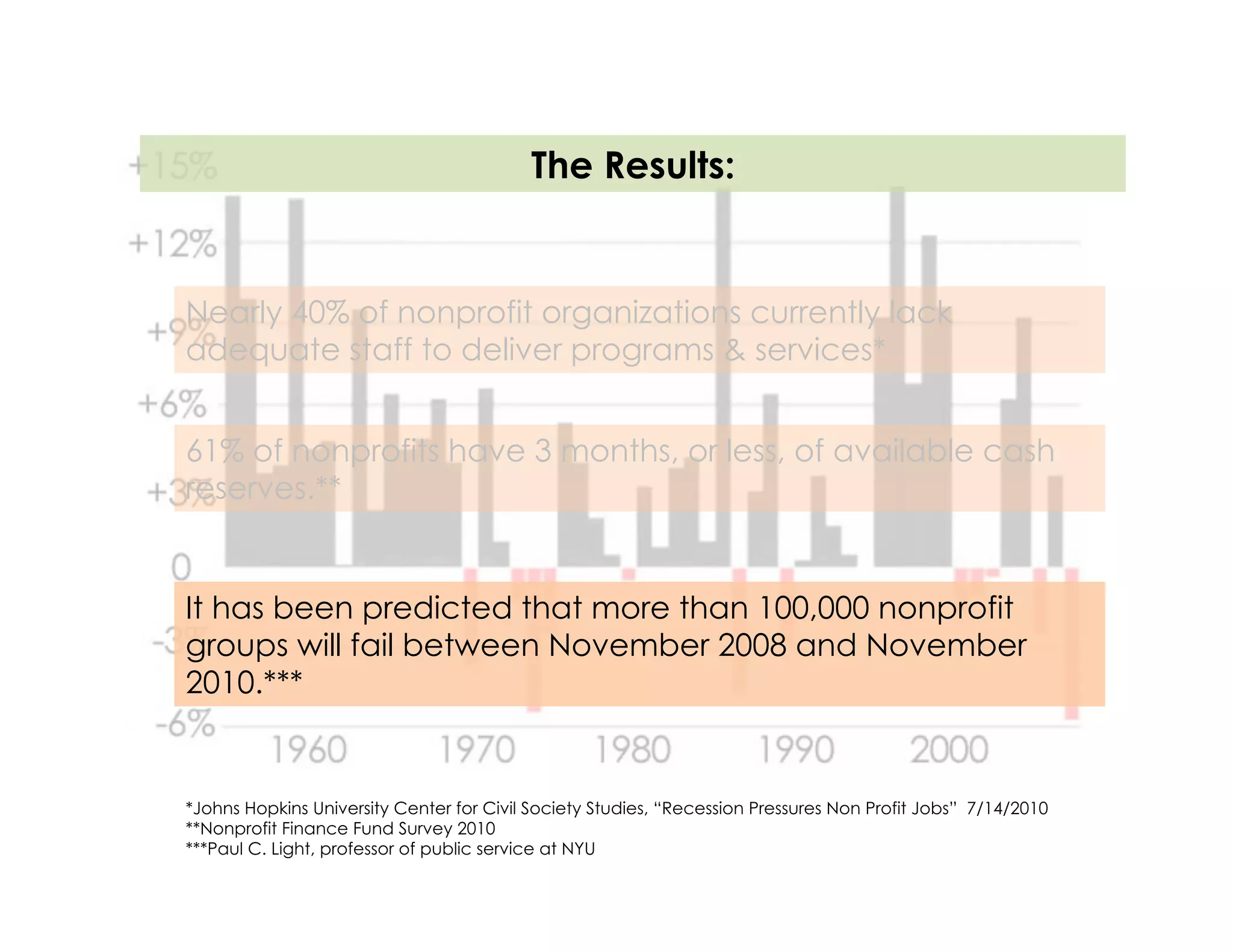
It has been predicted that more than 100,000 nonprofit
groups will fail between November 2008 and November
2010.***


*Johns Hopkins University Center for Civil Society Studies, “Recession Pressures Non Profit Jobs” 7/14/2010
**Nonprofit Finance Fund Survey 2010
***Paul C. Light, professor of public service at NYU
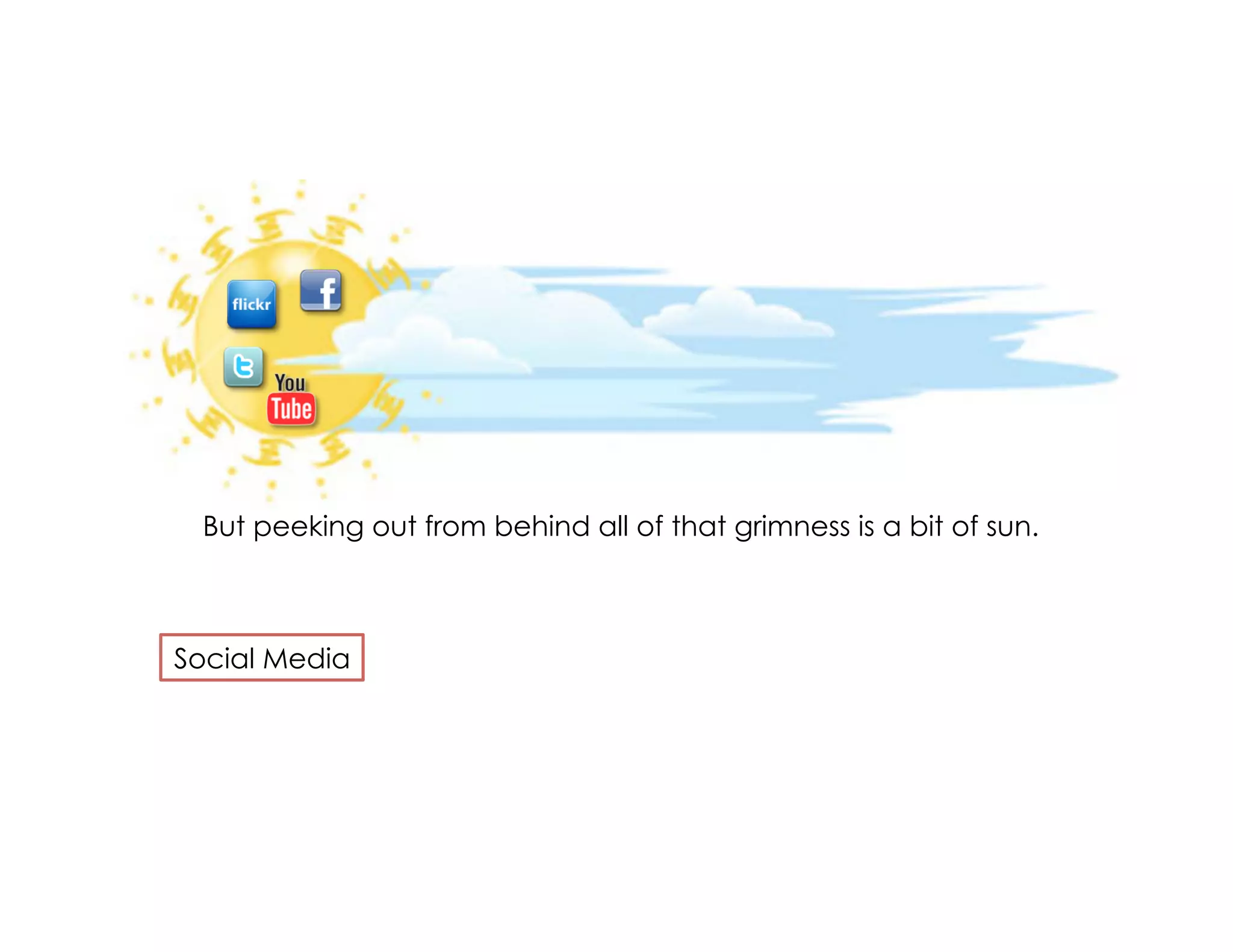
But peeking out from behind all of that grimness is a bit of sun.


Social Media
But peeking out from behind all of that grimness is a bit of sun.


Social Media
But peeking out from behind all of that grimness is a bit of sun.


Social Media           Technology
But peeking out from behind all of that grimness is a bit of sun.


Social Media           Technology
But peeking out from behind all of that grimness is a bit of sun.


                                               A new culture of
Social Media           Technology               participation,
                                             collaboration, and
                                             shared information.
Embrace change and learn the new rules: organizations that
reshape their strategies and tactics to meet new challenges are
the ones that will survive and continue to be effective
Non profits and for profit businesses are beginning
to learn from each other’s best practices, so it’s
not surprising that the new rules for non profits are
a lot like the rules that successful businesses follow
The New Rules:


1.  Define your brand and mission.
The New Rules:


1.  Define your brand and mission.

2.  Incorporate businesses planning practices

     a)  Develop concrete financial and program objectives
     b)  Identify specific strategies and tactics for achieving
         objectives
     c)  Define criteria for success for each program
     d)  Implement, review, analyze, revise
The New Rules:


1.  Define your brand and mission.

2.  Incorporate businesses planning practices

     a)  Develop concrete financial and program objectives
     b)  Identify specific strategies and tactics for achieving
         objectives
     c)  Define criteria for success for each program
     d)  Implement, review, analyze, revise

3.  Strategically incorporate technology to enable increased staff
   efficiency, operational economy, and access to valuable data.
The New Rules:


1.  Define your brand and mission.

2.  Incorporate businesses planning practices

     a)  Develop concrete financial and program objectives
     b)  Identify specific strategies and tactics for achieving
         objectives
     c)  Define criteria for success for each program
     d)  Implement, review, analyze, revise

3.  Strategically incorporate technology to enable increased staff
   efficiency, operational economy, and access to valuable data.

4.  Show appropriate appreciation to your donors
The New Rules:


1.  Define your brand and mission.

2.  Incorporate businesses planning practices

     a)  Develop concrete financial and program objectives
     b)  Identify specific strategies and tactics for achieving
         objectives
     c)  Define criteria for success for each program
     d)  Implement, review, analyze, revise

3.  Strategically incorporate technology to enable increased staff
   efficiency, operational economy, and access to valuable data.

4.  Show appropriate appreciation to your donors

5.  Embrace innovation
The New Rules:


1.  Define your brand and mission.

2.  Incorporate businesses planning practices

     a)  Develop concrete financial and program objectives
     b)  Identify specific strategies and tactics for achieving
         objectives
     c)  Define criteria for success for each program
     d)  Implement, review, analyze, revise

3.  Strategically incorporate technology to enable increased staff
    efficiency, operational economy, and access to valuable data.

4.  Show appropriate appreciation to your donors

5.  Embrace innovation

6.  Be part of the culture of participation, collaboration, and
    communication.
1.  Define your brand and mission.


•    Your brand identity is what distinguishes and identifies the soul of
     your organization. It’s more than your logo, or website. It’s what
     you say and how you say it. It’s your voice, your tone, your
     programming, and your attitude. It’s how people think of you.


•    Your mission (or vision, or core ideology) is part of your brand and
     defines everything you do. It isn’t the product you make or
     service you provide – it’s the benefits they deliver. (i.e., Merck
     doesn’t talk about pharmaceutical research or drug efficacy.
     Their mission is: “We are in the business of preserving and
     improving human life. All of our actions must be measured by our
     success in achieving this goal.”
2.  Incorporate business planning practices.


    Clearly define your financial and program objectives
    Use those objectives as the guide for developing programs,
     development, and fundraising strategies and tactics
    Develop criteria for to measure and evaluate success for
     programs, events, and fundraising initiatives. Use that criteria to
     analyze results, evaluate effectiveness, and revise strategies or
     tactics as needed.
3.  Strategically incorporate technology to
              enable increased staff efficiency, operational
              economy, and access to valuable data.

    There is a potential goldmine of data waiting to be extracted,
     analyzed, and used to help you generate more revenue, develop
     more successful relationships, and operate more effectively.
         Donor database and member management software
         Project and event management software
         Email marketing programs
         Online donation programs


www.nten.org (Consumers Guide to Low Cost Donor Management Systems –
pdf)
www.techsoup.org
www.constantcontact.com
www.basecamphq.com
www.networkforgood.org
4. Show appropriate appreciation to your donors


    Stay in touch with donors, even if they can’t give as much as they
     did at one time
4. Show appropriate appreciation to your donors


    Stay in touch with donors, even if they can’t give as much as they
     did at one time
    Make sure donors understand the direct impact of their gift – show
     them how they have impacted your mission.
4. Show appropriate appreciation to your donors


    Stay in touch with donors, even if they can’t give as much as they
     did at one time
    Make sure donors understand the direct impact of their gift – show
     them how they have impacted your mission.
    Say thank you frequently and meaningfully
4. Show appropriate appreciation to your donors


    Stay in touch with donors, even if they can’t give as much as they
     did at one time
    Make sure donors understand the direct impact of their gift – show
     them how they have impacted your mission.
    Say thank you frequently and meaningfully
    Engage donors continuously – fundraising isn’t seasonal – it’s
     always
5.  Embrace innovation.


    Non profits are facing unprecedented challenges on all fronts and
     are finding that their established processes are falling short in
     addressing them
       Foundation grantors and individual donors are increasingly
          requiring evidence of program effectiveness
       As more and more people gravitate towards social media,
          organizations must get better at finding and engaging them
          there
       Reduced budgets and staffing makes it imperative to find
          more efficient ways of operating
5.  Embrace innovation.


    Survival requires developing or finding, and then incorporating,
     innovative new solutions to address challenges
        Research peer organization best-practices
        Implement accountability and evaluation processes
        Conduct an honest evaluation of your programs, fundraising,
          marketing, and operations and look for new strategies and
          solutions for the ones that aren’t successful
        Look for silos in your organization and find ways of integrating
          efforts
        Find opportunities to collaborate
6.  Be part of the culture of participation,
              collaboration, and communication.


    Marketing communication is not longer a passive channel.
     People respond when they feel engaged and can
     participate.
    Don’t drown in the social media ocean. Be practical about
     how much you can handle.
    Your constituents expect transparency. Use social media to
     provide that.
    Use social media channels to tell a compelling story:
          Twitter (TwitCause)
          YouTube (http://www.youtube.com/nonprofits)
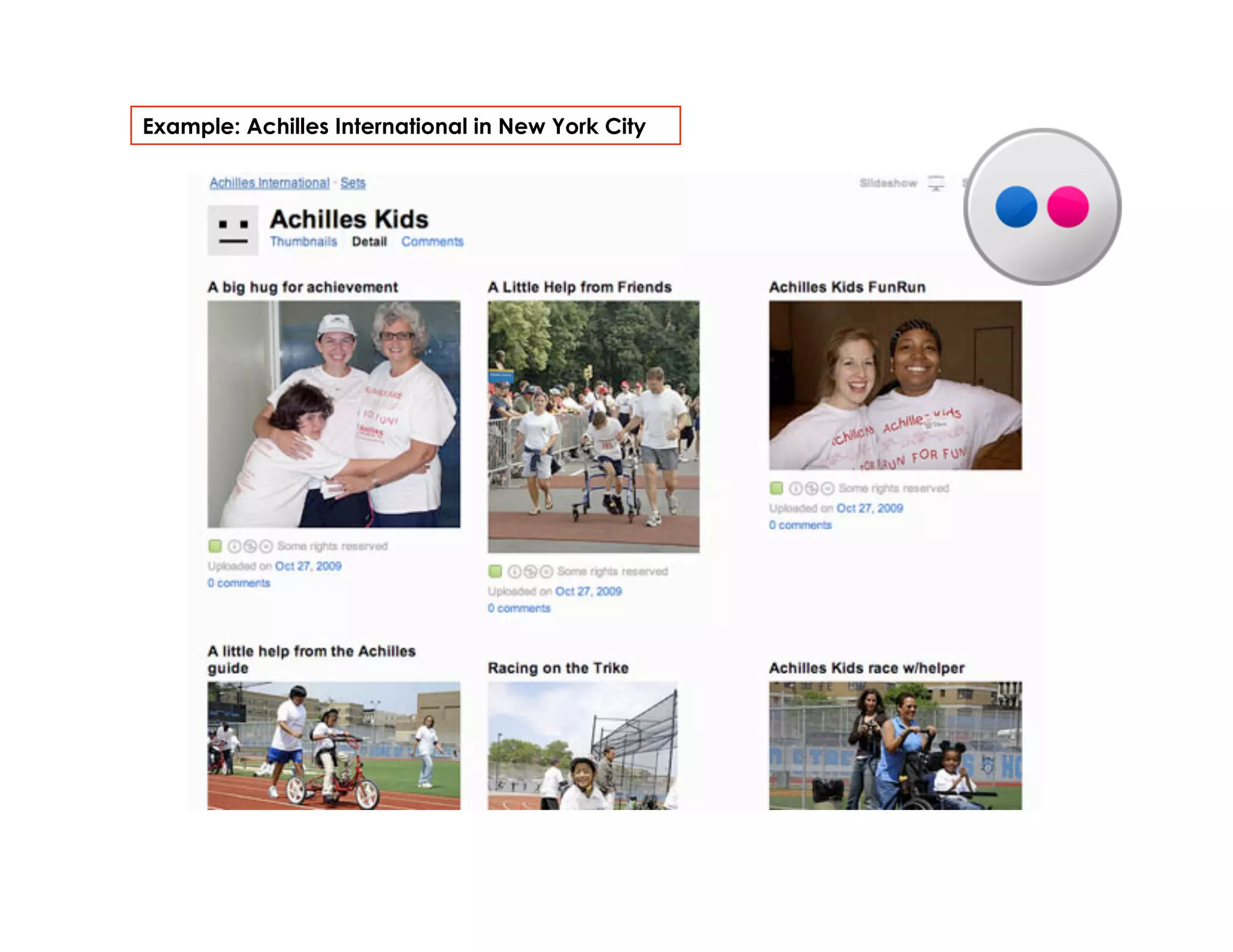
          Flickr
          Facebook
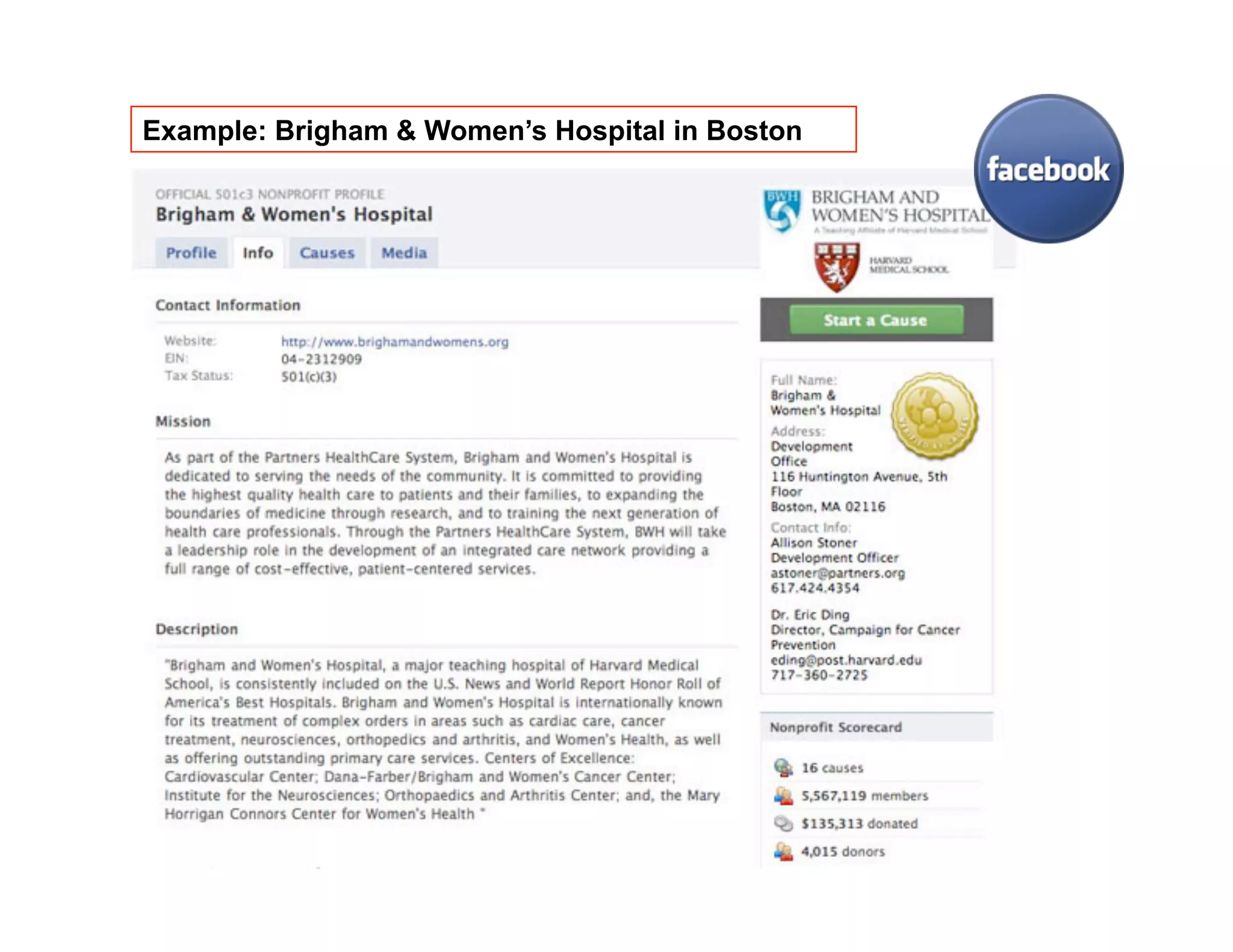
Example: Brigham & Women’s Hospital in Boston
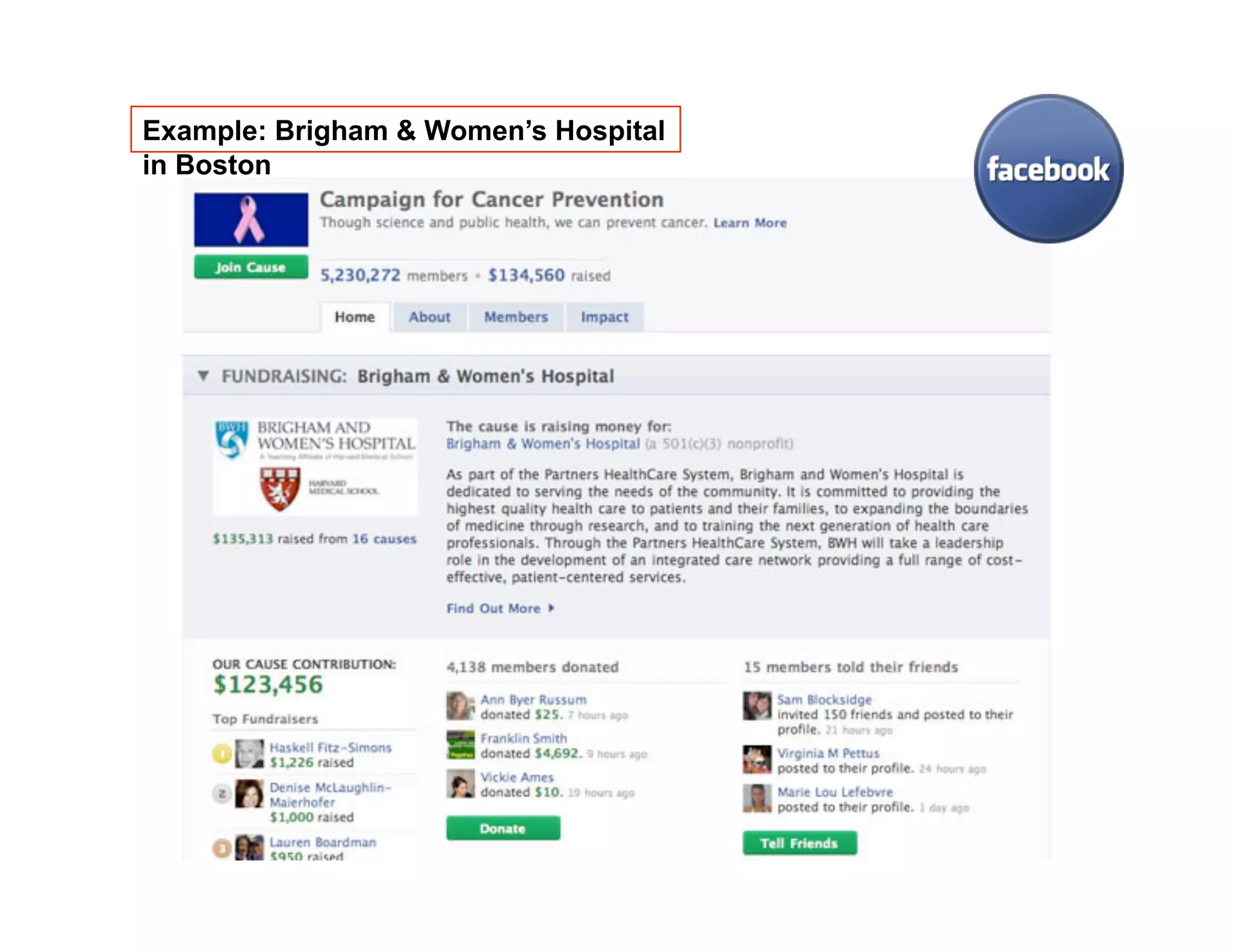
Example: Brigham & Women’s Hospital
in Boston
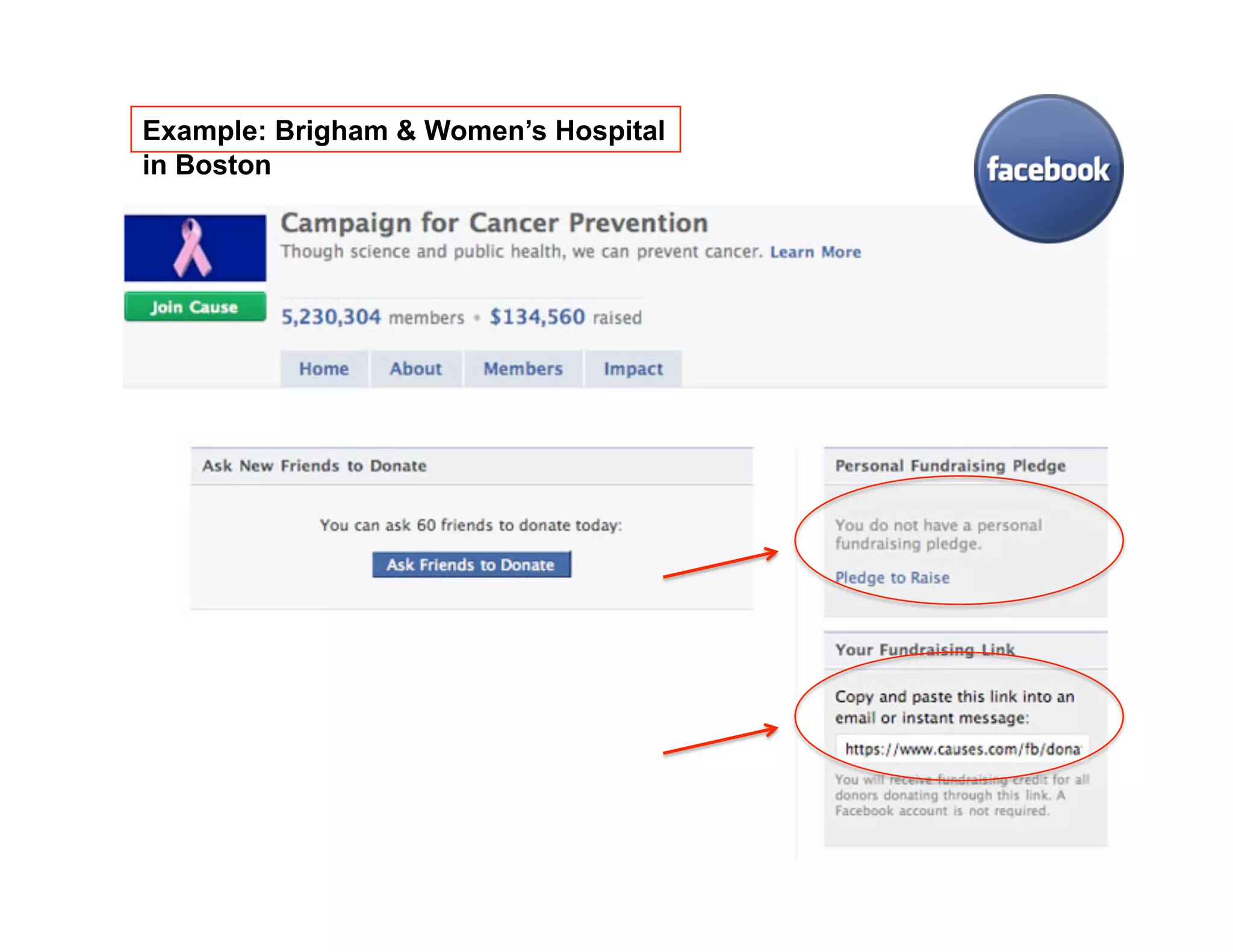
Example: Brigham & Women’s Hospital
in Boston
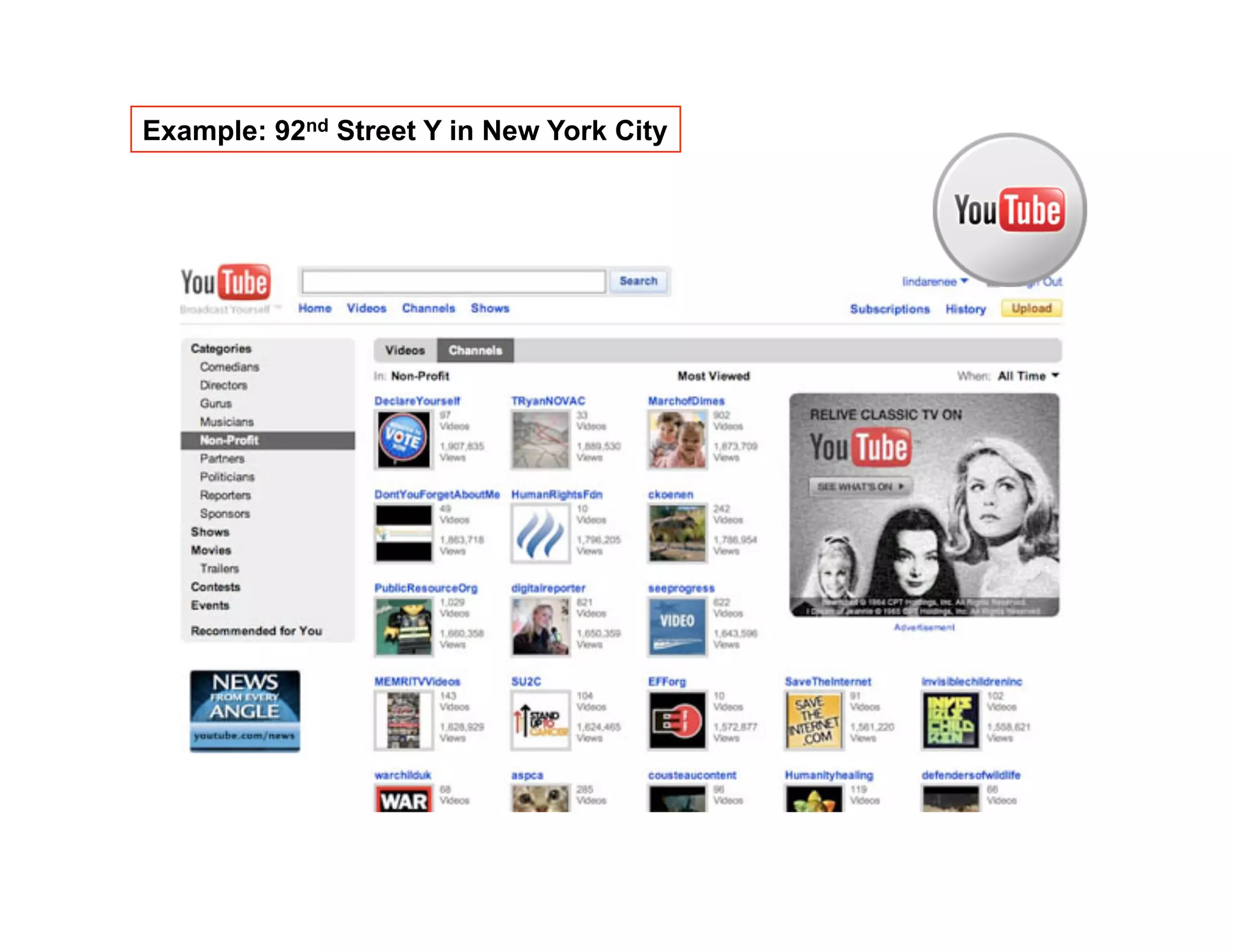
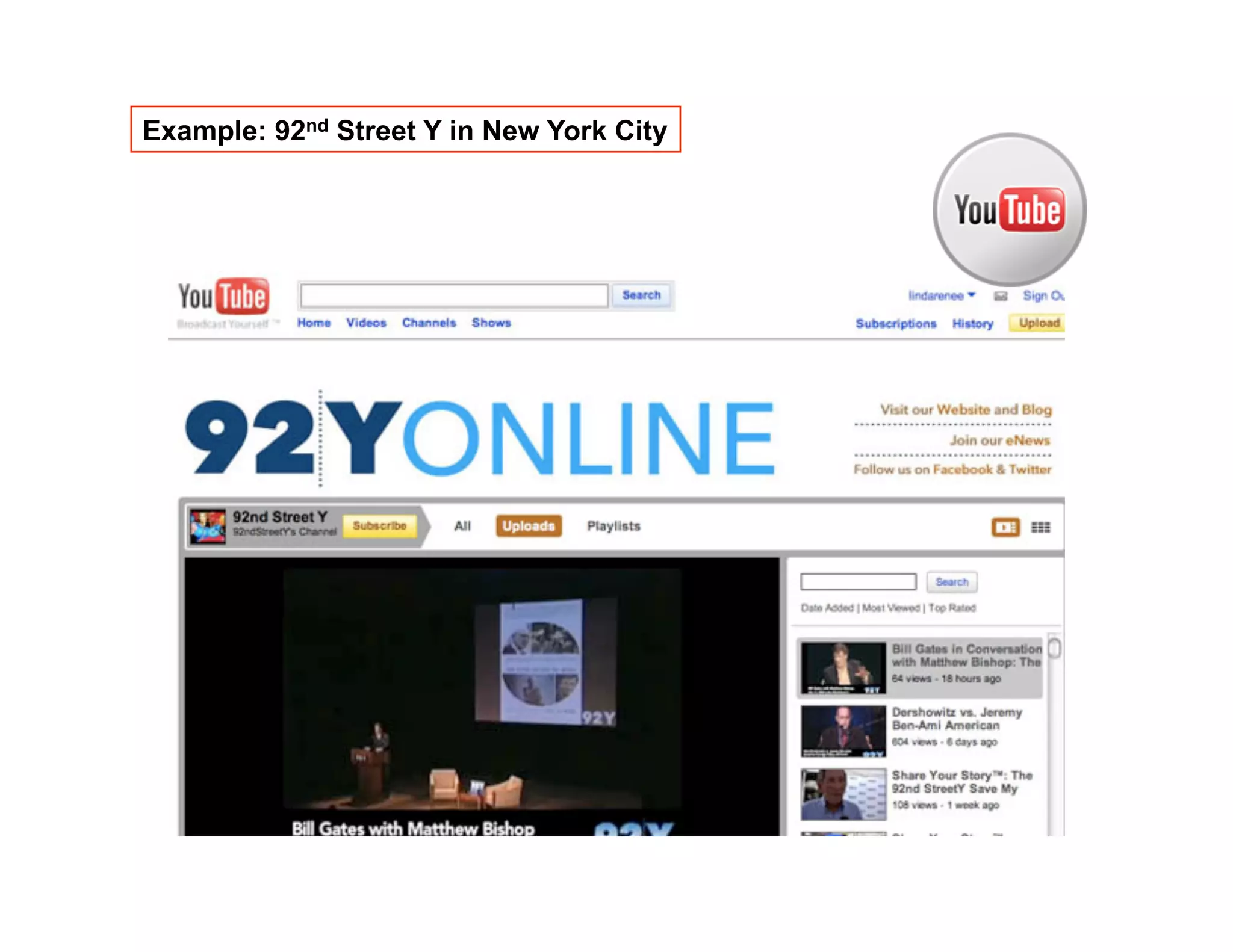
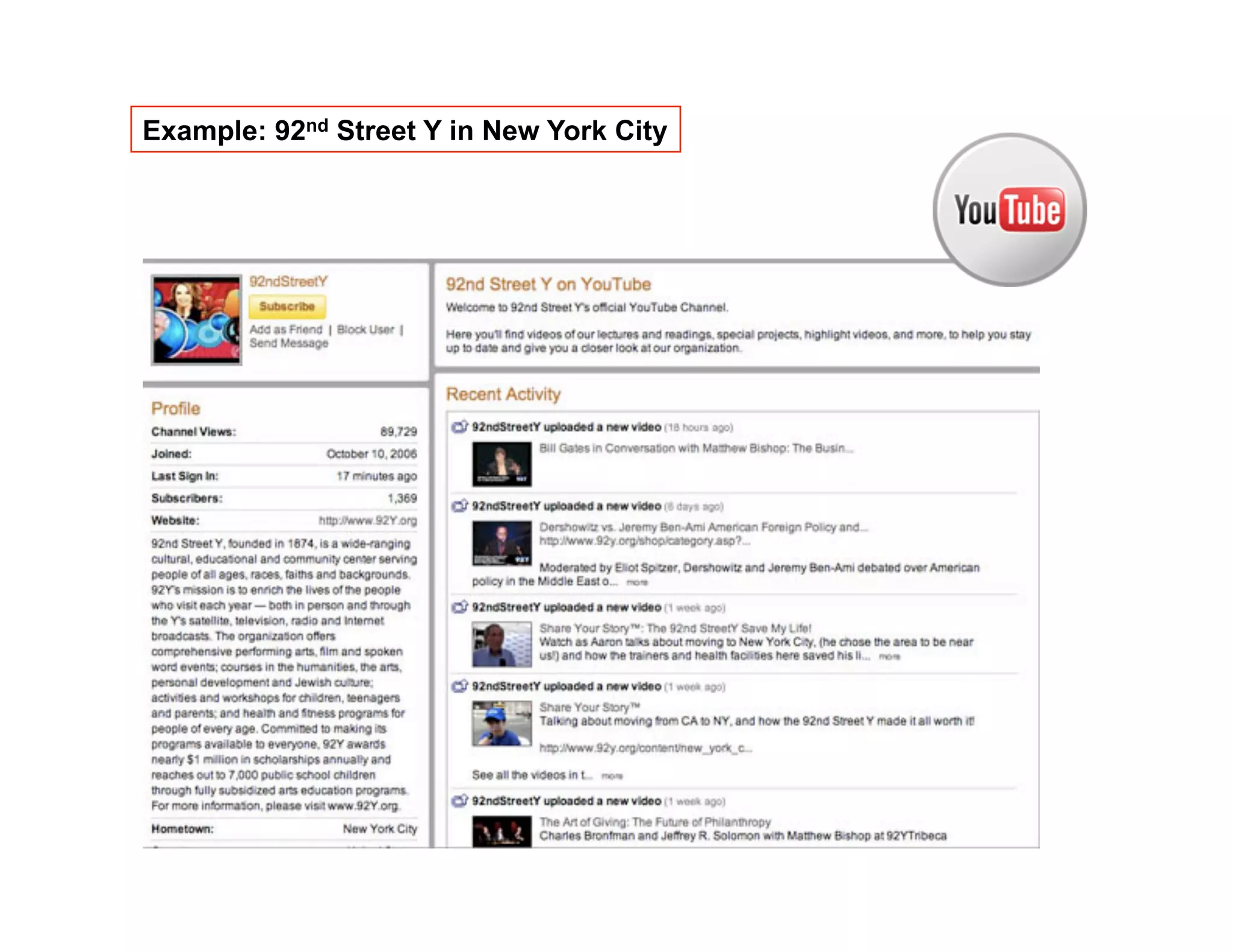
Example: 92nd Street Y in New York City
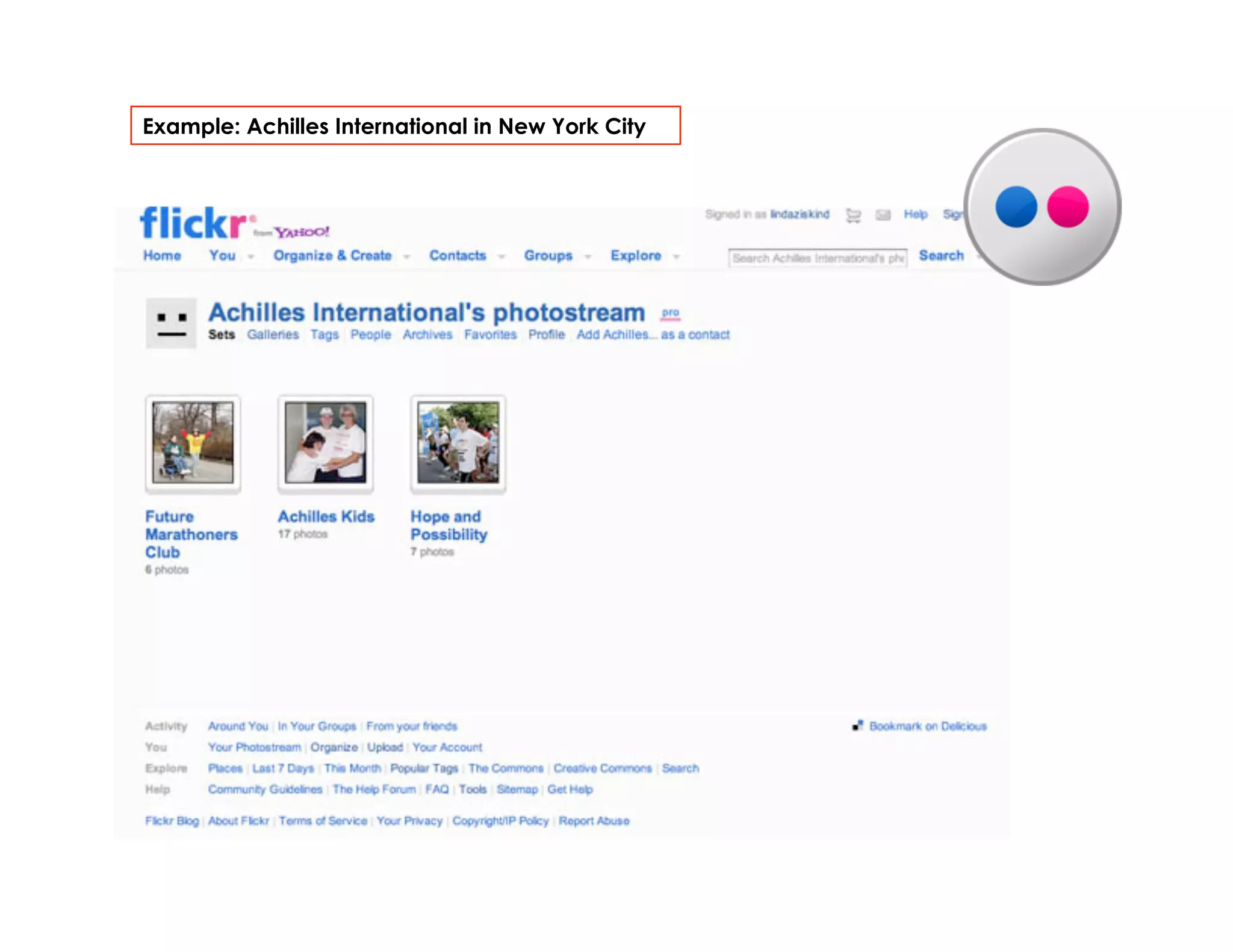
Example: Achilles International in New York City
New Rules for Non Profits:
Tips for Navigating a Changed World


                                 Linda Ziskind
                                 July 20, 2010

New Rules for Non Profits

  • 1.
    New Rules forNon Profits: Tips for Navigating a Changed World Linda Ziskind
  • 2.
    Brother, can you spare$11.32 billion?* *According to a report from the Giving USA Foundation, total charitable giving fell to $303.76 billion in 2009, down from $315.08 billion in 2008.
  • 3.
    Nonprofits faced unprecedented,simultaneous challenges over the past couple of years:
  • 4.
    Nonprofits faced unprecedented,simultaneous challenges over the past couple of years: The ongoing recession has reduced federal, state, and corporate funding dollars
  • 5.
    Nonprofits faced unprecedented,simultaneous challenges over the past couple of years: The ongoing recession has reduced federal, state, and corporate funding dollars Soaring and prolonged unemployment, mortgage defaults, and diminished net worth due to the battered market and investment advisor malfeasance has resulted in diminished individual donations
  • 6.
    Nonprofits faced unprecedented,simultaneous challenges over the past couple of years: The ongoing recession has reduced federal, state, and corporate funding dollars Soaring and prolonged unemployment, mortgage defaults, and diminished net worth due to the battered market and investment advisor malfeasance has resulted in diminished individual donations The high response rate and amount donated towards aid in the recent string of natural disasters has created a bit of donor fatigue
  • 7.
    The Results: *Johns HopkinsUniversity Center for Civil Society Studies, “Recession Pressures Non Profit Jobs” 7/14/2010 **Nonprofit Finance Fund Survey 2010 ***Paul C. Light, professor of public service at NYU
  • 8.
    The Results: Nearly 40%of nonprofit organizations currently lack adequate staff to deliver programs & services* *Johns Hopkins University Center for Civil Society Studies, “Recession Pressures Non Profit Jobs” 7/14/2010 **Nonprofit Finance Fund Survey 2010 ***Paul C. Light, professor of public service at NYU
  • 9.
    The Results: Nearly 40%of nonprofit organizations currently lack adequate staff to deliver programs & services* 61% of nonprofits have 3 months, or less, of available cash reserves.** *Johns Hopkins University Center for Civil Society Studies, “Recession Pressures Non Profit Jobs” 7/14/2010 **Nonprofit Finance Fund Survey 2010 ***Paul C. Light, professor of public service at NYU
  • 10.
    The Results: Nearly 40%of nonprofit organizations currently lack adequate staff to deliver programs & services* 61% of nonprofits have 3 months, or less, of available cash reserves.** It has been predicted that more than 100,000 nonprofit groups will fail between November 2008 and November 2010.*** *Johns Hopkins University Center for Civil Society Studies, “Recession Pressures Non Profit Jobs” 7/14/2010 **Nonprofit Finance Fund Survey 2010 ***Paul C. Light, professor of public service at NYU
  • 11.
    But peeking outfrom behind all of that grimness is a bit of sun.
  • 12.
    But peeking outfrom behind all of that grimness is a bit of sun. Social Media
  • 13.
    But peeking outfrom behind all of that grimness is a bit of sun. Social Media
  • 14.
    But peeking outfrom behind all of that grimness is a bit of sun. Social Media Technology
  • 15.
    But peeking outfrom behind all of that grimness is a bit of sun. Social Media Technology
  • 16.
    But peeking outfrom behind all of that grimness is a bit of sun. A new culture of Social Media Technology participation, collaboration, and shared information.
  • 17.
    Embrace change andlearn the new rules: organizations that reshape their strategies and tactics to meet new challenges are the ones that will survive and continue to be effective
  • 18.
    Non profits andfor profit businesses are beginning to learn from each other’s best practices, so it’s not surprising that the new rules for non profits are a lot like the rules that successful businesses follow
  • 19.
    The New Rules: 1. Define your brand and mission.
  • 20.
    The New Rules: 1. Define your brand and mission. 2.  Incorporate businesses planning practices a)  Develop concrete financial and program objectives b)  Identify specific strategies and tactics for achieving objectives c)  Define criteria for success for each program d)  Implement, review, analyze, revise
  • 21.
    The New Rules: 1. Define your brand and mission. 2.  Incorporate businesses planning practices a)  Develop concrete financial and program objectives b)  Identify specific strategies and tactics for achieving objectives c)  Define criteria for success for each program d)  Implement, review, analyze, revise 3.  Strategically incorporate technology to enable increased staff efficiency, operational economy, and access to valuable data.
  • 22.
    The New Rules: 1. Define your brand and mission. 2.  Incorporate businesses planning practices a)  Develop concrete financial and program objectives b)  Identify specific strategies and tactics for achieving objectives c)  Define criteria for success for each program d)  Implement, review, analyze, revise 3.  Strategically incorporate technology to enable increased staff efficiency, operational economy, and access to valuable data. 4.  Show appropriate appreciation to your donors
  • 23.
    The New Rules: 1. Define your brand and mission. 2.  Incorporate businesses planning practices a)  Develop concrete financial and program objectives b)  Identify specific strategies and tactics for achieving objectives c)  Define criteria for success for each program d)  Implement, review, analyze, revise 3.  Strategically incorporate technology to enable increased staff efficiency, operational economy, and access to valuable data. 4.  Show appropriate appreciation to your donors 5.  Embrace innovation
  • 24.
    The New Rules: 1. Define your brand and mission. 2.  Incorporate businesses planning practices a)  Develop concrete financial and program objectives b)  Identify specific strategies and tactics for achieving objectives c)  Define criteria for success for each program d)  Implement, review, analyze, revise 3.  Strategically incorporate technology to enable increased staff efficiency, operational economy, and access to valuable data. 4.  Show appropriate appreciation to your donors 5.  Embrace innovation 6.  Be part of the culture of participation, collaboration, and communication.
  • 25.
    1.  Define yourbrand and mission. •  Your brand identity is what distinguishes and identifies the soul of your organization. It’s more than your logo, or website. It’s what you say and how you say it. It’s your voice, your tone, your programming, and your attitude. It’s how people think of you. •  Your mission (or vision, or core ideology) is part of your brand and defines everything you do. It isn’t the product you make or service you provide – it’s the benefits they deliver. (i.e., Merck doesn’t talk about pharmaceutical research or drug efficacy. Their mission is: “We are in the business of preserving and improving human life. All of our actions must be measured by our success in achieving this goal.”
  • 26.
    2.  Incorporate businessplanning practices.   Clearly define your financial and program objectives   Use those objectives as the guide for developing programs, development, and fundraising strategies and tactics   Develop criteria for to measure and evaluate success for programs, events, and fundraising initiatives. Use that criteria to analyze results, evaluate effectiveness, and revise strategies or tactics as needed.
  • 27.
    3.  Strategically incorporatetechnology to enable increased staff efficiency, operational economy, and access to valuable data.   There is a potential goldmine of data waiting to be extracted, analyzed, and used to help you generate more revenue, develop more successful relationships, and operate more effectively.   Donor database and member management software   Project and event management software   Email marketing programs   Online donation programs www.nten.org (Consumers Guide to Low Cost Donor Management Systems – pdf) www.techsoup.org www.constantcontact.com www.basecamphq.com www.networkforgood.org
  • 28.
    4. Show appropriate appreciationto your donors   Stay in touch with donors, even if they can’t give as much as they did at one time
  • 29.
    4. Show appropriate appreciationto your donors   Stay in touch with donors, even if they can’t give as much as they did at one time   Make sure donors understand the direct impact of their gift – show them how they have impacted your mission.
  • 30.
    4. Show appropriate appreciationto your donors   Stay in touch with donors, even if they can’t give as much as they did at one time   Make sure donors understand the direct impact of their gift – show them how they have impacted your mission.   Say thank you frequently and meaningfully
  • 31.
    4. Show appropriate appreciationto your donors   Stay in touch with donors, even if they can’t give as much as they did at one time   Make sure donors understand the direct impact of their gift – show them how they have impacted your mission.   Say thank you frequently and meaningfully   Engage donors continuously – fundraising isn’t seasonal – it’s always
  • 32.
    5.  Embrace innovation.   Non profits are facing unprecedented challenges on all fronts and are finding that their established processes are falling short in addressing them   Foundation grantors and individual donors are increasingly requiring evidence of program effectiveness   As more and more people gravitate towards social media, organizations must get better at finding and engaging them there   Reduced budgets and staffing makes it imperative to find more efficient ways of operating
  • 33.
    5.  Embrace innovation.   Survival requires developing or finding, and then incorporating, innovative new solutions to address challenges   Research peer organization best-practices   Implement accountability and evaluation processes   Conduct an honest evaluation of your programs, fundraising, marketing, and operations and look for new strategies and solutions for the ones that aren’t successful   Look for silos in your organization and find ways of integrating efforts   Find opportunities to collaborate
  • 34.
    6.  Be partof the culture of participation, collaboration, and communication.   Marketing communication is not longer a passive channel. People respond when they feel engaged and can participate.   Don’t drown in the social media ocean. Be practical about how much you can handle.   Your constituents expect transparency. Use social media to provide that.   Use social media channels to tell a compelling story:   Twitter (TwitCause)   YouTube (http://www.youtube.com/nonprofits)   Flickr   Facebook
  • 35.
    Example: Brigham &Women’s Hospital in Boston
  • 36.
    Example: Brigham &Women’s Hospital in Boston
  • 37.
    Example: Brigham &Women’s Hospital in Boston
  • 38.
    Example: 92nd StreetY in New York City
  • 39.
    Example: 92nd StreetY in New York City
  • 40.
    Example: 92nd StreetY in New York City
  • 41.
  • 42.
  • 43.
    New Rules forNon Profits: Tips for Navigating a Changed World Linda Ziskind July 20, 2010

Editor's Notes

  • #3 It’s not that they didn’t see it coming, but many non profits were unprepared for the severity of the current financial crisis and its potential effect on them. A recent report from the Giving USA Foundation found that in 2009, total charitable giving in the US dropped over $11bn.
  • #4 In fact, this seems to have been the perfect-storm of disasters for non profits
  • #5 Federal, state, and corporate funding have been drastically cut,
  • #6 For a range of unfortunate reasons, people are worth a lot less than they used to be, so, consequently, they’re giving a lot less,
  • #7 A steady stream of massively destructive natural disasters, and a strategic incorporation of innovative fundraising strategies by relief organizations, has created donor fatigue.
  • #8 The net result on non profits has been grim:
  • #9 Staff reductions and reduced working hours have left nearly 40% of NPOs without enough staff to deliver their programs & services
  • #10 61% of nonprofits are operating on the edge with 3 months or less of available cash reserves.
  • #11 In early 2008, Paul Light, an NYU professor of public service, predicted that more than 100,000 non profit organizations would fail between Nov. 2008 and November 2010. Traditionally, an NPO that ran out of money would just close its doors. But in the last year, more and more non profits, including arts, as well as social services organizations, are filing for bankruptcy protection. There hasn’t been data compiled on the number of NPOs doing this, but, Diana Aviv, president and CEO of Independent Sector, a trade association for non profits, says it’s becoming more common.
  • #12 But, it’s not all bad news. At the same time that economic challenges have been hammering at the effectiveness of traditional strategies and tactics, something new has emerged.
  • #13 While social media is part of it…..
  • #14 It’s actually just the channel for delivery.
  • #15 Technology is, of course, critical…..
  • #16 But that’s just the framework.
  • #17 This thing that, right under our noses, is changing the rules and tactics for running a successful nonprofit, is the social media-enabled, technology-supported change in our culture. We are living in a new culture where everyone can participate, collaborate, and share information.
  • #18 It may not be possible to predict which organizations will weather this perfect-storm of challenges, but it’s a given that all the organizations that make it through will have an important characteristic in common: a willingness to embrace the changes in culture and communication and reshape their strategies to fit them.
  • #39 YouTube benefits for non profits: Premium branding capabilities and increased uploading capacity The option to drive fundraising through a Google Checkout "Donate" button Listing on the Nonprofit channels and the Nonprofit videos pages Ability to add a Call-to-action overlay on your videos to drive campaigns Posting a video opportunity on the YouTube Video Volunteers platform to find a skilled YouTube user to create a video for your cause.