Jimena
Betancourt
Coordinator TIS Talks
jbetancourt@telecentre.org
@jimebeta
THREE PHASES:
       1. Building Knowledge
       2. Finding Solutions and
          Partners
       3. Planning and Managing
          for Innovation,
          Technology and
          Sustainability
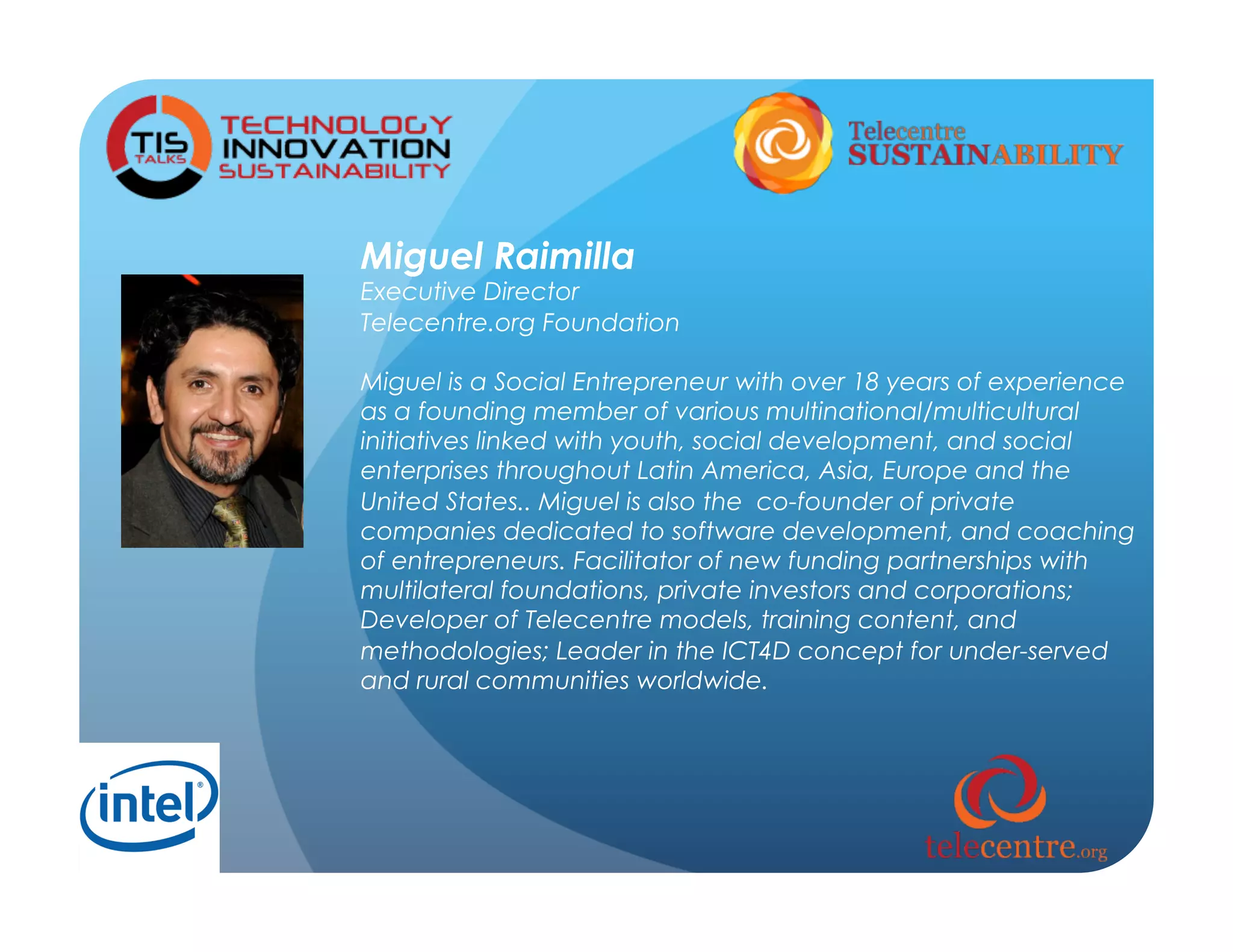
Miguel Raimilla
Executive Director
Telecentre.org Foundation

Miguel is a Social Entrepreneur with over 18 years of experience
as a founding member of various multinational/multicultural
initiatives linked with youth, social development, and social
enterprises throughout Latin America, Asia, Europe and the
United States.. Miguel is also the  co-founder of private
companies dedicated to software development, and coaching
of entrepreneurs. Facilitator of new funding partnerships with
multilateral foundations, private investors and corporations;
Developer of Telecentre models, training content, and
methodologies; Leader in the ICT4D concept for under-served
and rural communities worldwide.
Trends, Mechanism & Investors for
      Resource Mobilization

    How to finance innovation and
  telecentres as social enterprises?,
        …Where is the money?
Some ideas about the founding ecosystem:
  •  Philanthropy            •  Funds – Government
     •  Donations               •  Priority areas
     •  Recurrent               •  Recurrent v/s Stable
     •  Corporate               •  Change of rules

  •  Social Investment       •  Funds – Multi-Stakeholders
     •    Philanthropic $       •    Priority areas
     •    Recurrent             •    Competencies
     •    Corporate             •    Public & Private
     •    Public & Private      •    Conflicts of independency
     •    Venture Capital       •    Results and Accountability
     •    Impact investing
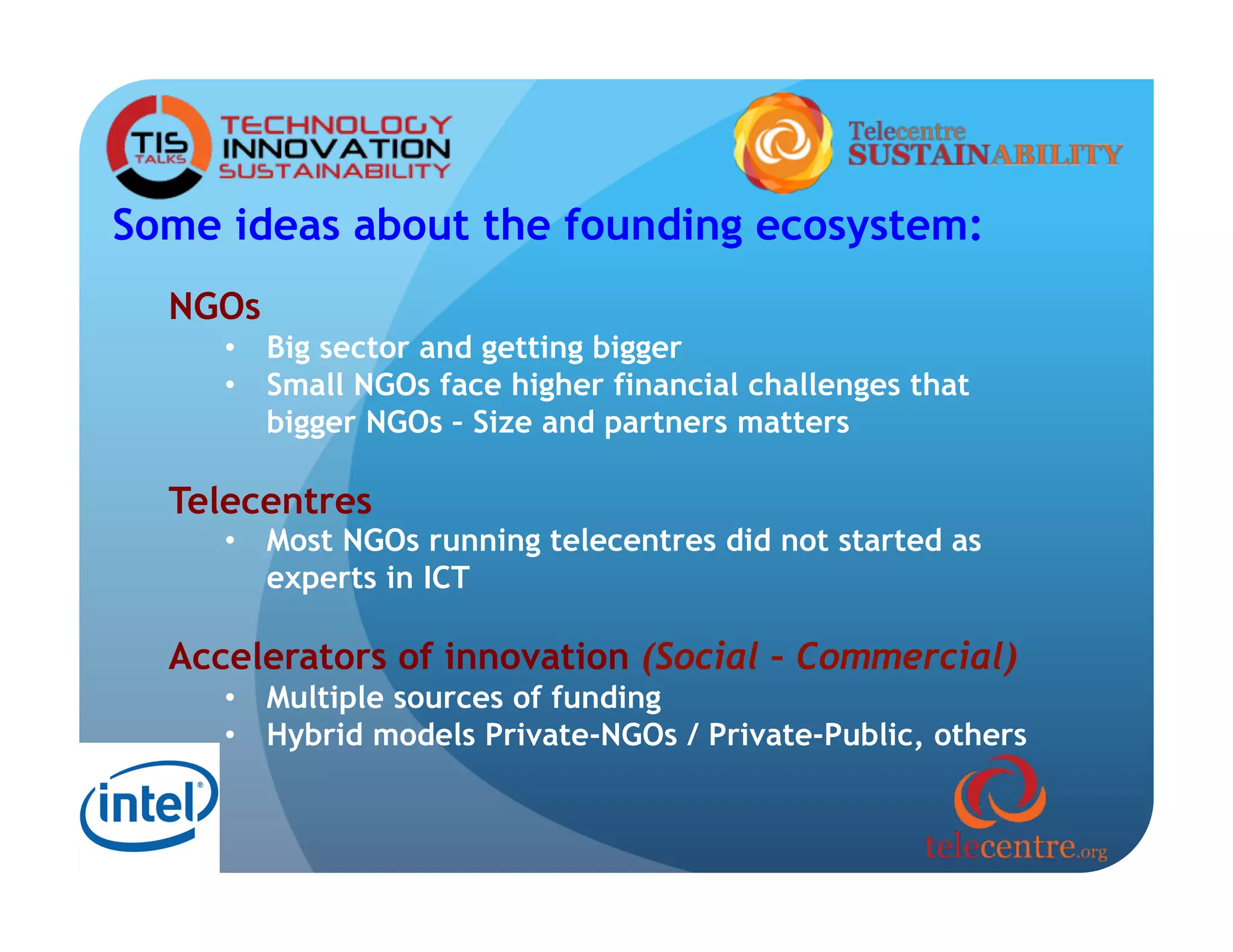
Some ideas about the founding ecosystem:
  NGOs
     •  Big sector and getting bigger
     •  Small NGOs face higher financial challenges that
        bigger NGOs – Size and partners matters

  Telecentres
     •  Most NGOs running telecentres did not started as
        experts in ICT

  Accelerators of innovation (Social – Commercial)
     •  Multiple sources of funding
     •  Hybrid models Private-NGOs / Private-Public, others
Philanthropy – Today 1
  Donors                                NGOs                   Beneficiaries


High Uncertainty              High Costs                   Lack of voice
•  How $ is used?             •  Of raising funds and      •  No feed-back
•  Poor available                sustain operations           mechanism about
   information on NGO         •  Lack of experience           what’s working and
   effectiveness                 measure and report           what’s not.
•  Small contributions           performance               •  Beneficiaries do not
                              •  Lack of visibility –         evaluate NGOs
                                 Difficulties attracting
                                 new funds
Philanthropy – Today 2
                             Facts
        Donors                                  NGOs
•  The vast majority of              •  Vast majority of
   donations comes form                 philanthropic donations
   individuals                          goes to big NGOs, or high
•  Difficulties to capture              impact initiatives
   donations persist                 •  Size and public
•  Big NGOs have an                     recognition is key
   advantage
•  Privates and individual
   give US$ 306 billions a
   year. *2009
Understanding Donors


    Re-payer                    Casual Giver                  Personal Ties
   23% of donors                  18% of donors                  13% of donors
  17% of donations               18% of donations               25% of donations
Gives because a personal       Gives to well-known NGOs      Gives when familiar with the
connection with the cause,     because it isn’t very         people who run the NGO.
theme or idea.                 complicated.                  Contributions vary.
Contributions are              Amount of its contributions   Require a good amount
consistent and a long-term     could vary over time.         time to nurture an effective
commitment                     Good campaign supporters.     relationship.
Understanding Donors


  Faith Based                   See the Difference                High Impact
   16% of donors                     14% of donors                 16% of donors
  18% of donations                  10% of donations              12% of donations
Gives to NGOs that fit with       Gives ONLY to small          Gives ONLY to NGOs
personal religious beliefs.       NGOs trying to make a        generating the greatest
Very consistent                   difference.                  social and economic good.
contributions and long-           Contributions vary in size   Interested in new ideas,
term commitments,                 and frequency.               recognition and scale.
However, it tends to be           Bring other donors.          Regional and Global.
modest amounts.                                                Bring other donors.
The New Donors
    Traditional v/s Social Investor
+ =                            + +                       +       =
                                                         •  Real Good Funding
•  Feel good funding.                                    •  Based on strategic
•  Based on                                     y $,        decisions
                               I’ll give you m to
                                                ke       •  Guided by research and
   relationships, affinities   but first I’d li
                                                 t the      measurement of social
   and emotional                know…. And a
                                               to
   responses to social          end, I’d like               impact.
   challenges                   see…                     •  Rigorous research
•  No rigorous research                                     performed
   performed                                             •  Insist on transparency and
•  Limited focus on social                                  evaluations
   returns                                               •  High focus on social return
Donors - New Interest and Requirements
            when searching NGOs
Care about performance    Do any Research

      85%                       32%
Research performance      Give based on performance

       21%                         3%
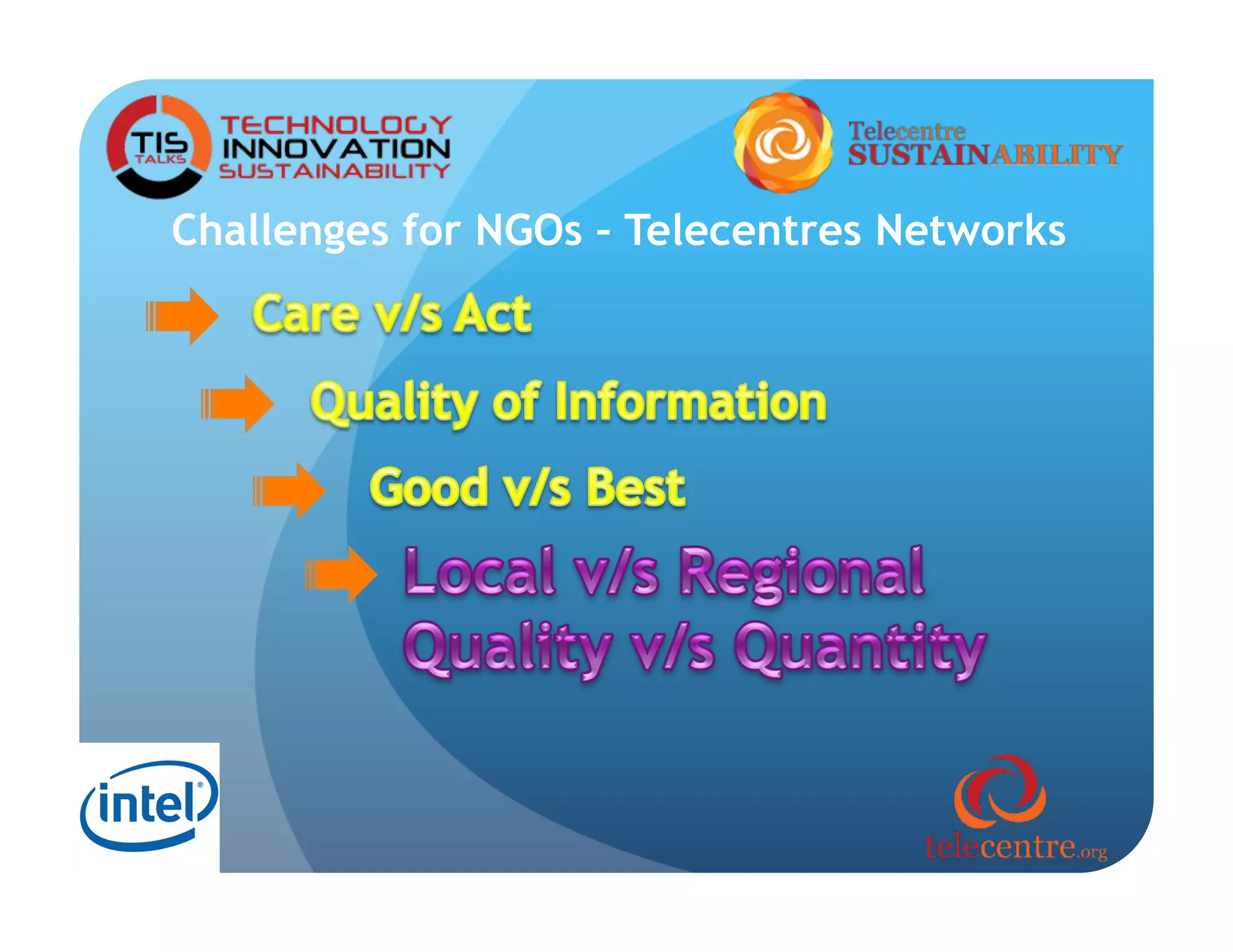
Challenges for NGOs – Telecentres Networks
The New ICT4D Ecosystem
                                                 Beneficiaries

                           Benefits        Voice
                           Services      Feed-back
  Donors                                                                 NGOs

              Impact                                             Data
             Investing
                                     ICT4D
                                  Innitiatives

   Social                                                                 Experts
Investment   Donations
                                                         Researches     Innovation


                         Transparency & Accountability
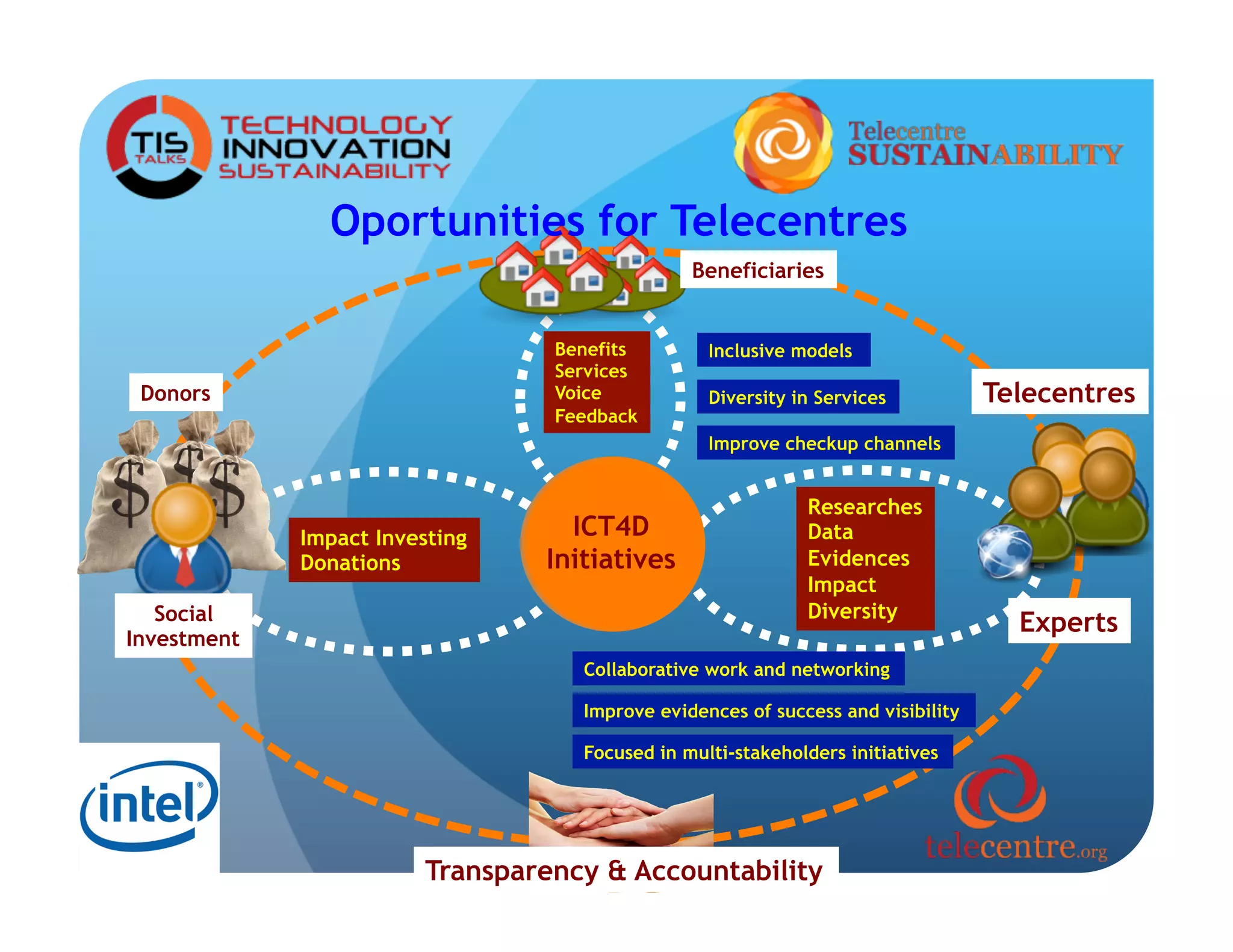
Oportunities for Telecentres
                                               Beneficiaries


                                 Benefits        Inclusive models
                                 Services
 Donors                          Voice           Diversity in Services           Telecentres
                                 Feedback
                                                 Improve checkup channels


                                                            Researches
             Impact Investing     ICT4D                     Data
             Donations          Initiatives                 Evidences
                                                            Impact
   Social                                                   Diversity
                                                                                   Experts
Investment
                                   Collaborative work and networking

                                   Improve evidences of success and visibility

                                   Focused in multi-stakeholders initiatives


                        Transparency & Accountability
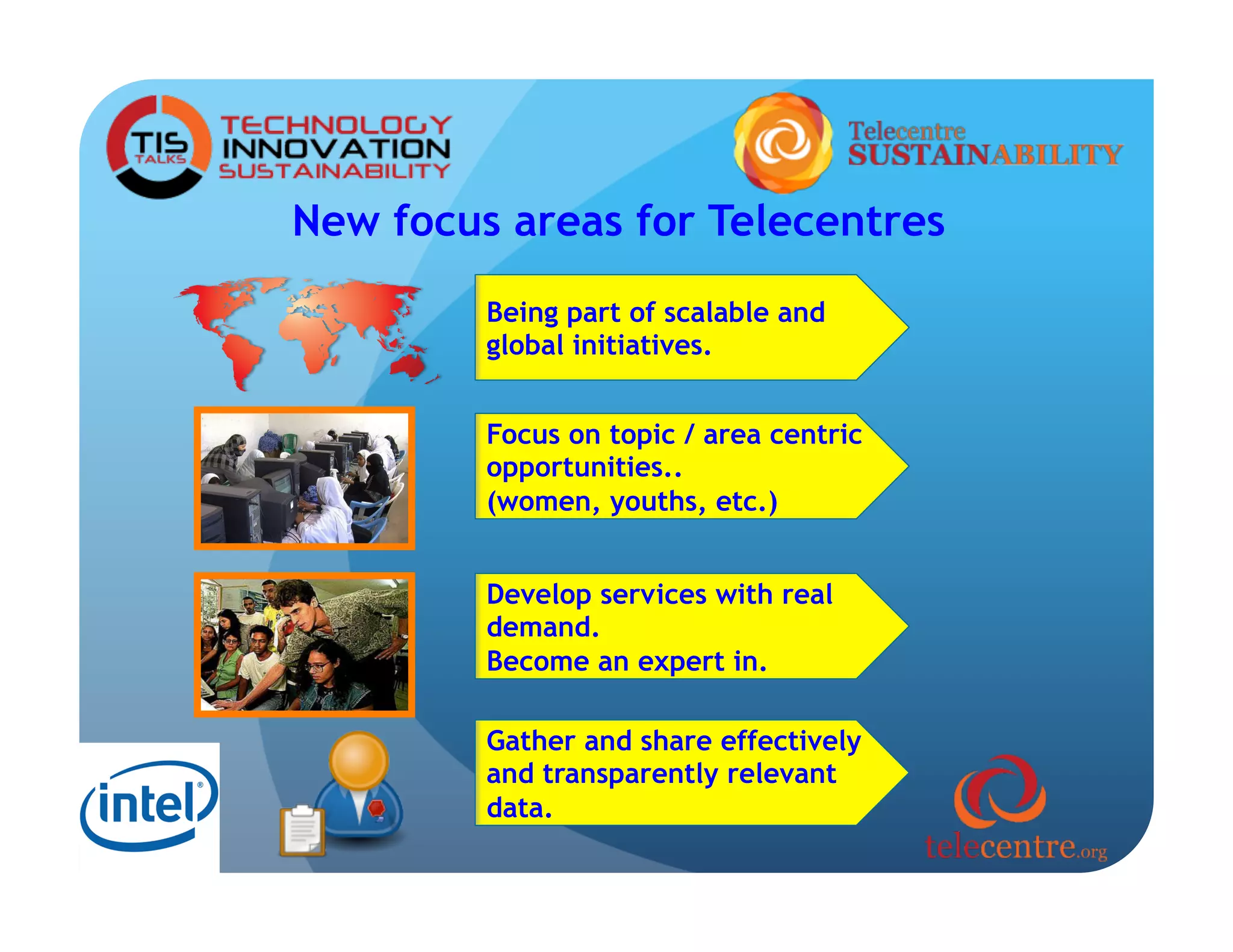
New focus areas for Telecentres
         Being part of scalable and
         global initiatives.


         Focus on topic / area centric
         opportunities..
         (women, youths, etc.)


         Develop services with real
         demand.
         Become an expert in.

         Gather and share effectively
         and transparently relevant
         data.
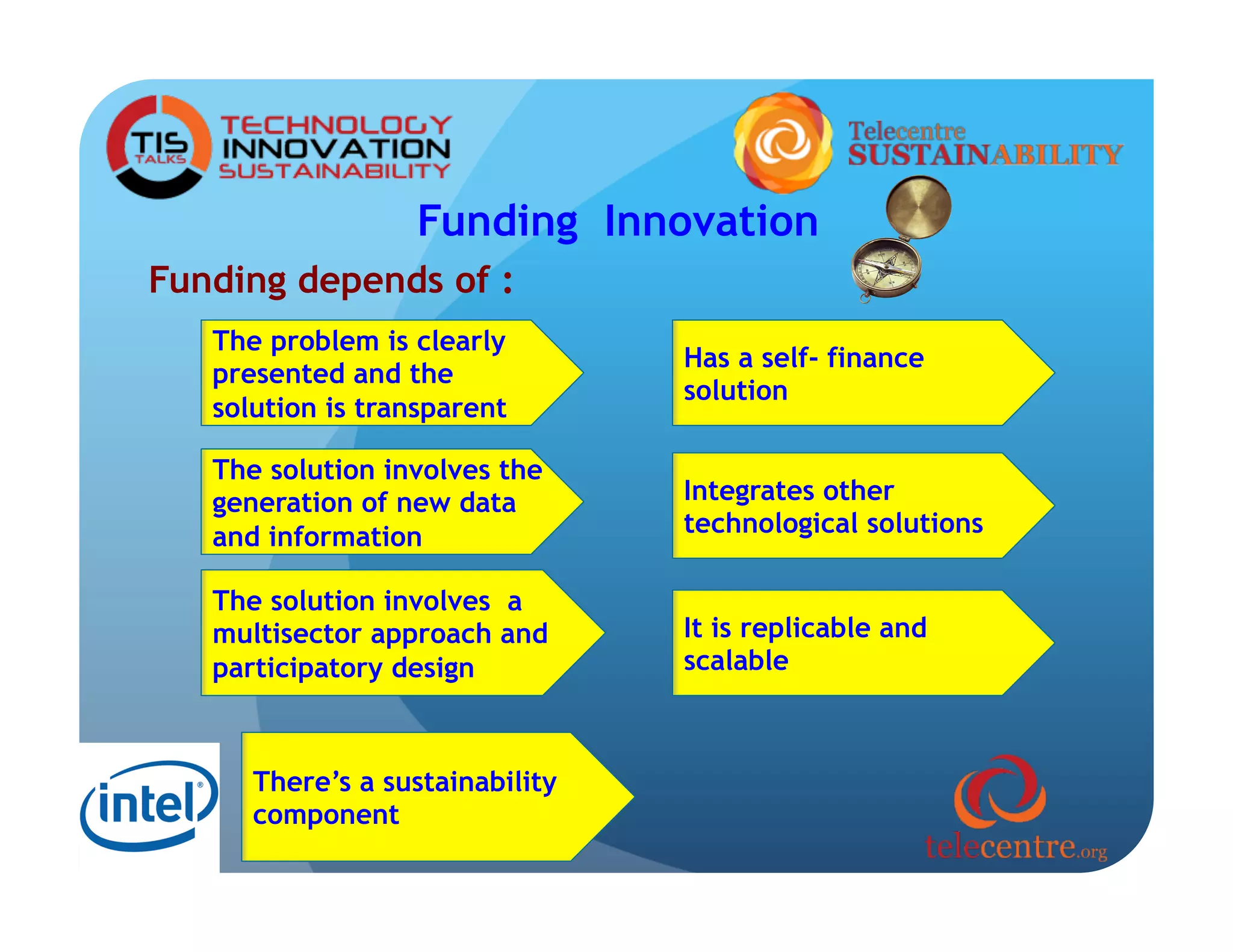
Funding Innovation
Funding depends of :
   The problem is clearly
                                 Has a self- finance
   presented and the
                                 solution
   solution is transparent

   The solution involves the
   generation of new data        Integrates other
   and information               technological solutions

   The solution involves a
   multisector approach and      It is replicable and
   participatory design          scalable


      There’s a sustainability
      component
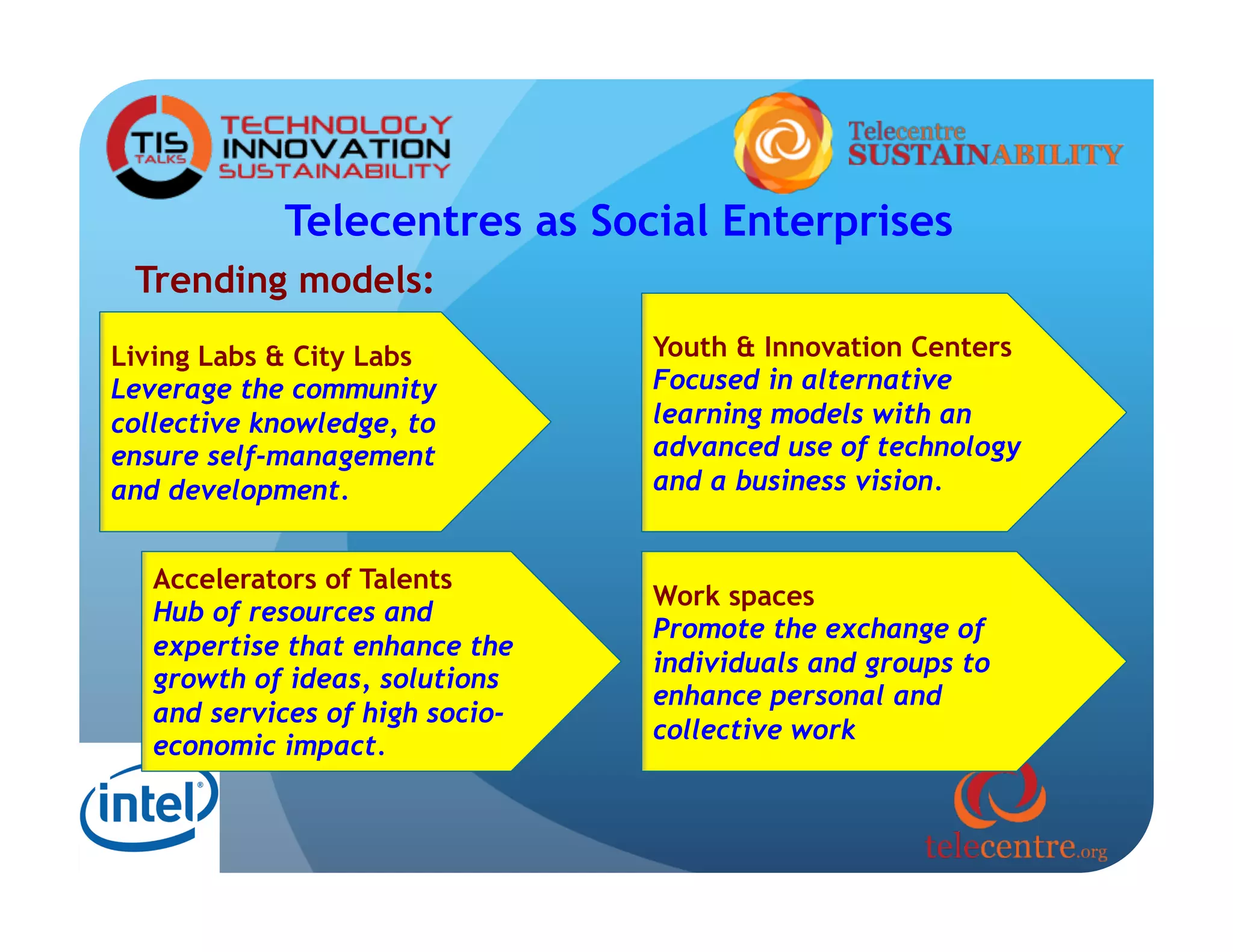
Telecentres as Social Enterprises
 Trending models:
Living Labs & City Labs          Youth & Innovation Centers
Leverage the community           Focused in alternative
collective knowledge, to         learning models with an
ensure self-management           advanced use of technology
and development.                 and a business vision.


   Accelerators of Talents
                                 Work spaces
   Hub of resources and
                                 Promote the exchange of
   expertise that enhance the
                                 individuals and groups to
   growth of ideas, solutions
                                 enhance personal and
   and services of high socio-
                                 collective work
   economic impact.
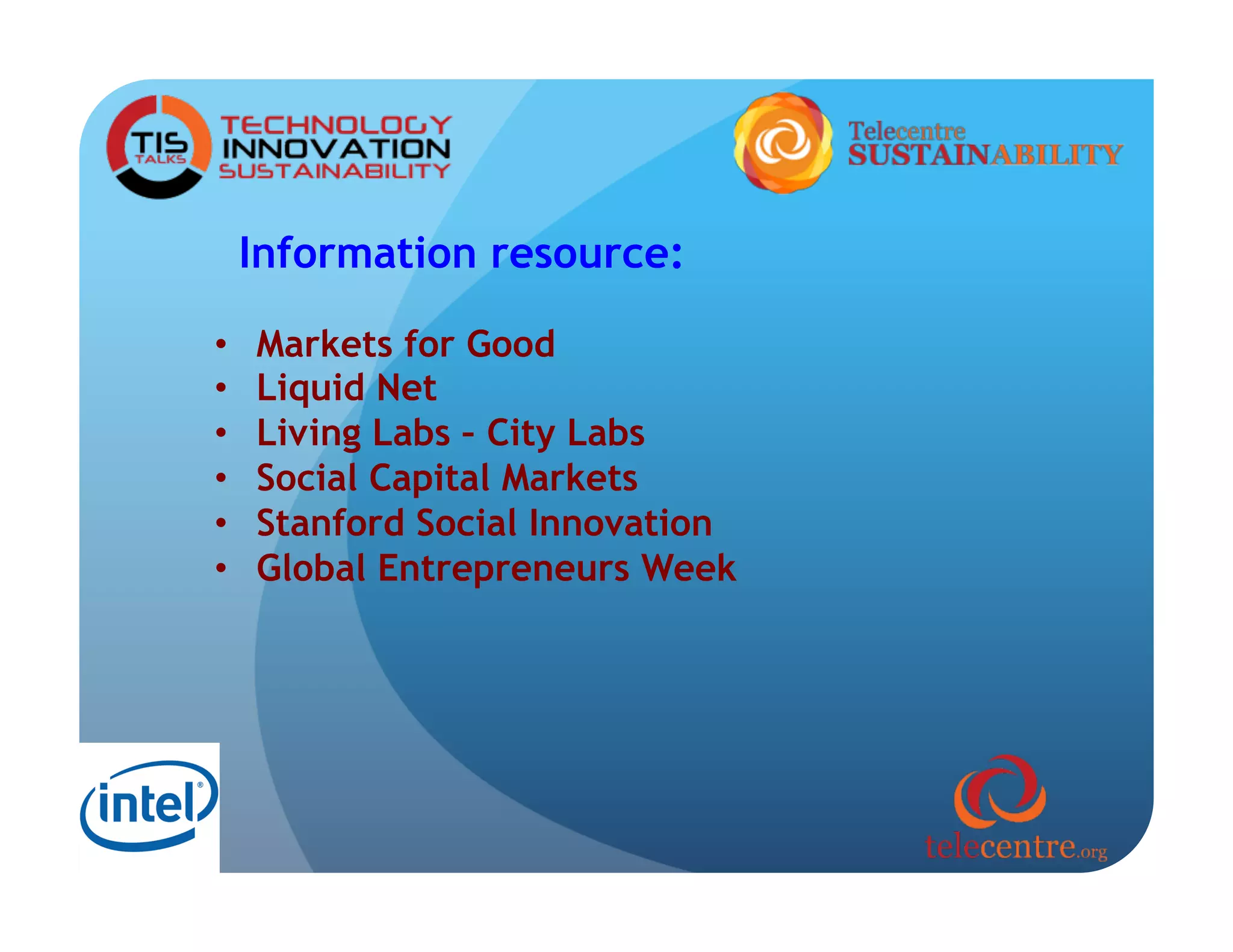
Information resource:

•    Markets for Good
•    Liquid Net
•    Living Labs – City Labs
•    Social Capital Markets
•    Stanford Social Innovation
•    Global Entrepreneurs Week
Enterprise models at
telecentre networks

Politécnica de Madrid

Ramón Fisac

November 22
09:00am GMT
5:00pm Manila
https://www.surveymonkey.com/s/mobres


         Thank you!

TCS english miguel_nov 14

  • 2.
  • 3.
    THREE PHASES: 1. Building Knowledge 2. Finding Solutions and Partners 3. Planning and Managing for Innovation, Technology and Sustainability
  • 4.
    Miguel Raimilla Executive Director Telecentre.orgFoundation Miguel is a Social Entrepreneur with over 18 years of experience as a founding member of various multinational/multicultural initiatives linked with youth, social development, and social enterprises throughout Latin America, Asia, Europe and the United States.. Miguel is also the  co-founder of private companies dedicated to software development, and coaching of entrepreneurs. Facilitator of new funding partnerships with multilateral foundations, private investors and corporations; Developer of Telecentre models, training content, and methodologies; Leader in the ICT4D concept for under-served and rural communities worldwide.
  • 5.
    Trends, Mechanism &Investors for Resource Mobilization How to finance innovation and telecentres as social enterprises?, …Where is the money?
  • 6.
    Some ideas aboutthe founding ecosystem: •  Philanthropy •  Funds – Government •  Donations •  Priority areas •  Recurrent •  Recurrent v/s Stable •  Corporate •  Change of rules •  Social Investment •  Funds – Multi-Stakeholders •  Philanthropic $ •  Priority areas •  Recurrent •  Competencies •  Corporate •  Public & Private •  Public & Private •  Conflicts of independency •  Venture Capital •  Results and Accountability •  Impact investing
  • 7.
    Some ideas aboutthe founding ecosystem: NGOs •  Big sector and getting bigger •  Small NGOs face higher financial challenges that bigger NGOs – Size and partners matters Telecentres •  Most NGOs running telecentres did not started as experts in ICT Accelerators of innovation (Social – Commercial) •  Multiple sources of funding •  Hybrid models Private-NGOs / Private-Public, others
  • 8.
    Philanthropy – Today1 Donors NGOs Beneficiaries High Uncertainty High Costs Lack of voice •  How $ is used? •  Of raising funds and •  No feed-back •  Poor available sustain operations mechanism about information on NGO •  Lack of experience what’s working and effectiveness measure and report what’s not. •  Small contributions performance •  Beneficiaries do not •  Lack of visibility – evaluate NGOs Difficulties attracting new funds
  • 9.
    Philanthropy – Today2 Facts Donors NGOs •  The vast majority of •  Vast majority of donations comes form philanthropic donations individuals goes to big NGOs, or high •  Difficulties to capture impact initiatives donations persist •  Size and public •  Big NGOs have an recognition is key advantage •  Privates and individual give US$ 306 billions a year. *2009
  • 10.
    Understanding Donors Re-payer Casual Giver Personal Ties 23% of donors 18% of donors 13% of donors 17% of donations 18% of donations 25% of donations Gives because a personal Gives to well-known NGOs Gives when familiar with the connection with the cause, because it isn’t very people who run the NGO. theme or idea. complicated. Contributions vary. Contributions are Amount of its contributions Require a good amount consistent and a long-term could vary over time. time to nurture an effective commitment Good campaign supporters. relationship.
  • 11.
    Understanding Donors Faith Based See the Difference High Impact 16% of donors 14% of donors 16% of donors 18% of donations 10% of donations 12% of donations Gives to NGOs that fit with Gives ONLY to small Gives ONLY to NGOs personal religious beliefs. NGOs trying to make a generating the greatest Very consistent difference. social and economic good. contributions and long- Contributions vary in size Interested in new ideas, term commitments, and frequency. recognition and scale. However, it tends to be Bring other donors. Regional and Global. modest amounts. Bring other donors.
  • 12.
    The New Donors Traditional v/s Social Investor + = + + + = •  Real Good Funding •  Feel good funding. •  Based on strategic •  Based on y $, decisions I’ll give you m to ke •  Guided by research and relationships, affinities but first I’d li t the measurement of social and emotional know…. And a to responses to social end, I’d like impact. challenges see… •  Rigorous research •  No rigorous research performed performed •  Insist on transparency and •  Limited focus on social evaluations returns •  High focus on social return
  • 13.
    Donors - NewInterest and Requirements when searching NGOs Care about performance Do any Research 85% 32% Research performance Give based on performance 21% 3%
  • 14.
    Challenges for NGOs– Telecentres Networks
  • 15.
    The New ICT4DEcosystem Beneficiaries Benefits Voice Services Feed-back Donors NGOs Impact Data Investing ICT4D Innitiatives Social Experts Investment Donations Researches Innovation Transparency & Accountability
  • 16.
    Oportunities for Telecentres Beneficiaries Benefits Inclusive models Services Donors Voice Diversity in Services Telecentres Feedback Improve checkup channels Researches Impact Investing ICT4D Data Donations Initiatives Evidences Impact Social Diversity Experts Investment Collaborative work and networking Improve evidences of success and visibility Focused in multi-stakeholders initiatives Transparency & Accountability
  • 17.
    New focus areasfor Telecentres Being part of scalable and global initiatives. Focus on topic / area centric opportunities.. (women, youths, etc.) Develop services with real demand. Become an expert in. Gather and share effectively and transparently relevant data.
  • 18.
    Funding Innovation Funding dependsof : The problem is clearly Has a self- finance presented and the solution solution is transparent The solution involves the generation of new data Integrates other and information technological solutions The solution involves a multisector approach and It is replicable and participatory design scalable There’s a sustainability component
  • 19.
    Telecentres as SocialEnterprises Trending models: Living Labs & City Labs Youth & Innovation Centers Leverage the community Focused in alternative collective knowledge, to learning models with an ensure self-management advanced use of technology and development. and a business vision. Accelerators of Talents Work spaces Hub of resources and Promote the exchange of expertise that enhance the individuals and groups to growth of ideas, solutions enhance personal and and services of high socio- collective work economic impact.
  • 20.
    Information resource: •  Markets for Good •  Liquid Net •  Living Labs – City Labs •  Social Capital Markets •  Stanford Social Innovation •  Global Entrepreneurs Week
  • 22.
    Enterprise models at telecentrenetworks Politécnica de Madrid Ramón Fisac November 22 09:00am GMT 5:00pm Manila
  • 23.