Personal Effectiveness:
A Critical Analysis of Stephen
Covey’s First Things First
Team #3:
Cindy Wang, Dhvani Thakkar, Noah VanderVeer-Harris
Section one: The Clock And The Compass
1. Becoming more introspective of our individual lives
a. Stepping back, and seeing what may require alteration or attention
b. Where do my rights end? In your personal space
2. How to prioritize our tasks and goals
a. Not a clock, a compass
b. Not how fast you’re going, but where you’re headed
c. Putting First things first
3. Benefits of weekly planning over daily planning
a. Short term vs. long term goals
b. To think we’re in control is an illusion
c. We can control our choices, but we can’t control the consequences of those choices
d. Understand the forces of: natural law, external centers (family, money, relationships)
4. How to create a Balance
a. Methods of management
b. Diff. between management and leadership
5. Self, Career, Relationships
a. Competence and character
i. Humility
ii. Understanding
iii. Learning perspective
b. Working with others, learning from them
c. Choices in the heat of the moment
d. PEACEFUL actions
6. Creating WIN-WIN situations
a. Giving and learning
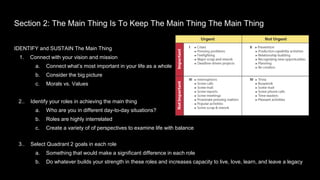
Section 2: The Main Thing Is To Keep The Main Thing The Main Thing
IDENTIFY and SUSTAIN The Main Thing
1. Connect with your vision and mission
a. Connect what’s most important in your life as a whole
b. Consider the big picture
c. Morals vs. Values
2.. Identify your roles in achieving the main thing
a. Who are you in different day-to-day situations?
b. Roles are highly interrelated
c. Create a variety of of perspectives to examine life with balance
3.. Select Quadrant 2 goals in each role
a. Something that would make a significant difference in each role
b. Do whatever builds your strength in these roles and increases capacity to live, love, learn, and leave a legacy
5. Create decision making framework for the week
a. Key is not to prioritize your schedule, but to schedule your priorities
b. Ideal is to eliminate Quadrant 3 and 4
6. Exercise integrity in the moment
7. Evaluate
a. Close the loop
b. Turn experience from one week into a foundation for increased effectiveness
8. Six aspects of an “addictive experience” -- what we should not prioritize
a. Creates predictable, reliable sensations
b. Becomes the primary focus and absorbs attention
c. Temporarily eradicates pain and other negative sensation
d. Provides artificial sense of self-worth, power, security, intimacy, accomplishment
e. Exacerbate problems and feelings
f. Worsens functioning
9. Passion of Vision
a. Accessing and creating an open connection with the deep energy that comes from a well-defined, thoroughly
integrated sense of purpose and meaning of life
b. The importance of empowering mission statements that helps you transcend higher than the self
10. Balance of roles
a. Balance is a “true north” principle
b. Need synergy among all your roles in life
c. Natural roles grows from mission; stems from principles
d. The Main Thing will guide you; keep it in mind!
Section 3: The Synergy of Interdependence
Survival of the fittest?
No, survival of the connected.
To Live: In good physical standing, provided by medical professionals and the like
To Love: A sense of belonging and want for the presence of another person.
To Learn To Grow: Information given from one human to another, in mutual respect and understanding
To Leave A Legacy: A societal contribution would be naught without a society of people to contribute to
The Independent Paradigm: “In the space between stimulus and response, independence is having the
strength of character to transcend scripting, the social mirror, and other influences that would keep us from a
principle centered response to life.”
The Interdependence Paradigm: “In our relationships, we will work with others to accomplish tasks,
represented by the managerial dimension. We align systems and coordinate work for collective purposes.”
Synergistic Roles and Goals
Empathy feeds communication and synergy
Understanding allows for a wider scope of the world
Builds directly into problem solving, solution building, and compromise
Fighting displays the ultimate disdain for another person’s views or morals
Character vs. Competence
Character: based in Integrity, Maturity, and holding an Abundance Mentality
Competence: different Technical, Conceptual, or Interdependent qualities of individual evaluation
Managing mistakes: Recognizing the difference in character and competence issues
Does someone falter due to personality? Due to their lack of physical knowledge of the
position?
Honest mistakes are exactly that: honest
Open a dialogue, communicate, and be trusting of one another
MOVE ON AFTER IT’S HANDLED.
Section 4: The Power and Peace of Principle Centered Living
“Management works IN the system,
Leadership works ON the system.”
Leaders ask the tough questions:
- What are our ultimate objectives?
- How did the group end up at this point in the project?
- Does this align with our organization’s mission and purpose?
- Are we effectively and efficiently using all of our resources?
Leadership vs. Management
Inspires change Manages transformation
Requires vision Requires tenacity
Requires imagination Requires specifics
Requires abstract thinking Requires concrete data
Ability to articulate Ability to interpret
Aptitude to sell Aptitude to teach
Understanding of the external environment Understanding of how work gets done in the
organization
Requires risk-taking Requires self-discipline
Confidence in the face of uncertainty Blind commitment to completing the task at hand
Accountable to the entire organization Accountable to their team
Courtesy of Zeta Beta Tau Fraternity, James E. Greer Jr.
Presidents’ Leadership Academy
Other Daily Questions for your Organization
What is our mission?
How do we strive for this mission every day?
What detracts from accomplishing our goals?
What will we do to realign ourselves with our goals?
Are we being as efficient as possible?
Is everyone in a position that suits them?
Is everyone enjoying their work and focused on the overall success of the group?
Remove the Barrier. Be the Success.
Put the First Things First.

FRS 026 Final Presentation Group 3

  • 1.
    Personal Effectiveness: A CriticalAnalysis of Stephen Covey’s First Things First Team #3: Cindy Wang, Dhvani Thakkar, Noah VanderVeer-Harris
  • 2.
    Section one: TheClock And The Compass 1. Becoming more introspective of our individual lives a. Stepping back, and seeing what may require alteration or attention b. Where do my rights end? In your personal space 2. How to prioritize our tasks and goals a. Not a clock, a compass b. Not how fast you’re going, but where you’re headed c. Putting First things first
  • 3.
    3. Benefits ofweekly planning over daily planning a. Short term vs. long term goals b. To think we’re in control is an illusion c. We can control our choices, but we can’t control the consequences of those choices d. Understand the forces of: natural law, external centers (family, money, relationships) 4. How to create a Balance a. Methods of management b. Diff. between management and leadership
  • 4.
    5. Self, Career,Relationships a. Competence and character i. Humility ii. Understanding iii. Learning perspective b. Working with others, learning from them c. Choices in the heat of the moment d. PEACEFUL actions 6. Creating WIN-WIN situations a. Giving and learning
  • 5.
    Section 2: TheMain Thing Is To Keep The Main Thing The Main Thing IDENTIFY and SUSTAIN The Main Thing 1. Connect with your vision and mission a. Connect what’s most important in your life as a whole b. Consider the big picture c. Morals vs. Values 2.. Identify your roles in achieving the main thing a. Who are you in different day-to-day situations? b. Roles are highly interrelated c. Create a variety of of perspectives to examine life with balance 3.. Select Quadrant 2 goals in each role a. Something that would make a significant difference in each role b. Do whatever builds your strength in these roles and increases capacity to live, love, learn, and leave a legacy
  • 6.
    5. Create decisionmaking framework for the week a. Key is not to prioritize your schedule, but to schedule your priorities b. Ideal is to eliminate Quadrant 3 and 4 6. Exercise integrity in the moment 7. Evaluate a. Close the loop b. Turn experience from one week into a foundation for increased effectiveness 8. Six aspects of an “addictive experience” -- what we should not prioritize a. Creates predictable, reliable sensations b. Becomes the primary focus and absorbs attention c. Temporarily eradicates pain and other negative sensation d. Provides artificial sense of self-worth, power, security, intimacy, accomplishment e. Exacerbate problems and feelings f. Worsens functioning
  • 7.
    9. Passion ofVision a. Accessing and creating an open connection with the deep energy that comes from a well-defined, thoroughly integrated sense of purpose and meaning of life b. The importance of empowering mission statements that helps you transcend higher than the self 10. Balance of roles a. Balance is a “true north” principle b. Need synergy among all your roles in life c. Natural roles grows from mission; stems from principles d. The Main Thing will guide you; keep it in mind!
  • 8.
    Section 3: TheSynergy of Interdependence Survival of the fittest? No, survival of the connected. To Live: In good physical standing, provided by medical professionals and the like To Love: A sense of belonging and want for the presence of another person. To Learn To Grow: Information given from one human to another, in mutual respect and understanding To Leave A Legacy: A societal contribution would be naught without a society of people to contribute to The Independent Paradigm: “In the space between stimulus and response, independence is having the strength of character to transcend scripting, the social mirror, and other influences that would keep us from a principle centered response to life.” The Interdependence Paradigm: “In our relationships, we will work with others to accomplish tasks, represented by the managerial dimension. We align systems and coordinate work for collective purposes.”
  • 9.
    Synergistic Roles andGoals Empathy feeds communication and synergy Understanding allows for a wider scope of the world Builds directly into problem solving, solution building, and compromise Fighting displays the ultimate disdain for another person’s views or morals
  • 10.
    Character vs. Competence Character:based in Integrity, Maturity, and holding an Abundance Mentality Competence: different Technical, Conceptual, or Interdependent qualities of individual evaluation Managing mistakes: Recognizing the difference in character and competence issues Does someone falter due to personality? Due to their lack of physical knowledge of the position? Honest mistakes are exactly that: honest Open a dialogue, communicate, and be trusting of one another MOVE ON AFTER IT’S HANDLED.
  • 11.
    Section 4: ThePower and Peace of Principle Centered Living “Management works IN the system, Leadership works ON the system.” Leaders ask the tough questions: - What are our ultimate objectives? - How did the group end up at this point in the project? - Does this align with our organization’s mission and purpose? - Are we effectively and efficiently using all of our resources?
  • 12.
    Leadership vs. Management Inspireschange Manages transformation Requires vision Requires tenacity Requires imagination Requires specifics Requires abstract thinking Requires concrete data Ability to articulate Ability to interpret Aptitude to sell Aptitude to teach Understanding of the external environment Understanding of how work gets done in the organization Requires risk-taking Requires self-discipline Confidence in the face of uncertainty Blind commitment to completing the task at hand Accountable to the entire organization Accountable to their team Courtesy of Zeta Beta Tau Fraternity, James E. Greer Jr. Presidents’ Leadership Academy
  • 13.
    Other Daily Questionsfor your Organization What is our mission? How do we strive for this mission every day? What detracts from accomplishing our goals? What will we do to realign ourselves with our goals? Are we being as efficient as possible? Is everyone in a position that suits them? Is everyone enjoying their work and focused on the overall success of the group?
  • 14.
    Remove the Barrier.Be the Success. Put the First Things First.