From Multicultural to Translingual: Example Methodologies for the Monolingual Teacher  in the Translingual Classroom Chris Hermosilla October 2011
My Journey to Becoming  a Translingual Teacher Moving from “multicultural” to “translingual.”  Establish a framework with a set of overarching plans. The teacher as conductor, “letting go.” First, survey class to discover languages spoken, and how students engage them (home, community, etc.). Find my “language agents” (library staff, coworkers, church leaders, etc.) to contact as resources. 2 sample English classroom activities, based on  Preview-View-Review  (Freeman & Freeman, 1998):  Native language -> English -> Native language .
Lesson 1: Building a  Translingual Word Wall Context : 8 th  grade LA class in Harrison. 27 students,  4 languages (10 students primarily speak English,  7 Spanish, 5 Portuguese,  and 5 Chinese). Goal:  Students will gain an understanding of the cultural implications and characteristics of 5 different animals in their native languages prior to reading George Orwell’s  Animal Farm . Preparation:  Versions of the text in all 4 languages:  - Chinese:  http://www.chinapage.com/world/animal-farm.html - Spanish:  http://www.youtube.com/watch?v=4RLKcwIGFt0 - Portuguese:  http://www.ebooksbrasil.org/adobeebook/animaisf.pdf
Assembling the Wall Together The class builds a wall together, and students create their own “bricks” in their native language. One example: 5 different animals, each in 4 different languages – all brought together at the end for presentation. Students use research tools to discover animal qualities, then examine text in their own languages for content. Animal Name Picture/ Graphic Represen-tation Typical Western Qualities Qualities in Your Own Traditions In-Text Sentence Describing Animal Does This Match My Tradition’s Qualities? Pig | Cerdo | Porco |  猪 [provided] - Clever - Fat [Student fills in] [Student fills in] [Yes / No]
Lesson 2: Online Reading Discussion Context:  7 th  grade LA class in Harrison, predominantly homogenous English-language (22 English-only students, 1 student who speaks both English and Tamil). Goal:  Students will discuss and explore themes and symbolism of Harper Lee’s  To Kill a Mockingbird  through pre- and post-reading discussions in their native languages. Preparation:  Teacher will arrange meeting time and place for Skype video conference with peer or adult willing to discuss with student in Tamil. - New Jersey Tamil Sangam:  http://www.njtamilsangam.info/
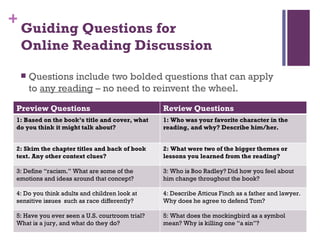
Guiding Questions for  Online Reading Discussion Questions include two bolded questions that can apply to  any reading  – no need to reinvent the wheel. Preview Questions Review Questions 1: Based on the book’s title and cover, what do you think it might talk about? 1: Who was your favorite character in the reading, and why? Describe him/her. 2: Skim the chapter titles and back of book text. Any other context clues? 2: What were two of the bigger themes or lessons you learned from the reading? 3: Define “racism.” What are some of the emotions and ideas around that concept? 3: Who is Boo Radley? Did how you feel about him change throughout the book?  4: Do you think adults and children look at sensitive issues  such as race differently? 4: Describe Atticus Finch as a father and lawyer. Why does he agree to defend Tom? 5: Have you ever seen a U.S. courtroom trial? What is a jury, and what do they do? 5: What does the mockingbird as a symbol mean? Why is killing one “a sin”?

From Multicultural to Translingual - with links

  • 1.
    From Multicultural toTranslingual: Example Methodologies for the Monolingual Teacher in the Translingual Classroom Chris Hermosilla October 2011
  • 2.
    My Journey toBecoming a Translingual Teacher Moving from “multicultural” to “translingual.” Establish a framework with a set of overarching plans. The teacher as conductor, “letting go.” First, survey class to discover languages spoken, and how students engage them (home, community, etc.). Find my “language agents” (library staff, coworkers, church leaders, etc.) to contact as resources. 2 sample English classroom activities, based on Preview-View-Review (Freeman & Freeman, 1998): Native language -> English -> Native language .
  • 3.
    Lesson 1: Buildinga Translingual Word Wall Context : 8 th grade LA class in Harrison. 27 students, 4 languages (10 students primarily speak English, 7 Spanish, 5 Portuguese, and 5 Chinese). Goal: Students will gain an understanding of the cultural implications and characteristics of 5 different animals in their native languages prior to reading George Orwell’s Animal Farm . Preparation: Versions of the text in all 4 languages: - Chinese: http://www.chinapage.com/world/animal-farm.html - Spanish: http://www.youtube.com/watch?v=4RLKcwIGFt0 - Portuguese: http://www.ebooksbrasil.org/adobeebook/animaisf.pdf
  • 4.
    Assembling the WallTogether The class builds a wall together, and students create their own “bricks” in their native language. One example: 5 different animals, each in 4 different languages – all brought together at the end for presentation. Students use research tools to discover animal qualities, then examine text in their own languages for content. Animal Name Picture/ Graphic Represen-tation Typical Western Qualities Qualities in Your Own Traditions In-Text Sentence Describing Animal Does This Match My Tradition’s Qualities? Pig | Cerdo | Porco | 猪 [provided] - Clever - Fat [Student fills in] [Student fills in] [Yes / No]
  • 5.
    Lesson 2: OnlineReading Discussion Context: 7 th grade LA class in Harrison, predominantly homogenous English-language (22 English-only students, 1 student who speaks both English and Tamil). Goal: Students will discuss and explore themes and symbolism of Harper Lee’s To Kill a Mockingbird through pre- and post-reading discussions in their native languages. Preparation: Teacher will arrange meeting time and place for Skype video conference with peer or adult willing to discuss with student in Tamil. - New Jersey Tamil Sangam: http://www.njtamilsangam.info/
  • 6.
    Guiding Questions for Online Reading Discussion Questions include two bolded questions that can apply to any reading – no need to reinvent the wheel. Preview Questions Review Questions 1: Based on the book’s title and cover, what do you think it might talk about? 1: Who was your favorite character in the reading, and why? Describe him/her. 2: Skim the chapter titles and back of book text. Any other context clues? 2: What were two of the bigger themes or lessons you learned from the reading? 3: Define “racism.” What are some of the emotions and ideas around that concept? 3: Who is Boo Radley? Did how you feel about him change throughout the book? 4: Do you think adults and children look at sensitive issues such as race differently? 4: Describe Atticus Finch as a father and lawyer. Why does he agree to defend Tom? 5: Have you ever seen a U.S. courtroom trial? What is a jury, and what do they do? 5: What does the mockingbird as a symbol mean? Why is killing one “a sin”?