Tracing a service business logic in manufacturing firms 
Nina Löfberg 
nina.lofberg@kau.se
Servitization 
How to create mutual value? 
Service logic + manufacturing? 
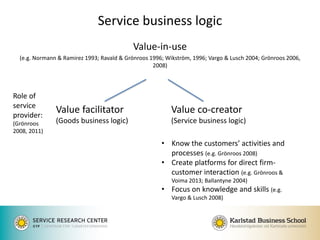
Service business logic
Service business logic 
Value-in-use 
(e.g. Normann & Ramirez 1993; Ravald & Grönroos 1996; Wikström, 1996; Vargo & Lusch 2004; Grönroos 2006, 2008) 
Value facilitator (Goods business logic) 
Value co-creator (Service business logic) 
Role of service provider: (Grönroos 2008, 2011) 
•Know the customers’ activities and processes (e.g. Grönroos 2008) 
•Create platforms for direct firm- customer interaction (e.g. Grönroos & Voima 2013; Ballantyne 2004) 
•Focus on knowledge and skills (e.g. Vargo & Lusch 2008)
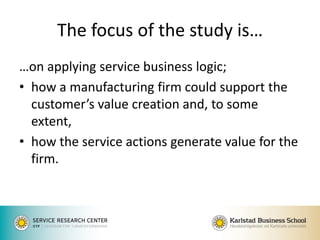
The focus of the study is… 
…on applying service business logic; 
•how a manufacturing firm could support the customer’s value creation and, to some extent, 
•how the service actions generate value for the firm.
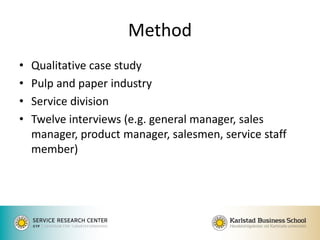
Method 
•Qualitative case study 
•Pulp and paper industry 
•Service division 
•Twelve interviews (e.g. general manager, sales manager, product manager, salesmen, service staff member)
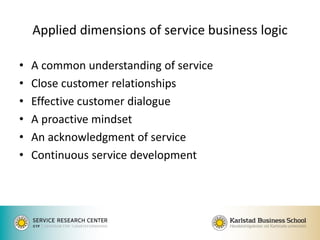
Applied dimensions of service business logic 
•A common understanding of service 
•Close customer relationships 
•Effective customer dialogue 
•A proactive mindset 
•An acknowledgment of service 
•Continuous service development
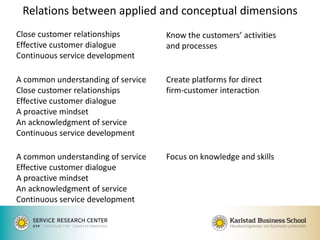
Relations between applied and conceptual dimensions 
Create platforms for direct firm-customer interaction 
Focus on knowledge and skills 
Know the customers’ activities and processes 
Close customer relationships 
Effective customer dialogue 
Continuous service development 
A common understanding of service Close customer relationships Effective customer dialogue A proactive mindset An acknowledgment of service Continuous service development 
A common understanding of service 
Effective customer dialogue 
A proactive mindset 
An acknowledgment of service 
Continuous service development
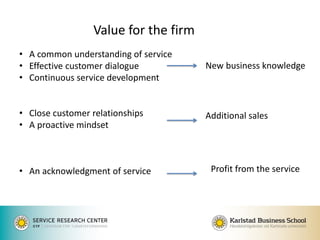
Value for the firm 
•A common understanding of service 
•Effective customer dialogue 
•Continuous service development 
New business knowledge 
•Close customer relationships 
•A proactive mindset 
Additional sales 
•An acknowledgment of service 
Profit from the service
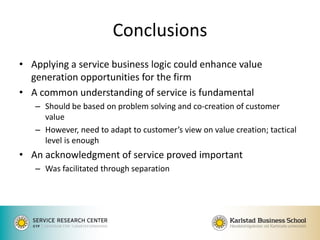
Conclusions 
•Applying a service business logic could enhance value generation opportunities for the firm 
•A common understanding of service is fundamental 
–Should be based on problem solving and co-creation of customer value 
–However, need to adapt to customer’s view on value creation; tactical level is enough 
•An acknowledgment of service proved important 
–Was facilitated through separation

Servitization Nina Lofberg

  • 1.
    Tracing a servicebusiness logic in manufacturing firms Nina Löfberg nina.lofberg@kau.se
  • 2.
    Servitization How tocreate mutual value? Service logic + manufacturing? Service business logic
  • 3.
    Service business logic Value-in-use (e.g. Normann & Ramirez 1993; Ravald & Grönroos 1996; Wikström, 1996; Vargo & Lusch 2004; Grönroos 2006, 2008) Value facilitator (Goods business logic) Value co-creator (Service business logic) Role of service provider: (Grönroos 2008, 2011) •Know the customers’ activities and processes (e.g. Grönroos 2008) •Create platforms for direct firm- customer interaction (e.g. Grönroos & Voima 2013; Ballantyne 2004) •Focus on knowledge and skills (e.g. Vargo & Lusch 2008)
  • 4.
    The focus ofthe study is… …on applying service business logic; •how a manufacturing firm could support the customer’s value creation and, to some extent, •how the service actions generate value for the firm.
  • 5.
    Method •Qualitative casestudy •Pulp and paper industry •Service division •Twelve interviews (e.g. general manager, sales manager, product manager, salesmen, service staff member)
  • 6.
    Applied dimensions ofservice business logic •A common understanding of service •Close customer relationships •Effective customer dialogue •A proactive mindset •An acknowledgment of service •Continuous service development
  • 7.
    Relations between appliedand conceptual dimensions Create platforms for direct firm-customer interaction Focus on knowledge and skills Know the customers’ activities and processes Close customer relationships Effective customer dialogue Continuous service development A common understanding of service Close customer relationships Effective customer dialogue A proactive mindset An acknowledgment of service Continuous service development A common understanding of service Effective customer dialogue A proactive mindset An acknowledgment of service Continuous service development
  • 8.
    Value for thefirm •A common understanding of service •Effective customer dialogue •Continuous service development New business knowledge •Close customer relationships •A proactive mindset Additional sales •An acknowledgment of service Profit from the service
  • 9.
    Conclusions •Applying aservice business logic could enhance value generation opportunities for the firm •A common understanding of service is fundamental –Should be based on problem solving and co-creation of customer value –However, need to adapt to customer’s view on value creation; tactical level is enough •An acknowledgment of service proved important –Was facilitated through separation