SERVICE BRANDING
SERVICE LOGIC, NEW SERVICE DEVELOPMENT AND SERVICE DESIGN
Chair of Product-Market Relations
SERVICE BRANDING
INTRODUCTION
2
• Contextualizing Service Branding
• Experience
• Brand – Key Concepts
• Brand Experience
• Different Views of Branding
Chair of Product-Market Relations
SERVICE BRANDING
DELIVERING
3
“A successful brand shapes customers’ experiences
by embedding the fundamental value proposition in
offerings’ every feature”
(Meyer and Schwager)
Chair of Product-Market Relations
SERVICE BRANDING
DELIVERING
4
§ Although sometimes organizations define their brands in a
similar way, what matters is what the brand values mean, and
specially, how they are delivered
§ It is not what the organization say, but how it delivers that
creates value
§ This can be done by:
• Supporting the employees to deliver the brand to the customers
• Supporting the customers to self-serve
§ Brand delivery is key
Chair of Product-Market Relations
SERVICE BRANDING
DELIVERING
5
§ Service Brands are monolithic
• The same name for the organization and the brand
• Thus everything that the organization does, impacts brand perception
§ A service brand has many touch points
• Thus branding must be responsibility of the entre organization
• They are at the intersection between employees, customers,
organization and external stakeholders; facilitating internal,
external, and interactive marketing, in the process of enabling the
brand to emerge
Chair of Product-Market Relations
SERVICE BRANDING
DELIVERING
6
§ Build shared understanding
• Within the entire organization, and enabling collaborators to live to this
brand
§ This includes enabling the employees to deliver adequately,
with the right systems and incentives
• Technologies
• Processes
• Incentives
§ There is a trend in branding towards the development of the
Service Enablers, and not only Organizational Culture
• Note: Organizational culture is strongly linked to Corporate Branding
Chair of Product-Market Relations
SERVICE BRANDING
IHIP
7
• Zeithaml, Parasuraman and Berry (1985) based on an
literature review and questionnaires
• The main received wisdom, and the basic assumption for
Service Marketing
• Service Marketing was taken as the same as marketing for
good, except for those “unique characteristics”.
• Intangibility – since services are performances, there is no object to be
seem or felt prior to purchase
• Heterogeneity – concerns the potential high variation in service
performance, specially due to human involvement
• Inseparability of production and consumption – due to simultaneous
production and consumption process that characterizes most services
• Perishability – services cannot be stored or inventoried, they must resort
to other techniques to adjust offer to demand
Chair of Product-Market Relations
SERVICE BRANDING
IHIP
8
”Although services dominate developed economies,
“textbook theory” treats services marketing as a sub-
discipline of manufacturing-based marketing
management”
(Lovelock and Gummesson)
Chair of Product-Market Relations
SERVICE BRANDING
IHIP – WHY NOT
9
Intangibility
• Physical intangibility – not touchable
• There are very few pure goods or pure services – most are a
combination, lying in the middle
• The management of the service environment – Servicescape as
tangible clues
• Mental intangibility - difficult/cannot be grasped mentally
• Through frequent use experience becomes a nice predicator
• Some products are also difficult to evaluate before first purchase
• More intangible services, such as internet based, show us how
tangible other services are
• Attribute Qualities:
• Search quality – Can be evaluated before (mostly products)
• Experience quality – Evaluated during consumption (both products and
services)
• Credence quality – More on faith (mostly services)
Chair of Product-Market Relations
SERVICE BRANDING
IHIP – WHY NOT
10
Intangibility
• Conclusion
• Associated with purchases where the customer has no prior experience,
a situation also valid for goods
• Many services involve tangible performances that users experience
through their senses –
• a service performance is tangible while being performed
• Changes can range from ephemeral to permanent
• A nice feeling after a massage
• A hip replacement surgery
• Mental intangibility is not necessarily correlated with physical tangibility
• The concept of intangibility can still be useful, but is not universally
applicable
Chair of Product-Market Relations
SERVICE BRANDING
IHIP – WHY NOT
11
Heterogeneity
• Difficulty to achieve uniformity in the output specially in labor-
intensive services
• Problems may arise from employees and customers
• Same employee variation
• Different employees
• Consumer involvement
• Third parties (consumer) involvement
• External factors such as climate
• Variation due to the consumer also occurs with products
• Machine intensive services are less susceptible for such issues
• Service variation can be positive – customization
• Services packages sold in standardized modules
Chair of Product-Market Relations
SERVICE BRANDING
IHIP – WHY NOT
12
Heterogeneity
“Although there appears to be a consensus that variability is an
inherent characteristic of labor-intensive services no such claim
us made about machine-intensive service operations”
(Lovelock and Gummesson)
• Conclusion:
• Even highly industrialized products suffer from variations as complaints
shows
• Also in products with high deterioration
• Labor intensive variability can be taken as an advantage
• Machine bases services don’t show such a problem
• Standardized modules in services reduce variability
Chair of Product-Market Relations
SERVICE BRANDING
IHIP – WHY NOT
13
Inseparability
• Inseparability – Since products are in many cases interactive
processes, the customer involvement is needed
• Simultaneity of consumption and production
• Consumer as co-producer
• There is a large group of separable products that doesn’t
require simultaneous production and consumption
• Freight
• Car wash
• Freight
• Many government services such as defense, maintenance of
infrastructure
• Outsourcing of services we don’t want to be involved
Chair of Product-Market Relations
SERVICE BRANDING
IHIP – WHY NOT
14
Inseparability
“Simultaneity of production and consumption is a distinctive
characteristic for inseparable services, with very important
implications for marketing and operations strategy, including the
role played by the customer”
(Lovelock and Gummesson)
• Conclusion
• There are inseparable services, and for those the interactive
process and consumer involvement must be considered, but
• There are too many outsourced services
• Even manufacturing is outsourced
Chair of Product-Market Relations
SERVICE BRANDING
IHIP – WHY NOT
15
Perishability
• Finding offer demand balance
• If demand is low, unused
• If demand is too high, business goes unfulfilled
• Services carry costs for idle production capacity
• Inventory problems exist in good because storage costs in are
high and many products are perishable
• For manufacturing companies, inventory are complex costs that
represent invested capital
• On demand production
• Different perspectives on perishability
• Perishability of capacity – Unused capacity
• Perishability of experience – Transitory action
• Perishability of output – The result of the service
Chair of Product-Market Relations
SERVICE BRANDING
IHIP – WHY NOT
16
Perishability
• Conclusion
• Production capacity waste happens in both products of
services: Idle hotels and idle factories
• Manufacturing might buffer production, but will incur storage
costs
• In services perishability is important for sectors with high
demand fluctuations
• Information based services can be stored as digital media
Chair of Product-Market Relations
SERVICE BRANDING
IHIP – WHAT TO DO?
17
IHIP characteristics are only supported in
certain types of services, as it was for goods
• Declare Victory and Abandon the Notion of Separated
Marketing Fields
• Focus on Specific Service Subfields
• Search for a New, Unifying Service Parading
• Non-ownership paradigm
• Manufactured goods can be the base for services
• Services often involve selling slices of larger physical entities
• Labor and expertise are renewable resources
• Time plays a central role in most services
• The need for a new thinking on service pricing
• Services as opportunities for resources sharing
Chair of Product-Market Relations
SERVICE BRANDING
SERVICE DOMINANT LOGIC
18
As the division between goods and services became
outdated the emergence of Service Dominant Logic
has helped not only service marketing, but also the
whole of marketing discipline to break free from the
“manufacturing-based model of the exchange of
outputs”
(Vargo and Lusch)
Chair of Product-Market Relations
SERVICE BRANDING
SERVICE DOMINANT LOGIC
19
§ In a SDL perspective, service (in the singular) is viewed as “the
application of competences (knowledge and skills) by one entity for
the benefit of another” (Vargo et al., 2008, p.145)
• Service is a transcending concept to products and services
§ ‘Service’ as described in the literature:
• From à service as a category of market offerings – an industry,
service sector
• To à service as a perspective on value creation
§ Vargo and Lusch (2008a, p.4) note that “the perception of service
economy is mostly an aberration of the G-D logic thinking”
Chair of Product-Market Relations
SERVICE BRANDING
SERVICE DOMINANT LOGIC
20
§ Service Dominant Logic (SDL) proposes to change the focus
of value creation from exchange to the use experience (value-
in-use)
• Not a theory, but rather as a perspective of value creation in which
service – “the application of competences (knowledge and skills) by one
entity for the benefit of another” (Vargo et al., 2008, p.145) – is the
fundamental basis of exchange
• Since value-in-use focuses on the customer’s experience, the distinction
between goods and services becomes irrelevant
§ What the customers acquire is the benefits that the offering can
provide, the value it helps them co-create
• It is not about the goods or services per se, but the exchange of
knowledge and skills (service), which are usually masked by a “complex
combinations of goods, money, and institutions” (Vargo and Lusch,
2008a, p.7)
Chair of Product-Market Relations
SERVICE BRANDING
SERVICE DOMINANT LOGIC
21
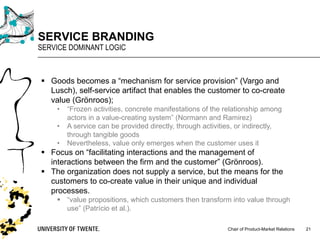
§ Goods becomes a “mechanism for service provision” (Vargo and
Lusch), self-service artifact that enables the customer to co-create
value (Grönroos);
• “Frozen activities, concrete manifestations of the relationship among
actors in a value-creating system” (Normann and Ramirez)
• A service can be provided directly, through activities, or indirectly,
through tangible goods
• Nevertheless, value only emerges when the customer uses it
§ Focus on “facilitating interactions and the management of
interactions between the firm and the customer” (Grönroos).
§ The organization does not supply a service, but the means for the
customers to co-create value in their unique and individual
processes.
§ “value propositions, which customers then transform into value through
use” (Patrício et al.).
Chair of Product-Market Relations
SERVICE BRANDING
SERVICE DOMINANT LOGIC
22
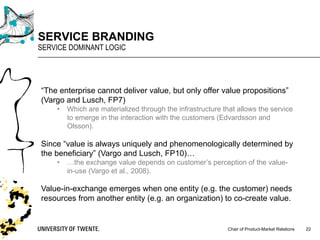
“The enterprise cannot deliver value, but only offer value propositions”
(Vargo and Lusch, FP7)
• Which are materialized through the infrastructure that allows the service
to emerge in the interaction with the customers (Edvardsson and
Olsson).
Since “value is always uniquely and phenomenologically determined by
the beneficiary” (Vargo and Lusch, FP10)…
• …the exchange value depends on customer’s perception of the value-
in-use (Vargo et al., 2008).
Value-in-exchange emerges when one entity (e.g. the customer) needs
resources from another entity (e.g. an organization) to co-create value.
Chair of Product-Market Relations
SERVICE BRANDING
SERVICE DOMINANT LOGIC
23
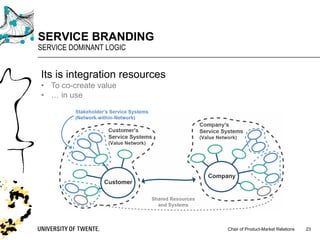
Its is integration resources
• To co-create value
• … in use
Chair of Product-Market Relations
SERVICE BRANDING
SERVICES
24
Services are conceptualized as capacities
embedded in, and enabled by a dynamic
configuration of resources that facilitate the
value co-creation process
Chair of Product-Market Relations
SERVICE BRANDING
SERVICE DESIGN
25
Service design emerged in the context of the transition to a
knowledge-based society
§ Although services exist for a long time, a systematic designerly
approach to services has only emerged in the last 25 years
§ Service design as a design discipline
§ Silent Design
• “a profusion of diverse services exist, designed by all sorts of
people with range of knowledge and intellectual traditions, but
typically not people who have been to design school” (Kimbell,
2009a, p.160).
§ “The design of the points of contact between the service
provider and the customer is not new” (Clatworthy)
Chair of Product-Market Relations
SERVICE BRANDING
SERVICE DESIGN
26
§ Service design “represents the application of design as a creative
and culturally informed approach to services” (Clatworthy)
• Service design as “the use of a designerly way of working when
improving or developing people-intensive service systems through the
engagement of stakeholders” (Segelström, 2013, p.27) .
§ This ‘designerly ways’ mentioned by both authors grounds service
design as a design discipline
• “the abilities of resolving ill-defined problems, adopting solution-focused
cognitive strategies, employing abductive or appositional thinking and
using non-verbal modeling media” (Cross, 2010, p.100).
Chair of Product-Market Relations
SERVICE BRANDING
SERVICE DESIGN - THINKING
27
§ Possibly, the main characteristic of service design is its focus on the
customer experience; furthermore,
• the co-creative nature of service design can be understood as not only
multidisciplinary, but also as transdisciplinary. Therefore, service design
offers
• an integrative approach to service development, which incorporates
• stakeholders from different silos, departments and operational levels in
the service development process.
§ Additionally, service design uses visual tools that facilitate the design
of immaterial activities through collaborative and enactive
approaches; following an
• iterative process through cycles of evaluation and redesign
§ Jointly, these characteristics facilitate not only co-development of the
new service offerings with customers, but they also foster
organizational support for the new projects
Chair of Product-Market Relations
SERVICE BRANDING
SERVICE DESIGN
28
§ Service Design materializing the interfaces between the customers
and the company’s infrastructure (Secomandi and Snelders, 2010)
• Integrating service systems with the touch points that supports the
interactions, and that brings the new service into being
• this is what a touch point is – an interface between the infrastructure
and the customers
§ Touch point are artifacts that materialize the value proposition,
enabling its realization through the customer’s interaction
• the tangible expressions of the service infrastructure.
§ Service encounters are the moments when the customers interact
with any given service touch point.
Chair of Product-Market Relations
SERVICE BRANDING
SERVICE DESIGN
29
§ Services are processes through which the company’s resources
interact with the customers’ to co-create value
• the way these processes unfolds - the customer’s journeys with the
service - is paramount
• “Touch-point orchestration is often mentioned as central to service
success” (Clatworthy, 2011, p.25)
• Service orchestration may help connecting different silos in the
organization into delivering an aligned customer journey
Furthermore:
• Touch points don’t tell the whole story, as they are sub-components of a
larger picture
• à “it is as if companies spend fortunes building gleaming towers
and cities while the roads between them are muddy dirt tracks”
(Polaine et al.)
• Clatworthy defines service design as “designed offerings to provide
experiences that happen overtime and across different touch-point
Chair of Product-Market Relations
SERVICE BRANDING
DESIGN FOR SERVICE
30
To design a service is to create a service as a
concept. However, to enable this service to become
reality, one must focus on designing its enablers.
§ Design for service is an approach to service design that “points to
the impossibility of being able to fully imagine, plan or define any
complete design for a service” (Kimbell)
Chair of Product-Market Relations
SERVICE BRANDING
DESIGN FOR SERVICE
31
Design for Service
… “acknowledges the indeterminacy of services as an object of
design” (Sangiorgi, 2012, p.98-99).
§ Thus, it is understood that a service company does not provide a
service, but the prerequisites that enables the services to emerge
through the customers’ interactions
§ Design for service “has provided important theoretical grounding for
the, arguably, most important theoretical advancement in service
design this far (Segelström).
Chair of Product-Market Relations
SERVICE BRANDING
DESIGN FOR SERVICE
32
Design for service operationalizes the development of service
experiences under a service dominant logic perspective
…as such, it does not focus on a specific kind of outcome (goods
or services).
§ Since experiences are phenomenological, it is understood that
organizations cannot design experiences, but only the systems that
will enable the customers to develop their own experience through
the service process.
§ Design for services recognizes that what is being designed is not the
service itself, but rather a platform for action where the actors and
their value network may engage in a value co-creation process.
Chair of Product-Market Relations
SERVICE BRANDING
SERVICE DESIGN – NEW SERVICE DEVELOPMENT
33
Before Service Design as a Designerly approach, there was
New Service Development (NSD) process
”… the overall process of developing new service offerings and is
concerned with the complete set of stages from idea to launch” (Goldstein
et al.).
Stages of the NSD process
• “where the front end selects a service concept to develop more fully,
• … the back end implements this chosen service concept” (Tatikonda
and Zeithaml)
Chair of Product-Market Relations
SERVICE BRANDING
SERVICE DESIGN – NEW SERVICE DEVELOPMENT
34
NSD – Key Elements
§ Service Concept
• An expression of the value proposition the organization makes to the
customers
§ Service Systems
• Represents the set of resources the organization needs to realize the
service concept
§ Service Process
• A prototype for the different customers’ processes – a collective and
generic customer journey
Chair of Product-Market Relations
SERVICE BRANDING
SERVICE DESIGN – NEW SERVICE DEVELOPMENT
35
Limitations from the traditional NSD methods must be noticed
• The importance of taking the customer’s point of view into consideration
during the NSD process
• The complexity of designing for multiple touch points
These characteristics, which are not fully addressed by NSD,
became the subject of Service Design
However, in many aspects the pendulum swung too far, and
now a new focus on the back end and implementation was
necessary
Chair of Product-Market Relations
SERVICE BRANDING
DESIGN FOR SERVICE – NEW SERVICE DEVELOPMENT
36
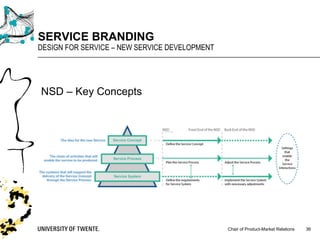
NSD – Key Concepts
Chair of Product-Market Relations
SERVICE BRANDING
MULTI-LEVEL SERVICE DESIGN
37
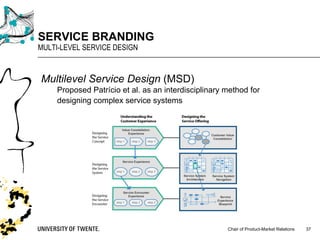
Multilevel Service Design (MSD)
Proposed Patrício et al. as an interdisciplinary method for
designing complex service systems
Chair of Product-Market Relations
SERVICE BRANDING
SERVICE BRANDING
38
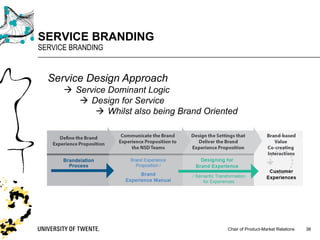
Service Design Approach
à Service Dominant Logic
à Design for Service
à Whilst also being Brand Oriented
Chair of Product-Market Relations
SERVICE BRANDING
SERVICE BRANDING
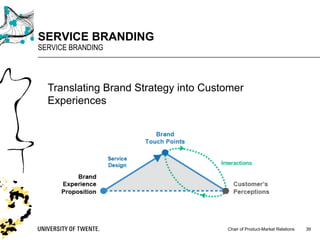
39
Translating Brand Strategy into Customer
Experiences
Chair of Product-Market Relations
SERVICE BRANDING
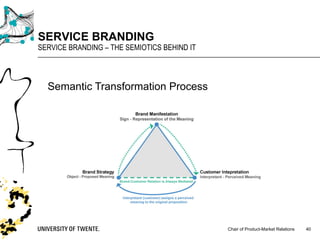
SERVICE BRANDING – THE SEMIOTICS BEHIND IT
40
Semantic Transformation Process
Chair of Product-Market Relations
SERVICE BRANDING
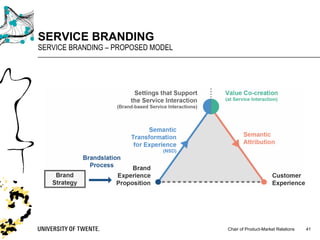
SERVICE BRANDING – PROPOSED MODEL
41
Chair of Product-Market Relations
SERVICE BRANDING
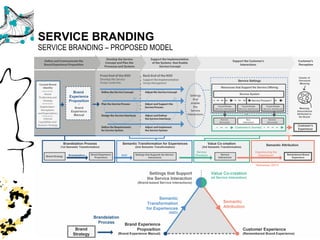
SERVICE BRANDING – PROPOSED MODEL
42
Chair of Product-Market Relations
SERVICE BRANDING
SERVICE BRANDING – BREAK
43
Break Time
Afterward, an Exercise
Chair of Product-Market Relations
SERVICE BRANDING
SERVICE BRANDING – EXERCISE
44
Exploring the Brand Experience
Proposition of Industrial Design
and Develop a Relationship
Metaphor for Expressing it
Chair of Product-Market Relations
SERVICE BRANDING
SERVICE BRANDING – EXERCISE
45
If there is time …
Develop a Manifestation of that
Brand Experience Proposition
Chair of Product-Market Relations
SERVICE BRANDING
SERVICE BRANDING – EXERCISE
46
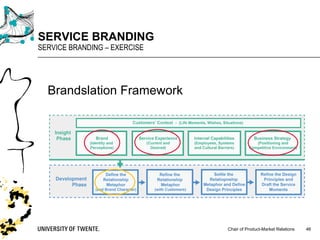
Brandslation Framework
Chair of Product-Market Relations
SERVICE BRANDING
EXPLORING THE ID BRAND AND EXPERIENCE
47
Brand Mapping
• Through analogies, express how you see the ID brand. Use cars,
places, airlines, football teams, artists, anything – the main outcome
is not the visual map, but the meanings it help uncover
Brand Positioning
• Place the ID (University of Twente) in a map in relation to other
course. This map can be a X and Y coordinate map, where the axis
are chosen by categories/qualities you find relevant (i.e. design
orientation)
Reason of choice – Expectation – Experience
• Why you chose ID, what were you expectations, and how is your
actual experience
Chair of Product-Market Relations
SERVICE BRANDING
EXPLORING IDE’S STRATEGY
48
Brand Identity
• How ID portraits itself through its official communication channels.
Also, how do you read ID’s communication (implicit meanings
embedded in the visual) – also consider UT’s brand
SWOT
• What are the main strengths of ID? And the main weaknesses? How
does that influence in the external environment – what are the
opportunities and threats? – also consider UT’s brand
Portfolio Positioning
• The ID place within UT’s multiple courses
Chair of Product-Market Relations
SERVICE BRANDING
DEVELOPING A METAPHOR FOR ID
49
Who is IDE?
• Building on the material developed previously, express who ID would
be, if it were a person.
• It might be easier to start by thinking of a persona for a student, and
then see who ID would be to that person. What would ID do for that
persona? How would ID act towards that person? Who would ID be
to that person (i.e. friend, mentor, family)?
• Express as a Relationship between ID and the student
Chair of Product-Market Relations
SERVICE BRANDING
DEVELOPING AN EXPRESSION/MANIFESTATION OF ID
50
Considering that ”ideal” relationship
• Develop a point of contact between ID and the persona
• This could be an advertisement
• Or a touch-point that you find particularly ”painful”

minors_Lecture_2 copy.pdf

  • 1.
    SERVICE BRANDING SERVICE LOGIC,NEW SERVICE DEVELOPMENT AND SERVICE DESIGN
  • 2.
    Chair of Product-MarketRelations SERVICE BRANDING INTRODUCTION 2 • Contextualizing Service Branding • Experience • Brand – Key Concepts • Brand Experience • Different Views of Branding
  • 3.
    Chair of Product-MarketRelations SERVICE BRANDING DELIVERING 3 “A successful brand shapes customers’ experiences by embedding the fundamental value proposition in offerings’ every feature” (Meyer and Schwager)
  • 4.
    Chair of Product-MarketRelations SERVICE BRANDING DELIVERING 4 § Although sometimes organizations define their brands in a similar way, what matters is what the brand values mean, and specially, how they are delivered § It is not what the organization say, but how it delivers that creates value § This can be done by: • Supporting the employees to deliver the brand to the customers • Supporting the customers to self-serve § Brand delivery is key
  • 5.
    Chair of Product-MarketRelations SERVICE BRANDING DELIVERING 5 § Service Brands are monolithic • The same name for the organization and the brand • Thus everything that the organization does, impacts brand perception § A service brand has many touch points • Thus branding must be responsibility of the entre organization • They are at the intersection between employees, customers, organization and external stakeholders; facilitating internal, external, and interactive marketing, in the process of enabling the brand to emerge
  • 6.
    Chair of Product-MarketRelations SERVICE BRANDING DELIVERING 6 § Build shared understanding • Within the entire organization, and enabling collaborators to live to this brand § This includes enabling the employees to deliver adequately, with the right systems and incentives • Technologies • Processes • Incentives § There is a trend in branding towards the development of the Service Enablers, and not only Organizational Culture • Note: Organizational culture is strongly linked to Corporate Branding
  • 7.
    Chair of Product-MarketRelations SERVICE BRANDING IHIP 7 • Zeithaml, Parasuraman and Berry (1985) based on an literature review and questionnaires • The main received wisdom, and the basic assumption for Service Marketing • Service Marketing was taken as the same as marketing for good, except for those “unique characteristics”. • Intangibility – since services are performances, there is no object to be seem or felt prior to purchase • Heterogeneity – concerns the potential high variation in service performance, specially due to human involvement • Inseparability of production and consumption – due to simultaneous production and consumption process that characterizes most services • Perishability – services cannot be stored or inventoried, they must resort to other techniques to adjust offer to demand
  • 8.
    Chair of Product-MarketRelations SERVICE BRANDING IHIP 8 ”Although services dominate developed economies, “textbook theory” treats services marketing as a sub- discipline of manufacturing-based marketing management” (Lovelock and Gummesson)
  • 9.
    Chair of Product-MarketRelations SERVICE BRANDING IHIP – WHY NOT 9 Intangibility • Physical intangibility – not touchable • There are very few pure goods or pure services – most are a combination, lying in the middle • The management of the service environment – Servicescape as tangible clues • Mental intangibility - difficult/cannot be grasped mentally • Through frequent use experience becomes a nice predicator • Some products are also difficult to evaluate before first purchase • More intangible services, such as internet based, show us how tangible other services are • Attribute Qualities: • Search quality – Can be evaluated before (mostly products) • Experience quality – Evaluated during consumption (both products and services) • Credence quality – More on faith (mostly services)
  • 10.
    Chair of Product-MarketRelations SERVICE BRANDING IHIP – WHY NOT 10 Intangibility • Conclusion • Associated with purchases where the customer has no prior experience, a situation also valid for goods • Many services involve tangible performances that users experience through their senses – • a service performance is tangible while being performed • Changes can range from ephemeral to permanent • A nice feeling after a massage • A hip replacement surgery • Mental intangibility is not necessarily correlated with physical tangibility • The concept of intangibility can still be useful, but is not universally applicable
  • 11.
    Chair of Product-MarketRelations SERVICE BRANDING IHIP – WHY NOT 11 Heterogeneity • Difficulty to achieve uniformity in the output specially in labor- intensive services • Problems may arise from employees and customers • Same employee variation • Different employees • Consumer involvement • Third parties (consumer) involvement • External factors such as climate • Variation due to the consumer also occurs with products • Machine intensive services are less susceptible for such issues • Service variation can be positive – customization • Services packages sold in standardized modules
  • 12.
    Chair of Product-MarketRelations SERVICE BRANDING IHIP – WHY NOT 12 Heterogeneity “Although there appears to be a consensus that variability is an inherent characteristic of labor-intensive services no such claim us made about machine-intensive service operations” (Lovelock and Gummesson) • Conclusion: • Even highly industrialized products suffer from variations as complaints shows • Also in products with high deterioration • Labor intensive variability can be taken as an advantage • Machine bases services don’t show such a problem • Standardized modules in services reduce variability
  • 13.
    Chair of Product-MarketRelations SERVICE BRANDING IHIP – WHY NOT 13 Inseparability • Inseparability – Since products are in many cases interactive processes, the customer involvement is needed • Simultaneity of consumption and production • Consumer as co-producer • There is a large group of separable products that doesn’t require simultaneous production and consumption • Freight • Car wash • Freight • Many government services such as defense, maintenance of infrastructure • Outsourcing of services we don’t want to be involved
  • 14.
    Chair of Product-MarketRelations SERVICE BRANDING IHIP – WHY NOT 14 Inseparability “Simultaneity of production and consumption is a distinctive characteristic for inseparable services, with very important implications for marketing and operations strategy, including the role played by the customer” (Lovelock and Gummesson) • Conclusion • There are inseparable services, and for those the interactive process and consumer involvement must be considered, but • There are too many outsourced services • Even manufacturing is outsourced
  • 15.
    Chair of Product-MarketRelations SERVICE BRANDING IHIP – WHY NOT 15 Perishability • Finding offer demand balance • If demand is low, unused • If demand is too high, business goes unfulfilled • Services carry costs for idle production capacity • Inventory problems exist in good because storage costs in are high and many products are perishable • For manufacturing companies, inventory are complex costs that represent invested capital • On demand production • Different perspectives on perishability • Perishability of capacity – Unused capacity • Perishability of experience – Transitory action • Perishability of output – The result of the service
  • 16.
    Chair of Product-MarketRelations SERVICE BRANDING IHIP – WHY NOT 16 Perishability • Conclusion • Production capacity waste happens in both products of services: Idle hotels and idle factories • Manufacturing might buffer production, but will incur storage costs • In services perishability is important for sectors with high demand fluctuations • Information based services can be stored as digital media
  • 17.
    Chair of Product-MarketRelations SERVICE BRANDING IHIP – WHAT TO DO? 17 IHIP characteristics are only supported in certain types of services, as it was for goods • Declare Victory and Abandon the Notion of Separated Marketing Fields • Focus on Specific Service Subfields • Search for a New, Unifying Service Parading • Non-ownership paradigm • Manufactured goods can be the base for services • Services often involve selling slices of larger physical entities • Labor and expertise are renewable resources • Time plays a central role in most services • The need for a new thinking on service pricing • Services as opportunities for resources sharing
  • 18.
    Chair of Product-MarketRelations SERVICE BRANDING SERVICE DOMINANT LOGIC 18 As the division between goods and services became outdated the emergence of Service Dominant Logic has helped not only service marketing, but also the whole of marketing discipline to break free from the “manufacturing-based model of the exchange of outputs” (Vargo and Lusch)
  • 19.
    Chair of Product-MarketRelations SERVICE BRANDING SERVICE DOMINANT LOGIC 19 § In a SDL perspective, service (in the singular) is viewed as “the application of competences (knowledge and skills) by one entity for the benefit of another” (Vargo et al., 2008, p.145) • Service is a transcending concept to products and services § ‘Service’ as described in the literature: • From à service as a category of market offerings – an industry, service sector • To à service as a perspective on value creation § Vargo and Lusch (2008a, p.4) note that “the perception of service economy is mostly an aberration of the G-D logic thinking”
  • 20.
    Chair of Product-MarketRelations SERVICE BRANDING SERVICE DOMINANT LOGIC 20 § Service Dominant Logic (SDL) proposes to change the focus of value creation from exchange to the use experience (value- in-use) • Not a theory, but rather as a perspective of value creation in which service – “the application of competences (knowledge and skills) by one entity for the benefit of another” (Vargo et al., 2008, p.145) – is the fundamental basis of exchange • Since value-in-use focuses on the customer’s experience, the distinction between goods and services becomes irrelevant § What the customers acquire is the benefits that the offering can provide, the value it helps them co-create • It is not about the goods or services per se, but the exchange of knowledge and skills (service), which are usually masked by a “complex combinations of goods, money, and institutions” (Vargo and Lusch, 2008a, p.7)
  • 21.
    Chair of Product-MarketRelations SERVICE BRANDING SERVICE DOMINANT LOGIC 21 § Goods becomes a “mechanism for service provision” (Vargo and Lusch), self-service artifact that enables the customer to co-create value (Grönroos); • “Frozen activities, concrete manifestations of the relationship among actors in a value-creating system” (Normann and Ramirez) • A service can be provided directly, through activities, or indirectly, through tangible goods • Nevertheless, value only emerges when the customer uses it § Focus on “facilitating interactions and the management of interactions between the firm and the customer” (Grönroos). § The organization does not supply a service, but the means for the customers to co-create value in their unique and individual processes. § “value propositions, which customers then transform into value through use” (Patrício et al.).
  • 22.
    Chair of Product-MarketRelations SERVICE BRANDING SERVICE DOMINANT LOGIC 22 “The enterprise cannot deliver value, but only offer value propositions” (Vargo and Lusch, FP7) • Which are materialized through the infrastructure that allows the service to emerge in the interaction with the customers (Edvardsson and Olsson). Since “value is always uniquely and phenomenologically determined by the beneficiary” (Vargo and Lusch, FP10)… • …the exchange value depends on customer’s perception of the value- in-use (Vargo et al., 2008). Value-in-exchange emerges when one entity (e.g. the customer) needs resources from another entity (e.g. an organization) to co-create value.
  • 23.
    Chair of Product-MarketRelations SERVICE BRANDING SERVICE DOMINANT LOGIC 23 Its is integration resources • To co-create value • … in use
  • 24.
    Chair of Product-MarketRelations SERVICE BRANDING SERVICES 24 Services are conceptualized as capacities embedded in, and enabled by a dynamic configuration of resources that facilitate the value co-creation process
  • 25.
    Chair of Product-MarketRelations SERVICE BRANDING SERVICE DESIGN 25 Service design emerged in the context of the transition to a knowledge-based society § Although services exist for a long time, a systematic designerly approach to services has only emerged in the last 25 years § Service design as a design discipline § Silent Design • “a profusion of diverse services exist, designed by all sorts of people with range of knowledge and intellectual traditions, but typically not people who have been to design school” (Kimbell, 2009a, p.160). § “The design of the points of contact between the service provider and the customer is not new” (Clatworthy)
  • 26.
    Chair of Product-MarketRelations SERVICE BRANDING SERVICE DESIGN 26 § Service design “represents the application of design as a creative and culturally informed approach to services” (Clatworthy) • Service design as “the use of a designerly way of working when improving or developing people-intensive service systems through the engagement of stakeholders” (Segelström, 2013, p.27) . § This ‘designerly ways’ mentioned by both authors grounds service design as a design discipline • “the abilities of resolving ill-defined problems, adopting solution-focused cognitive strategies, employing abductive or appositional thinking and using non-verbal modeling media” (Cross, 2010, p.100).
  • 27.
    Chair of Product-MarketRelations SERVICE BRANDING SERVICE DESIGN - THINKING 27 § Possibly, the main characteristic of service design is its focus on the customer experience; furthermore, • the co-creative nature of service design can be understood as not only multidisciplinary, but also as transdisciplinary. Therefore, service design offers • an integrative approach to service development, which incorporates • stakeholders from different silos, departments and operational levels in the service development process. § Additionally, service design uses visual tools that facilitate the design of immaterial activities through collaborative and enactive approaches; following an • iterative process through cycles of evaluation and redesign § Jointly, these characteristics facilitate not only co-development of the new service offerings with customers, but they also foster organizational support for the new projects
  • 28.
    Chair of Product-MarketRelations SERVICE BRANDING SERVICE DESIGN 28 § Service Design materializing the interfaces between the customers and the company’s infrastructure (Secomandi and Snelders, 2010) • Integrating service systems with the touch points that supports the interactions, and that brings the new service into being • this is what a touch point is – an interface between the infrastructure and the customers § Touch point are artifacts that materialize the value proposition, enabling its realization through the customer’s interaction • the tangible expressions of the service infrastructure. § Service encounters are the moments when the customers interact with any given service touch point.
  • 29.
    Chair of Product-MarketRelations SERVICE BRANDING SERVICE DESIGN 29 § Services are processes through which the company’s resources interact with the customers’ to co-create value • the way these processes unfolds - the customer’s journeys with the service - is paramount • “Touch-point orchestration is often mentioned as central to service success” (Clatworthy, 2011, p.25) • Service orchestration may help connecting different silos in the organization into delivering an aligned customer journey Furthermore: • Touch points don’t tell the whole story, as they are sub-components of a larger picture • à “it is as if companies spend fortunes building gleaming towers and cities while the roads between them are muddy dirt tracks” (Polaine et al.) • Clatworthy defines service design as “designed offerings to provide experiences that happen overtime and across different touch-point
  • 30.
    Chair of Product-MarketRelations SERVICE BRANDING DESIGN FOR SERVICE 30 To design a service is to create a service as a concept. However, to enable this service to become reality, one must focus on designing its enablers. § Design for service is an approach to service design that “points to the impossibility of being able to fully imagine, plan or define any complete design for a service” (Kimbell)
  • 31.
    Chair of Product-MarketRelations SERVICE BRANDING DESIGN FOR SERVICE 31 Design for Service … “acknowledges the indeterminacy of services as an object of design” (Sangiorgi, 2012, p.98-99). § Thus, it is understood that a service company does not provide a service, but the prerequisites that enables the services to emerge through the customers’ interactions § Design for service “has provided important theoretical grounding for the, arguably, most important theoretical advancement in service design this far (Segelström).
  • 32.
    Chair of Product-MarketRelations SERVICE BRANDING DESIGN FOR SERVICE 32 Design for service operationalizes the development of service experiences under a service dominant logic perspective …as such, it does not focus on a specific kind of outcome (goods or services). § Since experiences are phenomenological, it is understood that organizations cannot design experiences, but only the systems that will enable the customers to develop their own experience through the service process. § Design for services recognizes that what is being designed is not the service itself, but rather a platform for action where the actors and their value network may engage in a value co-creation process.
  • 33.
    Chair of Product-MarketRelations SERVICE BRANDING SERVICE DESIGN – NEW SERVICE DEVELOPMENT 33 Before Service Design as a Designerly approach, there was New Service Development (NSD) process ”… the overall process of developing new service offerings and is concerned with the complete set of stages from idea to launch” (Goldstein et al.). Stages of the NSD process • “where the front end selects a service concept to develop more fully, • … the back end implements this chosen service concept” (Tatikonda and Zeithaml)
  • 34.
    Chair of Product-MarketRelations SERVICE BRANDING SERVICE DESIGN – NEW SERVICE DEVELOPMENT 34 NSD – Key Elements § Service Concept • An expression of the value proposition the organization makes to the customers § Service Systems • Represents the set of resources the organization needs to realize the service concept § Service Process • A prototype for the different customers’ processes – a collective and generic customer journey
  • 35.
    Chair of Product-MarketRelations SERVICE BRANDING SERVICE DESIGN – NEW SERVICE DEVELOPMENT 35 Limitations from the traditional NSD methods must be noticed • The importance of taking the customer’s point of view into consideration during the NSD process • The complexity of designing for multiple touch points These characteristics, which are not fully addressed by NSD, became the subject of Service Design However, in many aspects the pendulum swung too far, and now a new focus on the back end and implementation was necessary
  • 36.
    Chair of Product-MarketRelations SERVICE BRANDING DESIGN FOR SERVICE – NEW SERVICE DEVELOPMENT 36 NSD – Key Concepts
  • 37.
    Chair of Product-MarketRelations SERVICE BRANDING MULTI-LEVEL SERVICE DESIGN 37 Multilevel Service Design (MSD) Proposed Patrício et al. as an interdisciplinary method for designing complex service systems
  • 38.
    Chair of Product-MarketRelations SERVICE BRANDING SERVICE BRANDING 38 Service Design Approach à Service Dominant Logic à Design for Service à Whilst also being Brand Oriented
  • 39.
    Chair of Product-MarketRelations SERVICE BRANDING SERVICE BRANDING 39 Translating Brand Strategy into Customer Experiences
  • 40.
    Chair of Product-MarketRelations SERVICE BRANDING SERVICE BRANDING – THE SEMIOTICS BEHIND IT 40 Semantic Transformation Process
  • 41.
    Chair of Product-MarketRelations SERVICE BRANDING SERVICE BRANDING – PROPOSED MODEL 41
  • 42.
    Chair of Product-MarketRelations SERVICE BRANDING SERVICE BRANDING – PROPOSED MODEL 42
  • 43.
    Chair of Product-MarketRelations SERVICE BRANDING SERVICE BRANDING – BREAK 43 Break Time Afterward, an Exercise
  • 44.
    Chair of Product-MarketRelations SERVICE BRANDING SERVICE BRANDING – EXERCISE 44 Exploring the Brand Experience Proposition of Industrial Design and Develop a Relationship Metaphor for Expressing it
  • 45.
    Chair of Product-MarketRelations SERVICE BRANDING SERVICE BRANDING – EXERCISE 45 If there is time … Develop a Manifestation of that Brand Experience Proposition
  • 46.
    Chair of Product-MarketRelations SERVICE BRANDING SERVICE BRANDING – EXERCISE 46 Brandslation Framework
  • 47.
    Chair of Product-MarketRelations SERVICE BRANDING EXPLORING THE ID BRAND AND EXPERIENCE 47 Brand Mapping • Through analogies, express how you see the ID brand. Use cars, places, airlines, football teams, artists, anything – the main outcome is not the visual map, but the meanings it help uncover Brand Positioning • Place the ID (University of Twente) in a map in relation to other course. This map can be a X and Y coordinate map, where the axis are chosen by categories/qualities you find relevant (i.e. design orientation) Reason of choice – Expectation – Experience • Why you chose ID, what were you expectations, and how is your actual experience
  • 48.
    Chair of Product-MarketRelations SERVICE BRANDING EXPLORING IDE’S STRATEGY 48 Brand Identity • How ID portraits itself through its official communication channels. Also, how do you read ID’s communication (implicit meanings embedded in the visual) – also consider UT’s brand SWOT • What are the main strengths of ID? And the main weaknesses? How does that influence in the external environment – what are the opportunities and threats? – also consider UT’s brand Portfolio Positioning • The ID place within UT’s multiple courses
  • 49.
    Chair of Product-MarketRelations SERVICE BRANDING DEVELOPING A METAPHOR FOR ID 49 Who is IDE? • Building on the material developed previously, express who ID would be, if it were a person. • It might be easier to start by thinking of a persona for a student, and then see who ID would be to that person. What would ID do for that persona? How would ID act towards that person? Who would ID be to that person (i.e. friend, mentor, family)? • Express as a Relationship between ID and the student
  • 50.
    Chair of Product-MarketRelations SERVICE BRANDING DEVELOPING AN EXPRESSION/MANIFESTATION OF ID 50 Considering that ”ideal” relationship • Develop a point of contact between ID and the persona • This could be an advertisement • Or a touch-point that you find particularly ”painful”