FUTURE	
  	
  	
  [RE]GENERATION	


ECO	
  2	
  	
   BUILDINGS	


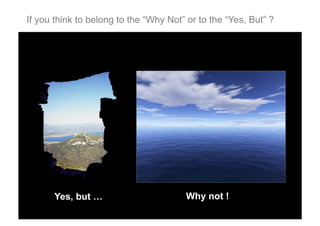
Yes, but …
Why not !
If you think to belong to the “Why Not” or to the “Yes, But” ?

Yes, but …

Why not !
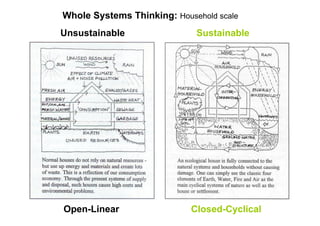
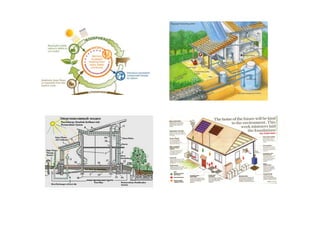
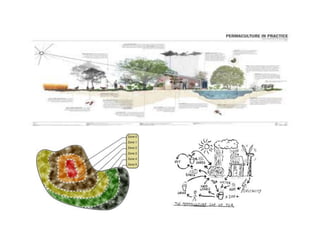
Whole Systems Thinking: Household scale
Unsustainable

Open-Linear

Sustainable

Closed-Cyclical
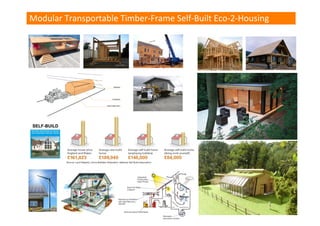
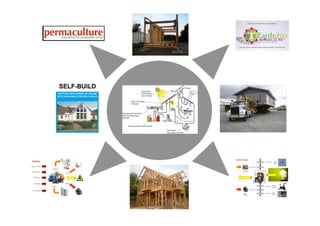
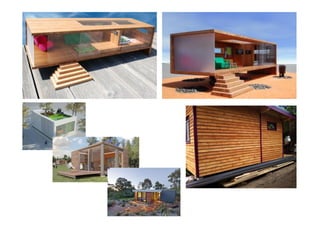
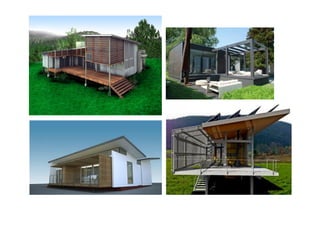
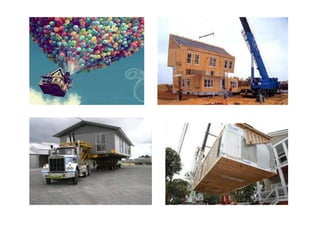
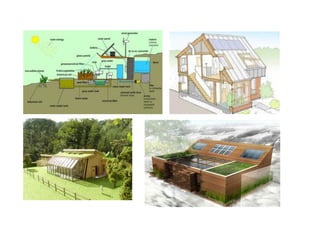
Modular	
  Transportable	
  Timber-­‐Frame	
  Self-­‐Built	
  Eco-­‐2-­‐Housing	
  	
  
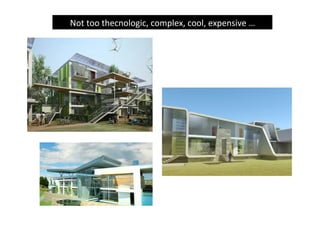
Not	
  too	
  thecnologic,	
  complex,	
  cool,	
  expensive	
  …	
  
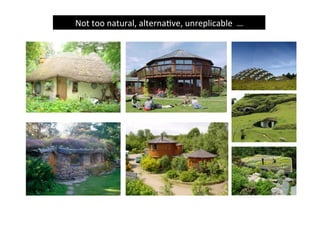
Not	
  too	
  natural,	
  alternaBve,	
  unreplicable	
  	
  …	
  
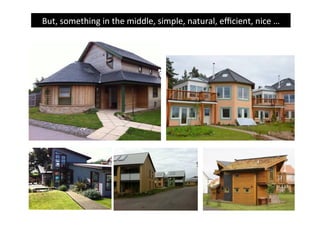
But,	
  something	
  in	
  the	
  middle,	
  simple,	
  natural,	
  efficient,	
  nice	
  …	
  
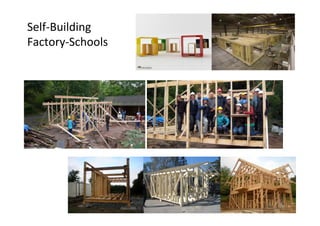
Self-­‐Building	
  
Factory-­‐Schools	
  
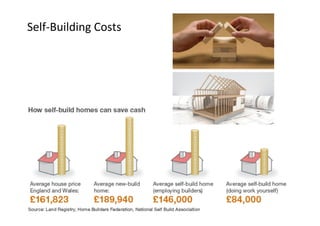
Self-­‐Building	
  Costs	


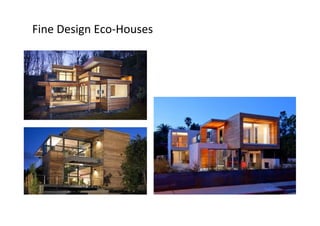
Fine	
  Design	
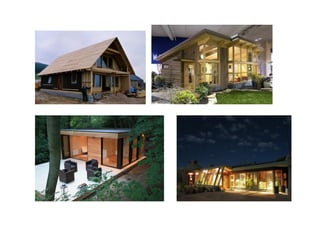
  Eco-­‐Houses	
  
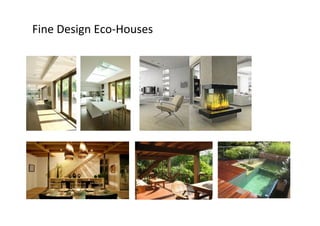
Fine	
  Design	
  Eco-­‐Houses	
  
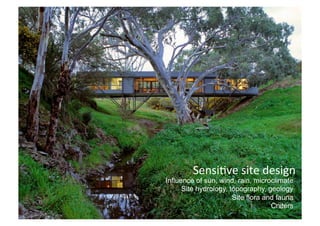
SensiBve	
  site	
  design	
  

Influence of sun, wind, rain, microclimate
Site hydrology, topography, geology
Site flora and fauna
Criiters
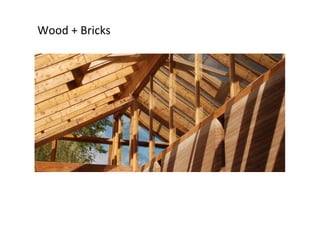
Wood	
  +	
  Bricks	
  
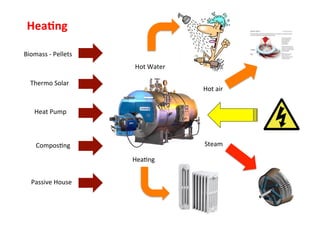
Hea7ng	
  
Biomass	
  -­‐	
  Pellets	
  
Hot	
  Water	
  
Thermo	
  Solar	
  

Hot	
  air	
  

Heat	
  Pump	
  

Steam	
  

ComposBng	
  
HeaBng	
  
Passive	
  House	
  
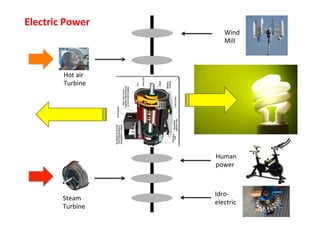
Electric	
  Power	
  

Wind	
  	
  
Mill	
  

Hot	
  air	
  
Turbine	
  

Human	
  	
  
power	
  

Steam	
  	
  
Turbine	
  

Idro-­‐	
  
electric	
  
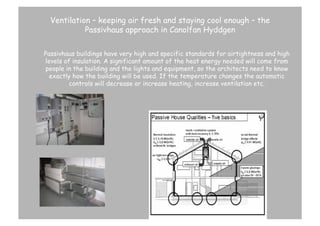
Ventilation – keeping air fresh and staying cool enough – the
Passivhaus approach in Canolfan Hyddgen
Passivhaus buildings have very high and specific standards for airtightness and high
levels of insulation. A significant amount of the heat energy needed will come from
people in the building and the lights and equipment, so the architects need to know
exactly how the building will be used. If the temperature changes the automatic
controls will decrease or increase heating, increase ventilation etc.
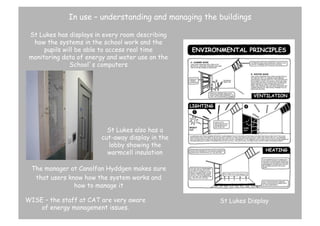
In use – understanding and managing the buildings
St Lukes has displays in every room describing
how the systems in the school work and the
pupils will be able to access real time
monitoring data of energy and water use on the
School’s computers

St Lukes also has a
cut-away display in the
lobby showing the
warmcell insulation
The manager at Canolfan Hyddgen makes sure
that users know how the system works and
how to manage it
WISE – the staff at CAT are very aware
of energy management issues.

St Lukes Display
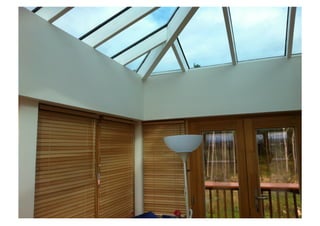
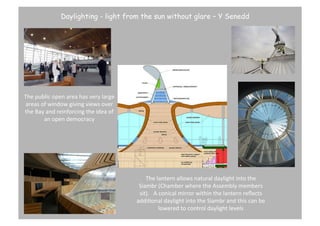
Daylighting - light from the sun without glare – Y Senedd

The	
  public	
  open	
  area	
  has	
  very	
  large	
  
areas	
  of	
  window	
  giving	
  views	
  over	
  
the	
  Bay	
  and	
  reinforcing	
  the	
  idea	
  of	
  
an	
  open	
  democracy	
  

The	
  lantern	
  allows	
  natural	
  daylight	
  into	
  the	
  
Siambr	
  (Chamber	
  where	
  the	
  Assembly	
  members	
  
sit).	
  	
  	
  A	
  conical	
  mirror	
  within	
  the	
  lantern	
  reflects	
  
addiBonal	
  daylight	
  into	
  the	
  Siambr	
  and	
  this	
  can	
  be	
  
lowered	
  to	
  control	
  daylight	
  levels	
  
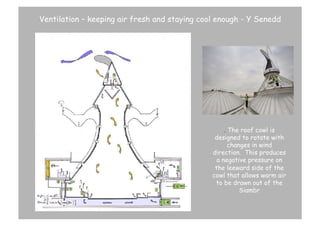
Ventilation – keeping air fresh and staying cool enough - Y Senedd

. The roof cowl is
designed to rotate with
changes in wind
direction.  This produces
a negative pressure on
the leeward side of the
cowl that allows warm air
to be drawn out of the
Siambr	
  	
  
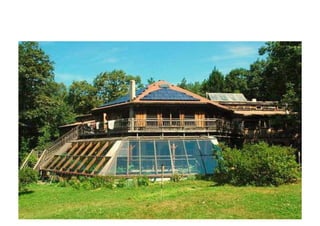
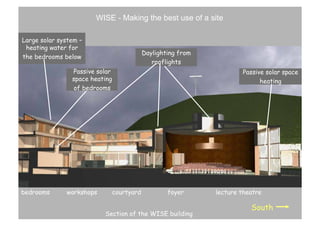
WISE - Making the best use of a site
Large solar system –
heating water for
the bedrooms below

Daylighting from
rooflights

Passive solar
space heating
of bedrooms

bedrooms

workshops

Passive solar space
heating

courtyard

foyer

Section of the WISE building

lecture theatre

South
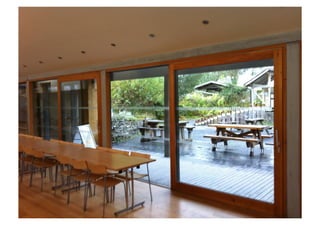
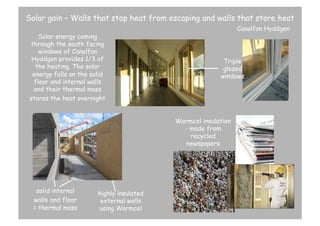
Solar gain – Walls that stop heat from escaping and walls that store heat
Solar energy coming
through the south facing
windows of Canolfan
Hyddgen provides 1/3 of
the heating. The solar
energy falls on the solid
floor and internal walls
and their thermal mass
stores the heat overnight

Canolfan Hyddgen

Triple
glazed
windows

Warmcel insulation
- made from
recycled
newspapers

solid internal
walls and floor
= thermal mass

highly insulated
external walls
using Warmcel
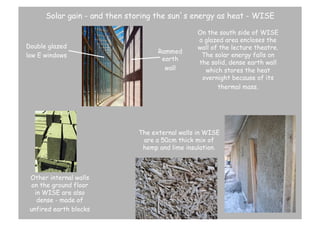
Solar gain - and then storing the sun’s energy as heat - WISE

Double glazed
low E windows

Rammed
earth
wall

On the south side of WISE
a glazed area encloses the
wall of the lecture theatre.
The solar energy falls on
the solid, dense earth wall
which stores the heat
overnight because of its
thermal mass.

The external walls in WISE
are a 50cm thick mix of
hemp and lime insulation.

Other internal walls
on the ground floor
in WISE are also
dense - made of
unfired earth blocks
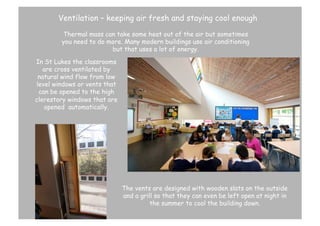
Ventilation – keeping air fresh and staying cool enough
Thermal mass can take some heat out of the air but sometimes
you need to do more. Many modern buildings use air conditioning
but that uses a lot of energy.
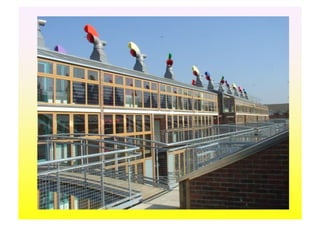
In St Lukes the classrooms
are cross ventilated by
natural wind flow from low
level windows or vents that
can be opened to the high
clerestory windows that are
opened automatically.

Vents

The vents are designed with wooden slats on the outside
and a grill so that they can even be left open at night in
the summer to cool the building down.
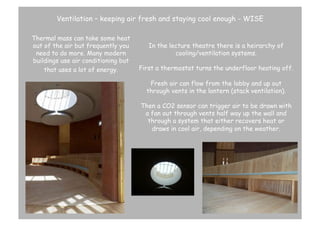
Ventilation – keeping air fresh and staying cool enough - WISE
Thermal mass can take some heat
out of the air but frequently you
need to do more. Many modern
buildings use air conditioning but
that uses a lot of energy.

In the lecture theatre there is a heirarchy of
cooling/ventilation systems.
First a thermostat turns the underfloor heating off.
Fresh air can flow from the lobby and up out
through vents in the lantern (stack ventilation).
Then a CO2 sensor can trigger air to be drawn with
a fan out through vents half way up the wall and
through a system that either recovers heat or
draws in cool air, depending on the weather.
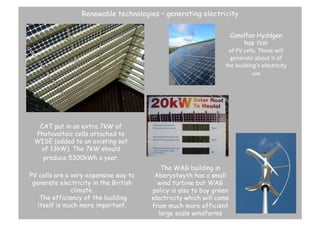
Renewable technologies – generating electricity
Canolfan Hyddgen
has 7kW	
  
of	
  PV	
  cells.	
  These	
  will	
  
generate	
  about	
  ¼	
  of	
  
the	
  building’s	
  electricity	
  
use	


CAT put in an extra 7kW of
Photovoltaic cells attached to
WISE (added to an existing set
of 13kW). The 7kW should
produce 5300kWh a year. 	
  	
  
PV cells are a very expensive way to
generate electricity in the British
climate.
The efficiency of the building
itself is much more important. 	
  

The WAG building in
Aberystwyth has a small
wind turbine but WAG
policy is also to buy green
electricity which will come
from much more efficient
large scale windfarms 	
  
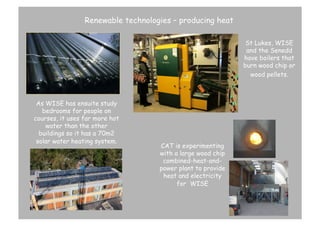
Renewable technologies – producing heat
St Lukes, WISE
and the Senedd
have boilers that
burn wood chip or
wood pellets.	


As WISE has ensuite study
bedrooms for people on
courses, it uses far more hot
water than the other
buildings so it has a 70m2
solar water heating system. 	
  

CAT is experimenting
with a large wood chip
combined-heat-andpower plant to provide
heat and electricity
for WISE
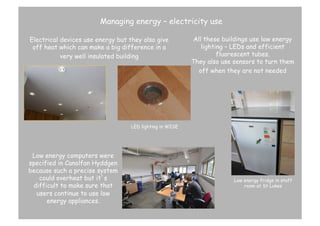
Managing energy – electricity use
Electrical devices use energy but they also give
off heat which can make a big difference in a
very well insulated building

All these buildings use low energy
lighting – LEDs and efficient
fluorescent tubes.
They also use sensors to turn them
off when they are not needed

LED lighting in WISE

Low energy computers were
specified in Canolfan Hyddgen
because such a precise system
could overheat but it’s
difficult to make sure that
users continue to use low
energy appliances.

Low energy fridge in staff
room at St Lukes
 

Thank	
  You!	


For	
  more	
  informaBon	
  and	
  the	
  next	
  steps,	
  write	
  to:	
  
luigi.spiga@solitaly.org	


Frg 1 - eco 2 buildings

  • 1.
              FUTURE      [RE]GENERATION                                               ECO  2     BUILDINGS    
  • 2.
  • 3.
  • 4.
    If you thinkto belong to the “Why Not” or to the “Yes, But” ? Yes, but … Why not !
  • 6.
    Whole Systems Thinking:Household scale Unsustainable Open-Linear Sustainable Closed-Cyclical
  • 7.
    Modular  Transportable  Timber-­‐Frame  Self-­‐Built  Eco-­‐2-­‐Housing    
  • 9.
    Not  too  thecnologic,  complex,  cool,  expensive  …  
  • 10.
    Not  too  natural,  alternaBve,  unreplicable    …  
  • 11.
    But,  something  in  the  middle,  simple,  natural,  efficient,  nice  …  
  • 17.
  • 18.
  • 21.
  • 22.
  • 36.
    SensiBve  site  design   Influence of sun, wind, rain, microclimate Site hydrology, topography, geology Site flora and fauna Criiters
  • 41.
  • 42.
    Hea7ng   Biomass  -­‐  Pellets   Hot  Water   Thermo  Solar   Hot  air   Heat  Pump   Steam   ComposBng   HeaBng   Passive  House  
  • 43.
    Electric  Power   Wind     Mill   Hot  air   Turbine   Human     power   Steam     Turbine   Idro-­‐   electric  
  • 47.
    Ventilation – keepingair fresh and staying cool enough – the Passivhaus approach in Canolfan Hyddgen Passivhaus buildings have very high and specific standards for airtightness and high levels of insulation. A significant amount of the heat energy needed will come from people in the building and the lights and equipment, so the architects need to know exactly how the building will be used. If the temperature changes the automatic controls will decrease or increase heating, increase ventilation etc.
  • 48.
    In use –understanding and managing the buildings St Lukes has displays in every room describing how the systems in the school work and the pupils will be able to access real time monitoring data of energy and water use on the School’s computers St Lukes also has a cut-away display in the lobby showing the warmcell insulation The manager at Canolfan Hyddgen makes sure that users know how the system works and how to manage it WISE – the staff at CAT are very aware of energy management issues. St Lukes Display
  • 50.
    Daylighting - lightfrom the sun without glare – Y Senedd The  public  open  area  has  very  large   areas  of  window  giving  views  over   the  Bay  and  reinforcing  the  idea  of   an  open  democracy   The  lantern  allows  natural  daylight  into  the   Siambr  (Chamber  where  the  Assembly  members   sit).      A  conical  mirror  within  the  lantern  reflects   addiBonal  daylight  into  the  Siambr  and  this  can  be   lowered  to  control  daylight  levels  
  • 51.
    Ventilation – keepingair fresh and staying cool enough - Y Senedd . The roof cowl is designed to rotate with changes in wind direction.  This produces a negative pressure on the leeward side of the cowl that allows warm air to be drawn out of the Siambr    
  • 52.
    WISE - Makingthe best use of a site Large solar system – heating water for the bedrooms below Daylighting from rooflights Passive solar space heating of bedrooms bedrooms workshops Passive solar space heating courtyard foyer Section of the WISE building lecture theatre South
  • 53.
    Solar gain –Walls that stop heat from escaping and walls that store heat Solar energy coming through the south facing windows of Canolfan Hyddgen provides 1/3 of the heating. The solar energy falls on the solid floor and internal walls and their thermal mass stores the heat overnight Canolfan Hyddgen Triple glazed windows Warmcel insulation - made from recycled newspapers solid internal walls and floor = thermal mass highly insulated external walls using Warmcel
  • 54.
    Solar gain -and then storing the sun’s energy as heat - WISE Double glazed low E windows Rammed earth wall On the south side of WISE a glazed area encloses the wall of the lecture theatre. The solar energy falls on the solid, dense earth wall which stores the heat overnight because of its thermal mass. The external walls in WISE are a 50cm thick mix of hemp and lime insulation. Other internal walls on the ground floor in WISE are also dense - made of unfired earth blocks
  • 55.
    Ventilation – keepingair fresh and staying cool enough Thermal mass can take some heat out of the air but sometimes you need to do more. Many modern buildings use air conditioning but that uses a lot of energy. In St Lukes the classrooms are cross ventilated by natural wind flow from low level windows or vents that can be opened to the high clerestory windows that are opened automatically. Vents The vents are designed with wooden slats on the outside and a grill so that they can even be left open at night in the summer to cool the building down.
  • 56.
    Ventilation – keepingair fresh and staying cool enough - WISE Thermal mass can take some heat out of the air but frequently you need to do more. Many modern buildings use air conditioning but that uses a lot of energy. In the lecture theatre there is a heirarchy of cooling/ventilation systems. First a thermostat turns the underfloor heating off. Fresh air can flow from the lobby and up out through vents in the lantern (stack ventilation). Then a CO2 sensor can trigger air to be drawn with a fan out through vents half way up the wall and through a system that either recovers heat or draws in cool air, depending on the weather.
  • 57.
    Renewable technologies –generating electricity Canolfan Hyddgen has 7kW   of  PV  cells.  These  will   generate  about  ¼  of   the  building’s  electricity   use       CAT put in an extra 7kW of Photovoltaic cells attached to WISE (added to an existing set of 13kW). The 7kW should produce 5300kWh a year.     PV cells are a very expensive way to generate electricity in the British climate. The efficiency of the building itself is much more important.   The WAG building in Aberystwyth has a small wind turbine but WAG policy is also to buy green electricity which will come from much more efficient large scale windfarms  
  • 58.
    Renewable technologies –producing heat St Lukes, WISE and the Senedd have boilers that burn wood chip or wood pellets.     As WISE has ensuite study bedrooms for people on courses, it uses far more hot water than the other buildings so it has a 70m2 solar water heating system.   CAT is experimenting with a large wood chip combined-heat-andpower plant to provide heat and electricity for WISE
  • 59.
    Managing energy –electricity use Electrical devices use energy but they also give off heat which can make a big difference in a very well insulated building All these buildings use low energy lighting – LEDs and efficient fluorescent tubes. They also use sensors to turn them off when they are not needed LED lighting in WISE Low energy computers were specified in Canolfan Hyddgen because such a precise system could overheat but it’s difficult to make sure that users continue to use low energy appliances. Low energy fridge in staff room at St Lukes
  • 60.
      Thank  You!       For  more  informaBon  and  the  next  steps,  write  to:   luigi.spiga@solitaly.org