Sustainable School Design:
participation and post-occupancy
evaluation
...including my past work experience, skills and aspirations for research and why
am suited to teach here...

School of Architecture
IOWA State University

Andrea Wheeler
BA(Hons) Dip Arch (Oxford)
MPhil (Mech. Eng.) PhD (Architecture)

11 March 2013
Outline
About Me
Teaching
Research
Administration and Teaching Innovation
About Me
The journey so far…
PRIZE WINNING
STUDENT
BA (Hons) Architecture, Second year prize for outstanding achievement
National Diploma in Art and Design. Fine Art/ Studio Practice
(Distinction)
Graduate Diploma in Architecture – Prizes for Graphics and Dissertation
MPhil Mechanical Engineering (Timber Repair) TRADA Technology
Scholarship
PhD Architecture (Arts and Humanities Research Council Scholarship)
Ethics in the built environment.

 Wheeler, Andrea (2008) "About
 being-two in an architectural
 perspective". In Conversations,
 Luce Irigaray (ed.) Continuum. pp.
 53 – 72

 Wheeler, Andrea (2008)
 "Architectural Issues in Building
 Community through Luce
 Irigaray's Perspective on being-
 two". In, Teaching Luce Irigaray
 (ed.) Continuum. pp. 61- 68
Post Doctoral Research –
Success in Research Funding
1.Post doctoral UK Energy Research Council/ESRC , 3 year
Interdisciplinary Early Careers Fellowship , The University of
Nottingham (£220,000 over 3 years)
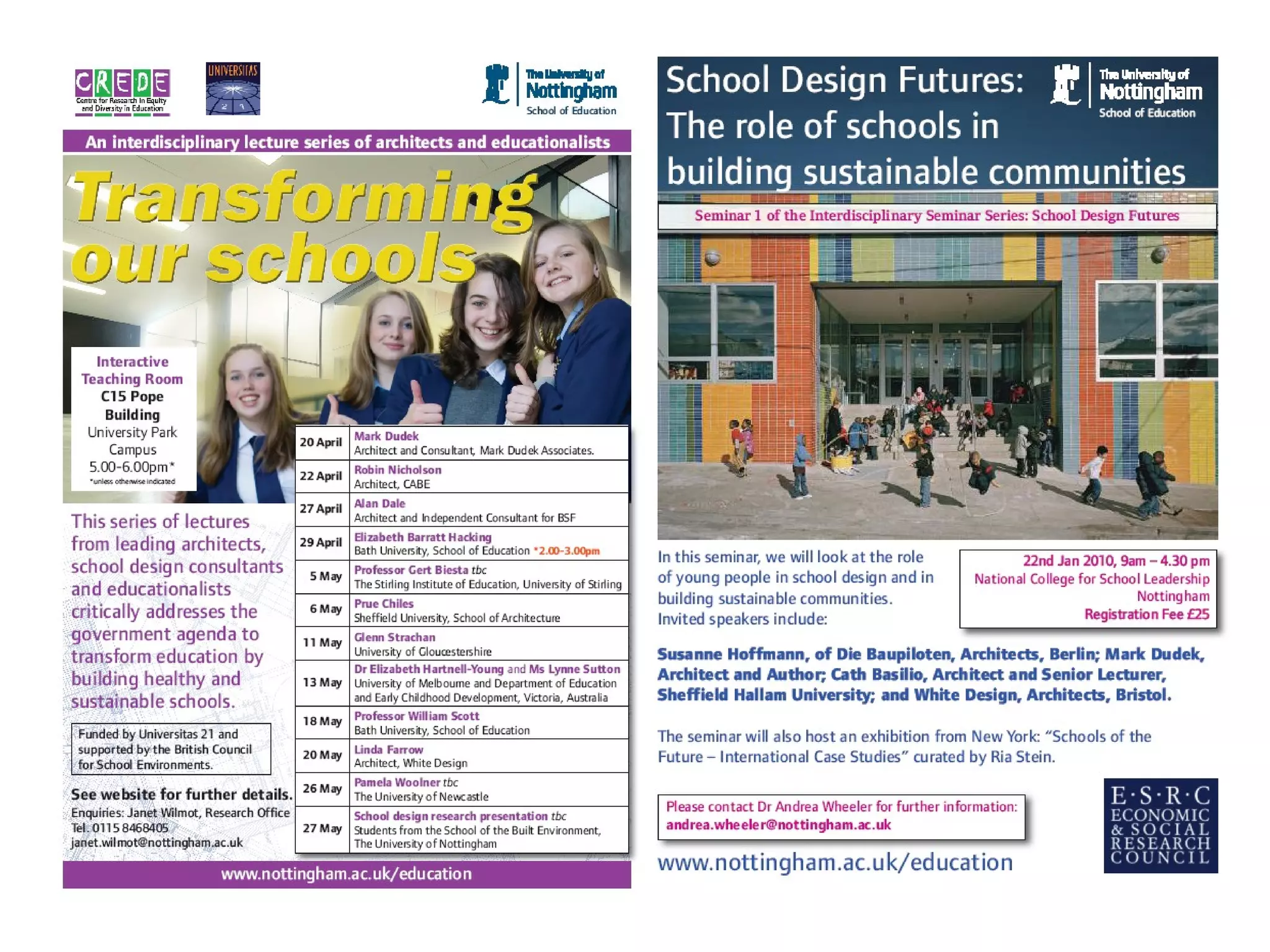
2.Universitas 21 (consortium of international Universities) lecture series
3.UK Energy Research Council “The Meeting Place” Oxford,
dissemination body for the UK Energy Research Council.
Research Question

How do you explore a different relation, a non-
exploitative, non-appropriative relation to the world and to
others? How does this translate into a design for a school
– what does it look like?
Commercial Experience
Architects, Engineers, Planning Consultants and Policy


Defra (Department of Environment
Food and Rural Affairs) ,
London (Policy)
Walker Troup, Architects
Shere Consulting Ltd., (Planning)
Redmak Architects, Nottingham
Derek Latham Architects, Derby
Regeneration East Midlands (Planning)
March and Grochowski, Nottingham (Architects)
Design Group Cambridge (Architects)
Holder and Mathias Alcock, Architects, Cardiff
So, why IOWA State
University?
Strong architectural design
Strong student community
Interdisciplinary design
History of community engagement
What I am bringing to
IOWA School of
Architecture…
•   Experience in teaching at Masters level.
•   Teaching innovation – social media
•   Publications
•   Success in research funding
•   Interest in interdisciplinary research
•   Skilled administrator/ education researcher
    (technologies) at the Centre for Engineering and
    Design Education (research, teaching development,
    software development)
TEACHING
18
                              18
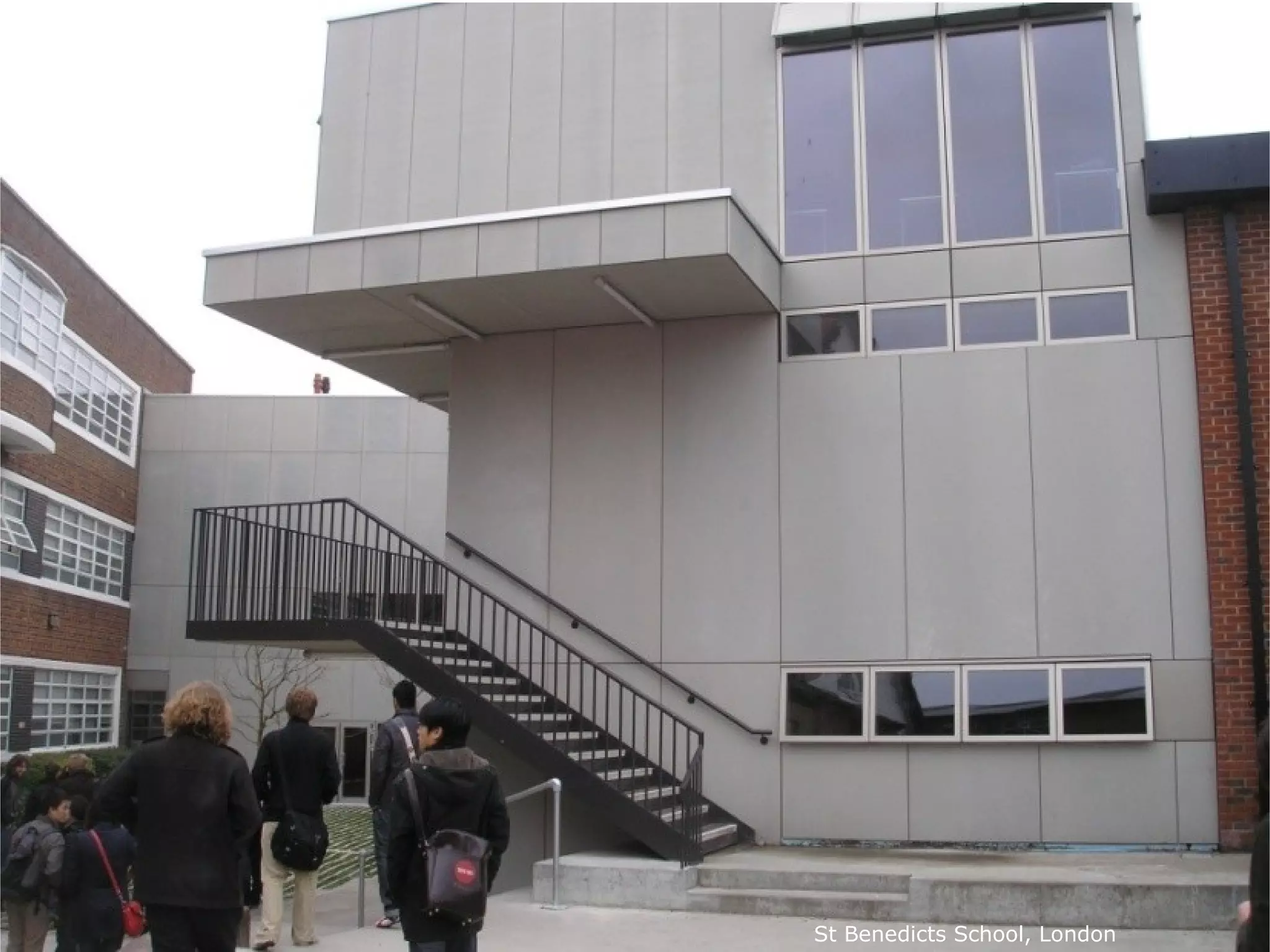
St Benedicts School, London
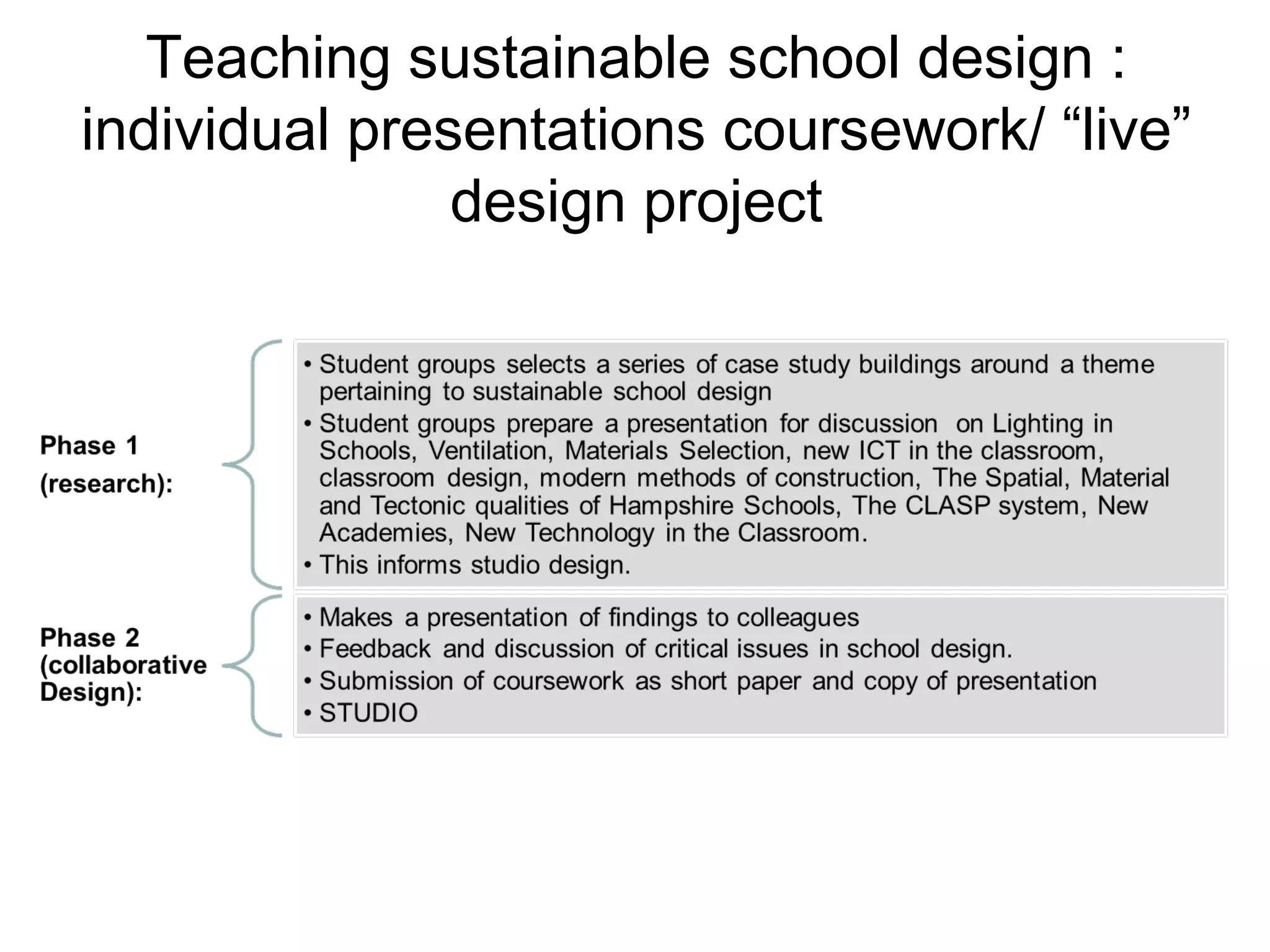
Teaching sustainable school design :
individual presentations coursework/ “live”
               design project
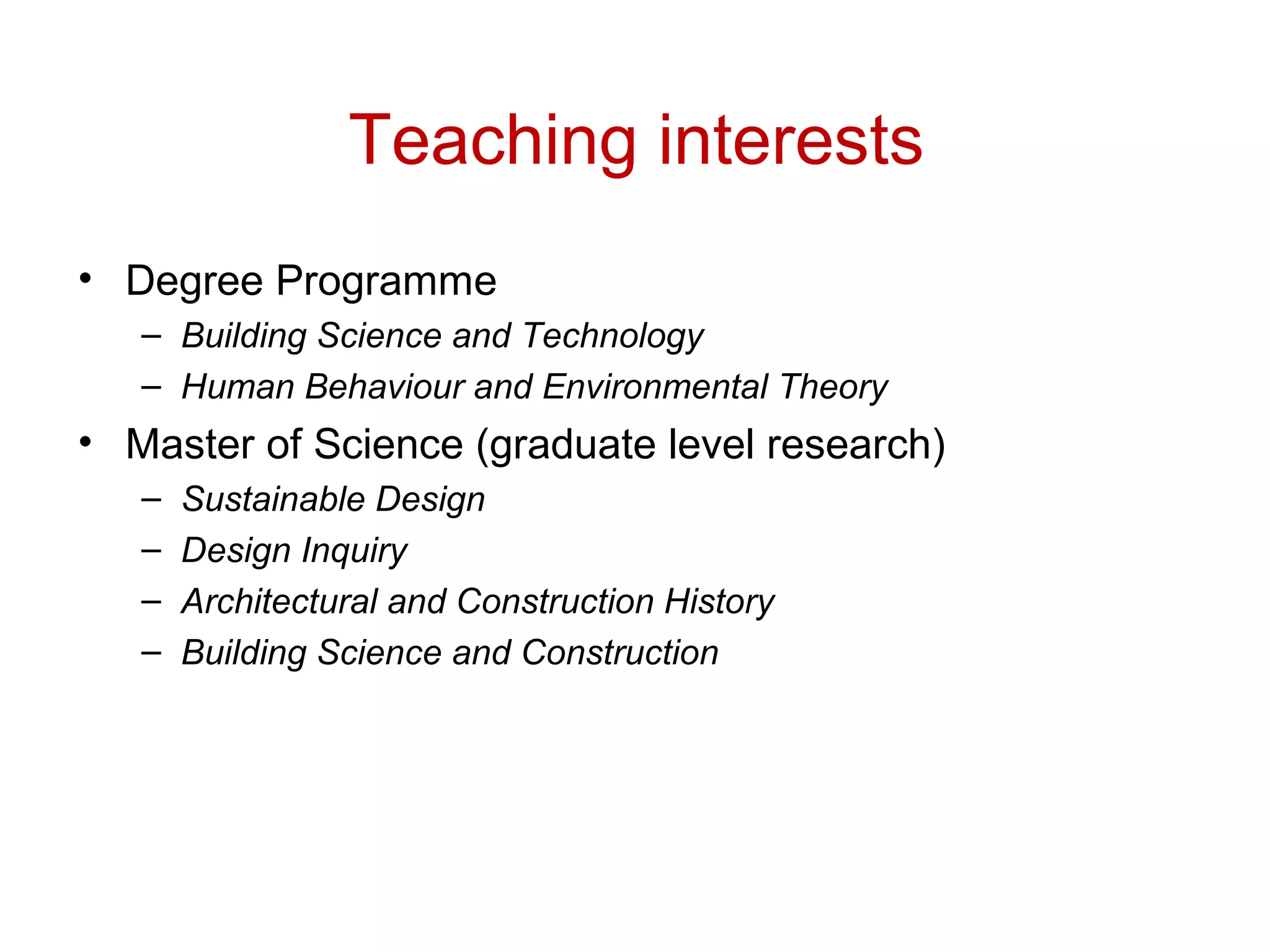
Teaching interests
• Degree Programme
   – Building Science and Technology
   – Human Behaviour and Environmental Theory
• Master of Science (graduate level research)
   –   Sustainable Design
   –   Design Inquiry
   –   Architectural and Construction History
   –   Building Science and Construction
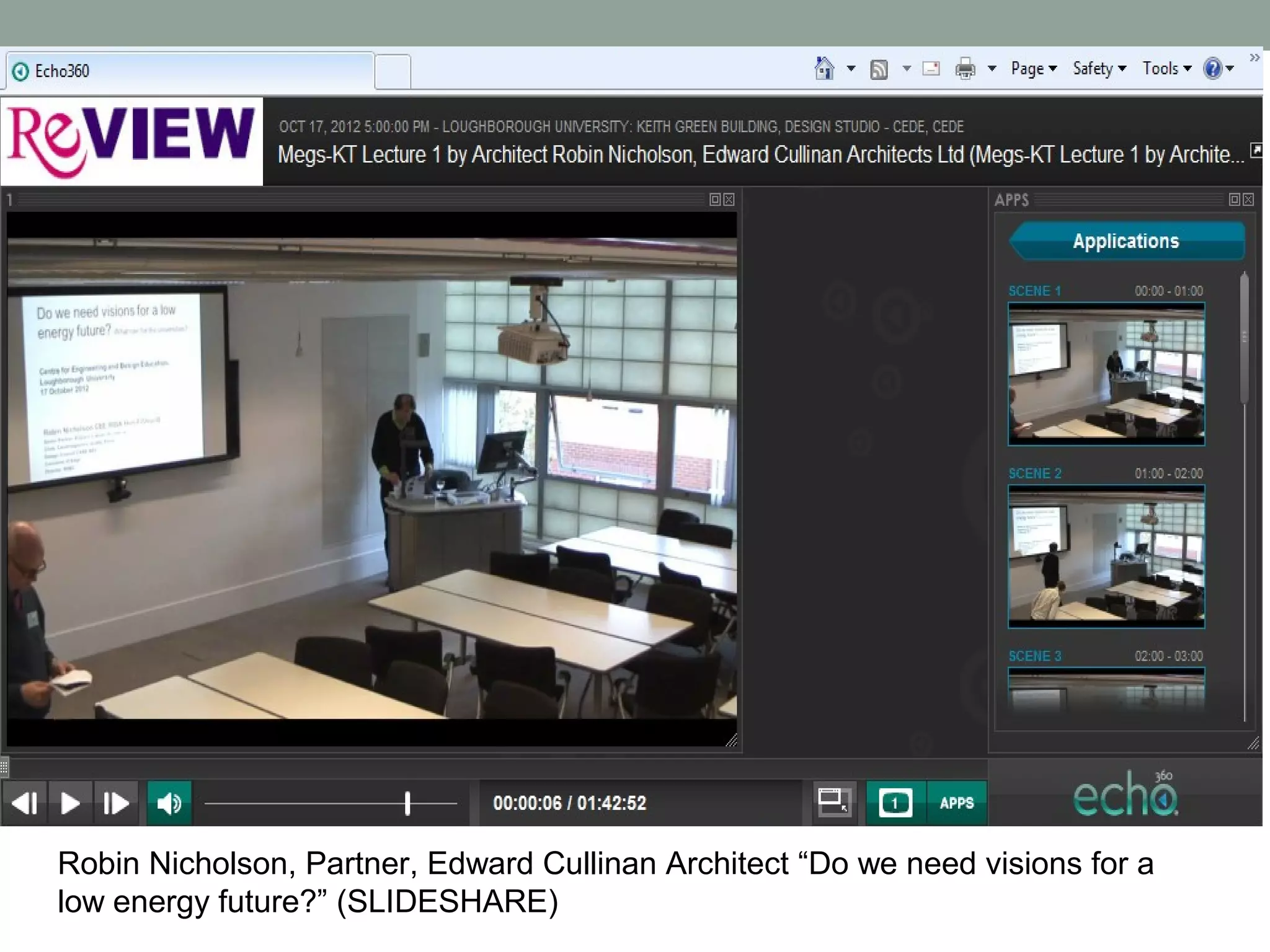
Robin Nicholson, Partner, Edward Cullinan Architect “Do we need visions for a
low energy future?” (SLIDESHARE)
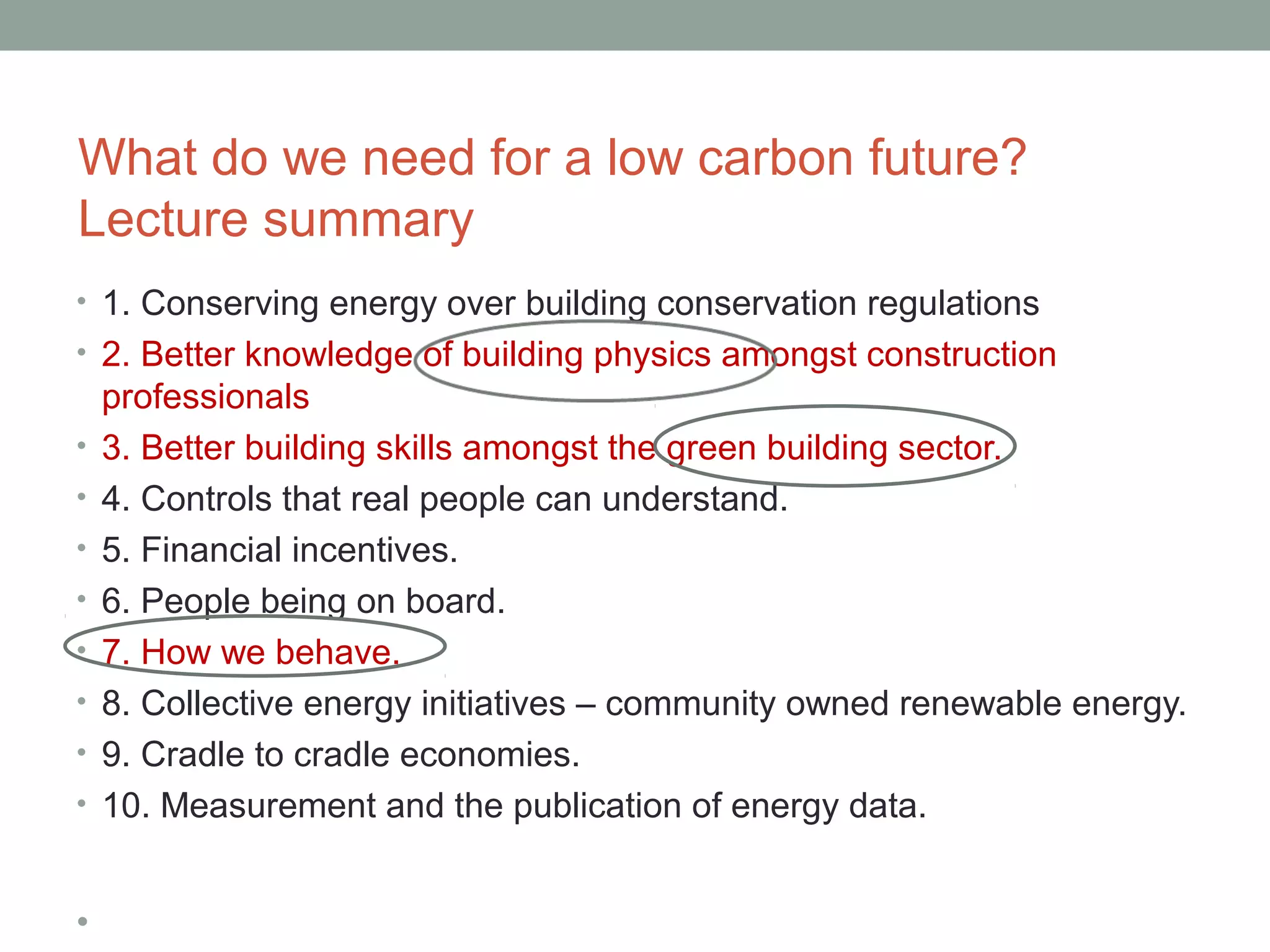
What do we need for a low carbon future?
Lecture summary
• 1. Conserving energy over building conservation regulations
• 2. Better knowledge of building physics amongst construction
    professionals
•   3. Better building skills amongst the green building sector.
•   4. Controls that real people can understand.
•   5. Financial incentives.
•   6. People being on board.
•   7. How we behave.
•   8. Collective energy initiatives – community owned renewable energy.
•   9. Cradle to cradle economies.
•   10. Measurement and the publication of energy data.


•
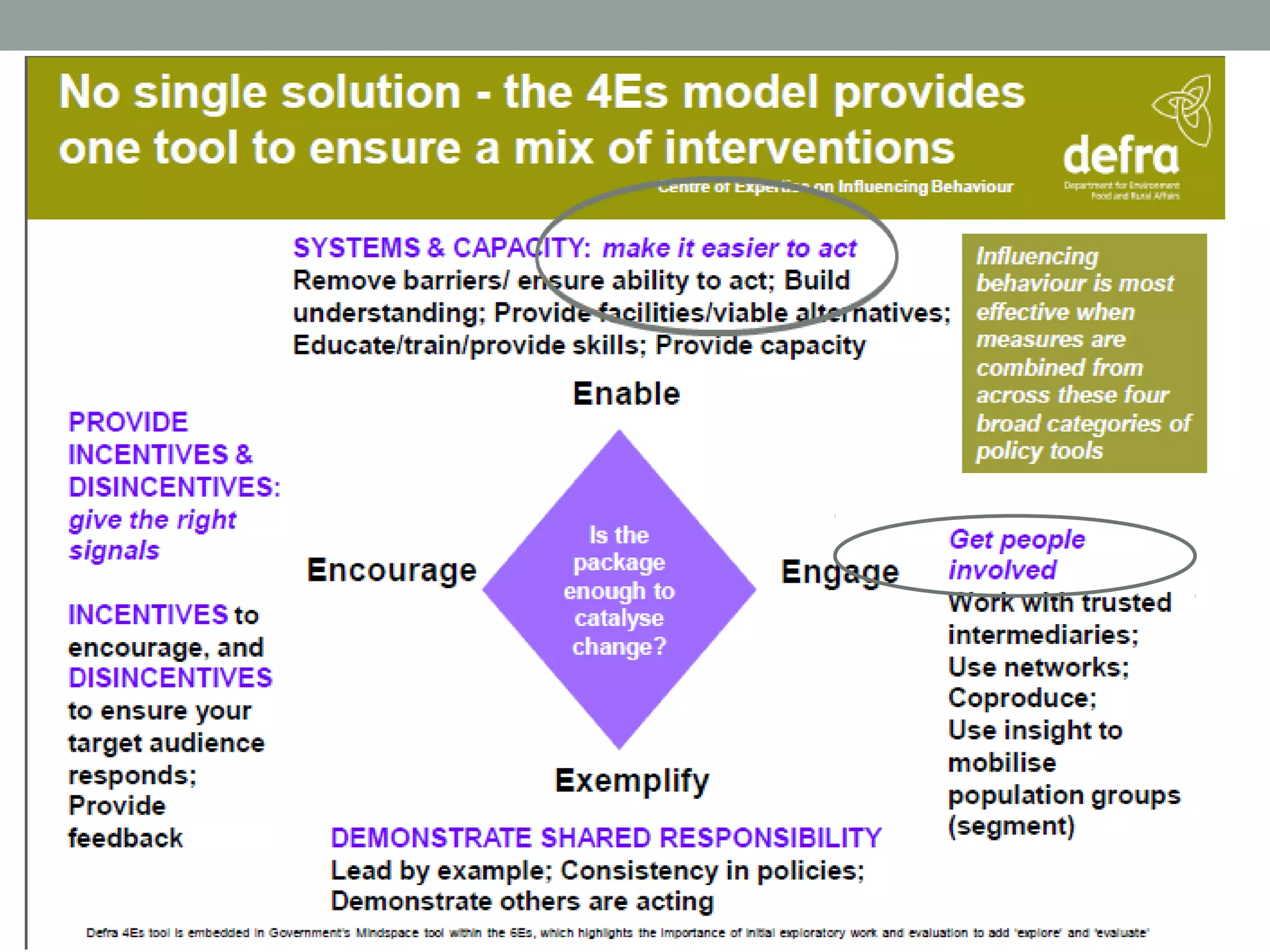
Centre of Expertise on Influencing Behaviours, (Centre for
Sustainable Behaviours) Defra March 2010 – August 2010
RESEARCH
SUSTAINABLE SCHOOL
DESIGN: PARTICIPATION AND
POST-OCCUPANCY
EVALUATION
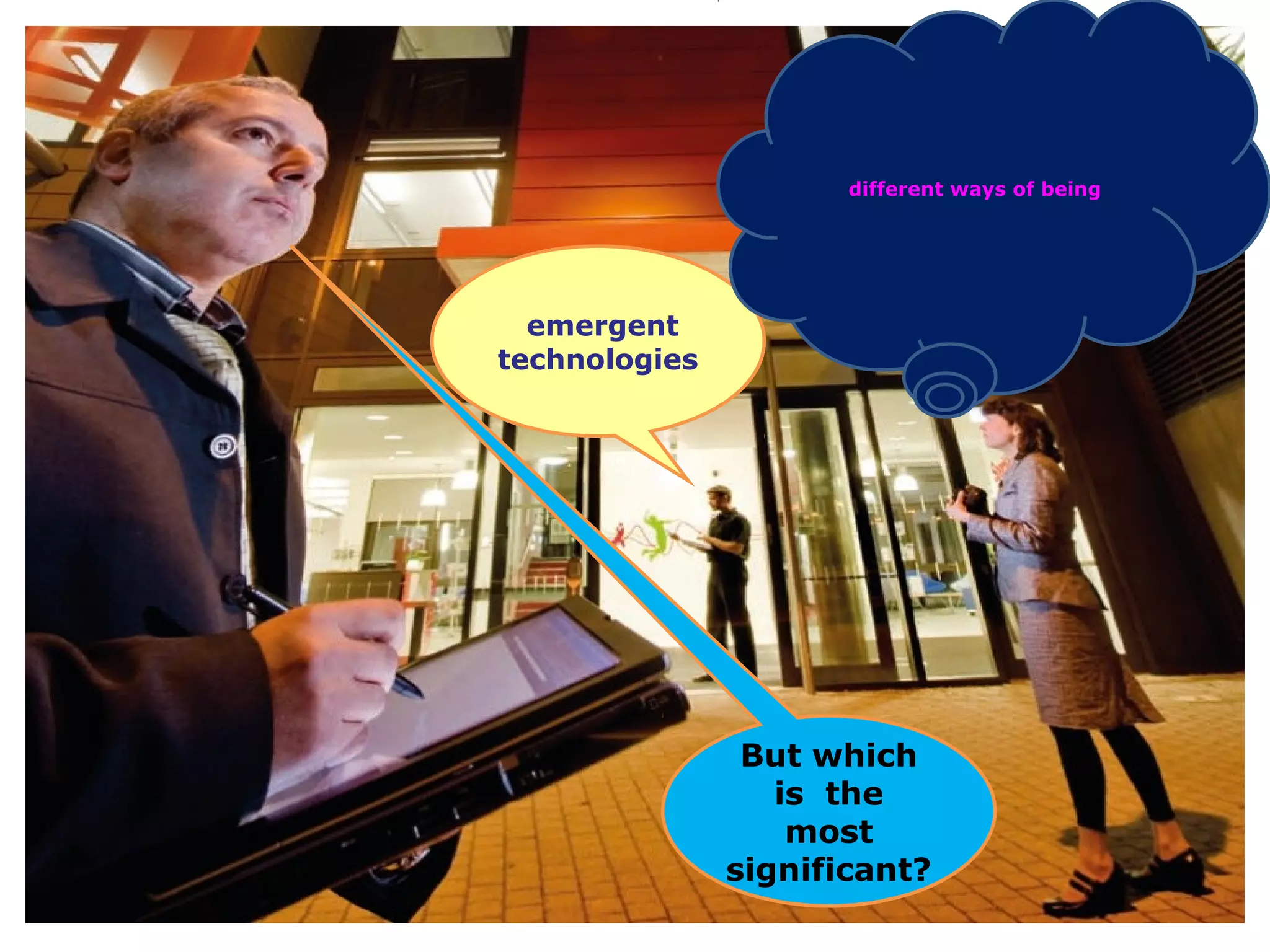
different ways of being


  emergent
technologies


                But which
                  is the
                   most
               significant?
                                                29
Innovative technology is not enough:
Engagement, behaviour and “rebound” effects

Technology will not be sufficient to transform housing to reduce its impact on the
environment as it will not challenge the way in which this impact is created (Seyfang 2012,
Reid and Houston 2013).

Research has demonstrated that occupants of low carbon homes have found methods to
bypass low carbon solutions in order to prevent the curtailment of their activities (Gill et al.
2010)
Architecture and the
                                           Avant-Guard
“Environmentalism was born from the avant-garde cultural movement in America and is
now in the hands of environmental technologists. I think it’s a problem that
environmentalists believe the happiness of man depends on the square metres of grass
available to them, and that our habitat should be based solely around energy
consumption.”

“Post environmentalism will come of age when environmentalists re-establish contact with
the avant-garde, with innovation, experimentation and aesthetic concerns. Only then will it
become an important historical movement”

Peruccio, Pier Paolo and Elena Formia (2013) “The designer as revolutionary” [Interview with Andrea Branzi] In Special Report:
Design. The Art Newspaper Section 2 Number 243, February 2013, p. 16).
Participation in School Design:
Building Schools for the Future
programme 2005 - 2010

How to develop schools that are ‘sustainable’ through the relationship of
the building design and the behaviour of the children (Blair, A, 2004).
(Context at that time)

Critical position on the role of children’s participation in the design of
schools was proposed as key element of the Building Schools for the
Future programme.
Publication

Wheeler, Andrea (2010) “An interview with Harry Shier: Contrasting
children’s participation in the UK Building Schools for the Future
programme with the Nicaraguan context” International Journal of
Children’s Rights Vol. 18/3, 457-474 (translated into Spanish for
Nicaraguan readers available at:
http://www.harryshier.110mb.com/docs/Wheeler_Entrevista_a_Harry_S
hier.pdf ).
Workshops with Children
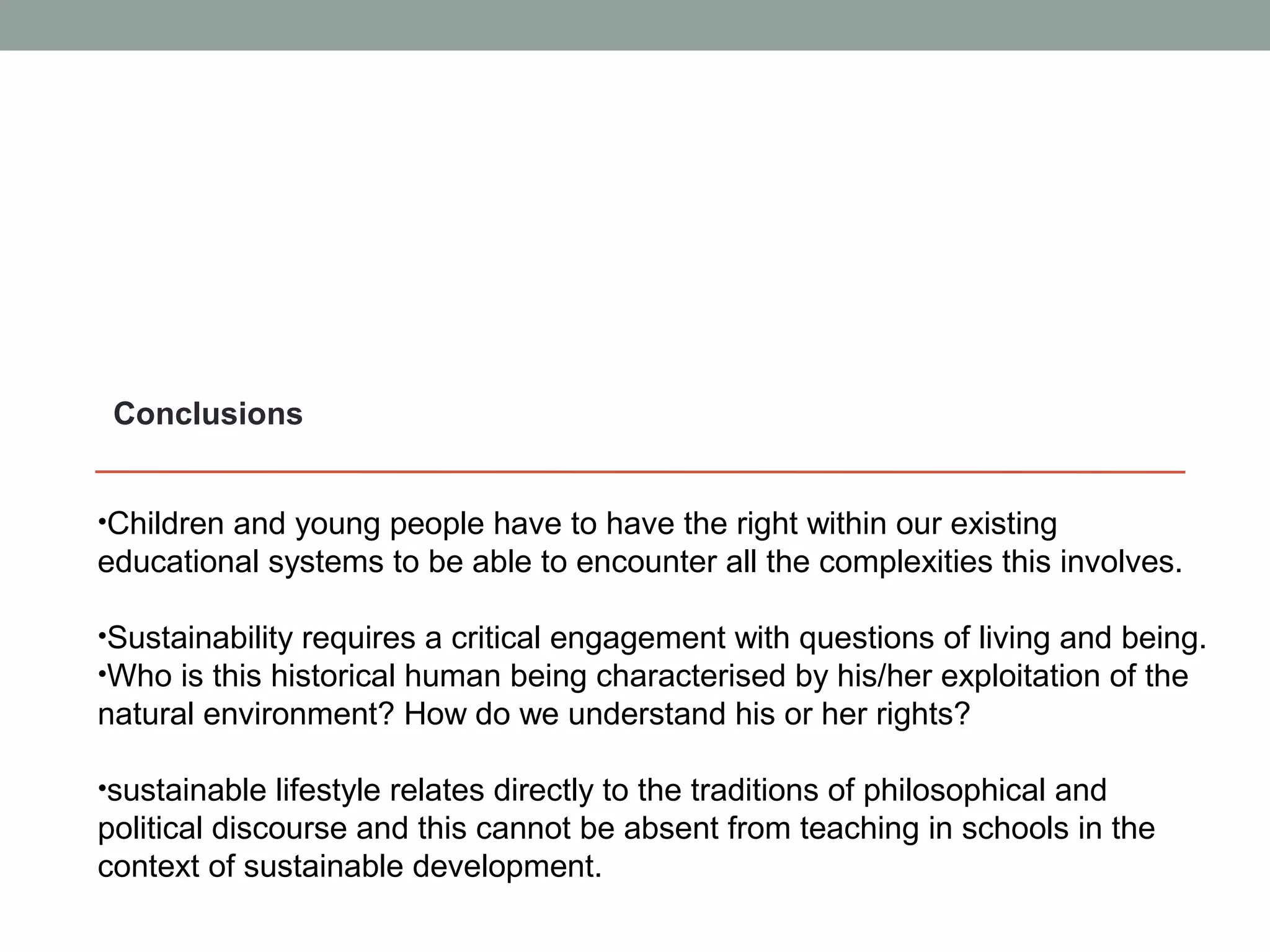
Conclusions


•Children and young people have to have the right within our existing
educational systems to be able to encounter all the complexities this involves.

•Sustainability requires a critical engagement with questions of living and being.
•Who is this historical human being characterised by his/her exploitation of the
natural environment? How do we understand his or her rights?

•sustainable lifestyle relates directly to the traditions of philosophical and
political discourse and this cannot be absent from teaching in schools in the
context of sustainable development.
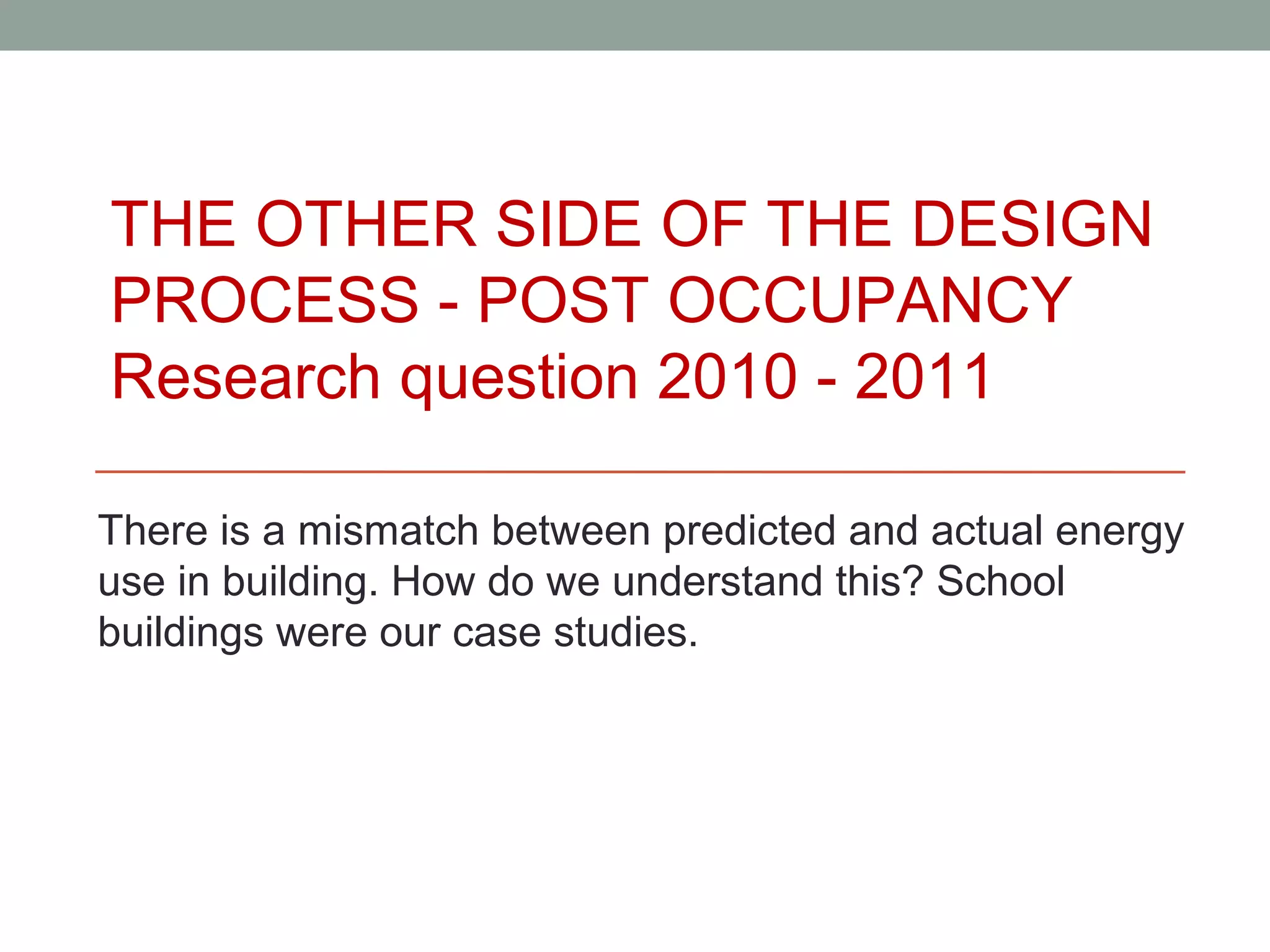
THE OTHER SIDE OF THE DESIGN
PROCESS - POST OCCUPANCY
Research question 2010 - 2011

There is a mismatch between predicted and actual energy
use in building. How do we understand this? School
buildings were our case studies.
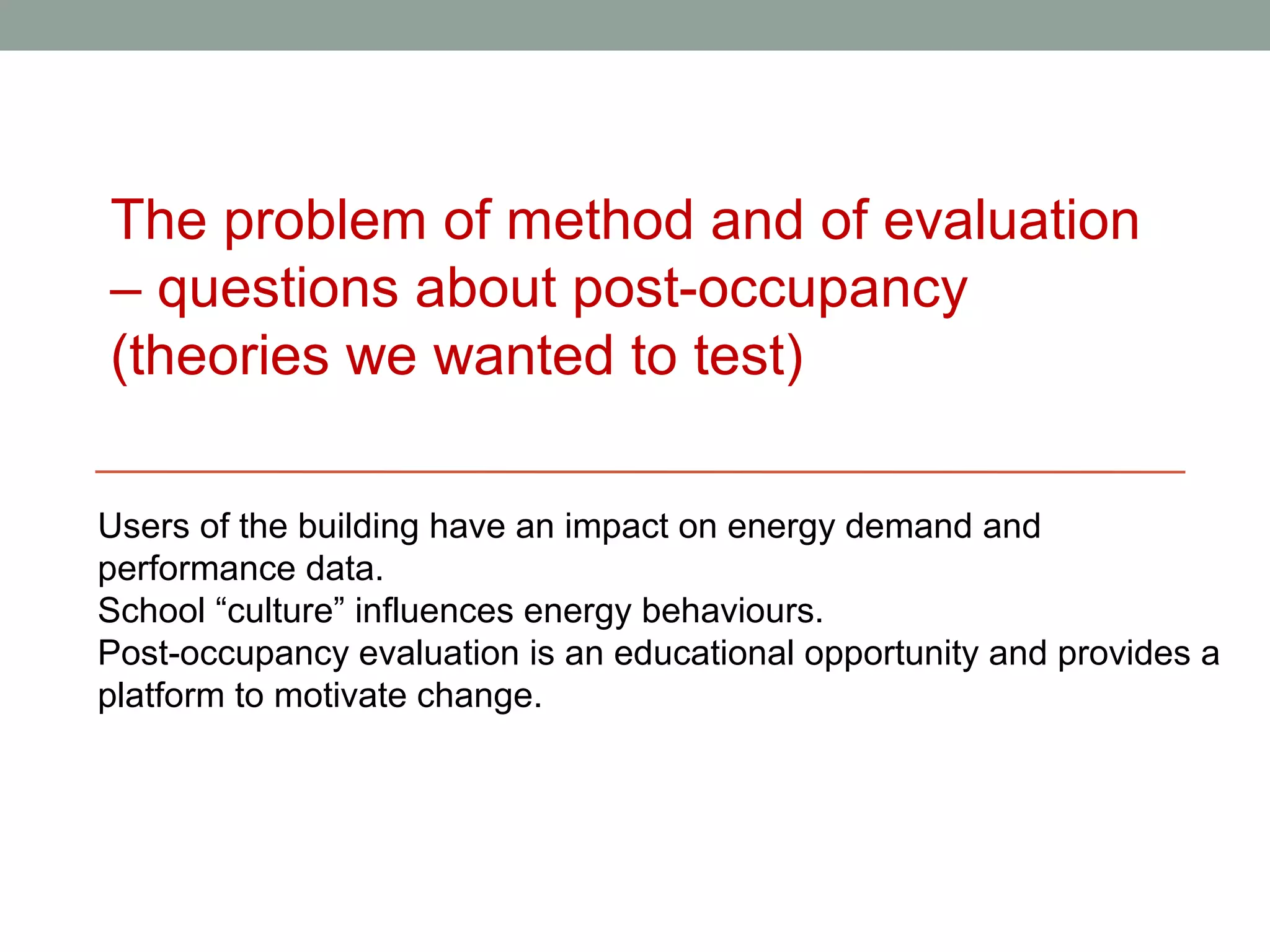
The problem of method and of evaluation
– questions about post-occupancy
(theories we wanted to test)

Users of the building have an impact on energy demand and
performance data.
School “culture” influences energy behaviours.
Post-occupancy evaluation is an educational opportunity and provides a
platform to motivate change.
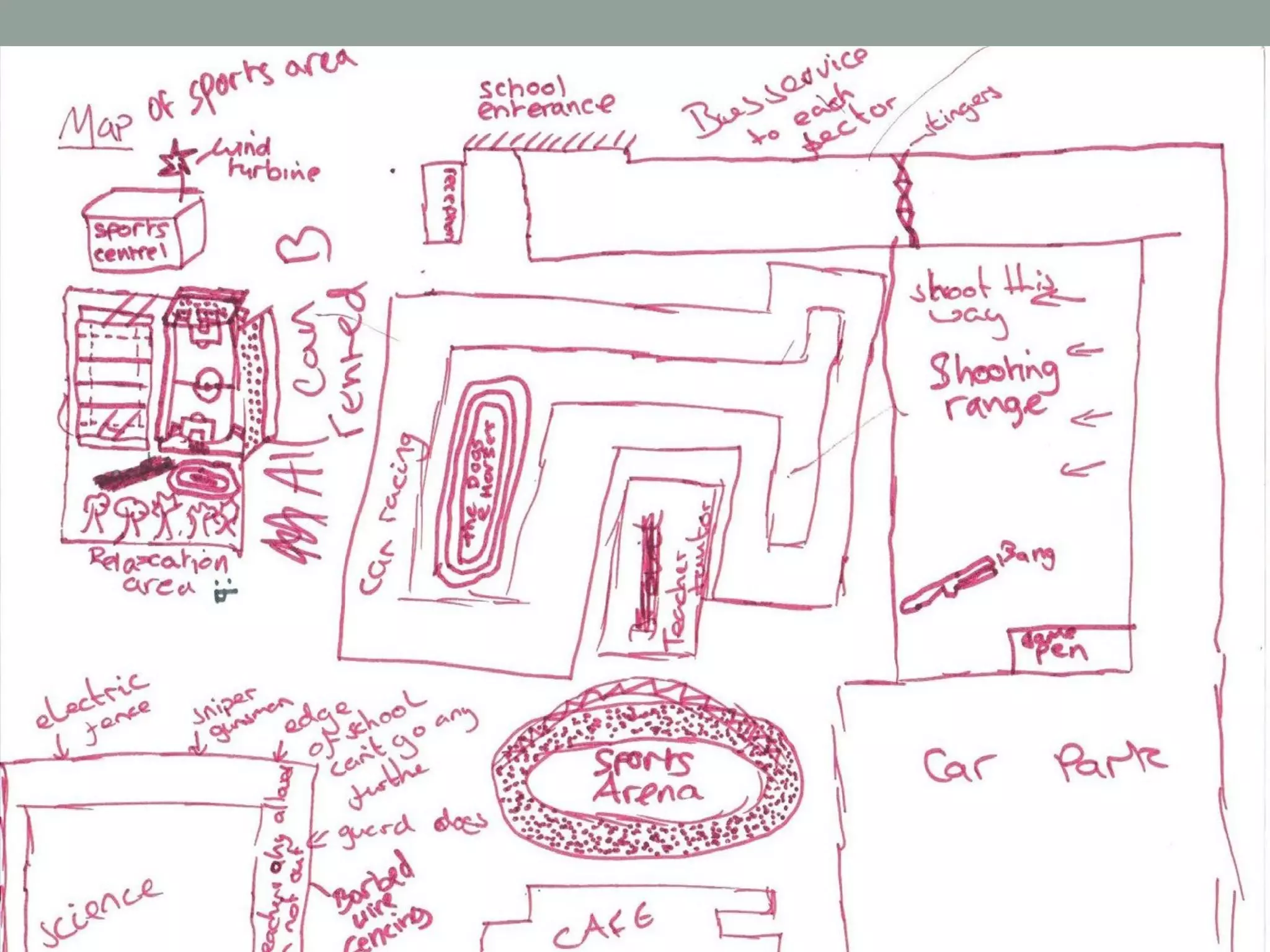
Adapted a method: Including children in
post-occupancy requires appropriate
methods

Open discussion
Walk-throughs with video
Quizzes
Drawings
Big group design maps and conversation
“We like to sit under
the stairs where there
is carpet and a
radiator, but we’re not
allowed. We just like
to sit there because it
is inside. We just like
having a quieter area
you can sit and just be
with your friends [...]
They should have little
benches [outside]
people can sit on and
a shelter in the winter.
I know it is cold but I
do like to go outside to
get some fresh air.
And also the lads
when they play
football would have
somewhere for their
bags” (Year 10 pupil).
School culture and user behaviours

There’s a lot of difficulties working with them [the construction company] ...If there is a
problem with the school, it’s the schools fault. [...] If there’s a problem they will blame the
school... it ends up just being a frustration. [...] And then obviously on the purchasing side,
whenever anything needs to be changed, if we need a new gat e or pathway, whatever it
is, we have to go through them and the costs are so significantly high” (Building Manager)

“On our first day they sat us down and told us what we couldn’t do in the school – from the
start it made us feel it wasn’t ours .
Children and Energy

“I think we should stop lighting the school in the day as the sun lights it up a lot and we’re
wasting electricity” (Final ‘design’ session, Year 8 pupil).

“Are the lights movement sensitive? I don’t think in the corridors they are. They could be
movement sensitive, but even just a switch”

Sometimes they [the classrooms] are really warm and the windows don’t open. None of
the windows open. Only the lower ones. In the summer it’s really hot” (Year 7 pupil.)
Researcher 1: “Are there things you think the architect could have done better?” “Just the
windows.”
“But you can’t open them and you get too hot... But then you have air conditioning. But
you only have it in ICT but when you do it’s nice and cool and then it gets too cold
[different voice]. In normal classrooms you have this thing that brings air in form outside,
but if it’s hot outside it’s just bringing in hot air.”

“I don't even think we are trying. It feels like they don't even think they care. But
they are always banging on about it. They are always telling us to save energy but
why not them”.
RESULTS

1.Contradictions between what adults say and what they tell children to do. A mismatch
between designers intention and teachers ability to manage the behaviours of pupils –
(many examples – dining biggest issue)
2.Poorly functioning building features (windows, heating and ventilation systems,
circulation, dining spaces) and either over provision or under provision of space and
facilities, together with teachers prohibiting use of facilities (toilets locked, .
3.Lack of ownership of PFI buildings
4.Lack of understanding of the ‘sustainable’ design features of the new school building –
solar heating panels
5.Convoluted facilities management procedures where prohibitions did nothing towards
children establishing their own “authentic” relationship to the environment and a deep or
lasting critical perspective on the problems of sustainable development.
MOTIVATING CHANGE

The School plans to enter into discussion with the local authority to
gain responsibility for paying their own bills and putting measures in
place to save 20%.
Schools setting up children “Eco-groups”.
ADMINISTRATION AND
TEACHING DEVELOPMENT

And what else do I bring?
49
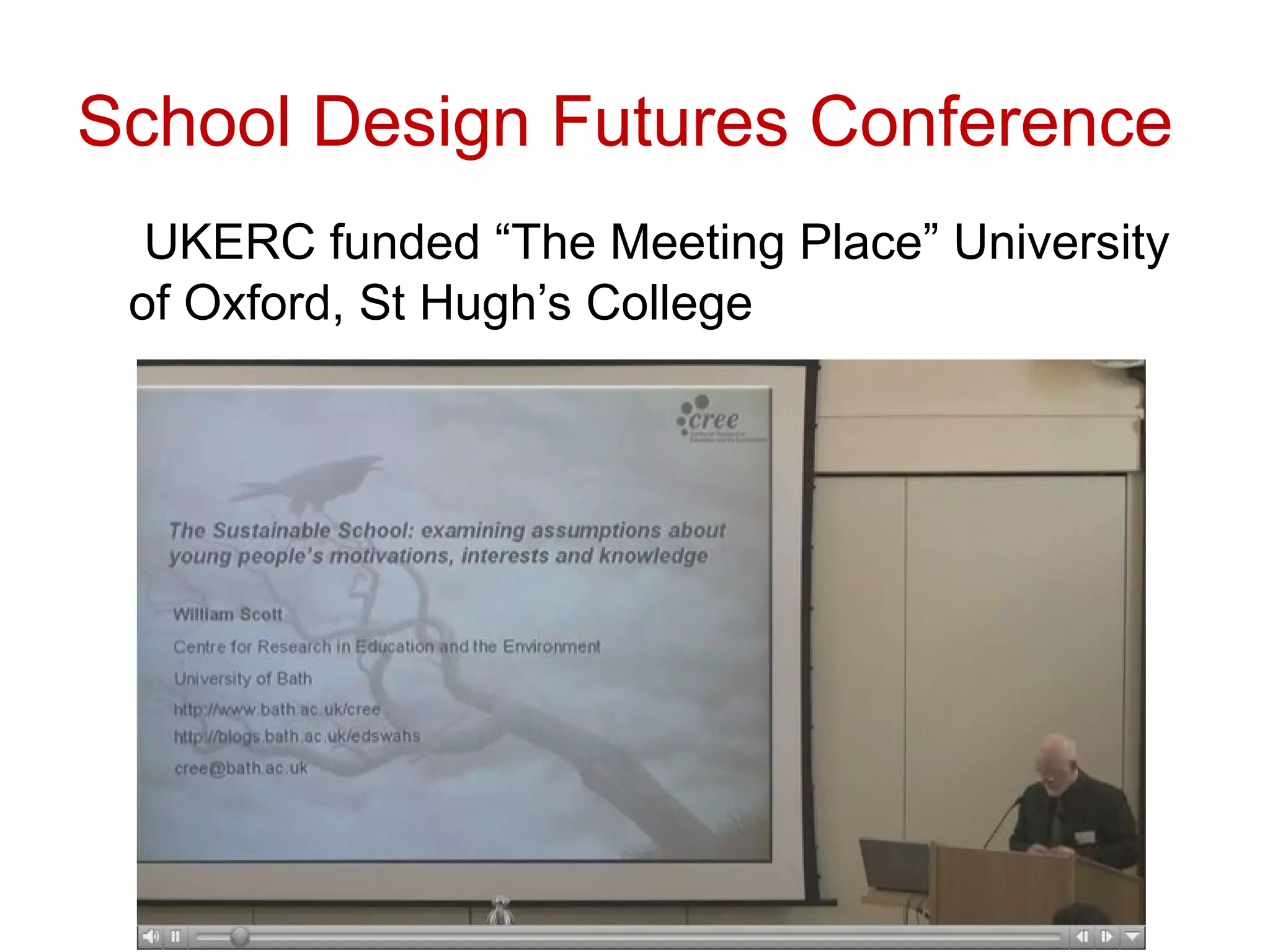
School Design Futures Conference
  UKERC funded “The Meeting Place” University
 of Oxford, St Hugh’s College
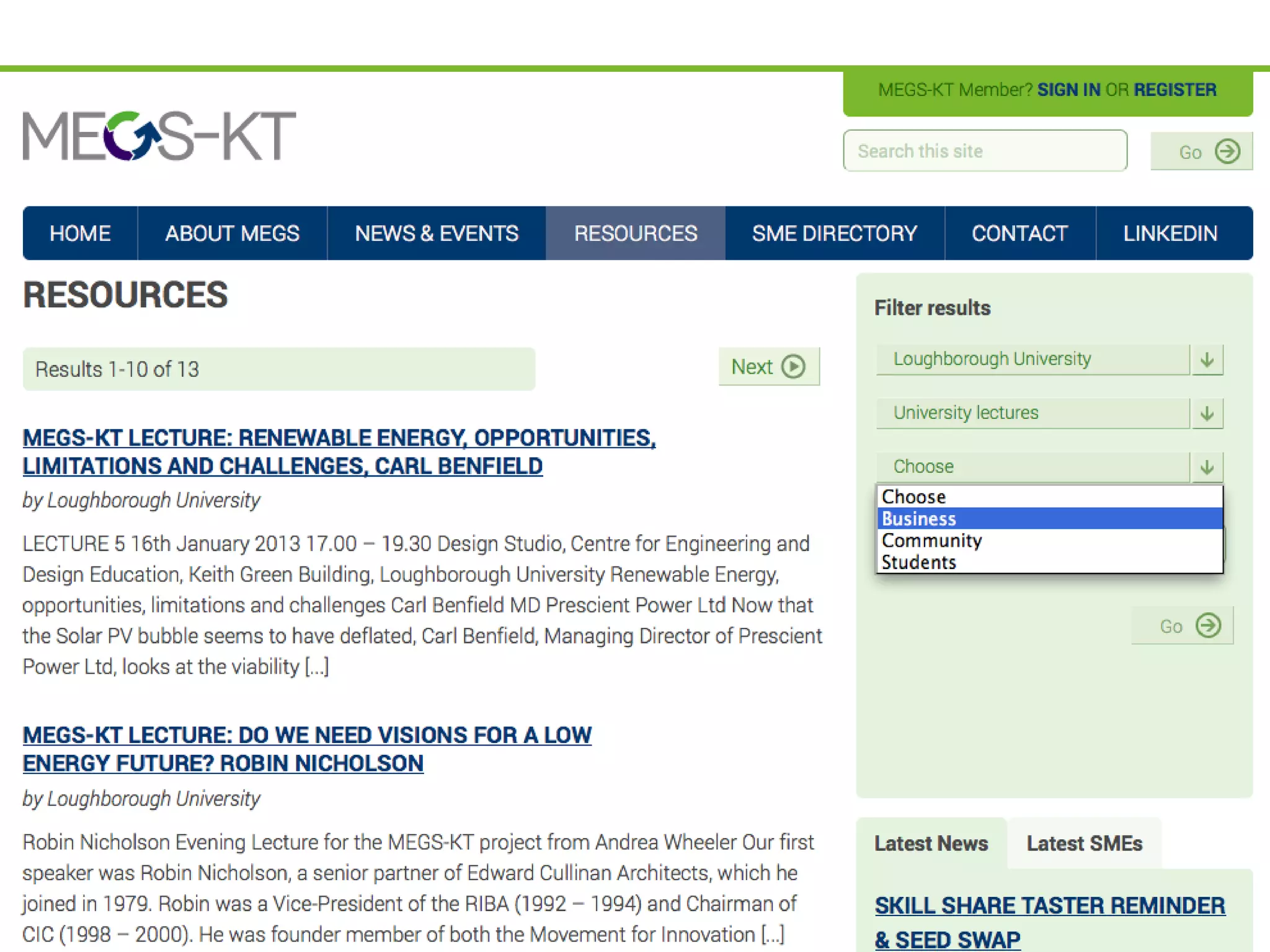
MEGS-KT: Teaching
                         development and Business and
                         Community Engagement
                         (towards low carbon
                         economies):

                         MEGS-KT: How to develop a
                         relevant, up-to-date desirable
                         platform for “CFD” opportunities,
                         opening up University resources
                         and allowing SMEs in the
                         renewable energy sector to share
                         their knowledge.
SASIE, Micro-Business,
Nottingham, UK
Building a Community of Practice,
“catalytic Individuals” and the small business
                  community.
17/10/2012 Robin Nicholson, Edward Cullinan Architects
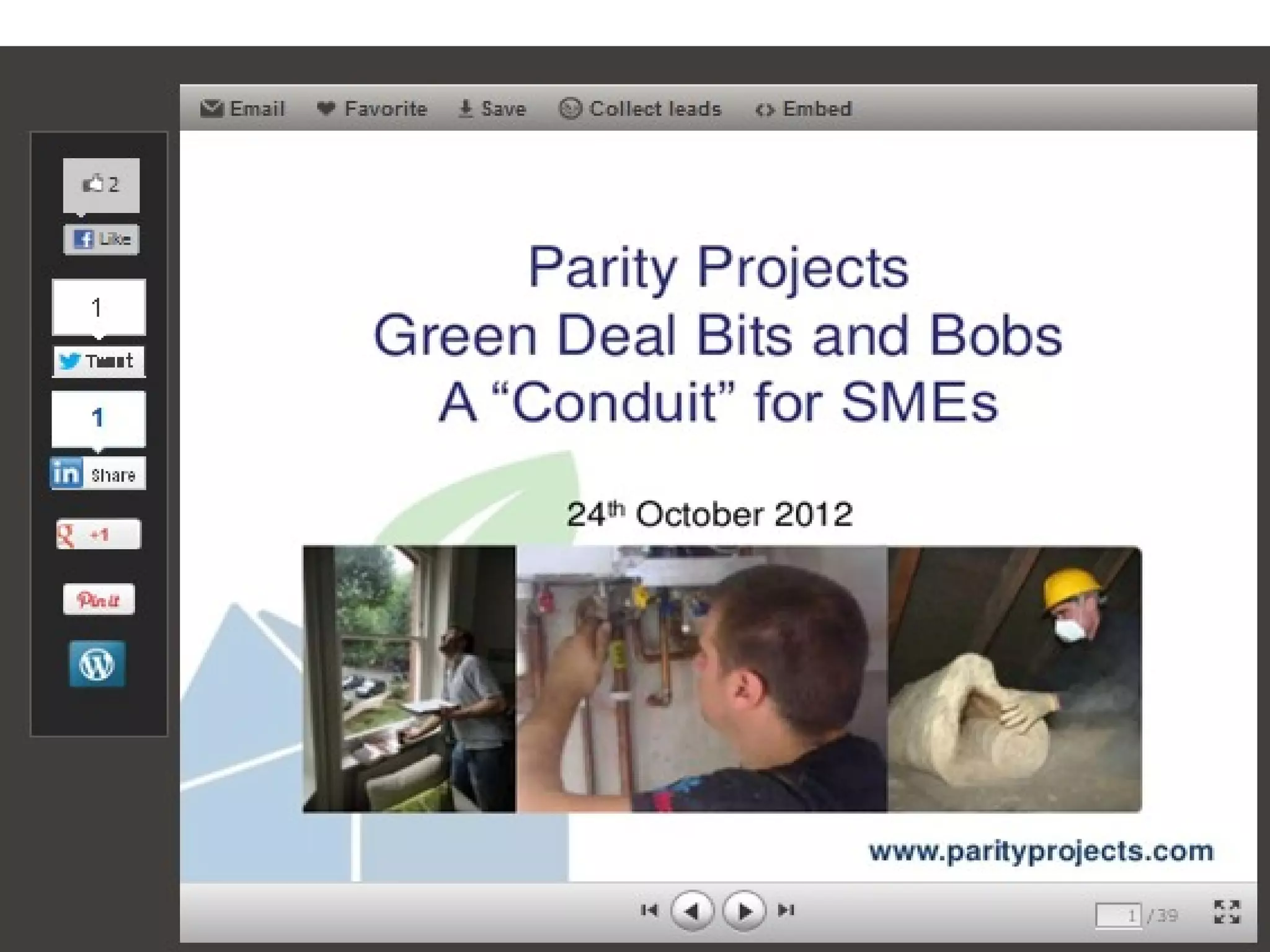
24/10/2012 Russell Smith, Parity Projects
14/11/2012 Terry McGivern, The Institute for Sustainability and the
Flash Programme
05/12/2012 John Davis, Domestic Green Deal Assessor
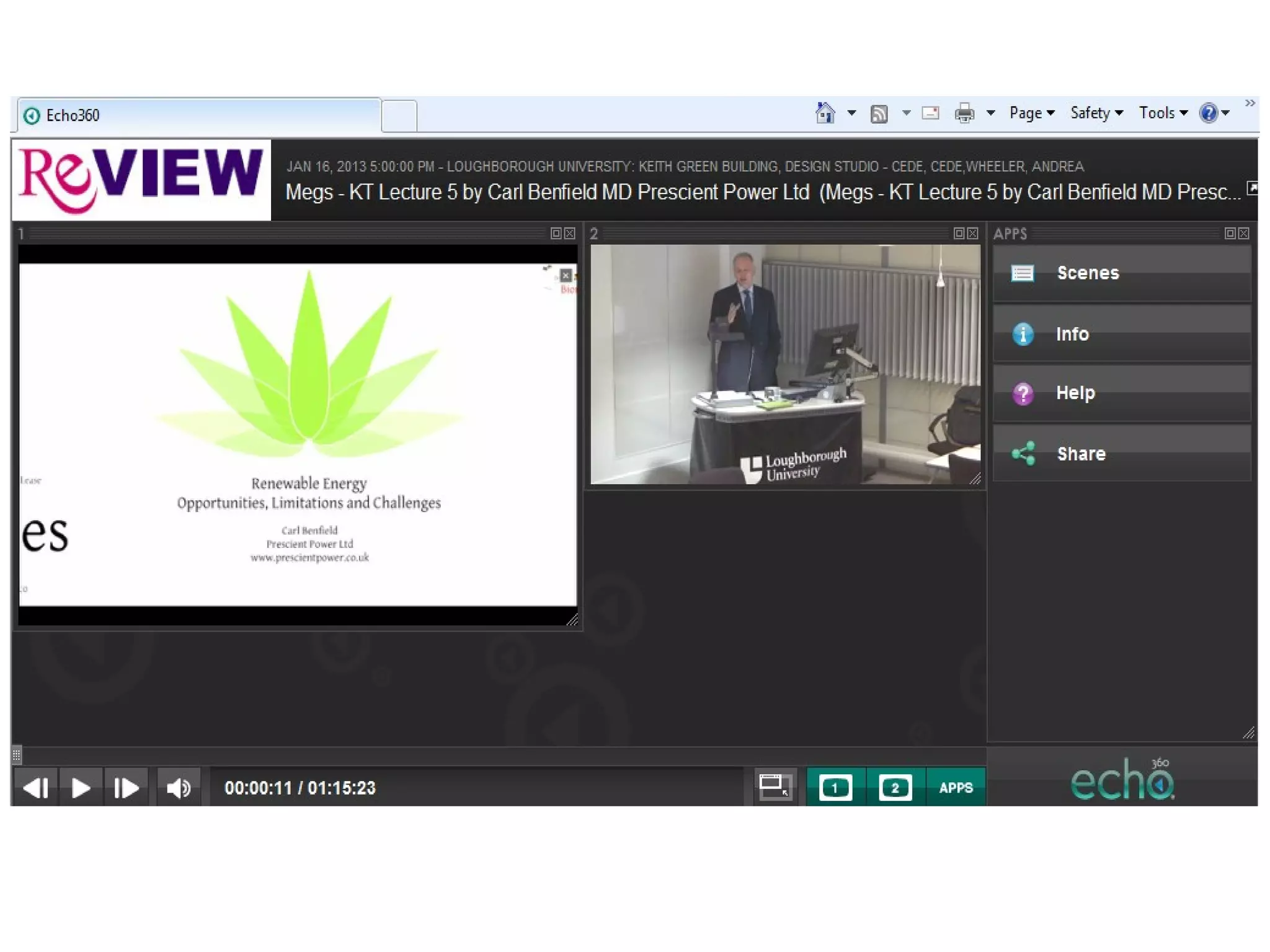
16/01/2012 Carl Benfield, Prescient Power
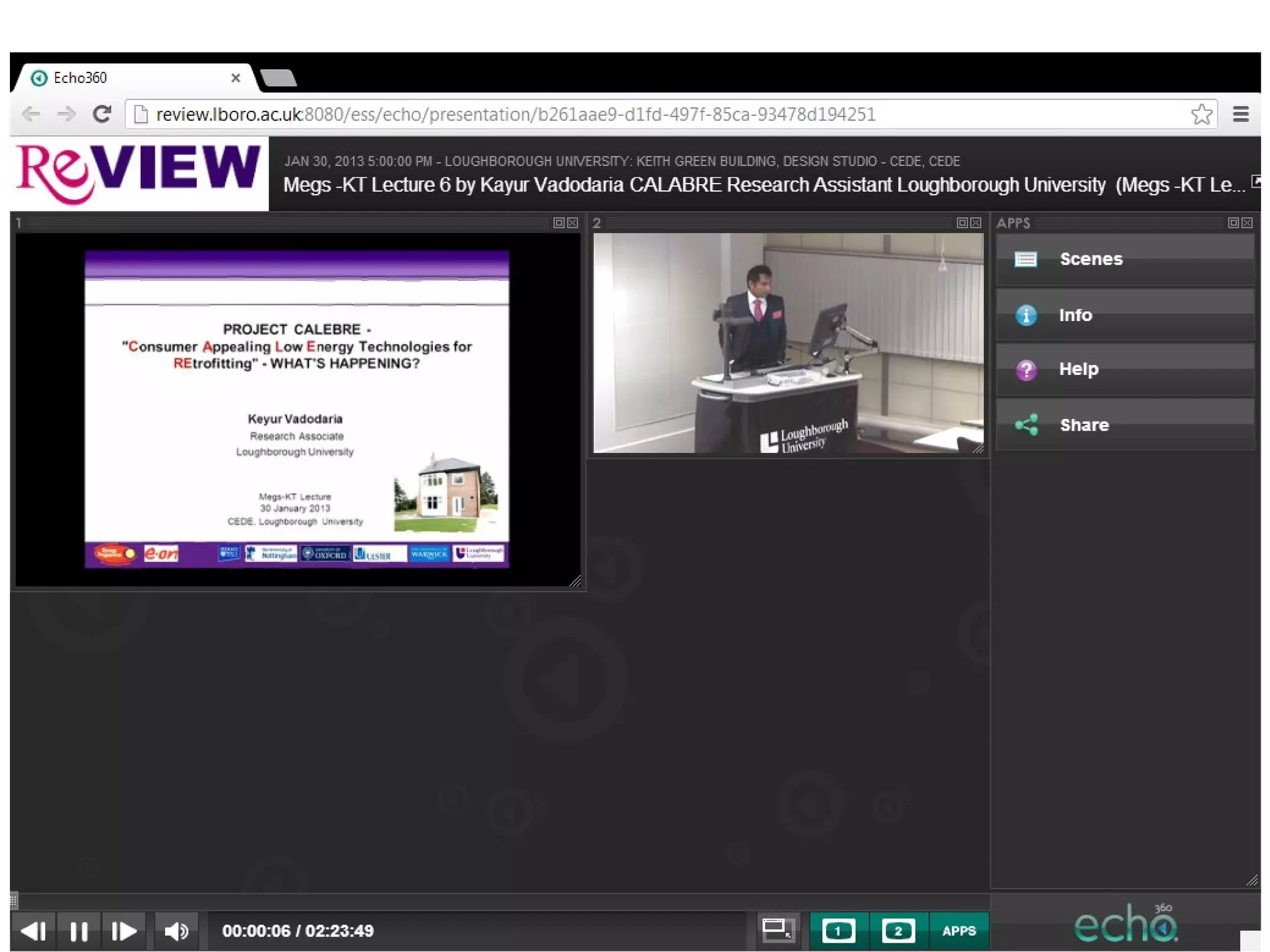
30/01/2012 Keyur Vadodaria, Researcher, CALEBRE project
20/02/2012 Rich Cartwright, RDC Energy , Jonathan Gilbert, The
Rapid technology Transfer Group, and Tracy Thomas
We built a an online community
Community (50 participants over 7 workshops (9 speakers))

Catalytic Individuals /Fellows: Robin Nicholson (Award Winning
Architect, ex- Vice President RIBA), Parity Projects (Award Winning SME),
Institute for Sustainability (Training Centre), John Davis (Green Deal
Assessor), Saucy Horse (Social Networking Business Champion). Carl
Benfield (Prescient Energy [Solar and Wind]), Keyur Vadodaria
(Researcher/ Architect), Richard Cartright (Engineer, RDC Energy Ltd,
[Heat Pumps]) Jonathan Gilbert (Rapid Technology Transfer Group
[Innovative Technologies]) Tracy Thomas (Saucy Horse, Social Media
Marketing)

PhD students/Researchers (Loughborough University, Nottingham
University) Enrique Centelles, Kate Simpson, Sergey Fomin, Paula Cosar,
Becky Gough, Philip Leicester, Sven Hallin

Academics: Professor Jacqui Glass, Dr Paul Rowley, Dr Steven Firth,
Zulfikar Adamu
Catalytic Individuals and Our Social
   Media Fellow Tracy Thomas
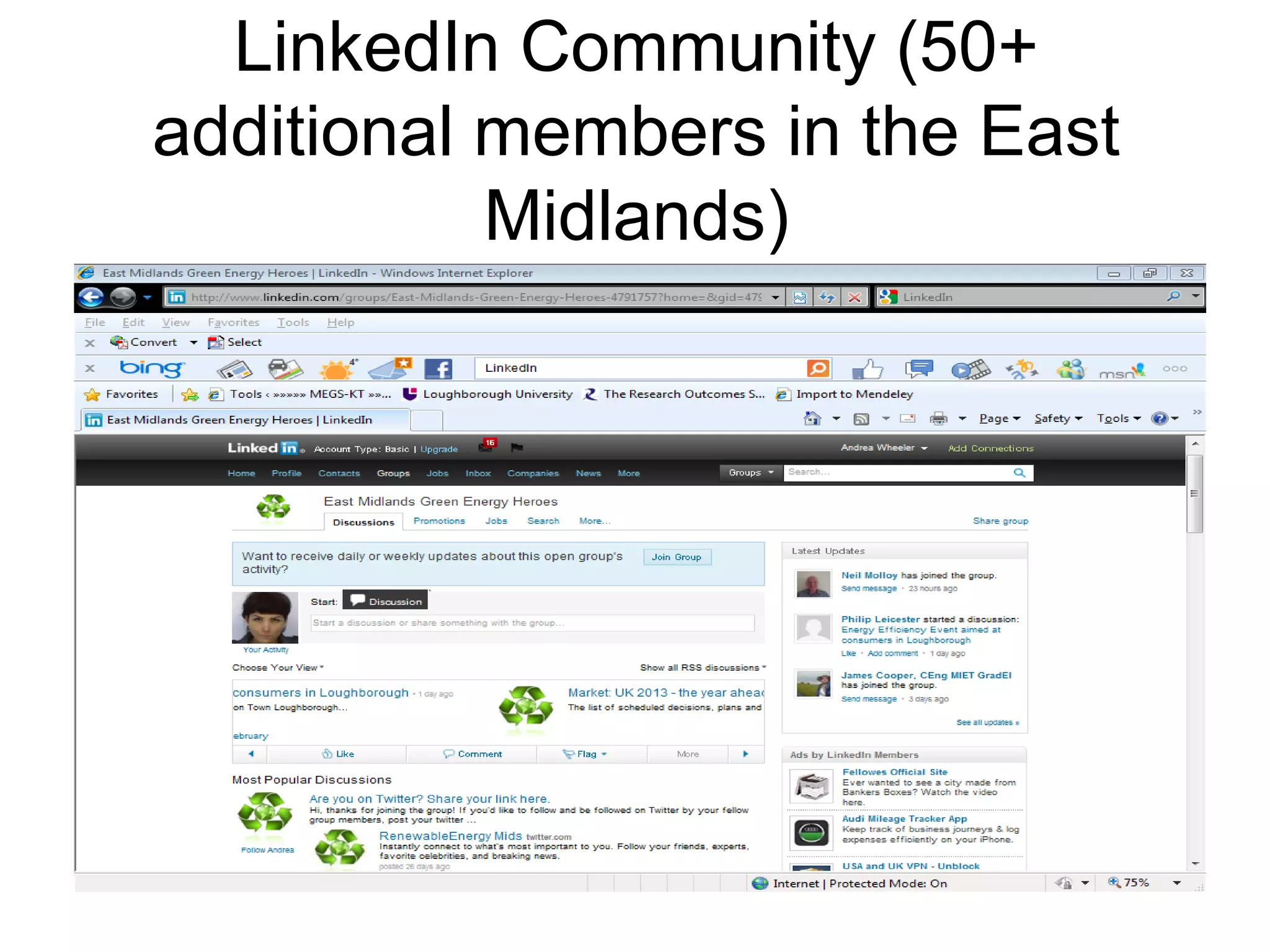
LinkedIn Community (50+
additional members in the East
           Midlands)
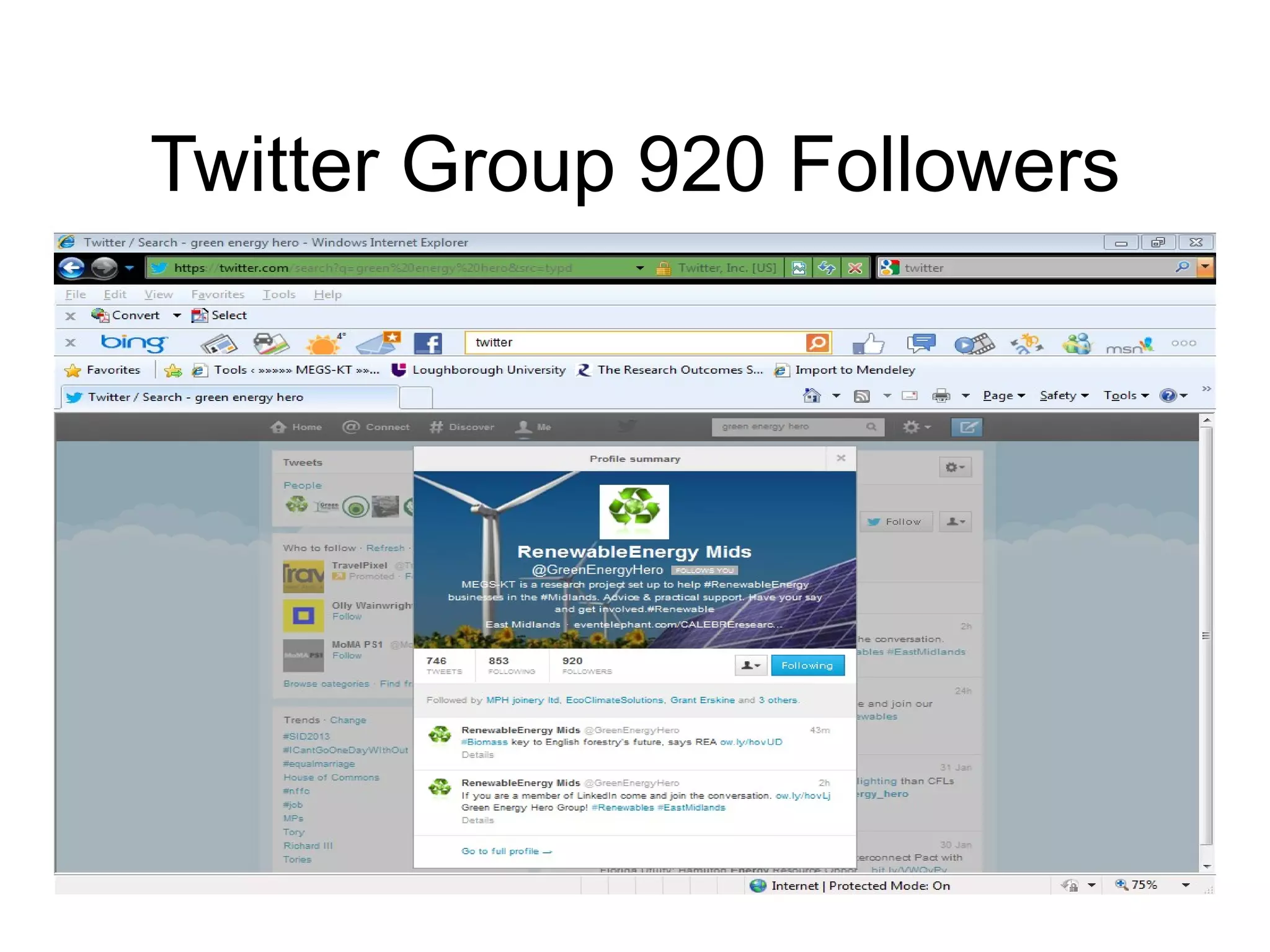
Twitter Group 920 Followers
Why is this important as a BCE
project for the University?

Small businesses represent a supply chain that will allow us to design
and build low cost low energy and sustainable buildings.
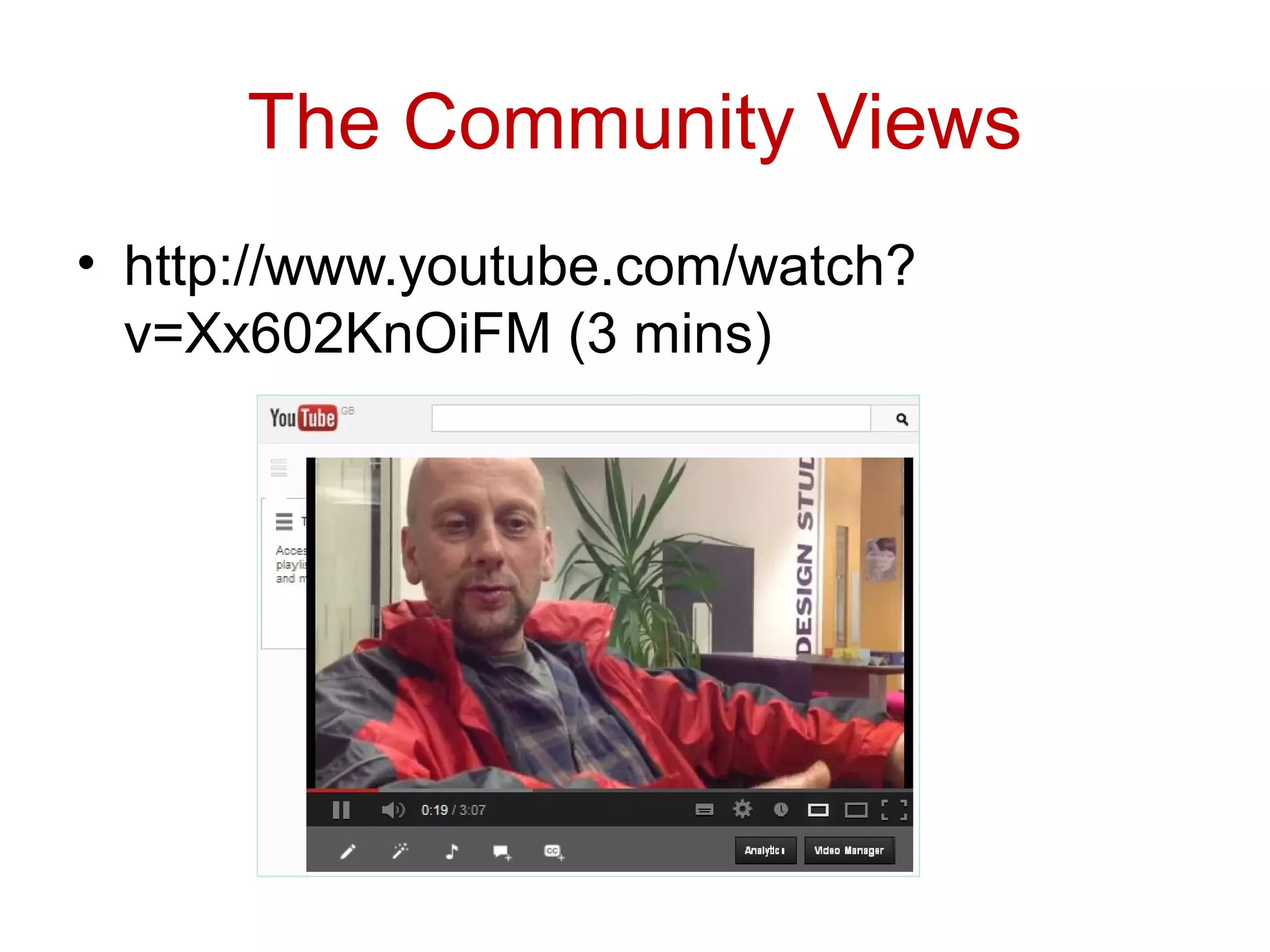
The Community Views
• http://www.youtube.com/watch?
  v=Xx602KnOiFM (3 mins)
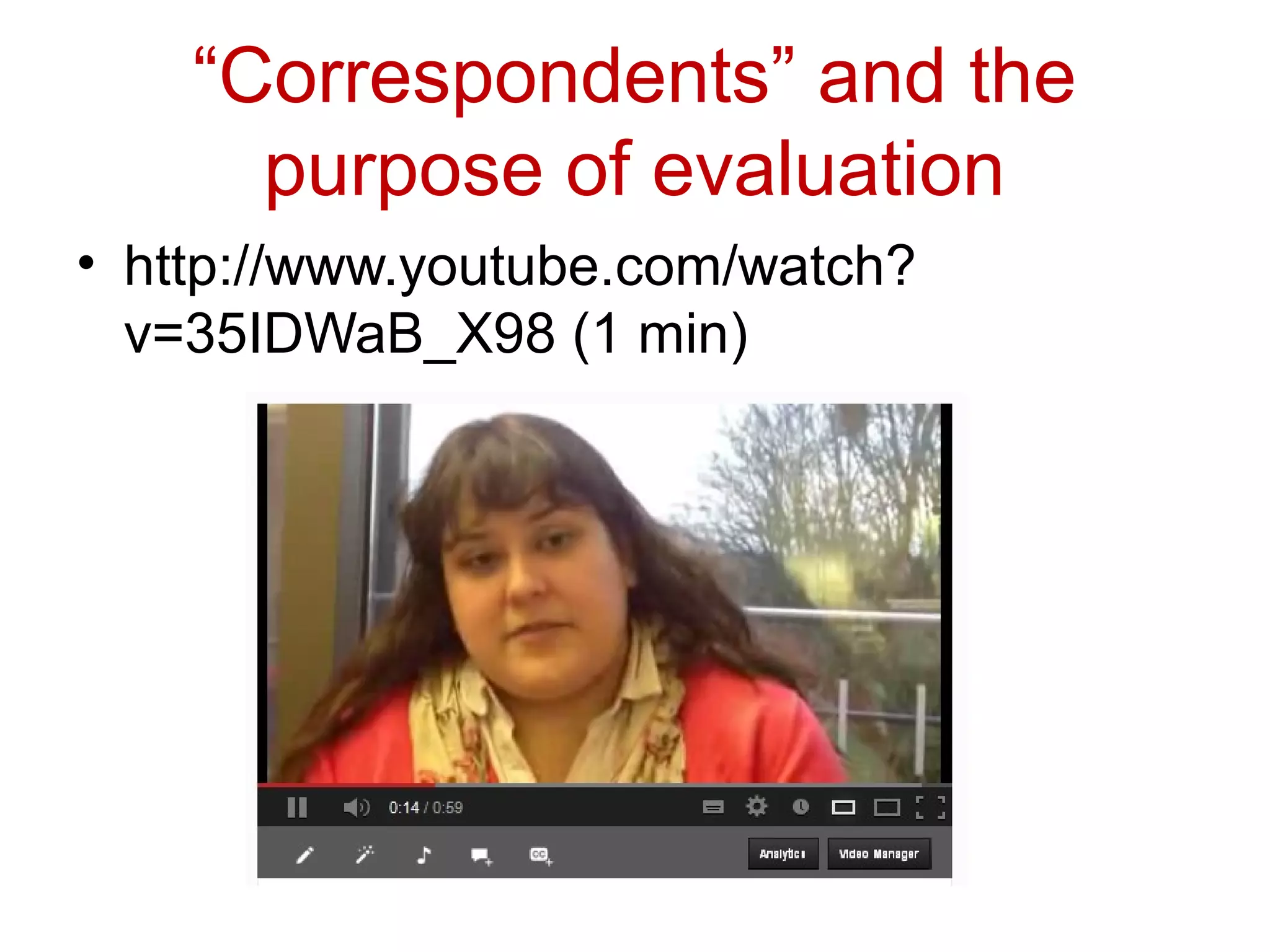
“Correspondents” and the
      purpose of evaluation
• http://www.youtube.com/watch?
  v=35IDWaB_X98 (1 min)
What emerges as a result of
participation?

A community trying to work together?
The E-MENTORING Pilot : “Improving
Student Employability Through E-
Mentoring”.
(February 2012 – June 2012)
• Awarded HEA Departmental Grant
• Recruited mentors and mentees. Mentors
  were young, 2- 7 years post qualification.
  Mentees from the School of Civil and
  Building Engineering (without placement
  experience).
• Invited to a launch meeting to meet
  mentors/mentees and have some training
  (all online).
• Left to get on with it. Some emails. Some
  invitations to feedback via online
  questionnaires.
• June – August interviews.
• September, review of programme and
  revision ahead of pilot 2.
Anticipating a changing working world and how
technology is reshaping work, education and society


Extreme longevity
Globally connected media and communication tools
Robotics
Greater computational power
The role of social media to create new forms of production
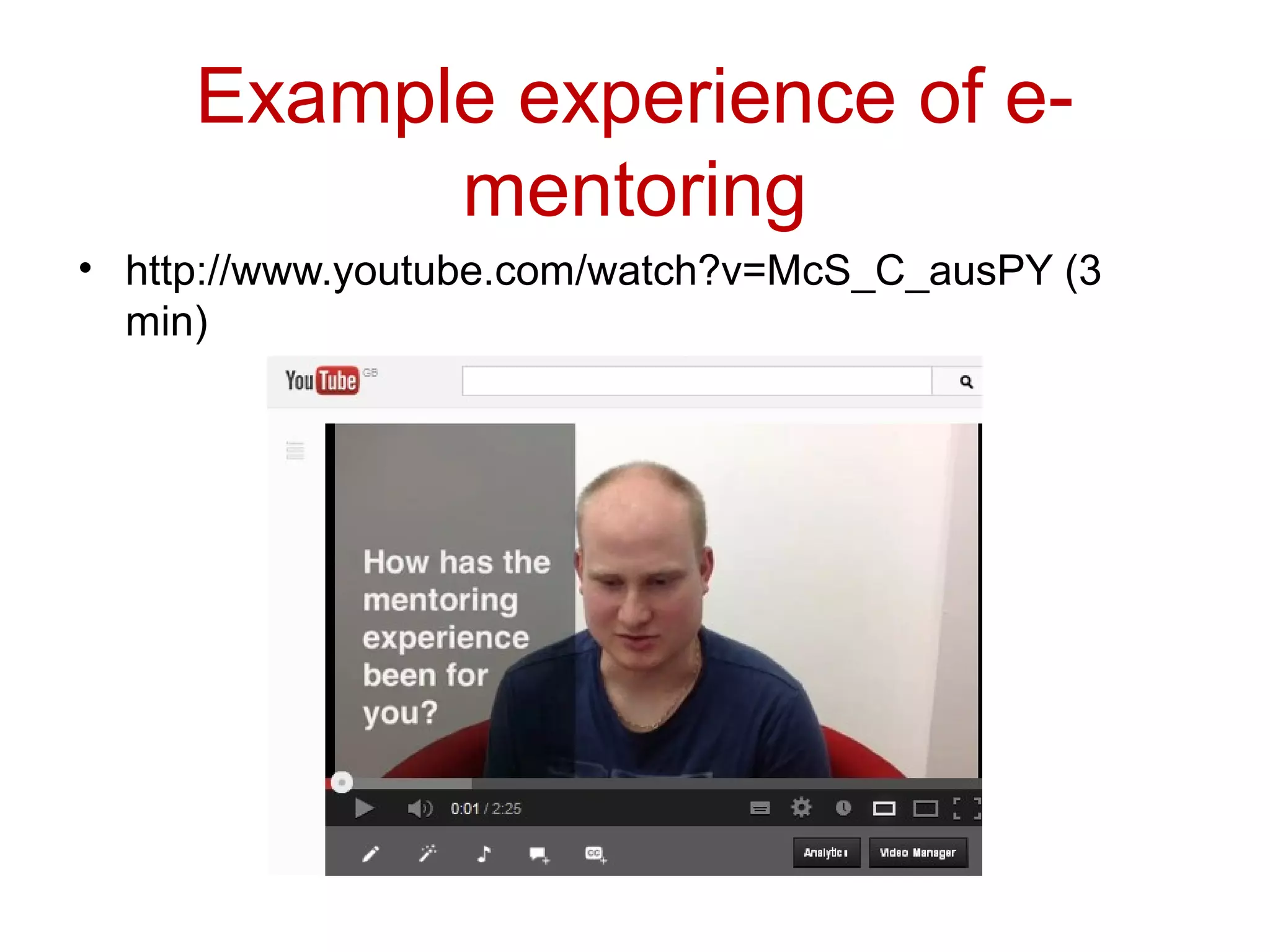
Example experience of e-
           mentoring
• http://www.youtube.com/watch?v=McS_C_ausPY (3
  min)
The benefits of e-mentoring and
the benefits of virtual mentoring/
   collaboration in the studio?
• Unique relationship (from our project)
• Benefits beyond simply employability
  (from our project)
• Expanding horizons and work practices
  (from our project)
New ICT Enhanced Approaches to
Teaching and Learning

Virtual mentoring with practitioners (architects) or International
academics using Skype, Google meeting.

Virtual Mentoring/ Collaboration (design studio courses): with other
schools of architecture (in term projects) with other disciplines
(interdisciplinary studio) Peers (international) twitter
CONCLUSION

So why am I here? What am I about? And why might you
want me to teach here?
RESEARCH AND TEACHING
DEVELOPMENT INTERESTS

•   Sustainable design, participation and post-occupancy as a learning
    opportunity for better design and as a means of motivating
    behavioural change amongst users
•   Interdisciplinary research between fine art and architecture/
    participation
•   Pedagogic research and social enhanced teaching methods
RESEARCH AND PUBLICATION
PLANS

Publication/ book on sustainable schools and participation addressing fine art
theory. “Space to ponder”

Grant funding for design for behaviour change/ motivating sustainable lifestyles
- how innovative technologies and controls can support behavioural change.

Grant funding for pedagogic research into social media and ICT enhance
mentoring in the studio.
HOW DO WE KNOW THE
FUTURE? HOW CAN WE
DESIGN FOR THE NEEDS OF
FUTURE OTHERS?

If the world is going to be different in 50 years, how can we
decide what is meant by sustainable design? Sustainable
design comments on the now. For architects it is a question
of ethics, we can act in good faith.
Is this sustainable design?
THANK YOU
…ANY
QUESTIONS?
a.s.wheeler@lboro.ac.uk

Andrea w iowa_interview9slideshare

  • 1.
    Sustainable School Design: participationand post-occupancy evaluation ...including my past work experience, skills and aspirations for research and why am suited to teach here... School of Architecture IOWA State University Andrea Wheeler BA(Hons) Dip Arch (Oxford) MPhil (Mech. Eng.) PhD (Architecture) 11 March 2013
  • 2.
  • 3.
  • 4.
    PRIZE WINNING STUDENT BA (Hons)Architecture, Second year prize for outstanding achievement National Diploma in Art and Design. Fine Art/ Studio Practice (Distinction) Graduate Diploma in Architecture – Prizes for Graphics and Dissertation MPhil Mechanical Engineering (Timber Repair) TRADA Technology Scholarship PhD Architecture (Arts and Humanities Research Council Scholarship)
  • 6.
    Ethics in thebuilt environment. Wheeler, Andrea (2008) "About being-two in an architectural perspective". In Conversations, Luce Irigaray (ed.) Continuum. pp. 53 – 72 Wheeler, Andrea (2008) "Architectural Issues in Building Community through Luce Irigaray's Perspective on being- two". In, Teaching Luce Irigaray (ed.) Continuum. pp. 61- 68
  • 8.
    Post Doctoral Research– Success in Research Funding 1.Post doctoral UK Energy Research Council/ESRC , 3 year Interdisciplinary Early Careers Fellowship , The University of Nottingham (£220,000 over 3 years) 2.Universitas 21 (consortium of international Universities) lecture series 3.UK Energy Research Council “The Meeting Place” Oxford, dissemination body for the UK Energy Research Council.
  • 10.
    Research Question How doyou explore a different relation, a non- exploitative, non-appropriative relation to the world and to others? How does this translate into a design for a school – what does it look like?
  • 11.
    Commercial Experience Architects, Engineers,Planning Consultants and Policy Defra (Department of Environment Food and Rural Affairs) , London (Policy) Walker Troup, Architects Shere Consulting Ltd., (Planning) Redmak Architects, Nottingham Derek Latham Architects, Derby Regeneration East Midlands (Planning) March and Grochowski, Nottingham (Architects) Design Group Cambridge (Architects) Holder and Mathias Alcock, Architects, Cardiff
  • 15.
    So, why IOWAState University? Strong architectural design Strong student community Interdisciplinary design History of community engagement
  • 16.
    What I ambringing to IOWA School of Architecture… • Experience in teaching at Masters level. • Teaching innovation – social media • Publications • Success in research funding • Interest in interdisciplinary research • Skilled administrator/ education researcher (technologies) at the Centre for Engineering and Design Education (research, teaching development, software development)
  • 17.
  • 18.
    18 18 St Benedicts School, London
  • 19.
    Teaching sustainable schooldesign : individual presentations coursework/ “live” design project
  • 20.
    Teaching interests • DegreeProgramme – Building Science and Technology – Human Behaviour and Environmental Theory • Master of Science (graduate level research) – Sustainable Design – Design Inquiry – Architectural and Construction History – Building Science and Construction
  • 23.
    Robin Nicholson, Partner,Edward Cullinan Architect “Do we need visions for a low energy future?” (SLIDESHARE)
  • 24.
    What do weneed for a low carbon future? Lecture summary • 1. Conserving energy over building conservation regulations • 2. Better knowledge of building physics amongst construction professionals • 3. Better building skills amongst the green building sector. • 4. Controls that real people can understand. • 5. Financial incentives. • 6. People being on board. • 7. How we behave. • 8. Collective energy initiatives – community owned renewable energy. • 9. Cradle to cradle economies. • 10. Measurement and the publication of energy data. •
  • 25.
    Centre of Expertiseon Influencing Behaviours, (Centre for Sustainable Behaviours) Defra March 2010 – August 2010
  • 27.
  • 28.
    SUSTAINABLE SCHOOL DESIGN: PARTICIPATIONAND POST-OCCUPANCY EVALUATION
  • 29.
    different ways ofbeing emergent technologies But which is the most significant? 29
  • 30.
    Innovative technology isnot enough: Engagement, behaviour and “rebound” effects Technology will not be sufficient to transform housing to reduce its impact on the environment as it will not challenge the way in which this impact is created (Seyfang 2012, Reid and Houston 2013). Research has demonstrated that occupants of low carbon homes have found methods to bypass low carbon solutions in order to prevent the curtailment of their activities (Gill et al. 2010)
  • 31.
    Architecture and the Avant-Guard “Environmentalism was born from the avant-garde cultural movement in America and is now in the hands of environmental technologists. I think it’s a problem that environmentalists believe the happiness of man depends on the square metres of grass available to them, and that our habitat should be based solely around energy consumption.” “Post environmentalism will come of age when environmentalists re-establish contact with the avant-garde, with innovation, experimentation and aesthetic concerns. Only then will it become an important historical movement” Peruccio, Pier Paolo and Elena Formia (2013) “The designer as revolutionary” [Interview with Andrea Branzi] In Special Report: Design. The Art Newspaper Section 2 Number 243, February 2013, p. 16).
  • 33.
    Participation in SchoolDesign: Building Schools for the Future programme 2005 - 2010 How to develop schools that are ‘sustainable’ through the relationship of the building design and the behaviour of the children (Blair, A, 2004). (Context at that time) Critical position on the role of children’s participation in the design of schools was proposed as key element of the Building Schools for the Future programme.
  • 34.
    Publication Wheeler, Andrea (2010)“An interview with Harry Shier: Contrasting children’s participation in the UK Building Schools for the Future programme with the Nicaraguan context” International Journal of Children’s Rights Vol. 18/3, 457-474 (translated into Spanish for Nicaraguan readers available at: http://www.harryshier.110mb.com/docs/Wheeler_Entrevista_a_Harry_S hier.pdf ).
  • 35.
  • 36.
    Conclusions •Children and youngpeople have to have the right within our existing educational systems to be able to encounter all the complexities this involves. •Sustainability requires a critical engagement with questions of living and being. •Who is this historical human being characterised by his/her exploitation of the natural environment? How do we understand his or her rights? •sustainable lifestyle relates directly to the traditions of philosophical and political discourse and this cannot be absent from teaching in schools in the context of sustainable development.
  • 37.
    THE OTHER SIDEOF THE DESIGN PROCESS - POST OCCUPANCY Research question 2010 - 2011 There is a mismatch between predicted and actual energy use in building. How do we understand this? School buildings were our case studies.
  • 38.
    The problem ofmethod and of evaluation – questions about post-occupancy (theories we wanted to test) Users of the building have an impact on energy demand and performance data. School “culture” influences energy behaviours. Post-occupancy evaluation is an educational opportunity and provides a platform to motivate change.
  • 39.
    Adapted a method:Including children in post-occupancy requires appropriate methods Open discussion Walk-throughs with video Quizzes Drawings Big group design maps and conversation
  • 42.
    “We like tosit under the stairs where there is carpet and a radiator, but we’re not allowed. We just like to sit there because it is inside. We just like having a quieter area you can sit and just be with your friends [...] They should have little benches [outside] people can sit on and a shelter in the winter. I know it is cold but I do like to go outside to get some fresh air. And also the lads when they play football would have somewhere for their bags” (Year 10 pupil).
  • 43.
    School culture anduser behaviours There’s a lot of difficulties working with them [the construction company] ...If there is a problem with the school, it’s the schools fault. [...] If there’s a problem they will blame the school... it ends up just being a frustration. [...] And then obviously on the purchasing side, whenever anything needs to be changed, if we need a new gat e or pathway, whatever it is, we have to go through them and the costs are so significantly high” (Building Manager) “On our first day they sat us down and told us what we couldn’t do in the school – from the start it made us feel it wasn’t ours .
  • 44.
    Children and Energy “Ithink we should stop lighting the school in the day as the sun lights it up a lot and we’re wasting electricity” (Final ‘design’ session, Year 8 pupil). “Are the lights movement sensitive? I don’t think in the corridors they are. They could be movement sensitive, but even just a switch” Sometimes they [the classrooms] are really warm and the windows don’t open. None of the windows open. Only the lower ones. In the summer it’s really hot” (Year 7 pupil.) Researcher 1: “Are there things you think the architect could have done better?” “Just the windows.”
  • 45.
    “But you can’topen them and you get too hot... But then you have air conditioning. But you only have it in ICT but when you do it’s nice and cool and then it gets too cold [different voice]. In normal classrooms you have this thing that brings air in form outside, but if it’s hot outside it’s just bringing in hot air.” “I don't even think we are trying. It feels like they don't even think they care. But they are always banging on about it. They are always telling us to save energy but why not them”.
  • 46.
    RESULTS 1.Contradictions between whatadults say and what they tell children to do. A mismatch between designers intention and teachers ability to manage the behaviours of pupils – (many examples – dining biggest issue) 2.Poorly functioning building features (windows, heating and ventilation systems, circulation, dining spaces) and either over provision or under provision of space and facilities, together with teachers prohibiting use of facilities (toilets locked, . 3.Lack of ownership of PFI buildings 4.Lack of understanding of the ‘sustainable’ design features of the new school building – solar heating panels 5.Convoluted facilities management procedures where prohibitions did nothing towards children establishing their own “authentic” relationship to the environment and a deep or lasting critical perspective on the problems of sustainable development.
  • 47.
    MOTIVATING CHANGE The Schoolplans to enter into discussion with the local authority to gain responsibility for paying their own bills and putting measures in place to save 20%. Schools setting up children “Eco-groups”.
  • 48.
  • 49.
  • 50.
    School Design FuturesConference UKERC funded “The Meeting Place” University of Oxford, St Hugh’s College
  • 51.
    MEGS-KT: Teaching development and Business and Community Engagement (towards low carbon economies): MEGS-KT: How to develop a relevant, up-to-date desirable platform for “CFD” opportunities, opening up University resources and allowing SMEs in the renewable energy sector to share their knowledge. SASIE, Micro-Business, Nottingham, UK
  • 52.
    Building a Communityof Practice, “catalytic Individuals” and the small business community. 17/10/2012 Robin Nicholson, Edward Cullinan Architects 24/10/2012 Russell Smith, Parity Projects 14/11/2012 Terry McGivern, The Institute for Sustainability and the Flash Programme 05/12/2012 John Davis, Domestic Green Deal Assessor 16/01/2012 Carl Benfield, Prescient Power 30/01/2012 Keyur Vadodaria, Researcher, CALEBRE project 20/02/2012 Rich Cartwright, RDC Energy , Jonathan Gilbert, The Rapid technology Transfer Group, and Tracy Thomas
  • 56.
    We built aan online community Community (50 participants over 7 workshops (9 speakers)) Catalytic Individuals /Fellows: Robin Nicholson (Award Winning Architect, ex- Vice President RIBA), Parity Projects (Award Winning SME), Institute for Sustainability (Training Centre), John Davis (Green Deal Assessor), Saucy Horse (Social Networking Business Champion). Carl Benfield (Prescient Energy [Solar and Wind]), Keyur Vadodaria (Researcher/ Architect), Richard Cartright (Engineer, RDC Energy Ltd, [Heat Pumps]) Jonathan Gilbert (Rapid Technology Transfer Group [Innovative Technologies]) Tracy Thomas (Saucy Horse, Social Media Marketing) PhD students/Researchers (Loughborough University, Nottingham University) Enrique Centelles, Kate Simpson, Sergey Fomin, Paula Cosar, Becky Gough, Philip Leicester, Sven Hallin Academics: Professor Jacqui Glass, Dr Paul Rowley, Dr Steven Firth, Zulfikar Adamu
  • 57.
    Catalytic Individuals andOur Social Media Fellow Tracy Thomas
  • 58.
    LinkedIn Community (50+ additionalmembers in the East Midlands)
  • 59.
  • 62.
    Why is thisimportant as a BCE project for the University? Small businesses represent a supply chain that will allow us to design and build low cost low energy and sustainable buildings.
  • 63.
    The Community Views •http://www.youtube.com/watch? v=Xx602KnOiFM (3 mins)
  • 64.
    “Correspondents” and the purpose of evaluation • http://www.youtube.com/watch? v=35IDWaB_X98 (1 min)
  • 65.
    What emerges asa result of participation? A community trying to work together?
  • 66.
    The E-MENTORING Pilot: “Improving Student Employability Through E- Mentoring”. (February 2012 – June 2012) • Awarded HEA Departmental Grant • Recruited mentors and mentees. Mentors were young, 2- 7 years post qualification. Mentees from the School of Civil and Building Engineering (without placement experience). • Invited to a launch meeting to meet mentors/mentees and have some training (all online). • Left to get on with it. Some emails. Some invitations to feedback via online questionnaires. • June – August interviews. • September, review of programme and revision ahead of pilot 2.
  • 67.
    Anticipating a changingworking world and how technology is reshaping work, education and society Extreme longevity Globally connected media and communication tools Robotics Greater computational power The role of social media to create new forms of production
  • 68.
    Example experience ofe- mentoring • http://www.youtube.com/watch?v=McS_C_ausPY (3 min)
  • 69.
    The benefits ofe-mentoring and the benefits of virtual mentoring/ collaboration in the studio? • Unique relationship (from our project) • Benefits beyond simply employability (from our project) • Expanding horizons and work practices (from our project)
  • 70.
    New ICT EnhancedApproaches to Teaching and Learning Virtual mentoring with practitioners (architects) or International academics using Skype, Google meeting. Virtual Mentoring/ Collaboration (design studio courses): with other schools of architecture (in term projects) with other disciplines (interdisciplinary studio) Peers (international) twitter
  • 71.
    CONCLUSION So why amI here? What am I about? And why might you want me to teach here?
  • 72.
    RESEARCH AND TEACHING DEVELOPMENTINTERESTS • Sustainable design, participation and post-occupancy as a learning opportunity for better design and as a means of motivating behavioural change amongst users • Interdisciplinary research between fine art and architecture/ participation • Pedagogic research and social enhanced teaching methods
  • 73.
    RESEARCH AND PUBLICATION PLANS Publication/book on sustainable schools and participation addressing fine art theory. “Space to ponder” Grant funding for design for behaviour change/ motivating sustainable lifestyles - how innovative technologies and controls can support behavioural change. Grant funding for pedagogic research into social media and ICT enhance mentoring in the studio.
  • 74.
    HOW DO WEKNOW THE FUTURE? HOW CAN WE DESIGN FOR THE NEEDS OF FUTURE OTHERS? If the world is going to be different in 50 years, how can we decide what is meant by sustainable design? Sustainable design comments on the now. For architects it is a question of ethics, we can act in good faith.
  • 75.
  • 76.

Editor's Notes

  • #19 Andrea Wheeler Tim Jackson
  • #22 constructed following the contours of the Weald and Downland Gridshell building. The glazing was constructed from flexible polycarbonate to allow it to deform slightly to follow the double curvature of the building to create a clerestory. The cladding was cut from locally sourced Western Red Cedar weather boarding sourced nearby. The Weald and Downland Gridshell building became an iconic building and went on to win a whole raft of awards including achieving the Stirling Prize shortlist. It is an example of the importance of partnering for complex structures where the early input of the carpenter is essential to the success of the project
  • #30 Translating to the area of school design – adds the theoretical dimension of education to that of lifestyle.