


1
Abstract of Paper
I am using this paper to document my experiences teaching Civilization and
Its Discontents by Sigmund Freud to two separate classes:Mosaic 852 and
851. In the introduction of the paper, I will explain the background of both
courses as a General Education sequence in Temple University’s core
program. Then I will discuss the role of Freud in the first courseand the
various difficulties that occurred because so many people did not understand
the first book—IntroductoryLectures on Psychoanalysis and the students
found the bookto be boring and unnecessary. Then I will discuss the
decision to substitute Civilization and Its Discontents in lieu of
Psychoanalysis. This is where my action research project comes into play.
I am using the Proactive Action Research model, taken from the book
Practical Action Research For Change by Richard A. Schmuck. In the
second summer semester, I decided to pilot Civilization in its Discontents in
Mosaic 852, even though it is not a part of the curriculum for that course, as
I felt I could make it work, plus I wanted data from students who had
already read Introductory Lectures to see if I could find a comparison in the
reading experience. I also knew that some of them might have read
Civilization and It’s Discontents in Summer Semester one as a few teachers
were piloting it in their Mosaic 851 class. I wanted to see if my method of
teaching made the reading different for them: clearer, convoluted, difficult,
trite or boring. I also wanted to see if students already came with
preconceived notions about Freud the thinker.
Finally, I was concerned that the students had a full experience with the text
and Freud, whether they enjoyed his writings or found them to be absurd. I
specifically wanted to work with all three learning types: auditory, visual
and tactile. So I designed activities that worked with all three learners, even
if the tactile activities were, in my mind, not as well developed, and could
have easily have verged on the ridiculous side. I still felt that all was useful
because in learning, whatever works is good, and not all minds learn the
same.
To follow the proactive action research model, I decided to teach the book
that wasn’t a part of the curriculum. (Try a New Practice.) When I taught the
bookin the fall, I decided to make it the second text and include it in our
first unit because I wanted their minds fresh with the new semester. So the
proactive model continued in the second phase of my research, even though
2
I will focus primarily on my summer schoolexperience. For step 2, my
hopes and concerns were the following: I wanted to establish prior
knowledge of the material along with emotional attitudes, because Freud
tends to affect people. If people remain indifferent, it is because he was not
taught well and the student wasn’t engaged. I wasn’t concerned whether they
agreed with Freud as it isn’t my job to convert people, but I wanted them to
understand him and fully see his ideas so that they felt like mini Freudian
experts. I also hoped that they could recognize why we still need to read
Freud today, even if he isn’t perceived as relevant to many therapeutic
communities or central to social scientific discourse. I wanted them to see
that he mattered because he was the first to give us the idea of an interior
self that he called the unconscious, something we now take for granted. My
hope was that they would see that popular culture owes a great debt to
Freud, as do many liberal arts and social scientific disciplines, even if that
debt was shunned in those very circles. Finally my hope was that they began
to think like Freud, even if it were only for the few weeks we studied the
material.
Steps 3 and 4 involve the collecting of data along with figuring what the data
means. Since this research is based on two classes along with a few from
about 3 years ago, it is hardly encompassing for all teachers. At the same
time, it reaffirmed what I had suspected:Freud is necessary for students. I
used surveys in one class, journal entries in both, brief assignments, puzzles,
in class activities, discussionand movies. I will include selections from all
of these to show the various ways Freud can be taught to a college audience.
I will use the data to draw certain conclusions; namely, that Freud can be
learned by any student if the teacher is willing to meet him or her where the
student is, not where the instructor wants the student to be. The Mosaic
sequence is not a prerequisite for becoming a psychologist or a
psychoanalyst, but it is required by all undergraduates with the idea that they
understand certain texts and methodology with the expressed hope that it
helps them both in their chosen vocation and their daily lives.
3
Introduction to Mosaic 851 and 852
I work as a non-tenured track faculty member of the Intellectual Heritage
Program. The idea of our program stems from the corecurriculum design in
the undergraduate colleges of Columbia University and the University of
Chicago. When I was hired, I began teaching a two-part course called
Intellectual Heritage 51 and 52. The course was a chronological study of
great works largely from the Western Civilization canon. IH 51 consisted of
books like The Iliad, The Oresteia, TheRepublic, Bghaved Gita, TheQuran,
and selections from the Holy Bible. IH 52 dealt with more recent history
stemming from the enlightenment to postmodernism: we read On the Origin
of Species, Uncovering Our Masks: A Freud Reader, CommunistManifesto,
The Second Treatise of Government, Whatis the Fourth of July to a Slave,
Letter From Birmingham Jail and Selections from various British and
American Romantic poets. The coursewas writing intensive, meaning that
we assigned several formal essays and allowed rewrites. It was styled as a
traditional college course.
In the fall of 2007, the university administration enforced a change to our
curriculum. We began teaching a two-part coursecalled Mosaic. The
intention was to modernize our approachto critical thinking within a general
education course. The coursewas thematic: Mosaic 851 had four themes-
Journeys, Self and Other, Community and Ways of Knowing. Mosaic 852
also had four themes: Science, Power, Money and City/Environment. Each
theme required two texts—one text was mandatory and the other was chosen
from a list of five texts according to the professor’swhim. The coursewas
reading intensive, so we were no longer required to assign formal essays
with rewrites. Instead, many of us experimented with blogs, journals,
discussionforums, mind maps, portfolios and other non-traditional
assignments. Please see the following chart for the text selection, with
notations of changes within the text selection over the past two years.
The topic for this paper developed after our associate director proposed that
the program allowed for a choice within the required readings of the Self and
Other Unit, beginning in Fall, 2013. Up until that point, we were using
Freud’s Introductory Lectures on Psychoanalysis. The associate director
ordered a new edition of Freud’s Civilization and Its Discontents, and
4
suggested that instructors choosebetween the two texts for that particular
unit, along with a subsequent text from the suggested list. (See table).
A collective sigh of relief came from many instructors who did not
understand Freud’s Introductory Lectures to Psychoanalysis, or many of
Freud’s writings for that matter1. Many felt that the bookwas ungainly and
time consuming. Many instructors, including myself, understood the book
and Freud’s theories just fine; however, we recognized that it was not a good
beginning bookto the complexity of Freud’s thought. The lectures were
comprised from notes taken from Freud’s teachings in German, and then
translated into English. One had to understand Freud well to look for clues
to his thought and familiarize himself or herself with the vocabulary of the
text as well as traditional Freudian terms. (Find an example.) So the text was
problematic, but not impossible to teach. Yet to teach it well meant
sacrificing some of the texts in the later unit, like Genesis and other belief
centered texts. Using Civilization and Its Discontents seemed to take that
problem away, and many instructors found the text easier to understand and
to manipulate in order to apply it to other classroomthemes.
I was fortunate to have a strong background in Freud from graduate school,
as my advisor was a Freudian. I also had a mentor in my first year at Temple
who had edited the book Uncovering Our Masks—our reader in the original
IH on Freud. So I felt secure in teaching Freud; moreover, it was important
to me. I often neglected to teach the last unit other than The Daodejing,
because I felt strongly that Freud was essential for a good undergraduate
education as he gave us a road map into our own mind, which allowed us to
understand the motivations of others as well. I expected that Civilization
would be less ungainly, but I guessed that I would still need to focus on
1 Many faculty members from IH believed that the book list represented personal
favorites of the IH director who made the final decision on themes and texts in the
course. This director often opted to use Introductory Lectures instead of the
mandated text Uncovering Our Masks in his IH classes. The Mosaic course was
intended to stress primary texts, not compilations. However, the original
Introductory Lectures were a series of lectures Freud gave at the University of
Vienna in the winter terms of 1915 to 1917. They were first individually published,
then serialized, then finally put into one volume in 1917. Later lectures on key
changes to Freud’s original theories were included in New Introductory Lectures
on Psychoanylysis, published in 1933. Our text included the later lectures as well. In
short, people resented the text, as many perceived it as a personal favorite, not one
that may be readable for college sophomores.
5
teaching the students a lot of background on Freudian thought, whether the
text covered it or not, as Civilization is a later text. Freud’s original readers
already understood Freud’s paradigm as they read the book. My students
would need to understand it as well.
I kept all of this in mind as I began to use Civilization and Its Discontents as
a text in Mosaic, first as a supplemental text in my summer Mosaic 852 class
when it is assumed that students have already read Freud, then in my fall 851
class where many were reading Freud for the first time. The class met for six
weeks on Monday, Tuesdays, Wednesdays and Thursdays from 9 to 11 am.
Action ResearchProject:Step 1 Try a New Practice
Usually I begin any course with an online journal on Blackboard in which
the students answer a series of questions about their major, any previous
Mosaic courses, hobbies, and preferences for class style. For my summer
Mosaic 852 class, I decided to ask a few different questions. (See the journal
questions below:)
Please answer the following questions in the order you see listed below.
1. Your name and what you wouldlike to be called(nickname)
2. Your major. Why did you choose this major? What do you hope to do with
your degree?
3. Did you take Mosaic 851? When? With whom? (I generallyknow which
teachers emphasize certain material like the Tao or Gilgamesh.)
4. Did you have a good experience? Why or why not? (This is private.)
5. What makes a class interesting and fairly painless for you?
6. What do you expect Mosaic 852 to be?
7. Is there anything that you would like me to know about you--personal or
otherwise?
8. What do you like to do when you don't have to work, study, go to class or
fulfill any other obligations?
9. Did you read Civilization and Its Discontents by Sigmund Freud inyour
Mosaic 851 class? If so, what did you think of it? If not, did you read
Introductory Lectures to Psychoanalysis? If so, what did you think of it? If you
read no Freud at all in your Mosaic 851, please let me know. (We will be
reading some selections from Civilization and Its Discontents in our section
6
along withanother brief reading by Freud from a book called The
Uncanny that deals withthe paranormal and the creative process.)2
All of this helps me to know you better and think more mindfully about the flow
of the course.
Question 5 and 9 were new questions for me. Question 5 was my attempt to see
what students like. Question 9 was my attempt to gather research for this study,
and see the level of preparation. Here are some of the replies from question 9.
Please note that the students who read Civilization and Its Discontents had just
come from a Summer I Mosaic 851 class, so their experience with the book was
approximently 4 weeks prior to my class:
1. In Mosaic 851, we read Lectures to Psychoanalysis. Honestly, I do not have
much of an opinion on it because we barely discussed it (my teacher did not
utilize our class time wisely and we did not get too deep into it). What we
did discuss, I honestly cannot remember because it did not stick with me.
2. I did read Civilization and Its Discontents by Sigmund Freud; this was my
first adult experience with Freud. I find his arguments persuasive, well
constructed, however I'm not persuaded enough by Freud's writing to adopt
his views as my own.
3. We read introductory lectures in our mosaics 851 classes. I feel I don’t
remember it exactly, but if I am thinking right it talked about dreams. How
they are interpreted, but also talked about sex and the male anatomy. I
remember it was a different book than usual, but it was hard to read because
it was a bit boring. I'm hoping to read this book we'll have better though
since I’ll know what to expect in a way.4.
5. In my Mosaics 851 I read Freud’s Introductory Lectures to Psychoanalysis.
I thought that it was kind of interesting. I learned about Freud in a Psych
class, and that was a little easier to understand than his lectures. But we did
jump around a lot, so I may not have gotten the full effect. And the main
thing we did with it was analyze our own dreams, and mine weren’t really
comparable to the ones described in Freud. I think the concepts are
interesting, but I didn’t really grasp it.
6. I read Freud Introductory Lectures to Psychoanalysis. I did not enjoy
reading it. I don’t like how he explains a whole scenario and makes you
believe it’s totally correct then flips around and says it’s actually incorrect.
I feel like it was very basic concepts just made so difficult.
7. Yes, confusiong to read, easy to talk about. Also read the future of an
illusion, same opinion. (This student had read Civilization and Its
Discontents.)
2 I did not use selections from The Uncanny due to time constraints.
7
8. I read Freud’s Introductory Lectures to Psychoanalysis. I did not like the
book because I thought that most of what Freud said was nonsense and we
spent far too long on the topic.
9. I read Freud's Introductory Lectures to Psychoanalysis was definitely
intrigued by Freud's theories on psychoanalysis and the influence that he
had on modern thinking.
10.In my Mosaics 851 I read Freud’s Introductory Lectures to Psychoanalysis.
I thought that it was kind of interesting. I learned about Freud in a Psych
class, and that was a little easier to understand than his lectures. But we did
jump around a lot, so I may not have gotten the full effect. And the main
thing we did with it was analyze our own dreams, and mine weren’t really
comparable to the ones described in Freud. I think the concepts are
interesting, but I didn’t really grasp it.
11.I read Freud's Introductory Lectures to Psychoanalysis and loved it. I am
very intrigued with psychology and have always held an interest in the
field.
12.I didn't read any of those books.
13.He just told us what we should memorize for exams, because we always
run out of time.
14.We did read something by Freud but it's hard to remember which title. (All
information taken from the first assignment in Mosaic 852, Section 22 at
Temple University in Summer II term. Grammar, syntax and spelling have
not been altered.)
The sampling of responses told me what I had already assumed: most
students did not engage deeply in the text, whether it was Introductory
Lectures or Civilization and Its Discontents. I had not asked for specific
examples of Freudian thought, so I did not expect to see them in the
responses, and they were not. The few students who seemed to enjoy Freud
were all male. Response2 came from a returning veteran who loved being in
college, and worked very hard, often setting the standard for class discussion
very high. Response9 came from a motivated business student who was
fascinated with the theories of Ayn Rand and loathed Marxism, so he found
Freud to be an ally in his belief that humans acted largely out of self-interest.
Response11 came from another business student who behaved largely as an
observer in the class. He only spokewhen I called on him, but always came
highly prepared and wrote superb papers.
I told the students that I planned to use their responses anonymously for my
project on Freud. I explained to them the nature of my research. They
became more motivated to read the text after they knew they would be a part
8
of their professor’spaper. They also agreed to cooperateand put forth their
best effort. I also affirmed that I wanted candor, not canned responses that
they thought I would like as I too was trying to learn.
Surveys: The next day in class, I passed out a survey. We still had not begun
the text; we were reading Edmund Jenner’s Vaccination Against Smallpox,3
but I wanted them to anticipate the Freud reading which they would begin
that weekend. Please see the following for the survey.
Survey on Freud
1. What books if any have you read by Freud?
2. In your own words, tell me what these words mean. If you don’t know the answer,
just say I don’t know.
a. id
b. ego
c. superego
d. defense mechanism
e. repression
f. displacement
g. projection
h. libido
i. pleasure principle
j. narcissism
k. unconscious
l. preconscious
m. thanatos
n. neurosis
3 This text is always the first to read in the Mosaic 852 course.
9
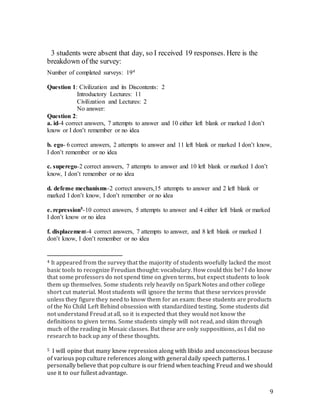
3 students were absent that day, so I received 19 responses. Here is the
breakdown of the survey:
Number of completed surveys: 194
Question 1: Civilization and its Discontents: 2
Introductory Lectures: 11
Civilization and Lectures: 2
No answer:
Question 2:
a. id-4 correct answers, 7 attempts to answer and 10 either left blank or marked I don’t
know or I don’t remember or no idea
b. ego- 6 correct answers, 2 attempts to answer and 11 left blank or marked I don’t know,
I don’t remember or no idea
c. superego-2 correct answers, 7 attempts to answer and 10 left blank or marked I don’t
know, I don’t remember or no idea
d. defense mechanisms-2 correct answers,15 attempts to answer and 2 left blank or
marked I don’t know, I don’t remember or no idea
e. repression5-10 correct answers, 5 attempts to answer and 4 either left blank or marked
I don’t know or no idea
f. displacement-4 correct answers, 7 attempts to answer, and 8 left blank or marked I
don’t know, I don’t remember or no idea
4 It appeared from the survey that the majority of students woefully lacked the most
basic tools to recognize Freudian thought: vocabulary. How could this be? I do know
that some professors do not spend time on given terms, but expect students to look
them up themselves. Some students rely heavily on Spark Notes and other college
short cut material. Most students will ignore the terms that these services provide
unless they figure they need to know them for an exam: these students are products
of the No Child Left Behind obsession with standardized testing. Some students did
not understand Freud at all, so it is expected that they would not know the
definitions to given terms. Some students simply will not read, and skim through
much of the reading in Mosaic classes. But these are only suppositions, as I did no
research to back up any of these thoughts.
5 I will opine that many knew repression along with libido and unconscious because
of various pop culture references along with general daily speech patterns. I
personally believe that pop culture is our friend when teaching Freud and we should
use it to our fullest advantage.
10
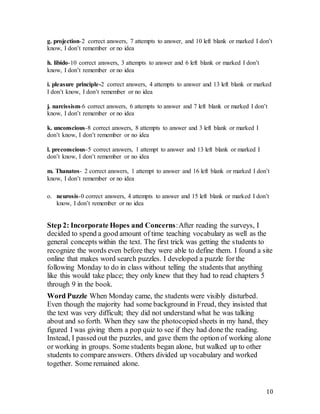
g. projection-2 correct answers, 7 attempts to answer, and 10 left blank or marked I don’t
know, I don’t remember or no idea
h. libido-10 correct answers, 3 attempts to answer and 6 left blank or marked I don’t
know, I don’t remember or no idea
i. pleasure principle-2 correct answers, 4 attempts to answer and 13 left blank or marked
I don’t know, I don’t remember or no idea
j. narcissism-6 correct answers, 6 attempts to answer and 7 left blank or marked I don’t
know, I don’t remember or no idea
k. unconscious-8 correct answers, 8 attempts to answer and 3 left blank or marked I
don’t know, I don’t remember or no idea
l. preconscious-5 correct answers, 1 attempt to answer and 13 left blank or marked I
don’t know, I don’t remember or no idea
m. Thanatos- 2 correct answers, 1 attempt to answer and 16 left blank or marked I don’t
know, I don’t remember or no idea
o. neurosis-0 correct answers, 4 attempts to answer and 15 left blank or marked I don’t
know, I don’t remember or no idea
Step 2: Incorporate Hopes and Concerns:After reading the surveys, I
decided to spend a good amount of time teaching vocabulary as well as the
general concepts within the text. The first trick was getting the students to
recognize the words even before they were able to define them. I found a site
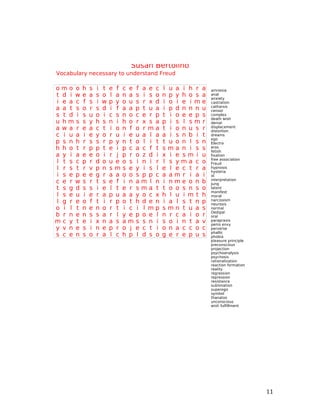
online that makes word search puzzles. I developed a puzzle for the
following Monday to do in class without telling the students that anything
like this would take place; they only knew that they had to read chapters 5
through 9 in the book.
Word Puzzle When Monday came, the students were visibly disturbed.
Even though the majority had some background in Freud, they insisted that
the text was very difficult; they did not understand what he was talking
about and so forth. When they saw the photocopied sheets in my hand, they
figured I was giving them a pop quiz to see if they had done the reading.
Instead, I passed out the puzzles, and gave them the option of working alone
or working in groups. Some students began alone, but walked up to other
students to compare answers. Others divided up vocabulary and worked
together. Some remained alone.
11
12
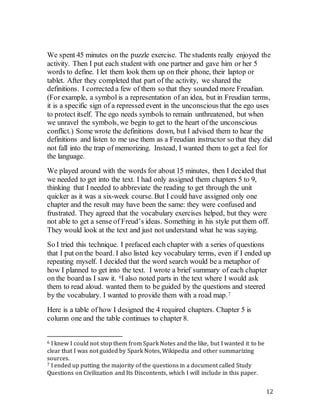
We spent 45 minutes on the puzzle exercise. The students really enjoyed the
activity. Then I put each student with one partner and gave him or her 5
words to define. I let them look them up on their phone, their laptop or
tablet. After they completed that part of the activity, we shared the
definitions. I corrected a few of them so that they sounded more Freudian.
(For example, a symbol is a representation of an idea, but in Freudian terms,
it is a specific sign of a repressed event in the unconscious that the ego uses
to protect itself. The ego needs symbols to remain unthreatened, but when
we unravel the symbols, we begin to get to the heart of the unconscious
conflict.) Some wrote the definitions down, but I advised them to hear the
definitions and listen to me use them as a Freudian instructor so that they did
not fall into the trap of memorizing. Instead, I wanted them to get a feel for
the language.
We played around with the words for about 15 minutes, then I decided that
we needed to get into the text. I had only assigned them chapters 5 to 9,
thinking that I needed to abbreviate the reading to get through the unit
quicker as it was a six-week course. But I could have assigned only one
chapter and the result may have been the same: they were confused and
frustrated. They agreed that the vocabulary exercises helped, but they were
not able to get a sense of Freud’s ideas. Something in his style put them off.
They would look at the text and just not understand what he was saying.
So I tried this technique. I prefaced each chapter with a series of questions
that I put on the board. I also listed key vocabulary terms, even if I ended up
repeating myself. I decided that the word search would be a metaphor of
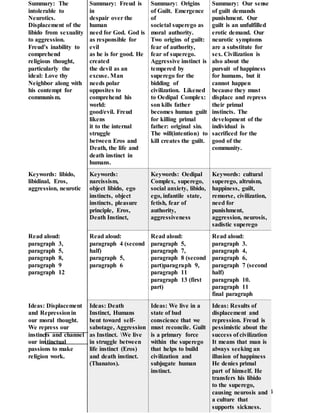
how I planned to get into the text. I wrote a brief summary of each chapter
on the board as I saw it. 6I also noted parts in the text where I would ask
them to read aloud. wanted them to be guided by the questions and steered
by the vocabulary. I wanted to provide them with a road map.7
Here is a table of how I designed the 4 required chapters. Chapter 5 is
column one and the table continues to chapter 8.
6 I knew I could not stop them from Spark Notes and the like, but I wanted it to be
clear that I was not guided by Spark Notes, Wikipedia and other summarizing
sources.
7 I ended up putting the majority of the questions in a document called Study
Questions on Civilization and Its Discontents, which I will include in this paper.
13
14
Summary: The
intolerable to
Neurotics.
Displacement of the
libido from sexuality
to aggression.
Freud’s inability to
comprehend
religious thought,
particularly the
ideal: Love thy
Neighbor along with
his contempt for
communism.
Summary: Freud is
in
despair over the
human
need for God. God is
as responsible for
evil
as he is for good. He
created
the devil as an
excuse. Man
needs polar
opposites to
comprehend his
world:
good/evil. Freud
likens
it to the internal
struggle
between Eros and
Death, the life and
death instinct in
humans.
Summary: Origins
of Guilt. Emergence
of
societal superego as
moral authority.
Two origins of guilt:
fear of authority,
fear of superego.
Aggressive instinct is
tempered by
superego for the
bidding of
civilization. Likened
to Oedipal Complex:
son kills father
becomes human guilt
for killing primal
father: original sin.
The will(intention) to
kill creates the guilt.
Summary: Our sense
of guilt demands
punishment. Our
guilt is an unfulfilled
erotic demand. Our
neurotic symptoms
are a substitute for
sex. Civilization is
also about the
pursuit of happiness
for humans, but it
cannot happen
because they must
displace and repress
their primal
instincts. The
development of the
individual is
sacrificed for the
good of the
community.
Keywords: libido,
libidinal, Eros,
aggression, neurotic
Keywords:
narcissism,
object libido, ego
instincts, object
instincts, pleasure
principle, Eros,
Death Instinct,
Keywords: Oedipal
Complex, superego,
social anxiety, libido,
ego, infantile state,
fetish, fear of
authority,
aggressiveness
Keywords: cultural
superego, altruism,
happiness, guilt,
remorse, civilization,
need for
punishment,
aggression, neurosis,
sadistic superego
Read aloud:
paragraph 3,
paragraph 5,
paragraph 8,
paragraph 9
paragraph 12
Read aloud:
paragraph 4 (second
half)
paragraph 5,
paragraph 6
Read aloud:
paragraph 5,
paragraph 7,
paragraph 8 (second
part)paragraph 9,
paragraph 11
paragraph 13 (first
part)
Read aloud:
paragraph 3.
paragraph 4,
paragraph 6,
paragraph 7 (second
half)
paragraph 10.
paragraph 11
final paragraph
Ideas: Displacement
and Repressionin
our moral thought.
We repress our
instincts and channel
our instinctual
passions to make
religion work.
Ideas: Death
Instinct, Humans
bent toward self-
sabotage, Aggression
as Instinct. We live
in struggle between
life instinct (Eros)
and death instinct.
(Thanatos).
Ideas: We live in a
state of bad
conscience that we
must reconcile. Guilt
is a primary force
within the superego
that helps to build
civilization and
subjugate human
instinct.
Ideas: Results of
displacement and
repression. Freud is
pessimistic about the
success of civilization
It means that man is
always seeking an
illusion of happiness
He denies primal
part of himself. He
transfers his libido
to the superego,
causing neurosis and
a culture that
supports sickness.
15
Instead of putting them into groups, we did this as a class. I gave them an
assignment to read my PowerPoint on Freud, which I will include separately
with this paper. This way they had a working definition and a familiarity
with Freud from a sourceI created. Each chapter led into great discussions
from the role of religion to the restrictions that civilization puts upon all of
us. There were some strict Christians in my class who found Freud’s critique
on Christianity frustrating as they felt he missed the point of faith.8 They
also hastened to point out that he had no real prooffor his theories; he was
going on a hunch after he had seen the destruction of the Europe he knew
after World War 1. Others appreciated his reasoning as they were in
rebellion against religion or simply had no God belief. They felt that Freud
had given a voice to what they had always known: religion is a crutch, we
create God to soothe ourselves and we often fail to understand the sourceof
our guilt. They were less sold on the Oedipal Complex, and did not quite
agree that it causes our collective guilt, but almost all of the students were
fascinated with the idea that God is a function of our narcissism. We
basically create God the father as a stern, punishing paternal authority that
reduces humans to the children they are. Even though my more religiously
minded students disagreed, they did see the relationship of the Judeo-
Christian God to an angry father forced to discipline his children.9
Before I closed my teaching of the text, I showed them a movie called God
on Trial.
The film deals with a group of men whoare sentenced to death by selection
in Auchwitz. They decide to putGod on trial. I thoughtit would be an
8 I had one Muslim student in my summer class who embraced the reading
thoroughly and felt absolutely no threat to his belief system, even though he
considered himself a devout Muslim. In the fall semester, I had several Muslim
students who also enjoyed the reading and did not feel the least bit disrespected by
Freud’s disdain for religion. I cannot explain their reaction, but it is something I
would like to understand. One student told me that Allah is many things: he named
various attributes to him such as all-merciful, all-powerful, all-forgiving, all-knowing
and all-seeing. I may ask my Muslim students directly how Freud relates to their
belief system in the upcoming semester.
9 When I used to teach Introductory Lectures to Psychoanalysis in Mosaic 851, I
would follow the text with a short story by Franz Kafka called “The Judgment”. I
will include it separately with this paper. The story deals with the concept of the
Exalted Father who sits in judgment of his son. I also would show clips from Star
Wars—the relationship between Luke and Darth Vader and Luke’s relationship
with Obi Wan Kenobi.
16
interesting look at other ways of looking at God as either an illusion, a
criminal, irresponsible or a mystery to be accepted without doubt. The film
for some was emotionally challenging to watch, and I admit that it has put
me in tears. Many students left the room for periods of time, then returned.
Later on, they admitted that they just could not deal with it. I will include a
YouTube link to the film and the PBS page.
( http://www.youtube.com/watch?v=5caAug5n8Zk,
http://www.pbs.org/wgbh/masterpiece/godontrial/). I decided to base my
final assignment on the film and Civilization and Its Discontents.
Step 3: CollectData
Here is the assignment I gave the students along with some key quotes from
the text. Since we had done so much work with the text itself, I decided not
to make the writing assignment very difficult. To me, the key was knowing
that they understood the text, not how eloquently they could retell some
aspectof Freud I had wanted to stress.
Assignment on Civilization and Its Discontents and God on Trial
Note: This assignment was meant as group work, but I am ill today, so I’m
revising it so that it can be done individually. Please get it to me by Sunday,
Aug. 4. You can email it to me. It isn’t very long. Feel free to use all resource
material on BB, including my lecture and powerpoint on Freud. Just make sure
you cite them if you use them. I will turn a blind eye if you look at Spark Notes
for further clarification as we all do it, but please don’t quote from them or
Wikipedia or any general internet sources as they are not authoritative.
Do this assignment sooner than later, while everything is fresh in your mind.
1. Tell me your reaction to the movie. What did it make you feel?
2. Does the film echo Freud’s anger and despair at a God he believes does not
exist? Look for the quotes in which Freud discusses his views on God to
support your points.
3. Do you think Freud is right about civilization? If so, what part makes sense to
you? What parts do not make sense to you? Make sure you look at the text.
4. What did you learn about Freud that you didn’t already know from Mosaic
851? How do you think Freud connects to both Mosaic 851 and 852? Why do
you think we use him in our curriculum? What do you think we intend for
students to get out of reading Freud?
17
Freud Quotes From Text Relevant to Today’s Film—God On Trial
From V: The existence of this inclination to aggression, which we can detect in
ourselves and justly assume to be present in others, is the factor which disturbs our
relations with our neighbor, and which forces civilization into such a high
expenditure of energy.
From VI: The assumption of the existence of an instinct of death or destruction has
met with resistance even in analytical circles.
I can no longer understand how we have overlooked the ubiquity of non-erotic
aggressivity and destructiveness and have failed to give it its due place in our
interpretation of life.
For “little children do not like it” when there is talk of the inborn human inclination
to badness, to aggressiveness and to destructiveness, as so to cruelty as well. God
has made them in the image of His own perfection; no one wants to be reminded
how hard it is to reconcile the undeniable existence of evil…with His all-
powerfulness or his all-goodness.
The Devil would be the best way out as an excuse for God….But even so, one can
hold God responsible for the existence of the Devil just as well as for the existence of
the wickedness which the Devil embodies.
Fate is regarded as a substitute for the parental agency (God the father). If a man is
unfortunate it means that he is no longer loved by this highest power; and
threatened by such a loss of love, he once more bows to the parental representative
in in his superego—a representative whom, in his days of good fortune, he was
ready to forget.
From VII: The people of Israel had believed themselves to be the favorite child of
God, and when the great Father caused misfortune after misfortune to rain down
upon this people of his, they were never shaken in their belief in his relationship to
them or questioned his power or righteousness.
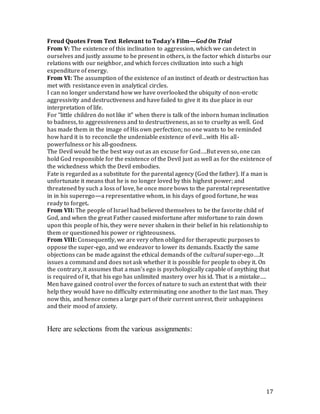
From VIII: Consequently, we are very often obliged for therapeutic purposes to
oppose the super-ego, and we endeavor to lower its demands. Exactly the same
objections can be made against the ethical demands of the cultural super-ego….It
issues a command and does not ask whether it is possible for people to obey it. On
the contrary, it assumes that a man’s ego is psychologically capable of anything that
is required of it, that his ego has unlimited mastery over his id. That is a mistake….
Men have gained control over the forces of nature to such an extent that with their
help they would have no difficulty exterminating one another to the last man. They
now this, and hence comes a large part of their current unrest, their unhappiness
and their mood of anxiety.
Here are selections from the various assignments:
18


19


Freud action research

  • 1.
    1 Abstract of Paper Iam using this paper to document my experiences teaching Civilization and Its Discontents by Sigmund Freud to two separate classes:Mosaic 852 and 851. In the introduction of the paper, I will explain the background of both courses as a General Education sequence in Temple University’s core program. Then I will discuss the role of Freud in the first courseand the various difficulties that occurred because so many people did not understand the first book—IntroductoryLectures on Psychoanalysis and the students found the bookto be boring and unnecessary. Then I will discuss the decision to substitute Civilization and Its Discontents in lieu of Psychoanalysis. This is where my action research project comes into play. I am using the Proactive Action Research model, taken from the book Practical Action Research For Change by Richard A. Schmuck. In the second summer semester, I decided to pilot Civilization in its Discontents in Mosaic 852, even though it is not a part of the curriculum for that course, as I felt I could make it work, plus I wanted data from students who had already read Introductory Lectures to see if I could find a comparison in the reading experience. I also knew that some of them might have read Civilization and It’s Discontents in Summer Semester one as a few teachers were piloting it in their Mosaic 851 class. I wanted to see if my method of teaching made the reading different for them: clearer, convoluted, difficult, trite or boring. I also wanted to see if students already came with preconceived notions about Freud the thinker. Finally, I was concerned that the students had a full experience with the text and Freud, whether they enjoyed his writings or found them to be absurd. I specifically wanted to work with all three learning types: auditory, visual and tactile. So I designed activities that worked with all three learners, even if the tactile activities were, in my mind, not as well developed, and could have easily have verged on the ridiculous side. I still felt that all was useful because in learning, whatever works is good, and not all minds learn the same. To follow the proactive action research model, I decided to teach the book that wasn’t a part of the curriculum. (Try a New Practice.) When I taught the bookin the fall, I decided to make it the second text and include it in our first unit because I wanted their minds fresh with the new semester. So the proactive model continued in the second phase of my research, even though
  • 2.
    2 I will focusprimarily on my summer schoolexperience. For step 2, my hopes and concerns were the following: I wanted to establish prior knowledge of the material along with emotional attitudes, because Freud tends to affect people. If people remain indifferent, it is because he was not taught well and the student wasn’t engaged. I wasn’t concerned whether they agreed with Freud as it isn’t my job to convert people, but I wanted them to understand him and fully see his ideas so that they felt like mini Freudian experts. I also hoped that they could recognize why we still need to read Freud today, even if he isn’t perceived as relevant to many therapeutic communities or central to social scientific discourse. I wanted them to see that he mattered because he was the first to give us the idea of an interior self that he called the unconscious, something we now take for granted. My hope was that they would see that popular culture owes a great debt to Freud, as do many liberal arts and social scientific disciplines, even if that debt was shunned in those very circles. Finally my hope was that they began to think like Freud, even if it were only for the few weeks we studied the material. Steps 3 and 4 involve the collecting of data along with figuring what the data means. Since this research is based on two classes along with a few from about 3 years ago, it is hardly encompassing for all teachers. At the same time, it reaffirmed what I had suspected:Freud is necessary for students. I used surveys in one class, journal entries in both, brief assignments, puzzles, in class activities, discussionand movies. I will include selections from all of these to show the various ways Freud can be taught to a college audience. I will use the data to draw certain conclusions; namely, that Freud can be learned by any student if the teacher is willing to meet him or her where the student is, not where the instructor wants the student to be. The Mosaic sequence is not a prerequisite for becoming a psychologist or a psychoanalyst, but it is required by all undergraduates with the idea that they understand certain texts and methodology with the expressed hope that it helps them both in their chosen vocation and their daily lives.
  • 3.
    3 Introduction to Mosaic851 and 852 I work as a non-tenured track faculty member of the Intellectual Heritage Program. The idea of our program stems from the corecurriculum design in the undergraduate colleges of Columbia University and the University of Chicago. When I was hired, I began teaching a two-part course called Intellectual Heritage 51 and 52. The course was a chronological study of great works largely from the Western Civilization canon. IH 51 consisted of books like The Iliad, The Oresteia, TheRepublic, Bghaved Gita, TheQuran, and selections from the Holy Bible. IH 52 dealt with more recent history stemming from the enlightenment to postmodernism: we read On the Origin of Species, Uncovering Our Masks: A Freud Reader, CommunistManifesto, The Second Treatise of Government, Whatis the Fourth of July to a Slave, Letter From Birmingham Jail and Selections from various British and American Romantic poets. The coursewas writing intensive, meaning that we assigned several formal essays and allowed rewrites. It was styled as a traditional college course. In the fall of 2007, the university administration enforced a change to our curriculum. We began teaching a two-part coursecalled Mosaic. The intention was to modernize our approachto critical thinking within a general education course. The coursewas thematic: Mosaic 851 had four themes- Journeys, Self and Other, Community and Ways of Knowing. Mosaic 852 also had four themes: Science, Power, Money and City/Environment. Each theme required two texts—one text was mandatory and the other was chosen from a list of five texts according to the professor’swhim. The coursewas reading intensive, so we were no longer required to assign formal essays with rewrites. Instead, many of us experimented with blogs, journals, discussionforums, mind maps, portfolios and other non-traditional assignments. Please see the following chart for the text selection, with notations of changes within the text selection over the past two years. The topic for this paper developed after our associate director proposed that the program allowed for a choice within the required readings of the Self and Other Unit, beginning in Fall, 2013. Up until that point, we were using Freud’s Introductory Lectures on Psychoanalysis. The associate director ordered a new edition of Freud’s Civilization and Its Discontents, and
  • 4.
    4 suggested that instructorschoosebetween the two texts for that particular unit, along with a subsequent text from the suggested list. (See table). A collective sigh of relief came from many instructors who did not understand Freud’s Introductory Lectures to Psychoanalysis, or many of Freud’s writings for that matter1. Many felt that the bookwas ungainly and time consuming. Many instructors, including myself, understood the book and Freud’s theories just fine; however, we recognized that it was not a good beginning bookto the complexity of Freud’s thought. The lectures were comprised from notes taken from Freud’s teachings in German, and then translated into English. One had to understand Freud well to look for clues to his thought and familiarize himself or herself with the vocabulary of the text as well as traditional Freudian terms. (Find an example.) So the text was problematic, but not impossible to teach. Yet to teach it well meant sacrificing some of the texts in the later unit, like Genesis and other belief centered texts. Using Civilization and Its Discontents seemed to take that problem away, and many instructors found the text easier to understand and to manipulate in order to apply it to other classroomthemes. I was fortunate to have a strong background in Freud from graduate school, as my advisor was a Freudian. I also had a mentor in my first year at Temple who had edited the book Uncovering Our Masks—our reader in the original IH on Freud. So I felt secure in teaching Freud; moreover, it was important to me. I often neglected to teach the last unit other than The Daodejing, because I felt strongly that Freud was essential for a good undergraduate education as he gave us a road map into our own mind, which allowed us to understand the motivations of others as well. I expected that Civilization would be less ungainly, but I guessed that I would still need to focus on 1 Many faculty members from IH believed that the book list represented personal favorites of the IH director who made the final decision on themes and texts in the course. This director often opted to use Introductory Lectures instead of the mandated text Uncovering Our Masks in his IH classes. The Mosaic course was intended to stress primary texts, not compilations. However, the original Introductory Lectures were a series of lectures Freud gave at the University of Vienna in the winter terms of 1915 to 1917. They were first individually published, then serialized, then finally put into one volume in 1917. Later lectures on key changes to Freud’s original theories were included in New Introductory Lectures on Psychoanylysis, published in 1933. Our text included the later lectures as well. In short, people resented the text, as many perceived it as a personal favorite, not one that may be readable for college sophomores.
  • 5.
    5 teaching the studentsa lot of background on Freudian thought, whether the text covered it or not, as Civilization is a later text. Freud’s original readers already understood Freud’s paradigm as they read the book. My students would need to understand it as well. I kept all of this in mind as I began to use Civilization and Its Discontents as a text in Mosaic, first as a supplemental text in my summer Mosaic 852 class when it is assumed that students have already read Freud, then in my fall 851 class where many were reading Freud for the first time. The class met for six weeks on Monday, Tuesdays, Wednesdays and Thursdays from 9 to 11 am. Action ResearchProject:Step 1 Try a New Practice Usually I begin any course with an online journal on Blackboard in which the students answer a series of questions about their major, any previous Mosaic courses, hobbies, and preferences for class style. For my summer Mosaic 852 class, I decided to ask a few different questions. (See the journal questions below:) Please answer the following questions in the order you see listed below. 1. Your name and what you wouldlike to be called(nickname) 2. Your major. Why did you choose this major? What do you hope to do with your degree? 3. Did you take Mosaic 851? When? With whom? (I generallyknow which teachers emphasize certain material like the Tao or Gilgamesh.) 4. Did you have a good experience? Why or why not? (This is private.) 5. What makes a class interesting and fairly painless for you? 6. What do you expect Mosaic 852 to be? 7. Is there anything that you would like me to know about you--personal or otherwise? 8. What do you like to do when you don't have to work, study, go to class or fulfill any other obligations? 9. Did you read Civilization and Its Discontents by Sigmund Freud inyour Mosaic 851 class? If so, what did you think of it? If not, did you read Introductory Lectures to Psychoanalysis? If so, what did you think of it? If you read no Freud at all in your Mosaic 851, please let me know. (We will be reading some selections from Civilization and Its Discontents in our section
  • 6.
    6 along withanother briefreading by Freud from a book called The Uncanny that deals withthe paranormal and the creative process.)2 All of this helps me to know you better and think more mindfully about the flow of the course. Question 5 and 9 were new questions for me. Question 5 was my attempt to see what students like. Question 9 was my attempt to gather research for this study, and see the level of preparation. Here are some of the replies from question 9. Please note that the students who read Civilization and Its Discontents had just come from a Summer I Mosaic 851 class, so their experience with the book was approximently 4 weeks prior to my class: 1. In Mosaic 851, we read Lectures to Psychoanalysis. Honestly, I do not have much of an opinion on it because we barely discussed it (my teacher did not utilize our class time wisely and we did not get too deep into it). What we did discuss, I honestly cannot remember because it did not stick with me. 2. I did read Civilization and Its Discontents by Sigmund Freud; this was my first adult experience with Freud. I find his arguments persuasive, well constructed, however I'm not persuaded enough by Freud's writing to adopt his views as my own. 3. We read introductory lectures in our mosaics 851 classes. I feel I don’t remember it exactly, but if I am thinking right it talked about dreams. How they are interpreted, but also talked about sex and the male anatomy. I remember it was a different book than usual, but it was hard to read because it was a bit boring. I'm hoping to read this book we'll have better though since I’ll know what to expect in a way.4. 5. In my Mosaics 851 I read Freud’s Introductory Lectures to Psychoanalysis. I thought that it was kind of interesting. I learned about Freud in a Psych class, and that was a little easier to understand than his lectures. But we did jump around a lot, so I may not have gotten the full effect. And the main thing we did with it was analyze our own dreams, and mine weren’t really comparable to the ones described in Freud. I think the concepts are interesting, but I didn’t really grasp it. 6. I read Freud Introductory Lectures to Psychoanalysis. I did not enjoy reading it. I don’t like how he explains a whole scenario and makes you believe it’s totally correct then flips around and says it’s actually incorrect. I feel like it was very basic concepts just made so difficult. 7. Yes, confusiong to read, easy to talk about. Also read the future of an illusion, same opinion. (This student had read Civilization and Its Discontents.) 2 I did not use selections from The Uncanny due to time constraints.
  • 7.
    7 8. I readFreud’s Introductory Lectures to Psychoanalysis. I did not like the book because I thought that most of what Freud said was nonsense and we spent far too long on the topic. 9. I read Freud's Introductory Lectures to Psychoanalysis was definitely intrigued by Freud's theories on psychoanalysis and the influence that he had on modern thinking. 10.In my Mosaics 851 I read Freud’s Introductory Lectures to Psychoanalysis. I thought that it was kind of interesting. I learned about Freud in a Psych class, and that was a little easier to understand than his lectures. But we did jump around a lot, so I may not have gotten the full effect. And the main thing we did with it was analyze our own dreams, and mine weren’t really comparable to the ones described in Freud. I think the concepts are interesting, but I didn’t really grasp it. 11.I read Freud's Introductory Lectures to Psychoanalysis and loved it. I am very intrigued with psychology and have always held an interest in the field. 12.I didn't read any of those books. 13.He just told us what we should memorize for exams, because we always run out of time. 14.We did read something by Freud but it's hard to remember which title. (All information taken from the first assignment in Mosaic 852, Section 22 at Temple University in Summer II term. Grammar, syntax and spelling have not been altered.) The sampling of responses told me what I had already assumed: most students did not engage deeply in the text, whether it was Introductory Lectures or Civilization and Its Discontents. I had not asked for specific examples of Freudian thought, so I did not expect to see them in the responses, and they were not. The few students who seemed to enjoy Freud were all male. Response2 came from a returning veteran who loved being in college, and worked very hard, often setting the standard for class discussion very high. Response9 came from a motivated business student who was fascinated with the theories of Ayn Rand and loathed Marxism, so he found Freud to be an ally in his belief that humans acted largely out of self-interest. Response11 came from another business student who behaved largely as an observer in the class. He only spokewhen I called on him, but always came highly prepared and wrote superb papers. I told the students that I planned to use their responses anonymously for my project on Freud. I explained to them the nature of my research. They became more motivated to read the text after they knew they would be a part
  • 8.
    8 of their professor’spaper.They also agreed to cooperateand put forth their best effort. I also affirmed that I wanted candor, not canned responses that they thought I would like as I too was trying to learn. Surveys: The next day in class, I passed out a survey. We still had not begun the text; we were reading Edmund Jenner’s Vaccination Against Smallpox,3 but I wanted them to anticipate the Freud reading which they would begin that weekend. Please see the following for the survey. Survey on Freud 1. What books if any have you read by Freud? 2. In your own words, tell me what these words mean. If you don’t know the answer, just say I don’t know. a. id b. ego c. superego d. defense mechanism e. repression f. displacement g. projection h. libido i. pleasure principle j. narcissism k. unconscious l. preconscious m. thanatos n. neurosis 3 This text is always the first to read in the Mosaic 852 course.
  • 9.
    9 3 students wereabsent that day, so I received 19 responses. Here is the breakdown of the survey: Number of completed surveys: 194 Question 1: Civilization and its Discontents: 2 Introductory Lectures: 11 Civilization and Lectures: 2 No answer: Question 2: a. id-4 correct answers, 7 attempts to answer and 10 either left blank or marked I don’t know or I don’t remember or no idea b. ego- 6 correct answers, 2 attempts to answer and 11 left blank or marked I don’t know, I don’t remember or no idea c. superego-2 correct answers, 7 attempts to answer and 10 left blank or marked I don’t know, I don’t remember or no idea d. defense mechanisms-2 correct answers,15 attempts to answer and 2 left blank or marked I don’t know, I don’t remember or no idea e. repression5-10 correct answers, 5 attempts to answer and 4 either left blank or marked I don’t know or no idea f. displacement-4 correct answers, 7 attempts to answer, and 8 left blank or marked I don’t know, I don’t remember or no idea 4 It appeared from the survey that the majority of students woefully lacked the most basic tools to recognize Freudian thought: vocabulary. How could this be? I do know that some professors do not spend time on given terms, but expect students to look them up themselves. Some students rely heavily on Spark Notes and other college short cut material. Most students will ignore the terms that these services provide unless they figure they need to know them for an exam: these students are products of the No Child Left Behind obsession with standardized testing. Some students did not understand Freud at all, so it is expected that they would not know the definitions to given terms. Some students simply will not read, and skim through much of the reading in Mosaic classes. But these are only suppositions, as I did no research to back up any of these thoughts. 5 I will opine that many knew repression along with libido and unconscious because of various pop culture references along with general daily speech patterns. I personally believe that pop culture is our friend when teaching Freud and we should use it to our fullest advantage.
  • 10.
    10 g. projection-2 correctanswers, 7 attempts to answer, and 10 left blank or marked I don’t know, I don’t remember or no idea h. libido-10 correct answers, 3 attempts to answer and 6 left blank or marked I don’t know, I don’t remember or no idea i. pleasure principle-2 correct answers, 4 attempts to answer and 13 left blank or marked I don’t know, I don’t remember or no idea j. narcissism-6 correct answers, 6 attempts to answer and 7 left blank or marked I don’t know, I don’t remember or no idea k. unconscious-8 correct answers, 8 attempts to answer and 3 left blank or marked I don’t know, I don’t remember or no idea l. preconscious-5 correct answers, 1 attempt to answer and 13 left blank or marked I don’t know, I don’t remember or no idea m. Thanatos- 2 correct answers, 1 attempt to answer and 16 left blank or marked I don’t know, I don’t remember or no idea o. neurosis-0 correct answers, 4 attempts to answer and 15 left blank or marked I don’t know, I don’t remember or no idea Step 2: Incorporate Hopes and Concerns:After reading the surveys, I decided to spend a good amount of time teaching vocabulary as well as the general concepts within the text. The first trick was getting the students to recognize the words even before they were able to define them. I found a site online that makes word search puzzles. I developed a puzzle for the following Monday to do in class without telling the students that anything like this would take place; they only knew that they had to read chapters 5 through 9 in the book. Word Puzzle When Monday came, the students were visibly disturbed. Even though the majority had some background in Freud, they insisted that the text was very difficult; they did not understand what he was talking about and so forth. When they saw the photocopied sheets in my hand, they figured I was giving them a pop quiz to see if they had done the reading. Instead, I passed out the puzzles, and gave them the option of working alone or working in groups. Some students began alone, but walked up to other students to compare answers. Others divided up vocabulary and worked together. Some remained alone.
  • 11.
  • 12.
    12 We spent 45minutes on the puzzle exercise. The students really enjoyed the activity. Then I put each student with one partner and gave him or her 5 words to define. I let them look them up on their phone, their laptop or tablet. After they completed that part of the activity, we shared the definitions. I corrected a few of them so that they sounded more Freudian. (For example, a symbol is a representation of an idea, but in Freudian terms, it is a specific sign of a repressed event in the unconscious that the ego uses to protect itself. The ego needs symbols to remain unthreatened, but when we unravel the symbols, we begin to get to the heart of the unconscious conflict.) Some wrote the definitions down, but I advised them to hear the definitions and listen to me use them as a Freudian instructor so that they did not fall into the trap of memorizing. Instead, I wanted them to get a feel for the language. We played around with the words for about 15 minutes, then I decided that we needed to get into the text. I had only assigned them chapters 5 to 9, thinking that I needed to abbreviate the reading to get through the unit quicker as it was a six-week course. But I could have assigned only one chapter and the result may have been the same: they were confused and frustrated. They agreed that the vocabulary exercises helped, but they were not able to get a sense of Freud’s ideas. Something in his style put them off. They would look at the text and just not understand what he was saying. So I tried this technique. I prefaced each chapter with a series of questions that I put on the board. I also listed key vocabulary terms, even if I ended up repeating myself. I decided that the word search would be a metaphor of how I planned to get into the text. I wrote a brief summary of each chapter on the board as I saw it. 6I also noted parts in the text where I would ask them to read aloud. wanted them to be guided by the questions and steered by the vocabulary. I wanted to provide them with a road map.7 Here is a table of how I designed the 4 required chapters. Chapter 5 is column one and the table continues to chapter 8. 6 I knew I could not stop them from Spark Notes and the like, but I wanted it to be clear that I was not guided by Spark Notes, Wikipedia and other summarizing sources. 7 I ended up putting the majority of the questions in a document called Study Questions on Civilization and Its Discontents, which I will include in this paper.
  • 13.
  • 14.
    14 Summary: The intolerable to Neurotics. Displacementof the libido from sexuality to aggression. Freud’s inability to comprehend religious thought, particularly the ideal: Love thy Neighbor along with his contempt for communism. Summary: Freud is in despair over the human need for God. God is as responsible for evil as he is for good. He created the devil as an excuse. Man needs polar opposites to comprehend his world: good/evil. Freud likens it to the internal struggle between Eros and Death, the life and death instinct in humans. Summary: Origins of Guilt. Emergence of societal superego as moral authority. Two origins of guilt: fear of authority, fear of superego. Aggressive instinct is tempered by superego for the bidding of civilization. Likened to Oedipal Complex: son kills father becomes human guilt for killing primal father: original sin. The will(intention) to kill creates the guilt. Summary: Our sense of guilt demands punishment. Our guilt is an unfulfilled erotic demand. Our neurotic symptoms are a substitute for sex. Civilization is also about the pursuit of happiness for humans, but it cannot happen because they must displace and repress their primal instincts. The development of the individual is sacrificed for the good of the community. Keywords: libido, libidinal, Eros, aggression, neurotic Keywords: narcissism, object libido, ego instincts, object instincts, pleasure principle, Eros, Death Instinct, Keywords: Oedipal Complex, superego, social anxiety, libido, ego, infantile state, fetish, fear of authority, aggressiveness Keywords: cultural superego, altruism, happiness, guilt, remorse, civilization, need for punishment, aggression, neurosis, sadistic superego Read aloud: paragraph 3, paragraph 5, paragraph 8, paragraph 9 paragraph 12 Read aloud: paragraph 4 (second half) paragraph 5, paragraph 6 Read aloud: paragraph 5, paragraph 7, paragraph 8 (second part)paragraph 9, paragraph 11 paragraph 13 (first part) Read aloud: paragraph 3. paragraph 4, paragraph 6, paragraph 7 (second half) paragraph 10. paragraph 11 final paragraph Ideas: Displacement and Repressionin our moral thought. We repress our instincts and channel our instinctual passions to make religion work. Ideas: Death Instinct, Humans bent toward self- sabotage, Aggression as Instinct. We live in struggle between life instinct (Eros) and death instinct. (Thanatos). Ideas: We live in a state of bad conscience that we must reconcile. Guilt is a primary force within the superego that helps to build civilization and subjugate human instinct. Ideas: Results of displacement and repression. Freud is pessimistic about the success of civilization It means that man is always seeking an illusion of happiness He denies primal part of himself. He transfers his libido to the superego, causing neurosis and a culture that supports sickness.
  • 15.
    15 Instead of puttingthem into groups, we did this as a class. I gave them an assignment to read my PowerPoint on Freud, which I will include separately with this paper. This way they had a working definition and a familiarity with Freud from a sourceI created. Each chapter led into great discussions from the role of religion to the restrictions that civilization puts upon all of us. There were some strict Christians in my class who found Freud’s critique on Christianity frustrating as they felt he missed the point of faith.8 They also hastened to point out that he had no real prooffor his theories; he was going on a hunch after he had seen the destruction of the Europe he knew after World War 1. Others appreciated his reasoning as they were in rebellion against religion or simply had no God belief. They felt that Freud had given a voice to what they had always known: religion is a crutch, we create God to soothe ourselves and we often fail to understand the sourceof our guilt. They were less sold on the Oedipal Complex, and did not quite agree that it causes our collective guilt, but almost all of the students were fascinated with the idea that God is a function of our narcissism. We basically create God the father as a stern, punishing paternal authority that reduces humans to the children they are. Even though my more religiously minded students disagreed, they did see the relationship of the Judeo- Christian God to an angry father forced to discipline his children.9 Before I closed my teaching of the text, I showed them a movie called God on Trial. The film deals with a group of men whoare sentenced to death by selection in Auchwitz. They decide to putGod on trial. I thoughtit would be an 8 I had one Muslim student in my summer class who embraced the reading thoroughly and felt absolutely no threat to his belief system, even though he considered himself a devout Muslim. In the fall semester, I had several Muslim students who also enjoyed the reading and did not feel the least bit disrespected by Freud’s disdain for religion. I cannot explain their reaction, but it is something I would like to understand. One student told me that Allah is many things: he named various attributes to him such as all-merciful, all-powerful, all-forgiving, all-knowing and all-seeing. I may ask my Muslim students directly how Freud relates to their belief system in the upcoming semester. 9 When I used to teach Introductory Lectures to Psychoanalysis in Mosaic 851, I would follow the text with a short story by Franz Kafka called “The Judgment”. I will include it separately with this paper. The story deals with the concept of the Exalted Father who sits in judgment of his son. I also would show clips from Star Wars—the relationship between Luke and Darth Vader and Luke’s relationship with Obi Wan Kenobi.
  • 16.
    16 interesting look atother ways of looking at God as either an illusion, a criminal, irresponsible or a mystery to be accepted without doubt. The film for some was emotionally challenging to watch, and I admit that it has put me in tears. Many students left the room for periods of time, then returned. Later on, they admitted that they just could not deal with it. I will include a YouTube link to the film and the PBS page. ( http://www.youtube.com/watch?v=5caAug5n8Zk, http://www.pbs.org/wgbh/masterpiece/godontrial/). I decided to base my final assignment on the film and Civilization and Its Discontents. Step 3: CollectData Here is the assignment I gave the students along with some key quotes from the text. Since we had done so much work with the text itself, I decided not to make the writing assignment very difficult. To me, the key was knowing that they understood the text, not how eloquently they could retell some aspectof Freud I had wanted to stress. Assignment on Civilization and Its Discontents and God on Trial Note: This assignment was meant as group work, but I am ill today, so I’m revising it so that it can be done individually. Please get it to me by Sunday, Aug. 4. You can email it to me. It isn’t very long. Feel free to use all resource material on BB, including my lecture and powerpoint on Freud. Just make sure you cite them if you use them. I will turn a blind eye if you look at Spark Notes for further clarification as we all do it, but please don’t quote from them or Wikipedia or any general internet sources as they are not authoritative. Do this assignment sooner than later, while everything is fresh in your mind. 1. Tell me your reaction to the movie. What did it make you feel? 2. Does the film echo Freud’s anger and despair at a God he believes does not exist? Look for the quotes in which Freud discusses his views on God to support your points. 3. Do you think Freud is right about civilization? If so, what part makes sense to you? What parts do not make sense to you? Make sure you look at the text. 4. What did you learn about Freud that you didn’t already know from Mosaic 851? How do you think Freud connects to both Mosaic 851 and 852? Why do you think we use him in our curriculum? What do you think we intend for students to get out of reading Freud?
  • 17.
    17 Freud Quotes FromText Relevant to Today’s Film—God On Trial From V: The existence of this inclination to aggression, which we can detect in ourselves and justly assume to be present in others, is the factor which disturbs our relations with our neighbor, and which forces civilization into such a high expenditure of energy. From VI: The assumption of the existence of an instinct of death or destruction has met with resistance even in analytical circles. I can no longer understand how we have overlooked the ubiquity of non-erotic aggressivity and destructiveness and have failed to give it its due place in our interpretation of life. For “little children do not like it” when there is talk of the inborn human inclination to badness, to aggressiveness and to destructiveness, as so to cruelty as well. God has made them in the image of His own perfection; no one wants to be reminded how hard it is to reconcile the undeniable existence of evil…with His all- powerfulness or his all-goodness. The Devil would be the best way out as an excuse for God….But even so, one can hold God responsible for the existence of the Devil just as well as for the existence of the wickedness which the Devil embodies. Fate is regarded as a substitute for the parental agency (God the father). If a man is unfortunate it means that he is no longer loved by this highest power; and threatened by such a loss of love, he once more bows to the parental representative in in his superego—a representative whom, in his days of good fortune, he was ready to forget. From VII: The people of Israel had believed themselves to be the favorite child of God, and when the great Father caused misfortune after misfortune to rain down upon this people of his, they were never shaken in their belief in his relationship to them or questioned his power or righteousness. From VIII: Consequently, we are very often obliged for therapeutic purposes to oppose the super-ego, and we endeavor to lower its demands. Exactly the same objections can be made against the ethical demands of the cultural super-ego….It issues a command and does not ask whether it is possible for people to obey it. On the contrary, it assumes that a man’s ego is psychologically capable of anything that is required of it, that his ego has unlimited mastery over his id. That is a mistake…. Men have gained control over the forces of nature to such an extent that with their help they would have no difficulty exterminating one another to the last man. They now this, and hence comes a large part of their current unrest, their unhappiness and their mood of anxiety. Here are selections from the various assignments:
  • 18.
    18 


  • 19.
    19