 FRENCH
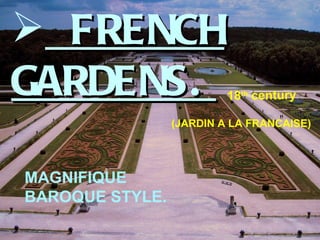
FRENCH
GARDENS.
GARDENS. 18th
century
MAGNIFIQUE
BAROQUE STYLE.
(JARDIN A LA FRANCAISE)
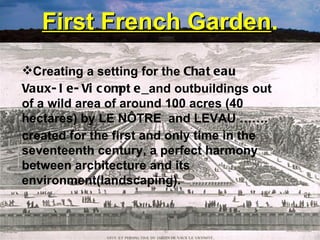
First French Garden
First French Garden.

Creating a setting for the Chat eau
Vaux- l e- Vi com
pt e and outbuildings out
of a wild area of around 100 acres (40
hectares) by LE NÔTRE and LEVAU …….
created for the first and only time in the
seventeenth century, a perfect harmony
between architecture and its
environment(landscaping).
The French garden…
 The French gardens were inspired by
the “Italian renaissance garden.
 symmetry and geometry are the
keywords when designing such
gardens.
 the whole of garden is composed like
a painting reaching for pure aesthetical
qualities.
 Like a painting, it is also created to be
seen as a whole
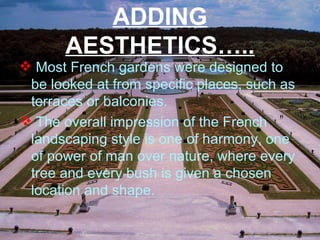
ADDING
AESTHETICS…..
 Most French gardens were designed to
be looked at from specific places, such as
terraces or balconies.
 The overall impression of the French
landscaping style is one of harmony, one
of power of man over nature, where every
tree and every bush is given a chosen
location and shape.
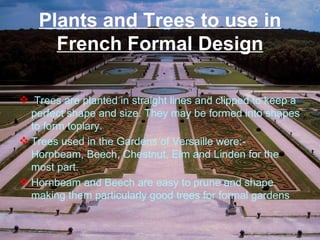
Plants and Trees to use in
French Formal Design
TREES:-
 Trees are planted in straight lines and clipped to keep a
perfect shape and size. They may be formed into shapes
to form topiary.
 Trees used in the Gardens of Versaille were:-
Hornbeam, Beech, Chestnut, Elm and Linden for the
most part.
 Hornbeam and Beech are easy to prune and shape
making them particularly good trees for formal gardens.
Plants and Trees to use in
French Formal Design
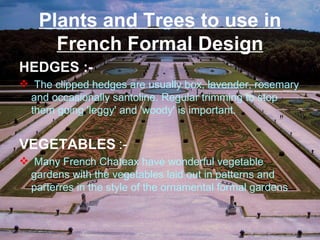
HEDGES :-
 The clipped hedges are usually box, lavender, rosemary
and occasionally santoline. Regular trimming to stop
them going 'leggy' and 'woody' is important.
VEGETABLES :-
 Many French Chateax have wonderful vegetable
gardens with the vegetables laid out in patterns and
parterres in the style of the ornamental formal gardens.
Plants and Trees to use in
French Formal Design
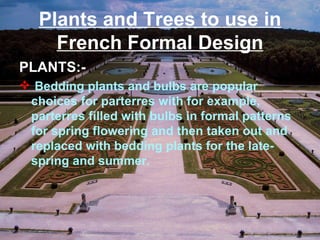
PLANTS:-
 Bedding plants and bulbs are popular
choices for parterres with for example,
parterres filled with bulbs in formal patterns
for spring flowering and then taken out and
replaced with bedding plants for the late-
spring and summer.
KEY FEATURES
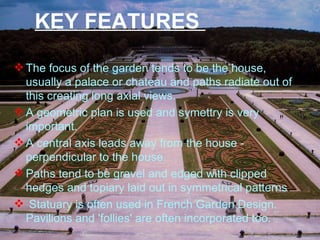
The focus of the garden tends to be the house,
usually a palace or chateau and paths radiate out of
this creating long axial views.
A geometric plan is used and symettry is very
important.
A central axis leads away from the house -
perpendicular to the house.
Paths tend to be gravel and edged with clipped
hedges and topiary laid out in symmetrical patterns.
 Statuary is often used in French Garden Design.
Pavilions and 'follies' are often incorporated too.
KEY FEATURES
 Water is often a key feature of French garden design
and lots of round pools and long rectangles of water will
be incorporated, the reflection of the water adding to the
symmetry and tranquillity of the scene. Fountains and
cascades are also very common features.
 Close to the house planting is kept low (no trees) and
tends to consist of parterres. Parterres close to the
house can be quite intricately patterened and will tend to
become more simple further from the house.
 Further from the house paths are often edged with trees,
these are almost almost always manipulated in some
way (see below). Trees are always planted in straight
lines adding perspective and reinforcing the symmetry of
the garden.
FRENCH
GARDENS
FRENCH
GARDENS
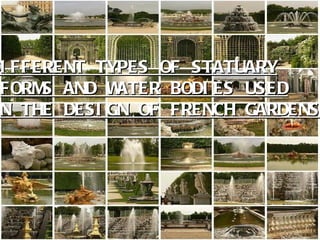
DI FFERENT TYPES OF STATUARY
FORM
S AND W
ATER BODI ES USED
FORM
S AND W
ATER BODI ES USED
N THE DESI GN OF FRENCH GARDENS
N THE DESI GN OF FRENCH GARDENS.
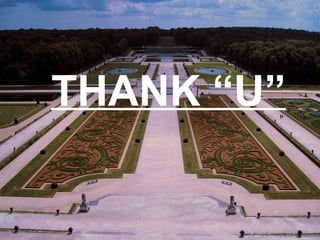
THANK “U”

presentation1 garden analysis show categories

  • 1.
  • 2.
    First French Garden FirstFrench Garden.  Creating a setting for the Chat eau Vaux- l e- Vi com pt e and outbuildings out of a wild area of around 100 acres (40 hectares) by LE NÔTRE and LEVAU ……. created for the first and only time in the seventeenth century, a perfect harmony between architecture and its environment(landscaping).
  • 3.
    The French garden… The French gardens were inspired by the “Italian renaissance garden.  symmetry and geometry are the keywords when designing such gardens.  the whole of garden is composed like a painting reaching for pure aesthetical qualities.  Like a painting, it is also created to be seen as a whole
  • 4.
    ADDING AESTHETICS…..  Most Frenchgardens were designed to be looked at from specific places, such as terraces or balconies.  The overall impression of the French landscaping style is one of harmony, one of power of man over nature, where every tree and every bush is given a chosen location and shape.
  • 5.
    Plants and Treesto use in French Formal Design TREES:-  Trees are planted in straight lines and clipped to keep a perfect shape and size. They may be formed into shapes to form topiary.  Trees used in the Gardens of Versaille were:- Hornbeam, Beech, Chestnut, Elm and Linden for the most part.  Hornbeam and Beech are easy to prune and shape making them particularly good trees for formal gardens.
  • 6.
    Plants and Treesto use in French Formal Design HEDGES :-  The clipped hedges are usually box, lavender, rosemary and occasionally santoline. Regular trimming to stop them going 'leggy' and 'woody' is important. VEGETABLES :-  Many French Chateax have wonderful vegetable gardens with the vegetables laid out in patterns and parterres in the style of the ornamental formal gardens.
  • 7.
    Plants and Treesto use in French Formal Design PLANTS:-  Bedding plants and bulbs are popular choices for parterres with for example, parterres filled with bulbs in formal patterns for spring flowering and then taken out and replaced with bedding plants for the late- spring and summer.
  • 8.
    KEY FEATURES The focusof the garden tends to be the house, usually a palace or chateau and paths radiate out of this creating long axial views. A geometric plan is used and symettry is very important. A central axis leads away from the house - perpendicular to the house. Paths tend to be gravel and edged with clipped hedges and topiary laid out in symmetrical patterns.  Statuary is often used in French Garden Design. Pavilions and 'follies' are often incorporated too.
  • 9.
    KEY FEATURES  Wateris often a key feature of French garden design and lots of round pools and long rectangles of water will be incorporated, the reflection of the water adding to the symmetry and tranquillity of the scene. Fountains and cascades are also very common features.  Close to the house planting is kept low (no trees) and tends to consist of parterres. Parterres close to the house can be quite intricately patterened and will tend to become more simple further from the house.  Further from the house paths are often edged with trees, these are almost almost always manipulated in some way (see below). Trees are always planted in straight lines adding perspective and reinforcing the symmetry of the garden.
  • 10.
  • 11.
    DI FFERENT TYPESOF STATUARY DI FFERENT TYPES OF STATUARY FORM S AND W ATER BODI ES USED FORM S AND W ATER BODI ES USED N THE DESI GN OF FRENCH GARDENS N THE DESI GN OF FRENCH GARDENS.
  • 12.