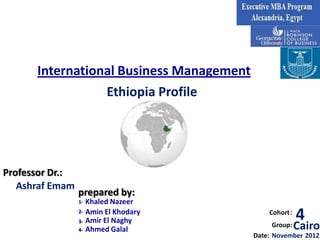
International Business Management
                 Ethiopia Profile


Professor Dr.:
   Ashraf Emam
                 prepared by:
                 1-   Khaled Nazeer
                 2-
                 3-
                      Amin El Khodary
                      Amir El Naghy
                                              Cohort :
                                                         4
                 4-   Ahmed Galal
                                                Group:   Cairo
                                          Date: November 2012
Ethiopia Overview
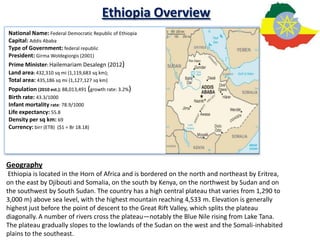
National Name: Federal Democratic Republic of Ethiopia
Capital: Addis Ababa
Type of Government: federal republic
President: Girma Woldegiorgis (2001)
Prime Minister: Hailemariam Desalegn (2012)
Land area: 432,310 sq mi (1,119,683 sq km);
Total area: 435,186 sq mi (1,127,127 sq km)
Population (2010 est.): 88,013,491 (growth rate: 3.2%)
Birth rate: 43.3/1000
Infant mortality rate: 78.9/1000
Life expectancy: 55.8
Density per sq km: 69
Currency: birr (ETB) ($1 = Br 18.18)


Geography
 Ethiopia is located in the Horn of Africa and is bordered on the north and northeast by Eritrea,
on the east by Djibouti and Somalia, on the south by Kenya, on the northwest by Sudan and on
the southwest by South Sudan. The country has a high central plateau that varies from 1,290 to
3,000 m) above sea level, with the highest mountain reaching 4,533 m. Elevation is generally
highest just before the point of descent to the Great Rift Valley, which splits the plateau
diagonally. A number of rivers cross the plateau—notably the Blue Nile rising from Lake Tana.
The plateau gradually slopes to the lowlands of the Sudan on the west and the Somali-inhabited
plains to the southeast.
Ethiopia History Profile
- Ethiopia is one of the oldest kingdoms in the world and
certainly the oldest independent country in Africa.
- Ancient Ethiopia is mentioned in Greek history as well as Hebrew
  history. Ethiopia managed to avoid colonization from Europe unlike
  most other African areas and countries.
- During World War II, Italy occupied the country for a few years, but
  was removed when they lost the war.
- In modern times Ethiopia has been ravaged by famine and military
  coups.
- For many years Ethiopia was a place of unrest and civil strife.
  Refugees starved as different military regimes fought for power.
- Some peace was restored in 1995 with the establishment of a
  constitution and multiparty elections.
- Ethiopia currently has a border dispute with Eritria
Ethiopia Demography Profile

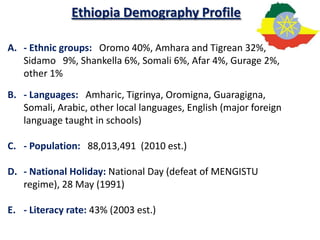
A. - Ethnic groups: Oromo 40%, Amhara and Tigrean 32%,
   Sidamo 9%, Shankella 6%, Somali 6%, Afar 4%, Gurage 2%,
   other 1%

B. - Languages: Amharic, Tigrinya, Oromigna, Guaragigna,
   Somali, Arabic, other local languages, English (major foreign
   language taught in schools)

C. - Population: 88,013,491 (2010 est.)

D. - National Holiday: National Day (defeat of MENGISTU
   regime), 28 May (1991)

E. - Literacy rate: 43% (2003 est.)
Ethiopia Economic Profile
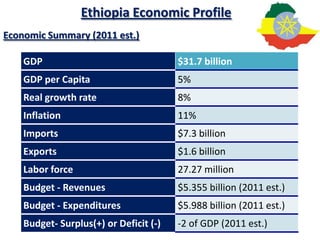
Economic Summary (2011 est.)

    GDP                                 $31.7 billion
    GDP per Capita                      5%
    Real growth rate                    8%
    Inflation                           11%
    Imports                             $7.3 billion
    Exports                             $1.6 billion
    Labor force                         27.27 million
    Budget - Revenues                   $5.355 billion (2011 est.)
    Budget - Expenditures               $5.988 billion (2011 est.)
    Budget- Surplus(+) or Deficit (-)   -2 of GDP (2011 est.)
Ethiopia Economic Profile Cont.

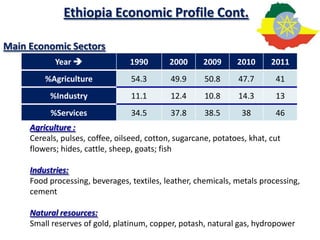
Main Economic Sectors
            Year                1990        2000     2009      2010      2011
         %Agriculture             54.3       49.9      50.8     47.7       41
          %Industry               11.1       12.4      10.8     14.3       13
          %Services               34.5       37.8      38.5      38        46
     Agriculture :
     Cereals, pulses, coffee, oilseed, cotton, sugarcane, potatoes, khat, cut
     flowers; hides, cattle, sheep, goats; fish

     Industries:
     Food processing, beverages, textiles, leather, chemicals, metals processing,
     cement

     Natural resources:
     Small reserves of gold, platinum, copper, potash, natural gas, hydropower
Ethiopia Investment Overview
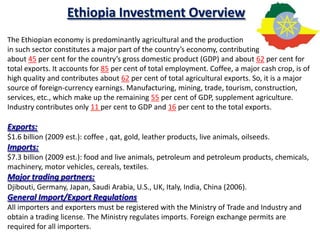
The Ethiopian economy is predominantly agricultural and the production
in such sector constitutes a major part of the country’s economy, contributing
about 45 per cent for the country’s gross domestic product (GDP) and about 62 per cent for
total exports. It accounts for 85 per cent of total employment. Coffee, a major cash crop, is of
high quality and contributes about 62 per cent of total agricultural exports. So, it is a major
source of foreign-currency earnings. Manufacturing, mining, trade, tourism, construction,
services, etc., which make up the remaining 55 per cent of GDP, supplement agriculture.
Industry contributes only 11 per cent to GDP and 16 per cent to the total exports.

Exports:
$1.6 billion (2009 est.): coffee , qat, gold, leather products, live animals, oilseeds.
Imports:
$7.3 billion (2009 est.): food and live animals, petroleum and petroleum products, chemicals,
machinery, motor vehicles, cereals, textiles.
Major trading partners:
Djibouti, Germany, Japan, Saudi Arabia, U.S., UK, Italy, India, China (2006).
General Import/Export Regulations
All importers and exporters must be registered with the Ministry of Trade and Industry and
obtain a trading license. The Ministry regulates imports. Foreign exchange permits are
required for all importers.
Ethiopia Profile

Relation between Egypt & Ethiopia:

- The diplomatic relation between Ethiopia and Egypt has strengthened since the
  aftermath of Egyptian Revolution that brought the Mubarek regime to its ends in
  the 2011. There is at least a general understanding to stick to a win-win approach
  particularly in connection with the utilization of the Nile Waters.


Our Recommendations:

- There are many potential investments in Ethiopia which lead the other countries to
  think for investing in Ethiopia. The investment areas are in electricity, livestock
  ,agricultures and Information Technology (particularly in Gov. e-Payment Services.).
  Egypt has long experience in electricity field especially after established high dam
  and in IT field.
- Documents from Ethiopian Ministry of Water and Energy indicate that about 95 per
  cent of the Nile Waters hasn’t been used yet. If there is common understanding
  and cooperation among the people along the region to develop various projects
  along it, the Nile will be the life of the entire people. It will be the life of Ethiopia,
  the life of Egypt and the life of other basin countries.

Ethiopia business profile

  • 1.
    International Business Management Ethiopia Profile Professor Dr.: Ashraf Emam prepared by: 1- Khaled Nazeer 2- 3- Amin El Khodary Amir El Naghy Cohort : 4 4- Ahmed Galal Group: Cairo Date: November 2012
  • 2.
    Ethiopia Overview National Name:Federal Democratic Republic of Ethiopia Capital: Addis Ababa Type of Government: federal republic President: Girma Woldegiorgis (2001) Prime Minister: Hailemariam Desalegn (2012) Land area: 432,310 sq mi (1,119,683 sq km); Total area: 435,186 sq mi (1,127,127 sq km) Population (2010 est.): 88,013,491 (growth rate: 3.2%) Birth rate: 43.3/1000 Infant mortality rate: 78.9/1000 Life expectancy: 55.8 Density per sq km: 69 Currency: birr (ETB) ($1 = Br 18.18) Geography Ethiopia is located in the Horn of Africa and is bordered on the north and northeast by Eritrea, on the east by Djibouti and Somalia, on the south by Kenya, on the northwest by Sudan and on the southwest by South Sudan. The country has a high central plateau that varies from 1,290 to 3,000 m) above sea level, with the highest mountain reaching 4,533 m. Elevation is generally highest just before the point of descent to the Great Rift Valley, which splits the plateau diagonally. A number of rivers cross the plateau—notably the Blue Nile rising from Lake Tana. The plateau gradually slopes to the lowlands of the Sudan on the west and the Somali-inhabited plains to the southeast.
  • 3.
    Ethiopia History Profile -Ethiopia is one of the oldest kingdoms in the world and certainly the oldest independent country in Africa. - Ancient Ethiopia is mentioned in Greek history as well as Hebrew history. Ethiopia managed to avoid colonization from Europe unlike most other African areas and countries. - During World War II, Italy occupied the country for a few years, but was removed when they lost the war. - In modern times Ethiopia has been ravaged by famine and military coups. - For many years Ethiopia was a place of unrest and civil strife. Refugees starved as different military regimes fought for power. - Some peace was restored in 1995 with the establishment of a constitution and multiparty elections. - Ethiopia currently has a border dispute with Eritria
  • 4.
    Ethiopia Demography Profile A.- Ethnic groups: Oromo 40%, Amhara and Tigrean 32%, Sidamo 9%, Shankella 6%, Somali 6%, Afar 4%, Gurage 2%, other 1% B. - Languages: Amharic, Tigrinya, Oromigna, Guaragigna, Somali, Arabic, other local languages, English (major foreign language taught in schools) C. - Population: 88,013,491 (2010 est.) D. - National Holiday: National Day (defeat of MENGISTU regime), 28 May (1991) E. - Literacy rate: 43% (2003 est.)
  • 5.
    Ethiopia Economic Profile EconomicSummary (2011 est.) GDP $31.7 billion GDP per Capita 5% Real growth rate 8% Inflation 11% Imports $7.3 billion Exports $1.6 billion Labor force 27.27 million Budget - Revenues $5.355 billion (2011 est.) Budget - Expenditures $5.988 billion (2011 est.) Budget- Surplus(+) or Deficit (-) -2 of GDP (2011 est.)
  • 6.
    Ethiopia Economic ProfileCont. Main Economic Sectors Year  1990 2000 2009 2010 2011 %Agriculture 54.3 49.9 50.8 47.7 41 %Industry 11.1 12.4 10.8 14.3 13 %Services 34.5 37.8 38.5 38 46 Agriculture : Cereals, pulses, coffee, oilseed, cotton, sugarcane, potatoes, khat, cut flowers; hides, cattle, sheep, goats; fish Industries: Food processing, beverages, textiles, leather, chemicals, metals processing, cement Natural resources: Small reserves of gold, platinum, copper, potash, natural gas, hydropower
  • 7.
    Ethiopia Investment Overview TheEthiopian economy is predominantly agricultural and the production in such sector constitutes a major part of the country’s economy, contributing about 45 per cent for the country’s gross domestic product (GDP) and about 62 per cent for total exports. It accounts for 85 per cent of total employment. Coffee, a major cash crop, is of high quality and contributes about 62 per cent of total agricultural exports. So, it is a major source of foreign-currency earnings. Manufacturing, mining, trade, tourism, construction, services, etc., which make up the remaining 55 per cent of GDP, supplement agriculture. Industry contributes only 11 per cent to GDP and 16 per cent to the total exports. Exports: $1.6 billion (2009 est.): coffee , qat, gold, leather products, live animals, oilseeds. Imports: $7.3 billion (2009 est.): food and live animals, petroleum and petroleum products, chemicals, machinery, motor vehicles, cereals, textiles. Major trading partners: Djibouti, Germany, Japan, Saudi Arabia, U.S., UK, Italy, India, China (2006). General Import/Export Regulations All importers and exporters must be registered with the Ministry of Trade and Industry and obtain a trading license. The Ministry regulates imports. Foreign exchange permits are required for all importers.
  • 8.
    Ethiopia Profile Relation betweenEgypt & Ethiopia: - The diplomatic relation between Ethiopia and Egypt has strengthened since the aftermath of Egyptian Revolution that brought the Mubarek regime to its ends in the 2011. There is at least a general understanding to stick to a win-win approach particularly in connection with the utilization of the Nile Waters. Our Recommendations: - There are many potential investments in Ethiopia which lead the other countries to think for investing in Ethiopia. The investment areas are in electricity, livestock ,agricultures and Information Technology (particularly in Gov. e-Payment Services.). Egypt has long experience in electricity field especially after established high dam and in IT field. - Documents from Ethiopian Ministry of Water and Energy indicate that about 95 per cent of the Nile Waters hasn’t been used yet. If there is common understanding and cooperation among the people along the region to develop various projects along it, the Nile will be the life of the entire people. It will be the life of Ethiopia, the life of Egypt and the life of other basin countries.