RENU VERMA 1
ESSENTIALS
OF
A VALID CONTRACT
FREE
CONSENT
RENU VERMA 2
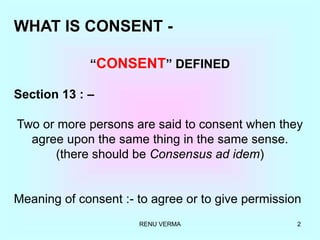
WHAT IS CONSENT -
“CONSENT” DEFINED
Section 13 : –
Two or more persons are said to consent when they
agree upon the same thing in the same sense.
(there should be Consensus ad idem)
Meaning of consent :- to agree or to give permission
RENU VERMA 3
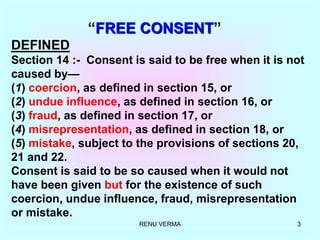
“FREE CONSENT”
DEFINED
Section 14 :- Consent is said to be free when it is not
caused by—
(1) coercion, as defined in section 15, or
(2) undue influence, as defined in section 16, or
(3) fraud, as defined in section 17, or
(4) misrepresentation, as defined in section 18, or
(5) mistake, subject to the provisions of sections 20,
21 and 22.
Consent is said to be so caused when it would not
have been given but for the existence of such
coercion, undue influence, fraud, misrepresentation
or mistake.
RENU VERMA 4
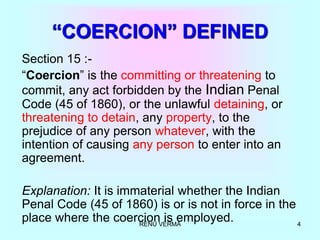
“COERCION” DEFINED
Section 15 :-
“Coercion” is the committing or threatening to
commit, any act forbidden by the Indian Penal
Code (45 of 1860), or the unlawful detaining, or
threatening to detain, any property, to the
prejudice of any person whatever, with the
intention of causing any person to enter into an
agreement.
Explanation: It is immaterial whether the Indian
Penal Code (45 of 1860) is or is not in force in the
place where the coercion is employed.
RENU VERMA 5
Illustrations
A, on board an English ship on the high
seas, causes B to enter into an agreement by
an act amounting to criminal intimidation
under the Indian Penal Code (45 of 1860).
A afterwards sues B for breach of contract at
Calcutta.
A has employed coercion, although his act is
not an offence by the law of England, and
although section 506 of the Indian Penal
Code (45 of 1860) was not in force at the time
when, or at the place where the act was
done.
RENU VERMA 6
• When a person is compelled to enter
into a contract by the use of force by
the other party or under a threat,
“coercion” is said to be employed
• May proceed even from a stranger
• May be directed against any body
• Effect
– Voidable
– If money paid to be repaid or returned
RENU VERMA 7
Acts forbidden by Indian
penal code
–Act forbidden by law
–Pistol, threat to commit hurt, threat to
commit suicide,
–Threat to commit criminal prosecution
•False case - coercion
•True case – not coercion
RENU VERMA 8
• Detention of property
–Pledge of a property
• Voidable agreement at the
option of the party coerced
RENU VERMA 9
“UNDUE INFLUENCE”
DEFINED
Section 16 :-
(1) A contract is said to be induced by
“undue influence” where the relations
subsisting between the parties are
such that one of the parties is in a
position to dominate the will of the
other and uses that position to obtain
an unfair advantage over the other.
RENU VERMA 10
(2) In particular and without prejudice to the
generality of the forgoing principle, a
person is deemed to be in a position to
dominate the will of another—
(a) where he holds a real or apparent authority
over the other, or where he stands in a
fiduciary relation to the other; or
(b) where he makes a contract with a person
whose mental capacity is temporarily or
permanently affected by reason of age,
illness, or mental or bodily distress.
RENU VERMA 11
(3) Where a person, who is in a position
to dominate the will of another, enters
into a contract with him, and the
transaction appears, on the face of it or
on the evidence adduced, to be
unconscionable, the burden of proving
that such contract was not induced by
undue influence shall lie upon the
person in a position to dominate the
will of the other.
RENU VERMA 12
Illustrations
(a) A, having advanced money to his son, B, during his minority, upon B's
coming of age obtains, by misuse of parental influence, a bond from B
for a greater amount than the sum due in respect of the advance. A
employs undue influence.
(b) A, a man enfeebled by disease or age, is induced, by B's influence
over him as his medical attendant, to agree to pay B an unreasonable
sum for his professional services. B employs undue influence.
(c) A, being in debt to B, the moneylender of his village, contracts a fresh
loan on terms which appear to be unconscionable. It lies on B to prove
that the contract was not induced by undue influence.
(d) A applies to a banker for a loan at a time when there is stringency in
the money market. The banker declines to make the loan except at an
unusually high rate of interest. A accepts the loan on these terms. This
is a transaction in the ordinary course of business, and the contract is
not induced by undue influence.
RENU VERMA 13
• Ability to dominate will of other
–Parties related to each other
–Person in superior position
–Spiritual advisor
RENU VERMA 14
• Relations of dominion over other
– Active trust or confidence
– Or parties are not on equal footing
– Influence is acquired and abused, confidence is reposed
and betrayed
• Real or apparent authority
– Income tax officer and assessee
– Magistrate or police officer and accused
• Fiduciary relation
– Several kinds; a very wide category
– Every relationship of trust and confidence
– exploitation
– Solicitor and client; trustee and beneficiary; spiritual adviser
and devotee; doctor and patient; parent or guardian and
child; creditor and debtor.
RENU VERMA 15
• Mental distress
– Mental capacity is temporarily or permanently
affected
– Due to extreme old age or mental or bodily illness
or any other cause
– Contract unfavourable to him
– Urgent need of money, no distress
– Statutory compulsion, no distress
• Influence distinguished from persuasion
– Illiterate widow handling her property
• Burden of proof
– Plaintiff has to prove
RENU VERMA 16
Presumption of undue influence
Once shown that the defendant
was in a position to dominate the
will – unfair advantage
confidence --- unfair advantage
RENU VERMA 17
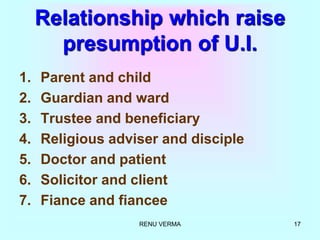
Relationship which raise
presumption of U.I.
1. Parent and child
2. Guardian and ward
3. Trustee and beneficiary
4. Religious adviser and disciple
5. Doctor and patient
6. Solicitor and client
7. Fiance and fiancee
RENU VERMA 18
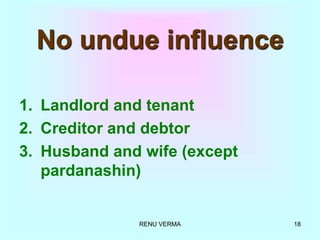
No undue influence
1. Landlord and tenant
2. Creditor and debtor
3. Husband and wife (except
pardanashin)
RENU VERMA 19
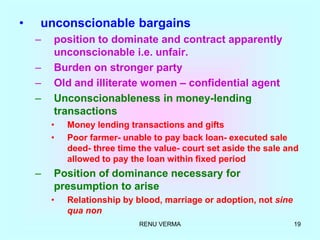
• unconscionable bargains
– position to dominate and contract apparently
unconscionable i.e. unfair.
– Burden on stronger party
– Old and illiterate women – confidential agent
– Unconscionableness in money-lending
transactions
• Money lending transactions and gifts
• Poor farmer- unable to pay back loan- executed sale
deed- three time the value- court set aside the sale and
allowed to pay the loan within fixed period
– Position of dominance necessary for
presumption to arise
• Relationship by blood, marriage or adoption, not sine
qua non
RENU VERMA 20
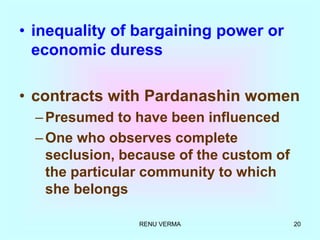
• inequality of bargaining power or
economic duress
• contracts with Pardanashin women
–Presumed to have been influenced
–One who observes complete
seclusion, because of the custom of
the particular community to which
she belongs
RENU VERMA 21
Power to set aside contract
induced by undue influence.
• Section 19A :- When consent to an
agreement is caused by undue influence, the
agreement is a contract voidable at the
option of the party whose consent was so
caused.
• Any such contract may be set aside either
absolutely, or, if the party who was entitled
to avoid it has received any benefit
thereunder, upon such terms and conditions
as to the Court may seem just.
RENU VERMA 22
Illustrations
(a) A's son has forged B's name to a
promissory note. B, under threat of
prosecuting A's son, obtains a bond from A
for the amount of the forged note. If B sues
on this bond, the Court may set the bond
aside.
(b) A, a moneylender, advances Rs. 100 to B,
an agriculturist, and, by undue influence,
induces B to execute a bond for Rs. 200 with
interest at 6 per cent per month. The Court
may set the bond aside, ordering B to repay
Rs. 100 with such interest as may seem just.
RENU VERMA 23
Representation
A statement of fact which one party
makes in the course of
negotiations with a view to
inducing the other party to enter
into a contract.
• Relate to some material fact
• May be expressed or implied
RENU VERMA 24
When a presentation
made is wrong ---- it
may be either innocently
or intentionally made
RENU VERMA 25
Misrepresentation may be :-
• An innocent or unintentional
misrepresentation, or
– Misrepresentation
• An intentional, deliberate or wilful
misrepresentation with an intent to
deceive or defraud the other party.
– fraud
RENU VERMA 26
“MISREPRESENTATION”
DEFINED.
Section 18 :- “Misrepresentation” means and includes—
(1) the positive assertion, in a manner not warranted by
the information of the person making it, of that which is
not true, though he believes it to be true;
(2) any breach of duty which, without an intent to deceive,
gains an advantage to the person committing it, or any
one claiming under him, by misleading another to his
prejudice or to the prejudice of anyone claiming under
him ;
(3) causing, however innocently, a party to an agreement
to make a mistake as to the substance of the thing
which is the subject of the agreement.
RENU VERMA 27
Illustrations
(a) A, intending to deceive B, falsely represents that five hundred maunds
of indigo are made annually at A's factory, and thereby induces B to
buy the factory. The contract is voidable at the option of B.
(b)A, by a misrepresentation, leads B erroneously to believe that five
hundred maunds of indigo are made annually at A's factory. B
examines the accounts of the factory, which show that only four
hundred maunds of indigo have been made. After this B buys the
factory. The contract is not voidable on account of A's
misrepresentation.
(c) A fraudulently informs B that A's estate is free from encumbrance. B
thereupon buys the estate. The estate is subject to a mortgage. B may
either avoid the contract, or may insist on its being carried out and the
mortgage-debt redeemed.
(d)B, having discovered a vein of ore on the estate of A, adopts means to
conceal, and does conceal, the existence of the ore from A. Through
A's ignorance B is enabled to buy the estate at an undervalue. The
contract is voidable at the option of A.
(e) A is entitled to succeed to an estate at the death of B; B dies; C,
having received intelligence of B's death, prevents the intelligence
reaching A, and thus induces A to sell him his interest in the estate.
The sale is voidable at the option of A.
RENU VERMA 28
Essentials of M.
• Material fact
• Before conclusion of contract
• Intention to be acted upon
• Actually acated
• Must be wrong; but believed to be true
• Without Intention to deceive
• Need not be made directly
RENU VERMA 29
Consequences of M.
• Aggrieved party can
– Avoid or rescind
– Accept with condition as if M. was true
• When loss of right to rescind
– After becoming aware take benefit or affirms it
– Restoration not possible
– 3rd part acquired rights in good faith for value
RENU VERMA 30
“FRAUD” DEFINED.
Section 17 :- “Fraud” means and includes any of the following
acts committed by a party to a contract, or with his connivance,
or by his agent, with intent to deceive another party thereto or
his agent, or to induce him to enter into the contract:—
(1) the suggestion, as a fact, of that which is not true by one who
does not believe it to be true;
(2) the active concealment of a fact by one having knowledge or
belief of the fact;
(3) a promise made without any intention of performing it;
(4) any other act fitted to deceive;
(5) any such act or omission as the law specially declares to be
fraudulent.
Explanation: Mere silence as to facts likely to affect the
willingness of a person to enter into a contract is not fraud,
unless the circumstances of the case are such that, regard
being had to them, it is the duty of the person keeping silence
to speak, or unless his silence is, in itself, equivalent to speech.
RENU VERMA 31
Illustrations
(a) A sells, by auction, to B, a horse which A knows
to be unsound. A says nothing to B about the
horse's unsoundness. This is not fraud in A.
(b) B is A's daughter and has just come of age.
Here, the relation between the parties would make it
A's duty to tell B if the horse is unsound.
(c) B says to A - “If you do not deny it, I shall
assume that the horse is sound”. A says nothing.
Here, A's silence is equivalent to speech.
(d) A and B, being traders, enter upon a contract. A
has private information of a change in prices which
would affect B's willingness to proceed with the
contract. A is not bound to inform B.
RENU VERMA 32
Essentials of fraud
• False representation
• Material fact
• Before conclusion of contract with intention
to induce to act
• With knowledge of falsity or without belief in
its truth or with recklessness
• Other party induced to act upon
representation
• Other party relied and decieved
• Subsequently suffered loss
RENU VERMA 33
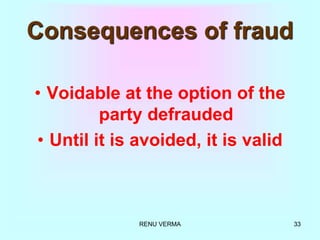
Consequences of fraud
• Voidable at the option of the
party defrauded
• Until it is avoided, it is valid
RENU VERMA 34
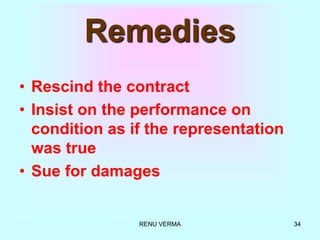
Remedies
• Rescind the contract
• Insist on the performance on
condition as if the representation
was true
• Sue for damages
RENU VERMA 35
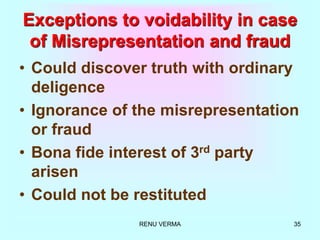
Exceptions to voidability in case
of Misrepresentation and fraud
• Could discover truth with ordinary
deligence
• Ignorance of the misrepresentation
or fraud
• Bona fide interest of 3rd party
arisen
• Could not be restituted
RENU VERMA 36
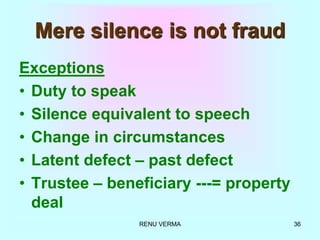
Mere silence is not fraud
Exceptions
• Duty to speak
• Silence equivalent to speech
• Change in circumstances
• Latent defect – past defect
• Trustee – beneficiary ---= property
deal
RENU VERMA 37
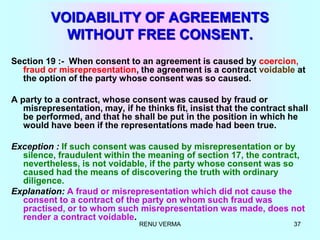
VOIDABILITY OF AGREEMENTS
WITHOUT FREE CONSENT.
Section 19 :- When consent to an agreement is caused by coercion,
fraud or misrepresentation, the agreement is a contract voidable at
the option of the party whose consent was so caused.
A party to a contract, whose consent was caused by fraud or
misrepresentation, may, if he thinks fit, insist that the contract shall
be performed, and that he shall be put in the position in which he
would have been if the representations made had been true.
Exception : If such consent was caused by misrepresentation or by
silence, fraudulent within the meaning of section 17, the contract,
nevertheless, is not voidable, if the party whose consent was so
caused had the means of discovering the truth with ordinary
diligence.
Explanation: A fraud or misrepresentation which did not cause the
consent to a contract of the party on whom such fraud was
practised, or to whom such misrepresentation was made, does not
render a contract voidable.
RENU VERMA 38
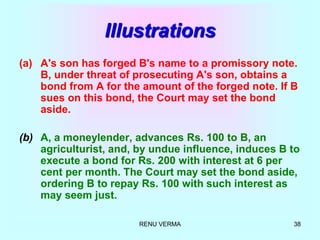
Illustrations
(a) A's son has forged B's name to a promissory note.
B, under threat of prosecuting A's son, obtains a
bond from A for the amount of the forged note. If B
sues on this bond, the Court may set the bond
aside.
(b) A, a moneylender, advances Rs. 100 to B, an
agriculturist, and, by undue influence, induces B to
execute a bond for Rs. 200 with interest at 6 per
cent per month. The Court may set the bond aside,
ordering B to repay Rs. 100 with such interest as
may seem just.
RENU VERMA 39
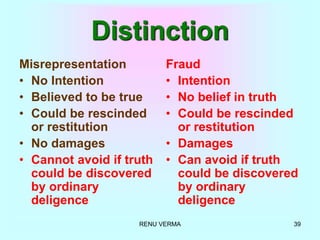
Distinction
Misrepresentation
• No Intention
• Believed to be true
• Could be rescinded
or restitution
• No damages
• Cannot avoid if truth
could be discovered
by ordinary
deligence
Fraud
• Intention
• No belief in truth
• Could be rescinded
or restitution
• Damages
• Can avoid if truth
could be discovered
by ordinary
deligence
RENU VERMA 40
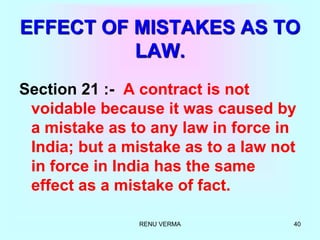
EFFECT OF MISTAKES AS TO
LAW.
Section 21 :- A contract is not
voidable because it was caused by
a mistake as to any law in force in
India; but a mistake as to a law not
in force in India has the same
effect as a mistake of fact.
RENU VERMA 41
Illustration
• A and B make a contract grounded
on the erroneous belief that a
particular debt is barred by the
Indian Law of Limitation; the
contract is not voidable.
RENU VERMA 42
CONTRACT CAUSED BY
MISTAKE OF ONE PARTY AS TO
MATTER OF FACT.
Section 22 :- A contract is not
voidable merely because it was
caused by one of the parties to
it being under a mistake as to a
matter of fact.
RENU VERMA 43
AGREEMENT VOID WHERE BOTH PARTIES
ARE UNDER MISTAKE AS TO MATTER OF
FACT.
Section 20 :- Where both the parties
to an agreement are under a
mistake as to a matter of fact
essential to the agreement, the
agreement is void.
RENU VERMA 44
Illustrations
(a) A agrees to sell to B a specific cargo of goods
supposed to be on its way from England to Bombay. It
turns out that, before the day of the bargain-, the ship
conveying the cargo had been cast away and the
goods lost. Neither party was aware of the facts. The
agreement is void.
(b) A agrees to buy from B a certain horse. It turns out
that the horse was dead at the time of the bargain,
though neither party was aware of the fact. The
agreement is void.
(c) A, being entitled to an estate for the life of B, agrees
to sell it to C. B was dead at the time of the
agreement, but both parties were ignorant of the fact.
The agreement is void.
RENU VERMA 45
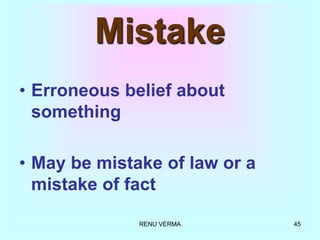
Mistake
• Erroneous belief about
something
• May be mistake of law or a
mistake of fact
RENU VERMA 46
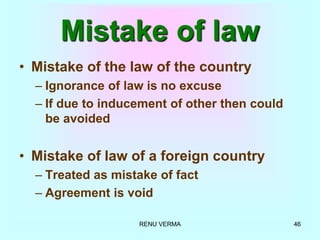
Mistake of law
• Mistake of the law of the country
– Ignorance of law is no excuse
– If due to inducement of other then could
be avoided
• Mistake of law of a foreign country
– Treated as mistake of fact
– Agreement is void
RENU VERMA 47
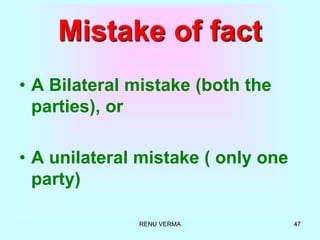
Mistake of fact
• A Bilateral mistake (both the
parties), or
• A unilateral mistake ( only one
party)
RENU VERMA 48
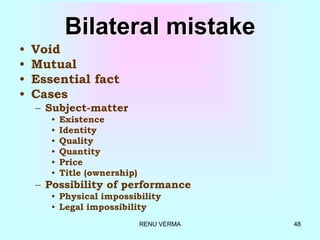
Bilateral mistake
• Void
• Mutual
• Essential fact
• Cases
– Subject-matter
• Existence
• Identity
• Quality
• Quantity
• Price
• Title (ownership)
– Possibility of performance
• Physical impossibility
• Legal impossibility
RENU VERMA 49
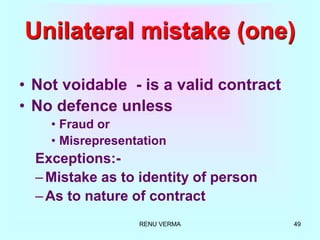
Unilateral mistake (one)
• Not voidable - is a valid contract
• No defence unless
• Fraud or
• Misrepresentation
Exceptions:-
–Mistake as to identity of person
–As to nature of contract
RENU VERMA 50
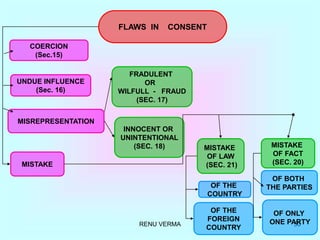
FLAWS IN CONSENT
COERCION
(Sec.15)
UNDUE INFLUENCE
(Sec. 16)
MISREPRESENTATION
MISTAKE
FRADULENT
OR
WILFULL - FRAUD
(SEC. 17)
INNOCENT OR
UNINTENTIONAL
(SEC. 18) MISTAKE
OF LAW
(SEC. 21)
MISTAKE
OF FACT
(SEC. 20)
OF THE
COUNTRY
OF THE
FOREIGN
COUNTRY
OF BOTH
THE PARTIES
OF ONLY
ONE PARTY

Free consent

  • 1.
    RENU VERMA 1 ESSENTIALS OF AVALID CONTRACT FREE CONSENT
  • 2.
    RENU VERMA 2 WHATIS CONSENT - “CONSENT” DEFINED Section 13 : – Two or more persons are said to consent when they agree upon the same thing in the same sense. (there should be Consensus ad idem) Meaning of consent :- to agree or to give permission
  • 3.
    RENU VERMA 3 “FREECONSENT” DEFINED Section 14 :- Consent is said to be free when it is not caused by— (1) coercion, as defined in section 15, or (2) undue influence, as defined in section 16, or (3) fraud, as defined in section 17, or (4) misrepresentation, as defined in section 18, or (5) mistake, subject to the provisions of sections 20, 21 and 22. Consent is said to be so caused when it would not have been given but for the existence of such coercion, undue influence, fraud, misrepresentation or mistake.
  • 4.
    RENU VERMA 4 “COERCION”DEFINED Section 15 :- “Coercion” is the committing or threatening to commit, any act forbidden by the Indian Penal Code (45 of 1860), or the unlawful detaining, or threatening to detain, any property, to the prejudice of any person whatever, with the intention of causing any person to enter into an agreement. Explanation: It is immaterial whether the Indian Penal Code (45 of 1860) is or is not in force in the place where the coercion is employed.
  • 5.
    RENU VERMA 5 Illustrations A,on board an English ship on the high seas, causes B to enter into an agreement by an act amounting to criminal intimidation under the Indian Penal Code (45 of 1860). A afterwards sues B for breach of contract at Calcutta. A has employed coercion, although his act is not an offence by the law of England, and although section 506 of the Indian Penal Code (45 of 1860) was not in force at the time when, or at the place where the act was done.
  • 6.
    RENU VERMA 6 •When a person is compelled to enter into a contract by the use of force by the other party or under a threat, “coercion” is said to be employed • May proceed even from a stranger • May be directed against any body • Effect – Voidable – If money paid to be repaid or returned
  • 7.
    RENU VERMA 7 Actsforbidden by Indian penal code –Act forbidden by law –Pistol, threat to commit hurt, threat to commit suicide, –Threat to commit criminal prosecution •False case - coercion •True case – not coercion
  • 8.
    RENU VERMA 8 •Detention of property –Pledge of a property • Voidable agreement at the option of the party coerced
  • 9.
    RENU VERMA 9 “UNDUEINFLUENCE” DEFINED Section 16 :- (1) A contract is said to be induced by “undue influence” where the relations subsisting between the parties are such that one of the parties is in a position to dominate the will of the other and uses that position to obtain an unfair advantage over the other.
  • 10.
    RENU VERMA 10 (2)In particular and without prejudice to the generality of the forgoing principle, a person is deemed to be in a position to dominate the will of another— (a) where he holds a real or apparent authority over the other, or where he stands in a fiduciary relation to the other; or (b) where he makes a contract with a person whose mental capacity is temporarily or permanently affected by reason of age, illness, or mental or bodily distress.
  • 11.
    RENU VERMA 11 (3)Where a person, who is in a position to dominate the will of another, enters into a contract with him, and the transaction appears, on the face of it or on the evidence adduced, to be unconscionable, the burden of proving that such contract was not induced by undue influence shall lie upon the person in a position to dominate the will of the other.
  • 12.
    RENU VERMA 12 Illustrations (a)A, having advanced money to his son, B, during his minority, upon B's coming of age obtains, by misuse of parental influence, a bond from B for a greater amount than the sum due in respect of the advance. A employs undue influence. (b) A, a man enfeebled by disease or age, is induced, by B's influence over him as his medical attendant, to agree to pay B an unreasonable sum for his professional services. B employs undue influence. (c) A, being in debt to B, the moneylender of his village, contracts a fresh loan on terms which appear to be unconscionable. It lies on B to prove that the contract was not induced by undue influence. (d) A applies to a banker for a loan at a time when there is stringency in the money market. The banker declines to make the loan except at an unusually high rate of interest. A accepts the loan on these terms. This is a transaction in the ordinary course of business, and the contract is not induced by undue influence.
  • 13.
    RENU VERMA 13 •Ability to dominate will of other –Parties related to each other –Person in superior position –Spiritual advisor
  • 14.
    RENU VERMA 14 •Relations of dominion over other – Active trust or confidence – Or parties are not on equal footing – Influence is acquired and abused, confidence is reposed and betrayed • Real or apparent authority – Income tax officer and assessee – Magistrate or police officer and accused • Fiduciary relation – Several kinds; a very wide category – Every relationship of trust and confidence – exploitation – Solicitor and client; trustee and beneficiary; spiritual adviser and devotee; doctor and patient; parent or guardian and child; creditor and debtor.
  • 15.
    RENU VERMA 15 •Mental distress – Mental capacity is temporarily or permanently affected – Due to extreme old age or mental or bodily illness or any other cause – Contract unfavourable to him – Urgent need of money, no distress – Statutory compulsion, no distress • Influence distinguished from persuasion – Illiterate widow handling her property • Burden of proof – Plaintiff has to prove
  • 16.
    RENU VERMA 16 Presumptionof undue influence Once shown that the defendant was in a position to dominate the will – unfair advantage confidence --- unfair advantage
  • 17.
    RENU VERMA 17 Relationshipwhich raise presumption of U.I. 1. Parent and child 2. Guardian and ward 3. Trustee and beneficiary 4. Religious adviser and disciple 5. Doctor and patient 6. Solicitor and client 7. Fiance and fiancee
  • 18.
    RENU VERMA 18 Noundue influence 1. Landlord and tenant 2. Creditor and debtor 3. Husband and wife (except pardanashin)
  • 19.
    RENU VERMA 19 •unconscionable bargains – position to dominate and contract apparently unconscionable i.e. unfair. – Burden on stronger party – Old and illiterate women – confidential agent – Unconscionableness in money-lending transactions • Money lending transactions and gifts • Poor farmer- unable to pay back loan- executed sale deed- three time the value- court set aside the sale and allowed to pay the loan within fixed period – Position of dominance necessary for presumption to arise • Relationship by blood, marriage or adoption, not sine qua non
  • 20.
    RENU VERMA 20 •inequality of bargaining power or economic duress • contracts with Pardanashin women –Presumed to have been influenced –One who observes complete seclusion, because of the custom of the particular community to which she belongs
  • 21.
    RENU VERMA 21 Powerto set aside contract induced by undue influence. • Section 19A :- When consent to an agreement is caused by undue influence, the agreement is a contract voidable at the option of the party whose consent was so caused. • Any such contract may be set aside either absolutely, or, if the party who was entitled to avoid it has received any benefit thereunder, upon such terms and conditions as to the Court may seem just.
  • 22.
    RENU VERMA 22 Illustrations (a)A's son has forged B's name to a promissory note. B, under threat of prosecuting A's son, obtains a bond from A for the amount of the forged note. If B sues on this bond, the Court may set the bond aside. (b) A, a moneylender, advances Rs. 100 to B, an agriculturist, and, by undue influence, induces B to execute a bond for Rs. 200 with interest at 6 per cent per month. The Court may set the bond aside, ordering B to repay Rs. 100 with such interest as may seem just.
  • 23.
    RENU VERMA 23 Representation Astatement of fact which one party makes in the course of negotiations with a view to inducing the other party to enter into a contract. • Relate to some material fact • May be expressed or implied
  • 24.
    RENU VERMA 24 Whena presentation made is wrong ---- it may be either innocently or intentionally made
  • 25.
    RENU VERMA 25 Misrepresentationmay be :- • An innocent or unintentional misrepresentation, or – Misrepresentation • An intentional, deliberate or wilful misrepresentation with an intent to deceive or defraud the other party. – fraud
  • 26.
    RENU VERMA 26 “MISREPRESENTATION” DEFINED. Section18 :- “Misrepresentation” means and includes— (1) the positive assertion, in a manner not warranted by the information of the person making it, of that which is not true, though he believes it to be true; (2) any breach of duty which, without an intent to deceive, gains an advantage to the person committing it, or any one claiming under him, by misleading another to his prejudice or to the prejudice of anyone claiming under him ; (3) causing, however innocently, a party to an agreement to make a mistake as to the substance of the thing which is the subject of the agreement.
  • 27.
    RENU VERMA 27 Illustrations (a)A, intending to deceive B, falsely represents that five hundred maunds of indigo are made annually at A's factory, and thereby induces B to buy the factory. The contract is voidable at the option of B. (b)A, by a misrepresentation, leads B erroneously to believe that five hundred maunds of indigo are made annually at A's factory. B examines the accounts of the factory, which show that only four hundred maunds of indigo have been made. After this B buys the factory. The contract is not voidable on account of A's misrepresentation. (c) A fraudulently informs B that A's estate is free from encumbrance. B thereupon buys the estate. The estate is subject to a mortgage. B may either avoid the contract, or may insist on its being carried out and the mortgage-debt redeemed. (d)B, having discovered a vein of ore on the estate of A, adopts means to conceal, and does conceal, the existence of the ore from A. Through A's ignorance B is enabled to buy the estate at an undervalue. The contract is voidable at the option of A. (e) A is entitled to succeed to an estate at the death of B; B dies; C, having received intelligence of B's death, prevents the intelligence reaching A, and thus induces A to sell him his interest in the estate. The sale is voidable at the option of A.
  • 28.
    RENU VERMA 28 Essentialsof M. • Material fact • Before conclusion of contract • Intention to be acted upon • Actually acated • Must be wrong; but believed to be true • Without Intention to deceive • Need not be made directly
  • 29.
    RENU VERMA 29 Consequencesof M. • Aggrieved party can – Avoid or rescind – Accept with condition as if M. was true • When loss of right to rescind – After becoming aware take benefit or affirms it – Restoration not possible – 3rd part acquired rights in good faith for value
  • 30.
    RENU VERMA 30 “FRAUD”DEFINED. Section 17 :- “Fraud” means and includes any of the following acts committed by a party to a contract, or with his connivance, or by his agent, with intent to deceive another party thereto or his agent, or to induce him to enter into the contract:— (1) the suggestion, as a fact, of that which is not true by one who does not believe it to be true; (2) the active concealment of a fact by one having knowledge or belief of the fact; (3) a promise made without any intention of performing it; (4) any other act fitted to deceive; (5) any such act or omission as the law specially declares to be fraudulent. Explanation: Mere silence as to facts likely to affect the willingness of a person to enter into a contract is not fraud, unless the circumstances of the case are such that, regard being had to them, it is the duty of the person keeping silence to speak, or unless his silence is, in itself, equivalent to speech.
  • 31.
    RENU VERMA 31 Illustrations (a)A sells, by auction, to B, a horse which A knows to be unsound. A says nothing to B about the horse's unsoundness. This is not fraud in A. (b) B is A's daughter and has just come of age. Here, the relation between the parties would make it A's duty to tell B if the horse is unsound. (c) B says to A - “If you do not deny it, I shall assume that the horse is sound”. A says nothing. Here, A's silence is equivalent to speech. (d) A and B, being traders, enter upon a contract. A has private information of a change in prices which would affect B's willingness to proceed with the contract. A is not bound to inform B.
  • 32.
    RENU VERMA 32 Essentialsof fraud • False representation • Material fact • Before conclusion of contract with intention to induce to act • With knowledge of falsity or without belief in its truth or with recklessness • Other party induced to act upon representation • Other party relied and decieved • Subsequently suffered loss
  • 33.
    RENU VERMA 33 Consequencesof fraud • Voidable at the option of the party defrauded • Until it is avoided, it is valid
  • 34.
    RENU VERMA 34 Remedies •Rescind the contract • Insist on the performance on condition as if the representation was true • Sue for damages
  • 35.
    RENU VERMA 35 Exceptionsto voidability in case of Misrepresentation and fraud • Could discover truth with ordinary deligence • Ignorance of the misrepresentation or fraud • Bona fide interest of 3rd party arisen • Could not be restituted
  • 36.
    RENU VERMA 36 Meresilence is not fraud Exceptions • Duty to speak • Silence equivalent to speech • Change in circumstances • Latent defect – past defect • Trustee – beneficiary ---= property deal
  • 37.
    RENU VERMA 37 VOIDABILITYOF AGREEMENTS WITHOUT FREE CONSENT. Section 19 :- When consent to an agreement is caused by coercion, fraud or misrepresentation, the agreement is a contract voidable at the option of the party whose consent was so caused. A party to a contract, whose consent was caused by fraud or misrepresentation, may, if he thinks fit, insist that the contract shall be performed, and that he shall be put in the position in which he would have been if the representations made had been true. Exception : If such consent was caused by misrepresentation or by silence, fraudulent within the meaning of section 17, the contract, nevertheless, is not voidable, if the party whose consent was so caused had the means of discovering the truth with ordinary diligence. Explanation: A fraud or misrepresentation which did not cause the consent to a contract of the party on whom such fraud was practised, or to whom such misrepresentation was made, does not render a contract voidable.
  • 38.
    RENU VERMA 38 Illustrations (a)A's son has forged B's name to a promissory note. B, under threat of prosecuting A's son, obtains a bond from A for the amount of the forged note. If B sues on this bond, the Court may set the bond aside. (b) A, a moneylender, advances Rs. 100 to B, an agriculturist, and, by undue influence, induces B to execute a bond for Rs. 200 with interest at 6 per cent per month. The Court may set the bond aside, ordering B to repay Rs. 100 with such interest as may seem just.
  • 39.
    RENU VERMA 39 Distinction Misrepresentation •No Intention • Believed to be true • Could be rescinded or restitution • No damages • Cannot avoid if truth could be discovered by ordinary deligence Fraud • Intention • No belief in truth • Could be rescinded or restitution • Damages • Can avoid if truth could be discovered by ordinary deligence
  • 40.
    RENU VERMA 40 EFFECTOF MISTAKES AS TO LAW. Section 21 :- A contract is not voidable because it was caused by a mistake as to any law in force in India; but a mistake as to a law not in force in India has the same effect as a mistake of fact.
  • 41.
    RENU VERMA 41 Illustration •A and B make a contract grounded on the erroneous belief that a particular debt is barred by the Indian Law of Limitation; the contract is not voidable.
  • 42.
    RENU VERMA 42 CONTRACTCAUSED BY MISTAKE OF ONE PARTY AS TO MATTER OF FACT. Section 22 :- A contract is not voidable merely because it was caused by one of the parties to it being under a mistake as to a matter of fact.
  • 43.
    RENU VERMA 43 AGREEMENTVOID WHERE BOTH PARTIES ARE UNDER MISTAKE AS TO MATTER OF FACT. Section 20 :- Where both the parties to an agreement are under a mistake as to a matter of fact essential to the agreement, the agreement is void.
  • 44.
    RENU VERMA 44 Illustrations (a)A agrees to sell to B a specific cargo of goods supposed to be on its way from England to Bombay. It turns out that, before the day of the bargain-, the ship conveying the cargo had been cast away and the goods lost. Neither party was aware of the facts. The agreement is void. (b) A agrees to buy from B a certain horse. It turns out that the horse was dead at the time of the bargain, though neither party was aware of the fact. The agreement is void. (c) A, being entitled to an estate for the life of B, agrees to sell it to C. B was dead at the time of the agreement, but both parties were ignorant of the fact. The agreement is void.
  • 45.
    RENU VERMA 45 Mistake •Erroneous belief about something • May be mistake of law or a mistake of fact
  • 46.
    RENU VERMA 46 Mistakeof law • Mistake of the law of the country – Ignorance of law is no excuse – If due to inducement of other then could be avoided • Mistake of law of a foreign country – Treated as mistake of fact – Agreement is void
  • 47.
    RENU VERMA 47 Mistakeof fact • A Bilateral mistake (both the parties), or • A unilateral mistake ( only one party)
  • 48.
    RENU VERMA 48 Bilateralmistake • Void • Mutual • Essential fact • Cases – Subject-matter • Existence • Identity • Quality • Quantity • Price • Title (ownership) – Possibility of performance • Physical impossibility • Legal impossibility
  • 49.
    RENU VERMA 49 Unilateralmistake (one) • Not voidable - is a valid contract • No defence unless • Fraud or • Misrepresentation Exceptions:- –Mistake as to identity of person –As to nature of contract
  • 50.
    RENU VERMA 50 FLAWSIN CONSENT COERCION (Sec.15) UNDUE INFLUENCE (Sec. 16) MISREPRESENTATION MISTAKE FRADULENT OR WILFULL - FRAUD (SEC. 17) INNOCENT OR UNINTENTIONAL (SEC. 18) MISTAKE OF LAW (SEC. 21) MISTAKE OF FACT (SEC. 20) OF THE COUNTRY OF THE FOREIGN COUNTRY OF BOTH THE PARTIES OF ONLY ONE PARTY