Free Consent For Contract
1 Ruby Sharma
Introduction
Free consent of all the parties to a contract is
an essential of a valid contract as per
requirement of section 10.
When there is no consent at all, the agreement
is void ab-initio, i.e. it is not enforceable at the
option of either party.
Consent defined: two or more person are said
to consent when they agree upon the same
thing in same sense ( sec 13).
2 Ruby Sharma
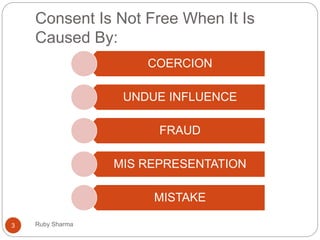
Consent Is Not Free When It Is
Caused By:
COERCION
UNDUE INFLUENCE
FRAUD
MIS REPRESENTATION
MISTAKE
3 Ruby Sharma
COERCION
 In simple words, coercion is threat or force used by
one party against another for compelling him to
enter into an agreement.
 Section 15 of Indian Contract Act defines coercion
as the committing or threatening to commit any act
forbidden by the Indian Penal Code or an unlawful
detaining or threatening to detain, any property to
the prejudice of any person with the intention of
inducing any person to enter into an agreement.
 Consent obtained at the point of pistol or intimidation,
threat of imprisonment and threat to commit suicide with
the intention of causing a person to enter into an
agreement is an act of coercion.4 Ruby Sharma
Essentials of Coercion
 There must be clear threat.
 The threat should be to commit an act forbidden
by law.
 It must be uttered with the intention of causing the
other party to enter into an agreement.
5 Ruby Sharma
Types of Coercion
 Threat to file a suit-A threat to file a suit does not amount
to coercion unless the suit is on false charge. Threat to
file a suit on false charge is an forbidden by the Indian
Penal Code and thus will amount to ant act of coercion.
 Threat to commit Suicide.
Effect of Coercion
Section 19 provides that an agreement consent to which is
obtained by coercion is voidable at the option of the party
whose consent is so obtained.
Burden of proof : it lies on the party who wants to set aside
the contract on the plea of coercion.
6 Ruby Sharma
Undue Influence
 Section 16(1) provides that “a contract is said
to be induced by undue influence where the
relations subsisting between the parties are
such that one of the parties is in a position to
dominate the will of the other and uses the
position to obtain an unfair advantage over
the other.”
7 Ruby Sharma
A person is deemed to be in a
position to dominate the will of
another:
 Where he holds a real or apparent authority over
the other e.g. relationship between master and
servant, public officer and accused, income tax
officer in relation an assessee.
 Where he stands in a fiduciary relationship to the
other. Fiduciary relation means a relation of
mutual trust and confidence. like father and son,
guardian and ward, solicitor and client, doctor and
patient, trustee and beneficiary.
 Where he makes a contract with a person whose
mental capacity is temporarily or permanently
affected by reason of age, illness or mental or
bodily distress.
8 Ruby Sharma
Effect of Undue Influence
 When consent to an agreement is caused by undue
influence , the agreement is a contract voidable at the
option of the party whose consent was so caused. Such
contract may be set aside either absolutely or subject to
restitution of the benefit there under or upon such
condition as the court may deem just.(section 19 (A)).
 Pardanashin Ladies-A paranashin women is one who
lives in seclusion having no communication except from
behind the pardah with any male person except a few
privileged relations.
 Law provides special protection to them on the ground of
their being ignorant so far as the worldly knowledge
goes. A contract with them is presumed to have been
induced by undue influence unless the other party show
9 Ruby Sharma
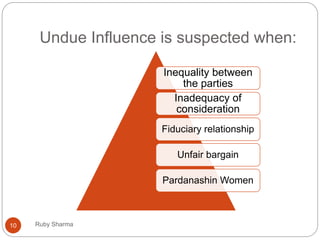
Undue Influence is suspected when:
Ruby Sharma10
Inequality between
the parties
Inadequacy of
consideration
Fiduciary relationship
Unfair bargain
Pardanashin Women
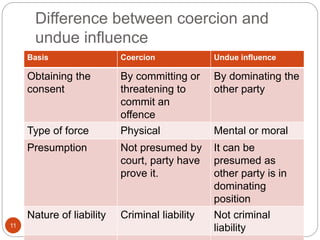
Difference between coercion and
undue influence
Ruby Sharma11
Basis Coercion Undue influence
Obtaining the
consent
By committing or
threatening to
commit an
offence
By dominating the
other party
Type of force Physical Mental or moral
Presumption Not presumed by
court, party have
prove it.
It can be
presumed as
other party is in
dominating
position
Nature of liability Criminal liability Not criminal
liability
FRAUD
Ruby Sharma12
Section 17 of Indian Contract Act, 1872 defines “Fraud'.
 "Fraud" means and includes any of the following acts committed by a
party to a contract, or with his connivance, or by his agent, with intent to
deceive another party thereto of his agent, or to induce him to enter into
the contract:-
(1) the suggestion, as a fact, of that which is not true, by one who does
not believe it to be true ;
(2) the active concealment of a fact by one having knowledge or belief
of the fact ;
(3) a promise made without any intention of performing it
(4) any other act fitted to deceive ;
(5) any such act or omission as the law specially declares to be
fraudulent.
 Mere silence as to facts likely to affect the willingness of a person to
enter into a contract is not fraud, unless the circumstances of the case are
such that, regard being had to them, it is the duty of the person keeping
silence to speak, or unless his silence is, in itself, equivalent to speech.
Ruby Sharma13
1.The suggestion, as a fact, of that which is not true, by one
who does not believe it to be true. The leading case: Peek V.
Gurney.
The prospectus of a company did not refer to the existence
of a document disclosing liabilities. This created an
impression that the company was prosperous. It was held
that there was suppression of truth and suggestion of false
statement amounting to fraud.
2. The active concealment of a fact by one having knowledge
or belief of the fact-If a person conceals a fat which is
material to the contract will be a case of fraud. Mere non
disclosure is not fraud, where there is no duty to
disclose.”Caveat Emptor” or “Buyer Beware” is the rule,
but in contracts of absolute faith mere silence about material
facts will be taken as fraud.
Ruby Sharma14
 E.g. A, horse dealer sold a mare to B.A knew that the mare
had a cracked hoof, which he filled up in such a way as to
defy detection. The defect was subsequently discovered by
B. It was held that the agreement could be avoided by B as
his consent was obtained by fraud.
 A promise made without any intention of performing it is
fraud.
 Any other act fitted to deceive. E.g. Where a party, who by
false impersonation induces another to enter into a
contract with him under the belief that he is somebody
else, commits fraud.
 Any such act or omission as the law specially declares to
be fraudulent.
Mere silence is not fraud….
Ruby Sharma15
 A party to the contract is under no obligation to
disclose the whole truth to the other party. Caveat
Emptor i.e. let the buyer beware is the rule
applicable to contracts. There is no duty to speak
in such cases and silence does not amount to
fraud.
Silence is treated as Fraud in:
 Fiduciary relationship
 Contract of insurance
 Contract of marriage
 Contract of Family settlement
 Share allotment contracts.
Effect of fraud
Ruby Sharma16
 When the consent to an agreement is caused by
fraud, the agreement is a voidable contract at the
option of the party whose consent was so
caused.
A party whose consent to an agreement is so
obtained has two remedies, namely:
 He may rescind the contract or
 He may insist that the contract shall be performed
and that he shall be put in the position in which
he would have been, if the representation made
had been true.
Misrepresentation
Ruby Sharma17
 The term “Misrepresentation means a false
representation of fact made innocently or non-
disclosure of a material fact without any intention to
deceive the other party.
According to Section 18 the term misrepresentation
means:
1. The positive assertion, in a manner not warranted
by the information of the person making it, of that
which is not true, though he believes it to be true.
E.g. A on the strength of hearsay information
positively asserted to B that certain third party is
going to be the Director of the co. to be
incorporated, bought the shares on faith of such a
statement. This is case of misrepresentation by
Contd…………
Ruby Sharma18
2.Any breach of duty, which ,without an intention to
deceive gains an advantage to the person committing
it or anyone claiming under him, by misleading
another to his prejudice or to the prejudice of anyone
claiming under him. This is known as ‘Constructive
fraud".
3.It also covers those cases where a statement when
made was true but subsequently before it was acted
upon, it became false to the knowledge of the person
making it .In such a case , the person making the
statement comes under an obligation to inform the
other party of the true facts.
Essentials Of Misrepresentation
Ruby Sharma19
 There should be a representation or assertion.
 Such representation must relate to a matter of fact which
has become untrue ; and It was made before the
finalization of transaction with a view to induce the other
party to enter into a contract.
 It must actually have been acted upon by the party.
 It must have been made either by the party himself or by
his duly authorized agent.
 Consequences of Misrepresentation- The aggrieved party
may avoid the contract, or May affirm the contract and
insist on the misrepresentation being made good.
 When consent is induced by misrepresentation &
aggrieved party has the means of discovering the truth with
ordinary diligence, the contract cannot be set aside.
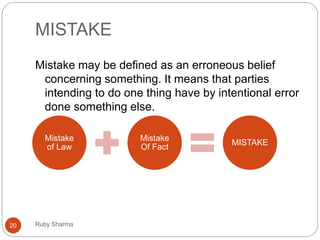
MISTAKE
Ruby Sharma20
Mistake may be defined as an erroneous belief
concerning something. It means that parties
intending to do one thing have by intentional error
done something else.
Mistake
of Law
Mistake
Of Fact
MISTAKE
Mistake Law
Ruby Sharma21
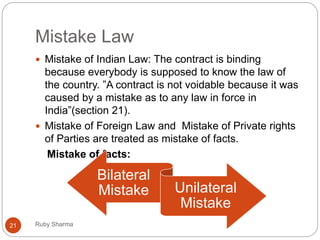
 Mistake of Indian Law: The contract is binding
because everybody is supposed to know the law of
the country. ”A contract is not voidable because it was
caused by a mistake as to any law in force in
India”(section 21).
 Mistake of Foreign Law and Mistake of Private rights
of Parties are treated as mistake of facts.
Mistake of facts:
Bilateral
Mistake Unilateral
Mistake
Bilateral Mistake
Ruby Sharma22
 Mistake as to subject matter. It falls into six heads
namely
1.Existence 2.Identity 3. Title 4. Price 5. Quantity 6.Quality
When both the parties to an agreement are under a
mistake as to a matter of fact, which are essential to
the agreement, and this agreement shall be Void.
Thus this mistake shall be termed as bilateral
mistake of facts.
 It should be committed by both the parties
 It should be related to a matter of fact which are
essential to the agreement.
Unilateral Mistake
Ruby Sharma23
Section 22 provides that if one party alone is
under mistake of fact. Unilateral mistakes do
not affect the validity of contract unless they
concern some fundamental fact and the other
party is aware of the mistake.
1.Mistake as to identity of the person or party:
Mistake as to the identity of a person may also
avoid a contract. Where A intends to contract
only with B, but enters into a contract with C
believing him to be B, the contract is vitiated.
2.Mistake as to the nature of transaction: A blind
man signing a document, read over to him
Ruby Sharma24
 Case ; Foster V. Mackinnon.
 A an illiterate old man, was made to put his
signature on a document which was a pronote .A
thought the document to be a will where his
signature was required as a witness. Under this
presumption hr signed the document which was
in fact a pronote. Subsequently B endorsed the
pronote to C who paid value for it in good faith. C
sued A on the pronote. It was held that A was not
bound by it.

Free consent for contract

  • 1.
    Free Consent ForContract 1 Ruby Sharma
  • 2.
    Introduction Free consent ofall the parties to a contract is an essential of a valid contract as per requirement of section 10. When there is no consent at all, the agreement is void ab-initio, i.e. it is not enforceable at the option of either party. Consent defined: two or more person are said to consent when they agree upon the same thing in same sense ( sec 13). 2 Ruby Sharma
  • 3.
    Consent Is NotFree When It Is Caused By: COERCION UNDUE INFLUENCE FRAUD MIS REPRESENTATION MISTAKE 3 Ruby Sharma
  • 4.
    COERCION  In simplewords, coercion is threat or force used by one party against another for compelling him to enter into an agreement.  Section 15 of Indian Contract Act defines coercion as the committing or threatening to commit any act forbidden by the Indian Penal Code or an unlawful detaining or threatening to detain, any property to the prejudice of any person with the intention of inducing any person to enter into an agreement.  Consent obtained at the point of pistol or intimidation, threat of imprisonment and threat to commit suicide with the intention of causing a person to enter into an agreement is an act of coercion.4 Ruby Sharma
  • 5.
    Essentials of Coercion There must be clear threat.  The threat should be to commit an act forbidden by law.  It must be uttered with the intention of causing the other party to enter into an agreement. 5 Ruby Sharma
  • 6.
    Types of Coercion Threat to file a suit-A threat to file a suit does not amount to coercion unless the suit is on false charge. Threat to file a suit on false charge is an forbidden by the Indian Penal Code and thus will amount to ant act of coercion.  Threat to commit Suicide. Effect of Coercion Section 19 provides that an agreement consent to which is obtained by coercion is voidable at the option of the party whose consent is so obtained. Burden of proof : it lies on the party who wants to set aside the contract on the plea of coercion. 6 Ruby Sharma
  • 7.
    Undue Influence  Section16(1) provides that “a contract is said to be induced by undue influence where the relations subsisting between the parties are such that one of the parties is in a position to dominate the will of the other and uses the position to obtain an unfair advantage over the other.” 7 Ruby Sharma
  • 8.
    A person isdeemed to be in a position to dominate the will of another:  Where he holds a real or apparent authority over the other e.g. relationship between master and servant, public officer and accused, income tax officer in relation an assessee.  Where he stands in a fiduciary relationship to the other. Fiduciary relation means a relation of mutual trust and confidence. like father and son, guardian and ward, solicitor and client, doctor and patient, trustee and beneficiary.  Where he makes a contract with a person whose mental capacity is temporarily or permanently affected by reason of age, illness or mental or bodily distress. 8 Ruby Sharma
  • 9.
    Effect of UndueInfluence  When consent to an agreement is caused by undue influence , the agreement is a contract voidable at the option of the party whose consent was so caused. Such contract may be set aside either absolutely or subject to restitution of the benefit there under or upon such condition as the court may deem just.(section 19 (A)).  Pardanashin Ladies-A paranashin women is one who lives in seclusion having no communication except from behind the pardah with any male person except a few privileged relations.  Law provides special protection to them on the ground of their being ignorant so far as the worldly knowledge goes. A contract with them is presumed to have been induced by undue influence unless the other party show 9 Ruby Sharma
  • 10.
    Undue Influence issuspected when: Ruby Sharma10 Inequality between the parties Inadequacy of consideration Fiduciary relationship Unfair bargain Pardanashin Women
  • 11.
    Difference between coercionand undue influence Ruby Sharma11 Basis Coercion Undue influence Obtaining the consent By committing or threatening to commit an offence By dominating the other party Type of force Physical Mental or moral Presumption Not presumed by court, party have prove it. It can be presumed as other party is in dominating position Nature of liability Criminal liability Not criminal liability
  • 12.
    FRAUD Ruby Sharma12 Section 17of Indian Contract Act, 1872 defines “Fraud'.  "Fraud" means and includes any of the following acts committed by a party to a contract, or with his connivance, or by his agent, with intent to deceive another party thereto of his agent, or to induce him to enter into the contract:- (1) the suggestion, as a fact, of that which is not true, by one who does not believe it to be true ; (2) the active concealment of a fact by one having knowledge or belief of the fact ; (3) a promise made without any intention of performing it (4) any other act fitted to deceive ; (5) any such act or omission as the law specially declares to be fraudulent.  Mere silence as to facts likely to affect the willingness of a person to enter into a contract is not fraud, unless the circumstances of the case are such that, regard being had to them, it is the duty of the person keeping silence to speak, or unless his silence is, in itself, equivalent to speech.
  • 13.
    Ruby Sharma13 1.The suggestion,as a fact, of that which is not true, by one who does not believe it to be true. The leading case: Peek V. Gurney. The prospectus of a company did not refer to the existence of a document disclosing liabilities. This created an impression that the company was prosperous. It was held that there was suppression of truth and suggestion of false statement amounting to fraud. 2. The active concealment of a fact by one having knowledge or belief of the fact-If a person conceals a fat which is material to the contract will be a case of fraud. Mere non disclosure is not fraud, where there is no duty to disclose.”Caveat Emptor” or “Buyer Beware” is the rule, but in contracts of absolute faith mere silence about material facts will be taken as fraud.
  • 14.
    Ruby Sharma14  E.g.A, horse dealer sold a mare to B.A knew that the mare had a cracked hoof, which he filled up in such a way as to defy detection. The defect was subsequently discovered by B. It was held that the agreement could be avoided by B as his consent was obtained by fraud.  A promise made without any intention of performing it is fraud.  Any other act fitted to deceive. E.g. Where a party, who by false impersonation induces another to enter into a contract with him under the belief that he is somebody else, commits fraud.  Any such act or omission as the law specially declares to be fraudulent.
  • 15.
    Mere silence isnot fraud…. Ruby Sharma15  A party to the contract is under no obligation to disclose the whole truth to the other party. Caveat Emptor i.e. let the buyer beware is the rule applicable to contracts. There is no duty to speak in such cases and silence does not amount to fraud. Silence is treated as Fraud in:  Fiduciary relationship  Contract of insurance  Contract of marriage  Contract of Family settlement  Share allotment contracts.
  • 16.
    Effect of fraud RubySharma16  When the consent to an agreement is caused by fraud, the agreement is a voidable contract at the option of the party whose consent was so caused. A party whose consent to an agreement is so obtained has two remedies, namely:  He may rescind the contract or  He may insist that the contract shall be performed and that he shall be put in the position in which he would have been, if the representation made had been true.
  • 17.
    Misrepresentation Ruby Sharma17  Theterm “Misrepresentation means a false representation of fact made innocently or non- disclosure of a material fact without any intention to deceive the other party. According to Section 18 the term misrepresentation means: 1. The positive assertion, in a manner not warranted by the information of the person making it, of that which is not true, though he believes it to be true. E.g. A on the strength of hearsay information positively asserted to B that certain third party is going to be the Director of the co. to be incorporated, bought the shares on faith of such a statement. This is case of misrepresentation by
  • 18.
    Contd………… Ruby Sharma18 2.Any breachof duty, which ,without an intention to deceive gains an advantage to the person committing it or anyone claiming under him, by misleading another to his prejudice or to the prejudice of anyone claiming under him. This is known as ‘Constructive fraud". 3.It also covers those cases where a statement when made was true but subsequently before it was acted upon, it became false to the knowledge of the person making it .In such a case , the person making the statement comes under an obligation to inform the other party of the true facts.
  • 19.
    Essentials Of Misrepresentation RubySharma19  There should be a representation or assertion.  Such representation must relate to a matter of fact which has become untrue ; and It was made before the finalization of transaction with a view to induce the other party to enter into a contract.  It must actually have been acted upon by the party.  It must have been made either by the party himself or by his duly authorized agent.  Consequences of Misrepresentation- The aggrieved party may avoid the contract, or May affirm the contract and insist on the misrepresentation being made good.  When consent is induced by misrepresentation & aggrieved party has the means of discovering the truth with ordinary diligence, the contract cannot be set aside.
  • 20.
    MISTAKE Ruby Sharma20 Mistake maybe defined as an erroneous belief concerning something. It means that parties intending to do one thing have by intentional error done something else. Mistake of Law Mistake Of Fact MISTAKE
  • 21.
    Mistake Law Ruby Sharma21 Mistake of Indian Law: The contract is binding because everybody is supposed to know the law of the country. ”A contract is not voidable because it was caused by a mistake as to any law in force in India”(section 21).  Mistake of Foreign Law and Mistake of Private rights of Parties are treated as mistake of facts. Mistake of facts: Bilateral Mistake Unilateral Mistake
  • 22.
    Bilateral Mistake Ruby Sharma22 Mistake as to subject matter. It falls into six heads namely 1.Existence 2.Identity 3. Title 4. Price 5. Quantity 6.Quality When both the parties to an agreement are under a mistake as to a matter of fact, which are essential to the agreement, and this agreement shall be Void. Thus this mistake shall be termed as bilateral mistake of facts.  It should be committed by both the parties  It should be related to a matter of fact which are essential to the agreement.
  • 23.
    Unilateral Mistake Ruby Sharma23 Section22 provides that if one party alone is under mistake of fact. Unilateral mistakes do not affect the validity of contract unless they concern some fundamental fact and the other party is aware of the mistake. 1.Mistake as to identity of the person or party: Mistake as to the identity of a person may also avoid a contract. Where A intends to contract only with B, but enters into a contract with C believing him to be B, the contract is vitiated. 2.Mistake as to the nature of transaction: A blind man signing a document, read over to him
  • 24.
    Ruby Sharma24  Case; Foster V. Mackinnon.  A an illiterate old man, was made to put his signature on a document which was a pronote .A thought the document to be a will where his signature was required as a witness. Under this presumption hr signed the document which was in fact a pronote. Subsequently B endorsed the pronote to C who paid value for it in good faith. C sued A on the pronote. It was held that A was not bound by it.