FREE
CONSENT
According to Sec 10 of the Indian Contract Act
one of the essentials of a valid contract is “Free
Consent”
Sec 13 defines “consent” as “Two or more
persons are said to consent when they agree
upon the same thing in the same
sense”.According to Sec 14, consent is said to
be free when it is not caused by:
1.Coercion
2.Undue influence
3.Fraud
4.Misrepresentation
5.Mistake
FREE CONSENT
According to Sec 15 coercion means
“Committing or threaten to commit any act
forbidden by Indian Penal Code 1860 or
unlawful detaining or threating to detaining any
other persons property with a view to enter into
an agreement. It is immaterial whether the IPC
is or is not in force where the coercion is
employed”
The threat amounting to coercion need not
necessarily be from a party to contract , it may
also proceed from a stranger to the contract.
COERCION
Consent is said to be caused by coercion when obtained
by:
1.The committing or threatening to commit any act
forbidden by the Indian Penal Code
2.The unlawful detaining or threatening to detain any
property
It is not important whether the IPC is or not in force
where the coercion is taking place.
For example A and B , both Indians are on a voyage trip to
America when the ship is on the Atlantic ocean B
threatens a that if doesn’t transfer his property to B’s
name then he will push him into the water.now though the
IPC is not in force on the Atlantic ocean it is still considered
a coercion.
1.Chikkim Ammiraju vs. Seshamma:
In this case a person threatened his wife and son that
he would suicide if she doesn’t transfer her property
in his brother’s favour. The wife and son executed
the release of the deed under the threat . Held the
threat of suicide amounted to coercion within Sec
15 and the release deed was therefore voidable.
This also is a very important case
to prove that threat to commit
suicide amounts to coercion
Important cases:
2. Ranganayakamma vs. Alwar Setty:
A young widowed girl of 13 years was forced to
adopt a boy by her relatives who prevented
the removal of his body for cremation until she
consented. Held the consent was not free but
was induces by coercion.Consequently the
adoption was set aside.
3.Muthia vs. Muthu Karuppa:
An agent refused to hand over the
account books of a business to the new
agent unless the principal released him
from all liabilities.the principal had to
give a release deed.held the deed was
given under coercion
and was voidable
at the option of the
principal.
4. Bansraj vs. Secretary of State:
The government gave a threat of
attachment against the property of P
for the recovery of the fine due from
his son. P paid the fine. Held contract
was
induced by
coercion
UNDUE INFLUENCE
Sometimes a party is compelled to enter into a
contract against his will as a result of unfair
persuasion by the other party.
Section 16 defines undue influence as follows
A contract is said to be induced by “undue
influence”where the relations subsisting between
the parties are such that one of the parties is in a
position to dominate the will of the other and uses
that position to obtain an unfair advantage over the
other
Essentials of undue
influence
1. There are two persons
2. The relations are satisfying between them
3. One must dominate the other
4. There must be unfair advantage
5. It involves the moral pressure
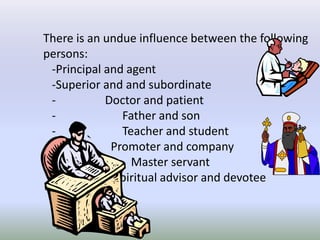
There is an undue influence between the following
persons:
-Principal and agent
-Superior and and subordinate
- Doctor and patient
- Father and son
- Teacher and student
- Promoter and company
- Master servant
- Spiritual advisor and devotee
Among the following relations there is no undue
influence
1.wife and husband
2.landlord and tenant
3.debtor and creditor
CASE: Raniannapurna vs. Swaminathan
A poor Hindu widow was persuaded by a money lender to
agree to pay 100% rate of interest on money lent by him.
She needed the money to establish her right to
maintenance.it was a clear case of undue influence and
the court reduced the rate of interest to 24%
FRAUD
According to Sec 17 fraud means and includes any of those
acts committed by a party to contract or with his connivance
or by his agent with an intent to deceive or induce a person
to enter a contract:
1. The suggestion that a fact is true when it is not true
and the person making it does not believe in itto be true
2. The active concealment of a fact by a person having
knowledge or belief of the fact
3. A promise made without any intention of performing it
4. Any other act fitted to deceive
5. Any such act or omission as the law specially declares
to be fraudulent
The essentials of fraud are:
1. There must be a representation or assertion
and it must be false
2.The representation must relate to a fact
3.The representation must have been made
with the intention of inducing the other party
to act upon it
4.the representation must have been made
with a knowledge of its falsity
5.the other party must have subsequently
suffered some loss
According to Sec 18 there is misrepresentation:
1. When a person positively asserts a fact is true
when his information does not warrant it to be so,
though he believes it to be true
2. When there is any Breach of duty by a person
which brings an advantage to the person
committing it by misleading another to his
prejudice
3. When a party causes however innocently the
other party to the agreement to make a mistake as
to the substance of the thing which s the subject
of the agreement
MISREPRESENTATION
Babul vs. R.A.Singh:
M was a marriage broker who gave Y the
photograph of a man and told him that the man
was young and rich. Y conveyed the same to his
daughter who agreed for the proposal. But on
the day of marriage it was discovered that the
man was the age of 60. There is fraud between
M and Y. whereas the is misrepresentation
between Y and his daughter.
Important case:
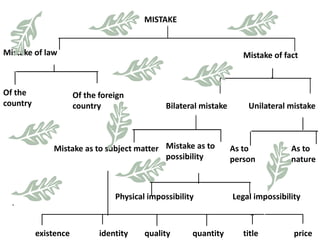
MISTAKE
Mistake of fact
Of the
country
Of the foreign
country Bilateral mistake Unilateral mistake
Mistake as to subject matter Mistake as to
possibility
As to
person
As to
nature
Physical impossibility Legal impossibility
existence identity quality quantity title price
Mistake of law
Free consent
Free consent

Free consent

  • 1.
  • 2.
    According to Sec10 of the Indian Contract Act one of the essentials of a valid contract is “Free Consent” Sec 13 defines “consent” as “Two or more persons are said to consent when they agree upon the same thing in the same sense”.According to Sec 14, consent is said to be free when it is not caused by: 1.Coercion 2.Undue influence 3.Fraud 4.Misrepresentation 5.Mistake FREE CONSENT
  • 3.
    According to Sec15 coercion means “Committing or threaten to commit any act forbidden by Indian Penal Code 1860 or unlawful detaining or threating to detaining any other persons property with a view to enter into an agreement. It is immaterial whether the IPC is or is not in force where the coercion is employed” The threat amounting to coercion need not necessarily be from a party to contract , it may also proceed from a stranger to the contract. COERCION
  • 4.
    Consent is saidto be caused by coercion when obtained by: 1.The committing or threatening to commit any act forbidden by the Indian Penal Code 2.The unlawful detaining or threatening to detain any property It is not important whether the IPC is or not in force where the coercion is taking place. For example A and B , both Indians are on a voyage trip to America when the ship is on the Atlantic ocean B threatens a that if doesn’t transfer his property to B’s name then he will push him into the water.now though the IPC is not in force on the Atlantic ocean it is still considered a coercion.
  • 5.
    1.Chikkim Ammiraju vs.Seshamma: In this case a person threatened his wife and son that he would suicide if she doesn’t transfer her property in his brother’s favour. The wife and son executed the release of the deed under the threat . Held the threat of suicide amounted to coercion within Sec 15 and the release deed was therefore voidable. This also is a very important case to prove that threat to commit suicide amounts to coercion Important cases:
  • 6.
    2. Ranganayakamma vs.Alwar Setty: A young widowed girl of 13 years was forced to adopt a boy by her relatives who prevented the removal of his body for cremation until she consented. Held the consent was not free but was induces by coercion.Consequently the adoption was set aside.
  • 7.
    3.Muthia vs. MuthuKaruppa: An agent refused to hand over the account books of a business to the new agent unless the principal released him from all liabilities.the principal had to give a release deed.held the deed was given under coercion and was voidable at the option of the principal.
  • 8.
    4. Bansraj vs.Secretary of State: The government gave a threat of attachment against the property of P for the recovery of the fine due from his son. P paid the fine. Held contract was induced by coercion
  • 9.
    UNDUE INFLUENCE Sometimes aparty is compelled to enter into a contract against his will as a result of unfair persuasion by the other party. Section 16 defines undue influence as follows A contract is said to be induced by “undue influence”where the relations subsisting between the parties are such that one of the parties is in a position to dominate the will of the other and uses that position to obtain an unfair advantage over the other
  • 10.
    Essentials of undue influence 1.There are two persons 2. The relations are satisfying between them 3. One must dominate the other 4. There must be unfair advantage 5. It involves the moral pressure
  • 11.
    There is anundue influence between the following persons: -Principal and agent -Superior and and subordinate - Doctor and patient - Father and son - Teacher and student - Promoter and company - Master servant - Spiritual advisor and devotee
  • 12.
    Among the followingrelations there is no undue influence 1.wife and husband 2.landlord and tenant 3.debtor and creditor CASE: Raniannapurna vs. Swaminathan A poor Hindu widow was persuaded by a money lender to agree to pay 100% rate of interest on money lent by him. She needed the money to establish her right to maintenance.it was a clear case of undue influence and the court reduced the rate of interest to 24%
  • 13.
    FRAUD According to Sec17 fraud means and includes any of those acts committed by a party to contract or with his connivance or by his agent with an intent to deceive or induce a person to enter a contract: 1. The suggestion that a fact is true when it is not true and the person making it does not believe in itto be true 2. The active concealment of a fact by a person having knowledge or belief of the fact 3. A promise made without any intention of performing it 4. Any other act fitted to deceive 5. Any such act or omission as the law specially declares to be fraudulent
  • 14.
    The essentials offraud are: 1. There must be a representation or assertion and it must be false 2.The representation must relate to a fact 3.The representation must have been made with the intention of inducing the other party to act upon it 4.the representation must have been made with a knowledge of its falsity 5.the other party must have subsequently suffered some loss
  • 15.
    According to Sec18 there is misrepresentation: 1. When a person positively asserts a fact is true when his information does not warrant it to be so, though he believes it to be true 2. When there is any Breach of duty by a person which brings an advantage to the person committing it by misleading another to his prejudice 3. When a party causes however innocently the other party to the agreement to make a mistake as to the substance of the thing which s the subject of the agreement MISREPRESENTATION
  • 16.
    Babul vs. R.A.Singh: Mwas a marriage broker who gave Y the photograph of a man and told him that the man was young and rich. Y conveyed the same to his daughter who agreed for the proposal. But on the day of marriage it was discovered that the man was the age of 60. There is fraud between M and Y. whereas the is misrepresentation between Y and his daughter. Important case:
  • 17.
    MISTAKE Mistake of fact Ofthe country Of the foreign country Bilateral mistake Unilateral mistake Mistake as to subject matter Mistake as to possibility As to person As to nature Physical impossibility Legal impossibility existence identity quality quantity title price Mistake of law