Whole Class Literacy ProfileSarah FrasierEDRDG 680July 16, 2010
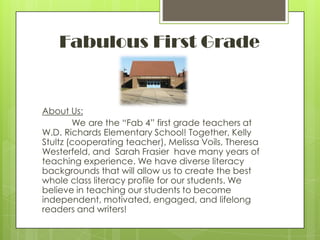
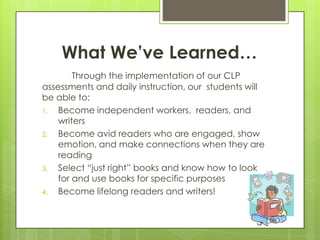
Fabulous First GradeAbout Us:	We are the “Fab 4” first grade teachers at W.D. Richards Elementary School! Together, Kelly Stultz (cooperating teacher), Melissa Voils, Theresa Westerfeld, and  Sarah Frasier  have many years of teaching experience. We have diverse literacy backgrounds that will allow us to create the best whole class literacy profile for our students. We believe in teaching our students to become independent, motivated, engaged, and lifelong readers and writers!
“If, Then… Thinking”CLP Thought ProcessesIf we plan on assessing our students on a certain skill, then we need to make sure we are teaching it.
If a student(s) is working above grade level, then we need to make sure that we are challenging him/her to meet his/her needs.
If we plan on using small group instruction, then how will we determine the make-up of our flexible groups?
If we are teaching students on individual needs, then how will they be able to master weekly language arts skills that are tested if they are not yet at that level of learning? How will we assign them grades?
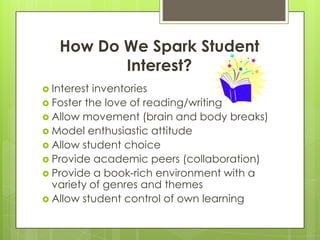
If we are using rubrics and checklists to assess students’ writing, then how will we determine percentages and grades at each level?How Do We Spark Student Interest?Interest inventoriesFoster the love of reading/writingAllow movement (brain and body breaks)Model enthusiastic attitudeAllow student choiceProvide academic peers (collaboration)Provide a book-rich environment with a variety of genres and themesAllow student control of own learning
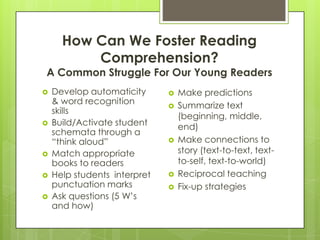
How Can We Foster Reading Comprehension?A Common Struggle For Our Young ReadersDevelop automaticity & word recognition skillsBuild/Activate student schemata through a “think aloud”Match appropriate books to readersHelp students  interpret punctuation marksAsk questions (5 W’s and how)Make predictionsSummarize text (beginning, middle, end)Make connections to story (text-to-text, text-to-self, text-to-world)Reciprocal teachingFix-up strategies
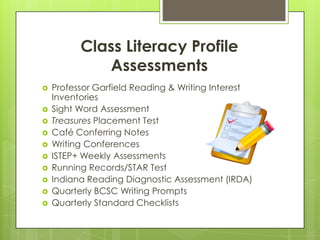
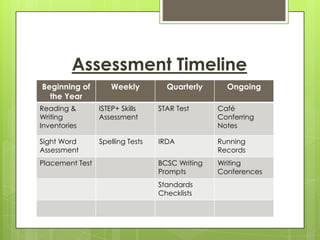
Class Literacy Profile AssessmentsProfessor Garfield Reading & Writing Interest InventoriesSight Word AssessmentTreasures Placement TestCafé Conferring NotesWriting ConferencesISTEP+ Weekly AssessmentsRunning Records/STAR TestIndiana Reading Diagnostic Assessment (IRDA)Quarterly BCSC Writing PromptsQuarterly Standard Checklists
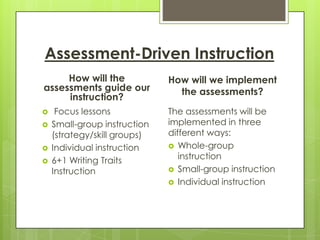
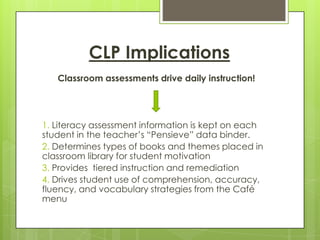
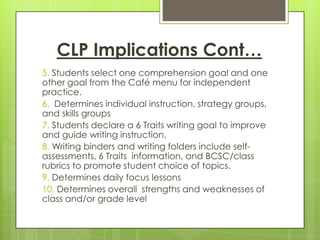
Assessment-Driven InstructionHow will we implement the assessments?How will the assessments guide our instruction? Focus lessons Small-group instruction (strategy/skill groups)Individual instruction6+1 Writing Traits InstructionThe assessments will be implemented in three different ways:Whole-group instructionSmall-group instructionIndividual instruction
Assessment Timeline

Frasier clp

  • 1.
    Whole Class LiteracyProfileSarah FrasierEDRDG 680July 16, 2010
  • 2.
    Fabulous First GradeAboutUs: We are the “Fab 4” first grade teachers at W.D. Richards Elementary School! Together, Kelly Stultz (cooperating teacher), Melissa Voils, Theresa Westerfeld, and Sarah Frasier have many years of teaching experience. We have diverse literacy backgrounds that will allow us to create the best whole class literacy profile for our students. We believe in teaching our students to become independent, motivated, engaged, and lifelong readers and writers!
  • 3.
    “If, Then… Thinking”CLPThought ProcessesIf we plan on assessing our students on a certain skill, then we need to make sure we are teaching it.
  • 4.
    If a student(s)is working above grade level, then we need to make sure that we are challenging him/her to meet his/her needs.
  • 5.
    If we planon using small group instruction, then how will we determine the make-up of our flexible groups?
  • 6.
    If we areteaching students on individual needs, then how will they be able to master weekly language arts skills that are tested if they are not yet at that level of learning? How will we assign them grades?
  • 7.
    If we areusing rubrics and checklists to assess students’ writing, then how will we determine percentages and grades at each level?How Do We Spark Student Interest?Interest inventoriesFoster the love of reading/writingAllow movement (brain and body breaks)Model enthusiastic attitudeAllow student choiceProvide academic peers (collaboration)Provide a book-rich environment with a variety of genres and themesAllow student control of own learning
  • 8.
    How Can WeFoster Reading Comprehension?A Common Struggle For Our Young ReadersDevelop automaticity & word recognition skillsBuild/Activate student schemata through a “think aloud”Match appropriate books to readersHelp students interpret punctuation marksAsk questions (5 W’s and how)Make predictionsSummarize text (beginning, middle, end)Make connections to story (text-to-text, text-to-self, text-to-world)Reciprocal teachingFix-up strategies
  • 9.
    Class Literacy ProfileAssessmentsProfessor Garfield Reading & Writing Interest InventoriesSight Word AssessmentTreasures Placement TestCafé Conferring NotesWriting ConferencesISTEP+ Weekly AssessmentsRunning Records/STAR TestIndiana Reading Diagnostic Assessment (IRDA)Quarterly BCSC Writing PromptsQuarterly Standard Checklists
  • 10.
    Assessment-Driven InstructionHow willwe implement the assessments?How will the assessments guide our instruction? Focus lessons Small-group instruction (strategy/skill groups)Individual instruction6+1 Writing Traits InstructionThe assessments will be implemented in three different ways:Whole-group instructionSmall-group instructionIndividual instruction
  • 11.

Editor's Notes

  • #8 The assessments that will be given in a whole-group setting are:Reading/writing interest inventoriesPlacement testQuarterly BCSC writing promptsIRDA (certain sections)Quarterly writing promptsThe assessments that will be given in small groups and/or individually are:Quarterly standard checklistsSTARRunning recordsCafé conferring recordsSight words assessment ISTEP+ Weekly Reading testsWriting conferences