Super-ultra-mega solving skills ;)


                 Mr. Standring Math
This presentation will help you to:
      add
      subtract
      multiply and
      divide fractions


                                  Mr. Standring Math
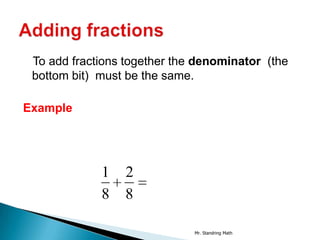
To add fractions together the denominator (the
 bottom bit) must be the same.

Example


             1   2
             8   8

                              Mr. Standring Math
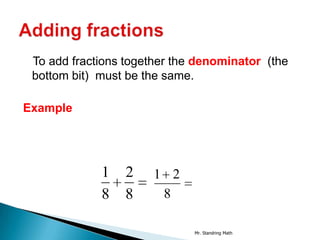
To add fractions together the denominator (the
 bottom bit) must be the same.

Example


             1   2    1 2
             8   8     8

                              Mr. Standring Math
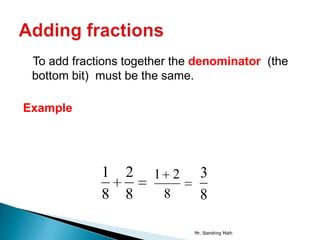
To add fractions together the denominator (the
 bottom bit) must be the same.

Example


             1   2    1 2       3
             8   8     8        8

                              Mr. Standring Math
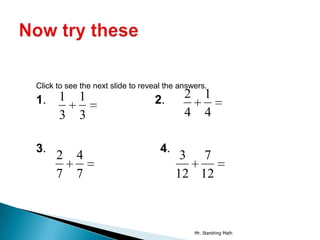
Click to see the next slide to reveal the answers.
1.    1     1                     2.       2       1
      3     3                              4       4

3.                                  4.
     2     4                              3 7
     7     7                             12 12


                                               Mr. Standring Math
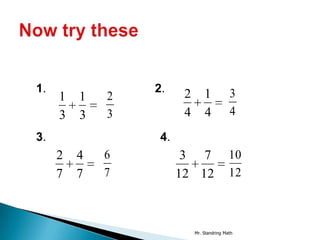
1.               2.     2       1           3
     1   1   2
     3   3   3          4       4           4

3.                4.
     2   4   6          3 7                 10
     7   7   7         12 12                12


                            Mr. Standring Math
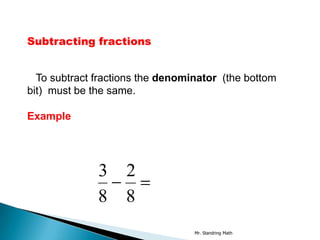
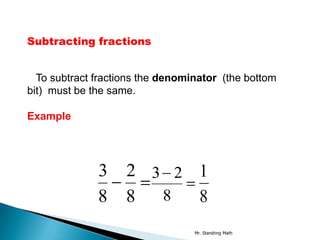
Subtracting fractions


  To subtract fractions the denominator (the bottom
bit) must be the same.

Example


              3     2
              8     8
                                  Mr. Standring Math
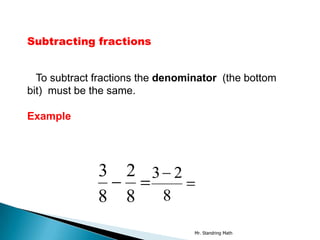
Subtracting fractions


  To subtract fractions the denominator (the bottom
bit) must be the same.

Example


              3     2 3 2
              8     8  8

                                  Mr. Standring Math
Subtracting fractions


  To subtract fractions the denominator (the bottom
bit) must be the same.

Example


              3     2 3 2 1
              8     8  8  8
                                  Mr. Standring Math
Now try these

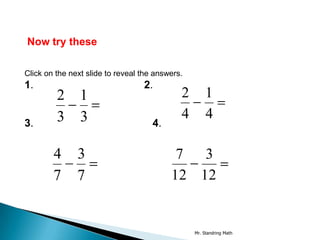
Click on the next slide to reveal the answers.
1.                                2.
         2      1                            2        1
         3      3                            4        4
3.                                   4.

        4      3                           7 3
        7      7                          12 12


                                                 Mr. Standring Math
Now try these

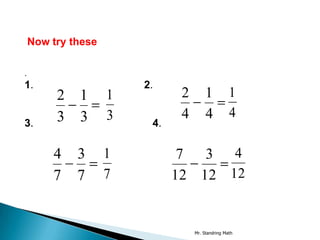
.
1.                      2.
         2   1      1          2        1          1
         3   3      3          4        4          4
3.                       4.

        4    3      1          7 3 4
        7    7      7         12 12 12


                                   Mr. Standring Math
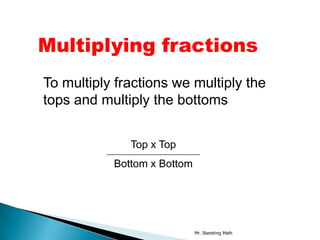
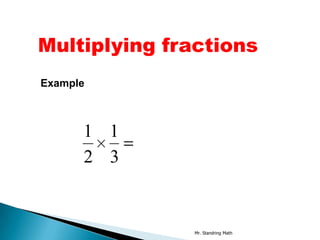
Multiplying fractions
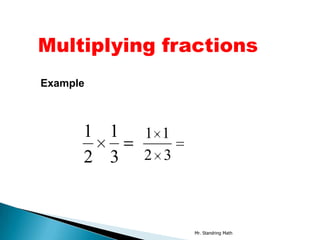
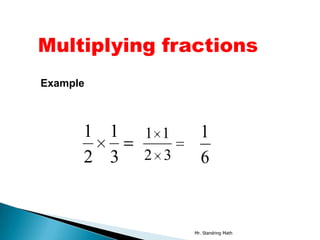
To multiply fractions we multiply the
tops and multiply the bottoms


              Top x Top
           Bottom x Bottom


                             Mr. Standring Math
Multiplying fractions
Example


      1 1
      2 3


              Mr. Standring Math
Multiplying fractions
Example


      1 1   1 1
      2 3   2 3


                  Mr. Standring Math
Multiplying fractions
Example


      1 1   1 1     1
      2 3   2 3     6


                  Mr. Standring Math
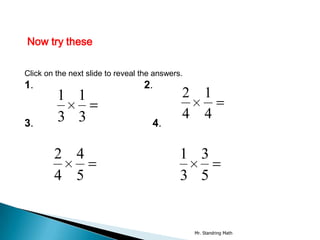
Now try these

Click on the next slide to reveal the answers.
1.                                2.
         1 1                                 2 1
         3 3                                 4 4
3.                                   4.

        2 4                                  1 3
        4 5                                  3 5


                                                 Mr. Standring Math
Now try these

.
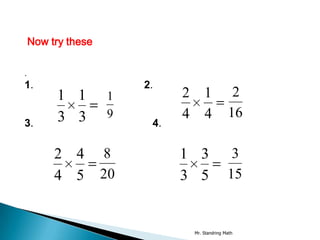
1.                       2.
         1 1        1          2 1              2
         3 3        9          4 4             16
3.                        4.

         2 4        8          1 3              3
         4 5        20         3 5             15


                                Mr. Standring Math
Dividing fractions
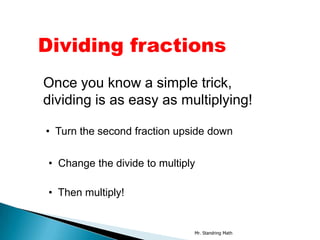
Once you know a simple trick,
dividing is as easy as multiplying!

• Turn the second fraction upside down

 • Change the divide to multiply

 • Then multiply!


                               Mr. Standring Math
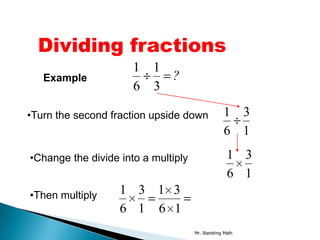
Dividing fractions
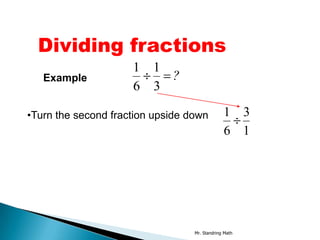
                     1 1
   Example               ?
                     6 3

•Turn the second fraction upside down          1 3
                                               6 1


                                  Mr. Standring Math
Dividing fractions
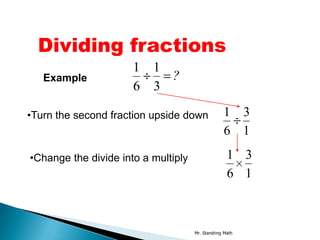
                      1 1
   Example                ?
                      6 3

•Turn the second fraction upside down             1 3
                                                  6 1

•Change the divide into a multiply                  1 3
                                                    6 1


                                     Mr. Standring Math
Dividing fractions
                      1 1
   Example                ?
                      6 3

•Turn the second fraction upside down             1 3
                                                  6 1

•Change the divide into a multiply                  1 3
                                                    6 1
•Then multiply     1 3 1 3
                   6 1 6 1
                                     Mr. Standring Math
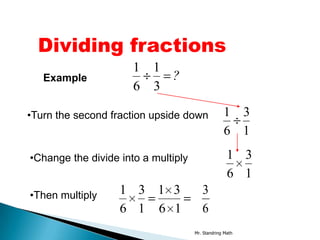
Dividing fractions
                      1 1
   Example                ?
                      6 3

•Turn the second fraction upside down             1 3
                                                  6 1

•Change the divide into a multiply                  1 3
                                                    6 1
•Then multiply     1 3 1 3              3
                   6 1 6 1              6
                                     Mr. Standring Math
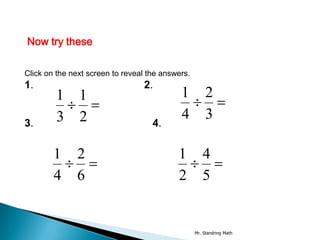
Now try these

Click on the next screen to reveal the answers.
1.                               2.
        1 1                                 1          2
        3 2                                 4          3
3.                                  4.

        1     2                            1         4
        4     6                            2         5


                                                  Mr. Standring Math
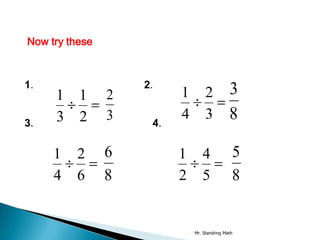
Now try these


1.                  2.
     1 1        2         1        2          3
3.   3 2        3    4.
                          4        3          8

     1   2      6         1      4             5
     4   6      8         2      5             8


                              Mr. Standring Math
To add or subtract fractions together the
denominator (the bottom bit) must be the
same.


So, sometimes we have to change the
bottoms to make them the same.

In “maths-speak” we say we must get
common denominators
                          Mr. Standring Math
To get a common denominator we have to:


1. Multiply the bottoms together.

2. Then multiply the top bit by the correct
number to get an equivalent fraction


                         Mr. Standring Math
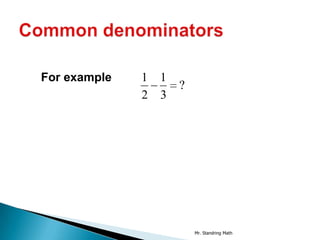
For example   1 1
                    ?
              2 3


                        Mr. Standring Math
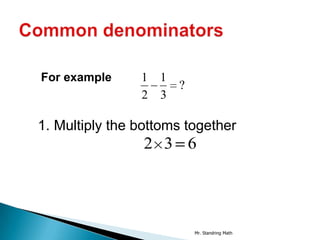
For example     1 1
                      ?
                2 3

1. Multiply the bottoms together
                 2 3 6


                          Mr. Standring Math
For example     1 1
                       ?
                2 3

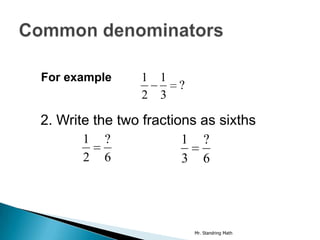
2. Write the two fractions as sixths
       1   ?           1       ?
       2   6           3       6


                           Mr. Standring Math
For example     1 1
                      ?
                2 3

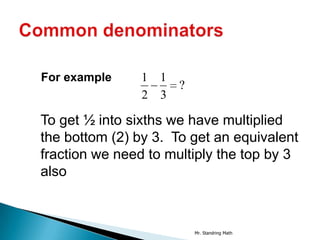
To get ½ into sixths we have multiplied
the bottom (2) by 3. To get an equivalent
fraction we need to multiply the top by 3
also


                          Mr. Standring Math
For example       1 1
                        ?
                  2 3

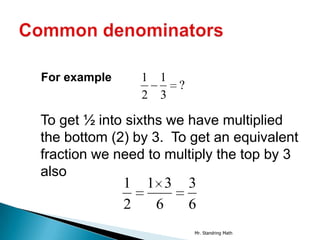
To get ½ into sixths we have multiplied
the bottom (2) by 3. To get an equivalent
fraction we need to multiply the top by 3
also
              1   1 3       3
              2    6        6
                            Mr. Standring Math
For example     1 1
                      ?
                2 3

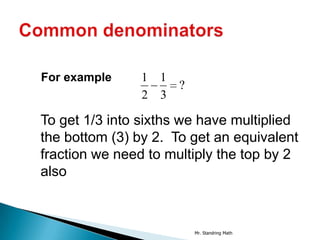
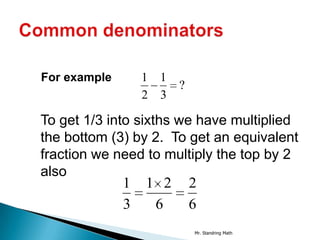
To get 1/3 into sixths we have multiplied
the bottom (3) by 2. To get an equivalent
fraction we need to multiply the top by 2
also


                          Mr. Standring Math
For example       1 1
                        ?
                  2 3

To get 1/3 into sixths we have multiplied
the bottom (3) by 2. To get an equivalent
fraction we need to multiply the top by 2
also
              1   1 2       2
              3    6        6
                            Mr. Standring Math
For example    1 1
                     ?
               2 3

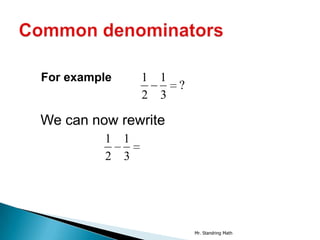
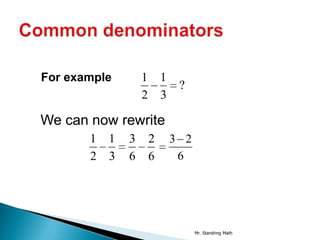
We can now rewrite
         1 1
         2 3


                         Mr. Standring Math
For example       1 1
                        ?
                  2 3

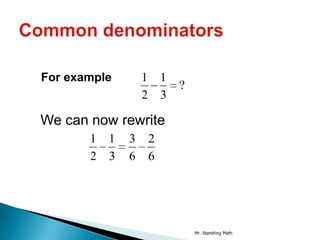
We can now rewrite
       1 1    3   2
       2 3    6   6


                            Mr. Standring Math
For example       1 1
                         ?
                  2 3

We can now rewrite
       1 1    3   2     3 2
       2 3    6   6      6


                              Mr. Standring Math
For example       1 1
                         ?
                  2 3

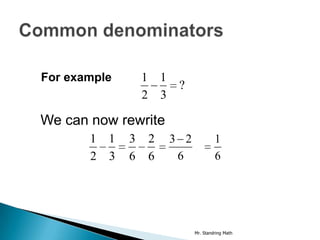
We can now rewrite
       1 1    3   2     3 2            1
       2 3    6   6      6             6


                              Mr. Standring Math
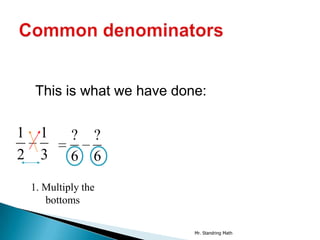
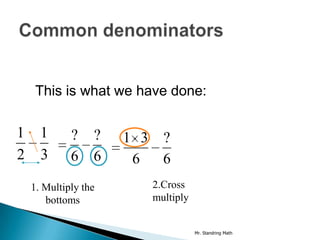
This is what we have done:

1     1      ?    ?
2     3      6    6
    1. Multiply the
       bottoms

                             Mr. Standring Math
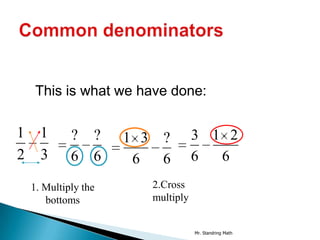
This is what we have done:

1     1      ?    ?   1 3 ?
2     3      6    6    6  6
    1. Multiply the      2.Cross
       bottoms           multiply


                                    Mr. Standring Math
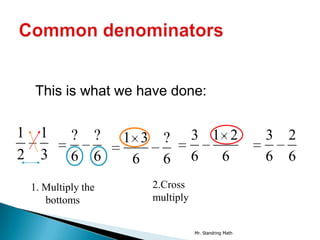
This is what we have done:

1     1      ?    ?   1 3 ?         3 1 2
2     3      6    6    6  6         6  6
    1. Multiply the      2.Cross
       bottoms           multiply


                                    Mr. Standring Math
This is what we have done:

1     1      ?    ?   1 3 ?         3 1 2                3   2
2     3      6    6    6  6         6  6                 6   6
    1. Multiply the      2.Cross
       bottoms           multiply


                                    Mr. Standring Math
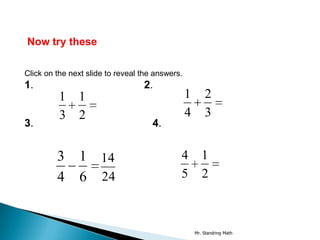
Now try these

Click on the next slide to reveal the answers.
1.                                2.
          1 1                                    1       2
          3 2                                    4       3
3.                                   4.


         3     1 14                          4          1
         4     6 24                          5          2


                                                     Mr. Standring Math
Now try these


1.                  2.
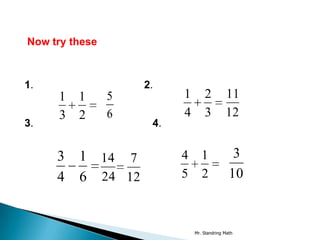
     1 1        5         1       2         11
     3 2        6         4       3         12
3.                   4.


     3   1 14 7           4      1             3
     4   6 24 12          5      2            10


                              Mr. Standring Math
Go to:
 BBC Bitesize Maths Revision site
                 by clicking here:


                               Mr. Standring Math

Fraction rules

  • 1.
    Super-ultra-mega solving skills;) Mr. Standring Math
  • 2.
    This presentation willhelp you to:  add  subtract  multiply and  divide fractions Mr. Standring Math
  • 3.
    To add fractionstogether the denominator (the bottom bit) must be the same. Example 1 2 8 8 Mr. Standring Math
  • 4.
    To add fractionstogether the denominator (the bottom bit) must be the same. Example 1 2 1 2 8 8 8 Mr. Standring Math
  • 5.
    To add fractionstogether the denominator (the bottom bit) must be the same. Example 1 2 1 2 3 8 8 8 8 Mr. Standring Math
  • 6.
    Click to seethe next slide to reveal the answers. 1. 1 1 2. 2 1 3 3 4 4 3. 4. 2 4 3 7 7 7 12 12 Mr. Standring Math
  • 7.
    1. 2. 2 1 3 1 1 2 3 3 3 4 4 4 3. 4. 2 4 6 3 7 10 7 7 7 12 12 12 Mr. Standring Math
  • 8.
    Subtracting fractions To subtract fractions the denominator (the bottom bit) must be the same. Example 3 2 8 8 Mr. Standring Math
  • 9.
    Subtracting fractions To subtract fractions the denominator (the bottom bit) must be the same. Example 3 2 3 2 8 8 8 Mr. Standring Math
  • 10.
    Subtracting fractions To subtract fractions the denominator (the bottom bit) must be the same. Example 3 2 3 2 1 8 8 8 8 Mr. Standring Math
  • 11.
    Now try these Clickon the next slide to reveal the answers. 1. 2. 2 1 2 1 3 3 4 4 3. 4. 4 3 7 3 7 7 12 12 Mr. Standring Math
  • 12.
    Now try these . 1. 2. 2 1 1 2 1 1 3 3 3 4 4 4 3. 4. 4 3 1 7 3 4 7 7 7 12 12 12 Mr. Standring Math
  • 13.
    Multiplying fractions To multiplyfractions we multiply the tops and multiply the bottoms Top x Top Bottom x Bottom Mr. Standring Math
  • 14.
    Multiplying fractions Example 1 1 2 3 Mr. Standring Math
  • 15.
    Multiplying fractions Example 1 1 1 1 2 3 2 3 Mr. Standring Math
  • 16.
    Multiplying fractions Example 1 1 1 1 1 2 3 2 3 6 Mr. Standring Math
  • 17.
    Now try these Clickon the next slide to reveal the answers. 1. 2. 1 1 2 1 3 3 4 4 3. 4. 2 4 1 3 4 5 3 5 Mr. Standring Math
  • 18.
    Now try these . 1. 2. 1 1 1 2 1 2 3 3 9 4 4 16 3. 4. 2 4 8 1 3 3 4 5 20 3 5 15 Mr. Standring Math
  • 19.
    Dividing fractions Once youknow a simple trick, dividing is as easy as multiplying! • Turn the second fraction upside down • Change the divide to multiply • Then multiply! Mr. Standring Math
  • 20.
    Dividing fractions 1 1 Example ? 6 3 •Turn the second fraction upside down 1 3 6 1 Mr. Standring Math
  • 21.
    Dividing fractions 1 1 Example ? 6 3 •Turn the second fraction upside down 1 3 6 1 •Change the divide into a multiply 1 3 6 1 Mr. Standring Math
  • 22.
    Dividing fractions 1 1 Example ? 6 3 •Turn the second fraction upside down 1 3 6 1 •Change the divide into a multiply 1 3 6 1 •Then multiply 1 3 1 3 6 1 6 1 Mr. Standring Math
  • 23.
    Dividing fractions 1 1 Example ? 6 3 •Turn the second fraction upside down 1 3 6 1 •Change the divide into a multiply 1 3 6 1 •Then multiply 1 3 1 3 3 6 1 6 1 6 Mr. Standring Math
  • 24.
    Now try these Clickon the next screen to reveal the answers. 1. 2. 1 1 1 2 3 2 4 3 3. 4. 1 2 1 4 4 6 2 5 Mr. Standring Math
  • 25.
    Now try these 1. 2. 1 1 2 1 2 3 3. 3 2 3 4. 4 3 8 1 2 6 1 4 5 4 6 8 2 5 8 Mr. Standring Math
  • 26.
    To add orsubtract fractions together the denominator (the bottom bit) must be the same. So, sometimes we have to change the bottoms to make them the same. In “maths-speak” we say we must get common denominators Mr. Standring Math
  • 27.
    To get acommon denominator we have to: 1. Multiply the bottoms together. 2. Then multiply the top bit by the correct number to get an equivalent fraction Mr. Standring Math
  • 28.
    For example 1 1 ? 2 3 Mr. Standring Math
  • 29.
    For example 1 1 ? 2 3 1. Multiply the bottoms together 2 3 6 Mr. Standring Math
  • 30.
    For example 1 1 ? 2 3 2. Write the two fractions as sixths 1 ? 1 ? 2 6 3 6 Mr. Standring Math
  • 31.
    For example 1 1 ? 2 3 To get ½ into sixths we have multiplied the bottom (2) by 3. To get an equivalent fraction we need to multiply the top by 3 also Mr. Standring Math
  • 32.
    For example 1 1 ? 2 3 To get ½ into sixths we have multiplied the bottom (2) by 3. To get an equivalent fraction we need to multiply the top by 3 also 1 1 3 3 2 6 6 Mr. Standring Math
  • 33.
    For example 1 1 ? 2 3 To get 1/3 into sixths we have multiplied the bottom (3) by 2. To get an equivalent fraction we need to multiply the top by 2 also Mr. Standring Math
  • 34.
    For example 1 1 ? 2 3 To get 1/3 into sixths we have multiplied the bottom (3) by 2. To get an equivalent fraction we need to multiply the top by 2 also 1 1 2 2 3 6 6 Mr. Standring Math
  • 35.
    For example 1 1 ? 2 3 We can now rewrite 1 1 2 3 Mr. Standring Math
  • 36.
    For example 1 1 ? 2 3 We can now rewrite 1 1 3 2 2 3 6 6 Mr. Standring Math
  • 37.
    For example 1 1 ? 2 3 We can now rewrite 1 1 3 2 3 2 2 3 6 6 6 Mr. Standring Math
  • 38.
    For example 1 1 ? 2 3 We can now rewrite 1 1 3 2 3 2 1 2 3 6 6 6 6 Mr. Standring Math
  • 39.
    This is whatwe have done: 1 1 ? ? 2 3 6 6 1. Multiply the bottoms Mr. Standring Math
  • 40.
    This is whatwe have done: 1 1 ? ? 1 3 ? 2 3 6 6 6 6 1. Multiply the 2.Cross bottoms multiply Mr. Standring Math
  • 41.
    This is whatwe have done: 1 1 ? ? 1 3 ? 3 1 2 2 3 6 6 6 6 6 6 1. Multiply the 2.Cross bottoms multiply Mr. Standring Math
  • 42.
    This is whatwe have done: 1 1 ? ? 1 3 ? 3 1 2 3 2 2 3 6 6 6 6 6 6 6 6 1. Multiply the 2.Cross bottoms multiply Mr. Standring Math
  • 43.
    Now try these Clickon the next slide to reveal the answers. 1. 2. 1 1 1 2 3 2 4 3 3. 4. 3 1 14 4 1 4 6 24 5 2 Mr. Standring Math
  • 44.
    Now try these 1. 2. 1 1 5 1 2 11 3 2 6 4 3 12 3. 4. 3 1 14 7 4 1 3 4 6 24 12 5 2 10 Mr. Standring Math
  • 45.
    Go to:  BBCBitesize Maths Revision site by clicking here: Mr. Standring Math