Fourier series expansion
Spectral analysis
Most part of signals involved in systems
working, are time-varying quantities.
Although a signal physically exists in
time domain, we can represent it in the
so called frequency domain, in which it
consists of a series of sinusoidal
components at various frequencies.
The frequency domain description is
called spectral analysis.
24/05/2012 2Fourier series expansion
LTI systems
The spectral analysis of signals, coupled with
frequency response characteristics of systems,
allows us to have a good approach in design
work.
In fact, when we can study the behavior of a
linear time-invariant (LTI) system in presence of
a particular sinusoidal signal, we can also
study the behavior in presence of all the
sinusoidal signals, and therefore in presence of
all the signals which we can consider
composed by a series of sinusoidal signals.
24/05/2012Fourier series expansion 3
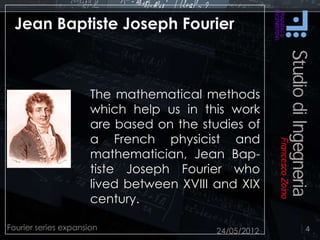
Jean Baptiste Joseph Fourier
The mathematical methods
which help us in this work
are based on the studies of
a French physicist and
mathematician, Jean Bap-
tiste Joseph Fourier who
lived between XVIII and XIX
century.
24/05/2012Fourier series expansion 4
Methods
There are two kinds of methods:
• Series expansion of periodic signals
• Transform of non-periodic signals
24/05/2012Fourier series expansion 5
Series expansion
Every periodic function can be represented as
the expansion of a series of sinusoidal functions:
24/05/2012Fourier series expansion 6
where
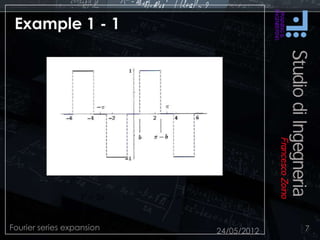
Example 1 - 1
24/05/2012Fourier series expansion 7
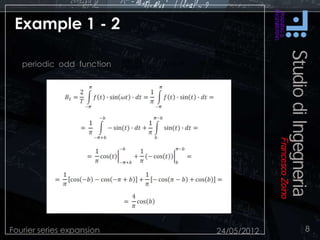
Example 1 - 2
24/05/2012Fourier series expansion 8
periodic odd function
Example 1 - 3
24/05/2012Fourier series expansion 9
in the end:
If b=0, the function represents the restriction of function sgn(t)
into the ] interval, periodically extended outside. In the
figure below (left) are represented the first five Fourier
polynomials of this function.
The amplitude spectrum is a line spectrum (right figure).
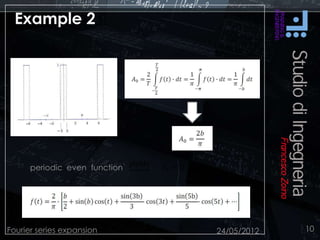
Example 2
24/05/2012Fourier series expansion 10
periodic even function
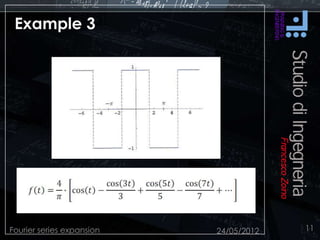
Example 3
24/05/2012Fourier series expansion 11
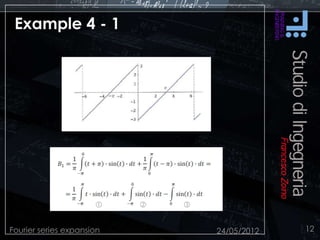
Example 4 - 1
24/05/2012Fourier series expansion 12
  
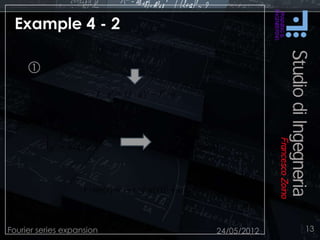
Example 4 - 2
24/05/2012Fourier series expansion 13

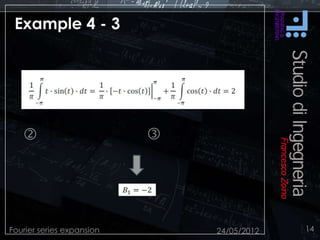
Example 4 - 3
24/05/2012Fourier series expansion 14
 
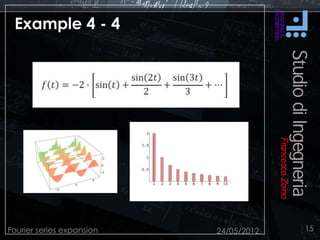
Example 4 - 4
24/05/2012Fourier series expansion 15
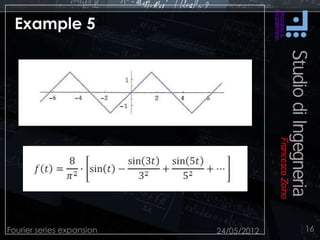
Example 5
24/05/2012Fourier series expansion 16
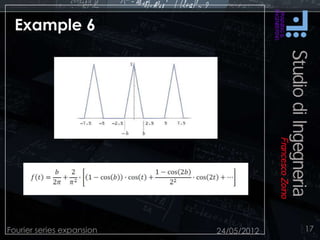
Example 6
24/05/2012Fourier series expansion 17

Fourier series expansion

  • 1.
  • 2.
    Spectral analysis Most partof signals involved in systems working, are time-varying quantities. Although a signal physically exists in time domain, we can represent it in the so called frequency domain, in which it consists of a series of sinusoidal components at various frequencies. The frequency domain description is called spectral analysis. 24/05/2012 2Fourier series expansion
  • 3.
    LTI systems The spectralanalysis of signals, coupled with frequency response characteristics of systems, allows us to have a good approach in design work. In fact, when we can study the behavior of a linear time-invariant (LTI) system in presence of a particular sinusoidal signal, we can also study the behavior in presence of all the sinusoidal signals, and therefore in presence of all the signals which we can consider composed by a series of sinusoidal signals. 24/05/2012Fourier series expansion 3
  • 4.
    Jean Baptiste JosephFourier The mathematical methods which help us in this work are based on the studies of a French physicist and mathematician, Jean Bap- tiste Joseph Fourier who lived between XVIII and XIX century. 24/05/2012Fourier series expansion 4
  • 5.
    Methods There are twokinds of methods: • Series expansion of periodic signals • Transform of non-periodic signals 24/05/2012Fourier series expansion 5
  • 6.
    Series expansion Every periodicfunction can be represented as the expansion of a series of sinusoidal functions: 24/05/2012Fourier series expansion 6 where
  • 7.
    Example 1 -1 24/05/2012Fourier series expansion 7
  • 8.
    Example 1 -2 24/05/2012Fourier series expansion 8 periodic odd function
  • 9.
    Example 1 -3 24/05/2012Fourier series expansion 9 in the end: If b=0, the function represents the restriction of function sgn(t) into the ] interval, periodically extended outside. In the figure below (left) are represented the first five Fourier polynomials of this function. The amplitude spectrum is a line spectrum (right figure).
  • 10.
    Example 2 24/05/2012Fourier seriesexpansion 10 periodic even function
  • 11.
  • 12.
    Example 4 -1 24/05/2012Fourier series expansion 12   
  • 13.
    Example 4 -2 24/05/2012Fourier series expansion 13 
  • 14.
    Example 4 -3 24/05/2012Fourier series expansion 14  
  • 15.
    Example 4 -4 24/05/2012Fourier series expansion 15
  • 16.
  • 17.