RAT 306, Dr Sreepriya.S, Associate Professor, Department of RA, ASIET
1
SIGNALS AND SYSTEM
MODULE 2
RAT 306, Dr Sreepriya.S, Associate Professor, Department of RA, ASIET 2
SYLLABUS
 Frequency domain representation of continuous time signals
 Continuous time Fourier series and its properties.
 Continuous time Fourier transform and its properties.
 Relation between Fourier and Laplace transforms.
 Analysis of LTI systems using Laplace and Fourier transforms.
 Concept of transfer function, Frequency response, Magnitude and
phase response
 Sampling of continuous time signals, Sampling theorem for low pass
signals, aliasing
RAT 306, Dr Sreepriya.S, Associate Professor, Department of RA, ASIET
3
FREQUENCY DOMAIN
REPRESENTATION OF CONTINUOUS
TIME SIGNALS
Continuous time Fourier series and its properties.
Continuous time Fourier transform and its properties.
RAT 306, Dr Sreepriya.S, Associate Professor, Department of RA, ASIET 4
FREQUENCY DOMAIN ANALYSIS
RAT 306, Dr Sreepriya.S, Associate Professor, Department of RA, ASIET 5
FREQUENCY DOMAIN ANALYSIS OF SIGNALS
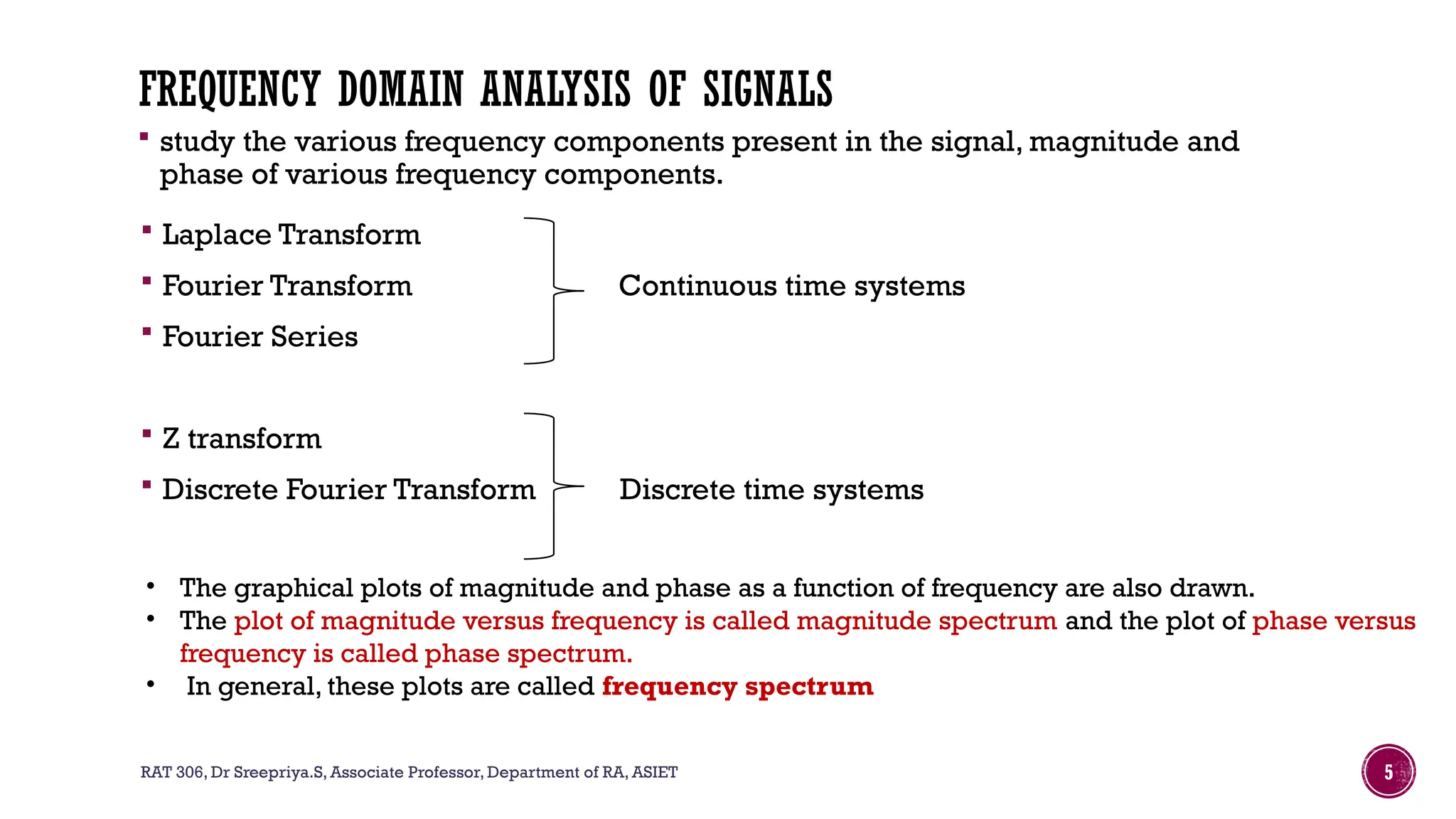
 study the various frequency components present in the signal, magnitude and
phase of various frequency components.
 Laplace Transform
 Fourier Transform Continuous time systems
 Fourier Series
 Z transform
 Discrete Fourier Transform Discrete time systems
• The graphical plots of magnitude and phase as a function of frequency are also drawn.
• The plot of magnitude versus frequency is called magnitude spectrum and the plot of phase versus
frequency is called phase spectrum.
• In general, these plots are called frequency spectrum
RAT 306, Dr Sreepriya.S, Associate Professor, Department of RA, ASIET 6
FREQUENCY DOMAIN ANALYSIS OF SIGNALS
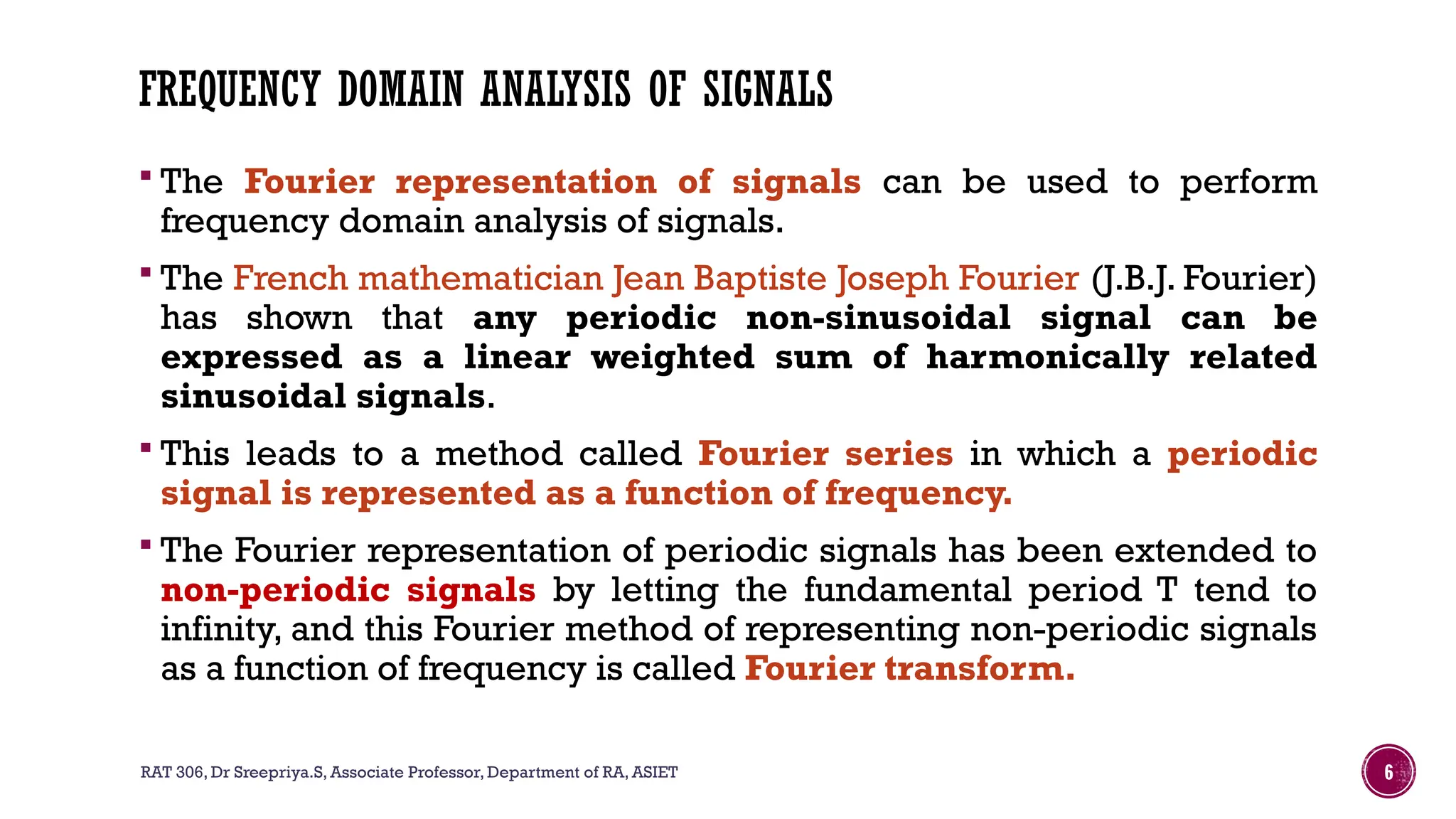
 The Fourier representation of signals can be used to perform
frequency domain analysis of signals.
 The French mathematician Jean Baptiste Joseph Fourier (J.B.J. Fourier)
has shown that any periodic non-sinusoidal signal can be
expressed as a linear weighted sum of harmonically related
sinusoidal signals.
 This leads to a method called Fourier series in which a periodic
signal is represented as a function of frequency.
 The Fourier representation of periodic signals has been extended to
non-periodic signals by letting the fundamental period T tend to
infinity, and this Fourier method of representing non-periodic signals
as a function of frequency is called Fourier transform.
RAT 306, Dr Sreepriya.S, Associate Professor, Department of RA, ASIET
7
FOURIER SERIES
Any periodic signal represented as a weighted
superposition of sinusoidal or complex exponentials
RAT 306, Dr Sreepriya.S, Associate Professor, Department of RA, ASIET 8
FOURIER SERIES: INTRODUCTION
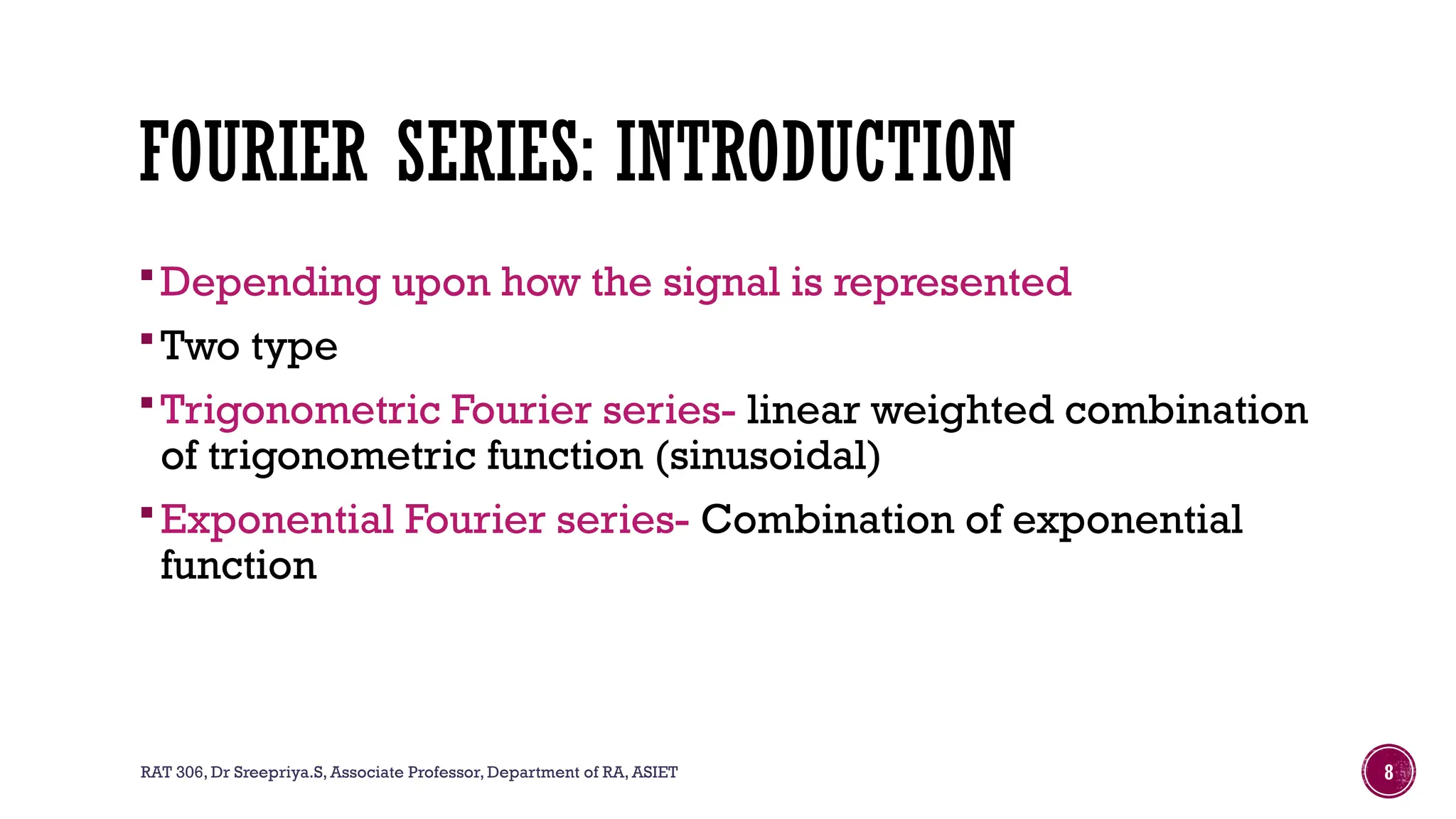
Depending upon how the signal is represented
Two type
Trigonometric Fourier series- linear weighted combination
of trigonometric function (sinusoidal)
Exponential Fourier series- Combination of exponential
function
RAT 306, Dr Sreepriya.S, Associate Professor, Department of RA, ASIET 9
FOURIER SERIES: INTRODUCTION
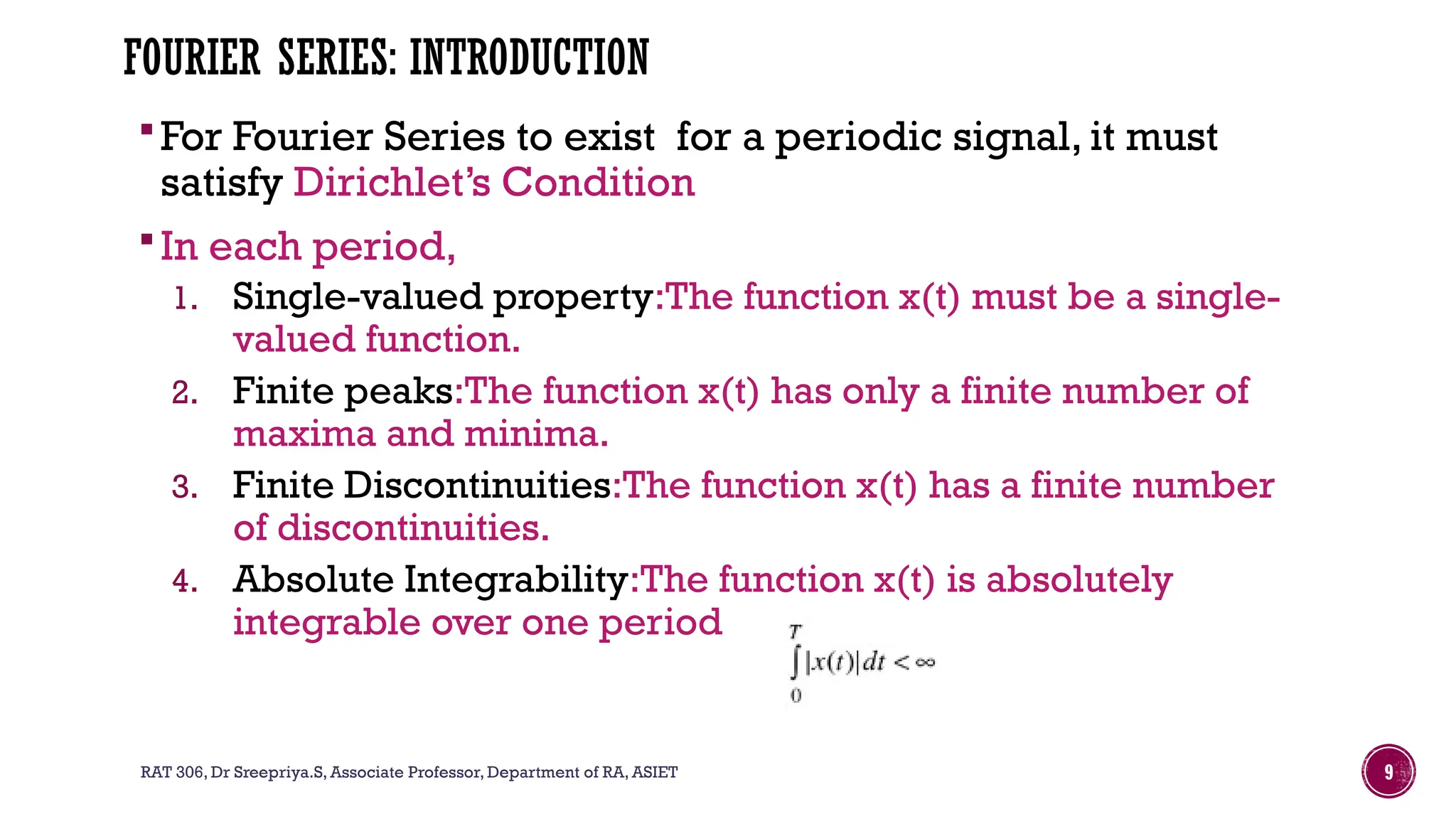
For Fourier Series to exist for a periodic signal, it must
satisfy Dirichlet’s Condition
In each period,
1. Single-valued property:The function x(t) must be a single-
valued function.
2. Finite peaks:The function x(t) has only a finite number of
maxima and minima.
3. Finite Discontinuities:The function x(t) has a finite number
of discontinuities.
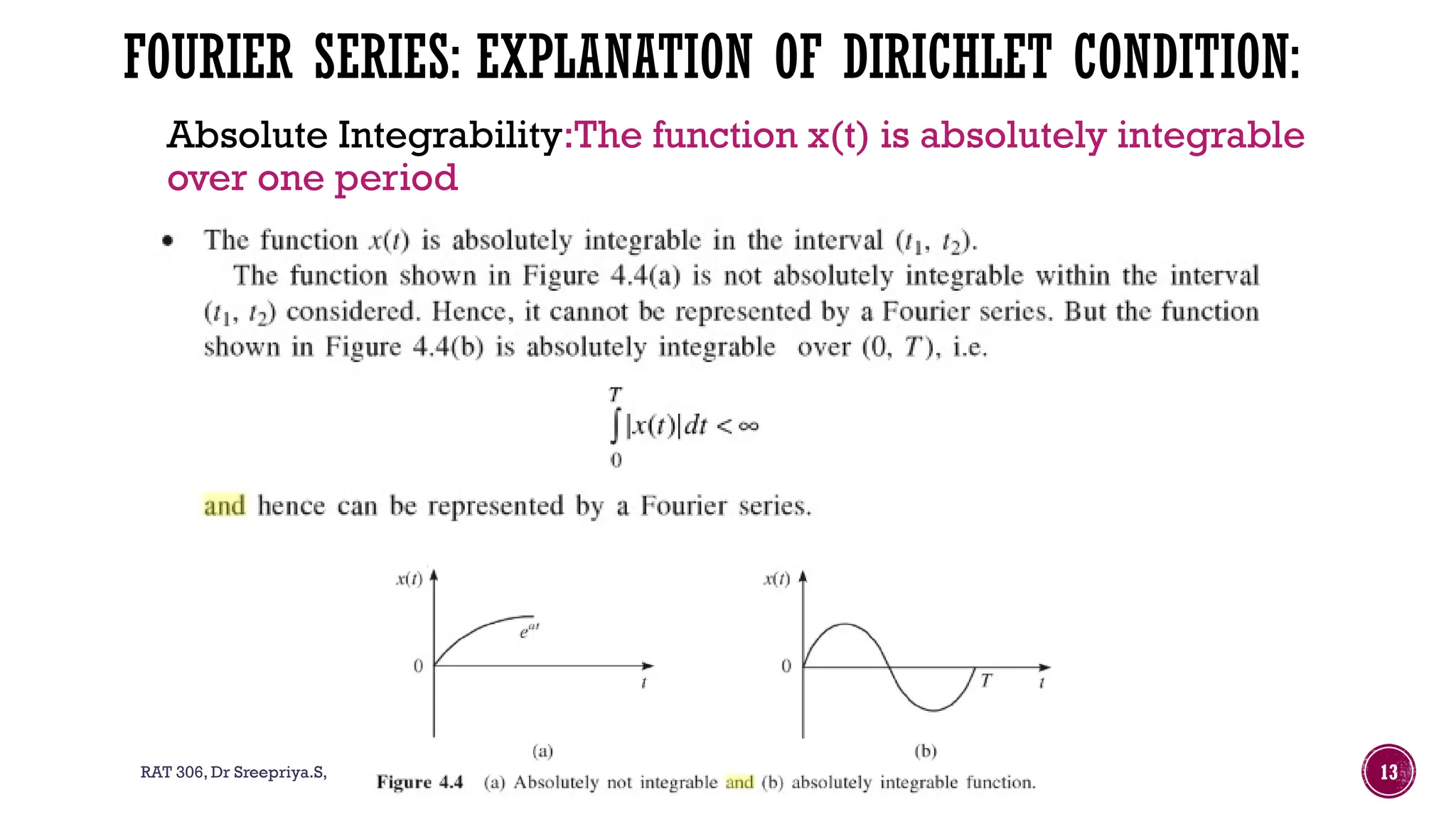
4. Absolute Integrability:The function x(t) is absolutely
integrable over one period
RAT 306, Dr Sreepriya.S, Associate Professor, Department of RA, ASIET 10
FOURIER SERIES: EXPLANATION OF DIRICHLET CONDITION:
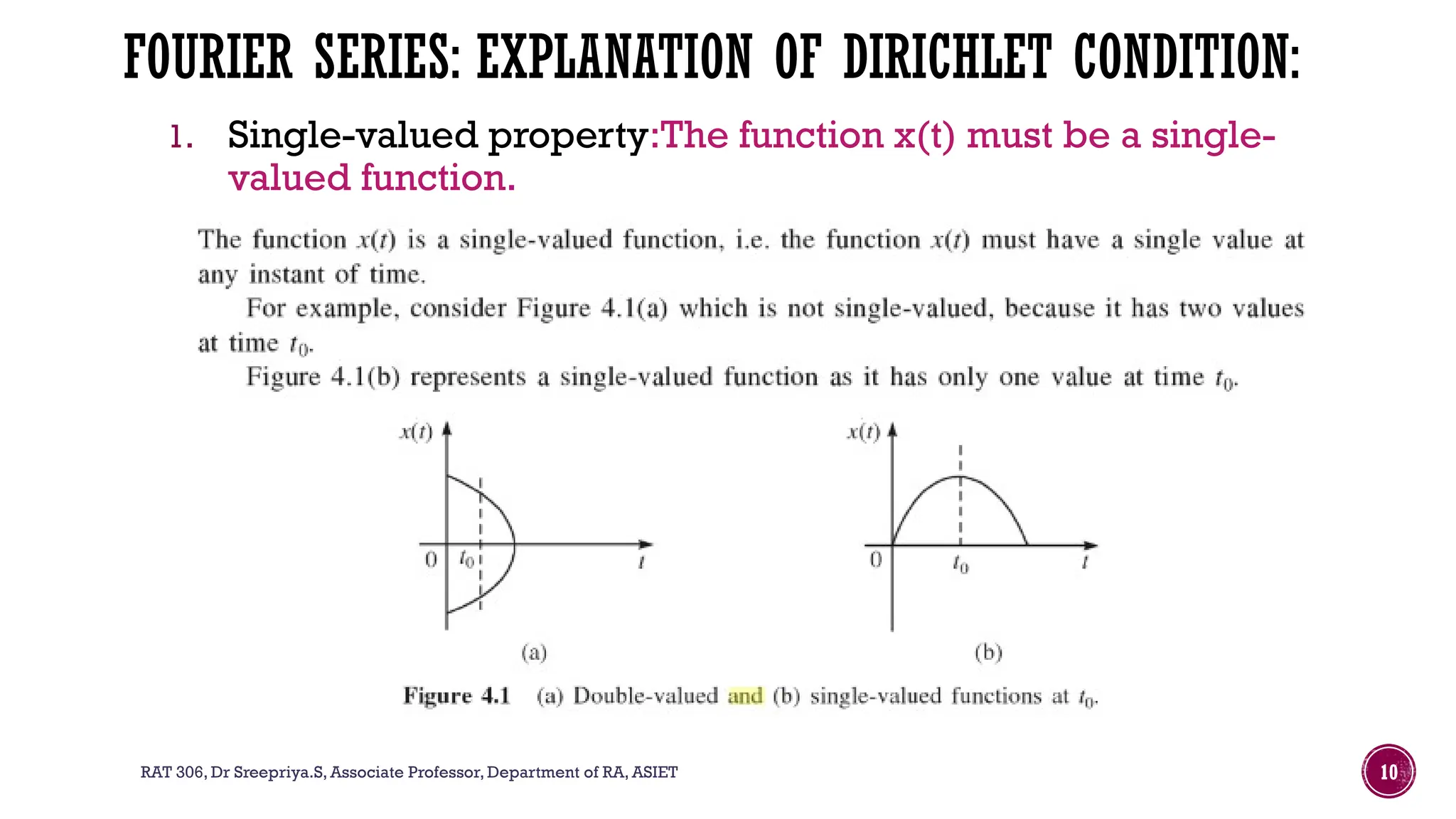
1. Single-valued property:The function x(t) must be a single-
valued function.
RAT 306, Dr Sreepriya.S, Associate Professor, Department of RA, ASIET 11
FOURIER SERIES: EXPLANATION OF DIRICHLET CONDITION:
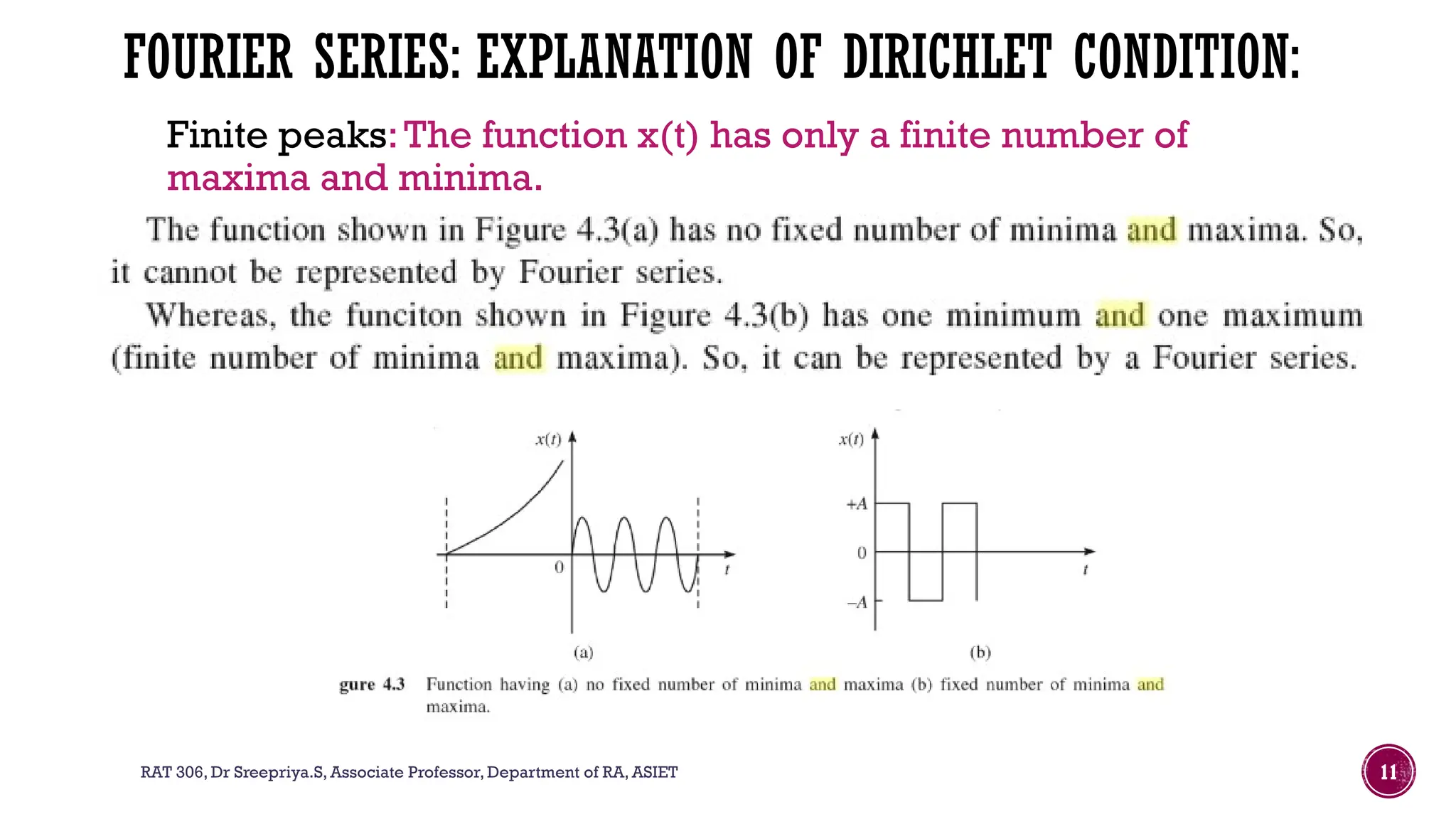
Finite peaks:The function x(t) has only a finite number of
maxima and minima.
RAT 306, Dr Sreepriya.S, Associate Professor, Department of RA, ASIET 12
FOURIER SERIES: EXPLANATION OF DIRICHLET CONDITION:
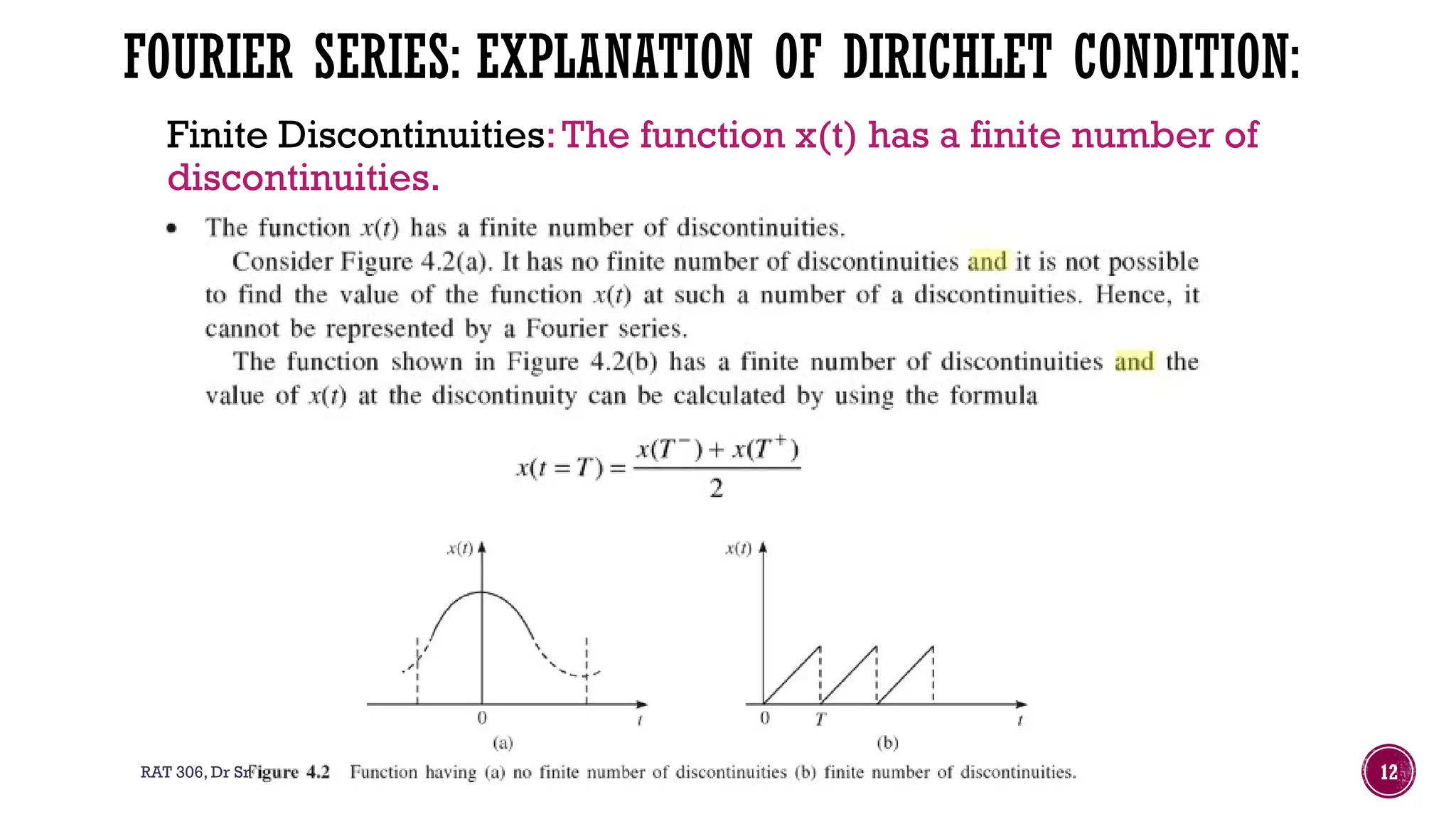
Finite Discontinuities:The function x(t) has a finite number of
discontinuities.
RAT 306, Dr Sreepriya.S, Associate Professor, Department of RA, ASIET 13
FOURIER SERIES: EXPLANATION OF DIRICHLET CONDITION:
Absolute Integrability:The function x(t) is absolutely integrable
over one period
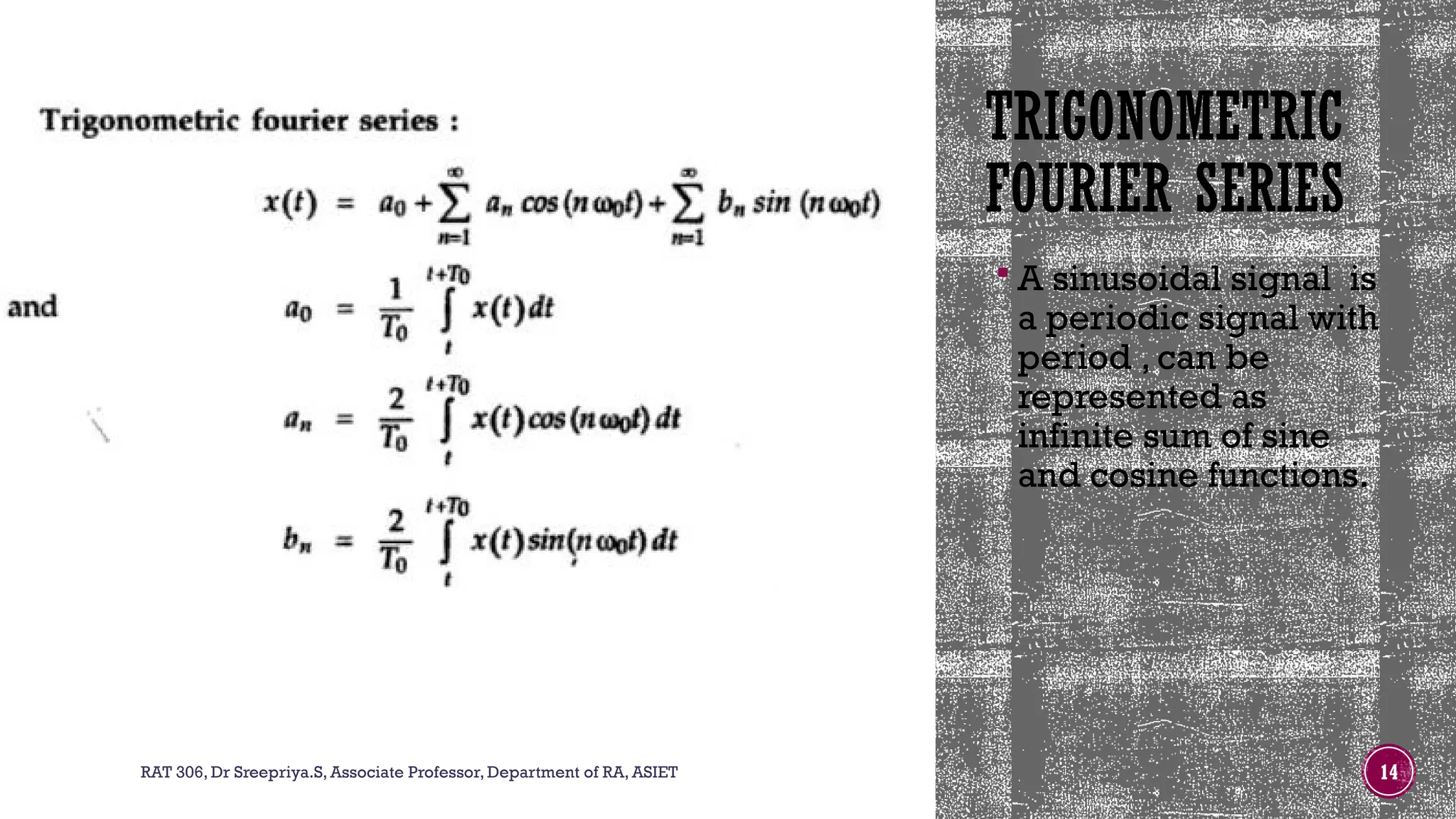
TRIGONOMETRIC
FOURIER SERIES
 A sinusoidal signal is
a periodic signal with
period , can be
represented as
infinite sum of sine
and cosine functions.
RAT 306, Dr Sreepriya.S, Associate Professor, Department of RA, ASIET 14
EXPONENTIAL
FOURIER SERIES
RAT 306, Dr Sreepriya.S, Associate Professor, Department of RA, ASIET 15
The signal x(t) is
represented as a
weighted sum of
complex exponential
functions
More convenient and
compact, hence widely
used.
EXPONENTIAL
FOURIER SERIES
The exponential form of Fourier series
of a periodic signal x(t) with period T is
given by
Where , Cn is the Fourier coefficient,T is
the fundamental period
The Fourier coefficients are given as
RAT 306, Dr Sreepriya.S, Associate Professor, Department of RA, ASIET 16
RAT 306, Dr Sreepriya.S, Associate Professor, Department of RA, ASIET 17
CONVERSION
 Exponential to Trignometric
coefficients
 )
 Trignometric to Exponential
RAT 306, Dr Sreepriya.S, Associate Professor, Department of RA, ASIET
18
PROPERTIES OF FOURIER
SERIES
RAT 306, Dr Sreepriya.S, Associate Professor, Department of RA, ASIET 19
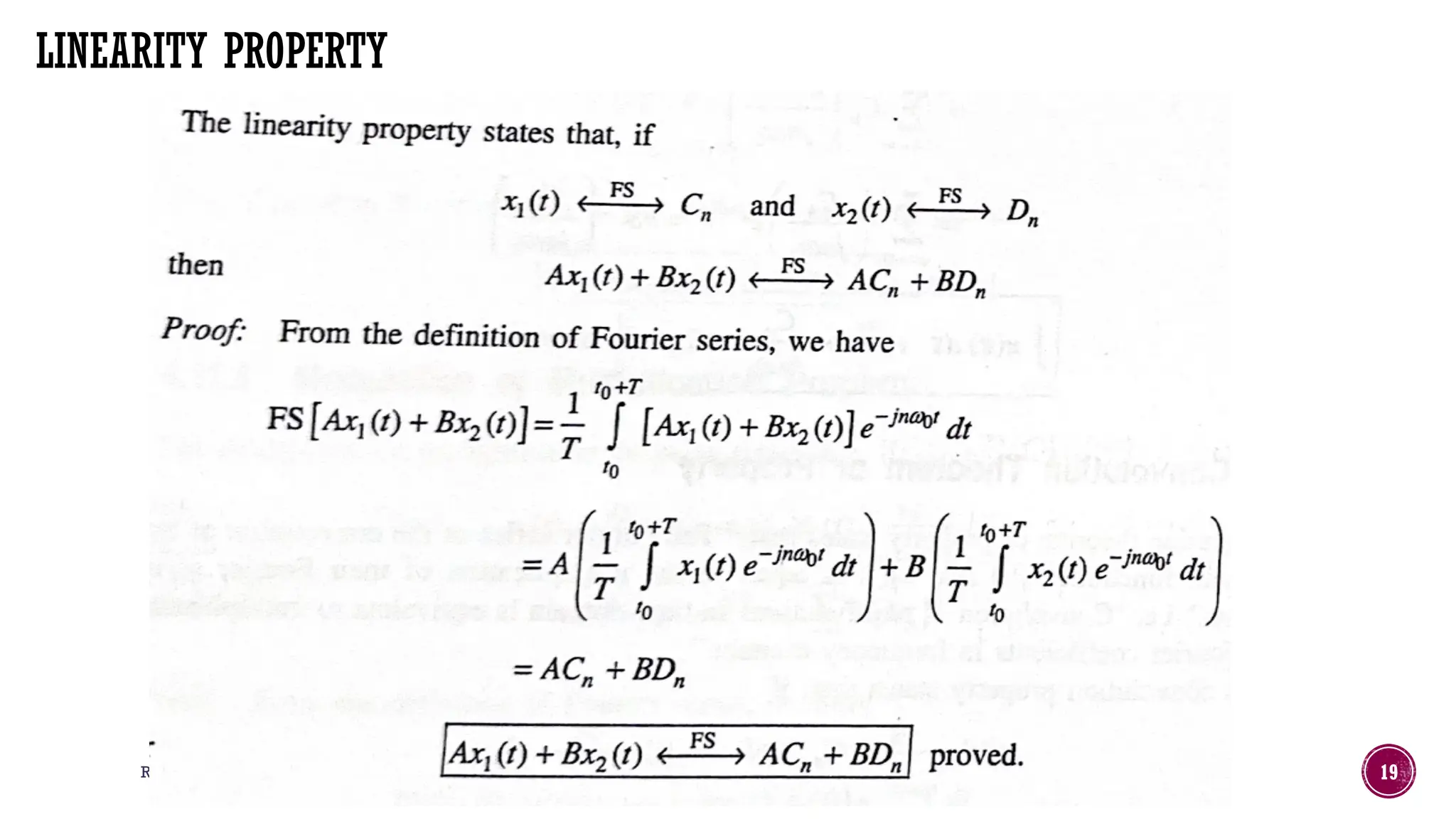
LINEARITY PROPERTY
RAT 306, Dr Sreepriya.S, Associate Professor, Department of RA, ASIET 20
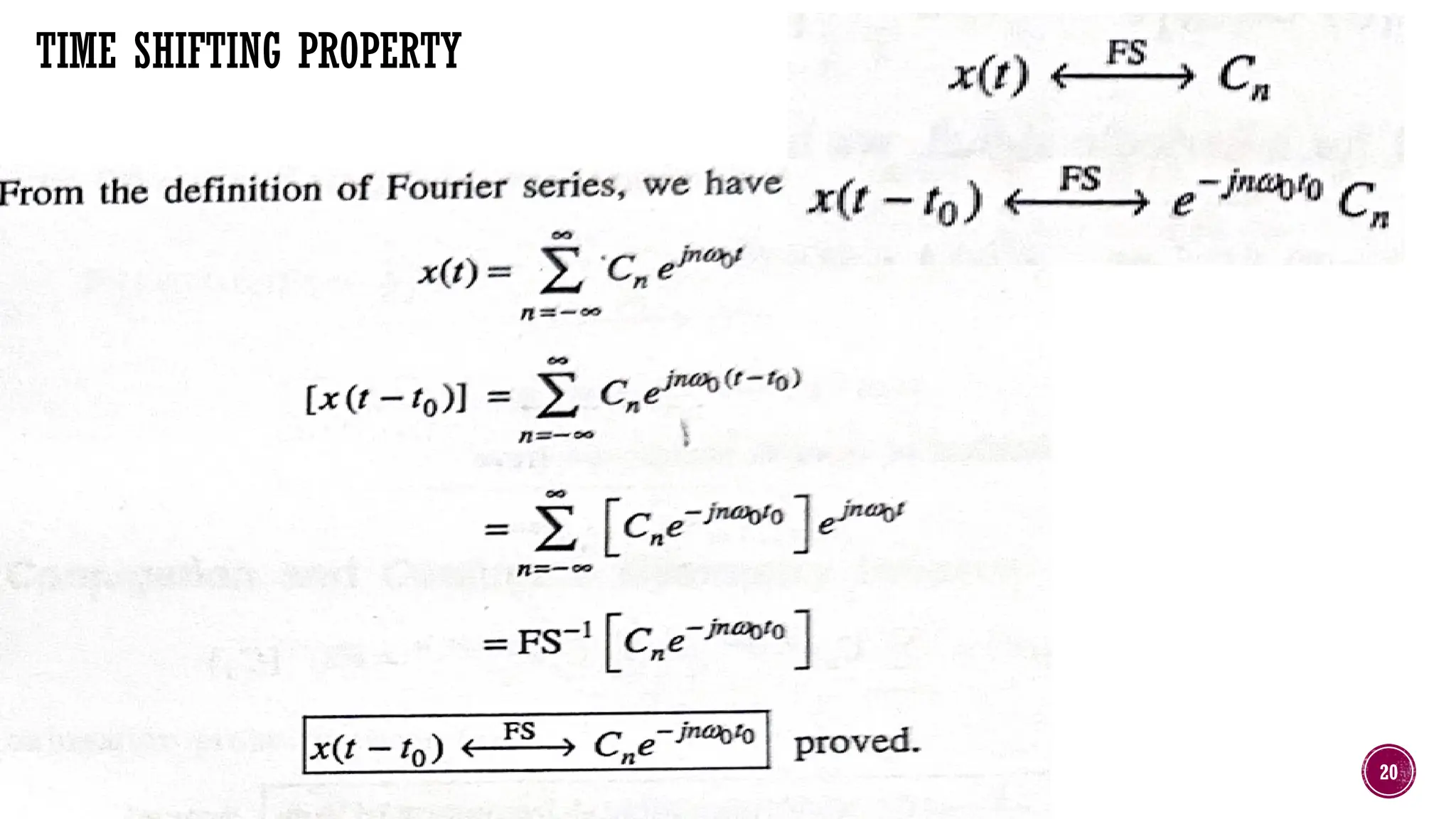
TIME SHIFTING PROPERTY
RAT 306, Dr Sreepriya.S, Associate Professor, Department of RA, ASIET 21
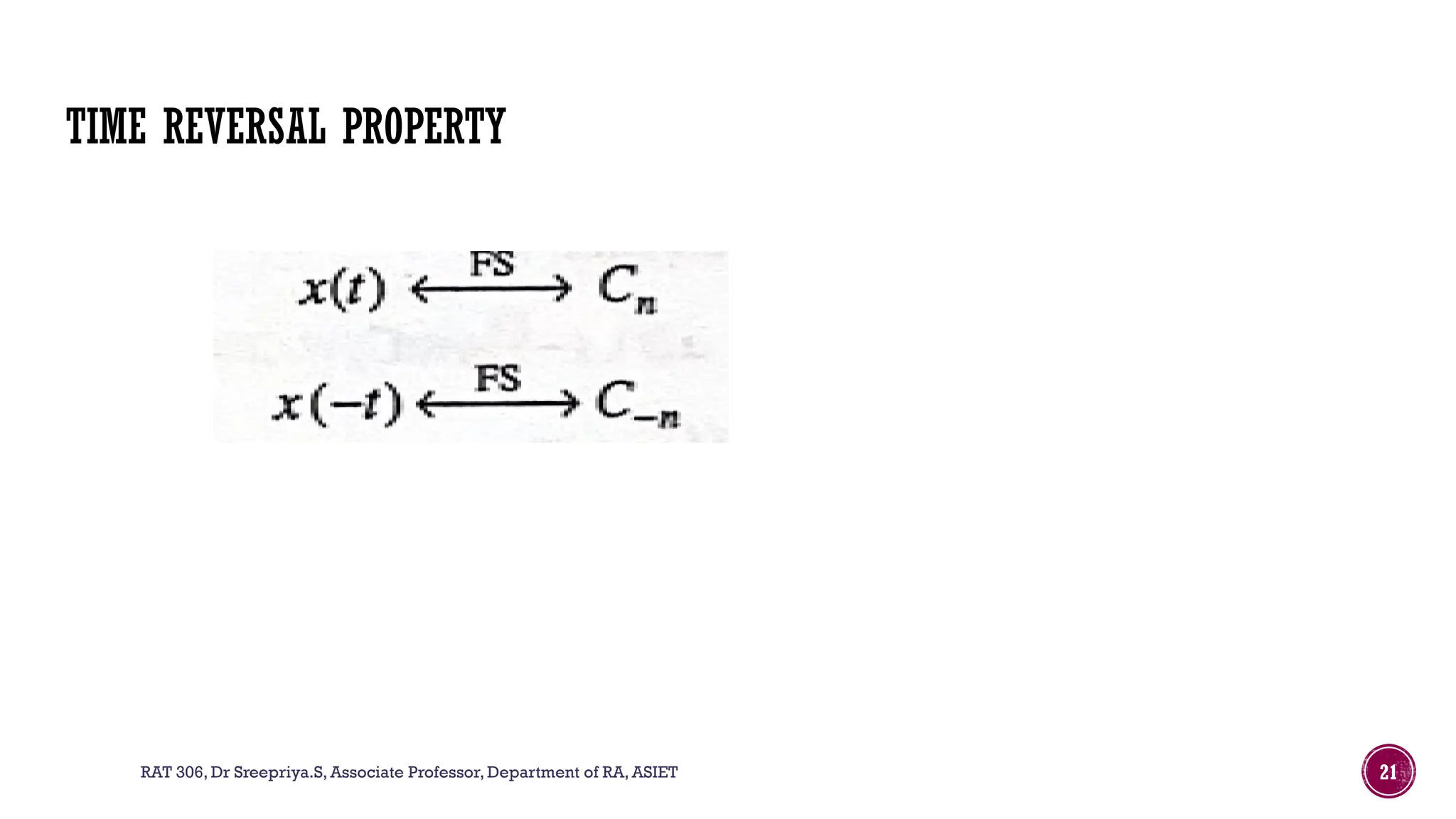
TIME REVERSAL PROPERTY
RAT 306, Dr Sreepriya.S, Associate Professor, Department of RA, ASIET 22
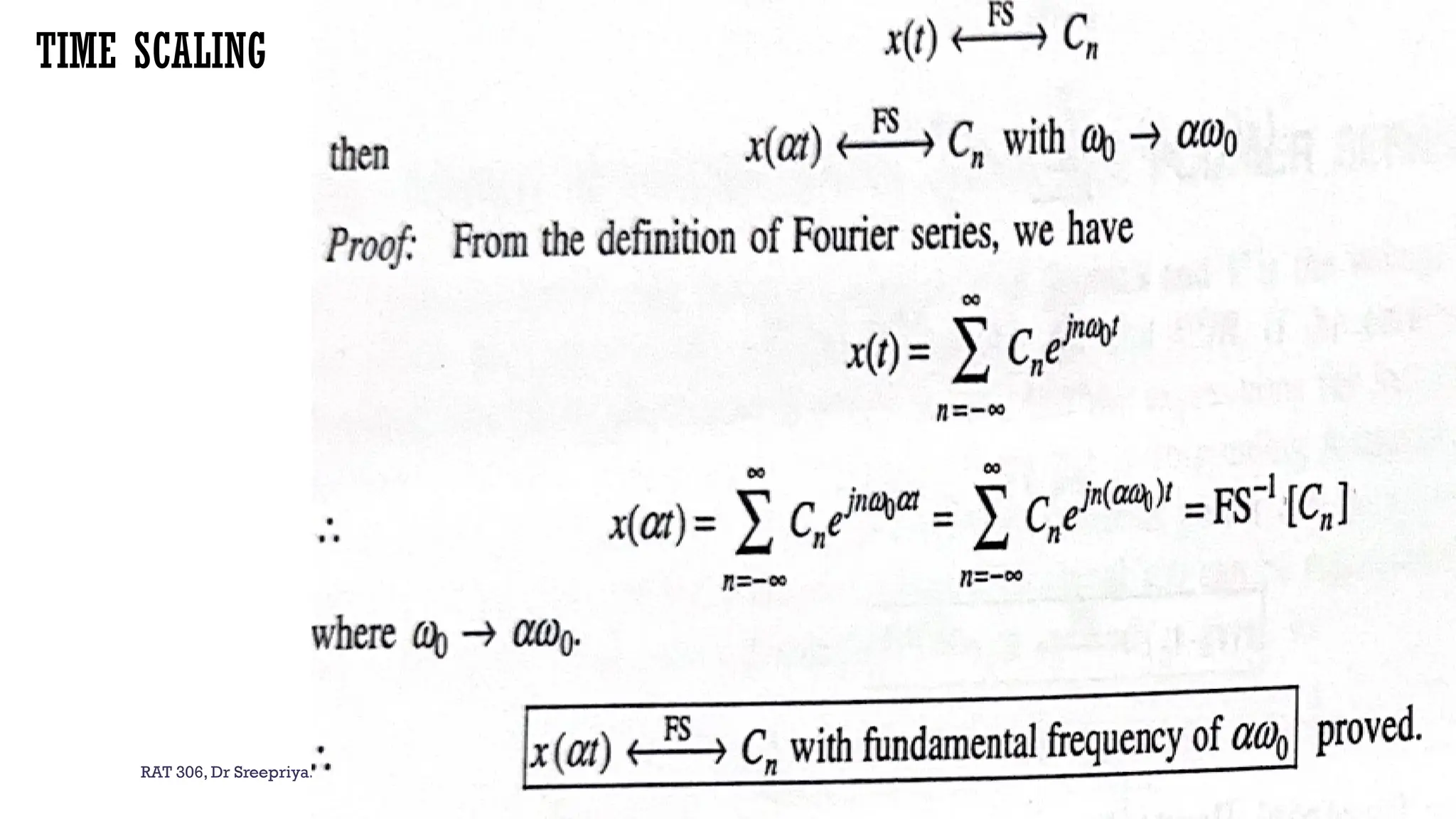
TIME SCALING

Signals and systems Module 2 part 1.pptx

  • 1.
    RAT 306, DrSreepriya.S, Associate Professor, Department of RA, ASIET 1 SIGNALS AND SYSTEM MODULE 2
  • 2.
    RAT 306, DrSreepriya.S, Associate Professor, Department of RA, ASIET 2 SYLLABUS  Frequency domain representation of continuous time signals  Continuous time Fourier series and its properties.  Continuous time Fourier transform and its properties.  Relation between Fourier and Laplace transforms.  Analysis of LTI systems using Laplace and Fourier transforms.  Concept of transfer function, Frequency response, Magnitude and phase response  Sampling of continuous time signals, Sampling theorem for low pass signals, aliasing
  • 3.
    RAT 306, DrSreepriya.S, Associate Professor, Department of RA, ASIET 3 FREQUENCY DOMAIN REPRESENTATION OF CONTINUOUS TIME SIGNALS Continuous time Fourier series and its properties. Continuous time Fourier transform and its properties.
  • 4.
    RAT 306, DrSreepriya.S, Associate Professor, Department of RA, ASIET 4 FREQUENCY DOMAIN ANALYSIS
  • 5.
    RAT 306, DrSreepriya.S, Associate Professor, Department of RA, ASIET 5 FREQUENCY DOMAIN ANALYSIS OF SIGNALS  study the various frequency components present in the signal, magnitude and phase of various frequency components.  Laplace Transform  Fourier Transform Continuous time systems  Fourier Series  Z transform  Discrete Fourier Transform Discrete time systems • The graphical plots of magnitude and phase as a function of frequency are also drawn. • The plot of magnitude versus frequency is called magnitude spectrum and the plot of phase versus frequency is called phase spectrum. • In general, these plots are called frequency spectrum
  • 6.
    RAT 306, DrSreepriya.S, Associate Professor, Department of RA, ASIET 6 FREQUENCY DOMAIN ANALYSIS OF SIGNALS  The Fourier representation of signals can be used to perform frequency domain analysis of signals.  The French mathematician Jean Baptiste Joseph Fourier (J.B.J. Fourier) has shown that any periodic non-sinusoidal signal can be expressed as a linear weighted sum of harmonically related sinusoidal signals.  This leads to a method called Fourier series in which a periodic signal is represented as a function of frequency.  The Fourier representation of periodic signals has been extended to non-periodic signals by letting the fundamental period T tend to infinity, and this Fourier method of representing non-periodic signals as a function of frequency is called Fourier transform.
  • 7.
    RAT 306, DrSreepriya.S, Associate Professor, Department of RA, ASIET 7 FOURIER SERIES Any periodic signal represented as a weighted superposition of sinusoidal or complex exponentials
  • 8.
    RAT 306, DrSreepriya.S, Associate Professor, Department of RA, ASIET 8 FOURIER SERIES: INTRODUCTION Depending upon how the signal is represented Two type Trigonometric Fourier series- linear weighted combination of trigonometric function (sinusoidal) Exponential Fourier series- Combination of exponential function
  • 9.
    RAT 306, DrSreepriya.S, Associate Professor, Department of RA, ASIET 9 FOURIER SERIES: INTRODUCTION For Fourier Series to exist for a periodic signal, it must satisfy Dirichlet’s Condition In each period, 1. Single-valued property:The function x(t) must be a single- valued function. 2. Finite peaks:The function x(t) has only a finite number of maxima and minima. 3. Finite Discontinuities:The function x(t) has a finite number of discontinuities. 4. Absolute Integrability:The function x(t) is absolutely integrable over one period
  • 10.
    RAT 306, DrSreepriya.S, Associate Professor, Department of RA, ASIET 10 FOURIER SERIES: EXPLANATION OF DIRICHLET CONDITION: 1. Single-valued property:The function x(t) must be a single- valued function.
  • 11.
    RAT 306, DrSreepriya.S, Associate Professor, Department of RA, ASIET 11 FOURIER SERIES: EXPLANATION OF DIRICHLET CONDITION: Finite peaks:The function x(t) has only a finite number of maxima and minima.
  • 12.
    RAT 306, DrSreepriya.S, Associate Professor, Department of RA, ASIET 12 FOURIER SERIES: EXPLANATION OF DIRICHLET CONDITION: Finite Discontinuities:The function x(t) has a finite number of discontinuities.
  • 13.
    RAT 306, DrSreepriya.S, Associate Professor, Department of RA, ASIET 13 FOURIER SERIES: EXPLANATION OF DIRICHLET CONDITION: Absolute Integrability:The function x(t) is absolutely integrable over one period
  • 14.
    TRIGONOMETRIC FOURIER SERIES  Asinusoidal signal is a periodic signal with period , can be represented as infinite sum of sine and cosine functions. RAT 306, Dr Sreepriya.S, Associate Professor, Department of RA, ASIET 14
  • 15.
    EXPONENTIAL FOURIER SERIES RAT 306,Dr Sreepriya.S, Associate Professor, Department of RA, ASIET 15 The signal x(t) is represented as a weighted sum of complex exponential functions More convenient and compact, hence widely used.
  • 16.
    EXPONENTIAL FOURIER SERIES The exponentialform of Fourier series of a periodic signal x(t) with period T is given by Where , Cn is the Fourier coefficient,T is the fundamental period The Fourier coefficients are given as RAT 306, Dr Sreepriya.S, Associate Professor, Department of RA, ASIET 16
  • 17.
    RAT 306, DrSreepriya.S, Associate Professor, Department of RA, ASIET 17 CONVERSION  Exponential to Trignometric coefficients  )  Trignometric to Exponential
  • 18.
    RAT 306, DrSreepriya.S, Associate Professor, Department of RA, ASIET 18 PROPERTIES OF FOURIER SERIES
  • 19.
    RAT 306, DrSreepriya.S, Associate Professor, Department of RA, ASIET 19 LINEARITY PROPERTY
  • 20.
    RAT 306, DrSreepriya.S, Associate Professor, Department of RA, ASIET 20 TIME SHIFTING PROPERTY
  • 21.
    RAT 306, DrSreepriya.S, Associate Professor, Department of RA, ASIET 21 TIME REVERSAL PROPERTY
  • 22.
    RAT 306, DrSreepriya.S, Associate Professor, Department of RA, ASIET 22 TIME SCALING