four architectural patterns
“ W H Y, S O M E T I M E S I ’ V E R E V I E W E D A S M A N Y A S
B E F O R E B R E A K FA S T ”
Slides Available: http://tinyurl.com/ArchiAlice
W H AT I S A N
“ A R C H I T E C T U R A L
PAT T E R N ”
• Enough ideas, rules and best
practices that stick together and form
a consistent approach to
development of systems.
• There is no one best or correct
pattern. It depends on your use case.
Some named ones may even be out
of favour.
“And what is the use of a book,” thought Alice, “without pictures or conversations?” 
domain driven design
W H AT I S D O M A I N
D R I V E N D E S I G N ?
• Your system is formed organically
through consideration of the real-
world domain it exists in.
• Since all 300 of us do not want to do
this together, we can identify
subdomains and/or bounded contexts.
• This is discovered through
collaboration with domain experts and
the adoption of a “ubiquitous
language”
W H AT I S D O M A I N
D R I V E N D E S I G N ?
• It believes strongly in the layered architecture,
and defines what it thinks can exist in the
“domain” layer:
• Entity (things with state)
• Value Object (Immutable attributes)
• Aggregate (Cluster of objects treated as one
for data changes)
• Event (“something has happened”)
• Service, Repository, Factory (for managing
changing, retrieval or creation of any of the
above)
W H Y ?
• Reduces cost of communication
across different parts of the
organisation
• Minimises risk of significant
refactoring
“She generally gave herself very good advice, (though she very seldom followed it).”
command-query segregation
W H AT I S C Q S ?
• You should have some interfaces to
your system that mutate logic; and
some that read state.
• They should not mix.
W H Y ?
• Clean code
• Reusable code
• Self-documentation / Principle of
least surprise
“But it’s no use now,” thought poor Alice, “to pretend to be two people!
Why, there’s hardly enough of me left to make one respectable person!” 
command-query
responsibility segregation
W H AT I S C Q R S ?
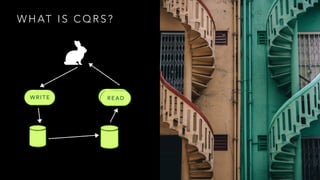
• You should have separate systems in
place for creating and reading data.
• This is more often used to describe
interfaces at a system or domain level
W H AT I S C Q R S ?
W R I T E R E A D
R E A D
W H Y ?
• (This is the most controversial of the
patterns presented today)
• Encourage re-use of APIs and
services
• Clear single source of truth for data
• Read and write can be scaled
independently
“I could tell you my adventures—beginning from this morning,” said Alice a little timidly
“but it’s no use going back to yesterday, because I was a different person then.”
event sourcing
W H AT I S E V E N T
S O U R C I N G ?
• The source of truth for your domain
is a series of events that tells the
system what state has changed.
• Any higher fidelity views are
“materialised” from this event stream
and are second class data citizen
W H Y ?
• Data restoration for free (if you treat
your events right)
• Audit log for free
• Can understand the state of a system
at a given time
“It seems very pretty,” she said when she had
finished it, “but it’s rather hard to understand!”
( Y O U S E E S H E D I D N ’ T L I K E T O C O N F E S S ,
E V E N T O H E R S E L F, T H AT S H E C O U L D N ’ T
M A K E I T O U T AT A L L . )
W H AT Y O U N E E D T O M O D E L …
D O M A I N
E V E N T S
C O M M A N D
E V E N T
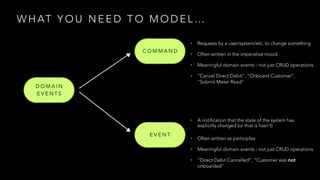
• Requests by a user/system/etc. to change something
• Often written in the imperative mood
• Meaningful domain events - not just CRUD operations
• “Cancel Direct Debit”, “Onboard Customer”,
“Submit Meter Read”
• A notification that the state of the system has
explicitly changed (or that is hasn’t)
• Often written as participles
• Meaningful domain events - not just CRUD operations
• “Direct Debit Cancelled”, “Customer was not
onboarded”
W H AT Y O U N E E D T O M O D E L …
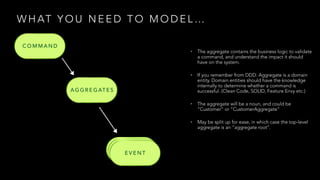
A G G R E G AT E S
C O M M A N D
E V E N T
• The aggregate contains the business logic to validate
a command, and understand the impact it should
have on the system.
• If you remember from DDD: Aggregate is a domain
entity. Domain entities should have the knowledge
internally to determine whether a command is
successful. (Clean Code, SOLID, Feature Envy etc.)
• The aggregate will be a noun, and could be
“Customer” or “CustomerAggregate”
• May be split up for ease, in which case the top-level
aggregate is an “aggregate root”.
E V E N T
E V E N T
W H AT Y O U N E E D T O M O D E L …
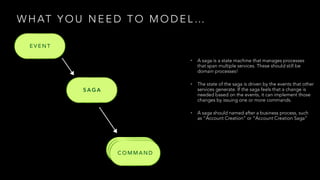
S A G A
E V E N T
E V E N T
• A saga is a state machine that manages processes
that span multiple services. These should still be
domain processes!
• The state of the saga is driven by the events that other
services generate. If the saga feels that a change is
needed based on the events, it can implement those
changes by issuing one or more commands.
• A saga should named after a business process, such
as “Account Creation” or “Account Creation Saga”
E V E N T
C O M M A N D
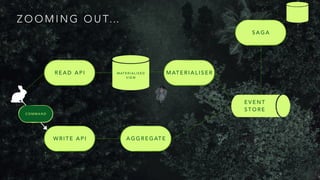
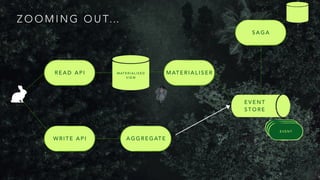
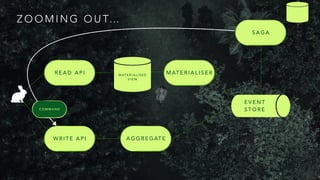
Z O O M I N G O U T…
A G G R E G AT E
W R I T E A P I
R E A D A P I
S A G A
E V E N T
S T O R E
M AT E R I A L I S E D
V I E W
M AT E R I A L I S E R
C O M M A N D
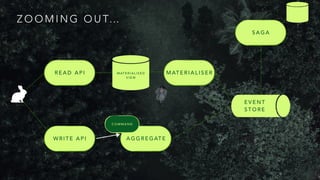
Z O O M I N G O U T…
A G G R E G AT E
W R I T E A P I
C O M M A N D
R E A D A P I
S A G A
E V E N T
S T O R E
M AT E R I A L I S E D
V I E W
M AT E R I A L I S E R
Z O O M I N G O U T…
A G G R E G AT E
W R I T E A P I
E V E N T
R E A D A P I
S A G A
E V E N T
S T O R E
M AT E R I A L I S E D
V I E W
M AT E R I A L I S E R
E V E N T
E V E N T
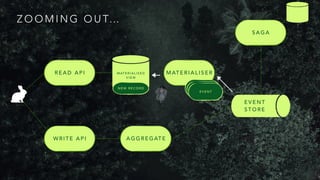
M AT E R I A L I S E R
Z O O M I N G O U T…
A G G R E G AT E
W R I T E A P I
E V E N T
R E A D A P I
S A G A
E V E N T
S T O R E
M AT E R I A L I S E D
V I E W
E V E N T
E V E N T
N E W R E C O R D
M AT E R I A L I S E R
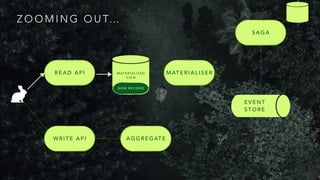
Z O O M I N G O U T…
A G G R E G AT E
W R I T E A P I
R E A D A P I
S A G A
E V E N T
S T O R E
M AT E R I A L I S E D
V I E W
N E W R E C O R D
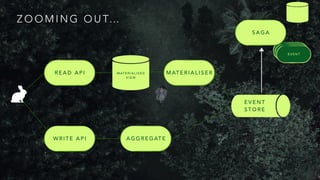
Z O O M I N G O U T…
A G G R E G AT E
W R I T E A P I
E V E N T
R E A D A P I
S A G A
E V E N T
S T O R E
M AT E R I A L I S E D
V I E W
M AT E R I A L I S E R
E V E N T
E V E N T
Z O O M I N G O U T…
A G G R E G AT E
W R I T E A P I
R E A D A P I
S A G A
E V E N T
S T O R E
M AT E R I A L I S E R
M AT E R I A L I S E D
V I E W
C O M M A N D
W H Y ?
• All the benefits of the other patterns
we’ve discussed
• Single, consolidated architecture that
scales nicely with the number of
teams
• Can spin up new microservices with
minimal cost down the line
“So she was considering in her own mind whether
the pleasure of making
a daisy-chain would
be worth the trouble
of getting up & picking the daisies...”
M I N I S T RY O F
J U S T I C E
• https://github.com/
CJSCommonPlatform/
microservice_framework_version_6
• Did the project succeed? Not really.
(And the consultancy behind was trashed in the news.)
• Did the architecture work? No.
Developers not good enough to
understand it, Ivory Tower Architecture
Function, 8 weeks to get words on a
screen.
M E T T L E
• Challenger bank targeting SMEs.
• Did the project succeed? Still going
strong. (And the consultancy behind was trashed
in the news.)
• Did it work? Kind of? After a bit of
wrangling. But we didn’t get half of
what it promised.
P E R S O N A L
P R O J E C T
• https://github.com/
SwamWithTurtles/decrypto-be/
• Did it work? Yeah, kinda but one
person projects are always doomed
to succeed.
Everything’s got a moral
(if only you can find it)

Four Architectural Patterns

  • 1.
    four architectural patterns “W H Y, S O M E T I M E S I ’ V E R E V I E W E D A S M A N Y A S B E F O R E B R E A K FA S T ”
  • 2.
  • 3.
    W H ATI S A N “ A R C H I T E C T U R A L PAT T E R N ” • Enough ideas, rules and best practices that stick together and form a consistent approach to development of systems. • There is no one best or correct pattern. It depends on your use case. Some named ones may even be out of favour.
  • 4.
    “And what isthe use of a book,” thought Alice, “without pictures or conversations?”  domain driven design
  • 5.
    W H ATI S D O M A I N D R I V E N D E S I G N ? • Your system is formed organically through consideration of the real- world domain it exists in. • Since all 300 of us do not want to do this together, we can identify subdomains and/or bounded contexts. • This is discovered through collaboration with domain experts and the adoption of a “ubiquitous language”
  • 6.
    W H ATI S D O M A I N D R I V E N D E S I G N ? • It believes strongly in the layered architecture, and defines what it thinks can exist in the “domain” layer: • Entity (things with state) • Value Object (Immutable attributes) • Aggregate (Cluster of objects treated as one for data changes) • Event (“something has happened”) • Service, Repository, Factory (for managing changing, retrieval or creation of any of the above)
  • 7.
    W H Y? • Reduces cost of communication across different parts of the organisation • Minimises risk of significant refactoring
  • 8.
    “She generally gaveherself very good advice, (though she very seldom followed it).” command-query segregation
  • 9.
    W H ATI S C Q S ? • You should have some interfaces to your system that mutate logic; and some that read state. • They should not mix.
  • 10.
    W H Y? • Clean code • Reusable code • Self-documentation / Principle of least surprise
  • 11.
    “But it’s nouse now,” thought poor Alice, “to pretend to be two people! Why, there’s hardly enough of me left to make one respectable person!”  command-query responsibility segregation
  • 12.
    W H ATI S C Q R S ? • You should have separate systems in place for creating and reading data. • This is more often used to describe interfaces at a system or domain level
  • 13.
    W H ATI S C Q R S ? W R I T E R E A D R E A D
  • 14.
    W H Y? • (This is the most controversial of the patterns presented today) • Encourage re-use of APIs and services • Clear single source of truth for data • Read and write can be scaled independently
  • 15.
    “I could tellyou my adventures—beginning from this morning,” said Alice a little timidly “but it’s no use going back to yesterday, because I was a different person then.” event sourcing
  • 16.
    W H ATI S E V E N T S O U R C I N G ? • The source of truth for your domain is a series of events that tells the system what state has changed. • Any higher fidelity views are “materialised” from this event stream and are second class data citizen
  • 17.
    W H Y? • Data restoration for free (if you treat your events right) • Audit log for free • Can understand the state of a system at a given time
  • 18.
    “It seems verypretty,” she said when she had finished it, “but it’s rather hard to understand!” ( Y O U S E E S H E D I D N ’ T L I K E T O C O N F E S S , E V E N T O H E R S E L F, T H AT S H E C O U L D N ’ T M A K E I T O U T AT A L L . )
  • 19.
    W H ATY O U N E E D T O M O D E L … D O M A I N E V E N T S C O M M A N D E V E N T • Requests by a user/system/etc. to change something • Often written in the imperative mood • Meaningful domain events - not just CRUD operations • “Cancel Direct Debit”, “Onboard Customer”, “Submit Meter Read” • A notification that the state of the system has explicitly changed (or that is hasn’t) • Often written as participles • Meaningful domain events - not just CRUD operations • “Direct Debit Cancelled”, “Customer was not onboarded”
  • 20.
    W H ATY O U N E E D T O M O D E L … A G G R E G AT E S C O M M A N D E V E N T • The aggregate contains the business logic to validate a command, and understand the impact it should have on the system. • If you remember from DDD: Aggregate is a domain entity. Domain entities should have the knowledge internally to determine whether a command is successful. (Clean Code, SOLID, Feature Envy etc.) • The aggregate will be a noun, and could be “Customer” or “CustomerAggregate” • May be split up for ease, in which case the top-level aggregate is an “aggregate root”. E V E N T E V E N T
  • 21.
    W H ATY O U N E E D T O M O D E L … S A G A E V E N T E V E N T • A saga is a state machine that manages processes that span multiple services. These should still be domain processes! • The state of the saga is driven by the events that other services generate. If the saga feels that a change is needed based on the events, it can implement those changes by issuing one or more commands. • A saga should named after a business process, such as “Account Creation” or “Account Creation Saga” E V E N T C O M M A N D
  • 22.
    Z O OM I N G O U T… A G G R E G AT E W R I T E A P I R E A D A P I S A G A E V E N T S T O R E M AT E R I A L I S E D V I E W M AT E R I A L I S E R C O M M A N D
  • 23.
    Z O OM I N G O U T… A G G R E G AT E W R I T E A P I C O M M A N D R E A D A P I S A G A E V E N T S T O R E M AT E R I A L I S E D V I E W M AT E R I A L I S E R
  • 24.
    Z O OM I N G O U T… A G G R E G AT E W R I T E A P I E V E N T R E A D A P I S A G A E V E N T S T O R E M AT E R I A L I S E D V I E W M AT E R I A L I S E R E V E N T E V E N T
  • 25.
    M AT ER I A L I S E R Z O O M I N G O U T… A G G R E G AT E W R I T E A P I E V E N T R E A D A P I S A G A E V E N T S T O R E M AT E R I A L I S E D V I E W E V E N T E V E N T N E W R E C O R D
  • 26.
    M AT ER I A L I S E R Z O O M I N G O U T… A G G R E G AT E W R I T E A P I R E A D A P I S A G A E V E N T S T O R E M AT E R I A L I S E D V I E W N E W R E C O R D
  • 27.
    Z O OM I N G O U T… A G G R E G AT E W R I T E A P I E V E N T R E A D A P I S A G A E V E N T S T O R E M AT E R I A L I S E D V I E W M AT E R I A L I S E R E V E N T E V E N T
  • 28.
    Z O OM I N G O U T… A G G R E G AT E W R I T E A P I R E A D A P I S A G A E V E N T S T O R E M AT E R I A L I S E R M AT E R I A L I S E D V I E W C O M M A N D
  • 29.
    W H Y? • All the benefits of the other patterns we’ve discussed • Single, consolidated architecture that scales nicely with the number of teams • Can spin up new microservices with minimal cost down the line
  • 30.
    “So she wasconsidering in her own mind whether the pleasure of making a daisy-chain would be worth the trouble of getting up & picking the daisies...”
  • 31.
    M I NI S T RY O F J U S T I C E • https://github.com/ CJSCommonPlatform/ microservice_framework_version_6 • Did the project succeed? Not really. (And the consultancy behind was trashed in the news.) • Did the architecture work? No. Developers not good enough to understand it, Ivory Tower Architecture Function, 8 weeks to get words on a screen.
  • 32.
    M E TT L E • Challenger bank targeting SMEs. • Did the project succeed? Still going strong. (And the consultancy behind was trashed in the news.) • Did it work? Kind of? After a bit of wrangling. But we didn’t get half of what it promised.
  • 33.
    P E RS O N A L P R O J E C T • https://github.com/ SwamWithTurtles/decrypto-be/ • Did it work? Yeah, kinda but one person projects are always doomed to succeed.
  • 34.
    Everything’s got amoral (if only you can find it)