Foundations of Public Health: Building a Healthier World
What is Public Health?
● Definition: The science and art of
promoting health, preventing disease, and
prolonging life through organized efforts of
society
● Focus on population-level health rather
than individual health
● Aims to create conditions where people
can be healthy
● Involves a wide range of professions and
disciplines
● How does public health impact your daily
life?
Core Functions of Public Health
● 1. Assessment: Monitoring community health status
● 2. Policy Development: Informing, educating, and empowering
people about health issues
● 3. Assurance: Ensuring the provision of health care when
otherwise unavailable
● Can you think of examples for each of these functions in your
community?
Historical Milestones in
Public Health
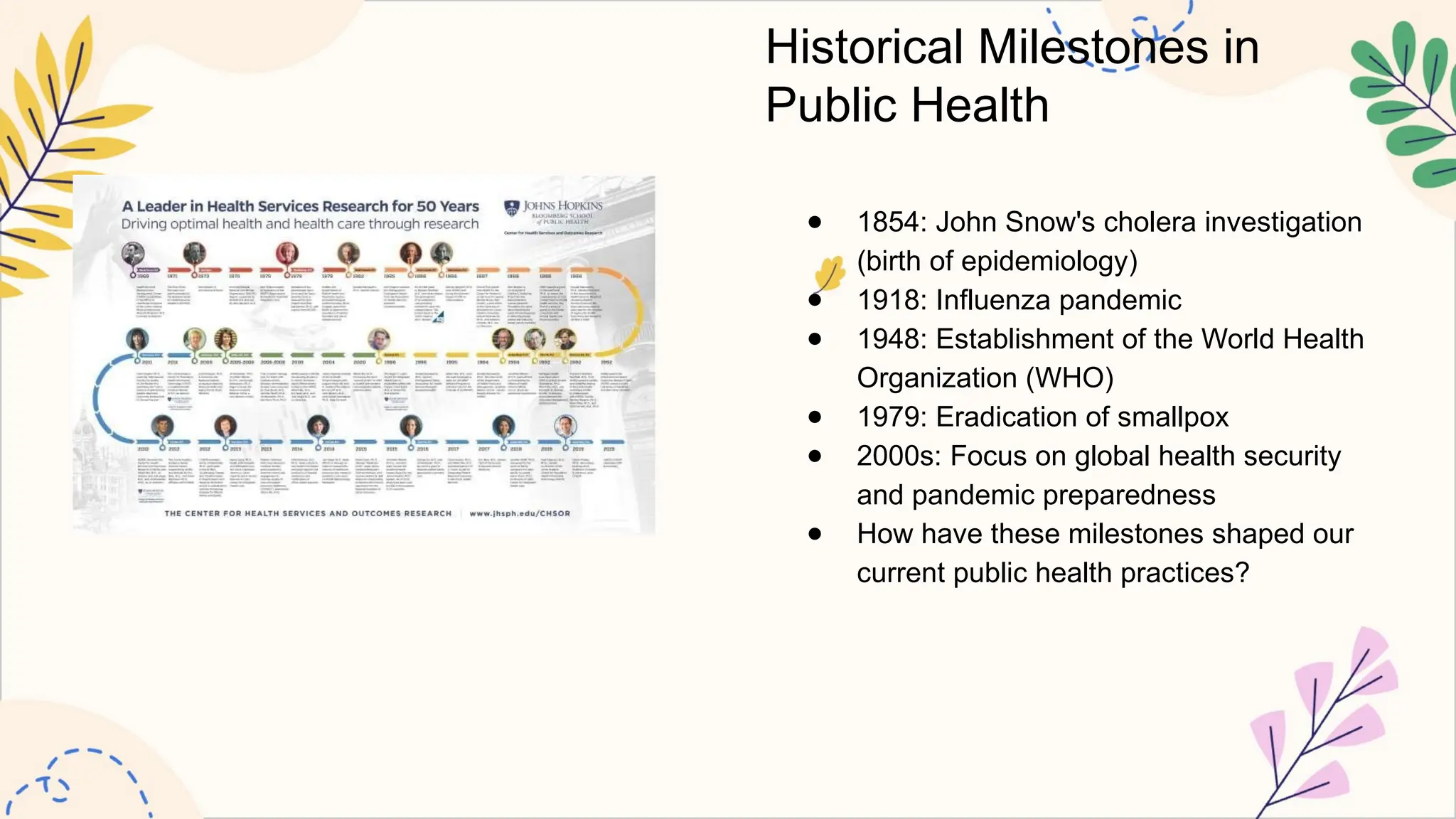
● 1854: John Snow's cholera investigation
(birth of epidemiology)
● 1918: Influenza pandemic
● 1948: Establishment of the World Health
Organization (WHO)
● 1979: Eradication of smallpox
● 2000s: Focus on global health security
and pandemic preparedness
● How have these milestones shaped our
current public health practices?
Social Determinants of Health
● Definition: Conditions in which people are born, grow, live, work,
and age
● Examples:
● Education
● Income and wealth
● Housing
● Access to healthcare
● Environmental conditions
● How might these factors influence health outcomes in your
community?
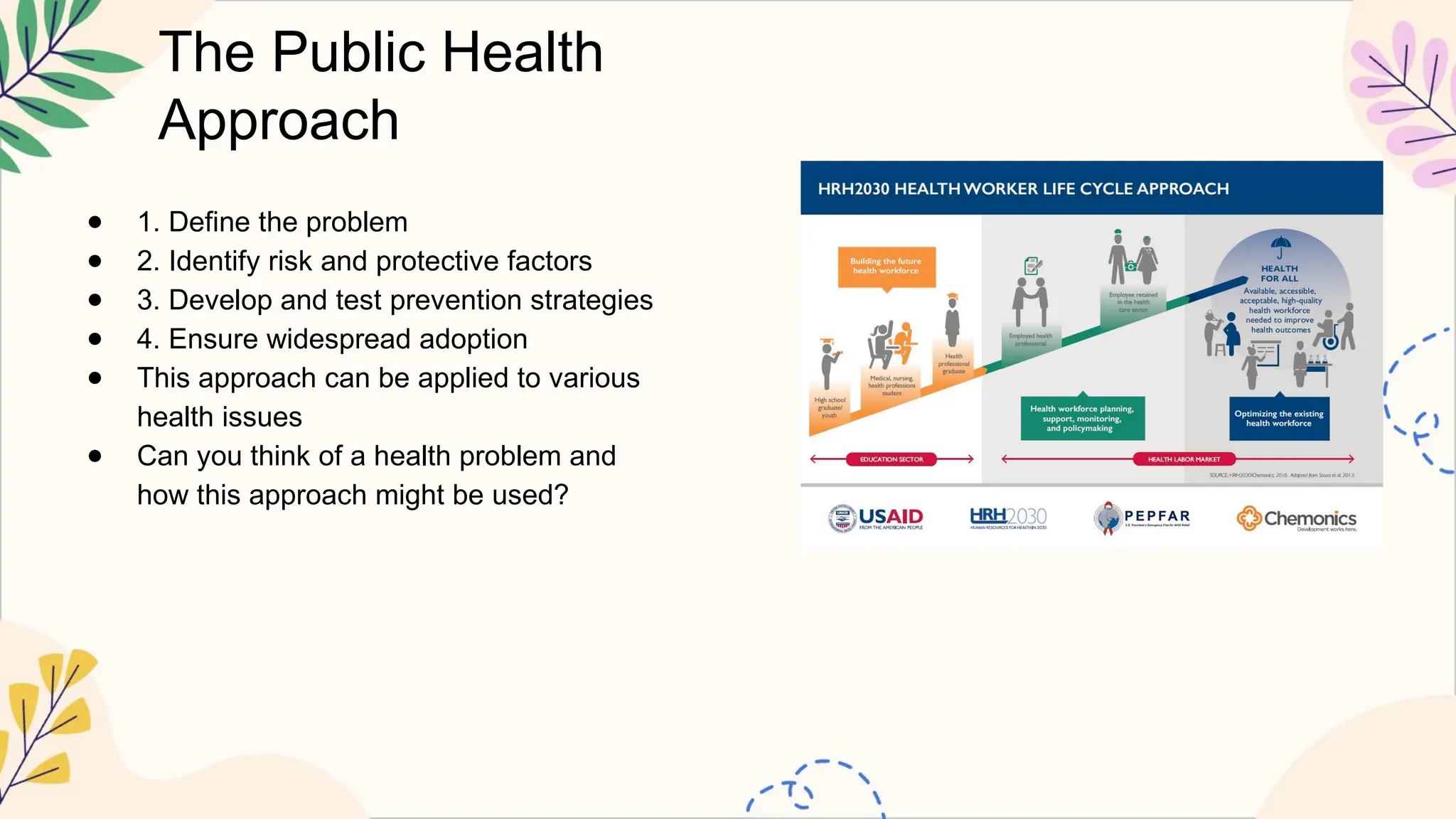
The Public Health
Approach
● 1. Define the problem
● 2. Identify risk and protective factors
● 3. Develop and test prevention strategies
● 4. Ensure widespread adoption
● This approach can be applied to various
health issues
● Can you think of a health problem and
how this approach might be used?
Epidemiology: The Foundation of Public Health
● Definition: The study of the distribution and determinants of
health-related states or events in specified populations
● Key concepts:
● Incidence and prevalence
● Risk factors
● Study designs (e.g., cohort, case-control)
● How does epidemiology help in decision-making for public health
policies?
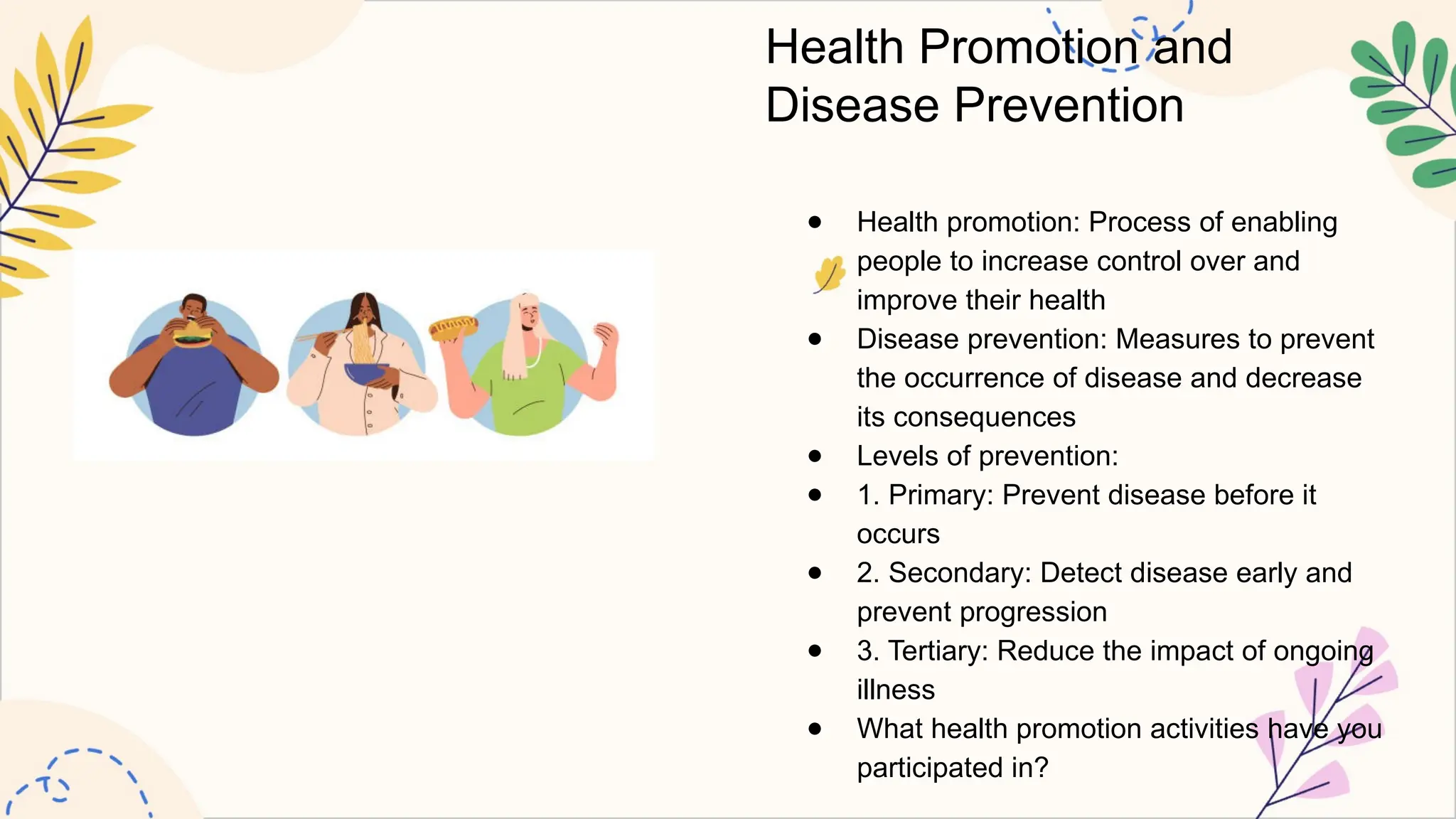
Health Promotion and
Disease Prevention
● Health promotion: Process of enabling
people to increase control over and
improve their health
● Disease prevention: Measures to prevent
the occurrence of disease and decrease
its consequences
● Levels of prevention:
● 1. Primary: Prevent disease before it
occurs
● 2. Secondary: Detect disease early and
prevent progression
● 3. Tertiary: Reduce the impact of ongoing
illness
● What health promotion activities have you
participated in?
Global Health Challenges
● Infectious diseases (e.g., HIV/AIDS, malaria, COVID-19)
● Non-communicable diseases (e.g., heart disease, cancer,
diabetes)
● Environmental health issues (e.g., climate change, air pollution)
● Health inequities and disparities
● Access to healthcare and medicines
● Which of these challenges do you think is most pressing in your
country?
Public Health Ethics
● Balancing individual rights and community well-being
● Ethical principles in public health:
● Respect for autonomy
● Beneficence
● Non-maleficence
● Justice
● Case study: Mandatory vaccination programs
● How would you approach this ethical dilemma?
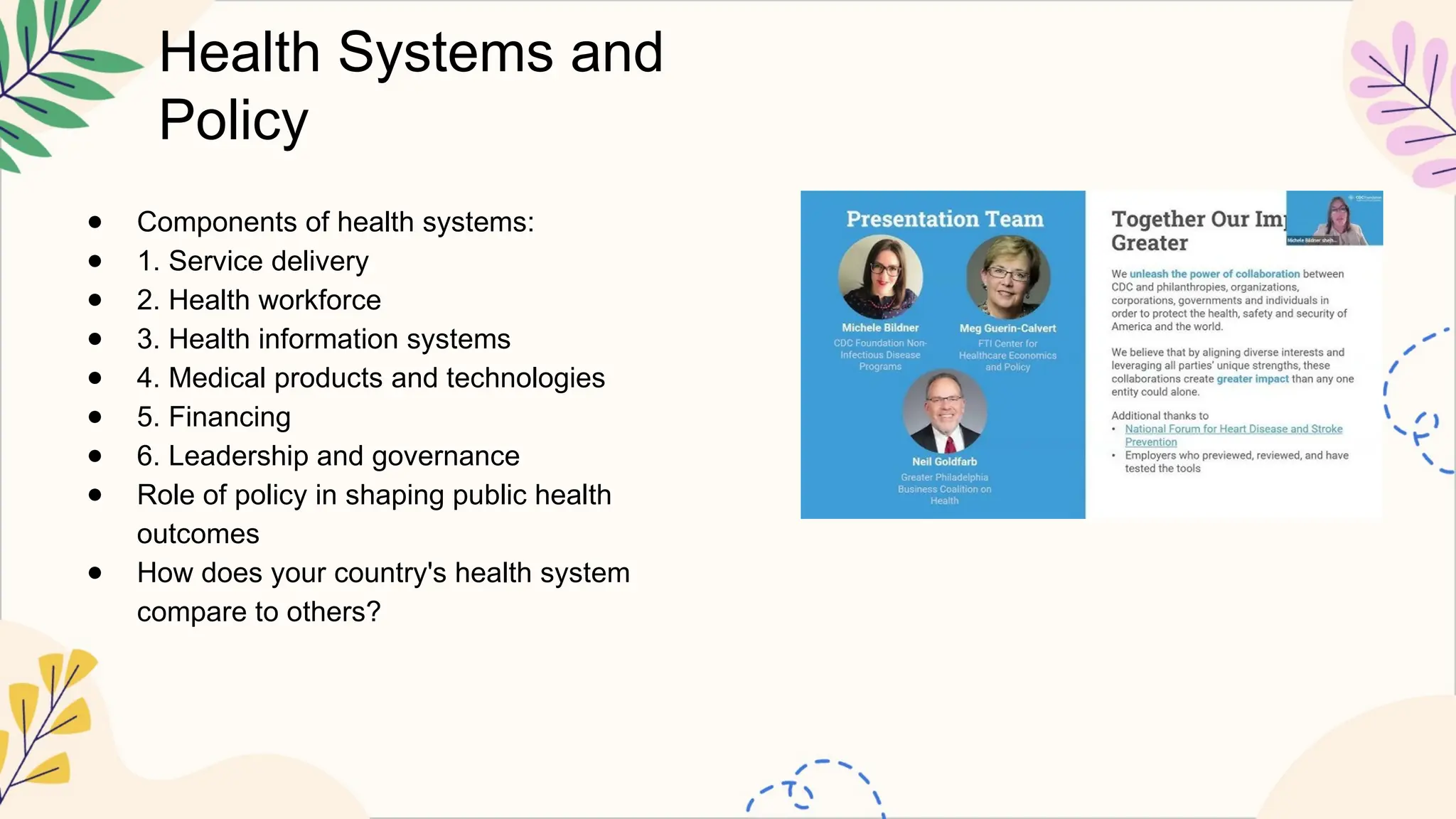
Health Systems and
Policy
● Components of health systems:
● 1. Service delivery
● 2. Health workforce
● 3. Health information systems
● 4. Medical products and technologies
● 5. Financing
● 6. Leadership and governance
● Role of policy in shaping public health
outcomes
● How does your country's health system
compare to others?
Environmental Health
● Focus on the relationship between human health and the
environment
● Key areas:
● Air quality
● Water safety
● Food safety
● Climate change
● Built environment
● How does your local environment impact your health?
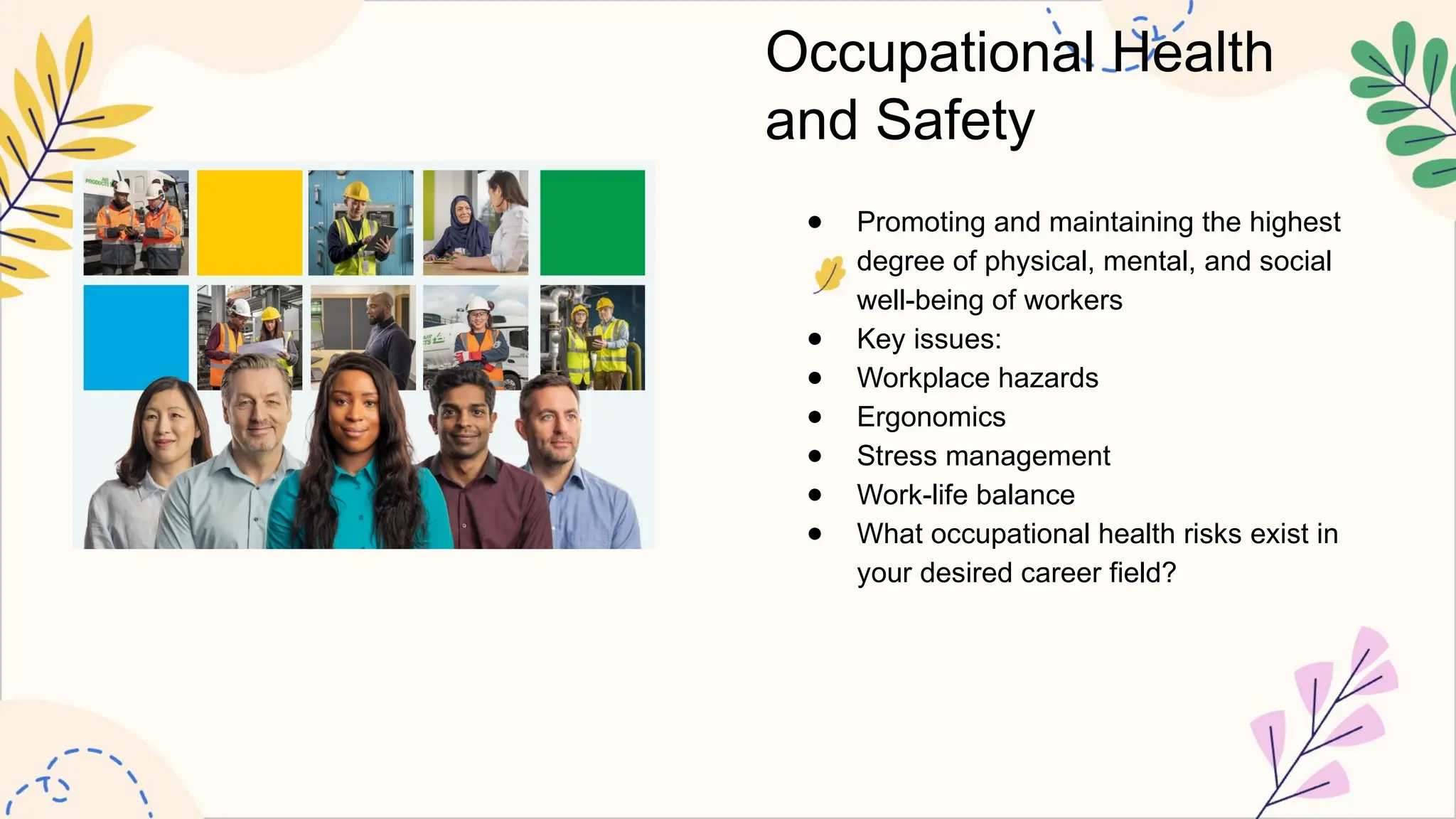
Occupational Health
and Safety
● Promoting and maintaining the highest
degree of physical, mental, and social
well-being of workers
● Key issues:
● Workplace hazards
● Ergonomics
● Stress management
● Work-life balance
● What occupational health risks exist in
your desired career field?
Maternal and Child Health
● Focus on the health and well-being of women, children, and
families
● Key areas:
● Prenatal care
● Infant and child nutrition
● Immunizations
● Adolescent health
● Why is maternal and child health considered a cornerstone of
public health?
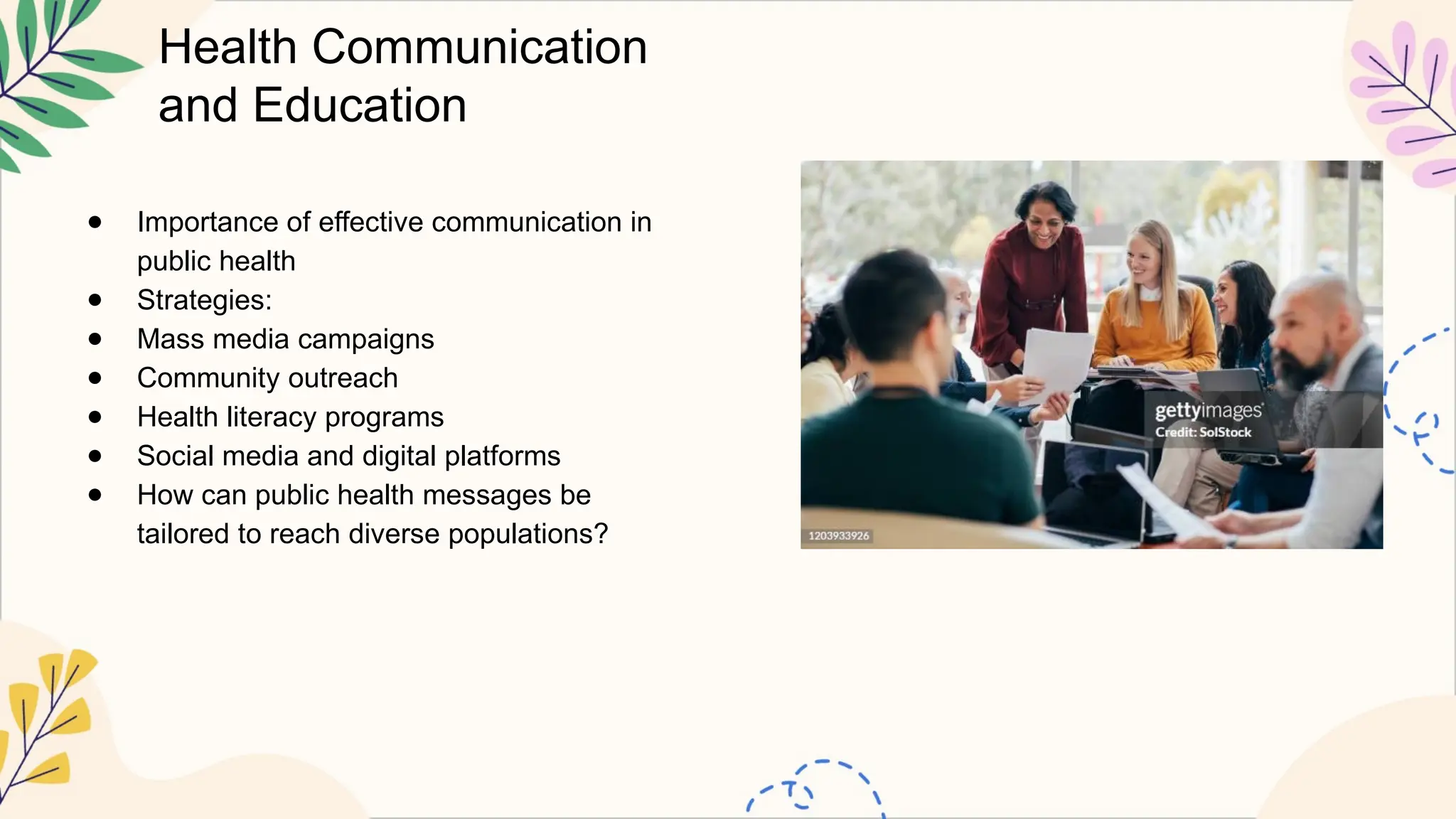
Health Communication
and Education
● Importance of effective communication in
public health
● Strategies:
● Mass media campaigns
● Community outreach
● Health literacy programs
● Social media and digital platforms
● How can public health messages be
tailored to reach diverse populations?
Emergency Preparedness and Response
● Planning for and responding to public health emergencies
● Types of emergencies:
● Natural disasters
● Disease outbreaks
● Bioterrorism
● Key components:
● 1. Surveillance and detection
● 2. Risk communication
● 3. Rapid response teams
● 4. Coordination with multiple sectors
● What lessons can we learn from recent public health
emergencies?
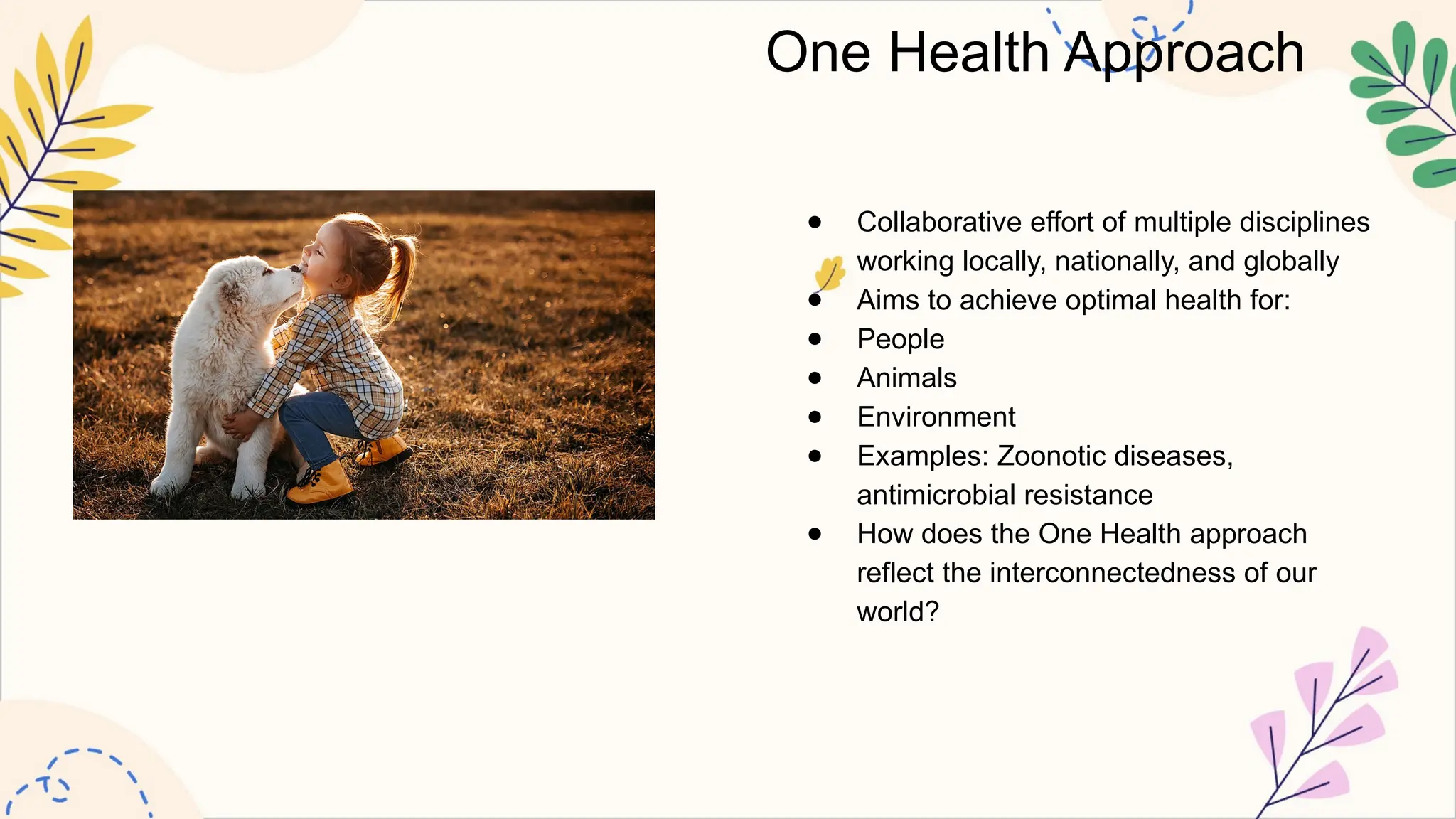
One Health Approach
● Collaborative effort of multiple disciplines
working locally, nationally, and globally
● Aims to achieve optimal health for:
● People
● Animals
● Environment
● Examples: Zoonotic diseases,
antimicrobial resistance
● How does the One Health approach
reflect the interconnectedness of our
world?
Health Informatics and Technology
● Use of information technology to improve health care delivery
and public health practice
● Applications:
● Electronic health records
● Disease surveillance systems
● Telemedicine
● Mobile health (mHealth) apps
● How might emerging technologies shape the future of public
health?
Public Health Research
● Importance of evidence-based practice in public health
● Types of research:
● Descriptive studies
● Analytical studies
● Intervention studies
● Challenges:
● Ethical considerations
● Funding
● Translation of research into practice
● Why is ongoing research crucial for advancing public health?
Future of Public Health
● Emerging trends:
● Precision public health
● Big data and artificial intelligence
● Climate change adaptation
● Global health security
● Challenges and opportunities
● How can you contribute to shaping the future of public health?
Careers in Public Health
● Diverse range of opportunities:
● Epidemiologist
● Health educator
● Environmental health specialist
● Biostatistician
● Health policy advisor
● Interdisciplinary nature of the field
● Which area of public health interests you most and why?

Foundations of Public Health: Building a Healthier World

  • 1.
    Foundations of PublicHealth: Building a Healthier World
  • 2.
    What is PublicHealth? ● Definition: The science and art of promoting health, preventing disease, and prolonging life through organized efforts of society ● Focus on population-level health rather than individual health ● Aims to create conditions where people can be healthy ● Involves a wide range of professions and disciplines ● How does public health impact your daily life?
  • 3.
    Core Functions ofPublic Health ● 1. Assessment: Monitoring community health status ● 2. Policy Development: Informing, educating, and empowering people about health issues ● 3. Assurance: Ensuring the provision of health care when otherwise unavailable ● Can you think of examples for each of these functions in your community?
  • 4.
    Historical Milestones in PublicHealth ● 1854: John Snow's cholera investigation (birth of epidemiology) ● 1918: Influenza pandemic ● 1948: Establishment of the World Health Organization (WHO) ● 1979: Eradication of smallpox ● 2000s: Focus on global health security and pandemic preparedness ● How have these milestones shaped our current public health practices?
  • 5.
    Social Determinants ofHealth ● Definition: Conditions in which people are born, grow, live, work, and age ● Examples: ● Education ● Income and wealth ● Housing ● Access to healthcare ● Environmental conditions ● How might these factors influence health outcomes in your community?
  • 6.
    The Public Health Approach ●1. Define the problem ● 2. Identify risk and protective factors ● 3. Develop and test prevention strategies ● 4. Ensure widespread adoption ● This approach can be applied to various health issues ● Can you think of a health problem and how this approach might be used?
  • 7.
    Epidemiology: The Foundationof Public Health ● Definition: The study of the distribution and determinants of health-related states or events in specified populations ● Key concepts: ● Incidence and prevalence ● Risk factors ● Study designs (e.g., cohort, case-control) ● How does epidemiology help in decision-making for public health policies?
  • 8.
    Health Promotion and DiseasePrevention ● Health promotion: Process of enabling people to increase control over and improve their health ● Disease prevention: Measures to prevent the occurrence of disease and decrease its consequences ● Levels of prevention: ● 1. Primary: Prevent disease before it occurs ● 2. Secondary: Detect disease early and prevent progression ● 3. Tertiary: Reduce the impact of ongoing illness ● What health promotion activities have you participated in?
  • 9.
    Global Health Challenges ●Infectious diseases (e.g., HIV/AIDS, malaria, COVID-19) ● Non-communicable diseases (e.g., heart disease, cancer, diabetes) ● Environmental health issues (e.g., climate change, air pollution) ● Health inequities and disparities ● Access to healthcare and medicines ● Which of these challenges do you think is most pressing in your country?
  • 10.
    Public Health Ethics ●Balancing individual rights and community well-being ● Ethical principles in public health: ● Respect for autonomy ● Beneficence ● Non-maleficence ● Justice ● Case study: Mandatory vaccination programs ● How would you approach this ethical dilemma?
  • 11.
    Health Systems and Policy ●Components of health systems: ● 1. Service delivery ● 2. Health workforce ● 3. Health information systems ● 4. Medical products and technologies ● 5. Financing ● 6. Leadership and governance ● Role of policy in shaping public health outcomes ● How does your country's health system compare to others?
  • 12.
    Environmental Health ● Focuson the relationship between human health and the environment ● Key areas: ● Air quality ● Water safety ● Food safety ● Climate change ● Built environment ● How does your local environment impact your health?
  • 13.
    Occupational Health and Safety ●Promoting and maintaining the highest degree of physical, mental, and social well-being of workers ● Key issues: ● Workplace hazards ● Ergonomics ● Stress management ● Work-life balance ● What occupational health risks exist in your desired career field?
  • 14.
    Maternal and ChildHealth ● Focus on the health and well-being of women, children, and families ● Key areas: ● Prenatal care ● Infant and child nutrition ● Immunizations ● Adolescent health ● Why is maternal and child health considered a cornerstone of public health?
  • 15.
    Health Communication and Education ●Importance of effective communication in public health ● Strategies: ● Mass media campaigns ● Community outreach ● Health literacy programs ● Social media and digital platforms ● How can public health messages be tailored to reach diverse populations?
  • 16.
    Emergency Preparedness andResponse ● Planning for and responding to public health emergencies ● Types of emergencies: ● Natural disasters ● Disease outbreaks ● Bioterrorism ● Key components: ● 1. Surveillance and detection ● 2. Risk communication ● 3. Rapid response teams ● 4. Coordination with multiple sectors ● What lessons can we learn from recent public health emergencies?
  • 17.
    One Health Approach ●Collaborative effort of multiple disciplines working locally, nationally, and globally ● Aims to achieve optimal health for: ● People ● Animals ● Environment ● Examples: Zoonotic diseases, antimicrobial resistance ● How does the One Health approach reflect the interconnectedness of our world?
  • 18.
    Health Informatics andTechnology ● Use of information technology to improve health care delivery and public health practice ● Applications: ● Electronic health records ● Disease surveillance systems ● Telemedicine ● Mobile health (mHealth) apps ● How might emerging technologies shape the future of public health?
  • 19.
    Public Health Research ●Importance of evidence-based practice in public health ● Types of research: ● Descriptive studies ● Analytical studies ● Intervention studies ● Challenges: ● Ethical considerations ● Funding ● Translation of research into practice ● Why is ongoing research crucial for advancing public health?
  • 20.
    Future of PublicHealth ● Emerging trends: ● Precision public health ● Big data and artificial intelligence ● Climate change adaptation ● Global health security ● Challenges and opportunities ● How can you contribute to shaping the future of public health?
  • 21.
    Careers in PublicHealth ● Diverse range of opportunities: ● Epidemiologist ● Health educator ● Environmental health specialist ● Biostatistician ● Health policy advisor ● Interdisciplinary nature of the field ● Which area of public health interests you most and why?

Editor's Notes

  • #1 Created from: https://docs.google.com/presentation/d/1jb8dQEScdfVz4N82bATV9_txVdRy_3EhDYVSrL5K6bE/edit#slide=id.p