Public Health
Functions
By.
Souma Shankar
Mukherjee
CONTENTS
• Definition of public health
• What is Public Health?
• Core Disciplines of Public Health
• Public Health Functions
• Problems and Barriers
• Conclusion
Definition of Public Health
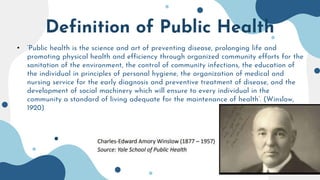
• ‘Public health is the science and art of preventing disease, prolonging life and
promoting physical health and efficiency through organized community efforts for the
sanitation of the environment, the control of community infections, the education of
the individual in principles of personal hygiene, the organization of medical and
nursing service for the early diagnosis and preventive treatment of disease, and the
development of social machinery which will ensure to every individual in the
community a standard of living adequate for the maintenance of health’. (Winslow,
1920)
Definition of Public Health
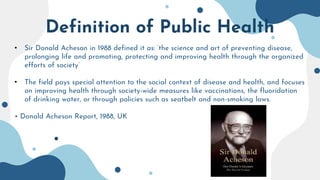
• Sir Donald Acheson in 1988 defined it as: ‘the science and art of preventing disease,
prolonging life and promoting, protecting and improving health through the organized
efforts of society’
• The field pays special attention to the social context of disease and health, and focuses
on improving health through society-wide measures like vaccinations, the fluoridation
of drinking water, or through policies such as seatbelt and non-smoking laws.
• Donald Acheson Report, 1988, UK
What is public health?
Public health is considered to be about the health of people or communities, as opposed to
individual health - it is everyone's responsibility
The concept of public health is not unique and has changed over the years due to changes in the
health status of the population and the determining situations of health.
This definition of public health is directly linked to the wider definition of health, found in the
preamble of the constitution of the World Health Organisation (1948), where health is referred to
as "a state of complete physical, mental and social well-being and not merely the absence of
disease."
Core Disciplines of Public Health
• Environmental Health
• Epidemiology
• Biostatistics
• Health Policy
• Social and Behavioral Sciences
Core Disciplines of Public Health
Environmental Health
The term environment implies all the external factors - living and
non-living, material and non-material which surround man.
Core Disciplines of Public Health
Environmental Health
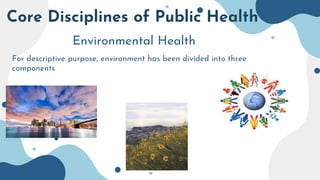
For descriptive purpose, environment has been divided into three
components
Core Disciplines of Public Health
Environmental Health
Environmental Sanitation" has been defined by WHO as "the control of
all those factors in man's physical environment which exercise or may
exercise a deleterious effect on his physical development, health and
survival"
Core Disciplines of Public Health
EPIDEMIOLOGY
The word epidemiology comes from the
Greek words epi, meaning on or upon,
demos, meaning people, and logos,
meaning the study of.
Core Disciplines of Public Health
EPIDEMIOLOGY
Epidemiology is the study of the distribution and
determinants of health-related states or events in specified
populations, and the application of this study to the control
of health problems.
Core Disciplines of Public Health
EPIDEMIOLOGY
Epidemiology is the study (scientific, systematic, data-driven) of the
distribution (frequency, pattern) and determinants (causes, risk
factors) of health-related states and events (not just diseases) in
specified populations (patient is community, individuals viewed
collectively), and the application of (since epidemiology is a discipline
within public health) this study to the control of health problems.
Core Disciplines of Public Health
EPIDEMIOLOGY
Uses
• Assessing the community’s health
• Making individual decisions
• Completing the clinical picture
• Searching for causes
Core Disciplines of Public Health
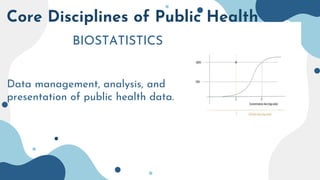
BIOSTATISTICS
Data management, analysis, and
presentation of public health data.
Core Disciplines of Public Health
BIOSTATISTICS
In the line of definition of Croxton and Cowden, a
comprehensive definition of statistics could be
The Science of
• Collection
• Organization
• Presentation
• Analysis
• And interpretation of numerical data
Core Disciplines of Public Health
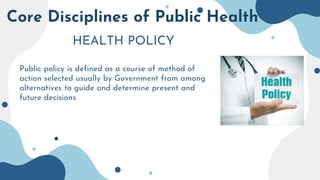
HEALTH POLICY
Public policy is defined as a course of method of
action selected usually by Government from among
alternatives to guide and determine present and
future decisions.
Core Disciplines of Public Health
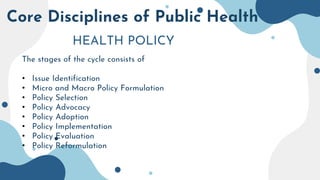
HEALTH POLICY
The stages of the cycle consists of
• Issue Identification
• Micro and Macro Policy Formulation
• Policy Selection
• Policy Advocacy
• Policy Adoption
• Policy Implementation
• Policy Evaluation
• Policy Reformulation
Core Disciplines of Public Health
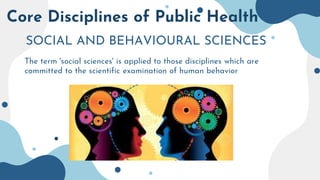
SOCIAL AND BEHAVIOURAL SCIENCES
The term 'social sciences' is applied to those disciplines which are
committed to the scientific examination of human behavior
Core Disciplines of Public Health
SOCIAL AND BEHAVIOURAL SCIENCES
• Economics
• Political Science
• Sociology
• Social Psychology
• Social Anthropology.
Public Health Functions
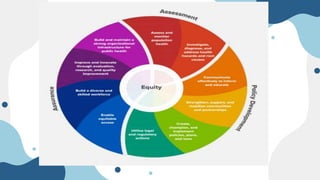
THE 10 ESSENTIAL PUBLIC
HEALTH SERVICES
To protect and promote the health of all people in
all communities
Public Health Functions
• To achieve equity, the Essential Public Health Services actively promote
policies, systems, and overall community conditions that enable optimal
health for all and seek to remove systemic and structural barriers that
have resulted in health inequities.
• Such barriers include poverty, racism, gender discrimination, ableism,
and other forms of oppression.
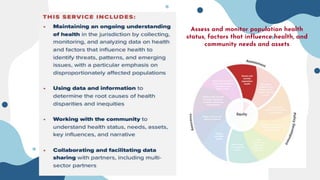
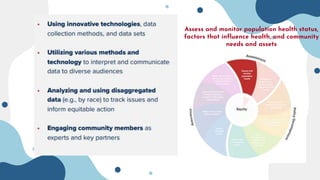
Assess and monitor population health
status, factors that influence health, and
community needs and assets
Assess and monitor population health status,
factors that influence health, and community
needs and assets
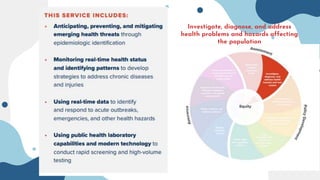
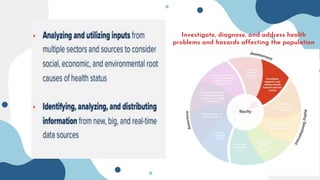
Investigate, diagnose, and address
health problems and hazards affecting
the population
Investigate, diagnose, and address health
problems and hazards affecting the population
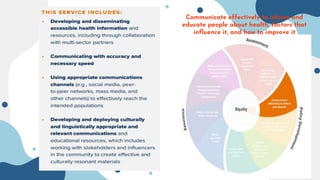
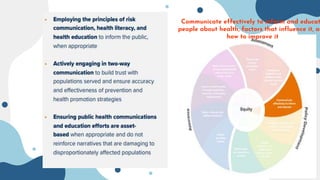
Communicate effectively to inform and
educate people about health, factors that
influence it, and how to improve it
Communicate effectively to inform and educat
people about health, factors that influence it, an
how to improve it
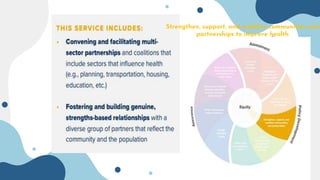
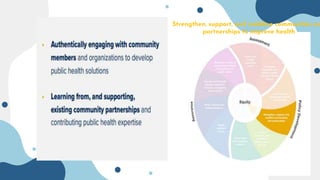
Strengthen, support, and mobilize communities and
partnerships to improve health
Strengthen, support, and mobilize communities an
partnerships to improve health
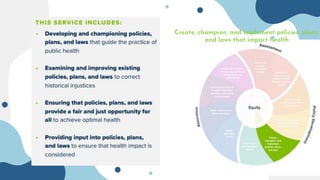
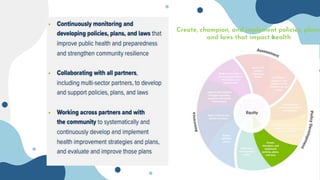
Create, champion, and implement policies, plans,
and laws that impact health
Create, champion, and implement policies, plans,
and laws that impact health
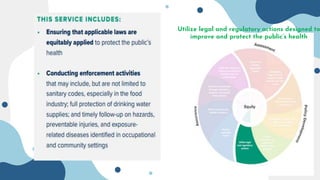
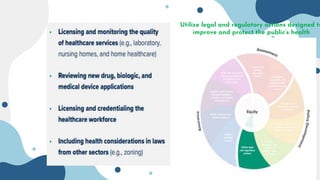
Utilize legal and regulatory actions designed to
improve and protect the public’s health
Utilize legal and regulatory actions designed to
improve and protect the public’s health
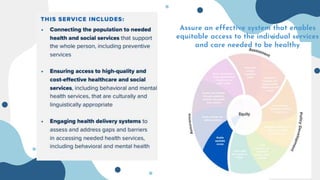
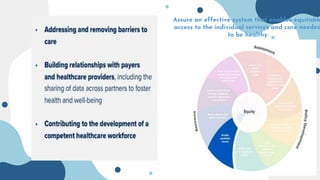
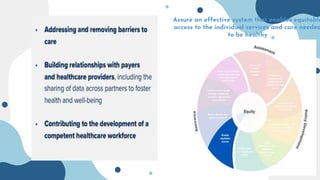
Assure an effective system that enables
equitable access to the individual services
and care needed to be healthy
Assure an effective system that enables equitable
access to the individual services and care needed
to be healthy
Assure an effective system that enables equitable
access to the individual services and care needed
to be healthy
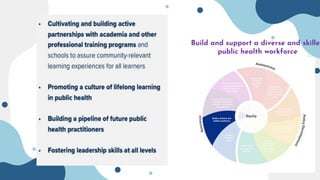
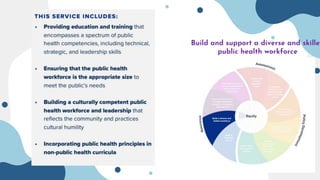
Build and support a diverse and skilled
public health workforce
Build and support a diverse and skilled
public health workforce
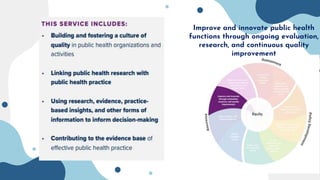
Improve and innovate public health
functions through ongoing evaluation,
research, and continuous quality
improvement
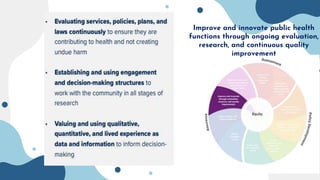
Improve and innovate public health
functions through ongoing evaluation,
research, and continuous quality
improvement
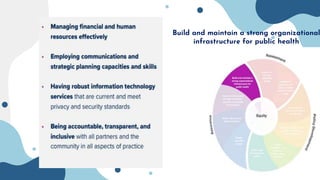
Build and maintain a strong organizational
infrastructure for public health
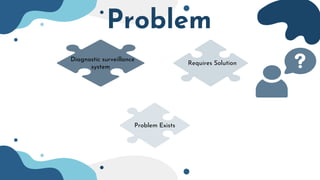
Problem
Diagnostic surveillance
system
Requires Solution
Problem Exists
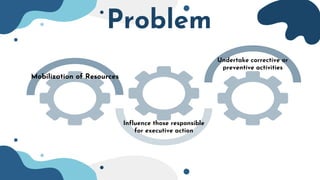
Problem
Undertake corrective or
preventive activities
Mobilization of Resources
Influence those responsible
for executive action
Problem
Environmental
Societal
Implementation of Proposals and Monitoring the
effectiveness
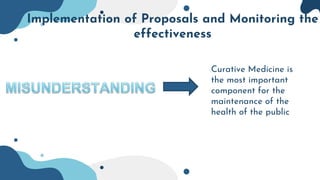
Curative Medicine is
the most important
component for the
maintenance of the
health of the public
Implementation of Proposals and Monitoring the
effectiveness
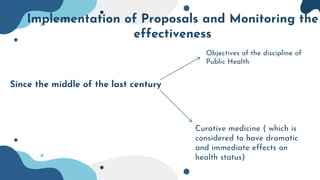
Since the middle of the last century
Curative medicine ( which is
considered to have dramatic
and immediate effects on
health status)
Objectives of the discipline of
Public Health
Implementation of Proposals and Monitoring the
effectiveness
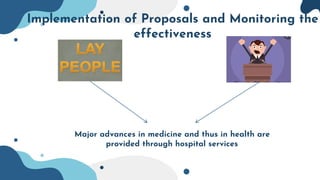
Major advances in medicine and thus in health are
provided through hospital services
Implementation of Proposals and Monitoring the
effectiveness
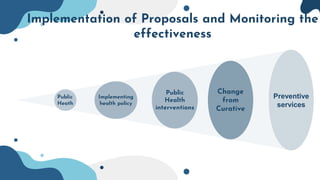
Implementing
health policy
Public
Health
interventions
Change
from
Curative
Preventive
services
Public
Heath
Implementation of Proposals and Monitoring the
effectiveness
• Investigation of the virus
• Molecular basis of generation of the
disease
• Its treatment
• Development of a vaccine to
prevent the disease
Implementation of Proposals and Monitoring the
effectiveness
• Problems of understanding human
behavior
• Modification of human behavior
• Which influence the rate and mode
of transmission in Western, African,
Asian and other populations
Implementation of Proposals and Monitoring the
effectiveness
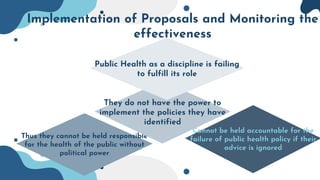
Cannot be held accountable for the
failure of public health policy if their
advice is ignored
Thus they cannot be held responsible
for the health of the public without
political power
They do not have the power to
implement the policies they have
identified
Public Health as a discipline is failing
to fulfill its role
Implementation of Proposals and Monitoring the
effectiveness
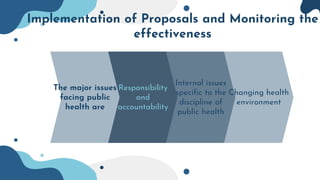
The major issues
facing public
health are
Responsibility
and
accountability
Internal issues
specific to the
discipline of
public health
Changing health
environment
Issue of responsibility and accountability
• Policy-making
• Determination of priorities.
• Health Service Organization
Policy Making
• Public health practitioners cannot act on isolations.
• Dependent on government at central or local level for the
freedom to practice their discipline effectively.
There is failure to recognize the
nature of professional responsibilities
for the public’s health
There is a failure to allow the public
health professions a sufficient place or
the power to determine and execute
appropriate health policies
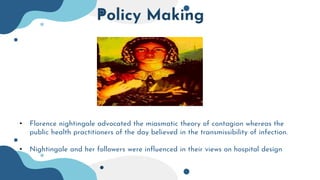
Policy Making
• Florence nightingale advocated the miasmatic theory of contagion whereas the
public health practitioners of the day believed in the transmissibility of infection.
• Nightingale and her followers were influenced in their views on hospital design
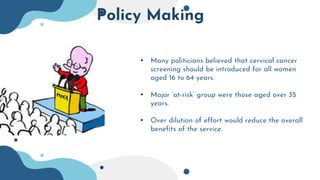
Policy Making
• Many politicians believed that cervical cancer
screening should be introduced for all women
aged 16 to 64 years.
• Major ‘at-risk’ group were those aged over 35
years.
• Over dilution of effort would reduce the overall
benefits of the service.
Policy Making
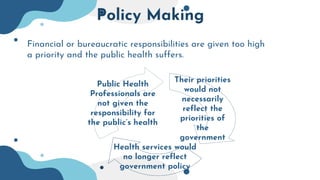
Financial or bureaucratic responsibilities are given too high
a priority and the public health suffers.
Public Health
Professionals are
not given the
responsibility for
the public’s health
Their priorities
would not
necessarily
reflect the
priorities of
the
government
Health services would
no longer reflect
government policy
Determination of Priorities
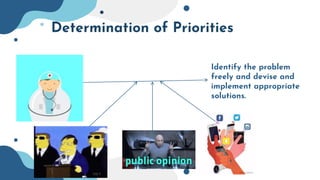
Identify the problem
freely and devise and
implement appropriate
solutions.
Determination of Priorities
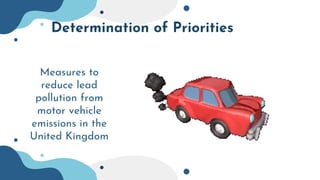
Measures to
reduce lead
pollution from
motor vehicle
emissions in the
United Kingdom
Determination of Priorities
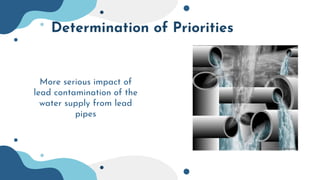
More serious impact of
lead contamination of the
water supply from lead
pipes
Health Service Organization
• Public Health Medicine plays a vital role in the management and
organization of health services.
• Decisions about reorganization are beyond the realms of the practitioners.
• Are given responsibilities for implementing operational decisions without
being party to strategic planning.
• This lack of clearly allocated responsibilities and accountabilities is the
paramount problem facing the public health services.
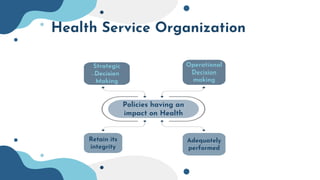
Health Service Organization
Policies having an
impact on Health
Adequately
performed
Retain its
integrity
Operational
Decision
making
Strategic
Decision
Making
Health Service Organization
Some of these conditions are now met in the
United Kingdom by the division into purchaser-
provider organizations, with the public health
discipline represented in the purchaser domain.
Health Service Organization
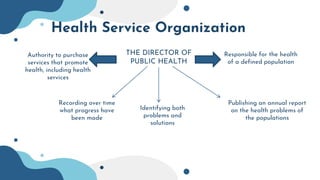
THE DIRECTOR OF
PUBLIC HEALTH
Responsible for the health
of a defined population
Authority to purchase
services that promote
health, including health
services
Publishing an annual report
on the health problems of
the populations
Identifying both
problems and
solutions
Recording over time
what progress have
been made
Health Service Organization
Such changes in structure enable an authority to take a much
broader view and enables expenditure to be directed in a more
structured manner.
Expenditure on road and housing
improvements rather than only accidents
and emergency facilities to reduce the
problem of accidents
CONCLUSION
• Public health is a vital function that requires broad public concern and support in
order to fulfill society's interest in assuring the conditions in which people can be
healthy. History teaches us that organized community effort to prevent disease
and promote health is both valuable and effective.
• Restoring an effective public health system cannot be achieved by public health
professionals alone.
Thank You
REFERENCES
• Centers for Disease Control and Prevention. Essential public health services.
National Public Health Performance Standards Program. 10.
• World Health Organization. Essential public health functions, health systems and
health security: developing conceptual clarity and a WHO roadmap for action.
• Park K. Preventive and social medicine.
• Detels R, Beaglehole R, Lansang MA, Gulliford M. Oxford textbook of public health.
Oxford University Press; 2011.
• Pellmar TC, Brandt Jr EN, Baird MA. Health and behavior: the interplay of
biological, behavioral, and social influences: summary of an Institute of Medicine
report. American Journal of Health Promotion. 2002 Mar;16(4):206-19.

Public_Health_Functions.pptx

  • 1.
  • 2.
    CONTENTS • Definition ofpublic health • What is Public Health? • Core Disciplines of Public Health • Public Health Functions • Problems and Barriers • Conclusion
  • 3.
    Definition of PublicHealth • ‘Public health is the science and art of preventing disease, prolonging life and promoting physical health and efficiency through organized community efforts for the sanitation of the environment, the control of community infections, the education of the individual in principles of personal hygiene, the organization of medical and nursing service for the early diagnosis and preventive treatment of disease, and the development of social machinery which will ensure to every individual in the community a standard of living adequate for the maintenance of health’. (Winslow, 1920)
  • 4.
    Definition of PublicHealth • Sir Donald Acheson in 1988 defined it as: ‘the science and art of preventing disease, prolonging life and promoting, protecting and improving health through the organized efforts of society’ • The field pays special attention to the social context of disease and health, and focuses on improving health through society-wide measures like vaccinations, the fluoridation of drinking water, or through policies such as seatbelt and non-smoking laws. • Donald Acheson Report, 1988, UK
  • 5.
    What is publichealth? Public health is considered to be about the health of people or communities, as opposed to individual health - it is everyone's responsibility The concept of public health is not unique and has changed over the years due to changes in the health status of the population and the determining situations of health. This definition of public health is directly linked to the wider definition of health, found in the preamble of the constitution of the World Health Organisation (1948), where health is referred to as "a state of complete physical, mental and social well-being and not merely the absence of disease."
  • 6.
    Core Disciplines ofPublic Health • Environmental Health • Epidemiology • Biostatistics • Health Policy • Social and Behavioral Sciences
  • 7.
    Core Disciplines ofPublic Health Environmental Health The term environment implies all the external factors - living and non-living, material and non-material which surround man.
  • 8.
    Core Disciplines ofPublic Health Environmental Health For descriptive purpose, environment has been divided into three components
  • 9.
    Core Disciplines ofPublic Health Environmental Health Environmental Sanitation" has been defined by WHO as "the control of all those factors in man's physical environment which exercise or may exercise a deleterious effect on his physical development, health and survival"
  • 10.
    Core Disciplines ofPublic Health EPIDEMIOLOGY The word epidemiology comes from the Greek words epi, meaning on or upon, demos, meaning people, and logos, meaning the study of.
  • 11.
    Core Disciplines ofPublic Health EPIDEMIOLOGY Epidemiology is the study of the distribution and determinants of health-related states or events in specified populations, and the application of this study to the control of health problems.
  • 12.
    Core Disciplines ofPublic Health EPIDEMIOLOGY Epidemiology is the study (scientific, systematic, data-driven) of the distribution (frequency, pattern) and determinants (causes, risk factors) of health-related states and events (not just diseases) in specified populations (patient is community, individuals viewed collectively), and the application of (since epidemiology is a discipline within public health) this study to the control of health problems.
  • 13.
    Core Disciplines ofPublic Health EPIDEMIOLOGY Uses • Assessing the community’s health • Making individual decisions • Completing the clinical picture • Searching for causes
  • 14.
    Core Disciplines ofPublic Health BIOSTATISTICS Data management, analysis, and presentation of public health data.
  • 15.
    Core Disciplines ofPublic Health BIOSTATISTICS In the line of definition of Croxton and Cowden, a comprehensive definition of statistics could be The Science of • Collection • Organization • Presentation • Analysis • And interpretation of numerical data
  • 16.
    Core Disciplines ofPublic Health HEALTH POLICY Public policy is defined as a course of method of action selected usually by Government from among alternatives to guide and determine present and future decisions.
  • 17.
    Core Disciplines ofPublic Health HEALTH POLICY The stages of the cycle consists of • Issue Identification • Micro and Macro Policy Formulation • Policy Selection • Policy Advocacy • Policy Adoption • Policy Implementation • Policy Evaluation • Policy Reformulation
  • 18.
    Core Disciplines ofPublic Health SOCIAL AND BEHAVIOURAL SCIENCES The term 'social sciences' is applied to those disciplines which are committed to the scientific examination of human behavior
  • 19.
    Core Disciplines ofPublic Health SOCIAL AND BEHAVIOURAL SCIENCES • Economics • Political Science • Sociology • Social Psychology • Social Anthropology.
  • 20.
    Public Health Functions THE10 ESSENTIAL PUBLIC HEALTH SERVICES To protect and promote the health of all people in all communities
  • 21.
    Public Health Functions •To achieve equity, the Essential Public Health Services actively promote policies, systems, and overall community conditions that enable optimal health for all and seek to remove systemic and structural barriers that have resulted in health inequities. • Such barriers include poverty, racism, gender discrimination, ableism, and other forms of oppression.
  • 23.
    Assess and monitorpopulation health status, factors that influence health, and community needs and assets
  • 24.
    Assess and monitorpopulation health status, factors that influence health, and community needs and assets
  • 25.
    Investigate, diagnose, andaddress health problems and hazards affecting the population
  • 26.
    Investigate, diagnose, andaddress health problems and hazards affecting the population
  • 27.
    Communicate effectively toinform and educate people about health, factors that influence it, and how to improve it
  • 28.
    Communicate effectively toinform and educat people about health, factors that influence it, an how to improve it
  • 29.
    Strengthen, support, andmobilize communities and partnerships to improve health
  • 30.
    Strengthen, support, andmobilize communities an partnerships to improve health
  • 31.
    Create, champion, andimplement policies, plans, and laws that impact health
  • 32.
    Create, champion, andimplement policies, plans, and laws that impact health
  • 33.
    Utilize legal andregulatory actions designed to improve and protect the public’s health
  • 34.
    Utilize legal andregulatory actions designed to improve and protect the public’s health
  • 35.
    Assure an effectivesystem that enables equitable access to the individual services and care needed to be healthy
  • 36.
    Assure an effectivesystem that enables equitable access to the individual services and care needed to be healthy
  • 37.
    Assure an effectivesystem that enables equitable access to the individual services and care needed to be healthy
  • 38.
    Build and supporta diverse and skilled public health workforce
  • 39.
    Build and supporta diverse and skilled public health workforce
  • 40.
    Improve and innovatepublic health functions through ongoing evaluation, research, and continuous quality improvement
  • 41.
    Improve and innovatepublic health functions through ongoing evaluation, research, and continuous quality improvement
  • 42.
    Build and maintaina strong organizational infrastructure for public health
  • 43.
  • 44.
    Problem Undertake corrective or preventiveactivities Mobilization of Resources Influence those responsible for executive action
  • 45.
  • 46.
    Implementation of Proposalsand Monitoring the effectiveness Curative Medicine is the most important component for the maintenance of the health of the public
  • 47.
    Implementation of Proposalsand Monitoring the effectiveness Since the middle of the last century Curative medicine ( which is considered to have dramatic and immediate effects on health status) Objectives of the discipline of Public Health
  • 48.
    Implementation of Proposalsand Monitoring the effectiveness Major advances in medicine and thus in health are provided through hospital services
  • 49.
    Implementation of Proposalsand Monitoring the effectiveness Implementing health policy Public Health interventions Change from Curative Preventive services Public Heath
  • 50.
    Implementation of Proposalsand Monitoring the effectiveness • Investigation of the virus • Molecular basis of generation of the disease • Its treatment • Development of a vaccine to prevent the disease
  • 51.
    Implementation of Proposalsand Monitoring the effectiveness • Problems of understanding human behavior • Modification of human behavior • Which influence the rate and mode of transmission in Western, African, Asian and other populations
  • 52.
    Implementation of Proposalsand Monitoring the effectiveness Cannot be held accountable for the failure of public health policy if their advice is ignored Thus they cannot be held responsible for the health of the public without political power They do not have the power to implement the policies they have identified Public Health as a discipline is failing to fulfill its role
  • 53.
    Implementation of Proposalsand Monitoring the effectiveness The major issues facing public health are Responsibility and accountability Internal issues specific to the discipline of public health Changing health environment
  • 54.
    Issue of responsibilityand accountability • Policy-making • Determination of priorities. • Health Service Organization
  • 55.
    Policy Making • Publichealth practitioners cannot act on isolations. • Dependent on government at central or local level for the freedom to practice their discipline effectively. There is failure to recognize the nature of professional responsibilities for the public’s health There is a failure to allow the public health professions a sufficient place or the power to determine and execute appropriate health policies
  • 56.
    Policy Making • Florencenightingale advocated the miasmatic theory of contagion whereas the public health practitioners of the day believed in the transmissibility of infection. • Nightingale and her followers were influenced in their views on hospital design
  • 57.
    Policy Making • Manypoliticians believed that cervical cancer screening should be introduced for all women aged 16 to 64 years. • Major ‘at-risk’ group were those aged over 35 years. • Over dilution of effort would reduce the overall benefits of the service.
  • 58.
    Policy Making Financial orbureaucratic responsibilities are given too high a priority and the public health suffers. Public Health Professionals are not given the responsibility for the public’s health Their priorities would not necessarily reflect the priorities of the government Health services would no longer reflect government policy
  • 59.
    Determination of Priorities Identifythe problem freely and devise and implement appropriate solutions.
  • 60.
    Determination of Priorities Measuresto reduce lead pollution from motor vehicle emissions in the United Kingdom
  • 61.
    Determination of Priorities Moreserious impact of lead contamination of the water supply from lead pipes
  • 62.
    Health Service Organization •Public Health Medicine plays a vital role in the management and organization of health services. • Decisions about reorganization are beyond the realms of the practitioners. • Are given responsibilities for implementing operational decisions without being party to strategic planning. • This lack of clearly allocated responsibilities and accountabilities is the paramount problem facing the public health services.
  • 63.
    Health Service Organization Policieshaving an impact on Health Adequately performed Retain its integrity Operational Decision making Strategic Decision Making
  • 64.
    Health Service Organization Someof these conditions are now met in the United Kingdom by the division into purchaser- provider organizations, with the public health discipline represented in the purchaser domain.
  • 65.
    Health Service Organization THEDIRECTOR OF PUBLIC HEALTH Responsible for the health of a defined population Authority to purchase services that promote health, including health services Publishing an annual report on the health problems of the populations Identifying both problems and solutions Recording over time what progress have been made
  • 66.
    Health Service Organization Suchchanges in structure enable an authority to take a much broader view and enables expenditure to be directed in a more structured manner. Expenditure on road and housing improvements rather than only accidents and emergency facilities to reduce the problem of accidents
  • 67.
    CONCLUSION • Public healthis a vital function that requires broad public concern and support in order to fulfill society's interest in assuring the conditions in which people can be healthy. History teaches us that organized community effort to prevent disease and promote health is both valuable and effective. • Restoring an effective public health system cannot be achieved by public health professionals alone.
  • 68.
  • 69.
    REFERENCES • Centers forDisease Control and Prevention. Essential public health services. National Public Health Performance Standards Program. 10. • World Health Organization. Essential public health functions, health systems and health security: developing conceptual clarity and a WHO roadmap for action. • Park K. Preventive and social medicine. • Detels R, Beaglehole R, Lansang MA, Gulliford M. Oxford textbook of public health. Oxford University Press; 2011. • Pellmar TC, Brandt Jr EN, Baird MA. Health and behavior: the interplay of biological, behavioral, and social influences: summary of an Institute of Medicine report. American Journal of Health Promotion. 2002 Mar;16(4):206-19.

Editor's Notes

  • #18 Build evidence based on analysis Influence policy makers
  • #20 The study of the total way of life of a contemporary primitive man.