INDIA NEWBORN
ACTION PLAN
Dr Rambadan P. Chauhan
Professor-Community Medicine
BKLWRMC-Sawarde, District-Ratnagiri
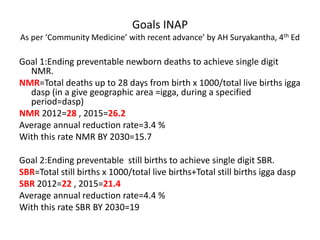
Goals INAP
As per ‘Community Medicine’ with recent advance’ by AH Suryakantha, 4th Ed
Goal 1:Ending preventable newborn deaths to achieve single digit
NMR.
NMR=Total deaths up to 28 days from birth x 1000/total live births igga
dasp (in a give geographic area =igga, during a specified
period=dasp)
NMR 2012=28 , 2015=26.2
Average annual reduction rate=3.4 %
With this rate NMR BY 2030=15.7
Goal 2:Ending preventable still births to achieve single digit SBR.
SBR=Total still births x 1000/total live births+Total still births igga dasp
SBR 2012=22 , 2015=21.4
Average annual reduction rate=4.4 %
With this rate SBR BY 2030=19
INDIA NEWBORN ACTION PLAN
At the end of the lecture you {student (s)} should be able to understand,
1.Rationale, goal, strategic intervention
categories & levels of care.
2. Six components of INAP
3.Three levels of care of each component.
4.Dashboard indicators of INAP
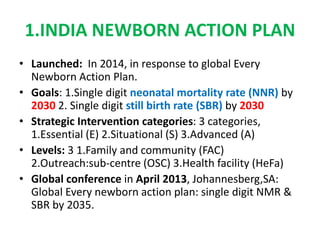
1.INDIA NEWBORN ACTION PLAN
• Launched: In 2014, in response to global Every
Newborn Action Plan.
• Goals: 1.Single digit neonatal mortality rate (NNR) by
2030 2. Single digit still birth rate (SBR) by 2030
• Strategic Intervention categories: 3 categories,
1.Essential (E) 2.Situational (S) 3.Advanced (A)
• Levels: 3 1.Family and community (FAC)
2.Outreach:sub-centre (OSC) 3.Health facility (HeFa)
• Global conference in April 2013, Johannesberg,SA:
Global Every newborn action plan: single digit NMR &
SBR by 2035.
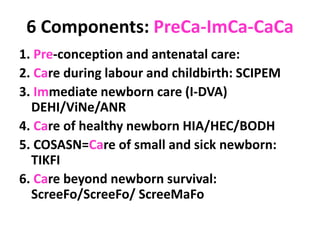
6 Components: PreCa-ImCa-CaCa
1. Pre-conception and antenatal care:
2. Care during labour and childbirth: SCIPEM
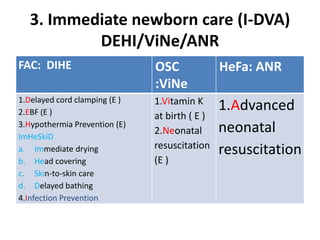
3. Immediate newborn care (I-DVA)
DEHI/ViNe/ANR
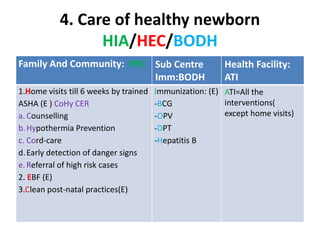
4. Care of healthy newborn HIA/HEC/BODH
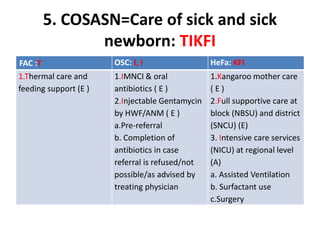
5. COSASN=Care of small and sick newborn:
TIKFI
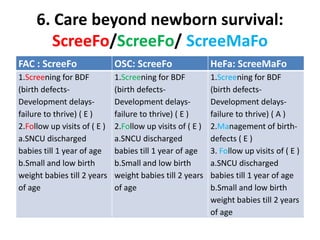
6. Care beyond newborn survival:
ScreeFo/ScreeFo/ ScreeMaFo
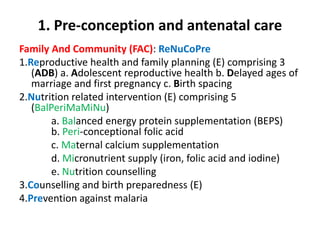
1. Pre-conception and antenatal care
Family And Community (FAC): ReNuCoPre
1.Reproductive health and family planning (E) comprising 3
(ADB) a. Adolescent reproductive health b. Delayed ages of
marriage and first pregnancy c. Birth spacing
2.Nutrition related intervention (E) comprising 5
(BalPeriMaMiNu)
a. Balanced energy protein supplementation (BEPS)
b. Peri-conceptional folic acid
c. Maternal calcium supplementation
d. Micronutrient supply (iron, folic acid and iodine)
e. Nutrition counselling
3.Counselling and birth preparedness (E)
4.Prevention against malaria
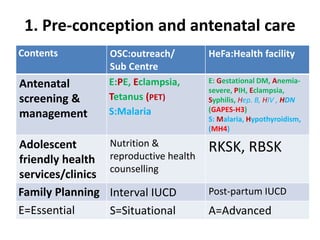
1. Pre-conception and antenatal care
Contents OSC:outreach/
Sub Centre
HeFa:Health facility
Antenatal
screening &
management
E:PE, Eclampsia,
Tetanus (PET)
S:Malaria
E: Gestational DM, Anemia-
severe, PIH, Eclampsia,
Syphilis, Hep. B, HIV , HDN
(GAPES-H3)
S: Malaria, Hypothyroidism,
(MH4)
Adolescent
friendly health
services/clinics
Nutrition &
reproductive health
counselling
RKSK, RBSK
Family Planning Interval IUCD Post-partum IUCD
E=Essential S=Situational A=Advanced
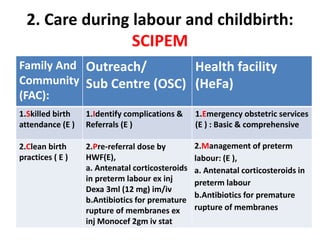
2. Care during labour and childbirth:
SCIPEM
Family And
Community
(FAC):
Outreach/
Sub Centre (OSC)
Health facility
(HeFa)
1.Skilled birth
attendance (E )
1.Identify complications &
Referrals (E )
1.Emergency obstetric services
(E ) : Basic & comprehensive
2.Clean birth
practices ( E )
2.Pre-referral dose by
HWF(E),
a. Antenatal corticosteroids
in preterm labour ex inj
Dexa 3ml (12 mg) im/iv
b.Antibiotics for premature
rupture of membranes ex
inj Monocef 2gm iv stat
2.Management of preterm
labour: (E ),
a. Antenatal corticosteroids in
preterm labour
b.Antibiotics for premature
rupture of membranes
3. Immediate newborn care (I-DVA)
DEHI/ViNe/ANR
FAC: DIHE OSC
:ViNe
HeFa: ANR
1.Delayed cord clamping (E )
2.EBF (E )
3.Hypothermia Prevention (E)
ImHeSkiD
a. Immediate drying
b. Head covering
c. Skin-to-skin care
d. Delayed bathing
4.Infection Prevention
1.Vitamin K
at birth ( E )
2.Neonatal
resuscitation
(E )
1.Advanced
neonatal
resuscitation
4. Care of healthy newborn
HIA/HEC/BODH
Family And Community: HEC Sub Centre
Imm:BODH
Health Facility:
ATI
1.Home visits till 6 weeks by trained
ASHA (E ) CoHy CER
a. Counselling
b.Hypothermia Prevention
c. Cord-care
d.Early detection of danger signs
e.Referral of high risk cases
2. EBF (E)
3.Clean post-natal practices(E)
Immunization: (E)
-BCG
-OPV
-DPT
-Hepatitis B
ATI=All the
interventions(
except home visits)
5. COSASN=Care of sick and sick
newborn: TIKFI
FAC :T OSC: I, I HeFa: KFI
1.Thermal care and
feeding support (E )
1.IMNCI & oral
antibiotics ( E )
2.Injectable Gentamycin
by HWF/ANM ( E )
a.Pre-referral
b. Completion of
antibiotics in case
referral is refused/not
possible/as advised by
treating physician
1.Kangaroo mother care
( E )
2.Full supportive care at
block (NBSU) and district
(SNCU) (E)
3. Intensive care services
(NICU) at regional level
(A)
a. Assisted Ventilation
b. Surfactant use
c.Surgery
6. Care beyond newborn survival:
ScreeFo/ScreeFo/ ScreeMaFo
FAC : ScreeFo OSC: ScreeFo HeFa: ScreeMaFo
1.Screening for BDF
(birth defects-
Development delays-
failure to thrive) ( E )
2.Follow up visits of ( E )
a.SNCU discharged
babies till 1 year of age
b.Small and low birth
weight babies till 2 years
of age
1.Screening for BDF
(birth defects-
Development delays-
failure to thrive) ( E )
2.Follow up visits of ( E )
a.SNCU discharged
babies till 1 year of age
b.Small and low birth
weight babies till 2 years
of age
1.Screening for BDF
(birth defects-
Development delays-
failure to thrive) ( A )
2.Management of birth-
defects ( E )
3. Follow up visits of ( E )
a.SNCU discharged
babies till 1 year of age
b.Small and low birth
weight babies till 2 years
of age
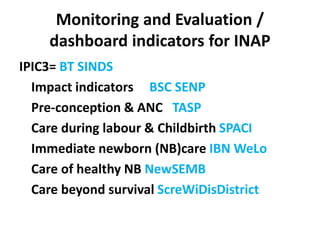
Monitoring and Evaluation /
dashboard indicators for INAP
IPIC3= BT SINDS
Impact indicators BSC SENP
Pre-conception & ANC TASP
Care during labour & Childbirth SPACI
Immediate newborn (NB)care IBN WeLo
Care of healthy NB NewSEMB
Care beyond survival ScreWiDisDistrict
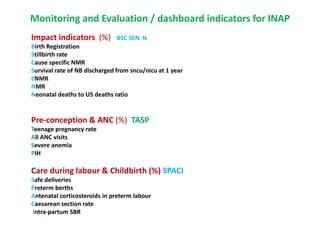
Monitoring and Evaluation / dashboard indicators for INAP
Impact indicators (%) BSC SEN N
Birth Registration
Stillbirth rate
Cause specific NMR
Survival rate of NB discharged from sncu/nicu at 1 year
ENMR
NMR
Neonatal deaths to U5 deaths ratio
Pre-conception & ANC (%) TASP
Teenage pregnancy rate
All ANC visits
Severe anemia
PIH
Care during labour & Childbirth (%) SPACI
Safe deliveries
Preterm berths
Antenatal corticosteroids in preterm labour
Caesarean section rate
Intra-partum SBR
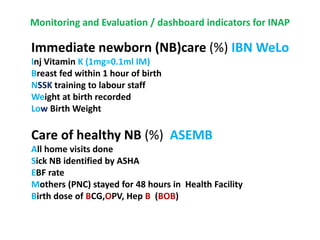
Monitoring and Evaluation / dashboard indicators for INAP
Immediate newborn (NB)care (%) IBN WeLo
Inj Vitamin K (1mg=0.1ml IM)
Breast fed within 1 hour of birth
NSSK training to labour staff
Weight at birth recorded
Low Birth Weight
Care of healthy NB (%) ASEMB
All home visits done
Sick NB identified by ASHA
EBF rate
Mothers (PNC) stayed for 48 hours in Health Facility
Birth dose of BCG,OPV, Hep B (BOB)
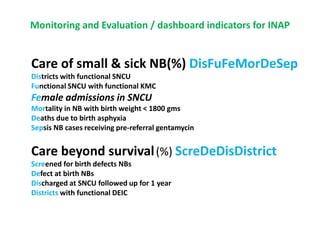
Monitoring and Evaluation / dashboard indicators for INAP
Care of small & sick NB(%) DisFuFeMorDeSep
Districts with functional SNCU
Functional SNCU with functional KMC
Female admissions in SNCU
Mortality in NB with birth weight < 1800 gms
Deaths due to birth asphyxia
Sepsis NB cases receiving pre-referral gentamycin
Care beyond survival(%) ScreDeDisDistrict
Screened for birth defects NBs
Defect at birth NBs
Discharged at SNCU followed up for 1 year
Districts with functional DEIC
Assignments
LAQ
Describe 6 components of INAP.(6 marks).
Enumerate dashboard indicators of INAP.(2
marks)
SAQs
1.Components of INAP ( Each category 0.5 mark)
2.Dashboard indicators of INAP
3.Describe goals, Intervention categories &
levels of care of INAP (1+1+1) marks

INDIA NEWBORN ACTION PLAN-2014

  • 1.
    INDIA NEWBORN ACTION PLAN DrRambadan P. Chauhan Professor-Community Medicine BKLWRMC-Sawarde, District-Ratnagiri
  • 2.
    Goals INAP As per‘Community Medicine’ with recent advance’ by AH Suryakantha, 4th Ed Goal 1:Ending preventable newborn deaths to achieve single digit NMR. NMR=Total deaths up to 28 days from birth x 1000/total live births igga dasp (in a give geographic area =igga, during a specified period=dasp) NMR 2012=28 , 2015=26.2 Average annual reduction rate=3.4 % With this rate NMR BY 2030=15.7 Goal 2:Ending preventable still births to achieve single digit SBR. SBR=Total still births x 1000/total live births+Total still births igga dasp SBR 2012=22 , 2015=21.4 Average annual reduction rate=4.4 % With this rate SBR BY 2030=19
  • 3.
    INDIA NEWBORN ACTIONPLAN At the end of the lecture you {student (s)} should be able to understand, 1.Rationale, goal, strategic intervention categories & levels of care. 2. Six components of INAP 3.Three levels of care of each component. 4.Dashboard indicators of INAP
  • 4.
    1.INDIA NEWBORN ACTIONPLAN • Launched: In 2014, in response to global Every Newborn Action Plan. • Goals: 1.Single digit neonatal mortality rate (NNR) by 2030 2. Single digit still birth rate (SBR) by 2030 • Strategic Intervention categories: 3 categories, 1.Essential (E) 2.Situational (S) 3.Advanced (A) • Levels: 3 1.Family and community (FAC) 2.Outreach:sub-centre (OSC) 3.Health facility (HeFa) • Global conference in April 2013, Johannesberg,SA: Global Every newborn action plan: single digit NMR & SBR by 2035.
  • 5.
    6 Components: PreCa-ImCa-CaCa 1.Pre-conception and antenatal care: 2. Care during labour and childbirth: SCIPEM 3. Immediate newborn care (I-DVA) DEHI/ViNe/ANR 4. Care of healthy newborn HIA/HEC/BODH 5. COSASN=Care of small and sick newborn: TIKFI 6. Care beyond newborn survival: ScreeFo/ScreeFo/ ScreeMaFo
  • 6.
    1. Pre-conception andantenatal care Family And Community (FAC): ReNuCoPre 1.Reproductive health and family planning (E) comprising 3 (ADB) a. Adolescent reproductive health b. Delayed ages of marriage and first pregnancy c. Birth spacing 2.Nutrition related intervention (E) comprising 5 (BalPeriMaMiNu) a. Balanced energy protein supplementation (BEPS) b. Peri-conceptional folic acid c. Maternal calcium supplementation d. Micronutrient supply (iron, folic acid and iodine) e. Nutrition counselling 3.Counselling and birth preparedness (E) 4.Prevention against malaria
  • 7.
    1. Pre-conception andantenatal care Contents OSC:outreach/ Sub Centre HeFa:Health facility Antenatal screening & management E:PE, Eclampsia, Tetanus (PET) S:Malaria E: Gestational DM, Anemia- severe, PIH, Eclampsia, Syphilis, Hep. B, HIV , HDN (GAPES-H3) S: Malaria, Hypothyroidism, (MH4) Adolescent friendly health services/clinics Nutrition & reproductive health counselling RKSK, RBSK Family Planning Interval IUCD Post-partum IUCD E=Essential S=Situational A=Advanced
  • 8.
    2. Care duringlabour and childbirth: SCIPEM Family And Community (FAC): Outreach/ Sub Centre (OSC) Health facility (HeFa) 1.Skilled birth attendance (E ) 1.Identify complications & Referrals (E ) 1.Emergency obstetric services (E ) : Basic & comprehensive 2.Clean birth practices ( E ) 2.Pre-referral dose by HWF(E), a. Antenatal corticosteroids in preterm labour ex inj Dexa 3ml (12 mg) im/iv b.Antibiotics for premature rupture of membranes ex inj Monocef 2gm iv stat 2.Management of preterm labour: (E ), a. Antenatal corticosteroids in preterm labour b.Antibiotics for premature rupture of membranes
  • 9.
    3. Immediate newborncare (I-DVA) DEHI/ViNe/ANR FAC: DIHE OSC :ViNe HeFa: ANR 1.Delayed cord clamping (E ) 2.EBF (E ) 3.Hypothermia Prevention (E) ImHeSkiD a. Immediate drying b. Head covering c. Skin-to-skin care d. Delayed bathing 4.Infection Prevention 1.Vitamin K at birth ( E ) 2.Neonatal resuscitation (E ) 1.Advanced neonatal resuscitation
  • 10.
    4. Care ofhealthy newborn HIA/HEC/BODH Family And Community: HEC Sub Centre Imm:BODH Health Facility: ATI 1.Home visits till 6 weeks by trained ASHA (E ) CoHy CER a. Counselling b.Hypothermia Prevention c. Cord-care d.Early detection of danger signs e.Referral of high risk cases 2. EBF (E) 3.Clean post-natal practices(E) Immunization: (E) -BCG -OPV -DPT -Hepatitis B ATI=All the interventions( except home visits)
  • 11.
    5. COSASN=Care ofsick and sick newborn: TIKFI FAC :T OSC: I, I HeFa: KFI 1.Thermal care and feeding support (E ) 1.IMNCI & oral antibiotics ( E ) 2.Injectable Gentamycin by HWF/ANM ( E ) a.Pre-referral b. Completion of antibiotics in case referral is refused/not possible/as advised by treating physician 1.Kangaroo mother care ( E ) 2.Full supportive care at block (NBSU) and district (SNCU) (E) 3. Intensive care services (NICU) at regional level (A) a. Assisted Ventilation b. Surfactant use c.Surgery
  • 12.
    6. Care beyondnewborn survival: ScreeFo/ScreeFo/ ScreeMaFo FAC : ScreeFo OSC: ScreeFo HeFa: ScreeMaFo 1.Screening for BDF (birth defects- Development delays- failure to thrive) ( E ) 2.Follow up visits of ( E ) a.SNCU discharged babies till 1 year of age b.Small and low birth weight babies till 2 years of age 1.Screening for BDF (birth defects- Development delays- failure to thrive) ( E ) 2.Follow up visits of ( E ) a.SNCU discharged babies till 1 year of age b.Small and low birth weight babies till 2 years of age 1.Screening for BDF (birth defects- Development delays- failure to thrive) ( A ) 2.Management of birth- defects ( E ) 3. Follow up visits of ( E ) a.SNCU discharged babies till 1 year of age b.Small and low birth weight babies till 2 years of age
  • 13.
    Monitoring and Evaluation/ dashboard indicators for INAP IPIC3= BT SINDS Impact indicators BSC SENP Pre-conception & ANC TASP Care during labour & Childbirth SPACI Immediate newborn (NB)care IBN WeLo Care of healthy NB NewSEMB Care beyond survival ScreWiDisDistrict
  • 14.
    Monitoring and Evaluation/ dashboard indicators for INAP Impact indicators (%) BSC SEN N Birth Registration Stillbirth rate Cause specific NMR Survival rate of NB discharged from sncu/nicu at 1 year ENMR NMR Neonatal deaths to U5 deaths ratio Pre-conception & ANC (%) TASP Teenage pregnancy rate All ANC visits Severe anemia PIH Care during labour & Childbirth (%) SPACI Safe deliveries Preterm berths Antenatal corticosteroids in preterm labour Caesarean section rate Intra-partum SBR
  • 15.
    Monitoring and Evaluation/ dashboard indicators for INAP Immediate newborn (NB)care (%) IBN WeLo Inj Vitamin K (1mg=0.1ml IM) Breast fed within 1 hour of birth NSSK training to labour staff Weight at birth recorded Low Birth Weight Care of healthy NB (%) ASEMB All home visits done Sick NB identified by ASHA EBF rate Mothers (PNC) stayed for 48 hours in Health Facility Birth dose of BCG,OPV, Hep B (BOB)
  • 16.
    Monitoring and Evaluation/ dashboard indicators for INAP Care of small & sick NB(%) DisFuFeMorDeSep Districts with functional SNCU Functional SNCU with functional KMC Female admissions in SNCU Mortality in NB with birth weight < 1800 gms Deaths due to birth asphyxia Sepsis NB cases receiving pre-referral gentamycin Care beyond survival(%) ScreDeDisDistrict Screened for birth defects NBs Defect at birth NBs Discharged at SNCU followed up for 1 year Districts with functional DEIC
  • 17.
    Assignments LAQ Describe 6 componentsof INAP.(6 marks). Enumerate dashboard indicators of INAP.(2 marks) SAQs 1.Components of INAP ( Each category 0.5 mark) 2.Dashboard indicators of INAP 3.Describe goals, Intervention categories & levels of care of INAP (1+1+1) marks