FREEDOM OF
THE HUMAN
PERSON
WHAT IS
FREEDOM?
01
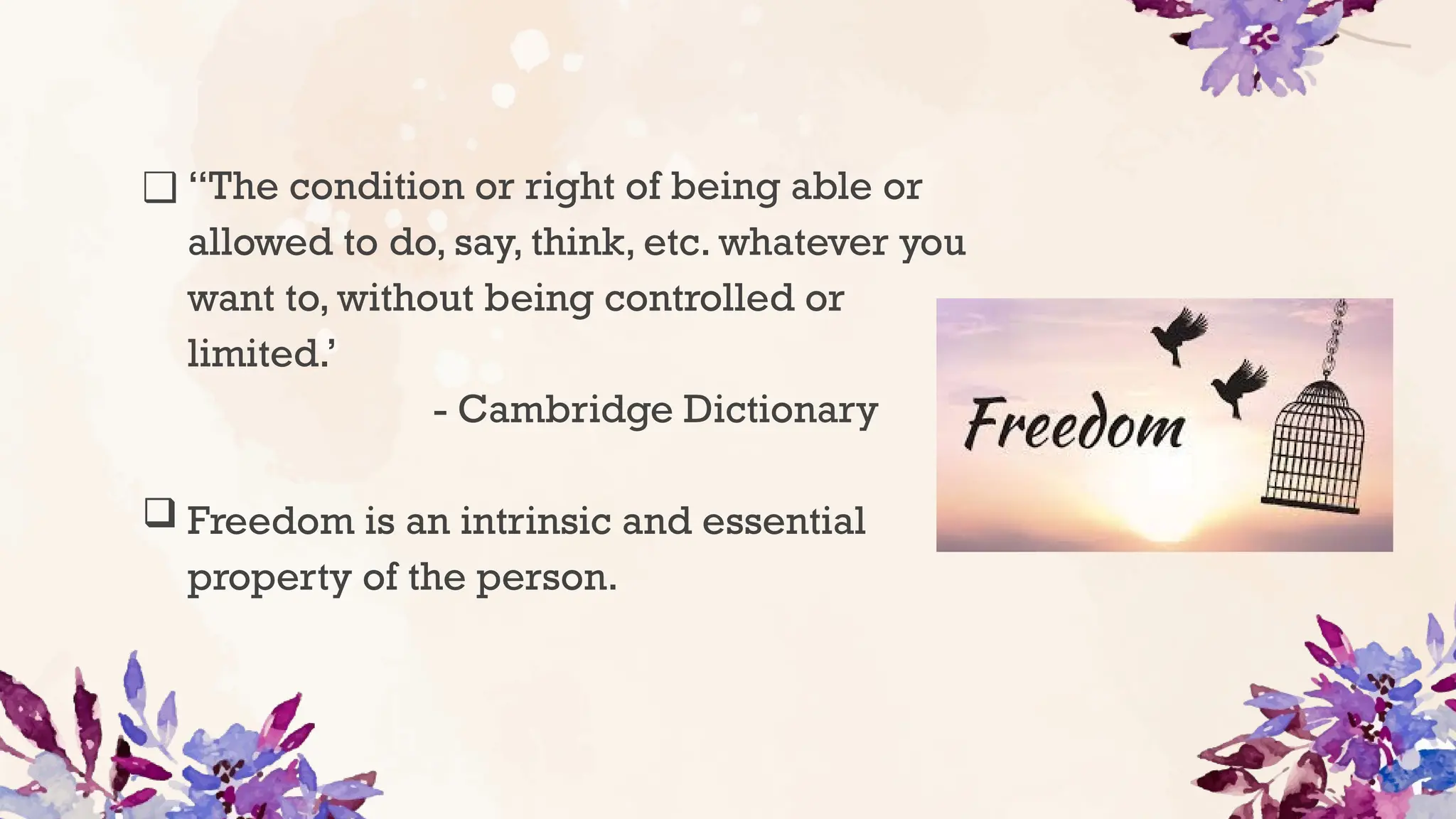
❑ “The condition or right of being able or
allowed to do, say, think, etc. whatever you
want to, without being controlled or
limited.’
- Cambridge Dictionary
 Freedom is an intrinsic and essential
property of the person.
❑Thomas Hobbes’ Social Contract
Give up some rights to obtain some
rights.
Social Contract implies sharing of
resources especially to the less
fortunate, weak, poor, helpless, and
needy.
The greatest exercise of freedom is
for the development of others.
WHERE DOES FREEDOM
ROOTED?
02
Self-determination
Exercise of Intellect
Free will
The ability or power to make decisions for yourself, especially the
power of a nation to decide how it will be governed.
“The ability to BECOME.”
The process to manifest his or her ideas and aspirations.
The ability to decide what to do independently of any
outside influence.
IT FEELS SO GOOD TO BE
FREE? DO YOU AGREE?
LOOK FOR A PARTNER!
Direction:
Grab both hands of your partner and as
much as possible, do not let your
partner go off his or her hands. Hold
him or her as tight as possible.
WHAT’S GOOD WITH
FREEDOM?
03
❑Freedom gives us the choice to undertake
one of the best possible action.
❑Freedom requires a degree of control from the
person who exercises it.
WHAT IS SLAVERY?
04
It is a dehumanizing act because a
person is forced to work for life
without the possibility of ever
leaving a life of a bondage.
KINDS OF FREEDOM?
05
Refers to the absence of any
physical restraint
Physical Freedom
The person if free to move wherever
he or she goes.
Is also called as FREEDOM OF
CHOICE
Psychological Freedom
The person performs actions that he
considers right and wise.
Refers to USING FREEDOM IN A
MANNER THAT UPHOLDS DIGNITY
AND GOODNESS
Moral Freedom
The person is not an object of
other’s freedom.
WHAT ARE THE
ELEMENTS OF
FREEDOM?
06
1. VOLUNTARINESS
 It refers to the ability of a person to act out his or her free will
and self-determination.
 It means that a person may decide to act or not to act, and
these decisions are made out of his or her own free will.
 It also means that a person may act even if he or she is not
required or called to take action.
2. RESPONSIBILITY
 It refers to the person being accountable for his or hers actions
and consequences.
 As a free being, the person must accept the consequences of
his or her action and take responsibility for them.
Voluntariness and responsibility go
hand-in-hand in determining a
person’s freedom.
In any situations where a person is
forced to do an action against his
or her will, it follows that he or she
cannot be held responsible foe his
or her involuntary actions.
We can therefore examine our actions, habits, and
behavior by asking ourselves the following questions:
1. What should I do?
2. Why should I do it?
3. What will happen if I do it?
4. How will my actions or behavior affect myself, others, and my
surroundings?
5. Will my actions or behavior be considered correct, proper,
beneficial, and moral?
OTHER ELEMENTS OF
FREEDOM?
07
 The capacity and ability to make a choice from given
alternatives.
 The awareness of the effects of our actions and non-actions on
us and others.
 The act of not choosing is still an action or decision.
 The awareness and presence of alternatives/choices.
 To be free is to be responsible for the effects of one’s actions or
non-action.
WHAT DO WE MEAN WHEN WE SAY,
“FREEDOM IS EXPERIENCED
THROUGH THE ACT OF MAKING
CHOICES?”
08
When we make the choice to do a particular
actions, we can never go back and redo our
actions and make another choices.
SELF-REFLECTION is vital in the
proper exercise of human
freedom.
Therefore it is very important that we exercise
caution and prudence and reflect on our
possible courses of action.
WHAT ARE THE
FACTORS THAT LIMIT
FREEDOM?
9
1. PHYSICAL OBSTACLES
 It refers to our body.
 Height, age, and physical limit us.
 We should follow laws that are written and unwritten.
2. LAWS
3. LIMITED KNOWLEDGE
4. OTHER PEOPLE
CONCLUSION
10
Freedom should be exercised with regard for
knowledge and truth.
In exercising our freedom, we should recogniz
and uphold not only our individual freedom
but also the freedom of others.
We use our freedom to act and acquire more
knowledge, and we use this knowledge in
order to come up with decisions and courses
of actions when confronted with difficult
situations.
ACTIVITY 1
If you were given a
chance to go back to the
past and you want to
change or fix something
in your life, what would
it be?
EXISTENTIALIST’
S VIEW ON
FREEDOM
We are not born free but we are “born to be
free’.
As we grow older, we learn and distinguish
“what is right” and “what is wrong”.
Our parents and older people in our family
decide for us while we are still very young.
We learn to develop our critical thinking skills
and become independent.
We grow in freedom.
We start to think on our own but not
disregarding the building blocks of values
and insights from our parents and family.
THE EXERCISE OF
FREEDOM LEADS TO
BECOMING AN
AUTENTIC PERSON
To be free is to exercise our power of choice
and facing the consequences.
Make our own essence and not as dictated
by other people society.
To be free is to be responsible in “seeing” the
effects of our actions and non-actions on us
and on other people and on the environment.
To be authentic is to be able to communicate
with oneself, knowing one’s weaknesses,
strengths and living with it.
The BEST exercise of freedom is when it
promotes the freedom of others.
HEROISM
It is to be real and be able to face one’s
reflection like in the story of Mulan.
It is similar with de-centering or making
others the center of one’s actions.

Introduction To Human Philosophy: Freedom of the Human Person.pptx

  • 1.
  • 2.
  • 3.
    ❑ “The conditionor right of being able or allowed to do, say, think, etc. whatever you want to, without being controlled or limited.’ - Cambridge Dictionary  Freedom is an intrinsic and essential property of the person.
  • 4.
    ❑Thomas Hobbes’ SocialContract Give up some rights to obtain some rights. Social Contract implies sharing of resources especially to the less fortunate, weak, poor, helpless, and needy. The greatest exercise of freedom is for the development of others.
  • 5.
  • 6.
    Self-determination Exercise of Intellect Freewill The ability or power to make decisions for yourself, especially the power of a nation to decide how it will be governed. “The ability to BECOME.” The process to manifest his or her ideas and aspirations. The ability to decide what to do independently of any outside influence.
  • 7.
    IT FEELS SOGOOD TO BE FREE? DO YOU AGREE?
  • 8.
    LOOK FOR APARTNER! Direction: Grab both hands of your partner and as much as possible, do not let your partner go off his or her hands. Hold him or her as tight as possible.
  • 9.
  • 10.
    ❑Freedom gives usthe choice to undertake one of the best possible action. ❑Freedom requires a degree of control from the person who exercises it.
  • 11.
  • 12.
    It is adehumanizing act because a person is forced to work for life without the possibility of ever leaving a life of a bondage.
  • 13.
  • 14.
    Refers to theabsence of any physical restraint Physical Freedom The person if free to move wherever he or she goes.
  • 15.
    Is also calledas FREEDOM OF CHOICE Psychological Freedom The person performs actions that he considers right and wise.
  • 16.
    Refers to USINGFREEDOM IN A MANNER THAT UPHOLDS DIGNITY AND GOODNESS Moral Freedom The person is not an object of other’s freedom.
  • 17.
    WHAT ARE THE ELEMENTSOF FREEDOM? 06
  • 18.
    1. VOLUNTARINESS  Itrefers to the ability of a person to act out his or her free will and self-determination.  It means that a person may decide to act or not to act, and these decisions are made out of his or her own free will.  It also means that a person may act even if he or she is not required or called to take action.
  • 19.
    2. RESPONSIBILITY  Itrefers to the person being accountable for his or hers actions and consequences.  As a free being, the person must accept the consequences of his or her action and take responsibility for them.
  • 20.
    Voluntariness and responsibilitygo hand-in-hand in determining a person’s freedom. In any situations where a person is forced to do an action against his or her will, it follows that he or she cannot be held responsible foe his or her involuntary actions.
  • 21.
    We can thereforeexamine our actions, habits, and behavior by asking ourselves the following questions: 1. What should I do? 2. Why should I do it? 3. What will happen if I do it? 4. How will my actions or behavior affect myself, others, and my surroundings? 5. Will my actions or behavior be considered correct, proper, beneficial, and moral?
  • 22.
  • 23.
     The capacityand ability to make a choice from given alternatives.  The awareness of the effects of our actions and non-actions on us and others.  The act of not choosing is still an action or decision.  The awareness and presence of alternatives/choices.  To be free is to be responsible for the effects of one’s actions or non-action.
  • 24.
    WHAT DO WEMEAN WHEN WE SAY, “FREEDOM IS EXPERIENCED THROUGH THE ACT OF MAKING CHOICES?” 08
  • 25.
    When we makethe choice to do a particular actions, we can never go back and redo our actions and make another choices. SELF-REFLECTION is vital in the proper exercise of human freedom. Therefore it is very important that we exercise caution and prudence and reflect on our possible courses of action.
  • 26.
    WHAT ARE THE FACTORSTHAT LIMIT FREEDOM? 9
  • 27.
    1. PHYSICAL OBSTACLES It refers to our body.  Height, age, and physical limit us.  We should follow laws that are written and unwritten. 2. LAWS 3. LIMITED KNOWLEDGE 4. OTHER PEOPLE
  • 28.
  • 29.
    Freedom should beexercised with regard for knowledge and truth. In exercising our freedom, we should recogniz and uphold not only our individual freedom but also the freedom of others. We use our freedom to act and acquire more knowledge, and we use this knowledge in order to come up with decisions and courses of actions when confronted with difficult situations.
  • 30.
    ACTIVITY 1 If youwere given a chance to go back to the past and you want to change or fix something in your life, what would it be?
  • 31.
  • 32.
    We are notborn free but we are “born to be free’. As we grow older, we learn and distinguish “what is right” and “what is wrong”. Our parents and older people in our family decide for us while we are still very young.
  • 33.
    We learn todevelop our critical thinking skills and become independent. We grow in freedom. We start to think on our own but not disregarding the building blocks of values and insights from our parents and family.
  • 34.
    THE EXERCISE OF FREEDOMLEADS TO BECOMING AN AUTENTIC PERSON
  • 35.
    To be freeis to exercise our power of choice and facing the consequences. Make our own essence and not as dictated by other people society. To be free is to be responsible in “seeing” the effects of our actions and non-actions on us and on other people and on the environment.
  • 36.
    To be authenticis to be able to communicate with oneself, knowing one’s weaknesses, strengths and living with it. The BEST exercise of freedom is when it promotes the freedom of others. HEROISM It is to be real and be able to face one’s reflection like in the story of Mulan. It is similar with de-centering or making others the center of one’s actions.