Case Studies On Non-Maleficence and
Autonomy
Ashish Saket – 20021
Altaf Khan – 20007
Attitude Ethics & Communication
AETCOM - Bioethics
Bioethics – Origin & Significance
⚫ Bioethics is a philosophical
disciplineencompassing
social, legal, cultural,
epidemiological,and
ethicalissues arising due to
advance in healthcare and life
science research
Dates back to the Nuremberg
Doctor’s Trial – Nazi Regimen
•The term medical ethics first dates back to 1803, when English author and physician
Thomas Percival published a document describing the requirements and expectations of
medical professionals within medical facilities.
•Historically, Western medical ethics may be traced to guidelines on the duty of
physicians in antiquity, such as the Hippocratic Oath, and early Christian teachings.
•In the medieval and early modern period, the field is indebted to Islamic scholarship such
as Ishaq ibn Ali al-Ruhawi (who wrote the Conduct of a Physician, the first book dedicated
to medical ethics), Avicenna's Canon of Medicine and Muhammad ibn Zakariya arRazi
(known as Rhazes in the West), Jewish thinkers such as Maimonides, Roman Catholic
scholastic thinkers such as Thomas Aquinas, and the case-oriented analysis (casuistry) of
Catholic moral theology.
•These intellectual traditions continue in Catholic, Islamic and Jewish medical ethics.
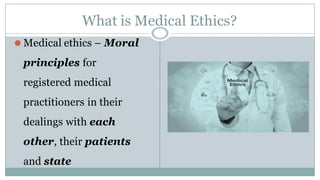
What is Medical Ethics?
⚫ Medical ethics – Moral
principles for
registered medical
practitioners in their
dealings with each
other, their patients
and state
Foundation of Medical Ethics
Terminologies
Non-maleficence
•The concept of non-maleficence is embodied by the phrase, "first, do no harm,"
or the Latin, primum non nocere.
•Many consider that should be the main or primary consideration (hence
primum): that it is more important not to harm your patient, than to do them
good, which is part of the Hippocratic oath that doctors take.
•It is not only more important to do no harm than to do good; it is also important
to know how likely it is that your treatment will harm a patient.
•In practice, however, many treatments carry some risk of harm. In some
circumstances, e.g. in desperate situations where the outcome without
treatment will be grave, risky treatments that stand a high chance of harming
the patient will be justified, as the risk of not treating is also very likely to do
harm.
Case study – AETCOM Booklet 2.5
⚫You evaluate Mrs. Lakshmi Srinivasan who is a 48
year old woman presenting with lymphadenopathy.
She had been complaining of mild fever and weight
loss for the past 4 -5 months. Examination of the
neck shows large rubbery lymph nodes that are
present also in the axilla and the groin. There is a
palpable spleen. She is accompanied by her caring
husband.
Case study contd......
⚫ Lakshmi undergoes a lymph node biopsy and the pathologist calls
you and tells you that she has a lymphoma. That evening Mr.
Srinivasan comes in first into your office and leaves the report on
your table. As you read the description you realise that the final
diagnosis has been altered to Tuberculosis by whitening out the
pathologist’s report. When you look up he tells you –“Sir, I googled
lymphoma - it is almost like a cancer. My wife can’t handle that
diagnosis. She has always been a worried frightened person. I want
you to tell my wife that she had TB. She is waiting outside, doctor. I
thought I will call her in after I had a chat about this with you”.
Discussion Q1
⚫ Does the patient have a right to know their
diagnosis?
⚫ Yes, every patient has the rightto know their diagnosis
⚫ Truthful and open communication between physician and
patient is essential for trust in the relationshipand for
respect for autonomy
⚫ Withholdingpertinentmedicalinformationfrom patients
in the belief that disclosure is medically contraindicated
creates a conflict between the physician’sobligationsto
promotepatient welfare and to respect patientautonomy
Discussion Q2
⚫What should the patient be told about their
diagnosis, therapy and prognosis?
⚫Paternalismversus Autonomy
Moving from Paternalism to Shared Decision Making
⚫ Paternalism - The physician alone makes the decision
https://org/2019/11/21/shared-decision-making-protecting-patient-autonomy-and-informed-
consent/
Discussion Q3
⚫ How much should be told to a patient about their illness?
⚫ The obligation to communicate truthfully does not mean that the
physician must communicate informationto the patient immediately
or all at once.
⚫ Information may be conveyed over time in keeping with the
patient’s preferences and ability to comprehend the
information.
⚫ Physiciansshould always communicate sensitively and
respectfully with patients.
Discussion Q4
⚫ Are there exceptions to full disclosure? Can family members
request withholding of information from patient?
⚫ Although the principle of respect for autonomy is the most
importantaspect, the principlesof beneficence and non-
maleficence have a place in evaluating truth-tellingand
nondisclosure,as in this case study
⚫ Timing of full, truthfuldisclosurecan be influencedby:
 Age & emotional state of patient
 Family’s desire for such disclosure
Practical aspects of Disclosure
Develop an understandingof the
family’s point of view
Understand the patient’s true
preferences for receiving information
Convey information overtime
considering patient’s preferences &
comprehension
Offerfulldisclosurewhen the patient is able
to decide whetherto receive the
information.
Patient Autonomy
Informed
Consent
Confidentiality
Truth
Telling
Fidelity
Autonomy As
Autonomy
•The principle of autonomy, broken down into "autos" (self) and
"nomos (rule), views the rights of an individual to self-
determination
•The increasing importance of autonomy can be seen as a social
reaction against the "paternalistic" tradition within healthcare.
•The definition of autonomy is the ability of an individual to make a
rational, uninfluenced decision.
•The progression of many terminal diseases are characterized by
loss of autonomy, in various manners and extents.
•Psychiatrists and clinical psychologists are often asked to evaluate
a patient's capacity for making life-and-death decisions at the end
of life.
•Persons with a psychiatric condition such as delirium or clinical
depression may lack capacity to make end-of-life decisions.
•Persons with the mental capacity to make end-of-life decisions
may refuse treatment with the understanding that it may shorten
their life.
•Psychiatrists and psychologists may be involved to support
decision making.
Examples
•For example, let's say that we took a blood sample from a patient who was complaining
of fatigue, and we saw very low platelets and RBCs with very high WBCs.
•This is highly suspicious of leukemia. So the physician goes back to the patient and
explains that their findings are consistent with leukemia. And then the physician
recommends that the patient do marrow biopsy to confirm the diagnosis.
•Now, legally and ethically speaking, here is where the physician's job end. They explored
the causes and discovered the diagnosis, and they provided the management options to
the patient. Now, autonomy gives the patient the full right to accept or refuse a mirror
tap.
•If the patient refuses the bone marrow biopsy, this might lead to worse complications
and even death. Now, in this case, the physician has to explain this outcome to the
patient. Now, the treating doctor has to respect the patient's decision and not judge
them or try to alter their decision.
•They can explain that it's a bad idea, but that's as far as they go. Now, autonomy can
work both ways. The treating physician can have autonomy of their own for example, if a
pregnant woman is in her third trimester and she requests serious section from the
treating physician but the treating doctor knows that this patient can deliver vaginally
with no problems and that there are no medical reasons for cesarean section.
•In this case, because the treatment is elective and optional, the physician can practice
their own autonomy and refuse providing this treatment. And here's a small quiz trying to
see whether or not the patient in this scenario was given autonomy.
Beneficence
•The term beneficence refers to actions that promote the well-
being of others. In the medical context, this means taking actions
that serve the best interests of patients and their families.
•However, uncertainty surrounds the precise definition of which
practices do in fact help patients.
•Some scholars argue that beneficence is the only fundamental
principle of medical ethics.
•They argue that healing should be the sole purpose of medicine,
and that endeavors like cosmetic surgery and euthanasia are
severely unethical and against the Hippocratic Oath.
Case study 2
⚫ You are taking care of 78-year-oldMrs.Mythili who was livingall alonein an
apartmentwithonly a live-in caretaker,3streets awayfrom your clinic.She is a
widow and her only son emigrated to the US 32 years ago. He visits her once a
year. One year ago, she had a fall with a hip fracture that healed badly. She has
hypertensionwhichis reasonablycontrolledonmedications.She continuesto
come to your clinic once a month.
⚫ Fourmonthsago, she spent sometime talkingabout her sister who recently died
following metastatic breast cancer. “My sister suffereda lot, Doctor- they put a
tube down her throatto breathe. Even when her heart stopped they kept
thumping her chest- it wasawful. If I everfall sick I don't wantto go through all
this. Promise me, doctor, that you won’t do all of this to me. I have lived all
alone since my husband died but I have lived independently-now I don't want
to dependon a machineto live”
Case contd....
⚫ One day you get a call from the Emergency Room of the local hospital
stating that Mrs. Mythili has been admitted by the caretaker. She had
developed fever and shortness of breath. She was brought hypoxic to
the emergency room and they had intubated her. Chest X ray
revealed a large pneumonicpatch. Laboratory testing revealed
hyponatremia. When you visited her she is somewhat drowsy,
intubated and restrained. The nurse tells you that she is sometimes
lucid; at other times not even able to recognise her son who was there
since this morning. She points out at the endotracheal tube and
makes a pleading gesture to remove it.
⚫ Herson accosts you in the hallway. He tells you that he got a
call while he was traveling in Singapore and took the first
flight out to be with his mom. He was very distressedat his
mother’shealth and that he wants “everything”possible
donefor her. You ask him if she had ever indicated what
she wanted to be done if she were to requirehospitalization
andintubation - he says that he used to speak to her every
month on the phone and she was always cheerful and
enquiring about her grandchildrenbut did not talk about
her health.
Ethical Concepts in this CASE
⚫Patient Autonomy
⚫Decision Making Capacity
⚫Surrogacy in Decision Making
⚫Autonomy vs Beneficience vs Non-maleficience
Supporting Mrs. Mythili’s decision which honors her own beliefs
and wishes recognizes the role of
….
Autonomy (Self- Determination)
The moral and legal right of a person with decisional capacityto
determine what will be done with their own
person.
This respectsthe rightof eachperson to make decisionsregarding their
own body and course of life.
However.................
Is she competent to make decisions?
⚫ What determines decision making capacity & competency?
“Testing” decision making capacity
⚫ Abilityto communicate
⚫ Ability to understand treatment options
⚫ Abilityto grasp consequences of accepting or declining
therapy
⚫ Abilityto reason
In this case, the patient is incapacitated: Unable to understand the benefits,
risks, alternatives totreatment
Who can decide??
⚫ SurrogateDecision Makers: Individual with authority to consentto
medical treatment for an incapacitated patient
⚫ Who can be legal surrogate-decision-makers?
• Spouse
• Adult child with Power of Attorney or majority of adult children
• Parents (In case of minors)
• In Parents Absence – (Grandparent, Adult sibling, Adult aunt/uncle
Educational institution with written authorization, Court with jurisdiction
• Nearest living relative
• Patient’s clergy
What if the Surrogate decision maker opts for ‘Do not
Resuscitate’?
⚫ The Conflicts: Autonomy vs Beneficience vs Non- maleficience
Initiation of life-saving measures
may be indicated (beneficence) if
there is uncertaintyabout the
outcomes of therapyand how
much benefit there will be for the
patient
Withdrawalof life-sustaining
therapies (non-maleficence) may
be appropriate whenthey are no
longerbeneficialor desirable for
the patient and produce negative
outcomes
Rule of Thumb
⚫Rightness or wrongness of an action depends on the
merits of the justification underlying the action, not the
action itself.
⚫Every situation needs to be evaluated in its own context,
so that patients, families and caregivers can achieve comfort
and trust in the final decisions.
aetcom-bioethics.pptx

aetcom-bioethics.pptx

  • 1.
    Case Studies OnNon-Maleficence and Autonomy Ashish Saket – 20021 Altaf Khan – 20007 Attitude Ethics & Communication AETCOM - Bioethics
  • 2.
    Bioethics – Origin& Significance ⚫ Bioethics is a philosophical disciplineencompassing social, legal, cultural, epidemiological,and ethicalissues arising due to advance in healthcare and life science research Dates back to the Nuremberg Doctor’s Trial – Nazi Regimen
  • 3.
    •The term medicalethics first dates back to 1803, when English author and physician Thomas Percival published a document describing the requirements and expectations of medical professionals within medical facilities. •Historically, Western medical ethics may be traced to guidelines on the duty of physicians in antiquity, such as the Hippocratic Oath, and early Christian teachings. •In the medieval and early modern period, the field is indebted to Islamic scholarship such as Ishaq ibn Ali al-Ruhawi (who wrote the Conduct of a Physician, the first book dedicated to medical ethics), Avicenna's Canon of Medicine and Muhammad ibn Zakariya arRazi (known as Rhazes in the West), Jewish thinkers such as Maimonides, Roman Catholic scholastic thinkers such as Thomas Aquinas, and the case-oriented analysis (casuistry) of Catholic moral theology. •These intellectual traditions continue in Catholic, Islamic and Jewish medical ethics.
  • 4.
    What is MedicalEthics? ⚫ Medical ethics – Moral principles for registered medical practitioners in their dealings with each other, their patients and state
  • 5.
  • 6.
  • 7.
    Non-maleficence •The concept ofnon-maleficence is embodied by the phrase, "first, do no harm," or the Latin, primum non nocere. •Many consider that should be the main or primary consideration (hence primum): that it is more important not to harm your patient, than to do them good, which is part of the Hippocratic oath that doctors take. •It is not only more important to do no harm than to do good; it is also important to know how likely it is that your treatment will harm a patient. •In practice, however, many treatments carry some risk of harm. In some circumstances, e.g. in desperate situations where the outcome without treatment will be grave, risky treatments that stand a high chance of harming the patient will be justified, as the risk of not treating is also very likely to do harm.
  • 8.
    Case study –AETCOM Booklet 2.5 ⚫You evaluate Mrs. Lakshmi Srinivasan who is a 48 year old woman presenting with lymphadenopathy. She had been complaining of mild fever and weight loss for the past 4 -5 months. Examination of the neck shows large rubbery lymph nodes that are present also in the axilla and the groin. There is a palpable spleen. She is accompanied by her caring husband.
  • 9.
    Case study contd...... ⚫Lakshmi undergoes a lymph node biopsy and the pathologist calls you and tells you that she has a lymphoma. That evening Mr. Srinivasan comes in first into your office and leaves the report on your table. As you read the description you realise that the final diagnosis has been altered to Tuberculosis by whitening out the pathologist’s report. When you look up he tells you –“Sir, I googled lymphoma - it is almost like a cancer. My wife can’t handle that diagnosis. She has always been a worried frightened person. I want you to tell my wife that she had TB. She is waiting outside, doctor. I thought I will call her in after I had a chat about this with you”.
  • 10.
    Discussion Q1 ⚫ Doesthe patient have a right to know their diagnosis? ⚫ Yes, every patient has the rightto know their diagnosis ⚫ Truthful and open communication between physician and patient is essential for trust in the relationshipand for respect for autonomy ⚫ Withholdingpertinentmedicalinformationfrom patients in the belief that disclosure is medically contraindicated creates a conflict between the physician’sobligationsto promotepatient welfare and to respect patientautonomy
  • 11.
    Discussion Q2 ⚫What shouldthe patient be told about their diagnosis, therapy and prognosis? ⚫Paternalismversus Autonomy
  • 12.
    Moving from Paternalismto Shared Decision Making ⚫ Paternalism - The physician alone makes the decision https://org/2019/11/21/shared-decision-making-protecting-patient-autonomy-and-informed- consent/
  • 13.
    Discussion Q3 ⚫ Howmuch should be told to a patient about their illness? ⚫ The obligation to communicate truthfully does not mean that the physician must communicate informationto the patient immediately or all at once. ⚫ Information may be conveyed over time in keeping with the patient’s preferences and ability to comprehend the information. ⚫ Physiciansshould always communicate sensitively and respectfully with patients.
  • 14.
    Discussion Q4 ⚫ Arethere exceptions to full disclosure? Can family members request withholding of information from patient? ⚫ Although the principle of respect for autonomy is the most importantaspect, the principlesof beneficence and non- maleficence have a place in evaluating truth-tellingand nondisclosure,as in this case study ⚫ Timing of full, truthfuldisclosurecan be influencedby:  Age & emotional state of patient  Family’s desire for such disclosure
  • 15.
    Practical aspects ofDisclosure Develop an understandingof the family’s point of view Understand the patient’s true preferences for receiving information Convey information overtime considering patient’s preferences & comprehension Offerfulldisclosurewhen the patient is able to decide whetherto receive the information.
  • 16.
  • 17.
    Autonomy •The principle ofautonomy, broken down into "autos" (self) and "nomos (rule), views the rights of an individual to self- determination •The increasing importance of autonomy can be seen as a social reaction against the "paternalistic" tradition within healthcare. •The definition of autonomy is the ability of an individual to make a rational, uninfluenced decision. •The progression of many terminal diseases are characterized by loss of autonomy, in various manners and extents.
  • 18.
    •Psychiatrists and clinicalpsychologists are often asked to evaluate a patient's capacity for making life-and-death decisions at the end of life. •Persons with a psychiatric condition such as delirium or clinical depression may lack capacity to make end-of-life decisions. •Persons with the mental capacity to make end-of-life decisions may refuse treatment with the understanding that it may shorten their life. •Psychiatrists and psychologists may be involved to support decision making.
  • 19.
    Examples •For example, let'ssay that we took a blood sample from a patient who was complaining of fatigue, and we saw very low platelets and RBCs with very high WBCs. •This is highly suspicious of leukemia. So the physician goes back to the patient and explains that their findings are consistent with leukemia. And then the physician recommends that the patient do marrow biopsy to confirm the diagnosis. •Now, legally and ethically speaking, here is where the physician's job end. They explored the causes and discovered the diagnosis, and they provided the management options to the patient. Now, autonomy gives the patient the full right to accept or refuse a mirror tap. •If the patient refuses the bone marrow biopsy, this might lead to worse complications and even death. Now, in this case, the physician has to explain this outcome to the patient. Now, the treating doctor has to respect the patient's decision and not judge them or try to alter their decision.
  • 20.
    •They can explainthat it's a bad idea, but that's as far as they go. Now, autonomy can work both ways. The treating physician can have autonomy of their own for example, if a pregnant woman is in her third trimester and she requests serious section from the treating physician but the treating doctor knows that this patient can deliver vaginally with no problems and that there are no medical reasons for cesarean section. •In this case, because the treatment is elective and optional, the physician can practice their own autonomy and refuse providing this treatment. And here's a small quiz trying to see whether or not the patient in this scenario was given autonomy.
  • 21.
    Beneficence •The term beneficencerefers to actions that promote the well- being of others. In the medical context, this means taking actions that serve the best interests of patients and their families. •However, uncertainty surrounds the precise definition of which practices do in fact help patients. •Some scholars argue that beneficence is the only fundamental principle of medical ethics. •They argue that healing should be the sole purpose of medicine, and that endeavors like cosmetic surgery and euthanasia are severely unethical and against the Hippocratic Oath.
  • 22.
    Case study 2 ⚫You are taking care of 78-year-oldMrs.Mythili who was livingall alonein an apartmentwithonly a live-in caretaker,3streets awayfrom your clinic.She is a widow and her only son emigrated to the US 32 years ago. He visits her once a year. One year ago, she had a fall with a hip fracture that healed badly. She has hypertensionwhichis reasonablycontrolledonmedications.She continuesto come to your clinic once a month. ⚫ Fourmonthsago, she spent sometime talkingabout her sister who recently died following metastatic breast cancer. “My sister suffereda lot, Doctor- they put a tube down her throatto breathe. Even when her heart stopped they kept thumping her chest- it wasawful. If I everfall sick I don't wantto go through all this. Promise me, doctor, that you won’t do all of this to me. I have lived all alone since my husband died but I have lived independently-now I don't want to dependon a machineto live”
  • 23.
    Case contd.... ⚫ Oneday you get a call from the Emergency Room of the local hospital stating that Mrs. Mythili has been admitted by the caretaker. She had developed fever and shortness of breath. She was brought hypoxic to the emergency room and they had intubated her. Chest X ray revealed a large pneumonicpatch. Laboratory testing revealed hyponatremia. When you visited her she is somewhat drowsy, intubated and restrained. The nurse tells you that she is sometimes lucid; at other times not even able to recognise her son who was there since this morning. She points out at the endotracheal tube and makes a pleading gesture to remove it.
  • 24.
    ⚫ Herson accostsyou in the hallway. He tells you that he got a call while he was traveling in Singapore and took the first flight out to be with his mom. He was very distressedat his mother’shealth and that he wants “everything”possible donefor her. You ask him if she had ever indicated what she wanted to be done if she were to requirehospitalization andintubation - he says that he used to speak to her every month on the phone and she was always cheerful and enquiring about her grandchildrenbut did not talk about her health.
  • 25.
    Ethical Concepts inthis CASE ⚫Patient Autonomy ⚫Decision Making Capacity ⚫Surrogacy in Decision Making ⚫Autonomy vs Beneficience vs Non-maleficience
  • 26.
    Supporting Mrs. Mythili’sdecision which honors her own beliefs and wishes recognizes the role of …. Autonomy (Self- Determination) The moral and legal right of a person with decisional capacityto determine what will be done with their own person. This respectsthe rightof eachperson to make decisionsregarding their own body and course of life. However.................
  • 27.
    Is she competentto make decisions? ⚫ What determines decision making capacity & competency? “Testing” decision making capacity ⚫ Abilityto communicate ⚫ Ability to understand treatment options ⚫ Abilityto grasp consequences of accepting or declining therapy ⚫ Abilityto reason In this case, the patient is incapacitated: Unable to understand the benefits, risks, alternatives totreatment
  • 28.
    Who can decide?? ⚫SurrogateDecision Makers: Individual with authority to consentto medical treatment for an incapacitated patient ⚫ Who can be legal surrogate-decision-makers? • Spouse • Adult child with Power of Attorney or majority of adult children • Parents (In case of minors) • In Parents Absence – (Grandparent, Adult sibling, Adult aunt/uncle Educational institution with written authorization, Court with jurisdiction • Nearest living relative • Patient’s clergy
  • 29.
    What if theSurrogate decision maker opts for ‘Do not Resuscitate’? ⚫ The Conflicts: Autonomy vs Beneficience vs Non- maleficience Initiation of life-saving measures may be indicated (beneficence) if there is uncertaintyabout the outcomes of therapyand how much benefit there will be for the patient Withdrawalof life-sustaining therapies (non-maleficence) may be appropriate whenthey are no longerbeneficialor desirable for the patient and produce negative outcomes
  • 30.
    Rule of Thumb ⚫Rightnessor wrongness of an action depends on the merits of the justification underlying the action, not the action itself. ⚫Every situation needs to be evaluated in its own context, so that patients, families and caregivers can achieve comfort and trust in the final decisions.