













CONFIDENTIAL
Presented by: Leslie Lawerence
PRINCE2 Agile Practitioner, PRINCE2 Practitioner
© Copyright AXELOS Limited 2018. PRINCE2 Agile® is a registered trade mark of AXELOS Limited. All rights reserved.
CONFIDENTIAL
WELCOME “At its root, Scrum is based on a simple idea:
whenever you start a project, why not regularly
check in, see if what you’re doing is heading in
the right direction, and if it’s actually what
people want? And question whether there are
any ways to improve how you’re doing what
you’re doing, any ways of doing it better and
faster, and what might be keeping you from
doing that.” – Jeff Sutherland
“When preparing for battle I find that plans are
useless but planning is inevitable.” – Dwight D.
Eisenhower
INTERNAL
HOW TO USE PRINCE2® WITH
AGILE WAYS OF WORKING
FOUNDATION AND PRACTITIONER
CERTIFICATION: PART ONE
TRAINING COURSE
INTERNAL
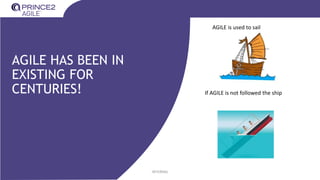
AGILE HAS BEEN IN
EXISTING FOR
CENTURIES! If AGILE is not followed the ship
AGILE is used to sail
ABOUT YOU
1. Name (and department)
2. Role(what you do)
3. Experience of PRINCE2
4. Experience of agile
5. Your objective for this course
CONFIDENTIAL
ABOUT THE PRINCE2 AGILE MANUAL
•Update due to be published mid-2018
•Aligned to the PRINCE2 2017 manual
•Early chapters:
• Basic understandings and drivers for PRINCE2 Agile
•Middle chapters:
• Discussion and description of the principles, themes, processes and management products
• What you may find
• What to do
•Final chapters:
• Focus areas: where PRINCE2 needs more detailed guidance in an agile context
• Appendices
CONFIDENTIAL
FOUNDATION EXAM STRUCTURE
•1 hour exam
•Closed book
•50 questions, each worth 1 mark
•Pass mark is 28 out of 50, or 55%
•Question types
•Standard
•Negative
•List
CONFIDENTIAL
PRACTITIONER EXAM STRUCTURE
•2.5 hour exam
•Open book: PRINCE2 Agile manual only
•Objective Testing Exam
•50 questions, each worth 1 mark
•Pass mark is 60% (30 marks out of 50)
CONFIDENTIAL
CONFIDENTIAL
PRINCE2 AGILE
MANUAL PART 1
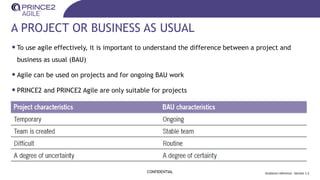
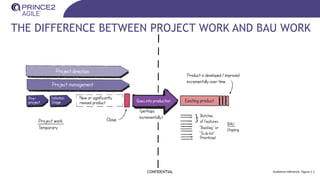
A PROJECT OR BUSINESS AS USUAL
•To use agile effectively, it is important to understand the difference between a project and
business as usual (BAU)
•Agile can be used on projects and for ongoing BAU work
•PRINCE2 and PRINCE2 Agile are only suitable for projects
CONFIDENTIAL Guidance reference : Section 1.2
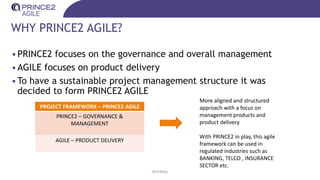
WHY PRINCE2 AGILE?
•PRINCE2 focuses on the governance and overall management
•AGILE focuses on product delivery
•To have a sustainable project management structure it was
decided to form PRINCE2 AGILE
INTERNAL
PROJECT FRAMEWORK – PRINCE2 AGILE
PRINCE2 – GOVERNANCE &
MANAGEMENT
AGILE – PRODUCT DELIVERY
More aligned and structured
approach with a focus on
management products and
product delivery
With PRINCE2 in play, this agile
framework can be used in
regulated industries such as
BANKING, TELCO , INSURANCE
SECTOR etc.
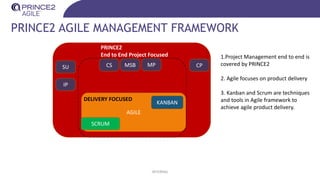
PRINCE2 AGILE MANAGEMENT FRAMEWORK
INTERNAL
AGILE
SCRUM
KANBAN
DELIVERY FOCUSED
PRINCE2
End to End Project Focused 1.Project Management end to end is
covered by PRINCE2
2. Agile focuses on product delivery
3. Kanban and Scrum are techniques
and tools in Agile framework to
achieve agile product delivery.
SU
IP
CS MSB CP
MP
THE DIFFERENCE BETWEEN PROJECT WORK AND BAU WORK
CONFIDENTIAL Guidance reference: Figure 1.1
CONFIDENTIAL
AN OVERVIEW
OF PRINCE2
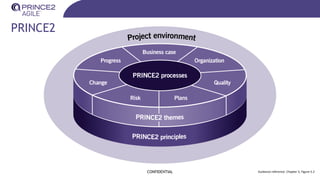
PRINCE2
CONFIDENTIAL Guidance reference: Chapter 5, Figure 5.2
PRINCE2 PRINCIPLES
The guiding principles that a PRINCE2 project should follow are:
• Continued business justification
• Learn from experience
• Defined roles and responsibilities
• Manage by stages
• Manage by exception
• Focus on products
• Tailor to suit the project
CONFIDENTIAL
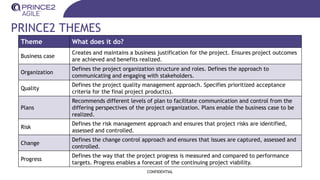
PRINCE2 THEMES
CONFIDENTIAL
Theme What does it do?
Business case
Creates and maintains a business justification for the project. Ensures project outcomes
are achieved and benefits realized.
Organization
Defines the project organization structure and roles. Defines the approach to
communicating and engaging with stakeholders.
Quality
Defines the project quality management approach. Specifies prioritized acceptance
criteria for the final project product(s).
Plans
Recommends different levels of plan to facilitate communication and control from the
differing perspectives of the project organization. Plans enable the business case to be
realized.
Risk
Defines the risk management approach and ensures that project risks are identified,
assessed and controlled.
Change
Defines the change control approach and ensures that issues are captured, assessed and
controlled.
Progress
Defines the way that the project progress is measured and compared to performance
targets. Progress enables a forecast of the continuing project viability.
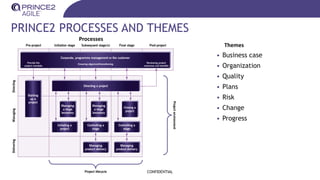
PRINCE2 PROCESSES AND THEMES
• Business case
• Organization
• Quality
• Plans
• Risk
• Change
• Progress
CONFIDENTIAL
Themes
Processes
PRINCE2 MANAGEMENT PRODUCTS
• There are 26 management products that support the PRINCE2 method.
All of them can and should be tailored.
• The following are key to successfully tailoring PRINCE2:
• Business case
• Checkpoint report
• Highlight report
• Project brief
• Project initiation documentation
• Project product description
• Work package
CONFIDENTIAL
Understanding the purpose of the above products is
vital.
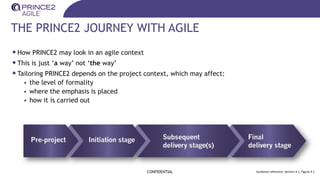
THE PRINCE2 JOURNEY WITH AGILE
•How PRINCE2 may look in an agile context
•This is just ‘a way’ not ‘the way’
•Tailoring PRINCE2 depends on the project context, which may affect:
• the level of formality
• where the emphasis is placed
• how it is carried out
CONFIDENTIAL Guidance reference: Section 4.1, Figure 4.1
CONFIDENTIAL
AN
INTRODUCTION
TO AGILE
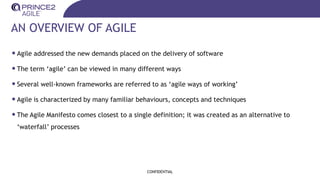
AN OVERVIEW OF AGILE
•Agile addressed the new demands placed on the delivery of software
•The term ‘agile’ can be viewed in many different ways
•Several well-known frameworks are referred to as ‘agile ways of working’
•Agile is characterized by many familiar behaviours, concepts and techniques
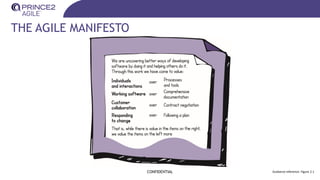
•The Agile Manifesto comes closest to a single definition; it was created as an alternative to
‘waterfall’ processes
CONFIDENTIAL
THE AGILE MANIFESTO
CONFIDENTIAL Guidance reference: Figure 2.1
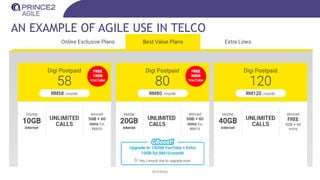
AN EXAMPLE OF AGILE USE IN TELCO
INTERNAL
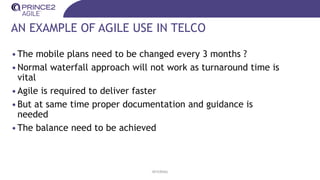
AN EXAMPLE OF AGILE USE IN TELCO
•The mobile plans need to be changed every 3 months ?
•Normal waterfall approach will not work as turnaround time is
vital
•Agile is required to deliver faster
•But at same time proper documentation and guidance is
needed
•The balance need to be achieved
INTERNAL
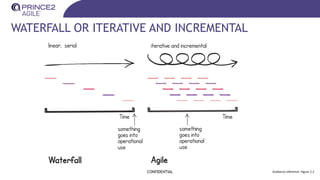
WATERFALL OR ITERATIVE AND INCREMENTAL
CONFIDENTIAL Guidance reference: Figure 2.2
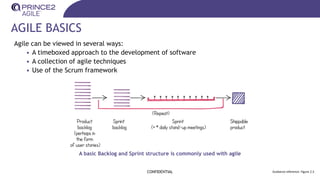
AGILE BASICS
CONFIDENTIAL Guidance reference: Figure 2.3
Agile can be viewed in several ways:
• A timeboxed approach to the development of software
• A collection of agile techniques
• Use of the Scrum framework
A basic Backlog and Sprint structure is commonly used with agile
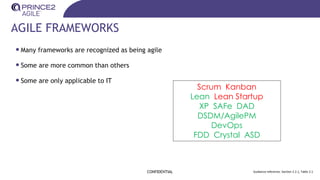
AGILE FRAMEWORKS
•Many frameworks are recognized as being agile
•Some are more common than others
•Some are only applicable to IT
CONFIDENTIAL Guidance reference: Section 2.2.1, Table 2.1
Scrum Kanban
Lean Lean Startup
XP SAFe DAD
DSDM/AgilePM
DevOps
FDD Crystal ASD
THE PRINCE2 AGILE VIEW
CONFIDENTIAL Guidance reference: Section 2.2.1
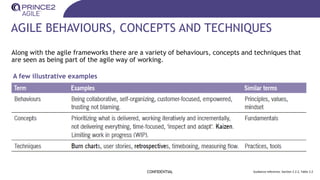
AGILE BEHAVIOURS, CONCEPTS AND TECHNIQUES
Along with the agile frameworks there are a variety of behaviours, concepts and techniques that
are seen as being part of the agile way of working.
CONFIDENTIAL Guidance reference: Section 2.2.2, Table 2.2
A few illustrative examples
CONFIDENTIAL
BLENDING
PRINCE2
AND AGILE
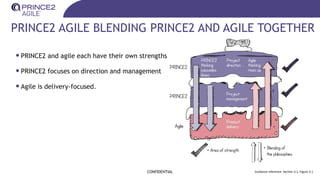
PRINCE2 AGILE BLENDING PRINCE2 AND AGILE TOGETHER
CONFIDENTIAL Guidance reference: Section 3.1, Figure 3.1
•PRINCE2 and agile each have their own strengths
•PRINCE2 focuses on direction and management
•Agile is delivery-focused.
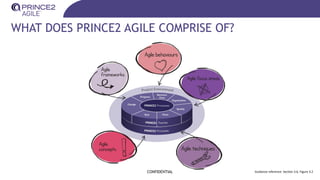
WHAT DOES PRINCE2 AGILE COMPRISE OF?
CONFIDENTIAL Guidance reference: Section 3.6, Figure 3.2
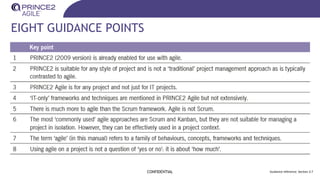
EIGHT GUIDANCE POINTS
CONFIDENTIAL Guidance reference: Section 3.7
BEWARE OF PREJUDICE!
CONFIDENTIAL Guidance reference: Section 3.8
Control and governance allows agile to be
used in complex environments
CONFIDENTIAL
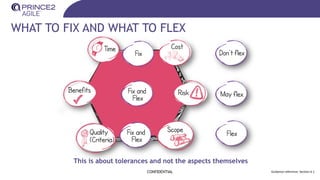
WHAT TO FIX
AND WHAT
TO FLEX
Fix = Cannot reduce or
change. Must be addressed
Flex = Can change a bit
EXERCISE #1 CASE STUDY
•List down the six factors that will impact your project
•Why it impacts the project
•Which cannot be changed. Which can be adjusted ?
INTERNAL
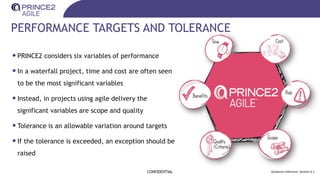
PERFORMANCE TARGETS AND TOLERANCE
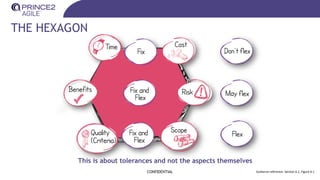
•PRINCE2 considers six variables of performance
•In a waterfall project, time and cost are often seen
to be the most significant variables
•Instead, in projects using agile delivery the
significant variables are scope and quality
•Tolerance is an allowable variation around targets
•If the tolerance is exceeded, an exception should be
raised
CONFIDENTIAL Guidance reference: Section 6.1
THE HEXAGON
CONFIDENTIAL Guidance reference: Section 6.1, Figure 6.1
This is about tolerances and not the aspects themselves
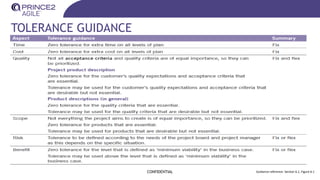
TOLERANCE GUIDANCE
CONFIDENTIAL Guidance reference: Section 6.1, Figure 6.1
THE FIVE TARGETS
•It is essential to understand why?
•The five targets represent the rationale behind the hexagon
• Be on time and hit deadlines
• Protect the level of quality
• Embrace change
• Keep teams stable
• Accept that the customer doesn’t need everything
CONFIDENTIAL Guidance reference: Section 6.4, Table 6.2
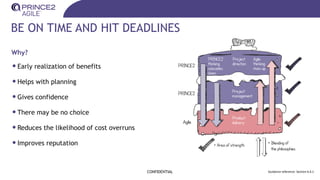
BE ON TIME AND HIT DEADLINES
Why?
•Early realization of benefits
•Helps with planning
•Gives confidence
•There may be no choice
•Reduces the likelihood of cost overruns
•Improves reputation
CONFIDENTIAL Guidance reference: Section 6.4.1
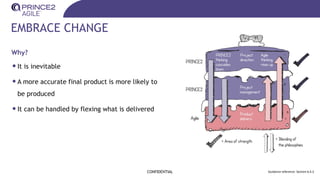
EMBRACE CHANGE
Why?
•It is inevitable
•A more accurate final product is more likely to
be produced
•It can be handled by flexing what is delivered
CONFIDENTIAL Guidance reference: Section 6.4.3
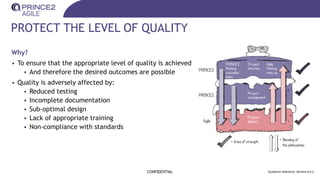
PROTECT THE LEVEL OF QUALITY
Why?
• To ensure that the appropriate level of quality is achieved
• And therefore the desired outcomes are possible
• Quality is adversely affected by:
• Reduced testing
• Incomplete documentation
• Sub-optimal design
• Lack of appropriate training
• Non-compliance with standards
CONFIDENTIAL Guidance reference: Section 6.4.2
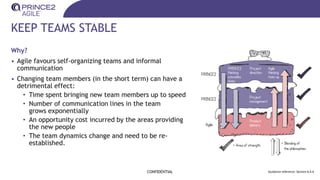
KEEP TEAMS STABLE
Why?
• Agile favours self-organizing teams and informal
communication
• Changing team members (in the short term) can have a
detrimental effect:
• Time spent bringing new team members up to speed
• Number of communication lines in the team
grows exponentially
• An opportunity cost incurred by the areas providing
the new people
• The team dynamics change and need to be re-
established.
CONFIDENTIAL Guidance reference: Section 6.4.4
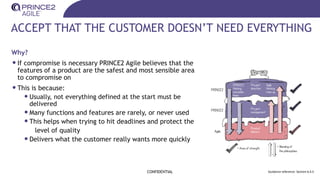
ACCEPT THAT THE CUSTOMER DOESN’T NEED EVERYTHING
Why?
•If compromise is necessary PRINCE2 Agile believes that the
features of a product are the safest and most sensible area
to compromise on
•This is because:
•Usually, not everything defined at the start must be
delivered
•Many functions and features are rarely, or never used
•This helps when trying to hit deadlines and protect the
level of quality
•Delivers what the customer really wants more quickly
CONFIDENTIAL Guidance reference: Section 6.4.5
CONFIDENTIAL
PRINCE2
AGILE MANUAL
PART 2
CONFIDENTIAL
AGILE
BEHAVIOURS
AND THE
PRINCE2
PRINCIPLES
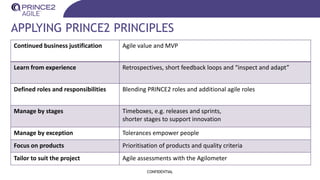
APPLYING PRINCE2 PRINCIPLES
CONFIDENTIAL
Continued business justification Agile value and MVP
Learn from experience Retrospectives, short feedback loops and “inspect and adapt”
Defined roles and responsibilities Blending PRINCE2 roles and additional agile roles
Manage by stages Timeboxes, e.g. releases and sprints,
shorter stages to support innovation
Manage by exception Tolerances empower people
Focus on products Prioritisation of products and quality criteria
Tailor to suit the project Agile assessments with the Agilometer
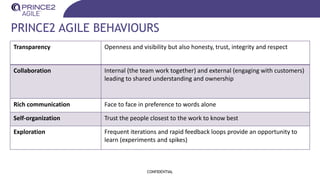
PRINCE2 AGILE BEHAVIOURS
CONFIDENTIAL
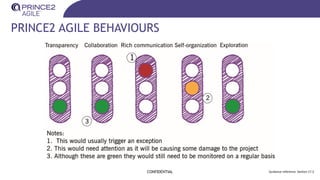
Transparency Openness and visibility but also honesty, trust, integrity and respect
Collaboration Internal (the team work together) and external (engaging with customers)
leading to shared understanding and ownership
Rich communication Face to face in preference to words alone
Self-organization Trust the people closest to the work to know best
Exploration Frequent iterations and rapid feedback loops provide an opportunity to
learn (experiments and spikes)
CONFIDENTIAL
AGILE AND
THE PRINCE2
THEMES
TAILORING THE BUSINESS CASE THEME
• No changes required
• More info on tolerances around benefits
• Best case, worst case, expected case
• Linking amount of product to benefit accrued
• Explicit definition of what constitutes the minimum viable product (MVP)
• Implications of incremental delivery
• Early benefit and early costs
• Where there is high uncertainty develop the business case quickly
• Plan to test assumptions quickly
CONFIDENTIAL
TAILORING THE ORGANIZATION THEME
• No changes required but additional delivery roles may be needed
• Consideration needs to be given to:
• The team manager role
• How it might be integrated into the delivery team
• Common agile roles
• E.g. product owner, scrum master, agile coach, business ambassador
• The senior user role
• Acting as a super product owner
• The scrum master
• Liaison with the project manager
• Management by exception to enable self-organization
CONFIDENTIAL
INTERNAL
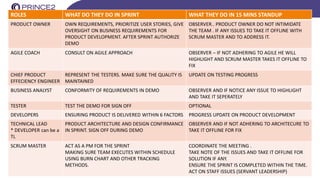
ROLES WHAT DO THEY DO IN SPRINT WHAT THEY DO IN 15 MINS STANDUP
PRODUCT OWNER OWN REQUIREMENTS, PRIORITIZE USER STORIES, GIVE
OVERSIGHT ON BUSINESS REQUIREMENTS FOR
PRODUCT DEVELOPMENT. AFTER SPRINT AUTHORIZE
DEMO
OBSERVER.. PRODUCT OWNER DO NOT INTIMIDATE
THE TEAM . IF ANY ISSUES TO TAKE IT OFFLINE WITH
SCRUM MASTER AND TO ADDRESS IT.
AGILE COACH CONSULT ON AGILE APPROACH OBSERVER – IF NOT ADHERING TO AGILE HE WILL
HIGHLIGHT AND SCRUM MASTER TAKES IT OFFLINE TO
FIX
CHIEF PRODUCT
EFFECIENCY ENGINEER
REPRESENT THE TESTERS. MAKE SURE THE QUALITY IS
MAINTAINED
UPDATE ON TESTING PROGRESS
BUSINESS ANALYST CONFORMITY OF REQUIREMENTS IN DEMO OBSERVER AND IF NOTICE ANY ISSUE TO HIGHLIGHT
AND TAKE IT SEPERATELY
TESTER TEST THE DEMO FOR SIGN OFF OPTIONAL
DEVELOPERS ENSURING PRODUCT IS DELIVERED WITHIN 6 FACTORS PROGRESS UPDATE ON PRODUCT DEVELOPMENT
TECHNICAL LEAD
* DEVELOPER can be a
TL
PRODUCT ARCHITECTURE AND DESIGN CONFIRMANCE
IN SPRINT. SIGN OFF DURING DEMO
OBSERVER AND IF NOT ADHERING TO ARCHITECURE TO
TAKE IT OFFLINE FOR FIX
SCRUM MASTER ACT AS A PM FOR THE SPRINT
MAKING SURE TEAM EXECUTES WITHIN SCHEDULE
USING BURN CHART AND OTHER TRACKING
METHODS.
COORDINATE THE MEETING .
TAKE NOTE OF THE ISSUES AND TAKE IT OFFLINE FOR
SOLUTION IF ANY.
ENSURE THE SPRINT IS COMPLETED WITHIN THE TIME.
ACT ON STAFF ISSUES (SERVANT LEADERSHIP)
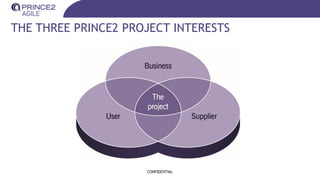
THE THREE PRINCE2 PROJECT INTERESTS
CONFIDENTIAL
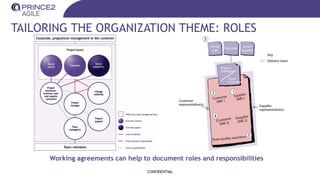
TAILORING THE ORGANIZATION THEME: ROLES
Working agreements can help to document roles and responsibilities
CONFIDENTIAL
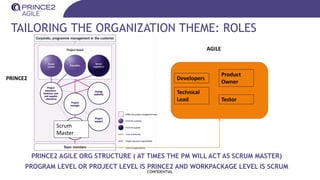
TAILORING THE ORGANIZATION THEME: ROLES
PRINCE2 AGILE ORG STRUCTURE ( AT TIMES THE PM WILL ACT AS SCRUM MASTER)
PROGRAM LEVEL OR PROJECT LEVEL IS PRINCE2 AND WORKPACKAGE LEVEL IS SCRUM
CONFIDENTIAL
Testor
Scrum
Master
Technical
Lead
Developers
Product
Owner
AGILE
PRINCE2
TAILORING THE QUALITY THEME
• Ensure that stakeholders appreciate the difference between scope and quality
• a reduction in scope is not a reduction in quality
• Protect the fitness of purpose of products by:
• prioritising acceptance criteria and quality criteria
• defining quality tolerances
• differentiating between functional and non functional requirements
• Use agile concepts to help clarify quality criteria
• Definitions of Ready and Done
• Consider the frequency of quality checking its the impact on the way the project is planned
and run
CONFIDENTIAL
TAILORING THE PLANS THEME
• No changes required but many agile techniques and approaches exist in this area
• Often informal and low tech e.g. sprint planning, simple list of backlog
• Agile typically looks at how much (or how much value) can be delivered in a fixed timeframe
• Releases, sprints, burn charts
• Gantt charts and formal milestones which demonstrate the duration a specific volume of work
will take or may be useful when working with higher levels of plan
• Synchronise high level plans and low level backlogs
CONFIDENTIAL
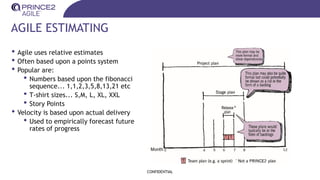
AGILE ESTIMATING
• Agile uses relative estimates
• Often based upon a points system
• Popular are:
• Numbers based upon the fibonacci
sequence... 1,1,2,3,5,8,13,21 etc
• T-shirt sizes... S,M, L, XL, XXL
• Story Points
• Velocity is based upon actual delivery
• Used to empirically forecast future
rates of progress
CONFIDENTIAL
TAILORING THE RISK THEME
• Agile techniques addresses many of the familiar project risks
• Avoiding too much detail at the start, daily stand-ups, frequent delivery of product,
frequent demos, customer interaction and self-managed teams
• However, agile working has its own set of potential risks
• e.g. the challenges of continual customer engagement
• Processes that support risk management do not need to be bureaucratic
• The level of formality should be appropriate to the needs of the project
• e.g. a few columns on the team board vs an electronic risk register
CONFIDENTIAL
TAILORING THE CHANGE THEME
• Both PRINCE2 and agile see change as inevitable
• The combination of both views
• control significant change
• the level where the project was justified
• enable responsive change at the detail level
• the level where change improves the quality and usability product
• Product descriptions (quality criteria and tolerance) and work packages need to enable
• clear baselines that can be managed formally (escalated to the project board or to a
change authority)
• detail level change within defined tolerances that can be managed by the team
dynamically
CONFIDENTIAL
TAILORING THE PROGRESS THEME
• No changes required but many agile techniques and approaches exist in this area
• Agile focus on tracking what is delivered, e.g. velocity, lead times or value
• Tolerances would be set to support this (scope and quality)
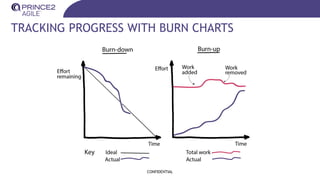
• Within the... sprint burn down and burn up charts
• Across releases... demonstrating value accrued
• Progress is tracked at all levels of the project
• Agile techniques and PRINCE2 processes both have value
CONFIDENTIAL
TRACKING PROGRESS WITH BURN CHARTS
CONFIDENTIAL
CONFIDENTIAL
AGILE
AND THE
PRINCE2
PROCESSES
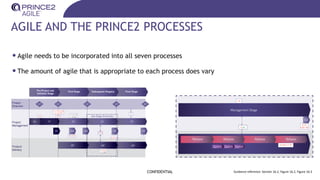
AGILE AND THE PRINCE2 PROCESSES
•Agile needs to be incorporated into all seven processes
•The amount of agile that is appropriate to each process does vary
CONFIDENTIAL Guidance reference: Section 16.2, Figure 16.2, Figure 16.3
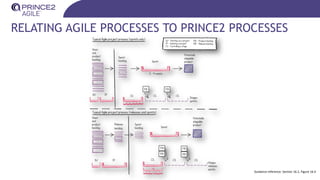
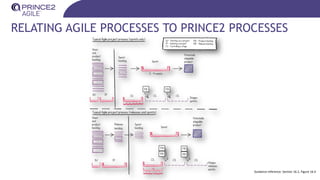
RELATING AGILE PROCESSES TO PRINCE2 PROCESSES
Guidance reference: Section 16.2, Figure 16.4
TAILORING STARTING UP A PROJECT AND INITIATING A PROJECT
• Viable and worthwhile / Solid foundations to understand the work
• Define things at the right level
• Project Product Description (Outputs, Outcomes)
• Business case (Best / worst amount of product and Benefits)
• High level requirements (epics)
• Define things in the right way
• To enable agile to work easier, e.g. outcome focussed
• Set the project up in an appropriate manner
• Integrating with agile teams, e.g. role names
• Impact of frequent releases of products to enable and provide benefits
CONFIDENTIAL
STARTING UP A PROJECT
AND INITIATING A PROJECT
PROCESSES CONT.
CONFIDENTIAL
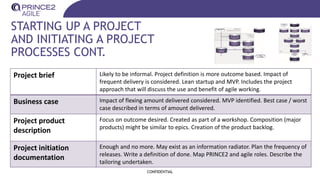
Project brief Likely to be informal. Project definition is more outcome based. Impact of
frequent delivery is considered. Lean startup and MVP. Includes the project
approach that will discuss the use and benefit of agile working.
Business case Impact of flexing amount delivered considered. MVP identified. Best case / worst
case described in terms of amount delivered.
Project product
description
Focus on outcome desired. Created as part of a workshop. Composition (major
products) might be similar to epics. Creation of the product backlog.
Project initiation
documentation
Enough and no more. May exist as an information radiator. Plan the frequency of
releases. Write a definition of done. Map PRINCE2 and agile roles. Describe the
tailoring undertaken.
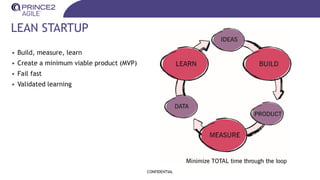
LEAN STARTUP
• Build, measure, learn
• Create a minimum viable product (MVP)
• Fail fast
• Validated learning
CONFIDENTIAL
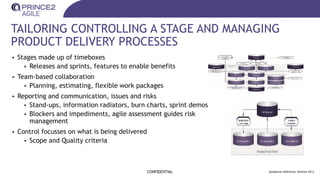
TAILORING CONTROLLING A STAGE AND MANAGING
PRODUCT DELIVERY PROCESSES
• Stages made up of timeboxes
• Releases and sprints, features to enable benefits
• Team-based collaboration
• Planning, estimating, flexible work packages
• Reporting and communication, issues and risks
• Stand-ups, information radiators, burn charts, sprint demos
• Blockers and impediments, agile assessment guides risk
management
• Control focusses on what is being delivered
• Scope and Quality criteria
CONFIDENTIAL Guidance reference: Section 20.3
CONTROLLING A STAGE AND MANAGING
PRODUCT DELIVERY PROCESSES CONT.
CONFIDENTIAL
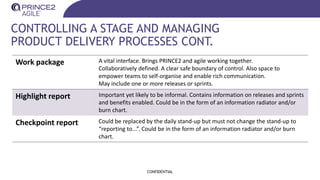
Work package A vital interface. Brings PRINCE2 and agile working together.
Collaboratively defined. A clear safe boundary of control. Also space to
empower teams to self-organise and enable rich communication.
May include one or more releases or sprints.
Highlight report Important yet likely to be informal. Contains information on releases and sprints
and benefits enabled. Could be in the form of an information radiator and/or
burn chart.
Checkpoint report Could be replaced by the daily stand-up but must not change the stand-up to
“reporting to...”. Could be in the form of an information radiator and/or burn
chart.
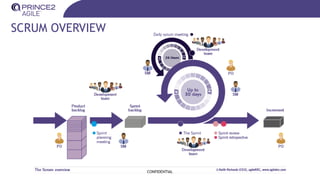
SCRUM OVERVIEW
CONFIDENTIAL
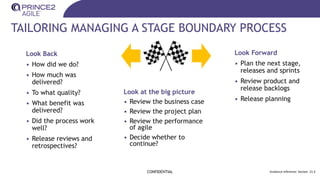
TAILORING MANAGING A STAGE BOUNDARY PROCESS
CONFIDENTIAL
Look Back
• How did we do?
• How much was
delivered?
• To what quality?
• What benefit was
delivered?
• Did the process work
well?
• Release reviews and
retrospectives?
Look Forward
• Plan the next stage,
releases and sprints
• Review product and
release backlogs
• Release planning
Look at the big picture
• Review the business case
• Review the project plan
• Review the performance
of agile
• Decide whether to
continue?
Guidance reference: Section 21.3
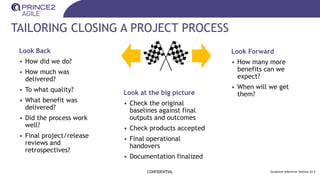
TAILORING CLOSING A PROJECT PROCESS
CONFIDENTIAL
Look Back
• How did we do?
• How much was
delivered?
• To what quality?
• What benefit was
delivered?
• Did the process work
well?
• Final project/release
reviews and
retrospectives?
Look Forward
• How many more
benefits can we
expect?
• When will we get
them?
Look at the big picture
• Check the original
baselines against final
outputs and outcomes
• Check products accepted
• Final operational
handovers
• Documentation finalized
Guidance reference: Section 22.3
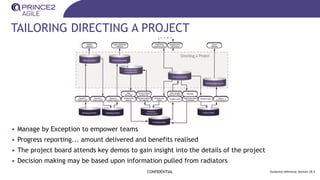
TAILORING DIRECTING A PROJECT
• Manage by Exception to empower teams
• Progress reporting... amount delivered and benefits realised
• The project board attends key demos to gain insight into the details of the project
• Decision making may be based upon information pulled from radiators
CONFIDENTIAL Guidance reference: Section 18.3
CONFIDENTIAL
PRINCE2
AGILE MANUAL
PART 3
CONFIDENTIAL
FOCUS
AREAS
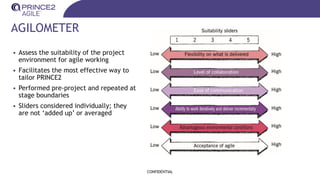
AGILOMETER
• Assess the suitability of the project
environment for agile working
• Facilitates the most effective way to
tailor PRINCE2
• Performed pre-project and repeated at
stage boundaries
• Sliders considered individually; they
are not ‘added up’ or averaged
CONFIDENTIAL
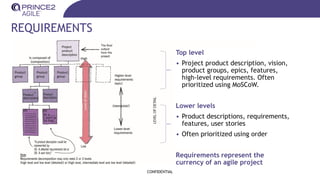
REQUIREMENTS
Top level
• Project product description, vision,
product groups, epics, features,
high-level requirements. Often
prioritized using MoSCoW.
Lower levels
• Product descriptions, requirements,
features, user stories
• Often prioritized using order
Requirements represent the
currency of an agile project
CONFIDENTIAL
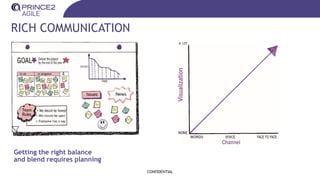
RICH COMMUNICATION
CONFIDENTIAL
Getting the right balance
and blend requires planning
WORKSHOPS
Preparation is essential
• Workshop objective
• Attendees
• Agenda
• Logistics
• Pre-reading
Useful techniques
• Group working
• Sticky notes
CONFIDENTIAL
FREQUENT RELEASES
Benefits
• Enables early delivery of benefits to the customer
• Allows for feedback
• Likely to reduce risk
• Gives confidence through visibility and evidence
• Fosters engagement with project stakeholders
• Makes releasing easier and perhaps second nature
CONFIDENTIAL
CONFIDENTIAL
FOUNDATION
EXAM
FOUNDATION EXAM STRUCTURE
•1-hour exam
•Closed book
•50 questions, each worth 1 mark
•Pass mark is 55% (28 out of 50)
•Question types
•Standard
•Negative
•List
CONFIDENTIAL
INTERNAL
HOW TO USE PRINCE2® WITH
AGILE WAYS OF WORKING –
FOUNDATION & PRACTITIONER
CERTIFICATION: PART2
TRAINING COURSE
AGILE BASICS
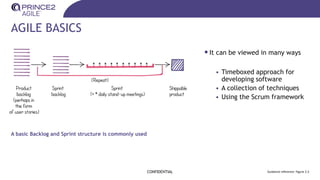
•It can be viewed in many ways
• Timeboxed approach for
developing software
• A collection of techniques
• Using the Scrum framework
CONFIDENTIAL Guidance reference: Figure 2.3
A basic Backlog and Sprint structure is commonly used
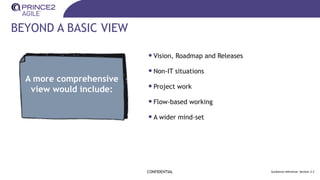
BEYOND A BASIC VIEW
•Vision, Roadmap and Releases
•Non-IT situations
•Project work
•Flow-based working
•A wider mind-set
CONFIDENTIAL Guidance reference: Section 2.2
A more comprehensive
view would include:
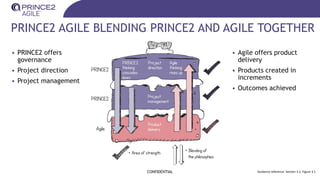
PRINCE2 AGILE BLENDING PRINCE2 AND AGILE TOGETHER
• PRINCE2 offers
governance
• Project direction
• Project management
CONFIDENTIAL Guidance reference: Section 3.1, Figure 3.1
• Agile offers product
delivery
• Products created in
increments
• Outcomes achieved
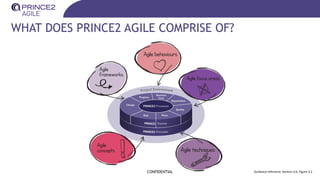
WHAT DOES PRINCE2 AGILE COMPRISE OF?
CONFIDENTIAL Guidance reference: Section 3.6, Figure 3.2
RELATING AGILE PROCESSES TO PRINCE2 PROCESSES
Guidance reference: Section 16.2, Figure 16.4
CONFIDENTIAL
FIX AND
FLEX AND
THE FIVE
TARGETS
WHAT TO FIX AND WHAT TO FLEX
CONFIDENTIAL Guidance reference: Section 6.1
This is about tolerances and not the aspects themselves
THE FIVE TARGETS
•It is essential to understand why?
•The five targets represent the rationale behind the hexagon
• Be on time and hit deadlines
• Protect the level of quality
• Embrace change
• Keep teams stable
• Accept that the customer doesn’t need everything
CONFIDENTIAL Guidance reference: Section 6.4, Table 6.2
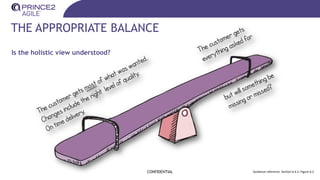
THE APPROPRIATE BALANCE
Is the holistic view understood?
CONFIDENTIAL Guidance reference: Section 6.4.5, Figure 6.2
CONFIDENTIAL
GETTING
STARTED
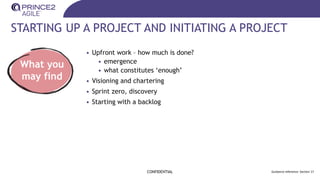
STARTING UP A PROJECT AND INITIATING A PROJECT
• Upfront work – how much is done?
• emergence
• what constitutes ‘enough’
• Visioning and chartering
• Sprint zero, discovery
• Starting with a backlog
CONFIDENTIAL Guidance reference: Section 17
What you
may find
STARTING UP A PROJECT AND INITIATING A PROJECT
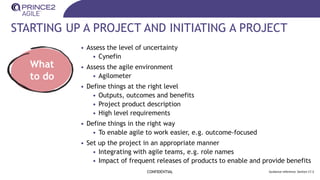
• Assess the level of uncertainty
• Cynefin
• Assess the agile environment
• Agilometer
• Define things at the right level
• Outputs, outcomes and benefits
• Project product description
• High level requirements
• Define things in the right way
• To enable agile to work easier, e.g. outcome-focused
• Set up the project in an appropriate manner
• Integrating with agile teams, e.g. role names
• Impact of frequent releases of products to enable and provide benefits
CONFIDENTIAL Guidance reference: Section 17.3
What
to do
PRINCE2 AGILE BEHAVIOURS
CONFIDENTIAL Guidance reference: Section 17.3
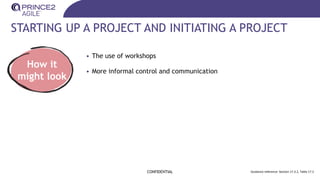
STARTING UP A PROJECT AND INITIATING A PROJECT
• The use of workshops
• More informal control and communication
CONFIDENTIAL Guidance reference: Section 17.3.2, Table 17.2
How it
might look
CYNEFIN
•A decision-making framework to help determine the level of complexity
•It describes the relationship between ‘cause and effect’
•It determines how complex an environment is
•It is used to help apply PRINCE2 and PRINCE2 Agile appropriately
CONFIDENTIAL Guidance reference: Section 17.4.1
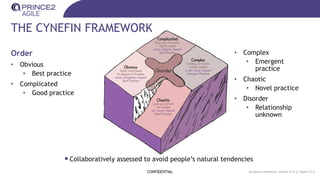
THE CYNEFIN FRAMEWORK
Order
• Obvious
• Best practice
• Complicated
• Good practice
CONFIDENTIAL Guidance references: Section 17.4.1, Figure 17.3
• Complex
• Emergent
practice
• Chaotic
• Novel practice
• Disorder
• Relationship
unknown
•Collaboratively assessed to avoid people’s natural tendencies
CYNEFIN
• Use it to analyse two areas:
• The level of complexity of the final product
• The level of complexity of the project environment
• This helps us to understand the project that we are taking on
• How should we approach delivery?
• How should we tailor PRINCE2?
• Projects will typically exist in the Complicated or Complex domains
• The Obvious domain it will probably be handled as BAU
• The Chaotic domain it will probably be unsuitable for existing processes
CONFIDENTIAL Guidance reference: Section 17.4.1
BUSINESS CASE – GENERAL VIEW OF AGILE
•It may not exist in some agile environments as there may be a focus on value assigned to
features instead
•May be created at the beginning of a piece of work as part of ‘sprint zero’ (or similar term)
CONFIDENTIAL Guidance reference: Section 9.2
BUSINESS CASE - GUIDANCE
•The business case may be affected by the amount being delivered
•Early delivery of benefits will affect the business case
•The minimum viable product (MVP) will need to be clearly stated
•Project viability is not the same as the MVP
•Best-case, worst-case and expected-case will relate to the amount of features delivered
•Where there is high uncertainty this may take very little time
CONFIDENTIAL Guidance reference: Section 9.3
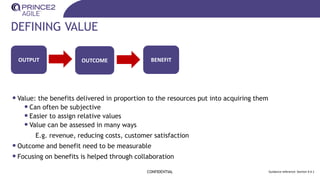
DEFINING VALUE
•Value: the benefits delivered in proportion to the resources put into acquiring them
•Can often be subjective
•Easier to assign relative values
•Value can be assessed in many ways
E.g. revenue, reducing costs, customer satisfaction
•Outcome and benefit need to be measurable
•Focusing on benefits is helped through collaboration
CONFIDENTIAL Guidance reference: Section 9.4.1
OUTPUT OUTCOME BENEFIT
THE LEAN STARTUP
CONFIDENTIAL Guidance reference: Section 20.4.2
•Core concepts are:
• Build, Measure, Learn
• Create a Minimum Viable Product (MVP)
• Fail fast learn fast
• Validated learning
• Minimum Viable Product (MVP): ‘version of the final product which allows the maximum
amount of validated learning with the least effort’
• An MVP may not go into operational use and may be an experiment
ORGANIZATION – GENERAL VIEW OF AGILE
•Focus on self-organizing teams
•Two common roles:
• Scrum Master
• Product Owner
•Less prominence for:
• Project Manager/Team Manager role
• Requirements Engineer/Business Analyst (or similar) role
CONFIDENTIAL Guidance reference: Section 10.2
ORGANIZATION – THE DELIVERY TEAM
Usually represented by some or all of the following:
•Someone to lead the team
•Someone from the customer (or at least someone to represent the customer)
•A team to create the product
•Someone to assure the quality of the product
•Someone to coach the team (which includes coaching them in agile)
•Multi-skilled ‘generalizing specialists’
CONFIDENTIAL Guidance reference: Section 10.4.3
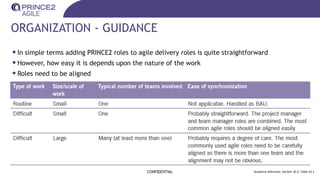
ORGANIZATION - GUIDANCE
•In simple terms adding PRINCE2 roles to agile delivery roles is quite straightforward
•However, how easy it is depends upon the nature of the work
•Roles need to be aligned
CONFIDENTIAL Guidance reference: Section 10.3, Table 10.1
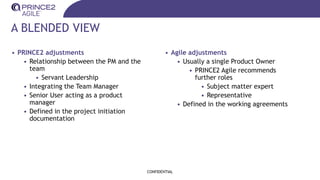
A BLENDED VIEW
• PRINCE2 adjustments
• Relationship between the PM and the
team
• Servant Leadership
• Integrating the Team Manager
• Senior User acting as a product
manager
• Defined in the project initiation
documentation
CONFIDENTIAL
• Agile adjustments
• Usually a single Product Owner
• PRINCE2 Agile recommends
further roles
• Subject matter expert
• Representative
• Defined in the working agreements
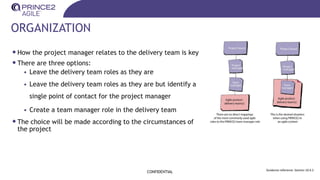
ORGANIZATION
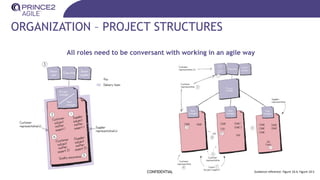
CONFIDENTIAL Guidance reference: Section 10.4.2
•How the project manager relates to the delivery team is key
•There are three options:
• Leave the delivery team roles as they are
• Leave the delivery team roles as they are but identify a
single point of contact for the project manager
• Create a team manager role in the delivery team
•The choice will be made according to the circumstances of
the project
ORGANIZATION – PROJECT STRUCTURES
All roles need to be conversant with working in an agile way
CONFIDENTIAL Guidance reference: Figure 10.4, Figure 10.5
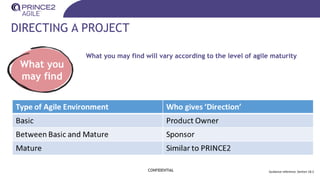
DIRECTING A PROJECT
CONFIDENTIAL Guidance reference: Section 18.2
What you
may find
What you may find will vary according to the level of agile maturity
DIRECTING A PROJECT
CONFIDENTIAL Guidance reference: Section 18.3
What
to do
What to do
•Manage by exception with the emphasis on:
• Empowerment
• The amount being delivered
• Rich information flows
• Value being delivered
DIRECTING A PROJECT
CONFIDENTIAL Guidance reference: Section 18.3
How it
might look
• How it might look
•Pulling information rather than having it delivered
•Collaborative working:
• Trusting
• Absence of a blame culture
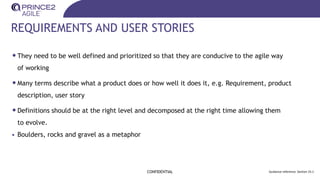
REQUIREMENTS AND USER STORIES
CONFIDENTIAL Guidance reference: Section 25.1
•They need to be well defined and prioritized so that they are conducive to the agile way
of working
•Many terms describe what a product does or how well it does it, e.g. Requirement, product
description, user story
•Definitions should be at the right level and decomposed at the right time allowing them
to evolve.
• Boulders, rocks and gravel as a metaphor
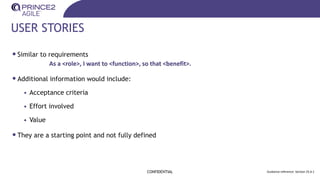
USER STORIES
•Similar to requirements
•Additional information would include:
• Acceptance criteria
• Effort involved
• Value
•They are a starting point and not fully defined
CONFIDENTIAL Guidance reference: Section 25.6.1
As a <role>, I want to <function>, so that <benefit>.
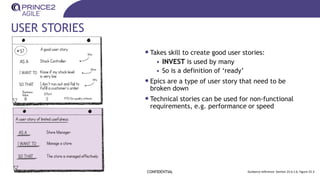
USER STORIES
•Takes skill to create good user stories:
• INVEST is used by many
• So is a definition of ‘ready’
•Epics are a type of user story that need to be
broken down
•Technical stories can be used for non-functional
requirements, e.g. performance or speed
CONFIDENTIAL Guidance reference: Section 25.6.1.6, Figure 25.3
REQUIREMENTS PRIORITIZATION
•An essential part of PRINCE2 Agile
•Two approaches frequently used are:
• MoSCoW
• Ordering (1,2,3,…,n)
•MoSCoW stands for:
• Must have
• Should have
• Could have
• Won’t have for now
CONFIDENTIAL Guidance reference: Section 25.5
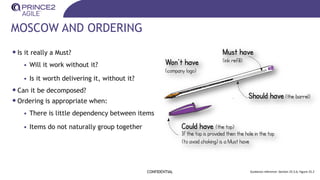
MOSCOW AND ORDERING
•Is it really a Must?
• Will it work without it?
• Is it worth delivering it, without it?
•Can it be decomposed?
•Ordering is appropriate when:
• There is little dependency between items
• Items do not naturally group together
CONFIDENTIAL Guidance reference: Section 25.5.6, Figure 25.2
CONFIDENTIAL
DELIVERING
PRODUCTS
CONTROLLING A STAGE
CONFIDENTIAL Guidance reference: Section 19.2
What you
might find
• Higher-level timeboxes
• Release
• Iteration or increment
• More than one team working together
• Scrum of scrums
CONTROLLING A STAGE
CONFIDENTIAL Guidance reference: Section 19.2
What
to do
• Plan around features
• Create flexible Work Packages in order to:
• Make management by exception easier
• Empower the teams to self-organise
• Enable rich communication; and is
• Equivalent to a release and multiple sprints or perhaps a single sprint
• Control focuses on what is being delivered
• Scope
• Quality criteria
• Monitor agile risks
CONTROLLING A STAGE
CONFIDENTIAL Guidance reference: Section 19.2
How it
might look
• Collaborative
• Work assignment is team-based
• Pulled by the team
• Visual
• Information Radiators
• Stand-up meetings
• Demos
• Empirical
• Inspect and adapt.
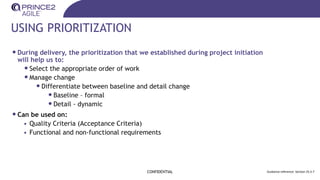
USING PRIORITIZATION
•During delivery, the prioritization that we established during project initiation
will help us to:
•Select the appropriate order of work
•Manage change
•Differentiate between baseline and detail change
•Baseline – formal
•Detail - dynamic
•Can be used on:
• Quality Criteria (Acceptance Criteria)
• Functional and non-functional requirements
CONFIDENTIAL Guidance reference: Section 25.5.7
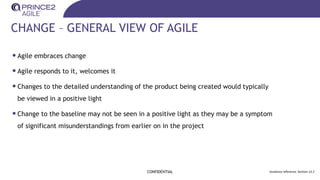
CHANGE – GENERAL VIEW OF AGILE
•Agile embraces change
•Agile responds to it, welcomes it
•Changes to the detailed understanding of the product being created would typically
be viewed in a positive light
•Change to the baseline may not be seen in a positive light as they may be a symptom
of significant misunderstandings from earlier on in the project
CONFIDENTIAL Guidance reference: Section 14.2
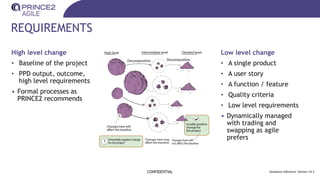
REQUIREMENTS
High level change
• Baseline of the project
• PPD output, outcome,
high level requirements
• Formal processes as
PRINCE2 recommends
CONFIDENTIAL Guidance reference: Section 14.2
Low level change
• A single product
• A user story
• A function / feature
• Quality criteria
• Low level requirements
• Dynamically managed
with trading and
swapping as agile
prefers
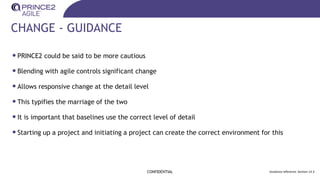
CHANGE - GUIDANCE
•PRINCE2 could be said to be more cautious
•Blending with agile controls significant change
•Allows responsive change at the detail level
•This typifies the marriage of the two
•It is important that baselines use the correct level of detail
•Starting up a project and initiating a project can create the correct environment for this
CONFIDENTIAL Guidance reference: Section 14.3
CHANGE - GUIDANCE
•Requirement definition can be binary or like a spectrum
•Good risk management can lessen the impact of change
•So can good configuration management
•Empowered self-organizing teams at the delivery level handle change dynamically within
defined tolerances
CONFIDENTIAL Guidance reference: Section 14.3
THE FEEDBACK LOOP
•Gather feedback as quickly as possible
•Ideally ‘true’ feedback from the end customer
•Many forms of feedback loop exist such as:
• OODA, (Observe Orient(ate), Decide, Act)
• PDCA (Plan, Do, Check, Act)
• PDSA (Plan, Do, Study, Act)
• Build, Measure, Learn (Lean Startup)
CONFIDENTIAL Guidance reference: Section 14.4.1
THE AGILOMETER – A FOCUS AREA
•A way of assessing the agile environment in order to tailor PRINCE2 in the most effective way
•Shows risk areas with using agile
•Shows benefits of using agile
•It is a guide to make an informed decision
•Assessed at the start of a project
•Repeated regularly throughout the project
•The project manager facilitates the assessment
CONFIDENTIAL Guidance reference: Section 24.1, Section 24.2, Section 24.3
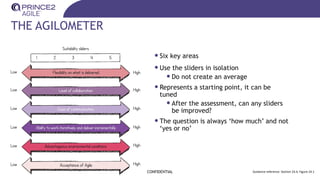
THE AGILOMETER
•Six key areas
•Use the sliders in isolation
•Do not create an average
•Represents a starting point, it can be
tuned
•After the assessment, can any sliders
be improved?
•The question is always ‘how much’ and not
‘yes or no’
CONFIDENTIAL Guidance reference: Section 24.4, Figure 24.1
RISK
CONFIDENTIAL Guidance reference: Section 13.1, Section 13.2
•Generally there is relatively less prominence given to the area of risk in agile
•Agile concepts mitigate many risks associated with other approaches (e.g. waterfall)
•PRINCE2 brings a level of formality and planning to risk management
•The level of formality should be appropriate
•Address risk during stand-up meetings
•Agile has risk areas of its own (assessed by The Agilometer)
•The five behaviours in PRINCE2 Agile help manage risk
•The five targets in PRINCE2 Agile help reduce risk
MANAGING PRODUCT DELIVERY
•There are many agile techniques and ideas in this area. They address:
• The management of product delivery
• Techniques and practices to improve quality and engagement
•Examples of frameworks that focus here:
•Scrum (a management framework)
•Kanban (a delivery process control)
CONFIDENTIAL Guidance reference: Section 20.2
What you
may find
MANAGING PRODUCT DELIVERY
CONFIDENTIAL Guidance reference: Section 20.3
What
to do
•Use work packages appropriately
•It is a vital interface/link to be managed
•Perhaps define tolerances on what is delivered at the work package level
•Ensure that product descriptions are defined at the right level
•Agree and/or give guidance on such areas as quality, releases and risk.
MANAGING PRODUCT DELIVERY
•Work packages are collaboratively defined
•Reporting arrangements have an appropriate level of formality
and transparency
•The wider project context is understood
CONFIDENTIAL Guidance reference: Section 20.3
How it
might look
SCRUM – WHAT IS IT?
•A framework for developing and sustaining complex products
•A collection of roles, events, artefacts and rules
•Created by Schwaber and Sutherland (c. 1995)
•A way to assess the efficiency of your practices so that you can improve
CONFIDENTIAL Guidance reference: Appendix H
SCRUM THEORY
•Founded on empirical process control theory
•Decisions based on evidence
•Covers three areas:
• Transparency
• Inspection
• Adaptation
CONFIDENTIAL Guidance reference: Appendix H
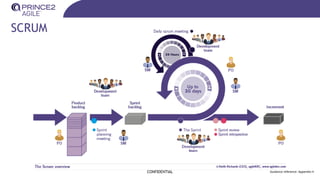
SCRUM
CONFIDENTIAL Guidance reference: Appendix H
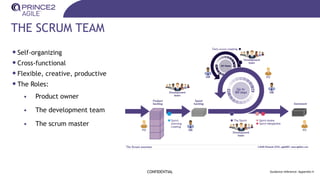
THE SCRUM TEAM
CONFIDENTIAL Guidance reference: Appendix H
•Self-organizing
•Cross-functional
•Flexible, creative, productive
•The Roles:
• Product owner
• The development team
• The scrum master
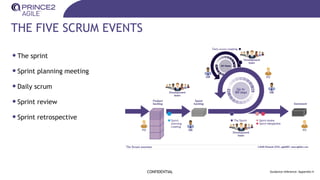
THE FIVE SCRUM EVENTS
CONFIDENTIAL Guidance reference: Appendix H
•The sprint
•Sprint planning meeting
•Daily scrum
•Sprint review
•Sprint retrospective
SCRUM EVENTS
CONFIDENTIAL Guidance reference: Appendix H
•Events are prescribed to create regularity
•Every event has a maximum duration
•The Sprint is at the heart of this concept
•Forces transparency
•Opportunities to inspect and adapt
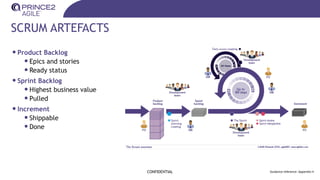
SCRUM ARTEFACTS
CONFIDENTIAL Guidance reference: Appendix H
•Product Backlog
•Epics and stories
•Ready status
•Sprint Backlog
•Highest business value
•Pulled
•Increment
•Shippable
•Done
PLANS – GENERAL VIEW
CONFIDENTIAL Guidance reference: Section 12.2
•Agile puts a lot of emphasis on planning
•Agile mostly uses Empiricism as opposed to Rationalism
•Planning style:
• Based on features
• A team-based exercise
• Plan at the last responsible moment
•Using a points scoring system to estimate is popular although there are other ways
•Both agile and PRINCE2 accept the premise of planning horizons
PLANS - GUIDANCE
CONFIDENTIAL Guidance reference: Section 12.3
•PRINCE2 supports any planning style
•Product-based planning can be used easily for any level of plan
•High level plans support continued business justification by providing
•Broad timings (end date)
•Broad costs (significant expenditure)
•Lower level plans support delivery by providing
•Ready stories
•Clear priorities
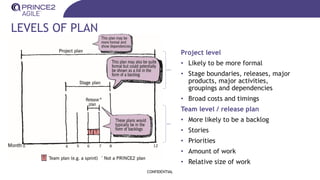
LEVELS OF PLAN
Project level
• Likely to be more formal
• Stage boundaries, releases, major
products, major activities,
groupings and dependencies
• Broad costs and timings
Team level / release plan
• More likely to be a backlog
• Stories
• Priorities
• Amount of work
• Relative size of work
CONFIDENTIAL
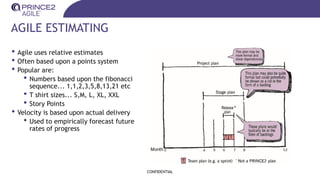
AGILE ESTIMATING
• Agile uses relative estimates
• Often based upon a points system
• Popular are:
• Numbers based upon the fibonacci
sequence... 1,1,2,3,5,8,13,21 etc
• T shirt sizes... S,M, L, XL, XXL
• Story Points
• Velocity is based upon actual delivery
• Used to empirically forecast future
rates of progress
CONFIDENTIAL
PROGRESS – GENERAL VIEW
CONFIDENTIAL Guidance reference: Section 12.3
•Similar to plans, agile puts a lot of emphasis on tracking progress
•Prefer visualization, e.g.
•Burn charts
•WIP boards
•The audience for any technique will need to be comfortable with the format
•The bigger picture relates to key agile values, e.g.
•Transparency
BURN CHARTS
CONFIDENTIAL Guidance reference: Section 12.3
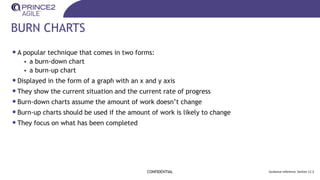
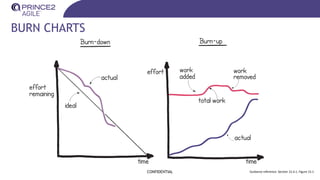
•A popular technique that comes in two forms:
• a burn-down chart
• a burn-up chart
•Displayed in the form of a graph with an x and y axis
•They show the current situation and the current rate of progress
•Burn-down charts assume the amount of work doesn’t change
•Burn-up charts should be used if the amount of work is likely to change
•They focus on what has been completed
BURN CHARTS
CONFIDENTIAL Guidance reference: Section 15.4.1, Figure 15.1
INFORMATION RADIATORS
CONFIDENTIAL Guidance reference: Section 15.4.2
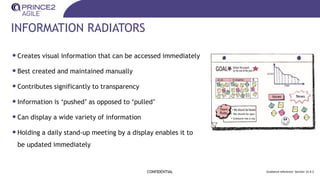
•Creates visual information that can be accessed immediately
•Best created and maintained manually
•Contributes significantly to transparency
•Information is ‘pushed’ as opposed to ‘pulled’
•Can display a wide variety of information
•Holding a daily stand-up meeting by a display enables it to
be updated immediately
QUALITY – GENERAL VIEW OF AGILE
CONFIDENTIAL Guidance reference: Section 11.2
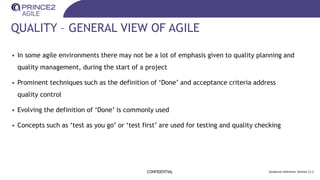
• In some agile environments there may not be a lot of emphasis given to quality planning and
quality management, during the start of a project
• Prominent techniques such as the definition of ‘Done’ and acceptance criteria address
quality control
• Evolving the definition of ‘Done’ is commonly used
• Concepts such as ‘test as you go’ or ‘test first’ are used for testing and quality checking
QUALITY - GUIDANCE
CONFIDENTIAL Guidance reference: Section 11.3
•Product descriptions are flexible (e.g. they can be user stories)
•The project product description purpose would preferably be defined as an outcome
•Quality management and quality planning includes:
• Which tools and approaches are to be used
• The role of the customer (an essential ingredient)
• Assessing and costing the resources
• Quality control considerations
QUALITY – HOW TO TEST
CONFIDENTIAL Guidance reference: Section 11.3.4
•Care needed when transferring these concepts from the software development domain
•Common agile terms include:
• Test-driven development (TDD)
• Behaviour-driven development (BDD)
• Definition of ‘Done’
• Definition of ‘Ready’
• Refactoring
• Technical debt
QUALITY IN RELATION TO SCOPE
CONFIDENTIAL Guidance reference: Section 11.5
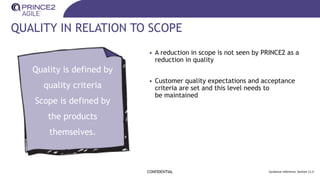
• A reduction in scope is not seen by PRINCE2 as a
reduction in quality
• Customer quality expectations and acceptance
criteria are set and this level needs to
be maintained
Quality is defined by
quality criteria
Scope is defined by
the products
themselves.
RETROSPECTIVES
CONFIDENTIAL Guidance reference: Section 11.3.4
•Review the way of working (not what was produced)
•A significant technique when working in an agile way
•They need to be planned and structured (such as with a workshop)
•Cover what went well and what didn’t go so well
•Improve little by little, and little and often
•Keep them effective by introducing variety
•Feedback can come in the form of facts or feelings
KANBAN AND THE KANBAN METHOD
CONFIDENTIAL Guidance references: Section 20.4.1
•Kanban systems are visual management systems that limit the number of work items in circulation
•Kanban should be seen as a way to increase agility through:
• Improved day-to-day decision making
• The deferral of commitment
• Reduced lead times
•In PRINCE2 Agile it is applicable in a project context to time boxes
THE SIX GENERAL PRACTICES OF THE KANBAN METHOD
CONFIDENTIAL Guidance reference: Section 20.4.1.2, Figure 20.2
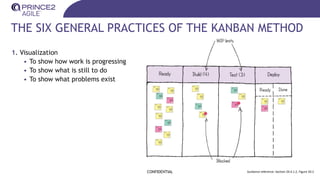
1. Visualization
• To show how work is progressing
• To show what is still to do
• To show what problems exist
THE SIX GENERAL PRACTICES OF THE KANBAN METHOD
CONFIDENTIAL Guidance reference: Section 20.4.1.2, Figure 20.2
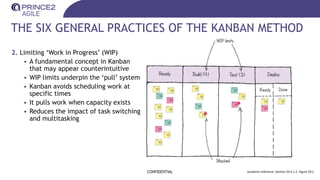
2. Limiting ‘Work in Progress’ (WIP)
• A fundamental concept in Kanban
that may appear counterintuitive
• WIP limits underpin the ‘pull’ system
• Kanban avoids scheduling work at
specific times
• It pulls work when capacity exists
• Reduces the impact of task switching
and multitasking
THE SIX GENERAL PRACTICES OF THE KANBAN METHOD
CONFIDENTIAL Guidance reference: Section 20.4.1.2, Figure 20.2
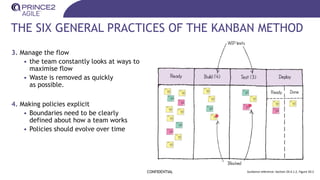
3. Manage the flow
• the team constantly looks at ways to
maximise flow
• Waste is removed as quickly
as possible.
4. Making policies explicit
• Boundaries need to be clearly
defined about how a team works
• Policies should evolve over time
THE SIX GENERAL PRACTICES OF THE KANBAN METHOD
CONFIDENTIAL Guidance reference: Section 20.4.1.2, Figure 20.2
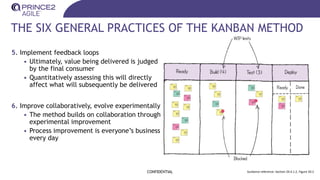
5. Implement feedback loops
• Ultimately, value being delivered is judged
by the final consumer
• Quantitatively assessing this will directly
affect what will subsequently be delivered
6. Improve collaboratively, evolve experimentally
• The method builds on collaboration through
experimental improvement
• Process improvement is everyone’s business
every day
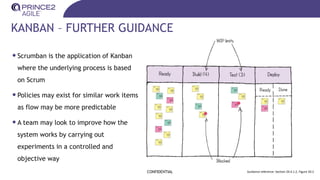
KANBAN – FURTHER GUIDANCE
CONFIDENTIAL Guidance reference: Section 20.4.1.2, Figure 20.2
•Scrumban is the application of Kanban
where the underlying process is based
on Scrum
•Policies may exist for similar work items
as flow may be more predictable
•A team may look to improve how the
system works by carrying out
experiments in a controlled and
objective way
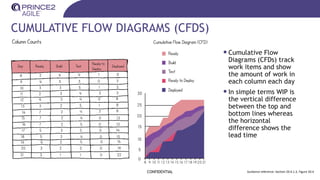
CUMULATIVE FLOW DIAGRAMS (CFDS)
CONFIDENTIAL Guidance reference: Section 20.4.1.3, Figure 20.4
•Cumulative Flow
Diagrams (CFDs) track
work items and show
the amount of work in
each column each day
•In simple terms WIP is
the vertical difference
between the top and
bottom lines whereas
the horizontal
difference shows the
lead time
MANAGING A STAGE BOUNDARY
CONFIDENTIAL Guidance reference: Section 21.2
What you
may find
What you may find:
•Stages may not exist as described in PRINCE2
•Viability decisions not usually planned in advance
•Similarity between a stage and a release
(where a release is a container timebox)
•How are things progressing
•How are the team and the processes working
MANAGING A STAGE BOUNDARY
CONFIDENTIAL Guidance reference: Section 21.3
What
to do
What to do:
• Assess how much is being delivered
• Assess the quality of what is being delivered
• What benefits have been realized?
• Is agile being use appropriately?
• Do the processes need improving?
MANAGING A STAGE BOUNDARY
CONFIDENTIAL Guidance reference: Section 21.4
How it
might look
How it might look
• Has many similarities to controlling a stage
• Visual
• Empirical
• Inspect and adapt
• A point of formality carried out with as little ceremony as possible
WORKSHOPS
•Harnesses interactions and creativity
•Ideally run by a neutral facilitator who manages the workshop
•Preparation is essential
•Many tools and techniques exist
•Workshops can be used at any point on a project
•It is important to get the group dynamics right
•Correctly run workshops can create high quality outputs quickly
•This leads to clarity, consensus and ownership
CONFIDENTIAL
FREQUENT RELEASES – FOCUS AREA
•Frequent releases are important when using agile
•The advantages are:
• Early delivery of benefit
• Allows for feedback
• Reduces risk (e.g. of delivering the wrong product)
• Gives confidence of how the project is progressing
• Fosters stakeholder engagement
• Makes releasing easier
•Needs to be planned (Product-based Planning can be used)
•A release may not go into the operational environment
CONFIDENTIAL
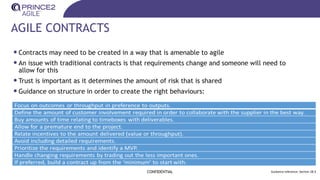
AGILE CONTRACTS
•Contracts may need to be created in a way that is amenable to agile
•An issue with traditional contracts is that requirements change and someone will need to
allow for this
•Trust is important as it determines the amount of risk that is shared
•Guidance on structure in order to create the right behaviours:
CONFIDENTIAL Guidance reference: Section 28.3
PRINCE2 MANAGEMENT PRODUCTS AND ROLES
•All 26 PRINCE2 management products are in appendix A
•The PRINCE2 roles are in appendix B along with the PRINCE2 Agile delivery roles
CONFIDENTIAL Guidance reference: Appendix A, Appendix B
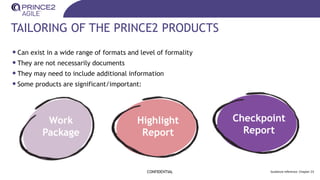
TAILORING OF THE PRINCE2 PRODUCTS
CONFIDENTIAL Guidance reference: Chapter 23
•Can exist in a wide range of formats and level of formality
•They are not necessarily documents
•They may need to include additional information
•Some products are significant/important:
Work
Package
Highlight
Report
Checkpoint
Report
RICH COMMUNICATION – FOCUS AREA
CONFIDENTIAL Guidance reference: Section 26.1, Section 26.2
• Communication problems need to be proactively addressed
• Effective communication is fundamental to agile
• Communication takes place in many ways therefore people should interact appropriately
• Communication channels:
• The written word
• Visualization
• Verbally, by telephone
• Verbally, face-to-face
RICH COMMUNICATION
CONFIDENTIAL Guidance references: Section 26.4.1
•Face-to-face should be favoured as a faster and clearer channel
•Technology and the level of formality needs to be assessed
•There is a role for the written word but it has disadvantages
•A project manager (or team manager) needs to be aware of how a team is communicating
•Communication needs to be organized and planned.
CONFIDENTIAL
WRAPPING UP
CLOSING A PROJECT
CONFIDENTIAL Guidance reference: Section 22.2
What you
might find
•Defined processes may only exist in mature agile environments
•Regular handovers have resulted in activities becoming second nature
CLOSING A PROJECT
CONFIDENTIAL Guidance reference: Section 22.3
What
to do
•Check against the original baseline
•Evaluate the use of agile on the project
•Ensure the formality of final acceptance is appropriate
•Finalize documentation that has been created iteratively
and incrementally.
CLOSING A PROJECT
CONFIDENTIAL Guidance reference: Section 22.4
How it
might look
•A workshop is used
•Benefits are already being delivered
•The majority of the information has already been completed
OTHER APPENDICES
CONFIDENTIAL Guidance reference: Appendix A, Appendix B
• C – Health check
• Addresses behaviours, environment, process, technique
• F – Transitioning to agile
• The success of the business case – benefits delivered
• The success of the project and project management
• The success of agile ways of working
• G - Advice for a project manager using agile
• Hints and tips
COURSE SUMMARY
CONFIDENTIAL Guidance reference: Appendix A, Appendix B
•PRINCE2 can be very effective in an agile context
•Tailoring is about creating an appropriate blend of the two
•PRINCE2 is already enabled to work with agile
•Agile covers a wide range of behaviours, concepts, frameworks and techniques
•Using agile is always a question of ‘how much can be used according to the situation?’
INTERNAL
COURSE COMPLETED
INTERNAL
INTERNAL
COURSE COMPLETED
INTERNAL
COMMON RULES
FOR SUCCESS
1. PLANNING IS CRITICAL : Compared to AGILE , PRINCE2 AGILE
encompasses early planning to an extent (not too detailed
yet not shallow) in SU AND IP Processes. Sprint planning is
also key
2. Prioritization : Initial EPIC and User Story followed by
MOSCOW to prioritize requirements is vital.
3. TEAM COLLABORATION: AGILE concepts of Daily stand-up is
MUST
4. Information radiators : Regular updates to it and sharing the
link or board to stakeholders is a MUST
5. Retrospectives at end of every sprint and stage : This is a
must to ensure stickiness and improvement
6. Risk management must be done
INTERNAL
STARTING UP A PROJECT (SP)
Agilometer ( repeat every stage)
Prince 2 templates and documents
Project Brief / Business Case/business case
Initiating a project (IP)
Product Backlog
Epics
Product Backlog
Sprint planning
MOSCOW
Project Initiation Document
Set stage tolerance levels
Risk mgmt
Quality mgmt
Controlling stage(CS)
Highlight report
Exception Report
User stories from epics
Retrospective document
Product backlog
Sprint backlog
Burn down chart
Burn up chart
Kanban
Risk Log
Quality Log
Issue Log
Managing Stage
Boundaries(MSB)
End stage report
User sign off
Retrospective of all
sprints of a stage
PUTTING IT ALL TOGETHER-FINAL EXERCISE
Managing Product Delivery(MPD)
Work package
Tolerance levels of work package
Daily Sprint
Closing Project(CP)
Consolidated retrospective
Business benefit review document
Directing a Project (DP)
*Manage By Exception* - Led by Executive
[MSB] End stage Report
[CP] Closing Project Document
[CS]Exception Report
[IP] Project Brief
[CS] Highlight Report
[CP] Consolidated Retrospective
CONTACT AXELOS
Web: AXELOS.com
Twitter: @AXELOS_GBP
G+: AXELOS
LinkedIn: AXELOS Global Best Practice
YouTube: AXELOS
CONFIDENTIAL

foundatamp;practitioner)princeion&2aombigile

  • 1.
    CONFIDENTIAL Presented by: LeslieLawerence PRINCE2 Agile Practitioner, PRINCE2 Practitioner © Copyright AXELOS Limited 2018. PRINCE2 Agile® is a registered trade mark of AXELOS Limited. All rights reserved.
  • 2.
    CONFIDENTIAL WELCOME “At itsroot, Scrum is based on a simple idea: whenever you start a project, why not regularly check in, see if what you’re doing is heading in the right direction, and if it’s actually what people want? And question whether there are any ways to improve how you’re doing what you’re doing, any ways of doing it better and faster, and what might be keeping you from doing that.” – Jeff Sutherland “When preparing for battle I find that plans are useless but planning is inevitable.” – Dwight D. Eisenhower
  • 3.
    INTERNAL HOW TO USEPRINCE2® WITH AGILE WAYS OF WORKING FOUNDATION AND PRACTITIONER CERTIFICATION: PART ONE TRAINING COURSE
  • 4.
    INTERNAL AGILE HAS BEENIN EXISTING FOR CENTURIES! If AGILE is not followed the ship AGILE is used to sail
  • 5.
    ABOUT YOU 1. Name(and department) 2. Role(what you do) 3. Experience of PRINCE2 4. Experience of agile 5. Your objective for this course CONFIDENTIAL
  • 6.
    ABOUT THE PRINCE2AGILE MANUAL •Update due to be published mid-2018 •Aligned to the PRINCE2 2017 manual •Early chapters: • Basic understandings and drivers for PRINCE2 Agile •Middle chapters: • Discussion and description of the principles, themes, processes and management products • What you may find • What to do •Final chapters: • Focus areas: where PRINCE2 needs more detailed guidance in an agile context • Appendices CONFIDENTIAL
  • 7.
    FOUNDATION EXAM STRUCTURE •1hour exam •Closed book •50 questions, each worth 1 mark •Pass mark is 28 out of 50, or 55% •Question types •Standard •Negative •List CONFIDENTIAL
  • 8.
    PRACTITIONER EXAM STRUCTURE •2.5hour exam •Open book: PRINCE2 Agile manual only •Objective Testing Exam •50 questions, each worth 1 mark •Pass mark is 60% (30 marks out of 50) CONFIDENTIAL
  • 9.
  • 10.
    A PROJECT ORBUSINESS AS USUAL •To use agile effectively, it is important to understand the difference between a project and business as usual (BAU) •Agile can be used on projects and for ongoing BAU work •PRINCE2 and PRINCE2 Agile are only suitable for projects CONFIDENTIAL Guidance reference : Section 1.2
  • 11.
    WHY PRINCE2 AGILE? •PRINCE2focuses on the governance and overall management •AGILE focuses on product delivery •To have a sustainable project management structure it was decided to form PRINCE2 AGILE INTERNAL PROJECT FRAMEWORK – PRINCE2 AGILE PRINCE2 – GOVERNANCE & MANAGEMENT AGILE – PRODUCT DELIVERY More aligned and structured approach with a focus on management products and product delivery With PRINCE2 in play, this agile framework can be used in regulated industries such as BANKING, TELCO , INSURANCE SECTOR etc.
  • 12.
    PRINCE2 AGILE MANAGEMENTFRAMEWORK INTERNAL AGILE SCRUM KANBAN DELIVERY FOCUSED PRINCE2 End to End Project Focused 1.Project Management end to end is covered by PRINCE2 2. Agile focuses on product delivery 3. Kanban and Scrum are techniques and tools in Agile framework to achieve agile product delivery. SU IP CS MSB CP MP
  • 13.
    THE DIFFERENCE BETWEENPROJECT WORK AND BAU WORK CONFIDENTIAL Guidance reference: Figure 1.1
  • 14.
  • 15.
  • 16.
    PRINCE2 PRINCIPLES The guidingprinciples that a PRINCE2 project should follow are: • Continued business justification • Learn from experience • Defined roles and responsibilities • Manage by stages • Manage by exception • Focus on products • Tailor to suit the project CONFIDENTIAL
  • 17.
    PRINCE2 THEMES CONFIDENTIAL Theme Whatdoes it do? Business case Creates and maintains a business justification for the project. Ensures project outcomes are achieved and benefits realized. Organization Defines the project organization structure and roles. Defines the approach to communicating and engaging with stakeholders. Quality Defines the project quality management approach. Specifies prioritized acceptance criteria for the final project product(s). Plans Recommends different levels of plan to facilitate communication and control from the differing perspectives of the project organization. Plans enable the business case to be realized. Risk Defines the risk management approach and ensures that project risks are identified, assessed and controlled. Change Defines the change control approach and ensures that issues are captured, assessed and controlled. Progress Defines the way that the project progress is measured and compared to performance targets. Progress enables a forecast of the continuing project viability.
  • 18.
    PRINCE2 PROCESSES ANDTHEMES • Business case • Organization • Quality • Plans • Risk • Change • Progress CONFIDENTIAL Themes Processes
  • 19.
    PRINCE2 MANAGEMENT PRODUCTS •There are 26 management products that support the PRINCE2 method. All of them can and should be tailored. • The following are key to successfully tailoring PRINCE2: • Business case • Checkpoint report • Highlight report • Project brief • Project initiation documentation • Project product description • Work package CONFIDENTIAL Understanding the purpose of the above products is vital.
  • 20.
    THE PRINCE2 JOURNEYWITH AGILE •How PRINCE2 may look in an agile context •This is just ‘a way’ not ‘the way’ •Tailoring PRINCE2 depends on the project context, which may affect: • the level of formality • where the emphasis is placed • how it is carried out CONFIDENTIAL Guidance reference: Section 4.1, Figure 4.1
  • 21.
  • 22.
    AN OVERVIEW OFAGILE •Agile addressed the new demands placed on the delivery of software •The term ‘agile’ can be viewed in many different ways •Several well-known frameworks are referred to as ‘agile ways of working’ •Agile is characterized by many familiar behaviours, concepts and techniques •The Agile Manifesto comes closest to a single definition; it was created as an alternative to ‘waterfall’ processes CONFIDENTIAL
  • 23.
    THE AGILE MANIFESTO CONFIDENTIALGuidance reference: Figure 2.1
  • 24.
    AN EXAMPLE OFAGILE USE IN TELCO INTERNAL
  • 25.
    AN EXAMPLE OFAGILE USE IN TELCO •The mobile plans need to be changed every 3 months ? •Normal waterfall approach will not work as turnaround time is vital •Agile is required to deliver faster •But at same time proper documentation and guidance is needed •The balance need to be achieved INTERNAL
  • 26.
    WATERFALL OR ITERATIVEAND INCREMENTAL CONFIDENTIAL Guidance reference: Figure 2.2
  • 27.
    AGILE BASICS CONFIDENTIAL Guidancereference: Figure 2.3 Agile can be viewed in several ways: • A timeboxed approach to the development of software • A collection of agile techniques • Use of the Scrum framework A basic Backlog and Sprint structure is commonly used with agile
  • 28.
    AGILE FRAMEWORKS •Many frameworksare recognized as being agile •Some are more common than others •Some are only applicable to IT CONFIDENTIAL Guidance reference: Section 2.2.1, Table 2.1 Scrum Kanban Lean Lean Startup XP SAFe DAD DSDM/AgilePM DevOps FDD Crystal ASD
  • 29.
    THE PRINCE2 AGILEVIEW CONFIDENTIAL Guidance reference: Section 2.2.1
  • 30.
    AGILE BEHAVIOURS, CONCEPTSAND TECHNIQUES Along with the agile frameworks there are a variety of behaviours, concepts and techniques that are seen as being part of the agile way of working. CONFIDENTIAL Guidance reference: Section 2.2.2, Table 2.2 A few illustrative examples
  • 31.
  • 32.
    PRINCE2 AGILE BLENDINGPRINCE2 AND AGILE TOGETHER CONFIDENTIAL Guidance reference: Section 3.1, Figure 3.1 •PRINCE2 and agile each have their own strengths •PRINCE2 focuses on direction and management •Agile is delivery-focused.
  • 33.
    WHAT DOES PRINCE2AGILE COMPRISE OF? CONFIDENTIAL Guidance reference: Section 3.6, Figure 3.2
  • 34.
    EIGHT GUIDANCE POINTS CONFIDENTIALGuidance reference: Section 3.7
  • 35.
    BEWARE OF PREJUDICE! CONFIDENTIALGuidance reference: Section 3.8 Control and governance allows agile to be used in complex environments
  • 36.
    CONFIDENTIAL WHAT TO FIX ANDWHAT TO FLEX Fix = Cannot reduce or change. Must be addressed Flex = Can change a bit
  • 37.
    EXERCISE #1 CASESTUDY •List down the six factors that will impact your project •Why it impacts the project •Which cannot be changed. Which can be adjusted ? INTERNAL
  • 38.
    PERFORMANCE TARGETS ANDTOLERANCE •PRINCE2 considers six variables of performance •In a waterfall project, time and cost are often seen to be the most significant variables •Instead, in projects using agile delivery the significant variables are scope and quality •Tolerance is an allowable variation around targets •If the tolerance is exceeded, an exception should be raised CONFIDENTIAL Guidance reference: Section 6.1
  • 39.
    THE HEXAGON CONFIDENTIAL Guidancereference: Section 6.1, Figure 6.1 This is about tolerances and not the aspects themselves
  • 40.
    TOLERANCE GUIDANCE CONFIDENTIAL Guidancereference: Section 6.1, Figure 6.1
  • 41.
    THE FIVE TARGETS •Itis essential to understand why? •The five targets represent the rationale behind the hexagon • Be on time and hit deadlines • Protect the level of quality • Embrace change • Keep teams stable • Accept that the customer doesn’t need everything CONFIDENTIAL Guidance reference: Section 6.4, Table 6.2
  • 42.
    BE ON TIMEAND HIT DEADLINES Why? •Early realization of benefits •Helps with planning •Gives confidence •There may be no choice •Reduces the likelihood of cost overruns •Improves reputation CONFIDENTIAL Guidance reference: Section 6.4.1
  • 43.
    EMBRACE CHANGE Why? •It isinevitable •A more accurate final product is more likely to be produced •It can be handled by flexing what is delivered CONFIDENTIAL Guidance reference: Section 6.4.3
  • 44.
    PROTECT THE LEVELOF QUALITY Why? • To ensure that the appropriate level of quality is achieved • And therefore the desired outcomes are possible • Quality is adversely affected by: • Reduced testing • Incomplete documentation • Sub-optimal design • Lack of appropriate training • Non-compliance with standards CONFIDENTIAL Guidance reference: Section 6.4.2
  • 45.
    KEEP TEAMS STABLE Why? •Agile favours self-organizing teams and informal communication • Changing team members (in the short term) can have a detrimental effect: • Time spent bringing new team members up to speed • Number of communication lines in the team grows exponentially • An opportunity cost incurred by the areas providing the new people • The team dynamics change and need to be re- established. CONFIDENTIAL Guidance reference: Section 6.4.4
  • 46.
    ACCEPT THAT THECUSTOMER DOESN’T NEED EVERYTHING Why? •If compromise is necessary PRINCE2 Agile believes that the features of a product are the safest and most sensible area to compromise on •This is because: •Usually, not everything defined at the start must be delivered •Many functions and features are rarely, or never used •This helps when trying to hit deadlines and protect the level of quality •Delivers what the customer really wants more quickly CONFIDENTIAL Guidance reference: Section 6.4.5
  • 47.
  • 48.
  • 49.
    APPLYING PRINCE2 PRINCIPLES CONFIDENTIAL Continuedbusiness justification Agile value and MVP Learn from experience Retrospectives, short feedback loops and “inspect and adapt” Defined roles and responsibilities Blending PRINCE2 roles and additional agile roles Manage by stages Timeboxes, e.g. releases and sprints, shorter stages to support innovation Manage by exception Tolerances empower people Focus on products Prioritisation of products and quality criteria Tailor to suit the project Agile assessments with the Agilometer
  • 50.
    PRINCE2 AGILE BEHAVIOURS CONFIDENTIAL TransparencyOpenness and visibility but also honesty, trust, integrity and respect Collaboration Internal (the team work together) and external (engaging with customers) leading to shared understanding and ownership Rich communication Face to face in preference to words alone Self-organization Trust the people closest to the work to know best Exploration Frequent iterations and rapid feedback loops provide an opportunity to learn (experiments and spikes)
  • 51.
  • 52.
    TAILORING THE BUSINESSCASE THEME • No changes required • More info on tolerances around benefits • Best case, worst case, expected case • Linking amount of product to benefit accrued • Explicit definition of what constitutes the minimum viable product (MVP) • Implications of incremental delivery • Early benefit and early costs • Where there is high uncertainty develop the business case quickly • Plan to test assumptions quickly CONFIDENTIAL
  • 53.
    TAILORING THE ORGANIZATIONTHEME • No changes required but additional delivery roles may be needed • Consideration needs to be given to: • The team manager role • How it might be integrated into the delivery team • Common agile roles • E.g. product owner, scrum master, agile coach, business ambassador • The senior user role • Acting as a super product owner • The scrum master • Liaison with the project manager • Management by exception to enable self-organization CONFIDENTIAL
  • 54.
    INTERNAL ROLES WHAT DOTHEY DO IN SPRINT WHAT THEY DO IN 15 MINS STANDUP PRODUCT OWNER OWN REQUIREMENTS, PRIORITIZE USER STORIES, GIVE OVERSIGHT ON BUSINESS REQUIREMENTS FOR PRODUCT DEVELOPMENT. AFTER SPRINT AUTHORIZE DEMO OBSERVER.. PRODUCT OWNER DO NOT INTIMIDATE THE TEAM . IF ANY ISSUES TO TAKE IT OFFLINE WITH SCRUM MASTER AND TO ADDRESS IT. AGILE COACH CONSULT ON AGILE APPROACH OBSERVER – IF NOT ADHERING TO AGILE HE WILL HIGHLIGHT AND SCRUM MASTER TAKES IT OFFLINE TO FIX CHIEF PRODUCT EFFECIENCY ENGINEER REPRESENT THE TESTERS. MAKE SURE THE QUALITY IS MAINTAINED UPDATE ON TESTING PROGRESS BUSINESS ANALYST CONFORMITY OF REQUIREMENTS IN DEMO OBSERVER AND IF NOTICE ANY ISSUE TO HIGHLIGHT AND TAKE IT SEPERATELY TESTER TEST THE DEMO FOR SIGN OFF OPTIONAL DEVELOPERS ENSURING PRODUCT IS DELIVERED WITHIN 6 FACTORS PROGRESS UPDATE ON PRODUCT DEVELOPMENT TECHNICAL LEAD * DEVELOPER can be a TL PRODUCT ARCHITECTURE AND DESIGN CONFIRMANCE IN SPRINT. SIGN OFF DURING DEMO OBSERVER AND IF NOT ADHERING TO ARCHITECURE TO TAKE IT OFFLINE FOR FIX SCRUM MASTER ACT AS A PM FOR THE SPRINT MAKING SURE TEAM EXECUTES WITHIN SCHEDULE USING BURN CHART AND OTHER TRACKING METHODS. COORDINATE THE MEETING . TAKE NOTE OF THE ISSUES AND TAKE IT OFFLINE FOR SOLUTION IF ANY. ENSURE THE SPRINT IS COMPLETED WITHIN THE TIME. ACT ON STAFF ISSUES (SERVANT LEADERSHIP)
  • 55.
    THE THREE PRINCE2PROJECT INTERESTS CONFIDENTIAL
  • 56.
    TAILORING THE ORGANIZATIONTHEME: ROLES Working agreements can help to document roles and responsibilities CONFIDENTIAL
  • 57.
    TAILORING THE ORGANIZATIONTHEME: ROLES PRINCE2 AGILE ORG STRUCTURE ( AT TIMES THE PM WILL ACT AS SCRUM MASTER) PROGRAM LEVEL OR PROJECT LEVEL IS PRINCE2 AND WORKPACKAGE LEVEL IS SCRUM CONFIDENTIAL Testor Scrum Master Technical Lead Developers Product Owner AGILE PRINCE2
  • 58.
    TAILORING THE QUALITYTHEME • Ensure that stakeholders appreciate the difference between scope and quality • a reduction in scope is not a reduction in quality • Protect the fitness of purpose of products by: • prioritising acceptance criteria and quality criteria • defining quality tolerances • differentiating between functional and non functional requirements • Use agile concepts to help clarify quality criteria • Definitions of Ready and Done • Consider the frequency of quality checking its the impact on the way the project is planned and run CONFIDENTIAL
  • 59.
    TAILORING THE PLANSTHEME • No changes required but many agile techniques and approaches exist in this area • Often informal and low tech e.g. sprint planning, simple list of backlog • Agile typically looks at how much (or how much value) can be delivered in a fixed timeframe • Releases, sprints, burn charts • Gantt charts and formal milestones which demonstrate the duration a specific volume of work will take or may be useful when working with higher levels of plan • Synchronise high level plans and low level backlogs CONFIDENTIAL
  • 60.
    AGILE ESTIMATING • Agileuses relative estimates • Often based upon a points system • Popular are: • Numbers based upon the fibonacci sequence... 1,1,2,3,5,8,13,21 etc • T-shirt sizes... S,M, L, XL, XXL • Story Points • Velocity is based upon actual delivery • Used to empirically forecast future rates of progress CONFIDENTIAL
  • 61.
    TAILORING THE RISKTHEME • Agile techniques addresses many of the familiar project risks • Avoiding too much detail at the start, daily stand-ups, frequent delivery of product, frequent demos, customer interaction and self-managed teams • However, agile working has its own set of potential risks • e.g. the challenges of continual customer engagement • Processes that support risk management do not need to be bureaucratic • The level of formality should be appropriate to the needs of the project • e.g. a few columns on the team board vs an electronic risk register CONFIDENTIAL
  • 62.
    TAILORING THE CHANGETHEME • Both PRINCE2 and agile see change as inevitable • The combination of both views • control significant change • the level where the project was justified • enable responsive change at the detail level • the level where change improves the quality and usability product • Product descriptions (quality criteria and tolerance) and work packages need to enable • clear baselines that can be managed formally (escalated to the project board or to a change authority) • detail level change within defined tolerances that can be managed by the team dynamically CONFIDENTIAL
  • 63.
    TAILORING THE PROGRESSTHEME • No changes required but many agile techniques and approaches exist in this area • Agile focus on tracking what is delivered, e.g. velocity, lead times or value • Tolerances would be set to support this (scope and quality) • Within the... sprint burn down and burn up charts • Across releases... demonstrating value accrued • Progress is tracked at all levels of the project • Agile techniques and PRINCE2 processes both have value CONFIDENTIAL
  • 64.
    TRACKING PROGRESS WITHBURN CHARTS CONFIDENTIAL
  • 65.
  • 66.
    AGILE AND THEPRINCE2 PROCESSES •Agile needs to be incorporated into all seven processes •The amount of agile that is appropriate to each process does vary CONFIDENTIAL Guidance reference: Section 16.2, Figure 16.2, Figure 16.3
  • 67.
    RELATING AGILE PROCESSESTO PRINCE2 PROCESSES Guidance reference: Section 16.2, Figure 16.4
  • 68.
    TAILORING STARTING UPA PROJECT AND INITIATING A PROJECT • Viable and worthwhile / Solid foundations to understand the work • Define things at the right level • Project Product Description (Outputs, Outcomes) • Business case (Best / worst amount of product and Benefits) • High level requirements (epics) • Define things in the right way • To enable agile to work easier, e.g. outcome focussed • Set the project up in an appropriate manner • Integrating with agile teams, e.g. role names • Impact of frequent releases of products to enable and provide benefits CONFIDENTIAL
  • 69.
    STARTING UP APROJECT AND INITIATING A PROJECT PROCESSES CONT. CONFIDENTIAL Project brief Likely to be informal. Project definition is more outcome based. Impact of frequent delivery is considered. Lean startup and MVP. Includes the project approach that will discuss the use and benefit of agile working. Business case Impact of flexing amount delivered considered. MVP identified. Best case / worst case described in terms of amount delivered. Project product description Focus on outcome desired. Created as part of a workshop. Composition (major products) might be similar to epics. Creation of the product backlog. Project initiation documentation Enough and no more. May exist as an information radiator. Plan the frequency of releases. Write a definition of done. Map PRINCE2 and agile roles. Describe the tailoring undertaken.
  • 70.
    LEAN STARTUP • Build,measure, learn • Create a minimum viable product (MVP) • Fail fast • Validated learning CONFIDENTIAL
  • 71.
    TAILORING CONTROLLING ASTAGE AND MANAGING PRODUCT DELIVERY PROCESSES • Stages made up of timeboxes • Releases and sprints, features to enable benefits • Team-based collaboration • Planning, estimating, flexible work packages • Reporting and communication, issues and risks • Stand-ups, information radiators, burn charts, sprint demos • Blockers and impediments, agile assessment guides risk management • Control focusses on what is being delivered • Scope and Quality criteria CONFIDENTIAL Guidance reference: Section 20.3
  • 72.
    CONTROLLING A STAGEAND MANAGING PRODUCT DELIVERY PROCESSES CONT. CONFIDENTIAL Work package A vital interface. Brings PRINCE2 and agile working together. Collaboratively defined. A clear safe boundary of control. Also space to empower teams to self-organise and enable rich communication. May include one or more releases or sprints. Highlight report Important yet likely to be informal. Contains information on releases and sprints and benefits enabled. Could be in the form of an information radiator and/or burn chart. Checkpoint report Could be replaced by the daily stand-up but must not change the stand-up to “reporting to...”. Could be in the form of an information radiator and/or burn chart.
  • 73.
  • 74.
    TAILORING MANAGING ASTAGE BOUNDARY PROCESS CONFIDENTIAL Look Back • How did we do? • How much was delivered? • To what quality? • What benefit was delivered? • Did the process work well? • Release reviews and retrospectives? Look Forward • Plan the next stage, releases and sprints • Review product and release backlogs • Release planning Look at the big picture • Review the business case • Review the project plan • Review the performance of agile • Decide whether to continue? Guidance reference: Section 21.3
  • 75.
    TAILORING CLOSING APROJECT PROCESS CONFIDENTIAL Look Back • How did we do? • How much was delivered? • To what quality? • What benefit was delivered? • Did the process work well? • Final project/release reviews and retrospectives? Look Forward • How many more benefits can we expect? • When will we get them? Look at the big picture • Check the original baselines against final outputs and outcomes • Check products accepted • Final operational handovers • Documentation finalized Guidance reference: Section 22.3
  • 76.
    TAILORING DIRECTING APROJECT • Manage by Exception to empower teams • Progress reporting... amount delivered and benefits realised • The project board attends key demos to gain insight into the details of the project • Decision making may be based upon information pulled from radiators CONFIDENTIAL Guidance reference: Section 18.3
  • 77.
  • 78.
  • 79.
    AGILOMETER • Assess thesuitability of the project environment for agile working • Facilitates the most effective way to tailor PRINCE2 • Performed pre-project and repeated at stage boundaries • Sliders considered individually; they are not ‘added up’ or averaged CONFIDENTIAL
  • 80.
    REQUIREMENTS Top level • Projectproduct description, vision, product groups, epics, features, high-level requirements. Often prioritized using MoSCoW. Lower levels • Product descriptions, requirements, features, user stories • Often prioritized using order Requirements represent the currency of an agile project CONFIDENTIAL
  • 81.
    RICH COMMUNICATION CONFIDENTIAL Getting theright balance and blend requires planning
  • 82.
    WORKSHOPS Preparation is essential •Workshop objective • Attendees • Agenda • Logistics • Pre-reading Useful techniques • Group working • Sticky notes CONFIDENTIAL
  • 83.
    FREQUENT RELEASES Benefits • Enablesearly delivery of benefits to the customer • Allows for feedback • Likely to reduce risk • Gives confidence through visibility and evidence • Fosters engagement with project stakeholders • Makes releasing easier and perhaps second nature CONFIDENTIAL
  • 84.
  • 85.
    FOUNDATION EXAM STRUCTURE •1-hourexam •Closed book •50 questions, each worth 1 mark •Pass mark is 55% (28 out of 50) •Question types •Standard •Negative •List CONFIDENTIAL
  • 86.
    INTERNAL HOW TO USEPRINCE2® WITH AGILE WAYS OF WORKING – FOUNDATION & PRACTITIONER CERTIFICATION: PART2 TRAINING COURSE
  • 87.
    AGILE BASICS •It canbe viewed in many ways • Timeboxed approach for developing software • A collection of techniques • Using the Scrum framework CONFIDENTIAL Guidance reference: Figure 2.3 A basic Backlog and Sprint structure is commonly used
  • 88.
    BEYOND A BASICVIEW •Vision, Roadmap and Releases •Non-IT situations •Project work •Flow-based working •A wider mind-set CONFIDENTIAL Guidance reference: Section 2.2 A more comprehensive view would include:
  • 89.
    PRINCE2 AGILE BLENDINGPRINCE2 AND AGILE TOGETHER • PRINCE2 offers governance • Project direction • Project management CONFIDENTIAL Guidance reference: Section 3.1, Figure 3.1 • Agile offers product delivery • Products created in increments • Outcomes achieved
  • 90.
    WHAT DOES PRINCE2AGILE COMPRISE OF? CONFIDENTIAL Guidance reference: Section 3.6, Figure 3.2
  • 91.
    RELATING AGILE PROCESSESTO PRINCE2 PROCESSES Guidance reference: Section 16.2, Figure 16.4
  • 92.
  • 93.
    WHAT TO FIXAND WHAT TO FLEX CONFIDENTIAL Guidance reference: Section 6.1 This is about tolerances and not the aspects themselves
  • 94.
    THE FIVE TARGETS •Itis essential to understand why? •The five targets represent the rationale behind the hexagon • Be on time and hit deadlines • Protect the level of quality • Embrace change • Keep teams stable • Accept that the customer doesn’t need everything CONFIDENTIAL Guidance reference: Section 6.4, Table 6.2
  • 95.
    THE APPROPRIATE BALANCE Isthe holistic view understood? CONFIDENTIAL Guidance reference: Section 6.4.5, Figure 6.2
  • 96.
  • 97.
    STARTING UP APROJECT AND INITIATING A PROJECT • Upfront work – how much is done? • emergence • what constitutes ‘enough’ • Visioning and chartering • Sprint zero, discovery • Starting with a backlog CONFIDENTIAL Guidance reference: Section 17 What you may find
  • 98.
    STARTING UP APROJECT AND INITIATING A PROJECT • Assess the level of uncertainty • Cynefin • Assess the agile environment • Agilometer • Define things at the right level • Outputs, outcomes and benefits • Project product description • High level requirements • Define things in the right way • To enable agile to work easier, e.g. outcome-focused • Set up the project in an appropriate manner • Integrating with agile teams, e.g. role names • Impact of frequent releases of products to enable and provide benefits CONFIDENTIAL Guidance reference: Section 17.3 What to do
  • 99.
    PRINCE2 AGILE BEHAVIOURS CONFIDENTIALGuidance reference: Section 17.3
  • 100.
    STARTING UP APROJECT AND INITIATING A PROJECT • The use of workshops • More informal control and communication CONFIDENTIAL Guidance reference: Section 17.3.2, Table 17.2 How it might look
  • 101.
    CYNEFIN •A decision-making frameworkto help determine the level of complexity •It describes the relationship between ‘cause and effect’ •It determines how complex an environment is •It is used to help apply PRINCE2 and PRINCE2 Agile appropriately CONFIDENTIAL Guidance reference: Section 17.4.1
  • 102.
    THE CYNEFIN FRAMEWORK Order •Obvious • Best practice • Complicated • Good practice CONFIDENTIAL Guidance references: Section 17.4.1, Figure 17.3 • Complex • Emergent practice • Chaotic • Novel practice • Disorder • Relationship unknown •Collaboratively assessed to avoid people’s natural tendencies
  • 103.
    CYNEFIN • Use itto analyse two areas: • The level of complexity of the final product • The level of complexity of the project environment • This helps us to understand the project that we are taking on • How should we approach delivery? • How should we tailor PRINCE2? • Projects will typically exist in the Complicated or Complex domains • The Obvious domain it will probably be handled as BAU • The Chaotic domain it will probably be unsuitable for existing processes CONFIDENTIAL Guidance reference: Section 17.4.1
  • 104.
    BUSINESS CASE –GENERAL VIEW OF AGILE •It may not exist in some agile environments as there may be a focus on value assigned to features instead •May be created at the beginning of a piece of work as part of ‘sprint zero’ (or similar term) CONFIDENTIAL Guidance reference: Section 9.2
  • 105.
    BUSINESS CASE -GUIDANCE •The business case may be affected by the amount being delivered •Early delivery of benefits will affect the business case •The minimum viable product (MVP) will need to be clearly stated •Project viability is not the same as the MVP •Best-case, worst-case and expected-case will relate to the amount of features delivered •Where there is high uncertainty this may take very little time CONFIDENTIAL Guidance reference: Section 9.3
  • 106.
    DEFINING VALUE •Value: thebenefits delivered in proportion to the resources put into acquiring them •Can often be subjective •Easier to assign relative values •Value can be assessed in many ways E.g. revenue, reducing costs, customer satisfaction •Outcome and benefit need to be measurable •Focusing on benefits is helped through collaboration CONFIDENTIAL Guidance reference: Section 9.4.1 OUTPUT OUTCOME BENEFIT
  • 107.
    THE LEAN STARTUP CONFIDENTIALGuidance reference: Section 20.4.2 •Core concepts are: • Build, Measure, Learn • Create a Minimum Viable Product (MVP) • Fail fast learn fast • Validated learning • Minimum Viable Product (MVP): ‘version of the final product which allows the maximum amount of validated learning with the least effort’ • An MVP may not go into operational use and may be an experiment
  • 108.
    ORGANIZATION – GENERALVIEW OF AGILE •Focus on self-organizing teams •Two common roles: • Scrum Master • Product Owner •Less prominence for: • Project Manager/Team Manager role • Requirements Engineer/Business Analyst (or similar) role CONFIDENTIAL Guidance reference: Section 10.2
  • 109.
    ORGANIZATION – THEDELIVERY TEAM Usually represented by some or all of the following: •Someone to lead the team •Someone from the customer (or at least someone to represent the customer) •A team to create the product •Someone to assure the quality of the product •Someone to coach the team (which includes coaching them in agile) •Multi-skilled ‘generalizing specialists’ CONFIDENTIAL Guidance reference: Section 10.4.3
  • 110.
    ORGANIZATION - GUIDANCE •Insimple terms adding PRINCE2 roles to agile delivery roles is quite straightforward •However, how easy it is depends upon the nature of the work •Roles need to be aligned CONFIDENTIAL Guidance reference: Section 10.3, Table 10.1
  • 111.
    A BLENDED VIEW •PRINCE2 adjustments • Relationship between the PM and the team • Servant Leadership • Integrating the Team Manager • Senior User acting as a product manager • Defined in the project initiation documentation CONFIDENTIAL • Agile adjustments • Usually a single Product Owner • PRINCE2 Agile recommends further roles • Subject matter expert • Representative • Defined in the working agreements
  • 112.
    ORGANIZATION CONFIDENTIAL Guidance reference:Section 10.4.2 •How the project manager relates to the delivery team is key •There are three options: • Leave the delivery team roles as they are • Leave the delivery team roles as they are but identify a single point of contact for the project manager • Create a team manager role in the delivery team •The choice will be made according to the circumstances of the project
  • 113.
    ORGANIZATION – PROJECTSTRUCTURES All roles need to be conversant with working in an agile way CONFIDENTIAL Guidance reference: Figure 10.4, Figure 10.5
  • 114.
    DIRECTING A PROJECT CONFIDENTIALGuidance reference: Section 18.2 What you may find What you may find will vary according to the level of agile maturity
  • 115.
    DIRECTING A PROJECT CONFIDENTIALGuidance reference: Section 18.3 What to do What to do •Manage by exception with the emphasis on: • Empowerment • The amount being delivered • Rich information flows • Value being delivered
  • 116.
    DIRECTING A PROJECT CONFIDENTIALGuidance reference: Section 18.3 How it might look • How it might look •Pulling information rather than having it delivered •Collaborative working: • Trusting • Absence of a blame culture
  • 117.
    REQUIREMENTS AND USERSTORIES CONFIDENTIAL Guidance reference: Section 25.1 •They need to be well defined and prioritized so that they are conducive to the agile way of working •Many terms describe what a product does or how well it does it, e.g. Requirement, product description, user story •Definitions should be at the right level and decomposed at the right time allowing them to evolve. • Boulders, rocks and gravel as a metaphor
  • 118.
    USER STORIES •Similar torequirements •Additional information would include: • Acceptance criteria • Effort involved • Value •They are a starting point and not fully defined CONFIDENTIAL Guidance reference: Section 25.6.1 As a <role>, I want to <function>, so that <benefit>.
  • 119.
    USER STORIES •Takes skillto create good user stories: • INVEST is used by many • So is a definition of ‘ready’ •Epics are a type of user story that need to be broken down •Technical stories can be used for non-functional requirements, e.g. performance or speed CONFIDENTIAL Guidance reference: Section 25.6.1.6, Figure 25.3
  • 120.
    REQUIREMENTS PRIORITIZATION •An essentialpart of PRINCE2 Agile •Two approaches frequently used are: • MoSCoW • Ordering (1,2,3,…,n) •MoSCoW stands for: • Must have • Should have • Could have • Won’t have for now CONFIDENTIAL Guidance reference: Section 25.5
  • 121.
    MOSCOW AND ORDERING •Isit really a Must? • Will it work without it? • Is it worth delivering it, without it? •Can it be decomposed? •Ordering is appropriate when: • There is little dependency between items • Items do not naturally group together CONFIDENTIAL Guidance reference: Section 25.5.6, Figure 25.2
  • 122.
  • 123.
    CONTROLLING A STAGE CONFIDENTIALGuidance reference: Section 19.2 What you might find • Higher-level timeboxes • Release • Iteration or increment • More than one team working together • Scrum of scrums
  • 124.
    CONTROLLING A STAGE CONFIDENTIALGuidance reference: Section 19.2 What to do • Plan around features • Create flexible Work Packages in order to: • Make management by exception easier • Empower the teams to self-organise • Enable rich communication; and is • Equivalent to a release and multiple sprints or perhaps a single sprint • Control focuses on what is being delivered • Scope • Quality criteria • Monitor agile risks
  • 125.
    CONTROLLING A STAGE CONFIDENTIALGuidance reference: Section 19.2 How it might look • Collaborative • Work assignment is team-based • Pulled by the team • Visual • Information Radiators • Stand-up meetings • Demos • Empirical • Inspect and adapt.
  • 126.
    USING PRIORITIZATION •During delivery,the prioritization that we established during project initiation will help us to: •Select the appropriate order of work •Manage change •Differentiate between baseline and detail change •Baseline – formal •Detail - dynamic •Can be used on: • Quality Criteria (Acceptance Criteria) • Functional and non-functional requirements CONFIDENTIAL Guidance reference: Section 25.5.7
  • 127.
    CHANGE – GENERALVIEW OF AGILE •Agile embraces change •Agile responds to it, welcomes it •Changes to the detailed understanding of the product being created would typically be viewed in a positive light •Change to the baseline may not be seen in a positive light as they may be a symptom of significant misunderstandings from earlier on in the project CONFIDENTIAL Guidance reference: Section 14.2
  • 128.
    REQUIREMENTS High level change •Baseline of the project • PPD output, outcome, high level requirements • Formal processes as PRINCE2 recommends CONFIDENTIAL Guidance reference: Section 14.2 Low level change • A single product • A user story • A function / feature • Quality criteria • Low level requirements • Dynamically managed with trading and swapping as agile prefers
  • 129.
    CHANGE - GUIDANCE •PRINCE2could be said to be more cautious •Blending with agile controls significant change •Allows responsive change at the detail level •This typifies the marriage of the two •It is important that baselines use the correct level of detail •Starting up a project and initiating a project can create the correct environment for this CONFIDENTIAL Guidance reference: Section 14.3
  • 130.
    CHANGE - GUIDANCE •Requirementdefinition can be binary or like a spectrum •Good risk management can lessen the impact of change •So can good configuration management •Empowered self-organizing teams at the delivery level handle change dynamically within defined tolerances CONFIDENTIAL Guidance reference: Section 14.3
  • 131.
    THE FEEDBACK LOOP •Gatherfeedback as quickly as possible •Ideally ‘true’ feedback from the end customer •Many forms of feedback loop exist such as: • OODA, (Observe Orient(ate), Decide, Act) • PDCA (Plan, Do, Check, Act) • PDSA (Plan, Do, Study, Act) • Build, Measure, Learn (Lean Startup) CONFIDENTIAL Guidance reference: Section 14.4.1
  • 132.
    THE AGILOMETER –A FOCUS AREA •A way of assessing the agile environment in order to tailor PRINCE2 in the most effective way •Shows risk areas with using agile •Shows benefits of using agile •It is a guide to make an informed decision •Assessed at the start of a project •Repeated regularly throughout the project •The project manager facilitates the assessment CONFIDENTIAL Guidance reference: Section 24.1, Section 24.2, Section 24.3
  • 133.
    THE AGILOMETER •Six keyareas •Use the sliders in isolation •Do not create an average •Represents a starting point, it can be tuned •After the assessment, can any sliders be improved? •The question is always ‘how much’ and not ‘yes or no’ CONFIDENTIAL Guidance reference: Section 24.4, Figure 24.1
  • 134.
    RISK CONFIDENTIAL Guidance reference:Section 13.1, Section 13.2 •Generally there is relatively less prominence given to the area of risk in agile •Agile concepts mitigate many risks associated with other approaches (e.g. waterfall) •PRINCE2 brings a level of formality and planning to risk management •The level of formality should be appropriate •Address risk during stand-up meetings •Agile has risk areas of its own (assessed by The Agilometer) •The five behaviours in PRINCE2 Agile help manage risk •The five targets in PRINCE2 Agile help reduce risk
  • 135.
    MANAGING PRODUCT DELIVERY •Thereare many agile techniques and ideas in this area. They address: • The management of product delivery • Techniques and practices to improve quality and engagement •Examples of frameworks that focus here: •Scrum (a management framework) •Kanban (a delivery process control) CONFIDENTIAL Guidance reference: Section 20.2 What you may find
  • 136.
    MANAGING PRODUCT DELIVERY CONFIDENTIALGuidance reference: Section 20.3 What to do •Use work packages appropriately •It is a vital interface/link to be managed •Perhaps define tolerances on what is delivered at the work package level •Ensure that product descriptions are defined at the right level •Agree and/or give guidance on such areas as quality, releases and risk.
  • 137.
    MANAGING PRODUCT DELIVERY •Workpackages are collaboratively defined •Reporting arrangements have an appropriate level of formality and transparency •The wider project context is understood CONFIDENTIAL Guidance reference: Section 20.3 How it might look
  • 138.
    SCRUM – WHATIS IT? •A framework for developing and sustaining complex products •A collection of roles, events, artefacts and rules •Created by Schwaber and Sutherland (c. 1995) •A way to assess the efficiency of your practices so that you can improve CONFIDENTIAL Guidance reference: Appendix H
  • 139.
    SCRUM THEORY •Founded onempirical process control theory •Decisions based on evidence •Covers three areas: • Transparency • Inspection • Adaptation CONFIDENTIAL Guidance reference: Appendix H
  • 140.
  • 141.
    THE SCRUM TEAM CONFIDENTIALGuidance reference: Appendix H •Self-organizing •Cross-functional •Flexible, creative, productive •The Roles: • Product owner • The development team • The scrum master
  • 142.
    THE FIVE SCRUMEVENTS CONFIDENTIAL Guidance reference: Appendix H •The sprint •Sprint planning meeting •Daily scrum •Sprint review •Sprint retrospective
  • 143.
    SCRUM EVENTS CONFIDENTIAL Guidancereference: Appendix H •Events are prescribed to create regularity •Every event has a maximum duration •The Sprint is at the heart of this concept •Forces transparency •Opportunities to inspect and adapt
  • 144.
    SCRUM ARTEFACTS CONFIDENTIAL Guidancereference: Appendix H •Product Backlog •Epics and stories •Ready status •Sprint Backlog •Highest business value •Pulled •Increment •Shippable •Done
  • 145.
    PLANS – GENERALVIEW CONFIDENTIAL Guidance reference: Section 12.2 •Agile puts a lot of emphasis on planning •Agile mostly uses Empiricism as opposed to Rationalism •Planning style: • Based on features • A team-based exercise • Plan at the last responsible moment •Using a points scoring system to estimate is popular although there are other ways •Both agile and PRINCE2 accept the premise of planning horizons
  • 146.
    PLANS - GUIDANCE CONFIDENTIALGuidance reference: Section 12.3 •PRINCE2 supports any planning style •Product-based planning can be used easily for any level of plan •High level plans support continued business justification by providing •Broad timings (end date) •Broad costs (significant expenditure) •Lower level plans support delivery by providing •Ready stories •Clear priorities
  • 147.
    LEVELS OF PLAN Projectlevel • Likely to be more formal • Stage boundaries, releases, major products, major activities, groupings and dependencies • Broad costs and timings Team level / release plan • More likely to be a backlog • Stories • Priorities • Amount of work • Relative size of work CONFIDENTIAL
  • 148.
    AGILE ESTIMATING • Agileuses relative estimates • Often based upon a points system • Popular are: • Numbers based upon the fibonacci sequence... 1,1,2,3,5,8,13,21 etc • T shirt sizes... S,M, L, XL, XXL • Story Points • Velocity is based upon actual delivery • Used to empirically forecast future rates of progress CONFIDENTIAL
  • 149.
    PROGRESS – GENERALVIEW CONFIDENTIAL Guidance reference: Section 12.3 •Similar to plans, agile puts a lot of emphasis on tracking progress •Prefer visualization, e.g. •Burn charts •WIP boards •The audience for any technique will need to be comfortable with the format •The bigger picture relates to key agile values, e.g. •Transparency
  • 150.
    BURN CHARTS CONFIDENTIAL Guidancereference: Section 12.3 •A popular technique that comes in two forms: • a burn-down chart • a burn-up chart •Displayed in the form of a graph with an x and y axis •They show the current situation and the current rate of progress •Burn-down charts assume the amount of work doesn’t change •Burn-up charts should be used if the amount of work is likely to change •They focus on what has been completed
  • 151.
    BURN CHARTS CONFIDENTIAL Guidancereference: Section 15.4.1, Figure 15.1
  • 152.
    INFORMATION RADIATORS CONFIDENTIAL Guidancereference: Section 15.4.2 •Creates visual information that can be accessed immediately •Best created and maintained manually •Contributes significantly to transparency •Information is ‘pushed’ as opposed to ‘pulled’ •Can display a wide variety of information •Holding a daily stand-up meeting by a display enables it to be updated immediately
  • 153.
    QUALITY – GENERALVIEW OF AGILE CONFIDENTIAL Guidance reference: Section 11.2 • In some agile environments there may not be a lot of emphasis given to quality planning and quality management, during the start of a project • Prominent techniques such as the definition of ‘Done’ and acceptance criteria address quality control • Evolving the definition of ‘Done’ is commonly used • Concepts such as ‘test as you go’ or ‘test first’ are used for testing and quality checking
  • 154.
    QUALITY - GUIDANCE CONFIDENTIALGuidance reference: Section 11.3 •Product descriptions are flexible (e.g. they can be user stories) •The project product description purpose would preferably be defined as an outcome •Quality management and quality planning includes: • Which tools and approaches are to be used • The role of the customer (an essential ingredient) • Assessing and costing the resources • Quality control considerations
  • 155.
    QUALITY – HOWTO TEST CONFIDENTIAL Guidance reference: Section 11.3.4 •Care needed when transferring these concepts from the software development domain •Common agile terms include: • Test-driven development (TDD) • Behaviour-driven development (BDD) • Definition of ‘Done’ • Definition of ‘Ready’ • Refactoring • Technical debt
  • 156.
    QUALITY IN RELATIONTO SCOPE CONFIDENTIAL Guidance reference: Section 11.5 • A reduction in scope is not seen by PRINCE2 as a reduction in quality • Customer quality expectations and acceptance criteria are set and this level needs to be maintained Quality is defined by quality criteria Scope is defined by the products themselves.
  • 157.
    RETROSPECTIVES CONFIDENTIAL Guidance reference:Section 11.3.4 •Review the way of working (not what was produced) •A significant technique when working in an agile way •They need to be planned and structured (such as with a workshop) •Cover what went well and what didn’t go so well •Improve little by little, and little and often •Keep them effective by introducing variety •Feedback can come in the form of facts or feelings
  • 158.
    KANBAN AND THEKANBAN METHOD CONFIDENTIAL Guidance references: Section 20.4.1 •Kanban systems are visual management systems that limit the number of work items in circulation •Kanban should be seen as a way to increase agility through: • Improved day-to-day decision making • The deferral of commitment • Reduced lead times •In PRINCE2 Agile it is applicable in a project context to time boxes
  • 159.
    THE SIX GENERALPRACTICES OF THE KANBAN METHOD CONFIDENTIAL Guidance reference: Section 20.4.1.2, Figure 20.2 1. Visualization • To show how work is progressing • To show what is still to do • To show what problems exist
  • 160.
    THE SIX GENERALPRACTICES OF THE KANBAN METHOD CONFIDENTIAL Guidance reference: Section 20.4.1.2, Figure 20.2 2. Limiting ‘Work in Progress’ (WIP) • A fundamental concept in Kanban that may appear counterintuitive • WIP limits underpin the ‘pull’ system • Kanban avoids scheduling work at specific times • It pulls work when capacity exists • Reduces the impact of task switching and multitasking
  • 161.
    THE SIX GENERALPRACTICES OF THE KANBAN METHOD CONFIDENTIAL Guidance reference: Section 20.4.1.2, Figure 20.2 3. Manage the flow • the team constantly looks at ways to maximise flow • Waste is removed as quickly as possible. 4. Making policies explicit • Boundaries need to be clearly defined about how a team works • Policies should evolve over time
  • 162.
    THE SIX GENERALPRACTICES OF THE KANBAN METHOD CONFIDENTIAL Guidance reference: Section 20.4.1.2, Figure 20.2 5. Implement feedback loops • Ultimately, value being delivered is judged by the final consumer • Quantitatively assessing this will directly affect what will subsequently be delivered 6. Improve collaboratively, evolve experimentally • The method builds on collaboration through experimental improvement • Process improvement is everyone’s business every day
  • 163.
    KANBAN – FURTHERGUIDANCE CONFIDENTIAL Guidance reference: Section 20.4.1.2, Figure 20.2 •Scrumban is the application of Kanban where the underlying process is based on Scrum •Policies may exist for similar work items as flow may be more predictable •A team may look to improve how the system works by carrying out experiments in a controlled and objective way
  • 164.
    CUMULATIVE FLOW DIAGRAMS(CFDS) CONFIDENTIAL Guidance reference: Section 20.4.1.3, Figure 20.4 •Cumulative Flow Diagrams (CFDs) track work items and show the amount of work in each column each day •In simple terms WIP is the vertical difference between the top and bottom lines whereas the horizontal difference shows the lead time
  • 165.
    MANAGING A STAGEBOUNDARY CONFIDENTIAL Guidance reference: Section 21.2 What you may find What you may find: •Stages may not exist as described in PRINCE2 •Viability decisions not usually planned in advance •Similarity between a stage and a release (where a release is a container timebox) •How are things progressing •How are the team and the processes working
  • 166.
    MANAGING A STAGEBOUNDARY CONFIDENTIAL Guidance reference: Section 21.3 What to do What to do: • Assess how much is being delivered • Assess the quality of what is being delivered • What benefits have been realized? • Is agile being use appropriately? • Do the processes need improving?
  • 167.
    MANAGING A STAGEBOUNDARY CONFIDENTIAL Guidance reference: Section 21.4 How it might look How it might look • Has many similarities to controlling a stage • Visual • Empirical • Inspect and adapt • A point of formality carried out with as little ceremony as possible
  • 168.
    WORKSHOPS •Harnesses interactions andcreativity •Ideally run by a neutral facilitator who manages the workshop •Preparation is essential •Many tools and techniques exist •Workshops can be used at any point on a project •It is important to get the group dynamics right •Correctly run workshops can create high quality outputs quickly •This leads to clarity, consensus and ownership CONFIDENTIAL
  • 169.
    FREQUENT RELEASES –FOCUS AREA •Frequent releases are important when using agile •The advantages are: • Early delivery of benefit • Allows for feedback • Reduces risk (e.g. of delivering the wrong product) • Gives confidence of how the project is progressing • Fosters stakeholder engagement • Makes releasing easier •Needs to be planned (Product-based Planning can be used) •A release may not go into the operational environment CONFIDENTIAL
  • 170.
    AGILE CONTRACTS •Contracts mayneed to be created in a way that is amenable to agile •An issue with traditional contracts is that requirements change and someone will need to allow for this •Trust is important as it determines the amount of risk that is shared •Guidance on structure in order to create the right behaviours: CONFIDENTIAL Guidance reference: Section 28.3
  • 171.
    PRINCE2 MANAGEMENT PRODUCTSAND ROLES •All 26 PRINCE2 management products are in appendix A •The PRINCE2 roles are in appendix B along with the PRINCE2 Agile delivery roles CONFIDENTIAL Guidance reference: Appendix A, Appendix B
  • 172.
    TAILORING OF THEPRINCE2 PRODUCTS CONFIDENTIAL Guidance reference: Chapter 23 •Can exist in a wide range of formats and level of formality •They are not necessarily documents •They may need to include additional information •Some products are significant/important: Work Package Highlight Report Checkpoint Report
  • 173.
    RICH COMMUNICATION –FOCUS AREA CONFIDENTIAL Guidance reference: Section 26.1, Section 26.2 • Communication problems need to be proactively addressed • Effective communication is fundamental to agile • Communication takes place in many ways therefore people should interact appropriately • Communication channels: • The written word • Visualization • Verbally, by telephone • Verbally, face-to-face
  • 174.
    RICH COMMUNICATION CONFIDENTIAL Guidancereferences: Section 26.4.1 •Face-to-face should be favoured as a faster and clearer channel •Technology and the level of formality needs to be assessed •There is a role for the written word but it has disadvantages •A project manager (or team manager) needs to be aware of how a team is communicating •Communication needs to be organized and planned.
  • 175.
  • 176.
    CLOSING A PROJECT CONFIDENTIALGuidance reference: Section 22.2 What you might find •Defined processes may only exist in mature agile environments •Regular handovers have resulted in activities becoming second nature
  • 177.
    CLOSING A PROJECT CONFIDENTIALGuidance reference: Section 22.3 What to do •Check against the original baseline •Evaluate the use of agile on the project •Ensure the formality of final acceptance is appropriate •Finalize documentation that has been created iteratively and incrementally.
  • 178.
    CLOSING A PROJECT CONFIDENTIALGuidance reference: Section 22.4 How it might look •A workshop is used •Benefits are already being delivered •The majority of the information has already been completed
  • 179.
    OTHER APPENDICES CONFIDENTIAL Guidancereference: Appendix A, Appendix B • C – Health check • Addresses behaviours, environment, process, technique • F – Transitioning to agile • The success of the business case – benefits delivered • The success of the project and project management • The success of agile ways of working • G - Advice for a project manager using agile • Hints and tips
  • 180.
    COURSE SUMMARY CONFIDENTIAL Guidancereference: Appendix A, Appendix B •PRINCE2 can be very effective in an agile context •Tailoring is about creating an appropriate blend of the two •PRINCE2 is already enabled to work with agile •Agile covers a wide range of behaviours, concepts, frameworks and techniques •Using agile is always a question of ‘how much can be used according to the situation?’
  • 181.
  • 182.
  • 183.
  • 184.
    INTERNAL COMMON RULES FOR SUCCESS 1.PLANNING IS CRITICAL : Compared to AGILE , PRINCE2 AGILE encompasses early planning to an extent (not too detailed yet not shallow) in SU AND IP Processes. Sprint planning is also key 2. Prioritization : Initial EPIC and User Story followed by MOSCOW to prioritize requirements is vital. 3. TEAM COLLABORATION: AGILE concepts of Daily stand-up is MUST 4. Information radiators : Regular updates to it and sharing the link or board to stakeholders is a MUST 5. Retrospectives at end of every sprint and stage : This is a must to ensure stickiness and improvement 6. Risk management must be done
  • 185.
    INTERNAL STARTING UP APROJECT (SP) Agilometer ( repeat every stage) Prince 2 templates and documents Project Brief / Business Case/business case Initiating a project (IP) Product Backlog Epics Product Backlog Sprint planning MOSCOW Project Initiation Document Set stage tolerance levels Risk mgmt Quality mgmt Controlling stage(CS) Highlight report Exception Report User stories from epics Retrospective document Product backlog Sprint backlog Burn down chart Burn up chart Kanban Risk Log Quality Log Issue Log Managing Stage Boundaries(MSB) End stage report User sign off Retrospective of all sprints of a stage PUTTING IT ALL TOGETHER-FINAL EXERCISE Managing Product Delivery(MPD) Work package Tolerance levels of work package Daily Sprint Closing Project(CP) Consolidated retrospective Business benefit review document Directing a Project (DP) *Manage By Exception* - Led by Executive [MSB] End stage Report [CP] Closing Project Document [CS]Exception Report [IP] Project Brief [CS] Highlight Report [CP] Consolidated Retrospective
  • 186.
    CONTACT AXELOS Web: AXELOS.com Twitter:@AXELOS_GBP G+: AXELOS LinkedIn: AXELOS Global Best Practice YouTube: AXELOS CONFIDENTIAL