HOW USING PRINCE2
AGILE COULD
REVOLUTIONIZE YOUR
PROJECTS
Michelle Rowland
PRINCE2® and PRINCE2 Agile®
Lead Examiner on behalf of AXELOS Ltd
18/03/2021
FIRST LET’S SEE
WHAT WE ALREADY
“UNDERSTAND” BY
THE TERM “AGILE”
18 MARCH 2021
Presentation Title 2
18 MARCH 2021
Presentation Title 3
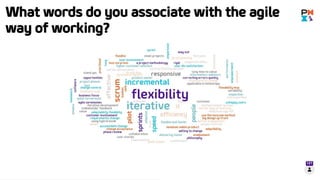
What words do you associate with the agile way of working?
Some common mis-conceptions about agile delivery?
• Poor quality – people do not know the difference between scope and quality
• Quicker than other delivery methods
• Need to work longer hours to hit a fixed deadline
• You can keep adding to the scope
• Everything must be delivered
• Being agile means being “out of control”
• Will fix all project management ills
NOW LET’S CONSIDER
HOW WE CONTROL
PROJECTS
18 MARCH 2021
Presentation Title 6
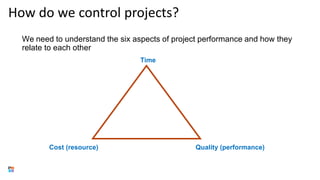
How do we control projects?
We need to understand the six aspects of project performance and how they
relate to each other
Time
Cost (resource) Quality (performance)
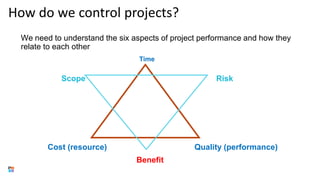
How do we control projects?
We need to understand the six aspects of project performance and how they
relate to each other
Time
Cost (resource) Quality (performance)
Scope Risk
Benefit
What is the waterfall way of working?
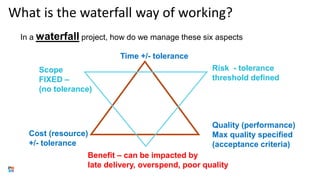
In a waterfall project, how do we manage these six aspects
Time +/- tolerance
Cost (resource)
+/- tolerance
Quality (performance)
Max quality specified
(acceptance criteria)
Scope
FIXED –
(no tolerance)
Risk - tolerance
threshold defined
Benefit – can be impacted by
late delivery, overspend, poor quality
What is the waterfall way of working?
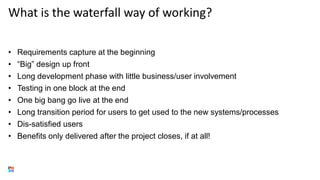
• Requirements capture at the beginning
• “Big” design up front
• Long development phase with little business/user involvement
• Testing in one block at the end
• One big bang go live at the end
• Long transition period for users to get used to the new systems/processes
• Dis-satisfied users
• Benefits only delivered after the project closes, if at all!
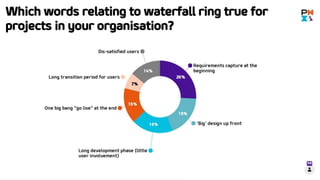
Which words relating to waterfall ring true for projects you have
seen in your organization?
What is the agile way of working?
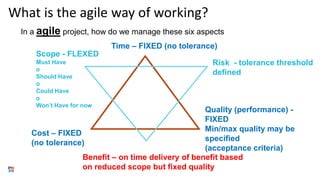
In a agile project, how do we manage these six aspects
Time – FIXED (no tolerance)
Cost – FIXED
(no tolerance)
Quality (performance) -
FIXED
Min/max quality may be
specified
(acceptance criteria)
Scope - FLEXED
Must Have
o
Should Have
o
Could Have
o
Won’t Have for now
Risk - tolerance threshold
defined
Benefit – on time delivery of benefit based
on reduced scope but fixed quality
What is the agile way of working?
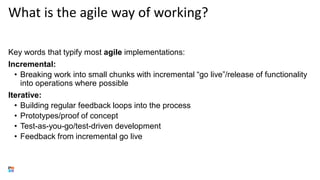
Key words that typify most agile implementations:
Incremental:
• Breaking work into small chunks with incremental “go live”/release of functionality
into operations where possible
Iterative:
• Building regular feedback loops into the process
• Prototypes/proof of concept
• Test-as-you-go/test-driven development
• Feedback from incremental go live
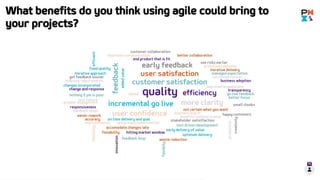
What benefits do you think using agile could bring to your
projects?
Benefits of the agile way of working
• Early delivery of benefits through incremental delivery
• Reduced risk of delivering the wrong product
• Reduced risk of delivering late/overspent
• Increased business involvement through user participation throughout
• Delivery of what the user actually wants rather than what they think they want at
the beginning
• Delivery in smaller chunks making change easier to absorb into operations
• Delivery of highest priority requirements – biggest “bang for buck” rather less
important requirements
• And many more….?
WHAT IS PRINCE2®
AND WHAT IS PRINCE2
AGIILE®?
18 MARCH 2021
Presentation Title 16
What is PRINCE2?
• PRINCE2® is a project management method widely adopted around the world
• PRINCE2® certifications are held and used in 220 countries* around the world
• Over 2 million PRINCE2® certifications taken globally, to date
18 MARCH 2021
Presentation Title 17
* This includes dependant territories/special areas of geographical interest using ISO3166 standard (as at 29 November 2019)
What is PRINCE2?
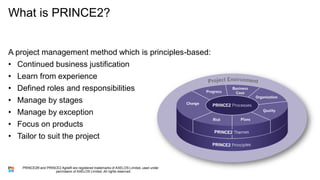
A project management method which is principles-based:
• Continued business justification
• Learn from experience
• Defined roles and responsibilities
• Manage by stages
• Manage by exception
• Focus on products
• Tailor to suit the project
PRINCE2® and PRINCE2 Agile® are registered trademarks of AXELOS Limited, used under
permission of AXELOS Limited. All rights reserved.
What is PRINCE2 Agile?
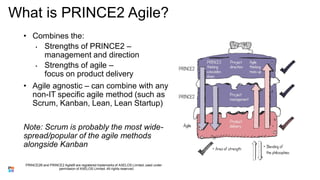
• Combines the:
• Strengths of PRINCE2 –
management and direction
• Strengths of agile –
focus on product delivery
• Agile agnostic – can combine with any
non-IT specific agile method (such as
Scrum, Kanban, Lean, Lean Startup)
Note: Scrum is probably the most wide-
spread/popular of the agile methods
alongside Kanban
PRINCE2® and PRINCE2 Agile® are registered trademarks of AXELOS Limited, used under
permission of AXELOS Limited. All rights reserved.
What is Scrum?
• “A lightweight framework that helps people, teams and organizations generate
value through adaptive solutions for complex problems”
• A collection of roles, events, artefacts and rules
• Created by Schwaber and Sutherland (c. 1995 and updated in 2017 and 2020)
• A way to assess the efficacy of your practices, so that you can improve (based on
pillars of transparency, inspection, adaptation)
• Points to note:
• Most recent publication now has more focus on product goal
• No concept of business case and benefits (focuses on value to the business
instead)
• Little control or governance outside of the self-organizing team
Key Scrum characteristics
• Small, empowered, self-organizing team of developers (max 10 people in a team)
• Servant leadership (scrum master) - no team manager/leader
• Scrum master’s role is to be accountable for the scrum team’s effectiveness and
serve the scrum team, product owner and the organization
• Single user representative (product owner)
Key Scrum characteristics (cont’d)
• Focuses on the product goal represented on a product backlog (longer term
requirements)
• Focuses on the sprint goal for the immediate timebox/sprint represented on the
sprint backlog (work of next sprint)
• Can be adapted to include more “project-like” focus with vision, roadmaps, sprint
zero/discovery phase, release backlog (but these adaptations are not a core
element of the Scrum Guide – November 2020)
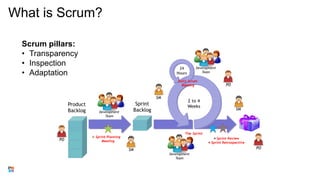
What is Scrum?
Scrum pillars:
• Transparency
• Inspection
• Adaptation
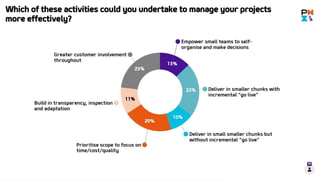
Which activities could you undertake now on your existing projects to
help you manage them more effectively?
18 MARCH 2021
Presentation Title 24
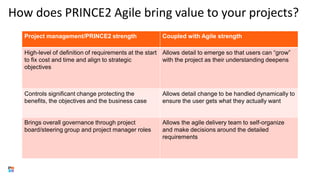
How does PRINCE2 Agile bring value to your projects?
Project management/PRINCE2 strength Coupled with Agile strength
High-level of definition of requirements at the start
to fix cost and time and align to strategic
objectives
Allows detail to emerge so that users can “grow”
with the project as their understanding deepens
Controls significant change protecting the
benefits, the objectives and the business case
Allows detail change to be handled dynamically to
ensure the user gets what they actually want
Brings overall governance through project
board/steering group and project manager roles
Allows the agile delivery team to self-organize
and make decisions around the detailed
requirements
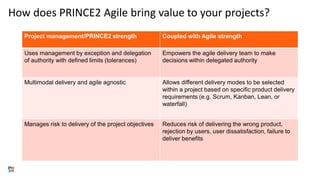
How does PRINCE2 Agile bring value to your projects?
Project management/PRINCE2 strength Coupled with Agile strength
Uses management by exception and delegation
of authority with defined limits (tolerances)
Empowers the agile delivery team to make
decisions within delegated authority
Multimodal delivery and agile agnostic Allows different delivery modes to be selected
within a project based on specific product delivery
requirements (e.g. Scrum, Kanban, Lean, or
waterfall)
Manages risk to delivery of the project objectives Reduces risk of delivering the wrong product,
rejection by users, user dissatisfaction, failure to
deliver benefits
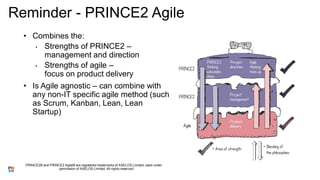
Reminder - PRINCE2 Agile
• Combines the:
• Strengths of PRINCE2 –
management and direction
• Strengths of agile –
focus on product delivery
• Is Agile agnostic – can combine with
any non-IT specific agile method (such
as Scrum, Kanban, Lean, Lean
Startup)
PRINCE2® and PRINCE2 Agile® are registered trademarks of AXELOS Limited, used under
permission of AXELOS Limited. All rights reserved.
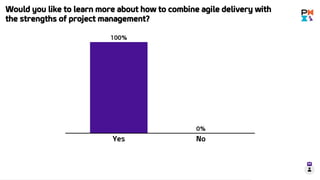
Would you like to learn more about how to combine agile delivery with
the strengths of project management?
18 MARCH 2021
Presentation Title 28
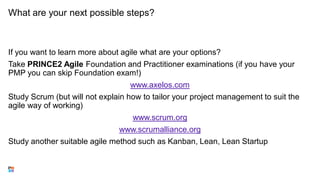
What are your next possible steps?
If you want to learn more about agile what are your options?
Take PRINCE2 Agile Foundation and Practitioner examinations (if you have your
PMP you can skip Foundation exam!)
www.axelos.com
Study Scrum (but will not explain how to tailor your project management to suit the
agile way of working)
www.scrum.org
www.scrumalliance.org
Study another suitable agile method such as Kanban, Lean, Lean Startup
18 MARCH 2021
Presentation Title 30
18 MARCH 2021
Presentation Title 31

How to revolutionize your projects using prince2 agile

  • 1.
    HOW USING PRINCE2 AGILECOULD REVOLUTIONIZE YOUR PROJECTS Michelle Rowland PRINCE2® and PRINCE2 Agile® Lead Examiner on behalf of AXELOS Ltd 18/03/2021
  • 2.
    FIRST LET’S SEE WHATWE ALREADY “UNDERSTAND” BY THE TERM “AGILE” 18 MARCH 2021 Presentation Title 2
  • 3.
  • 4.
    What words doyou associate with the agile way of working?
  • 5.
    Some common mis-conceptionsabout agile delivery? • Poor quality – people do not know the difference between scope and quality • Quicker than other delivery methods • Need to work longer hours to hit a fixed deadline • You can keep adding to the scope • Everything must be delivered • Being agile means being “out of control” • Will fix all project management ills
  • 6.
    NOW LET’S CONSIDER HOWWE CONTROL PROJECTS 18 MARCH 2021 Presentation Title 6
  • 7.
    How do wecontrol projects? We need to understand the six aspects of project performance and how they relate to each other Time Cost (resource) Quality (performance)
  • 8.
    How do wecontrol projects? We need to understand the six aspects of project performance and how they relate to each other Time Cost (resource) Quality (performance) Scope Risk Benefit
  • 9.
    What is thewaterfall way of working? In a waterfall project, how do we manage these six aspects Time +/- tolerance Cost (resource) +/- tolerance Quality (performance) Max quality specified (acceptance criteria) Scope FIXED – (no tolerance) Risk - tolerance threshold defined Benefit – can be impacted by late delivery, overspend, poor quality
  • 10.
    What is thewaterfall way of working? • Requirements capture at the beginning • “Big” design up front • Long development phase with little business/user involvement • Testing in one block at the end • One big bang go live at the end • Long transition period for users to get used to the new systems/processes • Dis-satisfied users • Benefits only delivered after the project closes, if at all!
  • 11.
    Which words relatingto waterfall ring true for projects you have seen in your organization?
  • 12.
    What is theagile way of working? In a agile project, how do we manage these six aspects Time – FIXED (no tolerance) Cost – FIXED (no tolerance) Quality (performance) - FIXED Min/max quality may be specified (acceptance criteria) Scope - FLEXED Must Have o Should Have o Could Have o Won’t Have for now Risk - tolerance threshold defined Benefit – on time delivery of benefit based on reduced scope but fixed quality
  • 13.
    What is theagile way of working? Key words that typify most agile implementations: Incremental: • Breaking work into small chunks with incremental “go live”/release of functionality into operations where possible Iterative: • Building regular feedback loops into the process • Prototypes/proof of concept • Test-as-you-go/test-driven development • Feedback from incremental go live
  • 14.
    What benefits doyou think using agile could bring to your projects?
  • 15.
    Benefits of theagile way of working • Early delivery of benefits through incremental delivery • Reduced risk of delivering the wrong product • Reduced risk of delivering late/overspent • Increased business involvement through user participation throughout • Delivery of what the user actually wants rather than what they think they want at the beginning • Delivery in smaller chunks making change easier to absorb into operations • Delivery of highest priority requirements – biggest “bang for buck” rather less important requirements • And many more….?
  • 16.
    WHAT IS PRINCE2® ANDWHAT IS PRINCE2 AGIILE®? 18 MARCH 2021 Presentation Title 16
  • 17.
    What is PRINCE2? •PRINCE2® is a project management method widely adopted around the world • PRINCE2® certifications are held and used in 220 countries* around the world • Over 2 million PRINCE2® certifications taken globally, to date 18 MARCH 2021 Presentation Title 17 * This includes dependant territories/special areas of geographical interest using ISO3166 standard (as at 29 November 2019)
  • 18.
    What is PRINCE2? Aproject management method which is principles-based: • Continued business justification • Learn from experience • Defined roles and responsibilities • Manage by stages • Manage by exception • Focus on products • Tailor to suit the project PRINCE2® and PRINCE2 Agile® are registered trademarks of AXELOS Limited, used under permission of AXELOS Limited. All rights reserved.
  • 19.
    What is PRINCE2Agile? • Combines the: • Strengths of PRINCE2 – management and direction • Strengths of agile – focus on product delivery • Agile agnostic – can combine with any non-IT specific agile method (such as Scrum, Kanban, Lean, Lean Startup) Note: Scrum is probably the most wide- spread/popular of the agile methods alongside Kanban PRINCE2® and PRINCE2 Agile® are registered trademarks of AXELOS Limited, used under permission of AXELOS Limited. All rights reserved.
  • 20.
    What is Scrum? •“A lightweight framework that helps people, teams and organizations generate value through adaptive solutions for complex problems” • A collection of roles, events, artefacts and rules • Created by Schwaber and Sutherland (c. 1995 and updated in 2017 and 2020) • A way to assess the efficacy of your practices, so that you can improve (based on pillars of transparency, inspection, adaptation) • Points to note: • Most recent publication now has more focus on product goal • No concept of business case and benefits (focuses on value to the business instead) • Little control or governance outside of the self-organizing team
  • 21.
    Key Scrum characteristics •Small, empowered, self-organizing team of developers (max 10 people in a team) • Servant leadership (scrum master) - no team manager/leader • Scrum master’s role is to be accountable for the scrum team’s effectiveness and serve the scrum team, product owner and the organization • Single user representative (product owner)
  • 22.
    Key Scrum characteristics(cont’d) • Focuses on the product goal represented on a product backlog (longer term requirements) • Focuses on the sprint goal for the immediate timebox/sprint represented on the sprint backlog (work of next sprint) • Can be adapted to include more “project-like” focus with vision, roadmaps, sprint zero/discovery phase, release backlog (but these adaptations are not a core element of the Scrum Guide – November 2020)
  • 23.
    What is Scrum? Scrumpillars: • Transparency • Inspection • Adaptation
  • 24.
    Which activities couldyou undertake now on your existing projects to help you manage them more effectively? 18 MARCH 2021 Presentation Title 24
  • 25.
    How does PRINCE2Agile bring value to your projects? Project management/PRINCE2 strength Coupled with Agile strength High-level of definition of requirements at the start to fix cost and time and align to strategic objectives Allows detail to emerge so that users can “grow” with the project as their understanding deepens Controls significant change protecting the benefits, the objectives and the business case Allows detail change to be handled dynamically to ensure the user gets what they actually want Brings overall governance through project board/steering group and project manager roles Allows the agile delivery team to self-organize and make decisions around the detailed requirements
  • 26.
    How does PRINCE2Agile bring value to your projects? Project management/PRINCE2 strength Coupled with Agile strength Uses management by exception and delegation of authority with defined limits (tolerances) Empowers the agile delivery team to make decisions within delegated authority Multimodal delivery and agile agnostic Allows different delivery modes to be selected within a project based on specific product delivery requirements (e.g. Scrum, Kanban, Lean, or waterfall) Manages risk to delivery of the project objectives Reduces risk of delivering the wrong product, rejection by users, user dissatisfaction, failure to deliver benefits
  • 27.
    Reminder - PRINCE2Agile • Combines the: • Strengths of PRINCE2 – management and direction • Strengths of agile – focus on product delivery • Is Agile agnostic – can combine with any non-IT specific agile method (such as Scrum, Kanban, Lean, Lean Startup) PRINCE2® and PRINCE2 Agile® are registered trademarks of AXELOS Limited, used under permission of AXELOS Limited. All rights reserved.
  • 28.
    Would you liketo learn more about how to combine agile delivery with the strengths of project management? 18 MARCH 2021 Presentation Title 28
  • 29.
    What are yournext possible steps? If you want to learn more about agile what are your options? Take PRINCE2 Agile Foundation and Practitioner examinations (if you have your PMP you can skip Foundation exam!) www.axelos.com Study Scrum (but will not explain how to tailor your project management to suit the agile way of working) www.scrum.org www.scrumalliance.org Study another suitable agile method such as Kanban, Lean, Lean Startup
  • 30.
  • 31.