La Société informatique de
          France

                  Colin de la Higuera
                      fOSSA, Lille
                  4th December 2012

http://www.societe-informatique-de-france.fr/


                                                1
Small vocabulary issue

The French word Informatique covers a complex
reality, which does not match ICT, Information
Technology, Informatics or Computer Science
I will use either and all of these terms in this talk.


                                                         2
A small presentation of the SIF


The 31st May 2012
  Specif became SIF, the Société Informatique de
  France
  Members approved changes in rules allowing to ask
  to become Association Reconnue d’Utilité Publique


                                                      3
                                                      3
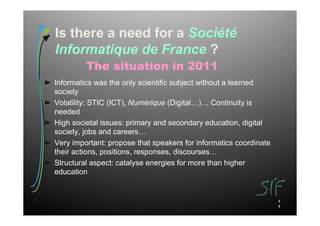
Is there a need for a Société
Informatique de France ?
         The situation in 2011
Informatics was the only scientific subject without a learned
society
Volatility: STIC (ICT), Numérique (Digital…)… Continuity is
needed
High societal issues: primary and secondary education, digital
society, jobs and careers…
Very important: propose that speakers for informatics coordinate
their actions, positions, responses, discourses…
Structural aspect: catalyse energies for more than higher
education


                                                                   4
                                                                   4
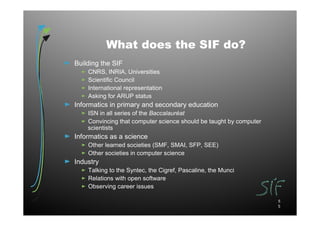
What does the SIF do?
Building the SIF
    CNRS, INRIA, Universities
    Scientific Council
    International representation
    Asking for ARUP status
Informatics in primary and secondary education
    ISN in all series of the Baccalauréat
    Convincing that computer science should be taught by computer
    scientists
Informatics as a science
    Other learned societies (SMF, SMAI, SFP, SEE)
    Other societies in computer science
Industry
    Talking to the Syntec, the Cigref, Pascaline, the Munci
    Relations with open software
    Observing career issues

                                                                    5
                                                                    5
Some key questions


Informatics in education
Informatics in the digital world
Informatics as a science
Informatics, jobs and careers


                                   6
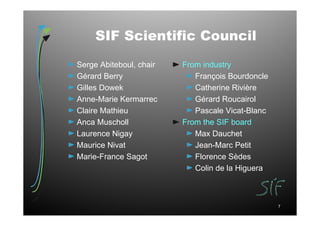
SIF Scientific Council
Serge Abiteboul, chair   From industry
Gérard Berry                François Bourdoncle
Gilles Dowek                Catherine Rivière
Anne-Marie Kermarrec        Gérard Roucairol
Claire Mathieu              Pascale Vicat-Blanc
Anca Muscholl            From the SIF board
Laurence Nigay              Max Dauchet
Maurice Nivat               Jean-Marc Petit
Marie-France Sagot          Florence Sèdes
                            Colin de la Higuera


                                                  7
Is Computer Science more
     open than other sciences?
Permanent contradiction:

Using a M.. to protest against M…!

Who do I hate more?
    The person who sends me a docx I can’t open
    The person who refuses to open my rtf
In all universities there are a few experts, but
generally there isn’t a policy
Key problem:
    Misunderstanding the problem

                                                   8
Proposed answer #1

Open concepts are difficult to understand without a
background in Informatics
That is why teaching Informatics in secondary
education is essential
Furthermore, the teacher has to know what he is
talking about: he should be trained and qualified for
that job
[If I have to teach cooking, I can do it from the books
and teach cooking from the books ]


                                                          9
Understanding is essential

Second reason of students for not picking CS at
University is that when they have their first course,
they believe it is too late
This is particularly the case for girls


                                                        10
Proposed answer #2

Open Education
We all write lectures (more than we write software!)
We typically prepare our lectures by reading books
and articles and downloading stuff from the web
Then we don’t know
   If we are allowed to (re)-use the stuff
   If we are allowed to be filmed using the stuff
   If we can distribute our courses containing the
  stuff


                                                       11
Proposal

Convince the academia to share their teaching
resources
As a side effect, they should build a non theoretical
understanding of open software issues


                                                        12
advancing formal and informal learning through the
                           worldwide sharing and use of free, open, high-quality
                           education materials organized as courses.


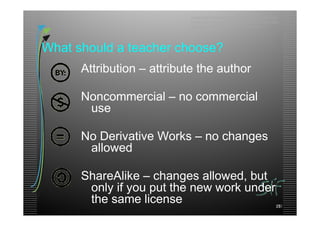
What should a teacher choose?
      Attribution – attribute the author

      Noncommercial – no commercial
       use

      No Derivative Works – no changes
       allowed

      ShareAlike – changes allowed, but
       only if you put the new work under
       the same license                                                       59
                                                                             13
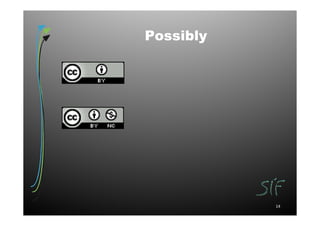
Possibly


           14
advancing formal and informal learning through the
                             worldwide sharing and use of free, open, high-quality
                             education materials organized as courses.


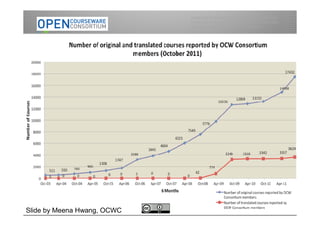
   OCW Course Growth Globally


                                                                               15
Slide by Meena Hwang, OCWC
Open education, links

 www.ocwconsortium.org
 http://openmooc.org/

 http://www.societe-informatique-
de-france.fr/


                                    16

fOSSa2012- sif presentation

  • 1.
    La Société informatiquede France Colin de la Higuera fOSSA, Lille 4th December 2012 http://www.societe-informatique-de-france.fr/ 1
  • 2.
    Small vocabulary issue TheFrench word Informatique covers a complex reality, which does not match ICT, Information Technology, Informatics or Computer Science I will use either and all of these terms in this talk. 2
  • 3.
    A small presentationof the SIF The 31st May 2012 Specif became SIF, the Société Informatique de France Members approved changes in rules allowing to ask to become Association Reconnue d’Utilité Publique 3 3
  • 4.
    Is there aneed for a Société Informatique de France ? The situation in 2011 Informatics was the only scientific subject without a learned society Volatility: STIC (ICT), Numérique (Digital…)… Continuity is needed High societal issues: primary and secondary education, digital society, jobs and careers… Very important: propose that speakers for informatics coordinate their actions, positions, responses, discourses… Structural aspect: catalyse energies for more than higher education 4 4
  • 5.
    What does theSIF do? Building the SIF CNRS, INRIA, Universities Scientific Council International representation Asking for ARUP status Informatics in primary and secondary education ISN in all series of the Baccalauréat Convincing that computer science should be taught by computer scientists Informatics as a science Other learned societies (SMF, SMAI, SFP, SEE) Other societies in computer science Industry Talking to the Syntec, the Cigref, Pascaline, the Munci Relations with open software Observing career issues 5 5
  • 6.
    Some key questions Informaticsin education Informatics in the digital world Informatics as a science Informatics, jobs and careers 6
  • 7.
    SIF Scientific Council SergeAbiteboul, chair From industry Gérard Berry François Bourdoncle Gilles Dowek Catherine Rivière Anne-Marie Kermarrec Gérard Roucairol Claire Mathieu Pascale Vicat-Blanc Anca Muscholl From the SIF board Laurence Nigay Max Dauchet Maurice Nivat Jean-Marc Petit Marie-France Sagot Florence Sèdes Colin de la Higuera 7
  • 8.
    Is Computer Sciencemore open than other sciences? Permanent contradiction: Using a M.. to protest against M…! Who do I hate more? The person who sends me a docx I can’t open The person who refuses to open my rtf In all universities there are a few experts, but generally there isn’t a policy Key problem: Misunderstanding the problem 8
  • 9.
    Proposed answer #1 Openconcepts are difficult to understand without a background in Informatics That is why teaching Informatics in secondary education is essential Furthermore, the teacher has to know what he is talking about: he should be trained and qualified for that job [If I have to teach cooking, I can do it from the books and teach cooking from the books ] 9
  • 10.
    Understanding is essential Secondreason of students for not picking CS at University is that when they have their first course, they believe it is too late This is particularly the case for girls 10
  • 11.
    Proposed answer #2 OpenEducation We all write lectures (more than we write software!) We typically prepare our lectures by reading books and articles and downloading stuff from the web Then we don’t know If we are allowed to (re)-use the stuff If we are allowed to be filmed using the stuff If we can distribute our courses containing the stuff 11
  • 12.
    Proposal Convince the academiato share their teaching resources As a side effect, they should build a non theoretical understanding of open software issues 12
  • 13.
    advancing formal andinformal learning through the worldwide sharing and use of free, open, high-quality education materials organized as courses. What should a teacher choose? Attribution – attribute the author Noncommercial – no commercial use No Derivative Works – no changes allowed ShareAlike – changes allowed, but only if you put the new work under the same license 59 13
  • 14.
  • 15.
    advancing formal andinformal learning through the worldwide sharing and use of free, open, high-quality education materials organized as courses. OCW Course Growth Globally 15 Slide by Meena Hwang, OCWC
  • 16.
    Open education, links www.ocwconsortium.org http://openmooc.org/ http://www.societe-informatique- de-france.fr/ 16