2
PURPOSE OF BUDGETING(PECCCMAD)
A budget is a quantitative plan prepared for a specific time period. It is
normally expressed in financial terms and prepared for one year.
Budgeting serves a number of purposes:
Planning
Evaluation
Control
Communication
Co-ordination
Motivation
Authorization
Delegation
3.
3
BUDGETING AND PERFORMANCEMANAGEMENT
Budgeting contributes to performance management by
providing benchmarks against which to compare actual results
and develop corrective measures.
Budgets give managers pre-approval for execution of spending
plans and allow them to provide forward looking guidance to
investors and creditors.
Individuals react to the demands of budgeting and budgetary
control in different ways and their behaviour can damage the
budgeting process.
4.
4
APPROACHES TO BUDGETING
There are a number of budgetary systems:
Incremental budgeting
Zero-based budgeting
Rolling budgets
Activity-based budgeting
Top-down budgeting
Bottom-up budgeting
5.
5
FLEXIBLE BUDGETING
Fixedbudget - It is prepared before the beginning of a budget period for a
single level of activity.
Flexible budget – it is prepared for a number of levels of activity and
requires the analysis of costs between fixed and variable elements.
It is prepared at the end of the budget period. It provides a more meaningful
estimate of costs and revenues and is based on the actual level of output.
Budgetary control compares actual results against expected results to
determine the variance which may be favourable or adverse.
A cost is controllable if a manger is responsible for it being incurred or is
able to authorize the expenditure.
Managers should only be evaluated on costs over which they have control.
A notional cost is outside the control of a manager and should not be
included in performance appraised.
7
BEHAVIOURAL ASPECTS OFBUDGETING
Individuals react to the demands of budgeting and budgetary
control in different ways and their behavior can damage the
budgeting process.
Behavioural problems are often linked to management style and
include dysfunctional behaviour and budget slacks.
Budgetary targets will assist motivation and appraisal if they are
at the right level.
Expectations Budget- It is a budget set at current achievable
level.
Aspirations Budgets- It is a budget set at a level which exceeds
the level currently achieved
8.
8
BUDGETING AND PARTICIPATION
•There are basically two ways in which a budget
can be set: from the top down (imposed budget)
or from the bottom up (participatory budget).
9.
9
TOP-DOWN (IMPOSED) BUDGETING
It is a budget set without permitting the ultimate budget user the
opportunity to participate in the budgeting process.
Advantages of Top-Down (Imposed Style):
Involving managers in the setting of budgets is time consuming.
Managers may not have the skills or motivation to participate.
Senior managers have the better overall view of the company and
its resources.
Senior managers are also aware of the long-term strategy of the
company and can prepare budgets which are in line with that.
10.
10
TOP-DOWN (IMPOSED) BUDGETINGCONT.
Managers may build budgetary slack or bias into the
budget in order to make it easier for them to achieve
it.
Managers cannot use budgets to play games which
disadvantage other budget users/holders.
It enhances objectivity.
It discourages pseudo-participation.
11.
11
BOTTOM-UP (PARTICIPATIVE) BUDGETING
It is a budgeting system in which all budget
holders/users are given the opportunity to participate
in setting the budget.
Advantages of participative budgets:
The morale of management is boosted.
Managers are more likely to accept the plans
contained in the budget and strive to achieve them.
Lower level managers have detained knowledge of
their departments than senior managers.
12.
12
INCREMENTAL BUDGETS
Itstarts with the previous year’s budget or actual results and adds or
subtracts an incremental amount to cover inflation and other known
changes.
It is suitable for stable business, where costs are not expected to
change significantly.
Advantages of Incremental
Budgets
Disadvantages of
Incremental Budgets
Quickest and easiest method Builds in previous problems
and inefficiencies
Suitable if the company is
stable and historic figures
are acceptable since only the
increments needs to be
justified
Uneconomic activities may be
continued
managers may spend
unnecessarily in order to use
up their budget.
13.
13
ZERO-BASED BUDGETING (ZBB)
It is a method of budgeting that required each cost element to be specifically
justified, as though the activities to which the budget relates were being
undertaken for the first time.
Without approval, the budget allowance is zero.
It is suitable for allocating resources in areas where spending is discretionary,
and public sector organisations.
There are four distinct stages in the implementation of ZBB.
Managers should specify, for their responsibility centres, those activities that
can be individually evaluated.
Each of the individual activities is then described in a decision package.
Each decision package is evaluated and ranked usually using cost/benefit
analysis.
The resources are then allocated to the various packages
14.
14
ZERO-BASED BUDGETING (ZBB)CONT.
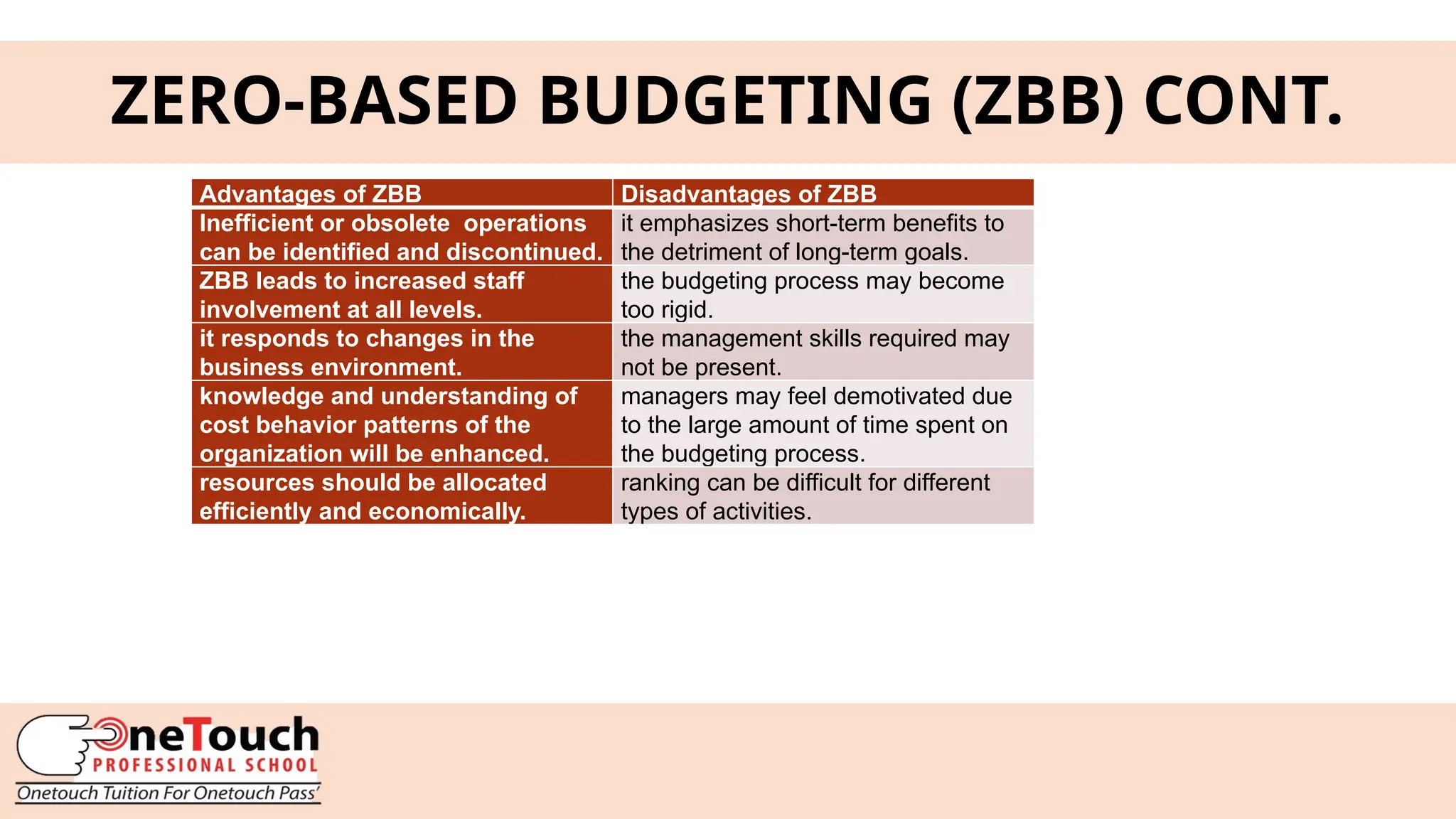
Advantages of ZBB Disadvantages of ZBB
Inefficient or obsolete operations
can be identified and discontinued.
it emphasizes short-term benefits to
the detriment of long-term goals.
ZBB leads to increased staff
involvement at all levels.
the budgeting process may become
too rigid.
it responds to changes in the
business environment.
the management skills required may
not be present.
knowledge and understanding of
cost behavior patterns of the
organization will be enhanced.
managers may feel demotivated due
to the large amount of time spent on
the budgeting process.
resources should be allocated
efficiently and economically.
ranking can be difficult for different
types of activities.
15.
15
ROLLING BUDGET
Itis a budget (usually annual) kept continuously up to date by adding
another accounting period.
It is suitable if accurate forecasts cannot be made or for any areas of
business that needs tight control.
Advantages of Rolling Budget Disadvantages of Rolling Budget
Planning and control will be based on
a more accurate budget.
More costly and time consuming.
It reduces the element of uncertainty
in budgeting
May demotivate employees if they feel
they spend too much time budgeting.
There is always a budget that extends
into the future.
There is the danger that the budget may
become the last year’s budget “plus or
minus a bit”.
It forces management to reassess the
budget regularly.
An increase in budgeting work may lead
to less control of the actual results.
Issues with version control, as each
month the full year numbers will change
17
ACTIVITY BASED BUDGETING(ABB)
It is a method of budgeting based on an activity framework and
utilizing cost driver data in the budget-setting and variance feedback
processes.
It is the preparing of budgets, using overhead costs from activity-
based costing methodology.
Advantages of ABB Disadvantages of ABB
It draws attention to the costs of
‘overhead activities” which can be a
large proportion of total operating
costs.
A considerable amount of time and effort
might be needed to establish the key
activities and their cost drivers.
It recognized that if is activities which
drive costs.
It may be difficult to identify clear
individual responsibilities for activities.
It can provide useful information in
TQM environment.
It could be argued that in the short-term
many overhead costs are not
controllable and do not vary directly with
activity levels.
18.
18
BUDGET MANUAL
There shouldbe a budget manual or budget handbook to guide everyone involved
in the budgeting process. This should set out:
The key objectives of the budget.
Budget planning procedures and budget timetables.
The budget details that must be included in the functional budgets.
Responsibilities for preparing the functional budgets.
Details of the budget approval process. The budget must be approved by the
budget committee and then by the board of directors.
19.
19
THE MASTER BUDGET
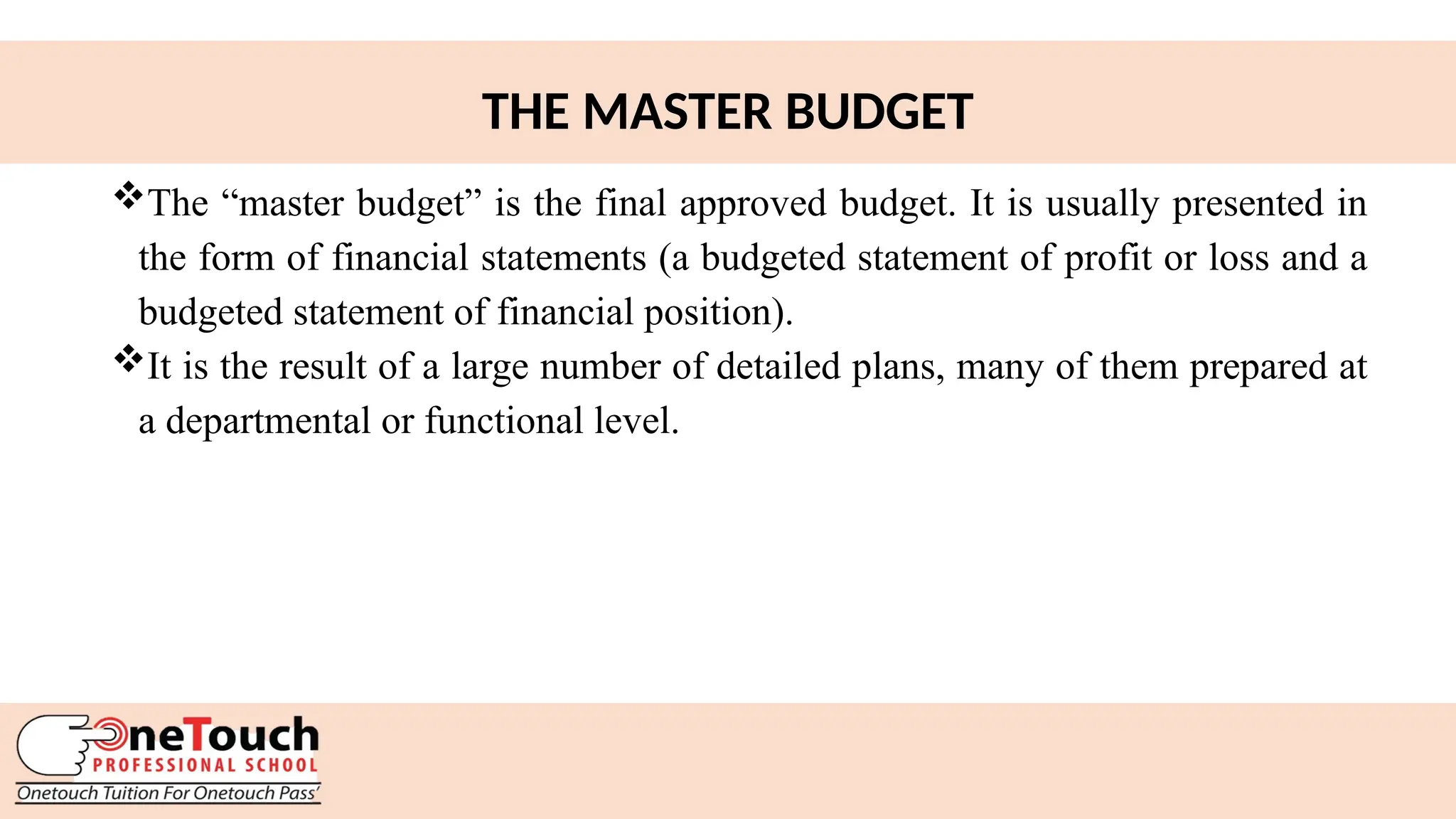
The“master budget” is the final approved budget. It is usually presented in
the form of financial statements (a budgeted statement of profit or loss and a
budgeted statement of financial position).
It is the result of a large number of detailed plans, many of them prepared at
a departmental or functional level.
20.
20
FUNCTIONAL BUDGETS
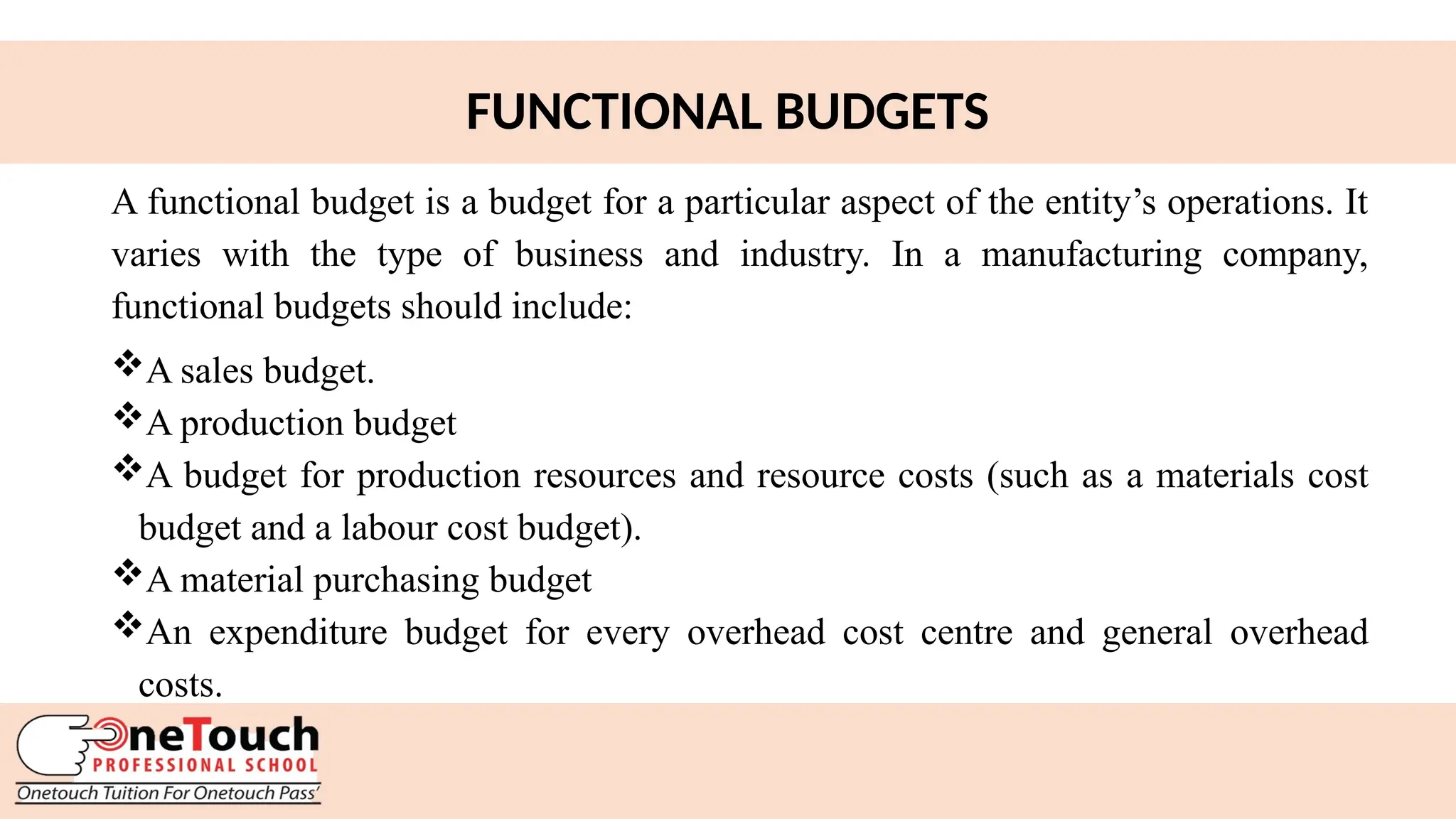
A functionalbudget is a budget for a particular aspect of the entity’s operations. It
varies with the type of business and industry. In a manufacturing company,
functional budgets should include:
A sales budget.
A production budget
A budget for production resources and resource costs (such as a materials cost
budget and a labour cost budget).
A material purchasing budget
An expenditure budget for every overhead cost centre and general overhead
costs.
21.
21
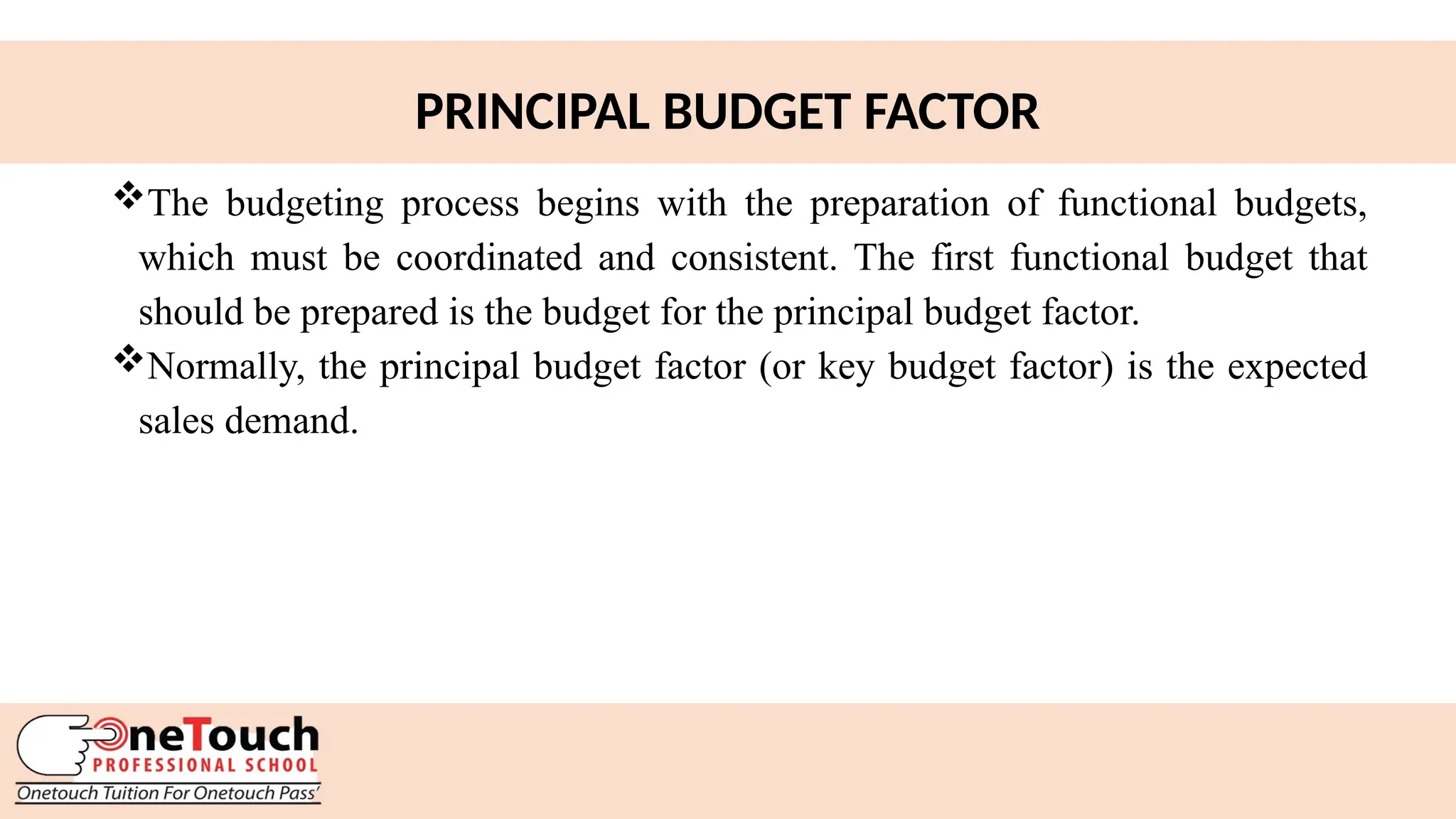
PRINCIPAL BUDGET FACTOR
Thebudgeting process begins with the preparation of functional budgets,
which must be coordinated and consistent. The first functional budget that
should be prepared is the budget for the principal budget factor.
Normally, the principal budget factor (or key budget factor) is the expected
sales demand.
22.
22
PROFILED BUDGETS
Most budgetsare prepared to cover a 12-month period and broken down into
months.
Budgetary control involves comparing actual results to a budget and taking
corrective action where needed.
Thus, a budgetary control system will usually compare actual performance for
the month to the budget for the month and actual performance for the year to the
budget for the year.
A profile budget reflects the expected pattern of expenses and income across the
year. This is important, as some parts of a budget do not occur evenly each
month of the year.
23.
23
BEHAVIOURAL FACTORS
Unfortunately, inpractice human behaviour in the budgeting process often has a
negative effect. There are several possible reasons why behavioural factors can be
harmful:
Misunderstanding and worries about cost-cutting.
Opposition to unfair targets set by senior management.
Blame culture.
Sub-optimisation (dysfunctional behaviour).
Budget slack or budget bias,
24.
24
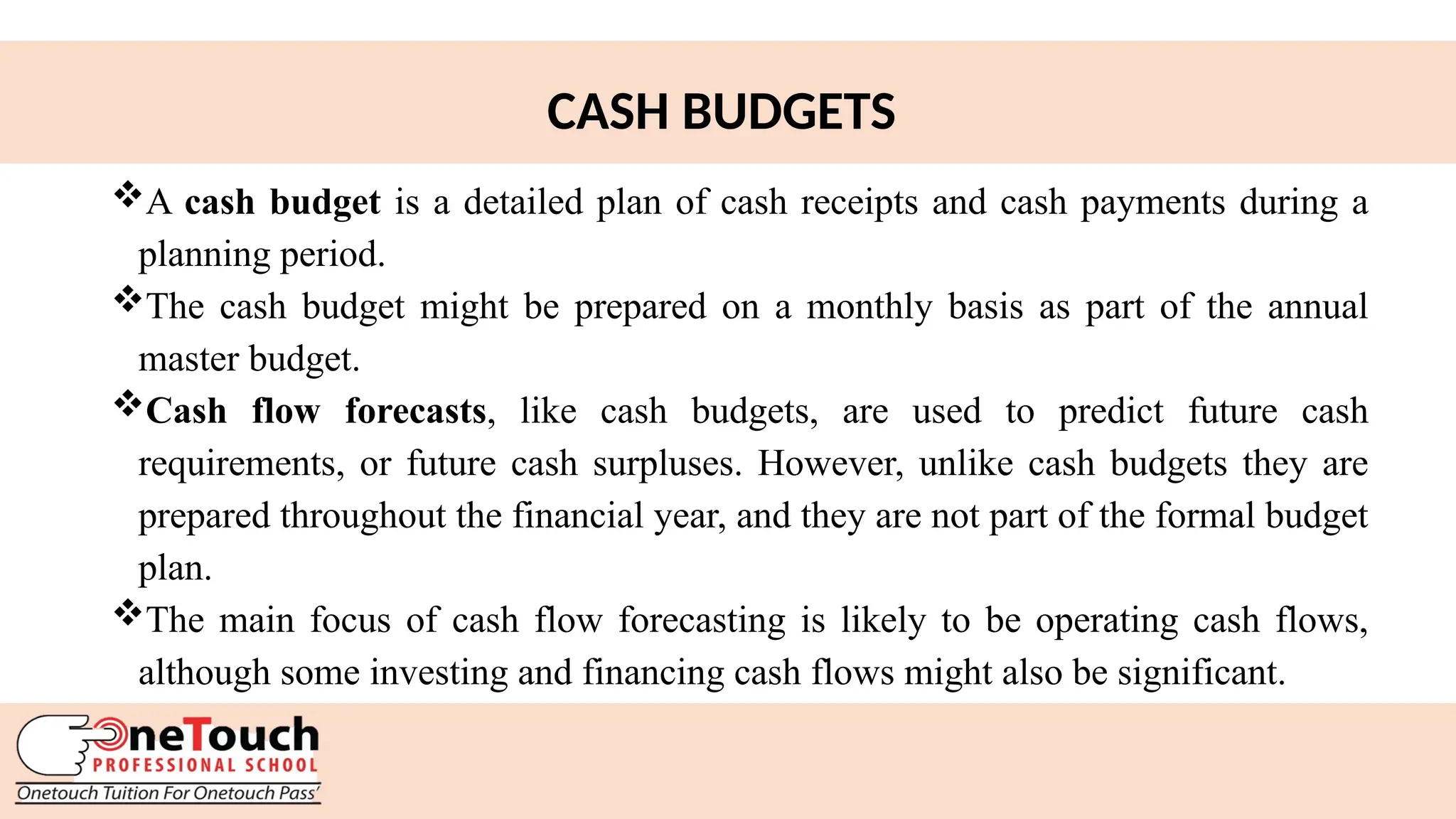
CASH BUDGETS
A cashbudget is a detailed plan of cash receipts and cash payments during a
planning period.
The cash budget might be prepared on a monthly basis as part of the annual
master budget.
Cash flow forecasts, like cash budgets, are used to predict future cash
requirements, or future cash surpluses. However, unlike cash budgets they are
prepared throughout the financial year, and they are not part of the formal budget
plan.
The main focus of cash flow forecasting is likely to be operating cash flows,
although some investing and financing cash flows might also be significant.
25.
25
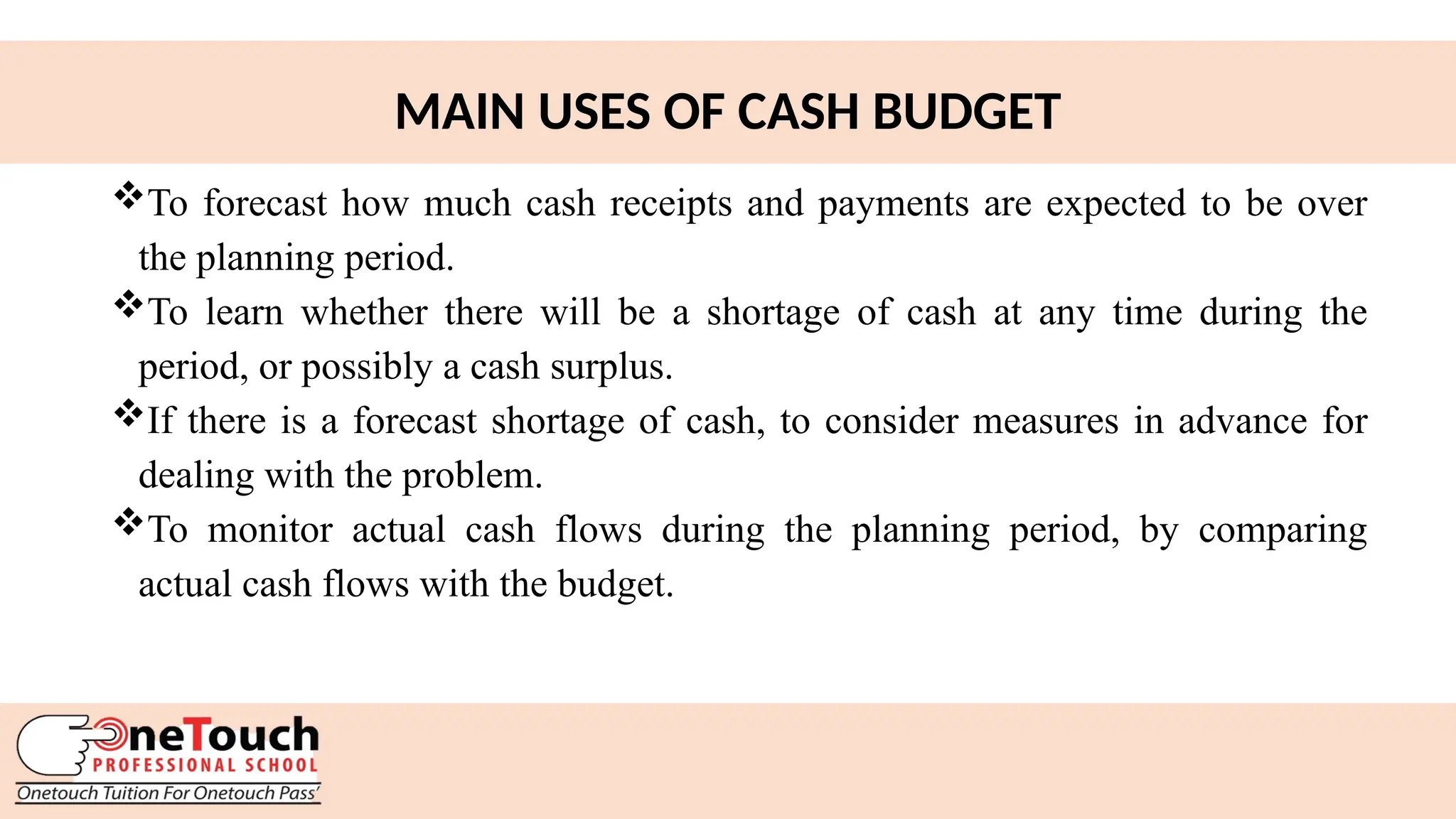
MAIN USES OFCASH BUDGET
To forecast how much cash receipts and payments are expected to be over
the planning period.
To learn whether there will be a shortage of cash at any time during the
period, or possibly a cash surplus.
If there is a forecast shortage of cash, to consider measures in advance for
dealing with the problem.
To monitor actual cash flows during the planning period, by comparing
actual cash flows with the budget.
26.
26
FORMAT OF ACASH BUDGET
Cash receipts: January
GH¢
February
GH¢
March
GH¢
Cash sales 500 600 500
Cash from credit sales 7200 6400 6400
Other cash receipts 400 200 200
Total cash receipts 8100 7200 7100
Cash payments:
Cash purchases 600 660 620
Payments for credit purchases 840 900 990
Rental payments - 3000 -
Wages and salaries 2300 2300 2300
Dividend payments - - 400
Other payments 300 7300 1300
Total cash payments (4040) (14160) (9210)
Net cash flow 4060 (6960) (2110)
Cash balance at the beginning 4500 8560 1600
Cash balance at the end 8560 1600 (510)
27.
27
FORMAT OF SALESBUDGET
Product Budgeted sales
quantity
Units
Budgeted sales
price
GH¢
Budgeted sales
revenue
GH¢
A 200 40 8,000
B 300 50 15,000
Total 23,000
28.
28
FORMAT OF PRODUCTIONBUDGET
Units
Sales budget in units xx
Add: Budget closing inventory of F.G xx
Less: Opening inventory of F.G xx
Production budget xx
29.
29
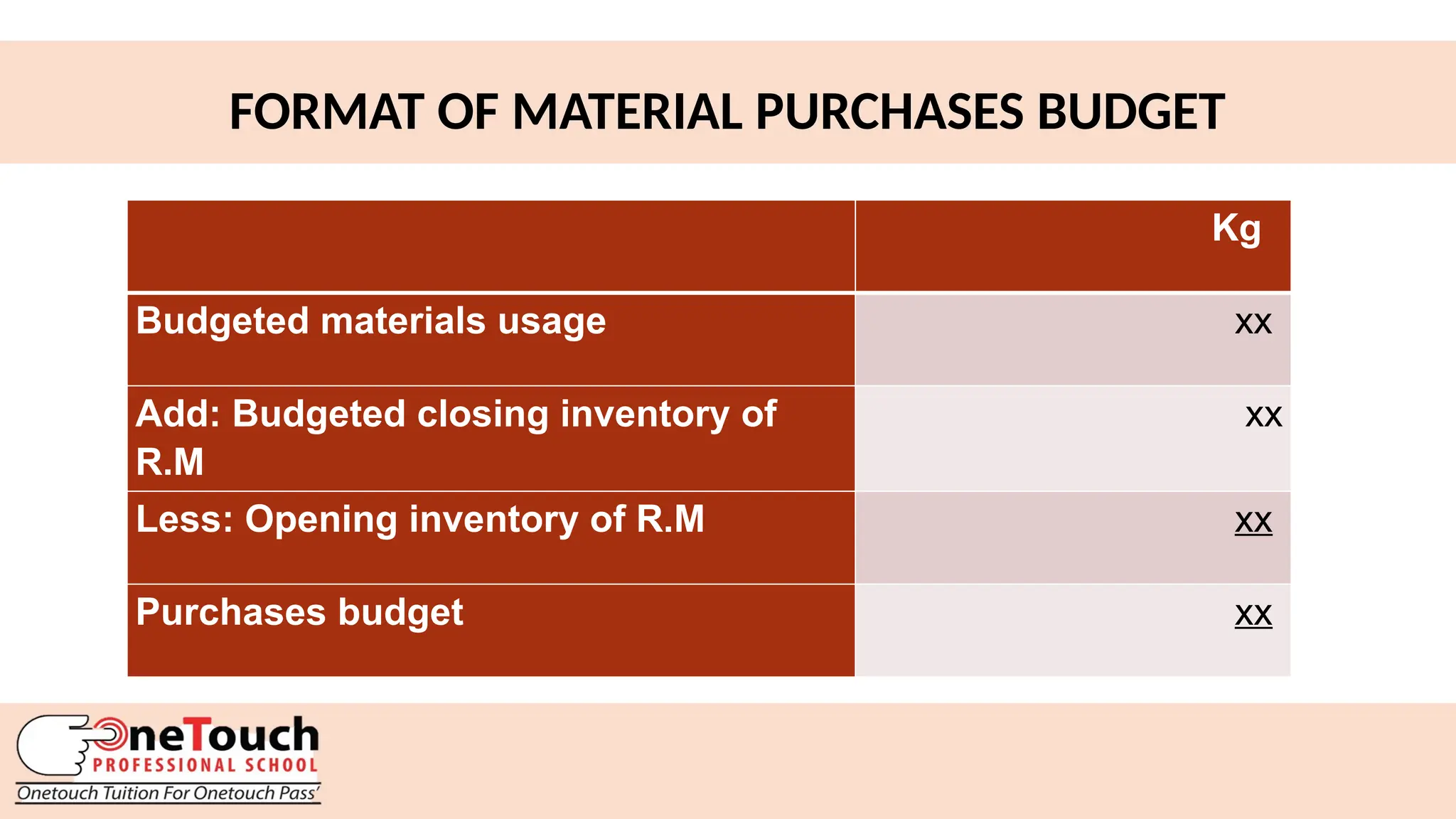
FORMAT OF MATERIALPURCHASES BUDGET
Kg
Budgeted materials usage xx
Add: Budgeted closing inventory of
R.M
xx
Less: Opening inventory of R.M xx
Purchases budget xx
30.
30
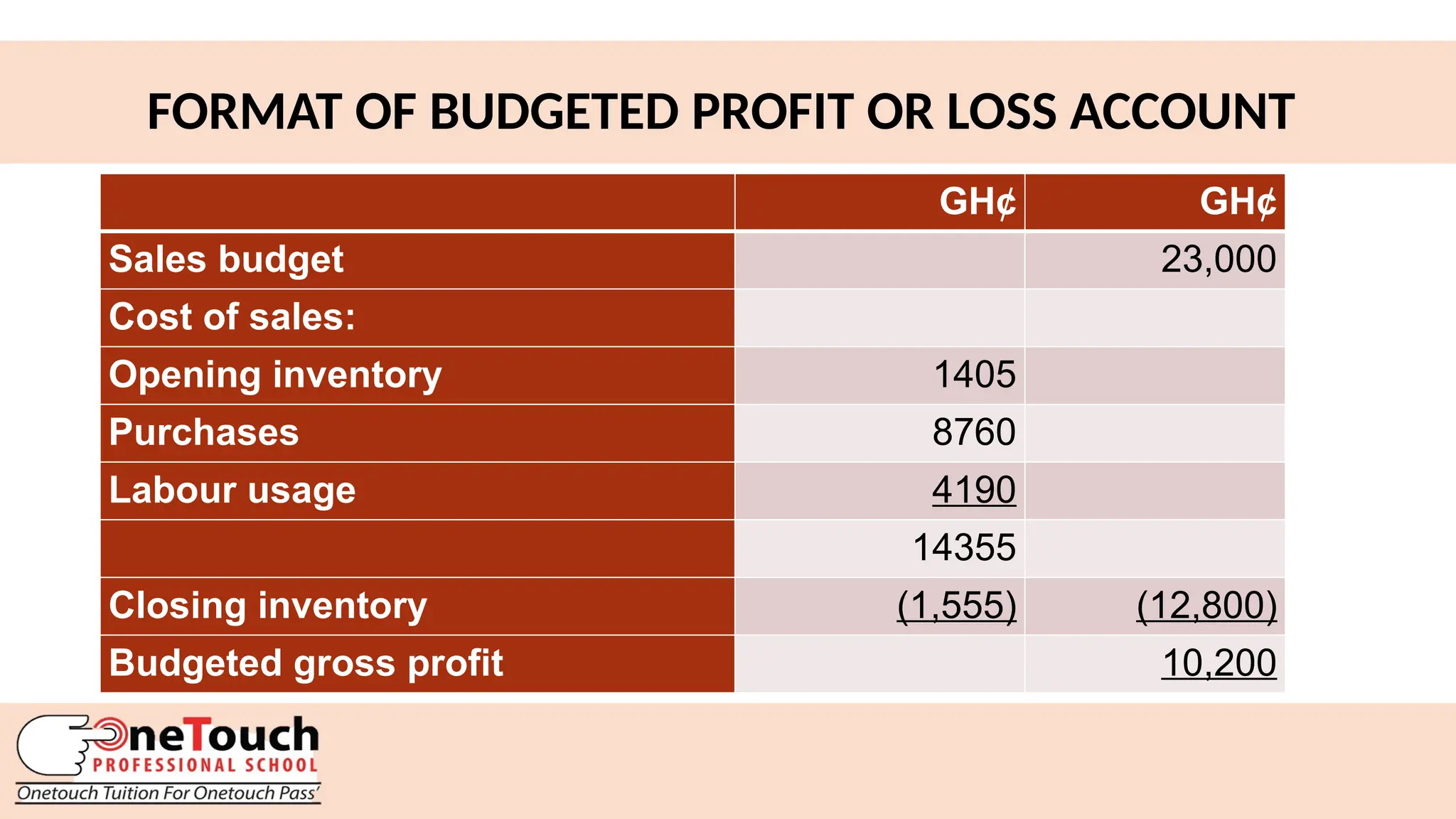
FORMAT OF BUDGETEDPROFIT OR LOSS ACCOUNT
GH¢ GH¢
Sales budget 23,000
Cost of sales:
Opening inventory 1405
Purchases 8760
Labour usage 4190
14355
Closing inventory (1,555) (12,800)
Budgeted gross profit 10,200
31.
31
MATERIALS USAGE BUDGETFORMAT
Total production quantity x materials required per unit.
You may need to gross up the material required per unit so pay attention to
the examiner.