2
Turing Machines are…
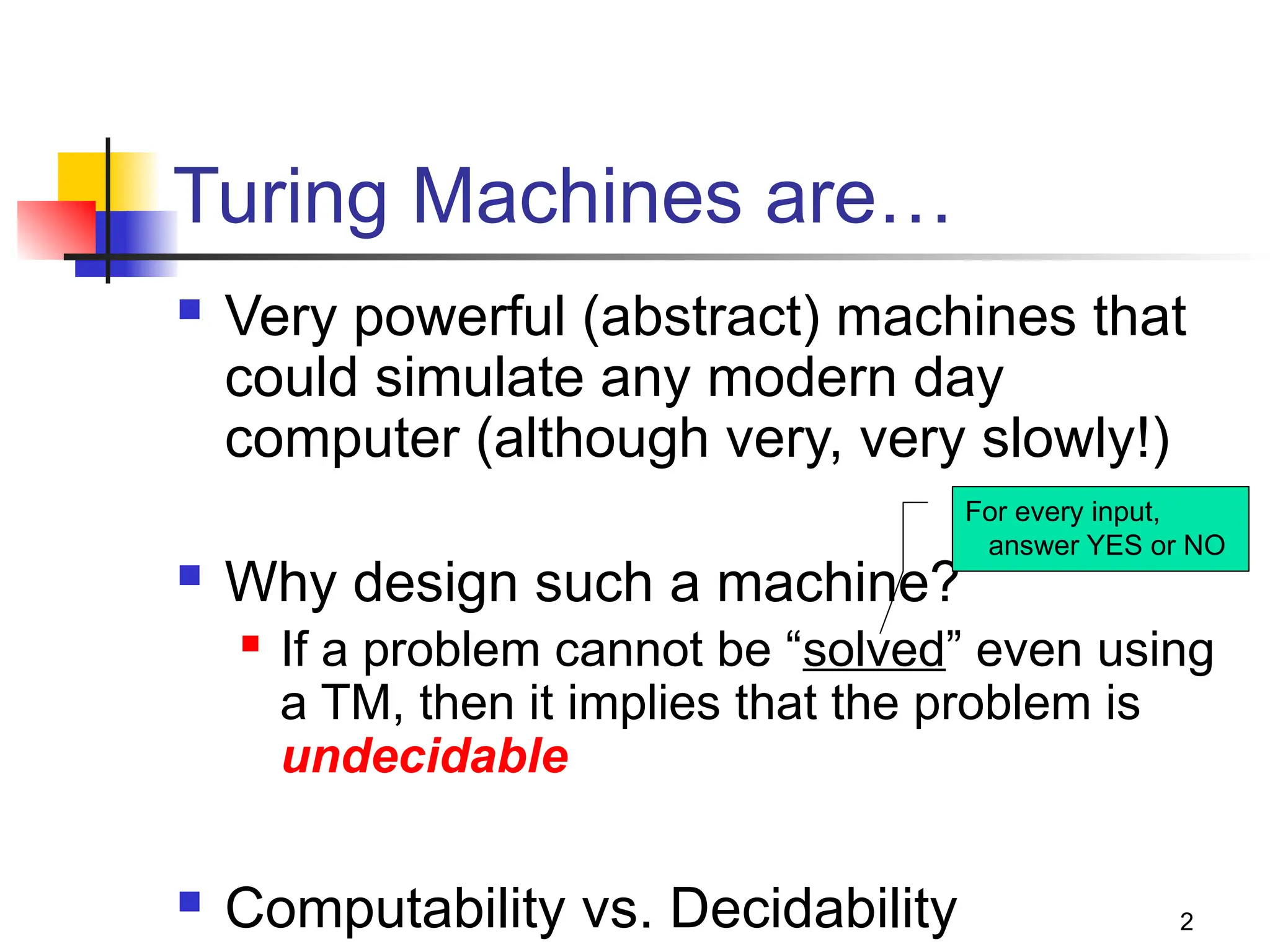
Very powerful (abstract) machines that
could simulate any modern day
computer (although very, very slowly!)
Why design such a machine?
If a problem cannot be “solved” even using
a TM, then it implies that the problem is
undecidable
Computability vs. Decidability
For every input,
answer YES or NO
3.
3
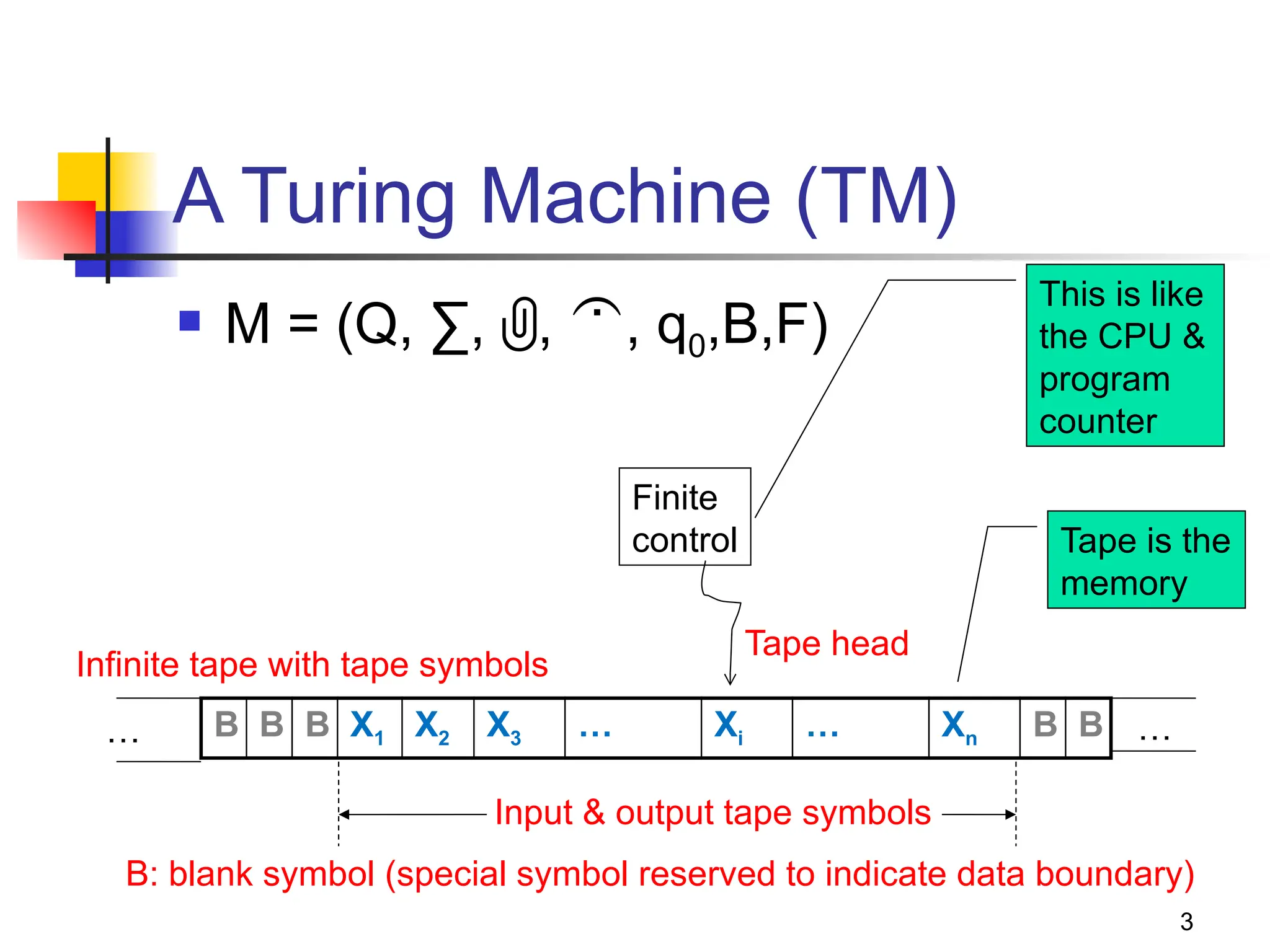
A Turing Machine(TM)
M = (Q, ∑, , , q0,B,F)
B B B X1 X2 X3 … Xi … Xn B B
… …
Finite
control
Infinite tape with tape symbols
B: blank symbol (special symbol reserved to indicate data boundary)
Input & output tape symbols
Tape head
This is like
the CPU &
program
counter
Tape is the
memory
4.
4
Transition function
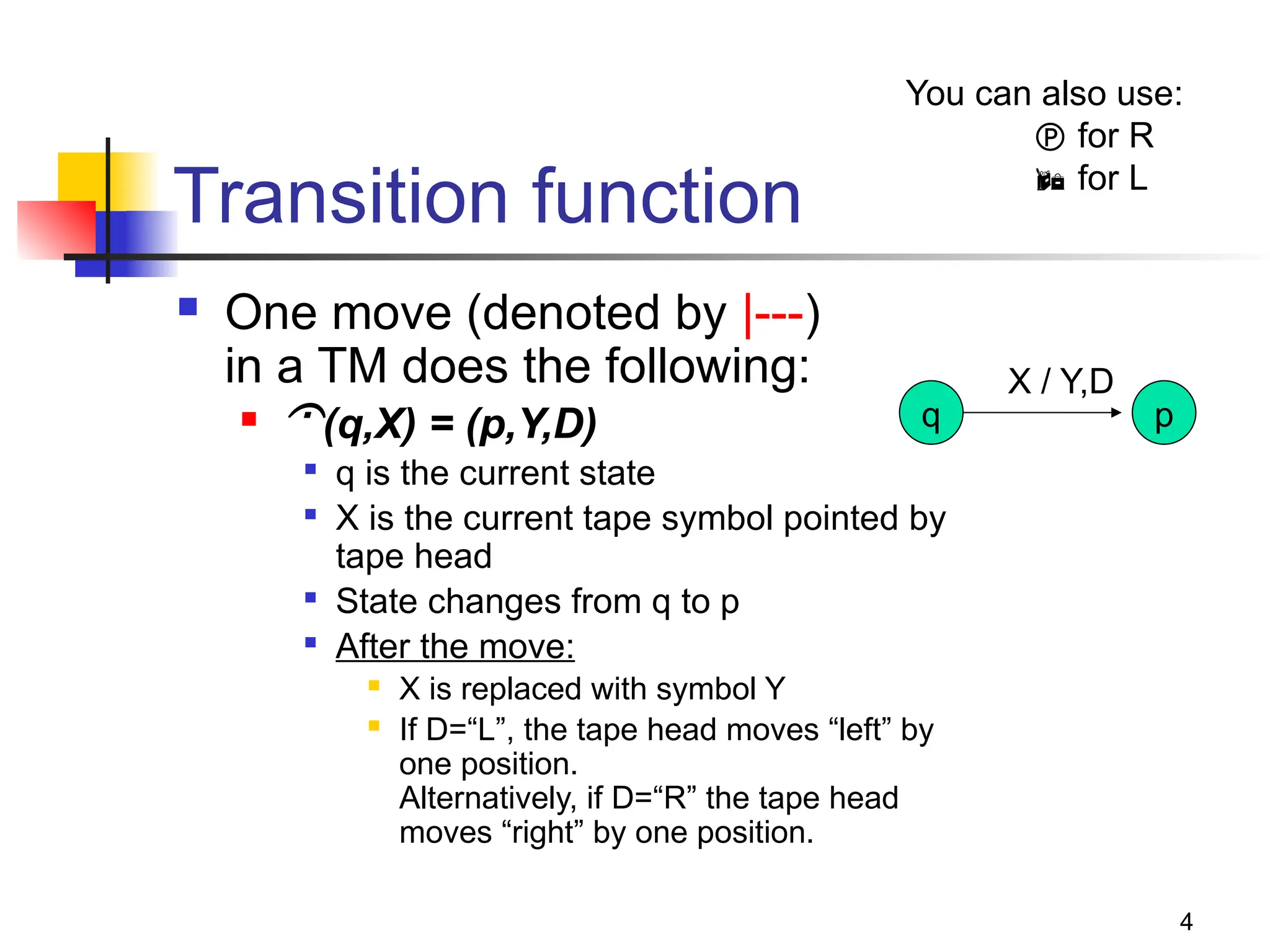
Onemove (denoted by |---)
in a TM does the following:
(q,X) = (p,Y,D)
q is the current state
X is the current tape symbol pointed by
tape head
State changes from q to p
After the move:
X is replaced with symbol Y
If D=“L”, the tape head moves “left” by
one position.
Alternatively, if D=“R” the tape head
moves “right” by one position.
q p
X / Y,D
You can also use:
for R
for L
5.
5
ID of aTM
Instantaneous Description or ID :
X1X2…Xi-1qXiXi+1…Xn
means:
q is the current state
Tape head is pointing to Xi
X1X2…Xi-1XiXi+1…Xn are the current tape symbols
(q,Xi) = (p,Y,R) is same as:
X1…Xi-1qXi…Xn |---- X1…Xi-1YpXi+1…Xn
(q,Xi) = (p,Y,L) is same as:
X1…Xi-1qXi…Xn |---- X1…pXi-1YXi+1…Xn
6.
6
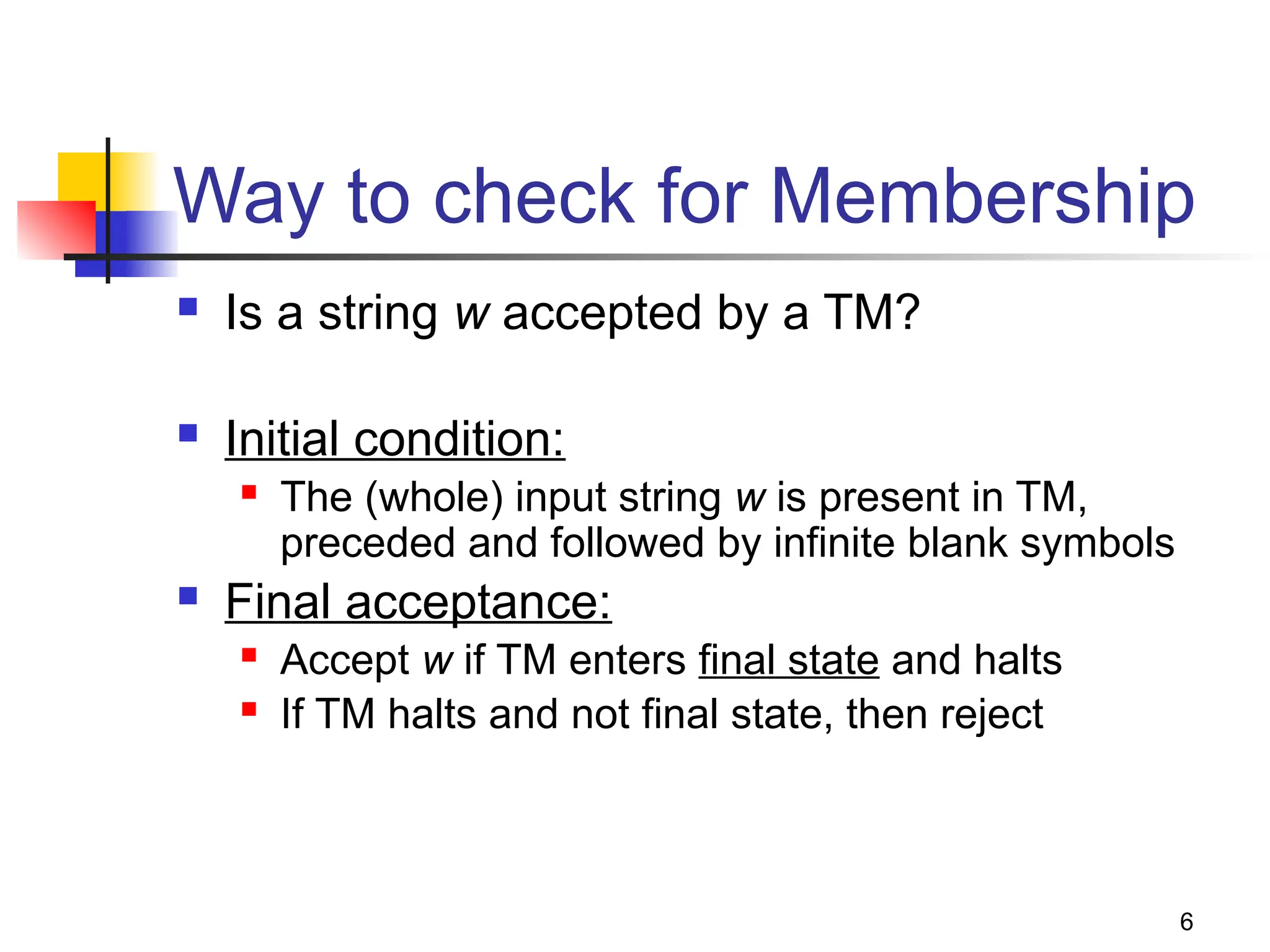
Way to checkfor Membership
Is a string w accepted by a TM?
Initial condition:
The (whole) input string w is present in TM,
preceded and followed by infinite blank symbols
Final acceptance:
Accept w if TM enters final state and halts
If TM halts and not final state, then reject
7.
7
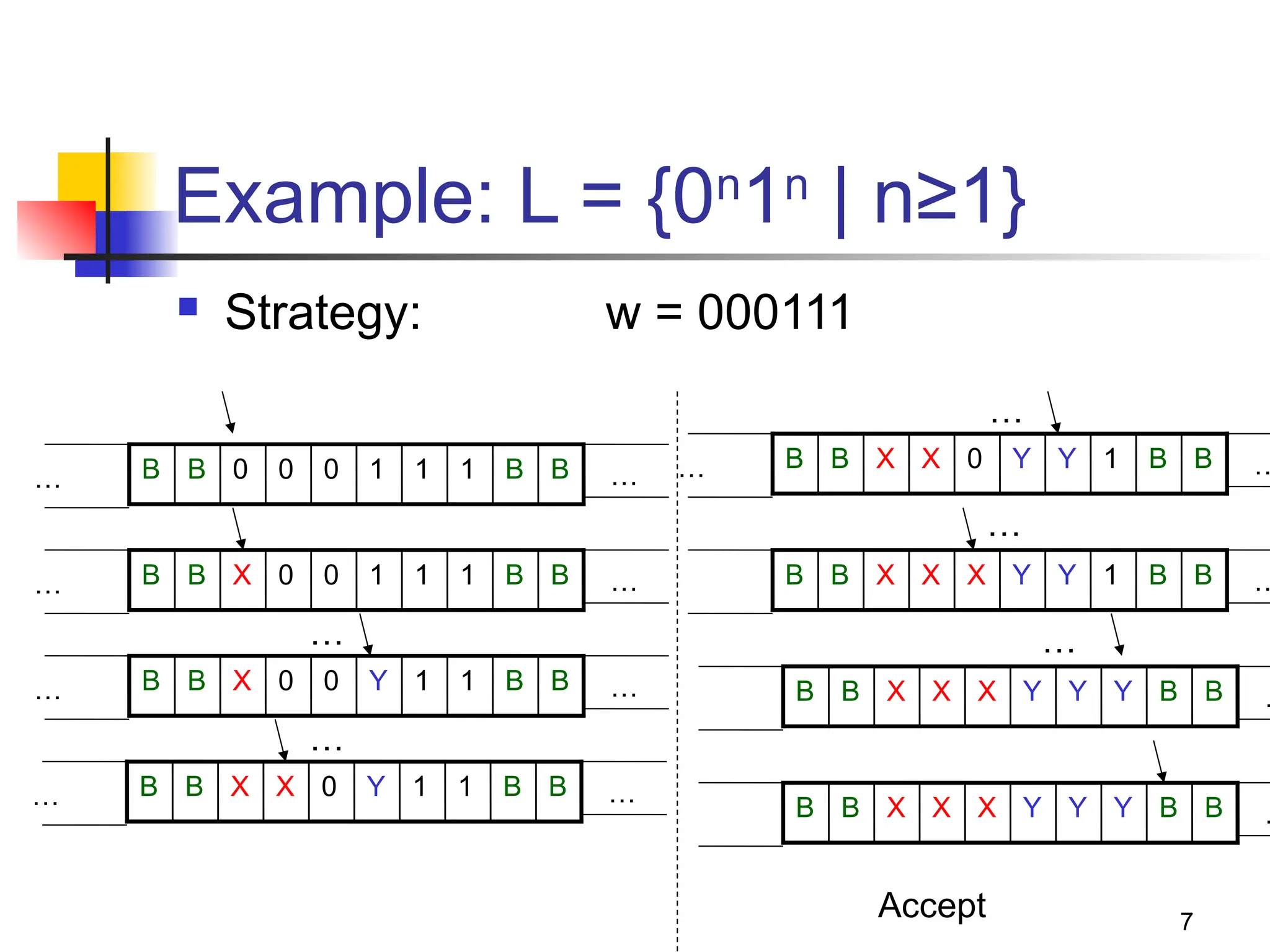
Example: L ={0n
1n
| n≥1}
Strategy: w = 000111
0 1 1 1
0
0 B B
B
B
… …
0 1 1 1
0
X B B
B
B
… …
… 0 Y 1 1
0
X B B
B
B …
0 Y 1 1
X
X B B
B
B
… …
0 Y Y 1
X
X B B
B
B
… …
X Y Y 1
X
X B B
B
B …
X Y Y Y
X
X B B
B
B …
Accept
X Y Y Y
X
X B B
B
B …
…
…
…
…
…
8.
8
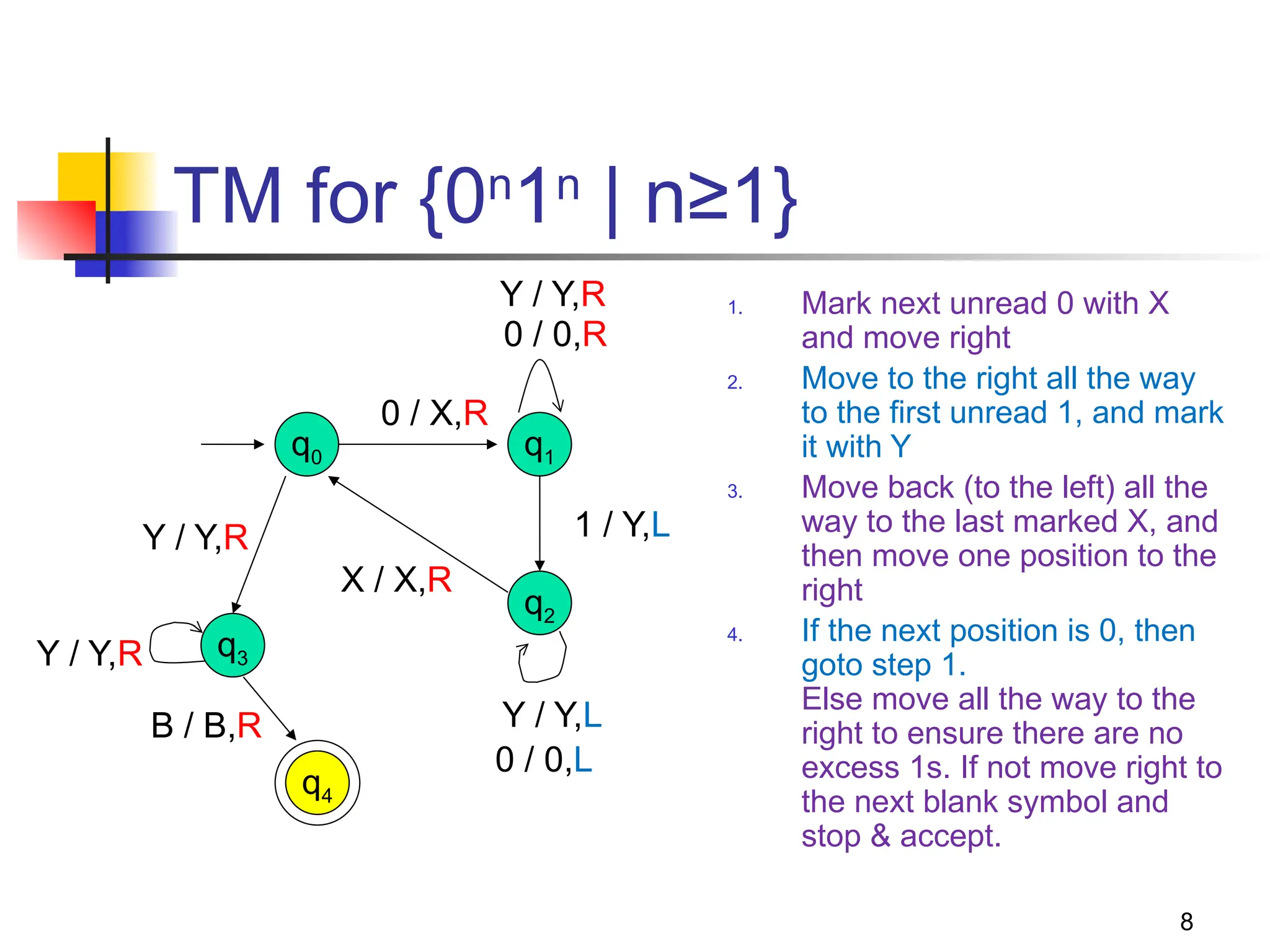
TM for {0n
1n
|n≥1}
q0 q1
0 / X,R
0 / 0,R
q2
1 / Y,L
Y / Y,L
0 / 0,L
X / X,R
q3
Y / Y,R
Y / Y,R
q4
B / B,R
1. Mark next unread 0 with X
and move right
2. Move to the right all the way
to the first unread 1, and mark
it with Y
3. Move back (to the left) all the
way to the last marked X, and
then move one position to the
right
4. If the next position is 0, then
goto step 1.
Else move all the way to the
right to ensure there are no
excess 1s. If not move right to
the next blank symbol and
stop & accept.
Y / Y,R
9.
9
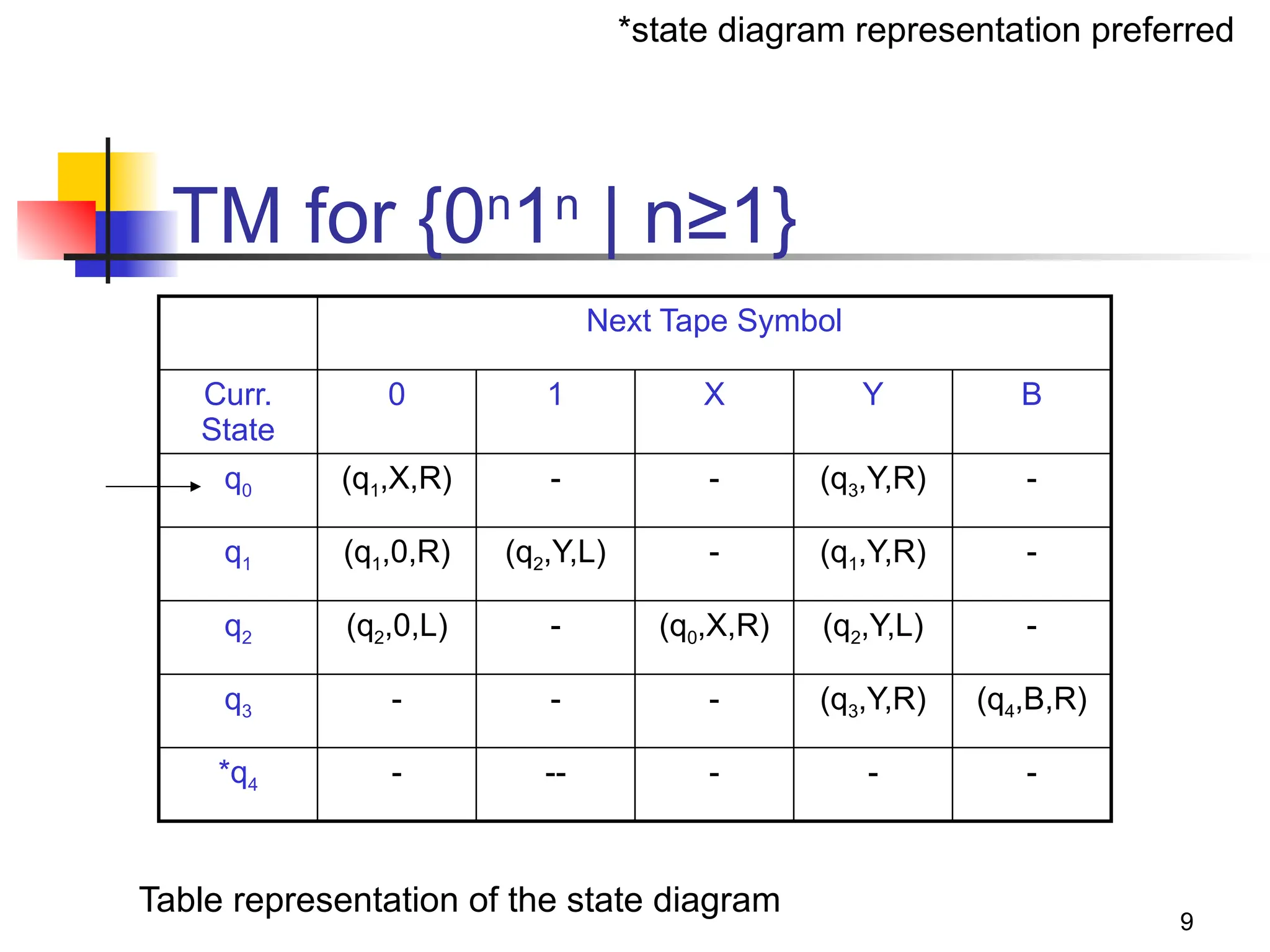
TM for {0n
1n
|n≥1}
Next Tape Symbol
Curr.
State
0 1 X Y B
q0 (q1,X,R) - - (q3,Y,R) -
q1 (q1,0,R) (q2,Y,L) - (q1,Y,R) -
q2 (q2,0,L) - (q0,X,R) (q2,Y,L) -
q3 - - - (q3,Y,R) (q4,B,R)
*q4 - -- - - -
Table representation of the state diagram
*state diagram representation preferred
10.
10
TMs for calculations
TMs can also be used for calculating
values
Like arithmetic computations
Eg., addition, subtraction, multiplication,
etc.
11.
11
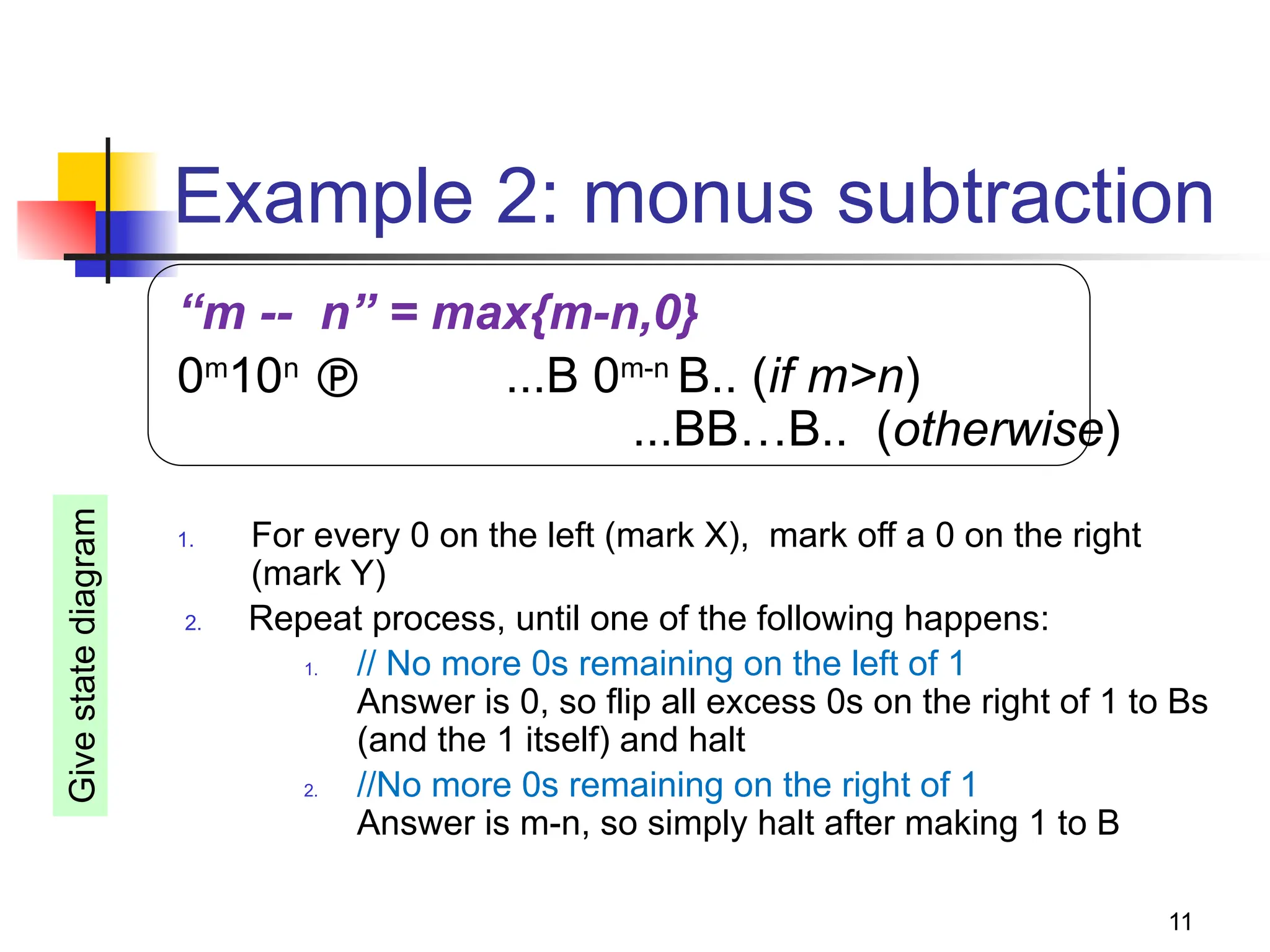
Example 2: monussubtraction
“m -- n” = max{m-n,0}
0m
10n
...B 0m-n
B.. (if m>n)
...BB…B.. (otherwise)
1. For every 0 on the left (mark X), mark off a 0 on the right
(mark Y)
2. Repeat process, until one of the following happens:
1. // No more 0s remaining on the left of 1
Answer is 0, so flip all excess 0s on the right of 1 to Bs
(and the 1 itself) and halt
2. //No more 0s remaining on the right of 1
Answer is m-n, so simply halt after making 1 to B
Give
state
diagram
12.
12
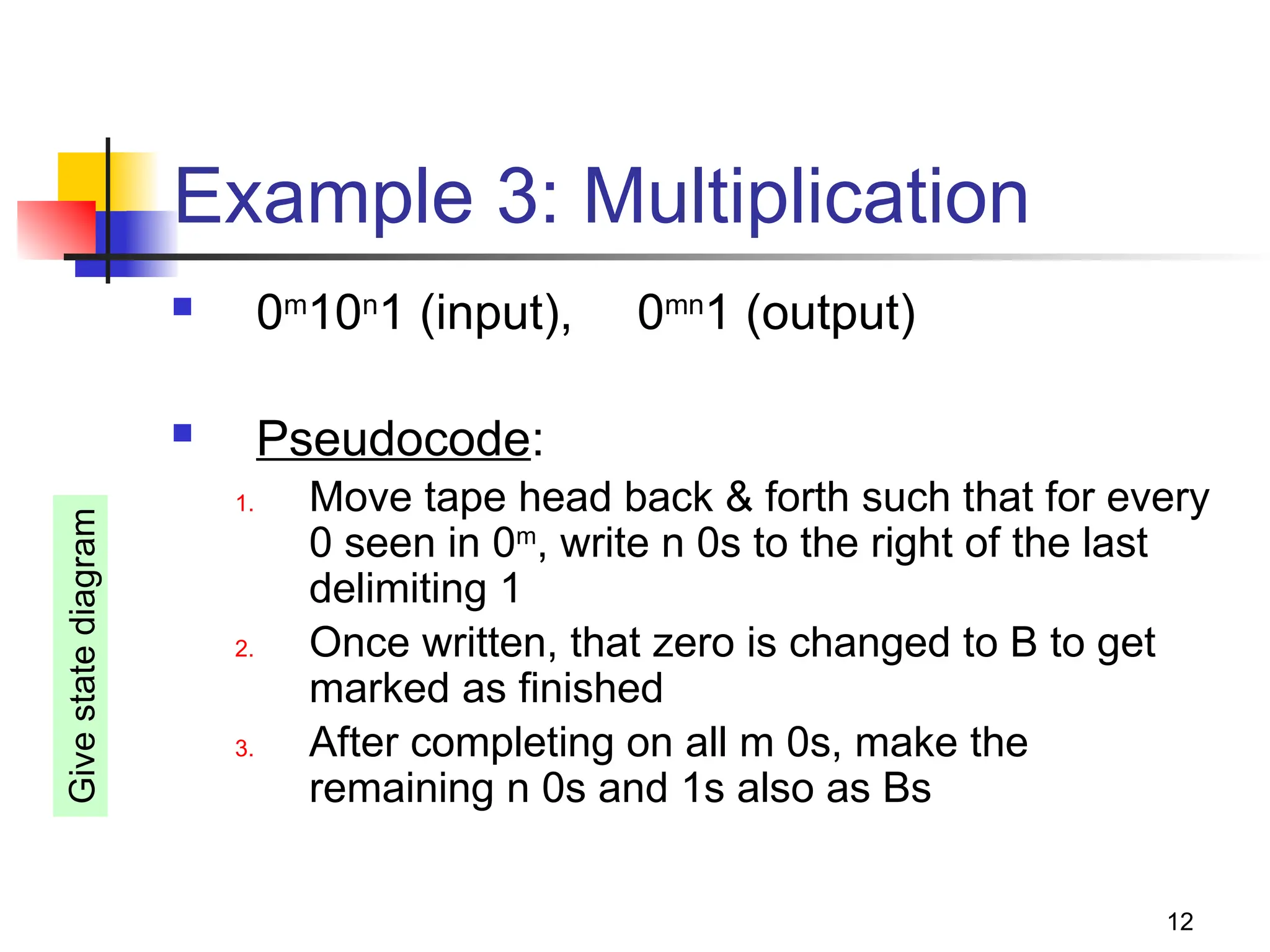
Example 3: Multiplication
0m
10n
1 (input), 0mn
1 (output)
Pseudocode:
1. Move tape head back & forth such that for every
0 seen in 0m
, write n 0s to the right of the last
delimiting 1
2. Once written, that zero is changed to B to get
marked as finished
3. After completing on all m 0s, make the
remaining n 0s and 1s also as Bs
Give
state
diagram
13.
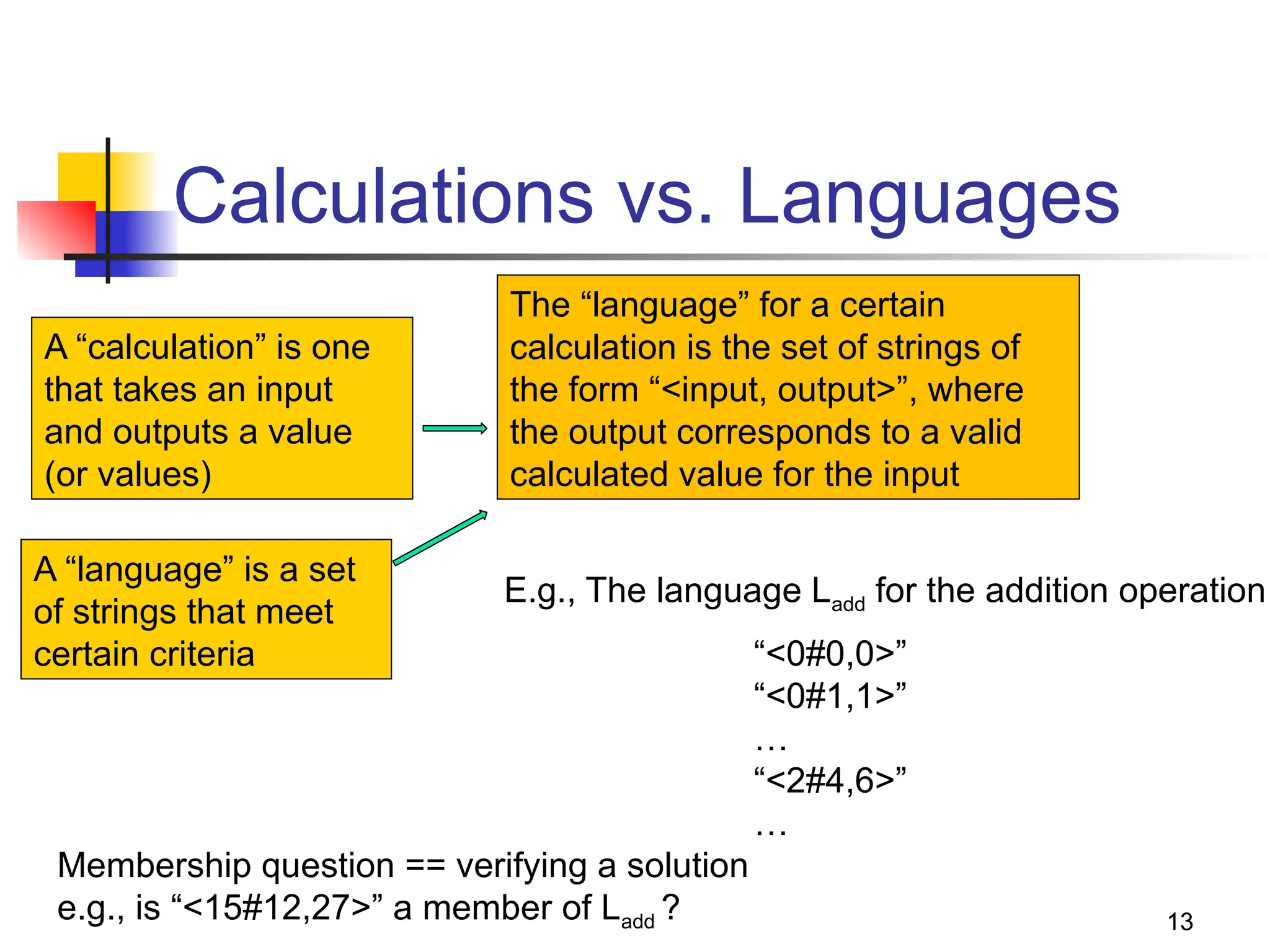
Calculations vs. Languages
13
A“calculation” is one
that takes an input
and outputs a value
(or values)
A “language” is a set
of strings that meet
certain criteria
The “language” for a certain
calculation is the set of strings of
the form “<input, output>”, where
the output corresponds to a valid
calculated value for the input
“<0#0,0>”
“<0#1,1>”
…
“<2#4,6>”
…
E.g., The language Ladd for the addition operation
Membership question == verifying a solution
e.g., is “<15#12,27>” a member of Ladd ?
14.
14
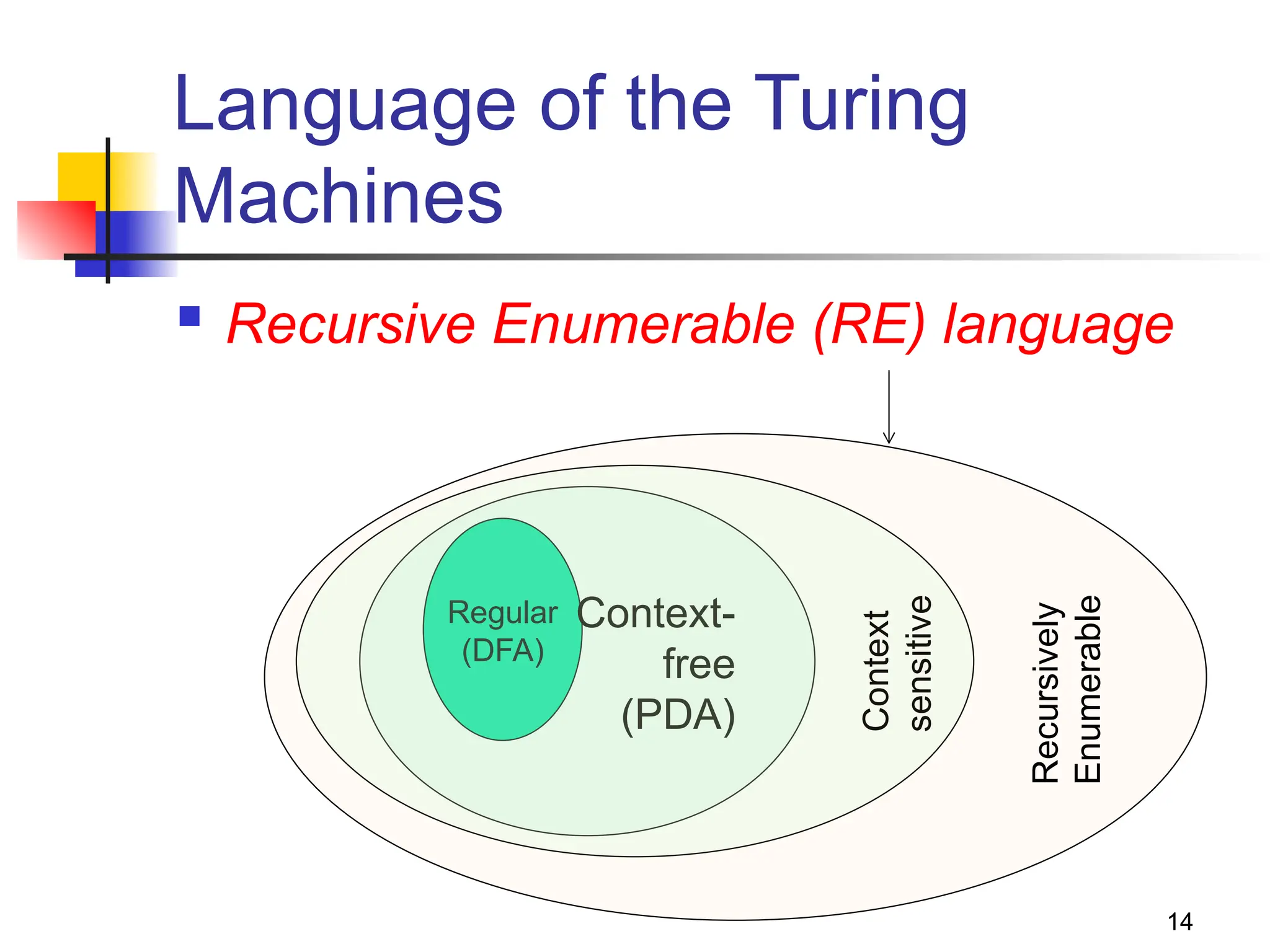
Language of theTuring
Machines
Recursive Enumerable (RE) language
Regular
(DFA)
Context-
free
(PDA)
Context
sensitive
Recursively
Enumerable
16
TMs with storage
E.g., TM for 01* + 10*
q
storage
Tape head
1 1 1 1
1
0 B B
B
B …
Transition function :
• ([q0,B],a) = ([q1,a], a, R)
• ([q1,a],a) = ([q1,a], a, R)
• ([q1,a],B) = ([q2,B], B, R)
[q,a]: where q is current state,
a is the symbol in storage
Are the standard TMs
equivalent to TMs with storage?
Yes
Generic description
Will work for both a=0 and a=1
Current
state
Current
Storage
symbol
Tape
symbol
Next
state
New
Storage
symbol
17.
18
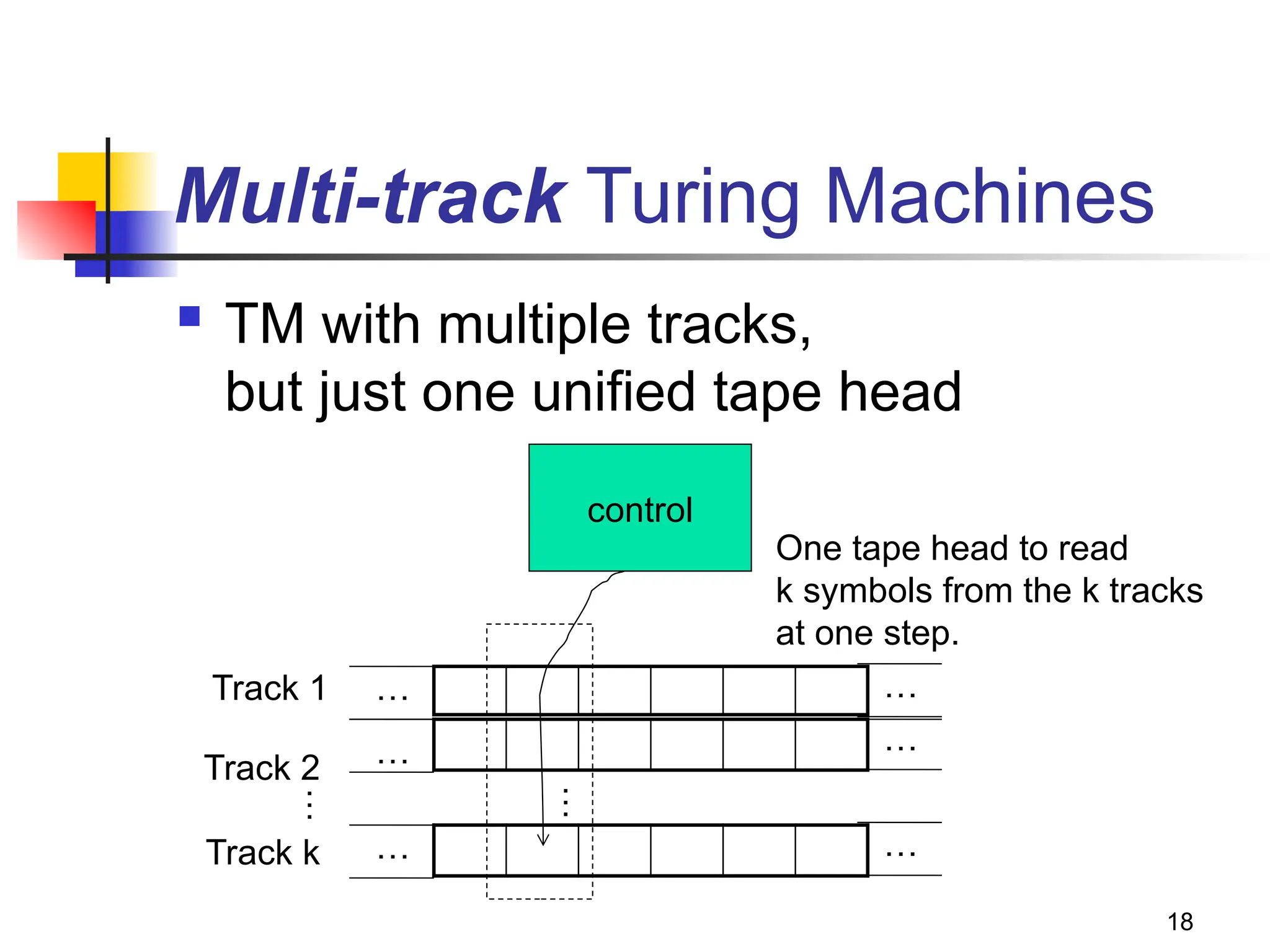
Multi-track Turing Machines
TM with multiple tracks,
but just one unified tape head
control
… …
… …
… …
Track 1
Track 2
Track k
…
One tape head to read
k symbols from the k tracks
at one step.
…
18.
19
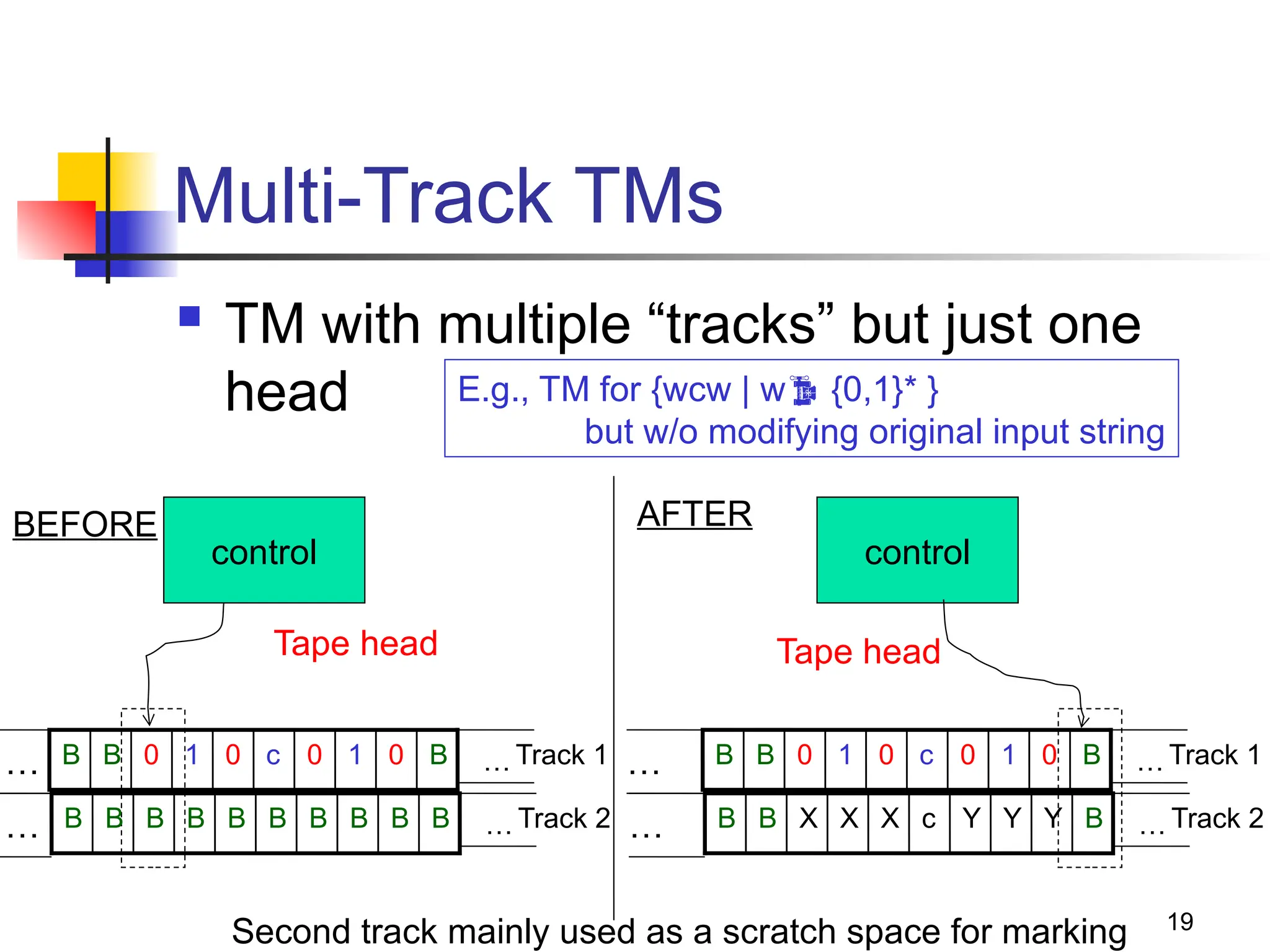
Multi-Track TMs
TMwith multiple “tracks” but just one
head E.g., TM for {wcw | w {0,1}* }
but w/o modifying original input string
control
Tape head
0 c 0 1
1
0 0 B
B
B …
… Track 1
X c Y Y
X
X Y B
B
B …
… Track 2
AFTER
control
Tape head
0 c 0 1
1
0 0 B
B
B …
… Track 1
B B B B
B
B B B
B
B …
… Track 2
BEFORE
Second track mainly used as a scratch space for marking
19.
22
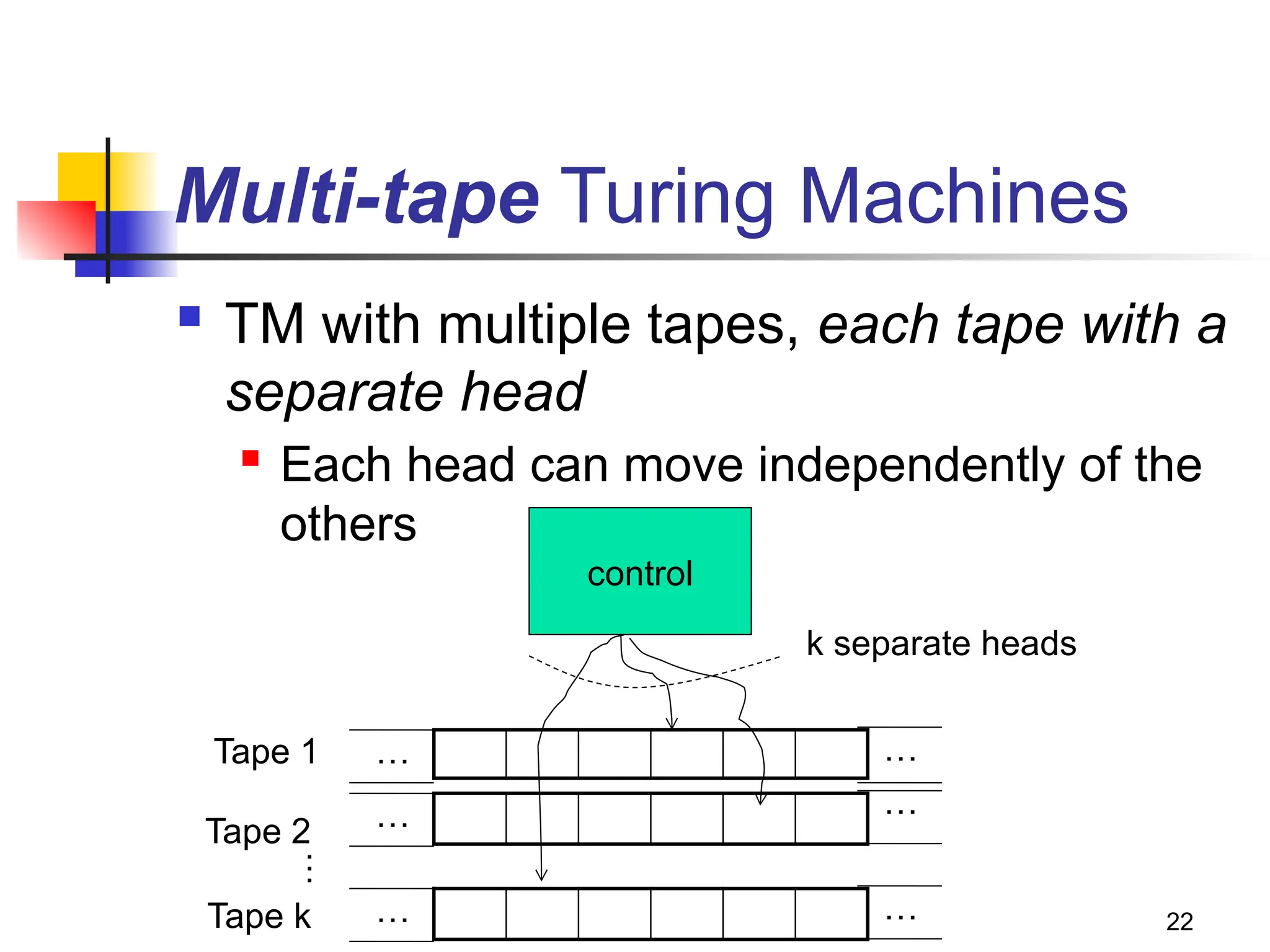
Multi-tape Turing Machines
TM with multiple tapes, each tape with a
separate head
Each head can move independently of the
others
control
… …
… …
… …
Tape 1
Tape 2
Tape k
…
k separate heads
20.
26
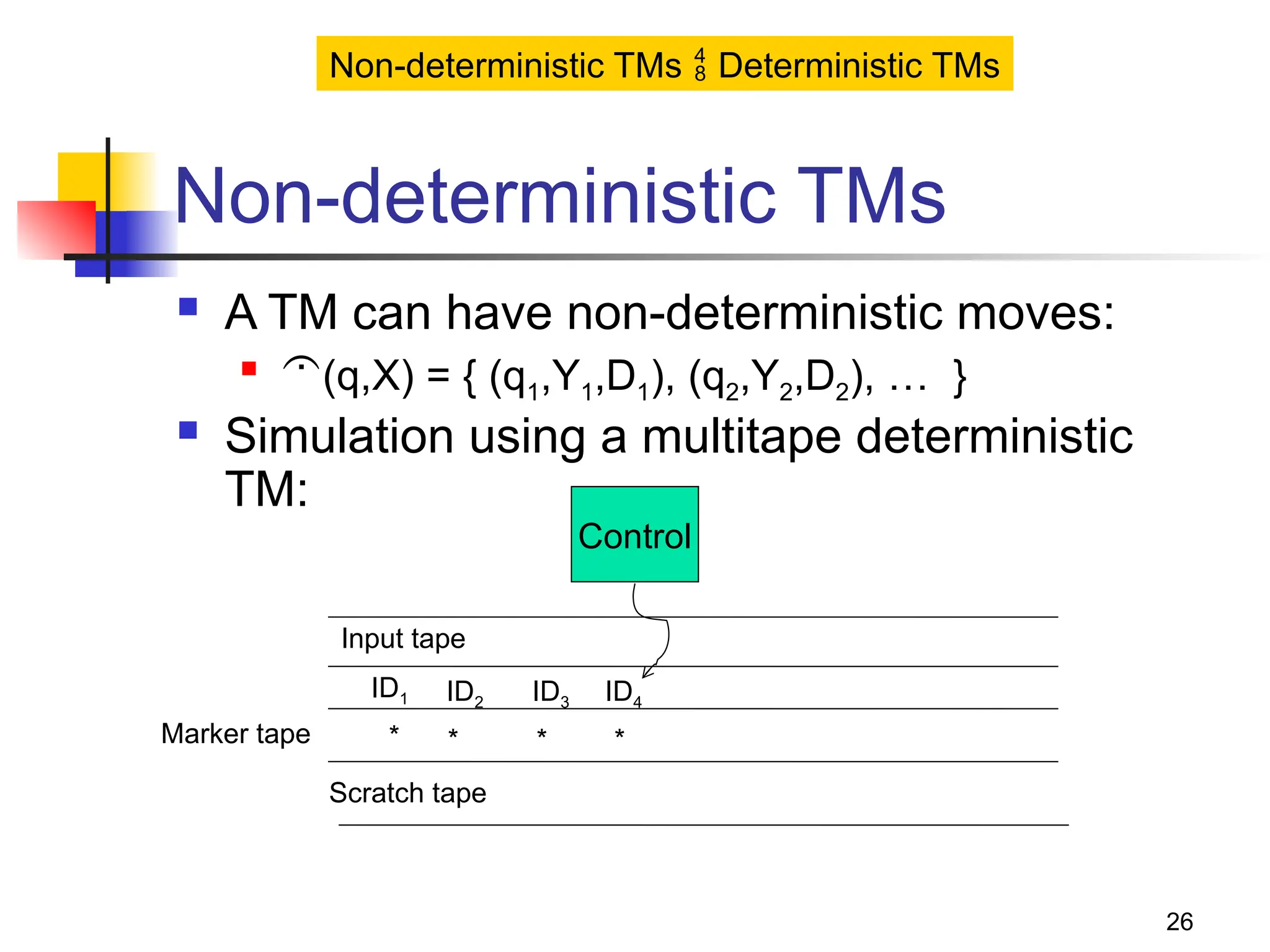
Non-deterministic TMs
ATM can have non-deterministic moves:
(q,X) = { (q1,Y1,D1), (q2,Y2,D2), … }
Simulation using a multitape deterministic
TM:
Control
ID1 ID2 ID3 ID4
* * * *
Scratch tape
Input tape
Marker tape
Non-deterministic TMs Deterministic TMs
21.
27
Summary
TMs ==Recursively Enumerable languages
TMs can be used as both:
Language recognizers
Calculators/computers
Basic TM is equivalent to all the below:
1. TM + storage
2. Multi-track TM
3. Multi-tape TM
4. Non-deterministic TM
TMs are like universal computing machines
with unbounded storage

![16
TMs with storage
E.g., TM for 01* + 10*
q
storage
Tape head
1 1 1 1
1
0 B B
B
B …
Transition function :
• ([q0,B],a) = ([q1,a], a, R)
• ([q1,a],a) = ([q1,a], a, R)
• ([q1,a],B) = ([q2,B], B, R)
[q,a]: where q is current state,
a is the symbol in storage
Are the standard TMs
equivalent to TMs with storage?
Yes
Generic description
Will work for both a=0 and a=1
Current
state
Current
Storage
symbol
Tape
symbol
Next
state
New
Storage
symbol](https://image.slidesharecdn.com/turingmachines-250502033909-2472e3a9/75/Formal-Languages-of-Automata-theory-Turing-Machines-16-2048.jpg)