Download as PDF, PPTX
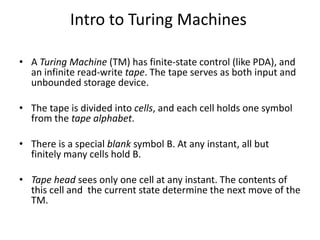
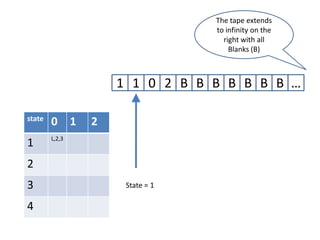

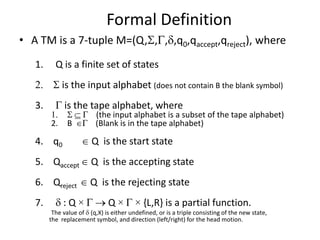

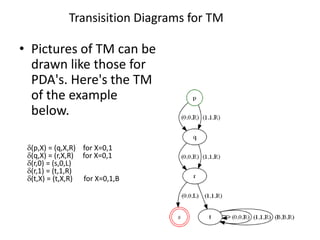
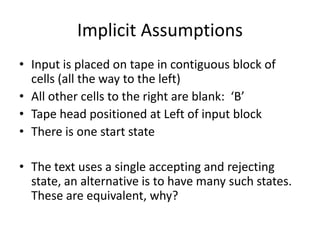

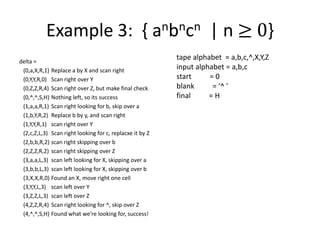


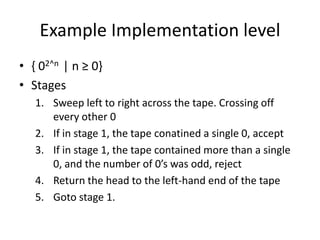

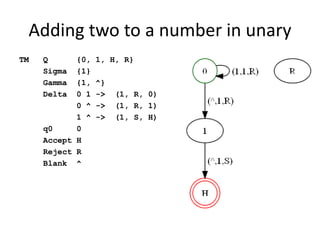


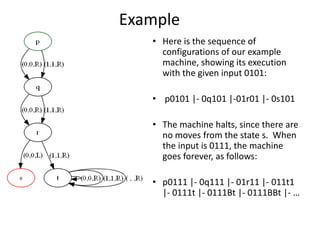

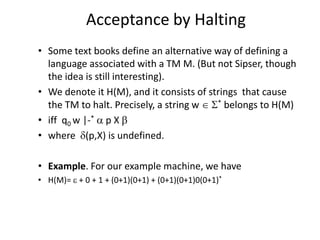


This document provides an introduction to Turing machines including their components, configuration, transitions, and languages. A Turing machine has a tape divided into cells that can be read from and written to. It has a finite set of states and uses its current state and the symbol being read to determine its next action. Transitions involve writing a symbol, moving the head, and changing state. The language of a Turing machine is the set of strings that cause it to enter an accepting state. Various examples are given to illustrate Turing machine definitions, components, and execution.


