Multi-tape Turing Machines: Informal
Description
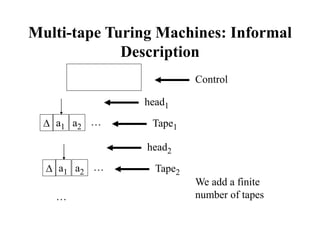
Control
…
a1 a2
 Tape1
head1
…
a1 a2
 Tape2
head2
…
We add a finite
number of tapes
Multi-tape Turing Machines: Informal
Description (II)
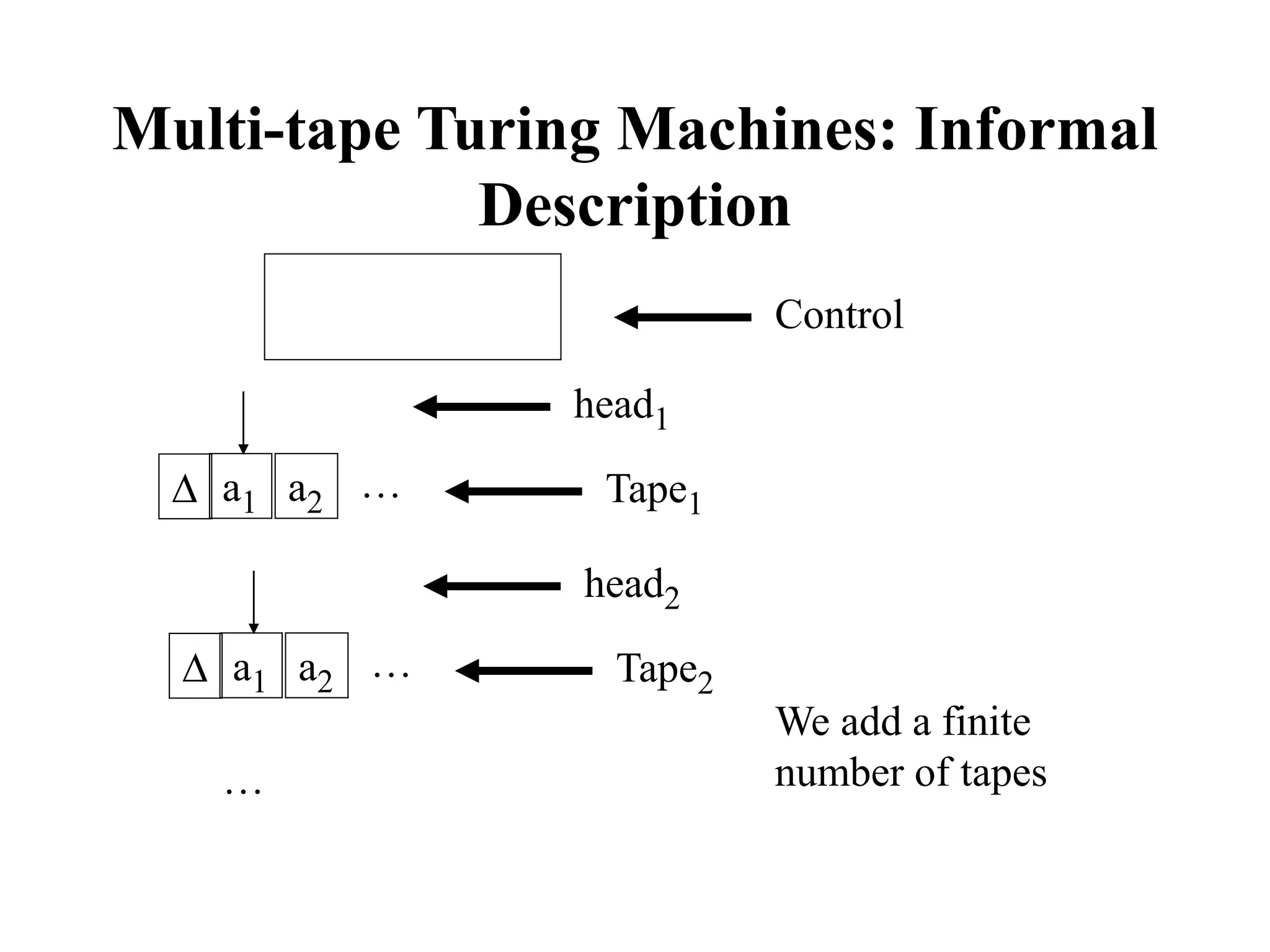
•Each tape is bounded to the left by a cell containing the
symbol 
•Each tape has a unique header
•Transitions have the form (for a 2-tape Turing machine):
( (p,(x1, x2)), (q, (y1, y2)) )
Such that each xi is in  and each yi is in  or is  or .
and if xi =  then yi =  or yi = 
Multi-tape Turing Machines
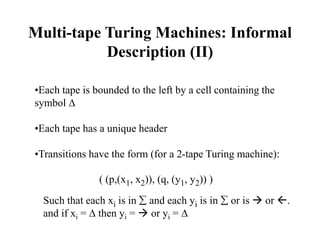
Construct a 2-tape Turing machine that recognizes the language:
L = {anbn : n = 0, 1, 2, …}
Hints:
•use the second tape as an stack
•Use the machines M1 and M0
Tape1: w
Input:
Tape2: 
Tape1: 1… if w  L
or
Tape1: 0… if w  L
Output:
Multi-tape Turing Machines vs Turing
Machines
a1 a2
 … ai
b1 b2
 … bj
…
…
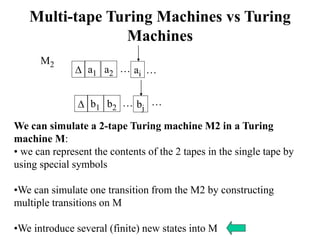
We can simulate a 2-tape Turing machine M2 in a Turing
machine M:
• we can represent the contents of the 2 tapes in the single tape by
using special symbols
•We can simulate one transition from the M2 by constructing
multiple transitions on M
•We introduce several (finite) new states into M
M2
a b

b b

Tape1 a b
a
Tape2
State: s
Configuration in a 2-tape Turing Machine M2:
Using States to “Remember”
Information
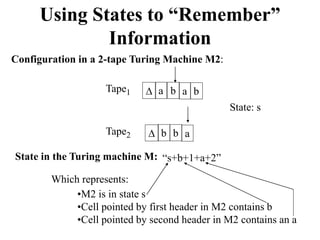
State in the Turing machine M: “s+b+1+a+2”
Which represents:
•M2 is in state s
•Cell pointed by first header in M2 contains b
•Cell pointed by second header in M2 contains an a
Using States to “Remember”
Information (2)
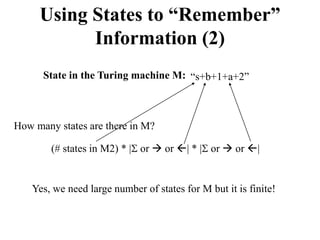
State in the Turing machine M: “s+b+1+a+2”
How many states are there in M?
(# states in M2) * | or  or | * | or  or |
Yes, we need large number of states for M but it is finite!
a b

b b

Tape1 a b
a
Tape2
State in M2: s
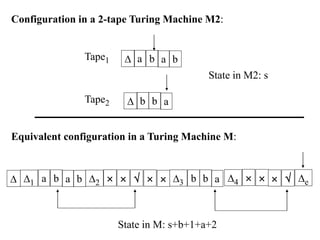
Configuration in a 2-tape Turing Machine M2:
Equivalent configuration in a Turing Machine M:
State in M: s+b+1+a+2
a b
1 a b 
2     
4 
b b a
3   e

Simulating M2 with M
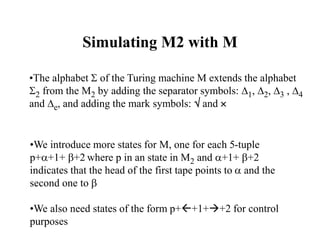
•The alphabet  of the Turing machine M extends the alphabet
2 from the M2 by adding the separator symbols: 1, 2, 3 , 4
and e, and adding the mark symbols:  and 
•We introduce more states for M, one for each 5-tuple
p++1+ +2 where p in an state in M2 and +1+ +2
indicates that the head of the first tape points to  and the
second one to 
•We also need states of the form p++1++2 for control
purposes
Simulating transitions in M2 with M
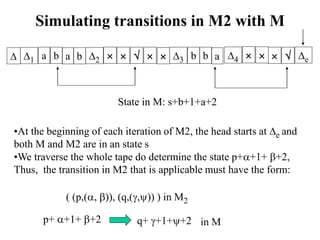
•At the beginning of each iteration of M2, the head starts at e and
both M and M2 are in an state s
•We traverse the whole tape do determine the state p++1+ +2,
Thus, the transition in M2 that is applicable must have the form:
( (p,(, )), (q,(,)) ) in M2
State in M: s+b+1+a+2
a b
1 a b 
2     
4 
b b a
3   e

p+ +1+ +2 q+ +1++2 in M
Simulating transitions in M2 with M (2)
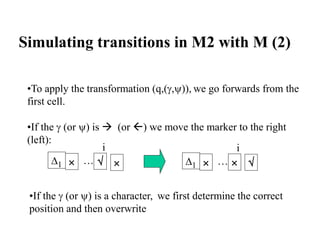
•To apply the transformation (q,(,)), we go forwards from the
first cell.
•If the  (or ) is  (or ) we move the marker to the right
(left):
1  … 
i
 1  … 
i

•If the  (or ) is a character, we first determine the correct
position and then overwrite
a b
 a b 
2     
4 
b b a
3   e
1
a b
 a b 
2     
4 
b b a
3   e
1
a b
 a b 1
2     
4 
b b a
3   e

 b
 a b 1
2 a    
4 
b b a
3   e

 
 a b 1
2 a b   
4 
b b a
3   e

a b
 a b 
2     
4 
b b a
3   e
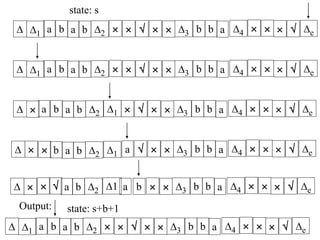
Output:
1
state: s
state: s+b+1
Multi-tape Turing Machines vs Turing
Machines (6)
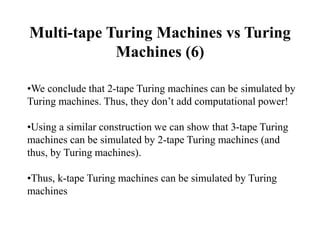
•We conclude that 2-tape Turing machines can be simulated by
Turing machines. Thus, they don’t add computational power!
•Using a similar construction we can show that 3-tape Turing
machines can be simulated by 2-tape Turing machines (and
thus, by Turing machines).
•Thus, k-tape Turing machines can be simulated by Turing
machines
Implications
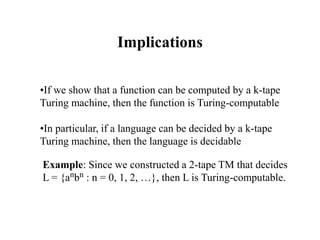
•If we show that a function can be computed by a k-tape
Turing machine, then the function is Turing-computable
•In particular, if a language can be decided by a k-tape
Turing machine, then the language is decidable
Example: Since we constructed a 2-tape TM that decides
L = {anbn : n = 0, 1, 2, …}, then L is Turing-computable.
Implications (2)
Example: Show that if L1 and L2 are decidable then
L1  L2 is also decidable
Proof. …
Homework
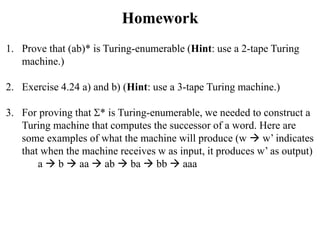
1. Prove that (ab)* is Turing-enumerable (Hint: use a 2-tape Turing
machine.)
2. Exercise 4.24 a) and b) (Hint: use a 3-tape Turing machine.)
3. For proving that * is Turing-enumerable, we needed to construct a
Turing machine that computes the successor of a word. Here are
some examples of what the machine will produce (w  w’ indicates
that when the machine receives w as input, it produces w’ as output)
a  b  aa  ab  ba  bb  aaa

Turing Machine and Multiple Turing Machine

  • 1.
    Multi-tape Turing Machines:Informal Description Control … a1 a2  Tape1 head1 … a1 a2  Tape2 head2 … We add a finite number of tapes
  • 2.
    Multi-tape Turing Machines:Informal Description (II) •Each tape is bounded to the left by a cell containing the symbol  •Each tape has a unique header •Transitions have the form (for a 2-tape Turing machine): ( (p,(x1, x2)), (q, (y1, y2)) ) Such that each xi is in  and each yi is in  or is  or . and if xi =  then yi =  or yi = 
  • 3.
    Multi-tape Turing Machines Constructa 2-tape Turing machine that recognizes the language: L = {anbn : n = 0, 1, 2, …} Hints: •use the second tape as an stack •Use the machines M1 and M0 Tape1: w Input: Tape2:  Tape1: 1… if w  L or Tape1: 0… if w  L Output:
  • 4.
    Multi-tape Turing Machinesvs Turing Machines a1 a2  … ai b1 b2  … bj … … We can simulate a 2-tape Turing machine M2 in a Turing machine M: • we can represent the contents of the 2 tapes in the single tape by using special symbols •We can simulate one transition from the M2 by constructing multiple transitions on M •We introduce several (finite) new states into M M2
  • 5.
    a b  b b  Tape1a b a Tape2 State: s Configuration in a 2-tape Turing Machine M2: Using States to “Remember” Information State in the Turing machine M: “s+b+1+a+2” Which represents: •M2 is in state s •Cell pointed by first header in M2 contains b •Cell pointed by second header in M2 contains an a
  • 6.
    Using States to“Remember” Information (2) State in the Turing machine M: “s+b+1+a+2” How many states are there in M? (# states in M2) * | or  or | * | or  or | Yes, we need large number of states for M but it is finite!
  • 7.
    a b  b b  Tape1a b a Tape2 State in M2: s Configuration in a 2-tape Turing Machine M2: Equivalent configuration in a Turing Machine M: State in M: s+b+1+a+2 a b 1 a b  2      4  b b a 3   e 
  • 8.
    Simulating M2 withM •The alphabet  of the Turing machine M extends the alphabet 2 from the M2 by adding the separator symbols: 1, 2, 3 , 4 and e, and adding the mark symbols:  and  •We introduce more states for M, one for each 5-tuple p++1+ +2 where p in an state in M2 and +1+ +2 indicates that the head of the first tape points to  and the second one to  •We also need states of the form p++1++2 for control purposes
  • 9.
    Simulating transitions inM2 with M •At the beginning of each iteration of M2, the head starts at e and both M and M2 are in an state s •We traverse the whole tape do determine the state p++1+ +2, Thus, the transition in M2 that is applicable must have the form: ( (p,(, )), (q,(,)) ) in M2 State in M: s+b+1+a+2 a b 1 a b  2      4  b b a 3   e  p+ +1+ +2 q+ +1++2 in M
  • 10.
    Simulating transitions inM2 with M (2) •To apply the transformation (q,(,)), we go forwards from the first cell. •If the  (or ) is  (or ) we move the marker to the right (left): 1  …  i  1  …  i  •If the  (or ) is a character, we first determine the correct position and then overwrite
  • 11.
    a b  ab  2      4  b b a 3   e 1 a b  a b  2      4  b b a 3   e 1 a b  a b 1 2      4  b b a 3   e   b  a b 1 2 a     4  b b a 3   e     a b 1 2 a b    4  b b a 3   e  a b  a b  2      4  b b a 3   e Output: 1 state: s state: s+b+1
  • 12.
    Multi-tape Turing Machinesvs Turing Machines (6) •We conclude that 2-tape Turing machines can be simulated by Turing machines. Thus, they don’t add computational power! •Using a similar construction we can show that 3-tape Turing machines can be simulated by 2-tape Turing machines (and thus, by Turing machines). •Thus, k-tape Turing machines can be simulated by Turing machines
  • 13.
    Implications •If we showthat a function can be computed by a k-tape Turing machine, then the function is Turing-computable •In particular, if a language can be decided by a k-tape Turing machine, then the language is decidable Example: Since we constructed a 2-tape TM that decides L = {anbn : n = 0, 1, 2, …}, then L is Turing-computable.
  • 14.
    Implications (2) Example: Showthat if L1 and L2 are decidable then L1  L2 is also decidable Proof. …
  • 15.
    Homework 1. Prove that(ab)* is Turing-enumerable (Hint: use a 2-tape Turing machine.) 2. Exercise 4.24 a) and b) (Hint: use a 3-tape Turing machine.) 3. For proving that * is Turing-enumerable, we needed to construct a Turing machine that computes the successor of a word. Here are some examples of what the machine will produce (w  w’ indicates that when the machine receives w as input, it produces w’ as output) a  b  aa  ab  ba  bb  aaa