Formal and Informal Writings
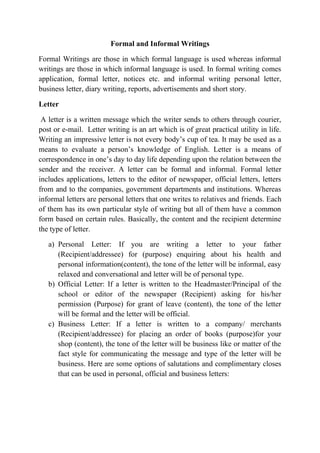
Formal Writings are those in which formal language is used whereas informal
writings are those in which informal language is used. In formal writing comes
application, formal letter, notices etc. and informal writing personal letter,
business letter, diary writing, reports, advertisements and short story.
Letter
A letter is a written message which the writer sends to others through courier,
post or e-mail. Letter writing is an art which is of great practical utility in life.
Writing an impressive letter is not every body’s cup of tea. It may be used as a
means to evaluate a person’s knowledge of English. Letter is a means of
correspondence in one’s day to day life depending upon the relation between the
sender and the receiver. A letter can be formal and informal. Formal letter
includes applications, letters to the editor of newspaper, official letters, letters
from and to the companies, government departments and institutions. Whereas
informal letters are personal letters that one writes to relatives and friends. Each
of them has its own particular style of writing but all of them have a common
form based on certain rules. Basically, the content and the recipient determine
the type of letter.
a) Personal Letter: If you are writing a letter to your father
(Recipient/addressee) for (purpose) enquiring about his health and
personal information(content), the tone of the letter will be informal, easy
relaxed and conversational and letter will be of personal type.
b) Official Letter: If a letter is written to the Headmaster/Principal of the
school or editor of the newspaper (Recipient) asking for his/her
permission (Purpose) for grant of leave (content), the tone of the letter
will be formal and the letter will be official.
c) Business Letter: If a letter is written to a company/ merchants
(Recipient/addressee) for placing an order of books (purpose)for your
shop (content), the tone of the letter will be business like or matter of the
fact style for communicating the message and type of the letter will be
business. Here are some options of salutations and complimentary closes
that can be used in personal, official and business letters:
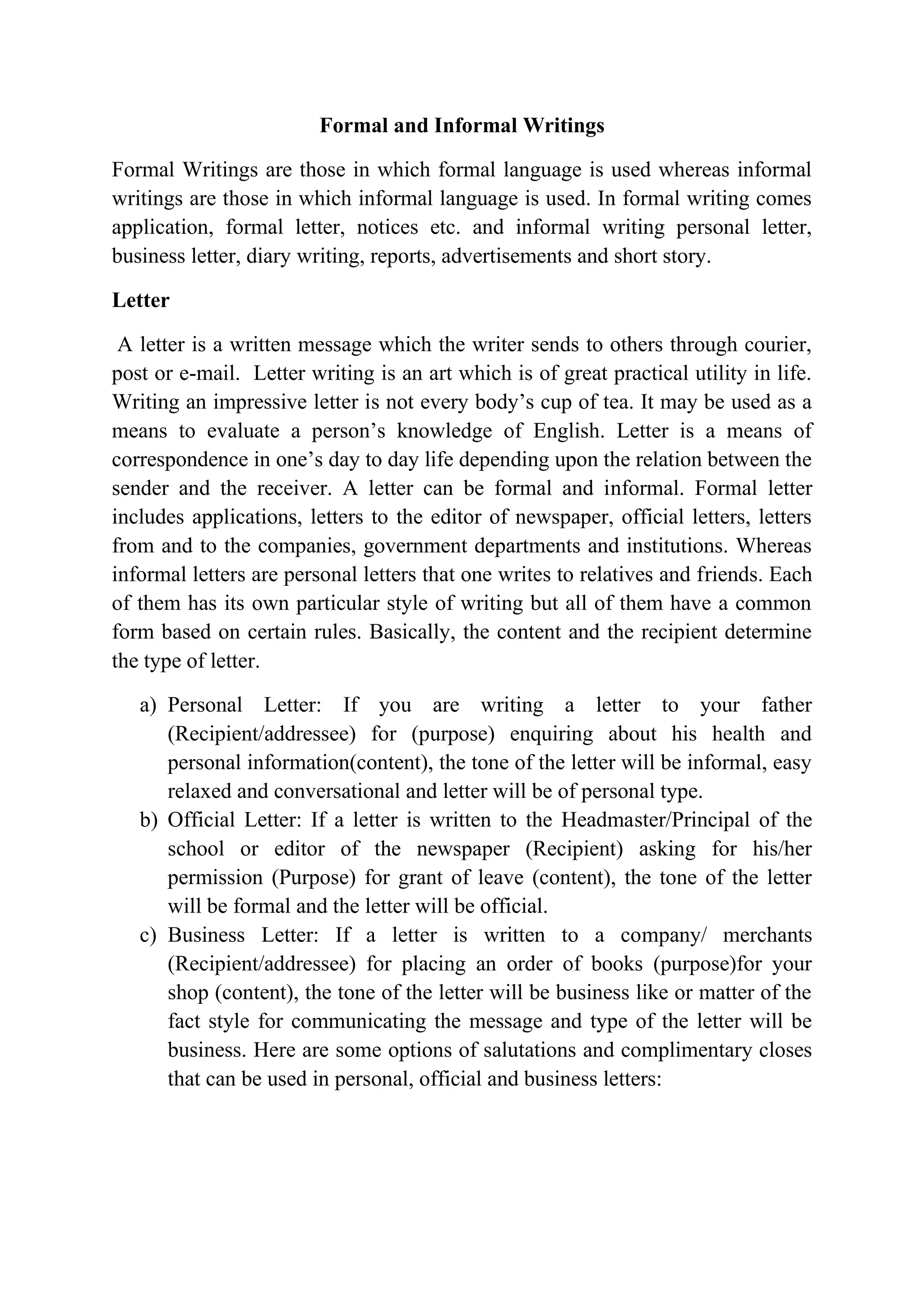
Salutation Personal
Official
Business
Dear/Dearest/My Dear (Name of the
friend/Relation)
Dear Mam/Dear Sir
Sir/Mam (Highly Formal)
Subscription/
Complimentary
close
Personal
Official
Business
Yours lovingly, or Lovingly yours, yours
affectionately, or Affectionately yours
Yours faithfully, Yours sincerely, Yours
obediently
Yours faithfully, Yours sincerely
Diary Writing
Diary is a very personal form of writing. It denotes a daily account of the life
and activities of a particular person written by person himself informally. It
gives you information about the person’s personal life, achievements, activities,
contribution to the family, society and other related details. A hidden message is
conveyed in every entry of the diary.
The main difference between diary writing and a biography is that the writer of
a biographical sketch is always a person other than the one about whom the
sketch is written whereas the diary is written by the person himself. Secondly,
the biographies of the famous persons are usually written after their death
whereas the diaries are written daily by a person himself when he is alive. If a
person regularly writes diary and adds information objectively without any
exaggeration related to his life activities and achievements daily, it may lead to
and autobiography. The diary entry should include the following in its format:
1. Day, date and time of the entry
2. A suitable descriptive heading of the entry
3. The body of the diary entry i.e. contents
4. Signature
Notice Writing
A notice is a short, written or printed statement made by a person or an
organisation to inform concerned people within an organisation or for the
general public about some meeting, occasions like inaugurations or sale, to
issue public instructions, to make appeals, to extend invitations etc.
When a notice is written for sending general information to a large number of
people, it is called as a circular. A notice is also different from memo
(memorandum) which is a short piece of writing usually used by the officers of
an organisation among themselves for recording or conveying information and
decisions or to make short request. That is why it is also called as intra office
memorandum or request for expression of interest.
Notice has to be circulated in advance to all the concerned people for calling an
official or emergency meeting or as per fixed agenda of the meeting. Every
notice has some sort of legal binding. The day, time and place of the meeting or
activity must be mentioned in the notice.
An effective notice will usually include the following:
1. Name of the organisation, institution or office
2. Date of issuing the notice
3. The word ‘Notice’
4. A suitable description or heading
5. Purpose of writing the notice
6. Details of schedule (date, time, venue, program, duration) in case the
notice is about an event or meeting
7. Signature, name, contact details, and designation of the person issuing
notice
8. Style and tone of the language
9. Write the notice in the third person. If you have to use the first person,
use the plural form of I, i.e. We.
Procedure of writing the notice
a) List the main points to be included
b) Always prepare a rough draft first
c) Check grammar and style of the language
d) Ensure the exact word limit
e) Revise it
f) Prepare the final draft
g) Draw the box; mention contact address and specific instructions if any.
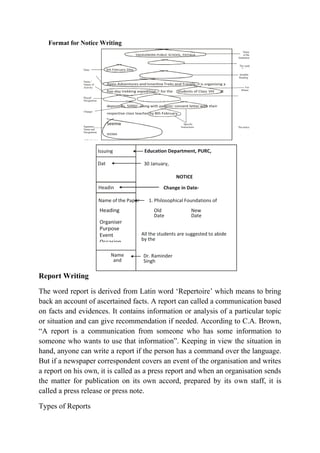
Name
of the
Institution
The word
'Notice'
Suitable
Heading
Name /
Nature of
Activity
Placed/
Designation
For
Whom
Duration
Charges
Signature,
Name and
Designation
of the Issuing
Specific
Instructions The notice
is put in
Issuing
Authority
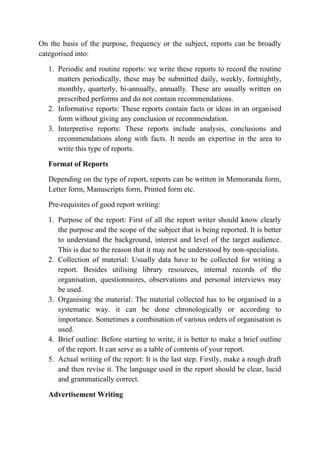
Education Department, PURC,
Bathinda
Dat
e
30 January,
2010
NOTICE
Headin
g
Change in Date-
sheet
Name of the Paper 1. Philosophical Foundations of
Education
Organiser
Old
Date
New
Date
All the students are suggested to abide
by the
new dates. There is no change in timings
Name
and
Designation of
Dr. Raminder
Singh
Format for Notice Writing
Report Writing
The word report is derived from Latin word ‘Repertoire’ which means to bring
back an account of ascertained facts. A report can called a communication based
on facts and evidences. It contains information or analysis of a particular topic
or situation and can give recommendation if needed. According to C.A. Brown,
“A report is a communication from someone who has some information to
someone who wants to use that information”. Keeping in view the situation in
hand, anyone can write a report if the person has a command over the language.
But if a newspaper correspondent covers an event of the organisation and writes
a report on his own, it is called as a press report and when an organisation sends
the matter for publication on its own accord, prepared by its own staff, it is
called a press release or press note.
Types of Reports
On the basis of the purpose, frequency or the subject, reports can be broadly
categorised into:
1. Periodic and routine reports: we write these reports to record the routine
matters periodically, these may be submitted daily, weekly, fortnightly,
monthly, quarterly, bi-annually, annually. These are usually written on
prescribed performs and do not contain recommendations.
2. Informative reports: These reports contain facts or ideas in an organised
form without giving any conclusion or recommendation.
3. Interpretive reports: These reports include analysis, conclusions and
recommendations along with facts. It needs an expertise in the area to
write this type of reports.
Format of Reports
Depending on the type of report, reports can be written in Memoranda form,
Letter form, Manuscripts form, Printed form etc.
Pre-requisites of good report writing:
1. Purpose of the report: First of all the report writer should know clearly
the purpose and the scope of the subject that is being reported. It is better
to understand the background, interest and level of the target audience.
This is due to the reason that it may not be understood by non-specialists.
2. Collection of material: Usually data have to be collected for writing a
report. Besides utilising library resources, internal records of the
organisation, questionnaires, observations and personal interviews may
be used.
3. Organising the material: The material collected has to be organised in a
systematic way. it can be done chronologically or according to
importance. Sometimes a combination of various orders of organisation is
used.
4. Brief outline: Before starting to write, it is better to make a brief outline
of the report. It can serve as a table of contents of your report.
5. Actual writing of the report: It is the last step. Firstly, make a rough draft
and then revise it. The language used in the report should be clear, lucid
and grammatically correct.
Advertisement Writing
An advertisement is a paid, non-personal, public communication about
causes, goods and services, ideas, organisations, people and places through
means such as direct mail, telephone, print, radio, television and internet. An
integral part of marketing, advertisements are public notices designed to
inform and motivate. Their objective is to change the thinking pattern (or
buying behaviour) of the recipient, so that he or she is persuaded to take the
action desired by the advertiser or in other words to enhance the image of the
company, point out and create a need for products or services, demonstrate
new uses for established products, announce new products and programs,
reinforce the salesman’s individual messages, draw customers to the
business and to hold existing customers. When aired on radio or television,
an advertisement is called a commercial. According to the Canadian-US
advertising pioneer, John E, Kennedy (1864-1928), an advertisement is
“salesmanship in print”. The purpose of advertising is to convince customers
that a company’s services or products are the best.
Press Advertising
Press advertising describes advertising in a printed medium such as a
newspaper, magazine, or trade journal. This encompasses everything from
media with a very broad readership base, such as a major national newspaper
or magazine, to more narrowly targeted media such as local newspapers and
trade journals on much specialised topics. A form of press advertising is
called classified advertising which allows private individuals or companies to
purchase a small, narrowly targeted ad for a low fee advertising a product or
service. Another form of press advertising is the display ad, which is a larger
ad (which can include art) that typically runs in an article section of a
newspaper.
Classified advertising is a form of advertising which is particularly common
in newspapers, online and other periodicals which may be sold or distributed
free of charge. Advertisements in a newspaper are typically short, as they are
charged for by the line and one newspaper column wide. These
advertisements are much cheaper than larger display advertisements used by
businesses and are therefore normally used by businesses with smaller
advertising budgets, or by private individual.
Story Writing
Story is basically a sequence of events or incidents that occur in the past.
When you pen down all the incidents and draw a moral out of it, is called a
story. It may be about animals, birds, kings, queens or a common man. A
story is always written in the past indefinite tense. The beauty of a story lies
in its narration and the characterisation and regular flow of events in a
coherent manner. Any incident that occurs in your daily life, teaches you a
lesson, takes the form of a story. There is no need to add any factual
information nor is the need to consult any data from primary or secondary
sources.
It may be an imagination of the author also, the characters used may be
artificial but it should be lively. One should use simple language, interesting
characters, narrative style while writing story.

Formal and Informal Writings .pdf

  • 1.
    Formal and InformalWritings Formal Writings are those in which formal language is used whereas informal writings are those in which informal language is used. In formal writing comes application, formal letter, notices etc. and informal writing personal letter, business letter, diary writing, reports, advertisements and short story. Letter A letter is a written message which the writer sends to others through courier, post or e-mail. Letter writing is an art which is of great practical utility in life. Writing an impressive letter is not every body’s cup of tea. It may be used as a means to evaluate a person’s knowledge of English. Letter is a means of correspondence in one’s day to day life depending upon the relation between the sender and the receiver. A letter can be formal and informal. Formal letter includes applications, letters to the editor of newspaper, official letters, letters from and to the companies, government departments and institutions. Whereas informal letters are personal letters that one writes to relatives and friends. Each of them has its own particular style of writing but all of them have a common form based on certain rules. Basically, the content and the recipient determine the type of letter. a) Personal Letter: If you are writing a letter to your father (Recipient/addressee) for (purpose) enquiring about his health and personal information(content), the tone of the letter will be informal, easy relaxed and conversational and letter will be of personal type. b) Official Letter: If a letter is written to the Headmaster/Principal of the school or editor of the newspaper (Recipient) asking for his/her permission (Purpose) for grant of leave (content), the tone of the letter will be formal and the letter will be official. c) Business Letter: If a letter is written to a company/ merchants (Recipient/addressee) for placing an order of books (purpose)for your shop (content), the tone of the letter will be business like or matter of the fact style for communicating the message and type of the letter will be business. Here are some options of salutations and complimentary closes that can be used in personal, official and business letters:
  • 2.
    Salutation Personal Official Business Dear/Dearest/My Dear(Name of the friend/Relation) Dear Mam/Dear Sir Sir/Mam (Highly Formal) Subscription/ Complimentary close Personal Official Business Yours lovingly, or Lovingly yours, yours affectionately, or Affectionately yours Yours faithfully, Yours sincerely, Yours obediently Yours faithfully, Yours sincerely Diary Writing Diary is a very personal form of writing. It denotes a daily account of the life and activities of a particular person written by person himself informally. It gives you information about the person’s personal life, achievements, activities, contribution to the family, society and other related details. A hidden message is conveyed in every entry of the diary. The main difference between diary writing and a biography is that the writer of a biographical sketch is always a person other than the one about whom the sketch is written whereas the diary is written by the person himself. Secondly, the biographies of the famous persons are usually written after their death whereas the diaries are written daily by a person himself when he is alive. If a person regularly writes diary and adds information objectively without any exaggeration related to his life activities and achievements daily, it may lead to and autobiography. The diary entry should include the following in its format: 1. Day, date and time of the entry 2. A suitable descriptive heading of the entry 3. The body of the diary entry i.e. contents 4. Signature Notice Writing A notice is a short, written or printed statement made by a person or an organisation to inform concerned people within an organisation or for the general public about some meeting, occasions like inaugurations or sale, to issue public instructions, to make appeals, to extend invitations etc.
  • 3.
    When a noticeis written for sending general information to a large number of people, it is called as a circular. A notice is also different from memo (memorandum) which is a short piece of writing usually used by the officers of an organisation among themselves for recording or conveying information and decisions or to make short request. That is why it is also called as intra office memorandum or request for expression of interest. Notice has to be circulated in advance to all the concerned people for calling an official or emergency meeting or as per fixed agenda of the meeting. Every notice has some sort of legal binding. The day, time and place of the meeting or activity must be mentioned in the notice. An effective notice will usually include the following: 1. Name of the organisation, institution or office 2. Date of issuing the notice 3. The word ‘Notice’ 4. A suitable description or heading 5. Purpose of writing the notice 6. Details of schedule (date, time, venue, program, duration) in case the notice is about an event or meeting 7. Signature, name, contact details, and designation of the person issuing notice 8. Style and tone of the language 9. Write the notice in the third person. If you have to use the first person, use the plural form of I, i.e. We. Procedure of writing the notice a) List the main points to be included b) Always prepare a rough draft first c) Check grammar and style of the language d) Ensure the exact word limit e) Revise it f) Prepare the final draft g) Draw the box; mention contact address and specific instructions if any.
  • 4.
    Name of the Institution The word 'Notice' Suitable Heading Name/ Nature of Activity Placed/ Designation For Whom Duration Charges Signature, Name and Designation of the Issuing Specific Instructions The notice is put in Issuing Authority Education Department, PURC, Bathinda Dat e 30 January, 2010 NOTICE Headin g Change in Date- sheet Name of the Paper 1. Philosophical Foundations of Education Organiser Old Date New Date All the students are suggested to abide by the new dates. There is no change in timings Name and Designation of Dr. Raminder Singh Format for Notice Writing Report Writing The word report is derived from Latin word ‘Repertoire’ which means to bring back an account of ascertained facts. A report can called a communication based on facts and evidences. It contains information or analysis of a particular topic or situation and can give recommendation if needed. According to C.A. Brown, “A report is a communication from someone who has some information to someone who wants to use that information”. Keeping in view the situation in hand, anyone can write a report if the person has a command over the language. But if a newspaper correspondent covers an event of the organisation and writes a report on his own, it is called as a press report and when an organisation sends the matter for publication on its own accord, prepared by its own staff, it is called a press release or press note. Types of Reports
  • 5.
    On the basisof the purpose, frequency or the subject, reports can be broadly categorised into: 1. Periodic and routine reports: we write these reports to record the routine matters periodically, these may be submitted daily, weekly, fortnightly, monthly, quarterly, bi-annually, annually. These are usually written on prescribed performs and do not contain recommendations. 2. Informative reports: These reports contain facts or ideas in an organised form without giving any conclusion or recommendation. 3. Interpretive reports: These reports include analysis, conclusions and recommendations along with facts. It needs an expertise in the area to write this type of reports. Format of Reports Depending on the type of report, reports can be written in Memoranda form, Letter form, Manuscripts form, Printed form etc. Pre-requisites of good report writing: 1. Purpose of the report: First of all the report writer should know clearly the purpose and the scope of the subject that is being reported. It is better to understand the background, interest and level of the target audience. This is due to the reason that it may not be understood by non-specialists. 2. Collection of material: Usually data have to be collected for writing a report. Besides utilising library resources, internal records of the organisation, questionnaires, observations and personal interviews may be used. 3. Organising the material: The material collected has to be organised in a systematic way. it can be done chronologically or according to importance. Sometimes a combination of various orders of organisation is used. 4. Brief outline: Before starting to write, it is better to make a brief outline of the report. It can serve as a table of contents of your report. 5. Actual writing of the report: It is the last step. Firstly, make a rough draft and then revise it. The language used in the report should be clear, lucid and grammatically correct. Advertisement Writing
  • 6.
    An advertisement isa paid, non-personal, public communication about causes, goods and services, ideas, organisations, people and places through means such as direct mail, telephone, print, radio, television and internet. An integral part of marketing, advertisements are public notices designed to inform and motivate. Their objective is to change the thinking pattern (or buying behaviour) of the recipient, so that he or she is persuaded to take the action desired by the advertiser or in other words to enhance the image of the company, point out and create a need for products or services, demonstrate new uses for established products, announce new products and programs, reinforce the salesman’s individual messages, draw customers to the business and to hold existing customers. When aired on radio or television, an advertisement is called a commercial. According to the Canadian-US advertising pioneer, John E, Kennedy (1864-1928), an advertisement is “salesmanship in print”. The purpose of advertising is to convince customers that a company’s services or products are the best. Press Advertising Press advertising describes advertising in a printed medium such as a newspaper, magazine, or trade journal. This encompasses everything from media with a very broad readership base, such as a major national newspaper or magazine, to more narrowly targeted media such as local newspapers and trade journals on much specialised topics. A form of press advertising is called classified advertising which allows private individuals or companies to purchase a small, narrowly targeted ad for a low fee advertising a product or service. Another form of press advertising is the display ad, which is a larger ad (which can include art) that typically runs in an article section of a newspaper. Classified advertising is a form of advertising which is particularly common in newspapers, online and other periodicals which may be sold or distributed free of charge. Advertisements in a newspaper are typically short, as they are charged for by the line and one newspaper column wide. These advertisements are much cheaper than larger display advertisements used by businesses and are therefore normally used by businesses with smaller advertising budgets, or by private individual. Story Writing
  • 7.
    Story is basicallya sequence of events or incidents that occur in the past. When you pen down all the incidents and draw a moral out of it, is called a story. It may be about animals, birds, kings, queens or a common man. A story is always written in the past indefinite tense. The beauty of a story lies in its narration and the characterisation and regular flow of events in a coherent manner. Any incident that occurs in your daily life, teaches you a lesson, takes the form of a story. There is no need to add any factual information nor is the need to consult any data from primary or secondary sources. It may be an imagination of the author also, the characters used may be artificial but it should be lively. One should use simple language, interesting characters, narrative style while writing story.