Letter Writing
Presented by
18501510-079 18501510-090
18501510-091 18501510-109
18815015-001 18811510-002
Letter
A letter is a written message that can be handwritten or printed
on paper. It is usually sent to the recipient via mail or post in
an envelope.
OR
A letter is a written message conveyed from one person to
another Person through a medium.
Medium
A medium is the way in which a piece of
writing is delivered.
E-mail
Mailed paper copy
Watts-app
Main Purposes
• To Inquire
• To Apologize
• To Confirm
• To Request
• To provide good or bad news
• To enclose document
Types of Letters
Let us first understand that there are broadly two types of
letter, name
Formal Letters
Informal Letters
Formal Letter
These letters follow a certain pattern and
formality. They are strictly kept professional in nature, and
directly address the issues concerned. Any type of business
letter or letter to authorities falls within this given category.
Informal Letter
These are personal letters. They need not follow any set
pattern or any formalities. They contain personal information
or are a written conversation. Informal letters are generally
written to friends, and relatives etc.
ELEMENTS OF A GOOD LETTER
The most important element of writing a good letter is your ability
to identify and write to your audience.
If you are addressing your letter to the department of human
resources, avoid using highly technical terms that only engineers
would understand.
The next element is that you make sure your present your
objective in a clear and concise manner. Don't be vague about
your objective.
Another important element to remember is to remain professional.
Even if you are writing a complaint letter, remain polite and
courteous, simply state the problem along with any other relevant
information and be sure to avoid threats and slander.
Key Points of Better Letter Writing
1) Selection of Correct Words: Words are the writer’s tools and the writer
need to put the right word and right expression with precision. It should
however be remembered that right words become relevant only in the
right context. For example an emotional or flowery language has to be
fully avoided in a business letter.
2) To the Point content: Nothing more is harmful to good communication
than confused state which may result in not conveying the exact point.
Before writing a letter one should ne sure of what one wants to convey.
One should not be vague about one’s objective.
3) Conciseness: Formal letters must be concise. In formal letters specially
one must not write unnecessary sentences. To the point information.
Long illustrations and elaboration must be avoided all costs.
4) Courtesy: A letter reveals its writer’s personality and character. One
must remain totally professional while writing a letter. Even while
writing a complaint letter, care should be taken that it is couched in
polite and civilized language. Good judgment determines what and
how a point has to be conveyed.
5) Correct Use of Punctuation Marks: Use of punctuation marks, use
of capital letters, commas or colons is must to make our writing
effective. Sometimes placement of comma or full stop at a wrong
place may change the meaning of the sentence can steal the
effectiveness of a good letter. Hence utmost attention should be paid
to punctuation while writing.
6) Style: The conversational style is the most suitable one for letter
writing. It is best to write in a simple, clear style maintaining a
logical sequence of ideas. Every sentence should grow out of the
preceding one. There should be no abrupt jumping from one idea to
the another.
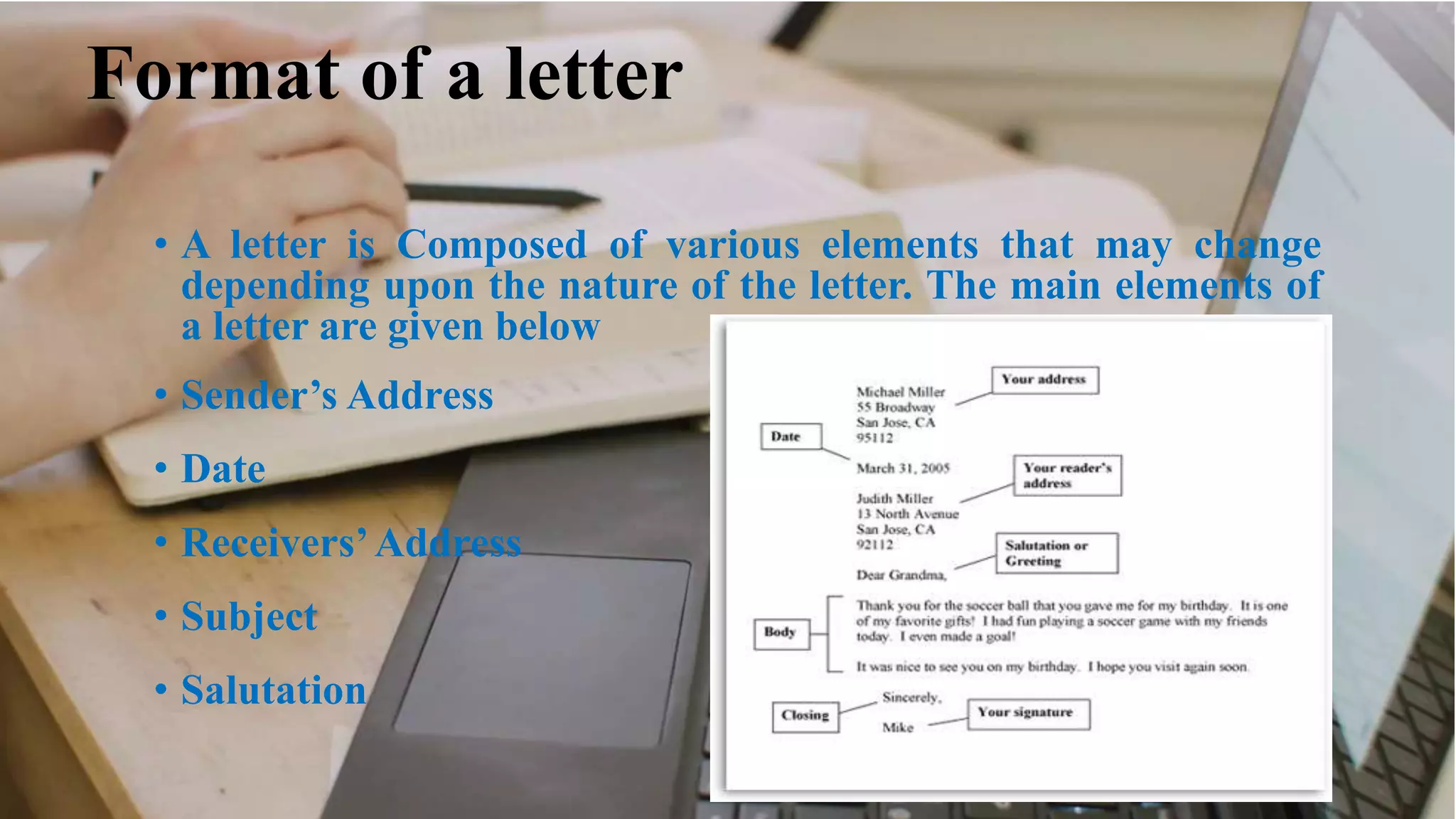
Format of a letter
• A letter is Composed of various elements that may change
depending upon the nature of the letter. The main elements of
a letter are given below
• Sender’s Address
• Date
• Receivers’Address
• Subject
• Salutation
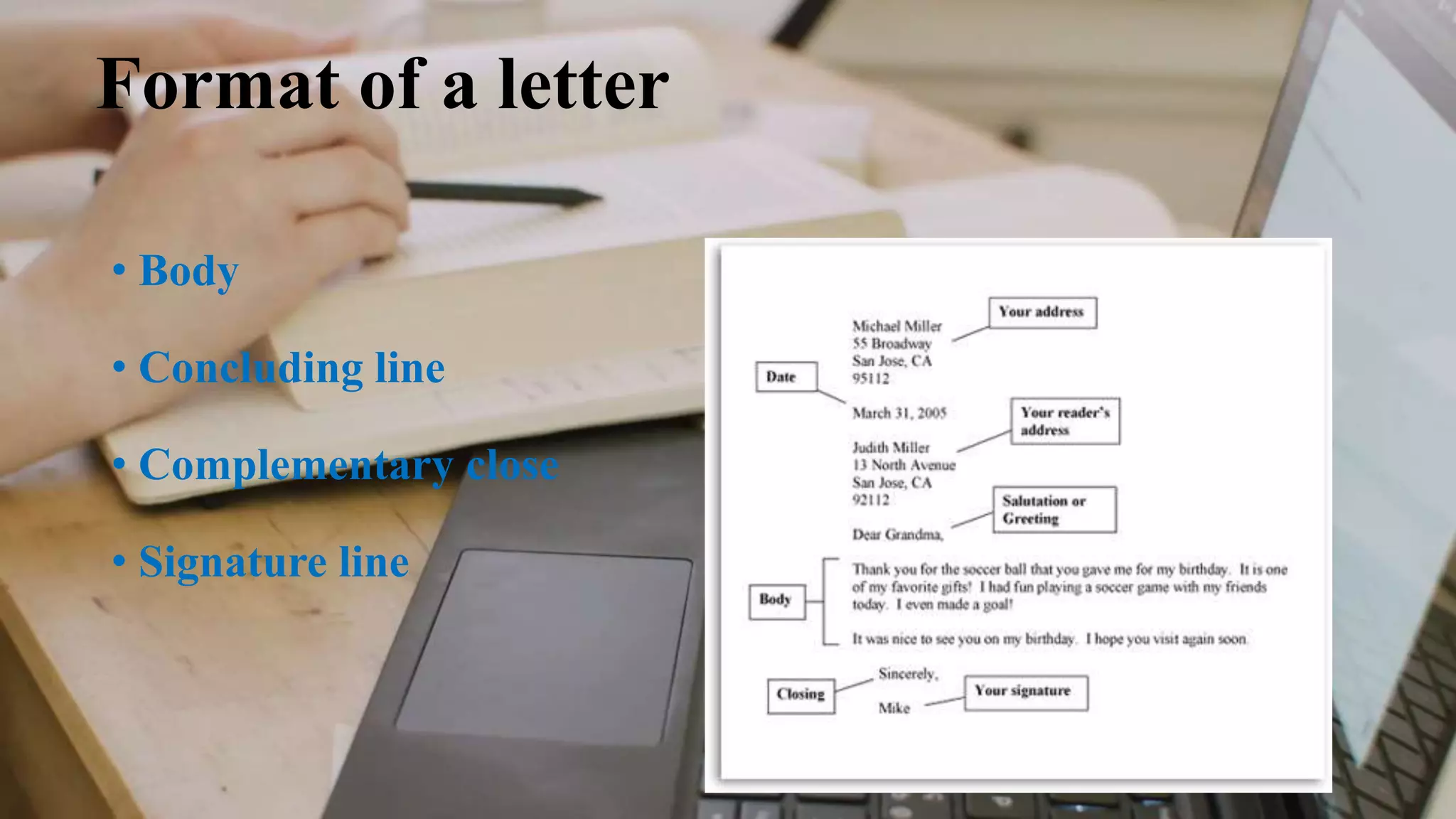
Format of a letter
• Body
• Concluding line
• Complementary close
• Signature line
Different Letter Format
• The Styles of Business Letters (Layouts of Business Letters)
have undergone changes over the period of time.
• The main four format are given below:
• Full Block
• Modified Block/Semi Block
• Indented Format
• Simplified Format
Different types of formal letters
Basically, they all have the same layout styles, salutation and endings.
However, the information that you include in these letters differ. Here is a
closer look at different types of formal letters.
Inquiry letters
These letters are used to request more information about a product
or service. You must clearly explain what information you are
seeking. You may also ask for further details in the form of
catalogs, brochures etc.
Sales Letters
Sales letters are used to promote new products and services.
A sales letter must clearly state the advantages of using the
specific product you are trying to promote. Ideally, a sales
letter must highlight an important problem and then explain
how that problem can be solved by using your product. All
sales letters must include a call to action.
Acceptance letter
An acceptance letter is one that is written when you want to accept a job, a
gift, an invitation, an honor, a resignation etc. You may have verbally
accepted the job or gift. Still it is a smart idea to formally accept the offer
with an acceptance letter.
Apology letters
Business apology letters should be typed on a computer. Use a serif font,
such as Times Roman. Once you have typed the letter, print it on good
quality, white paper.
Cover Letters
A cover letter is one that is sent along with your CV when you are applying
for a job. The purpose of a cover letter is to elicit a positive response from
your prospective employers by highlighting the plus points in your resume.
Order Letter
When a buyer needs to order some goods, he writes an order letter to the seller. The
three main parts of this letter are
The details of the items or the goods being ordered must be clearly stated. It must
have complete information like the quantity of the goods, model number (if
possible),
Recovery Letters
There are sometimes when a company or an organization needs to collect money
from a client or a customer. The intention behind writing recovery letters is to
recover the money form the customer without bothering or annoying the client. This
type of letter includes detail information regarding the amount of unclear payment,
last date of payment of the amount, the detail of the legal action in case of non-
payment of the dues. Although it is a recovery letter, one must always keep in mind

Letter and its types(Format of letters)

  • 1.
    Letter Writing Presented by 18501510-07918501510-090 18501510-091 18501510-109 18815015-001 18811510-002
  • 2.
    Letter A letter isa written message that can be handwritten or printed on paper. It is usually sent to the recipient via mail or post in an envelope. OR A letter is a written message conveyed from one person to another Person through a medium.
  • 3.
    Medium A medium isthe way in which a piece of writing is delivered. E-mail Mailed paper copy Watts-app
  • 4.
    Main Purposes • ToInquire • To Apologize • To Confirm • To Request • To provide good or bad news • To enclose document
  • 5.
    Types of Letters Letus first understand that there are broadly two types of letter, name Formal Letters Informal Letters Formal Letter These letters follow a certain pattern and formality. They are strictly kept professional in nature, and directly address the issues concerned. Any type of business letter or letter to authorities falls within this given category.
  • 6.
    Informal Letter These arepersonal letters. They need not follow any set pattern or any formalities. They contain personal information or are a written conversation. Informal letters are generally written to friends, and relatives etc.
  • 7.
    ELEMENTS OF AGOOD LETTER The most important element of writing a good letter is your ability to identify and write to your audience. If you are addressing your letter to the department of human resources, avoid using highly technical terms that only engineers would understand. The next element is that you make sure your present your objective in a clear and concise manner. Don't be vague about your objective. Another important element to remember is to remain professional. Even if you are writing a complaint letter, remain polite and courteous, simply state the problem along with any other relevant information and be sure to avoid threats and slander.
  • 8.
    Key Points ofBetter Letter Writing 1) Selection of Correct Words: Words are the writer’s tools and the writer need to put the right word and right expression with precision. It should however be remembered that right words become relevant only in the right context. For example an emotional or flowery language has to be fully avoided in a business letter. 2) To the Point content: Nothing more is harmful to good communication than confused state which may result in not conveying the exact point. Before writing a letter one should ne sure of what one wants to convey. One should not be vague about one’s objective. 3) Conciseness: Formal letters must be concise. In formal letters specially one must not write unnecessary sentences. To the point information. Long illustrations and elaboration must be avoided all costs.
  • 9.
    4) Courtesy: Aletter reveals its writer’s personality and character. One must remain totally professional while writing a letter. Even while writing a complaint letter, care should be taken that it is couched in polite and civilized language. Good judgment determines what and how a point has to be conveyed. 5) Correct Use of Punctuation Marks: Use of punctuation marks, use of capital letters, commas or colons is must to make our writing effective. Sometimes placement of comma or full stop at a wrong place may change the meaning of the sentence can steal the effectiveness of a good letter. Hence utmost attention should be paid to punctuation while writing. 6) Style: The conversational style is the most suitable one for letter writing. It is best to write in a simple, clear style maintaining a logical sequence of ideas. Every sentence should grow out of the preceding one. There should be no abrupt jumping from one idea to the another.
  • 10.
    Format of aletter • A letter is Composed of various elements that may change depending upon the nature of the letter. The main elements of a letter are given below • Sender’s Address • Date • Receivers’Address • Subject • Salutation
  • 11.
    Format of aletter • Body • Concluding line • Complementary close • Signature line
  • 12.
    Different Letter Format •The Styles of Business Letters (Layouts of Business Letters) have undergone changes over the period of time. • The main four format are given below: • Full Block • Modified Block/Semi Block • Indented Format • Simplified Format
  • 13.
    Different types offormal letters Basically, they all have the same layout styles, salutation and endings. However, the information that you include in these letters differ. Here is a closer look at different types of formal letters. Inquiry letters These letters are used to request more information about a product or service. You must clearly explain what information you are seeking. You may also ask for further details in the form of catalogs, brochures etc. Sales Letters Sales letters are used to promote new products and services. A sales letter must clearly state the advantages of using the specific product you are trying to promote. Ideally, a sales letter must highlight an important problem and then explain how that problem can be solved by using your product. All sales letters must include a call to action.
  • 14.
    Acceptance letter An acceptanceletter is one that is written when you want to accept a job, a gift, an invitation, an honor, a resignation etc. You may have verbally accepted the job or gift. Still it is a smart idea to formally accept the offer with an acceptance letter. Apology letters Business apology letters should be typed on a computer. Use a serif font, such as Times Roman. Once you have typed the letter, print it on good quality, white paper. Cover Letters A cover letter is one that is sent along with your CV when you are applying for a job. The purpose of a cover letter is to elicit a positive response from your prospective employers by highlighting the plus points in your resume.
  • 15.
    Order Letter When abuyer needs to order some goods, he writes an order letter to the seller. The three main parts of this letter are The details of the items or the goods being ordered must be clearly stated. It must have complete information like the quantity of the goods, model number (if possible), Recovery Letters There are sometimes when a company or an organization needs to collect money from a client or a customer. The intention behind writing recovery letters is to recover the money form the customer without bothering or annoying the client. This type of letter includes detail information regarding the amount of unclear payment, last date of payment of the amount, the detail of the legal action in case of non- payment of the dues. Although it is a recovery letter, one must always keep in mind