FOREST
J
FOREST
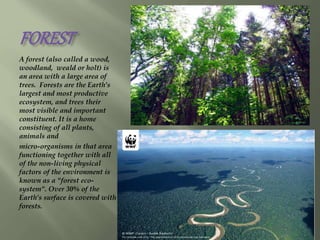
A forest (also called a wood,
woodland, weald or holt) is
an area with a large area of
trees. Forests are the Earth's
largest and most productive
ecosystem, and trees their
most visible and important
constituent. It is a home
consisting of all plants,
animals and
micro-organisms in that area
functioning together with all
of the non-living physical
factors of the environment is
known as a "forest eco-
system". Over 30% of the
Earth's surface is covered with
forests.
TYPES
OF
FOREST
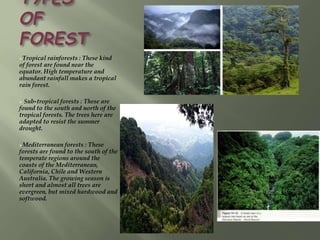
Tropical rainforests : These kind
of forest are found near the
equator. High temperature and
abundant rainfall makes a tropical
rain forest.
 Sub-tropical forests : These are
found to the south and north of the
tropical forests. The trees here are
adapted to resist the summer
drought.
Mediterranean forests : These
forests are found to the south of the
temperate regions around the
coasts of the Mediterranean,
California, Chile and Western
Australia. The growing season is
short and almost all trees are
evergreen, but mixed hardwood and
softwood.
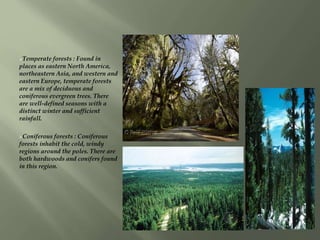
Temperate forests : Found in
places as eastern North America,
northeastern Asia, and western and
eastern Europe, temperate forests
are a mix of deciduous and
coniferous evergreen trees. There
are well-defined seasons with a
distinct winter and sufficient
rainfall.
Coniferous forests : Coniferous
forests inhabit the cold, windy
regions around the poles. There are
both hardwoods and conifers found
in this region.
USES OF
FOREST
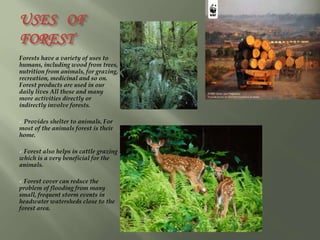
Forests have a variety of uses to
humans, including wood from trees,
nutrition from animals, for grazing,
recreation, medicinal and so on.
Forest products are used in our
daily lives All these and many
more activities directly or
indirectly involve forests.
 Provides shelter to animals. For
most of the animals forest is their
home.
 Forest also helps in cattle grazing
which is a very beneficial for the
animals.
 Forest cover can reduce the
problem of flooding from many
small, frequent storm events in
headwater watersheds close to the
forest area.
 It is also plays a very vital role in
recycling water. As show in the
picture.
 Among other ecological benefits, the
forests play a vital role as
watersheds.
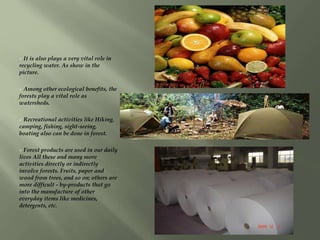
 Recreational activities like Hiking,
camping, fishing, sight-seeing,
boating also can be done in forest.
 Forest products are used in our daily
lives All these and many more
activities directly or indirectly
involve forests. Fruits, paper and
wood from trees, and so on; others are
more difficult - by-products that go
into the manufacture of other
everyday items like medicines,
detergents, etc.
FOREST AS
HABITAT
Although the ocean was the
original home of all life of Earth,
forests, as they themselves evolved,
quickly became home to a vast
majority of land based creatures...
including early ma
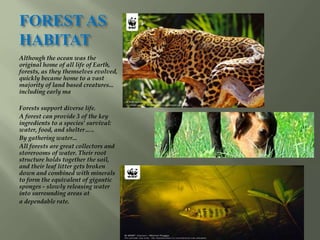
Forests support diverse life.
A forest can provide 3 of the key
ingredients to a species' survival:
water, food, and shelter…..
By gathering water...
All forests are great collectors and
storerooms of water. Their root
structure holds together the soil,
and their leaf litter gets broken
down and combined with minerals
to form the equivalent of gigantic
sponges - slowly releasing water
into surrounding areas at
a dependable rate.
Originating and supporting food
chains.......
A forest is home to many types plants,
which are the food source for many
types of animals, which are, in their
turn, also sources of food for other
animals. This circle of life, the
linkages between all animals and all
plants, is often referred to as "the web
of life" - a
reference to the common dependencies
between all life in an ecosystem.
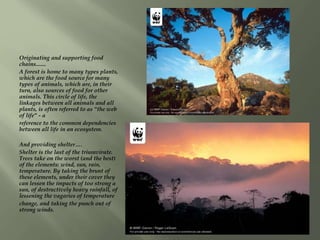
And providing shelter….
Shelter is the last of the triumvirate.
Trees take on the worst (and the best)
of the elements: wind, sun, rain,
temperature. By taking the brunt of
these elements, under their cover they
can lessen the impacts of too strong a
sun, of destructively heavy rainfall, of
lessening the vagaries of temperature
change, and taking the punch out of
strong winds.
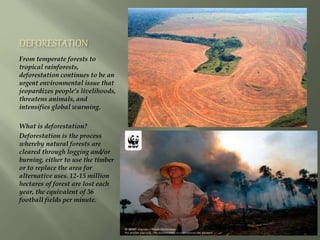
DEFORESTATION
From temperate forests to
tropical rainforests,
deforestation continues to be an
urgent environmental issue that
jeopardizes people’s livelihoods,
threatens animals, and
intensifies global warming.
What is deforestation?
Deforestation is the process
whereby natural forests are
cleared through logging and/or
burning, either to use the timber
or to replace the area for
alternative uses. 12-15 million
hectares of forest are lost each
year, the equivalent of 36
football fields per minute.
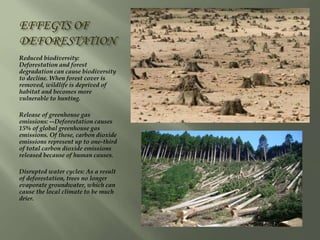
EFFEGTS OF
DEFORESTATION
Reduced biodiversity:
Deforestation and forest
degradation can cause biodiversity
to decline. When forest cover is
removed, wildlife is deprived of
habitat and becomes more
vulnerable to hunting.
Release of greenhouse gas
emissions: --Deforestation causes
15% of global greenhouse gas
emissions. Of these, carbon dioxide
emissions represent up to one-third
of total carbon dioxide emissions
released because of human causes.
Disrupted water cycles: As a result
of deforestation, trees no longer
evaporate groundwater, which can
cause the local climate to be much
drier.
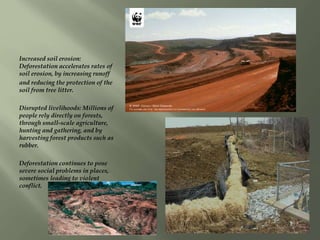
Increased soil erosion:
Deforestation accelerates rates of
soil erosion, by increasing runoff
and reducing the protection of the
soil from tree litter.
Disrupted livelihoods: Millions of
people rely directly on forests,
through small-scale agriculture,
hunting and gathering, and by
harvesting forest products such as
rubber.
Deforestation continues to pose
severe social problems in places,
sometimes leading to violent
conflict.
SAVEFOREST& SERVETOHUMANKIND
TRIBAL PEOPLE
OF INDIA
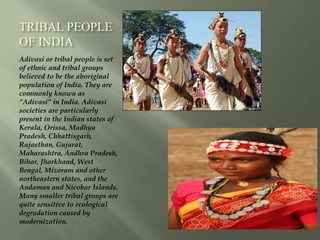
Adivasi or tribal people is set
of ethnic and tribal groups
believed to be the aboriginal
population of India. They are
commonly known as
"Adivasi" in India. Adivasi
societies are particularly
present in the Indian states of
Kerala, Orissa, Madhya
Pradesh, Chhattisgarh,
Rajasthan, Gujarat,
Maharashtra, Andhra Pradesh,
Bihar, Jharkhand, West
Bengal, Mizoram and other
northeastern states, and the
Andaman and Nicobar Islands.
Many smaller tribal groups are
quite sensitive to ecological
degradation caused by
modernization.
Some notable
Scheduled Tribes
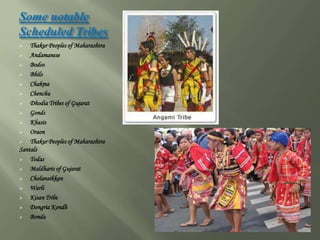
 Thakur Peoples of Maharashtra
 Andamanese
 Bodos
 Bhils
 Chakma
 Chenchu
 Dhodia Tribes of Gujarat
 Gonds
 Khasis
 Oraon
 Thakur Peoples of Maharashtra
Santals
 Todas
 Maldharis of Gujarat
 Cholanaikkan
 Warli
 Kisan Tribe
 Dongria Kondh
 Bonda
ORAONTRIBE
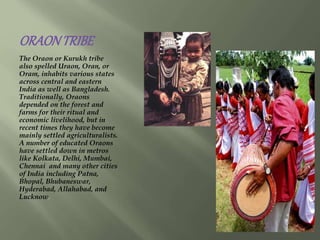
The Oraon or Kurukh tribe
also spelled Uraon, Oran, or
Oram, inhabits various states
across central and eastern
India as well as Bangladesh.
Traditionally, Oraons
depended on the forest and
farms for their ritual and
economic livelihood, but in
recent times they have become
mainly settled agriculturalists.
A number of educated Oraons
have settled down in metros
like Kolkata, Delhi, Mumbai,
Chennai and many other cities
of India including Patna,
Bhopal, Bhubaneswar,
Hyderabad, Allahabad, and
Lucknow.
LANGUAGE &
CULTURE
The Oraon language, Kurukh,
belongs to the Dravidian language,
and is most closely related to
Brahui and Malto (Paharia).
Kurukh language is being taught in
Ranchi University in Jharkhand. A
Kurukh Literary Society have been
formed after the first Kurukh
Conference held in Ranchi in
October, 2006.
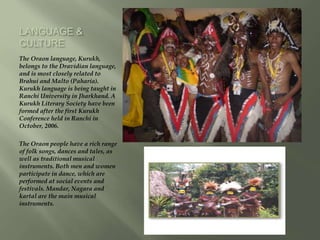
The Oraon people have a rich range
of folk songs, dances and tales, as
well as traditional musical
instruments. Both men and women
participate in dance, which are
performed at social events and
festivals. Mandar, Nagara and
kartal are the main musical
instruments.

FOREST ITS TYPES AND VEGETATION FOUND THERE

  • 1.
  • 2.
    FOREST A forest (alsocalled a wood, woodland, weald or holt) is an area with a large area of trees. Forests are the Earth's largest and most productive ecosystem, and trees their most visible and important constituent. It is a home consisting of all plants, animals and micro-organisms in that area functioning together with all of the non-living physical factors of the environment is known as a "forest eco- system". Over 30% of the Earth's surface is covered with forests.
  • 3.
    TYPES OF FOREST Tropical rainforests :These kind of forest are found near the equator. High temperature and abundant rainfall makes a tropical rain forest.  Sub-tropical forests : These are found to the south and north of the tropical forests. The trees here are adapted to resist the summer drought. Mediterranean forests : These forests are found to the south of the temperate regions around the coasts of the Mediterranean, California, Chile and Western Australia. The growing season is short and almost all trees are evergreen, but mixed hardwood and softwood.
  • 4.
    Temperate forests :Found in places as eastern North America, northeastern Asia, and western and eastern Europe, temperate forests are a mix of deciduous and coniferous evergreen trees. There are well-defined seasons with a distinct winter and sufficient rainfall. Coniferous forests : Coniferous forests inhabit the cold, windy regions around the poles. There are both hardwoods and conifers found in this region.
  • 5.
    USES OF FOREST Forests havea variety of uses to humans, including wood from trees, nutrition from animals, for grazing, recreation, medicinal and so on. Forest products are used in our daily lives All these and many more activities directly or indirectly involve forests.  Provides shelter to animals. For most of the animals forest is their home.  Forest also helps in cattle grazing which is a very beneficial for the animals.  Forest cover can reduce the problem of flooding from many small, frequent storm events in headwater watersheds close to the forest area.
  • 6.
     It isalso plays a very vital role in recycling water. As show in the picture.  Among other ecological benefits, the forests play a vital role as watersheds.  Recreational activities like Hiking, camping, fishing, sight-seeing, boating also can be done in forest.  Forest products are used in our daily lives All these and many more activities directly or indirectly involve forests. Fruits, paper and wood from trees, and so on; others are more difficult - by-products that go into the manufacture of other everyday items like medicines, detergents, etc.
  • 7.
    FOREST AS HABITAT Although theocean was the original home of all life of Earth, forests, as they themselves evolved, quickly became home to a vast majority of land based creatures... including early ma Forests support diverse life. A forest can provide 3 of the key ingredients to a species' survival: water, food, and shelter….. By gathering water... All forests are great collectors and storerooms of water. Their root structure holds together the soil, and their leaf litter gets broken down and combined with minerals to form the equivalent of gigantic sponges - slowly releasing water into surrounding areas at a dependable rate.
  • 8.
    Originating and supportingfood chains....... A forest is home to many types plants, which are the food source for many types of animals, which are, in their turn, also sources of food for other animals. This circle of life, the linkages between all animals and all plants, is often referred to as "the web of life" - a reference to the common dependencies between all life in an ecosystem. And providing shelter…. Shelter is the last of the triumvirate. Trees take on the worst (and the best) of the elements: wind, sun, rain, temperature. By taking the brunt of these elements, under their cover they can lessen the impacts of too strong a sun, of destructively heavy rainfall, of lessening the vagaries of temperature change, and taking the punch out of strong winds.
  • 9.
    DEFORESTATION From temperate foreststo tropical rainforests, deforestation continues to be an urgent environmental issue that jeopardizes people’s livelihoods, threatens animals, and intensifies global warming. What is deforestation? Deforestation is the process whereby natural forests are cleared through logging and/or burning, either to use the timber or to replace the area for alternative uses. 12-15 million hectares of forest are lost each year, the equivalent of 36 football fields per minute.
  • 10.
    EFFEGTS OF DEFORESTATION Reduced biodiversity: Deforestationand forest degradation can cause biodiversity to decline. When forest cover is removed, wildlife is deprived of habitat and becomes more vulnerable to hunting. Release of greenhouse gas emissions: --Deforestation causes 15% of global greenhouse gas emissions. Of these, carbon dioxide emissions represent up to one-third of total carbon dioxide emissions released because of human causes. Disrupted water cycles: As a result of deforestation, trees no longer evaporate groundwater, which can cause the local climate to be much drier.
  • 11.
    Increased soil erosion: Deforestationaccelerates rates of soil erosion, by increasing runoff and reducing the protection of the soil from tree litter. Disrupted livelihoods: Millions of people rely directly on forests, through small-scale agriculture, hunting and gathering, and by harvesting forest products such as rubber. Deforestation continues to pose severe social problems in places, sometimes leading to violent conflict.
  • 12.
  • 13.
    TRIBAL PEOPLE OF INDIA Adivasior tribal people is set of ethnic and tribal groups believed to be the aboriginal population of India. They are commonly known as "Adivasi" in India. Adivasi societies are particularly present in the Indian states of Kerala, Orissa, Madhya Pradesh, Chhattisgarh, Rajasthan, Gujarat, Maharashtra, Andhra Pradesh, Bihar, Jharkhand, West Bengal, Mizoram and other northeastern states, and the Andaman and Nicobar Islands. Many smaller tribal groups are quite sensitive to ecological degradation caused by modernization.
  • 14.
    Some notable Scheduled Tribes Thakur Peoples of Maharashtra  Andamanese  Bodos  Bhils  Chakma  Chenchu  Dhodia Tribes of Gujarat  Gonds  Khasis  Oraon  Thakur Peoples of Maharashtra Santals  Todas  Maldharis of Gujarat  Cholanaikkan  Warli  Kisan Tribe  Dongria Kondh  Bonda
  • 15.
    ORAONTRIBE The Oraon orKurukh tribe also spelled Uraon, Oran, or Oram, inhabits various states across central and eastern India as well as Bangladesh. Traditionally, Oraons depended on the forest and farms for their ritual and economic livelihood, but in recent times they have become mainly settled agriculturalists. A number of educated Oraons have settled down in metros like Kolkata, Delhi, Mumbai, Chennai and many other cities of India including Patna, Bhopal, Bhubaneswar, Hyderabad, Allahabad, and Lucknow.
  • 16.
    LANGUAGE & CULTURE The Oraonlanguage, Kurukh, belongs to the Dravidian language, and is most closely related to Brahui and Malto (Paharia). Kurukh language is being taught in Ranchi University in Jharkhand. A Kurukh Literary Society have been formed after the first Kurukh Conference held in Ranchi in October, 2006. The Oraon people have a rich range of folk songs, dances and tales, as well as traditional musical instruments. Both men and women participate in dance, which are performed at social events and festivals. Mandar, Nagara and kartal are the main musical instruments.