Dr. Rahul Dangi
DANGI RAHUL
DANGI RAHUL
DANGI RAHUL
Forest fires are a regular phenomenon in our country often
observed during summers.
A number of 52,785 forest fires were detected using
MODIS (Moderate Resolution Imaging Spectroradiometer)
sensor and 3,45,989 forest fires were detected using
SNPP-VIIRS (Suomi – National Polar Orbiting
Partnership- Visible infrared imaging Radiometer suite) in
forest fire season from Nov. 2020 to June 2021.
DANGI RAHUL
More than 36% of the country’s forest cover has been
estimated to be prone to frequent forest fires.
Nearly 4% of the country’s forest cover is extremely prone
to fire, whereas 6% of forest cover is found to be very
highly prone (ISFR 2019).
Based on the forest inventory records, 54.40% of forests in
India are exposed to occasional fires, 7.49% to moderately
frequent fires and 2.40% to high incidence levels while
35.71% of India’s forests have not yet been exposed to fires
of any real significance.
DANGI RAHUL
Natural causes like lightening can set fires on trees which
may be spread by wind. Sometimes, high atmospheric
temperatures and dryness (low humidity) offer favourable
circumstances for a fire to start.
 Anthropogenic causes (90% of all wildfires) are smoking
in forests, campfires, burning debris, fireworks, electric
spark or any other source of ignition.
Other human led causes are land clearing, industrial
development, resettlement, hunting, negligence, and
arson.
DANGI RAHUL
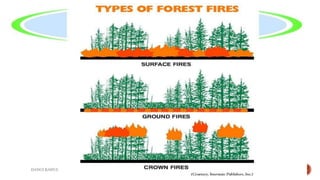
There are three basic types:-
CROWN FIRES:
1. This type burn trees up their entire length to the top.
2. They burn through the canopy, spreading from treetop to
treetop.
3. These are the most intense and dangerous forest fires as
they are very difficult to contain.
4. It needs strong winds, steep slopes, and a heavy fuel
load to continue burning.
DANGI RAHUL
SURFACE FIRES:
1. They burn only surface litter like dried leaves, twigs,
and grasses.
2. These are the easiest fires to put out and cause the least
damage to the forest.
3. Parched grass or fallen leaves often fuel surface fires.
DANGI RAHUL
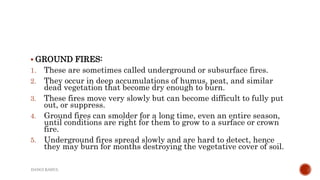
 GROUND FIRES:
1. These are sometimes called underground or subsurface fires.
2. They occur in deep accumulations of humus, peat, and similar
dead vegetation that become dry enough to burn.
3. These fires move very slowly but can become difficult to fully put
out, or suppress.
4. Ground fires can smolder for a long time, even an entire season,
until conditions are right for them to grow to a surface or crown
fire.
5. Underground fires spread slowly and are hard to detect, hence
they may burn for months destroying the vegetative cover of soil.
DANGI RAHUL
DANGI RAHUL
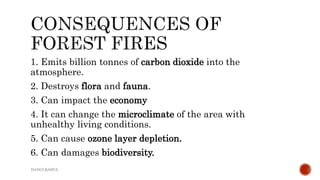
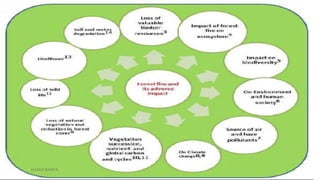
1. Emits billion tonnes of carbon dioxide into the
atmosphere.
2. Destroys flora and fauna.
3. Can impact the economy
4. It can change the microclimate of the area with
unhealthy living conditions.
5. Can cause ozone layer depletion.
6. Can damages biodiversity.
DANGI RAHUL
DANGI RAHUL
 The Ministry of Environment, Forest & Climate change has
prepared a National Master Plan for forest fire control. The Forest
Survey of India (FSI) monitors the incidence of wildfires.
 This plan proposes to introduce a well coordinated and integrated
fire management program that includes the following components:-
1.Prevention of human caused fires through education and
environment modification.
2. It is proposed that more emphasis be given to people participation
through Joint forest fire management for fire prevention.
DANGI RAHUL
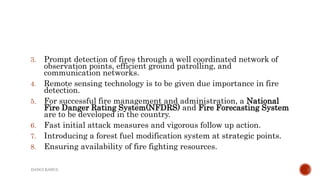
3. Prompt detection of fires through a well coordinated network of
observation points, efficient ground patrolling, and
communication networks.
4. Remote sensing technology is to be given due importance in fire
detection.
5. For successful fire management and administration, a National
Fire Danger Rating System(NFDRS) and Fire Forecasting System
are to be developed in the country.
6. Fast initial attack measures and vigorous follow up action.
7. Introducing a forest fuel modification system at strategic points.
8. Ensuring availability of fire fighting resources.
DANGI RAHUL
 Mizoram has had the highest number of wildfire
incidences in the last two decades, with more than 95% of
its districts being forest fire hotspots.
 Assam, M. P., Himachal Pradesh, Uttarakhand,
Maharashtra, Tripura, and Odisha also report frequent
forest fires annually.
 Bandipur forest fire in 2017, destroyed more than 1000
hectares.
 In 2016, the dreadful Uttarakhand forest fire brought
4000 hectares of forest to ashes.
DANGI RAHUL
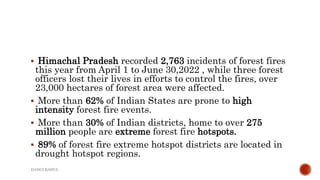
 Himachal Pradesh recorded 2,763 incidents of forest fires
this year from April 1 to June 30,2022 , while three forest
officers lost their lives in efforts to control the fires, over
23,000 hectares of forest area were affected.
 More than 62% of Indian States are prone to high
intensity forest fire events.
 More than 30% of Indian districts, home to over 275
million people are extreme forest fire hotspots.
 89% of forest fire extreme hotspot districts are located in
drought hotspot regions.
DANGI RAHUL
DANGI RAHUL
DANGI RAHUL
THANK
YOU
DANGI RAHUL

Forest fire CONTROL fire forest fire 6.pptx

  • 1.
  • 2.
  • 3.
  • 4.
    Forest fires area regular phenomenon in our country often observed during summers. A number of 52,785 forest fires were detected using MODIS (Moderate Resolution Imaging Spectroradiometer) sensor and 3,45,989 forest fires were detected using SNPP-VIIRS (Suomi – National Polar Orbiting Partnership- Visible infrared imaging Radiometer suite) in forest fire season from Nov. 2020 to June 2021. DANGI RAHUL
  • 5.
    More than 36%of the country’s forest cover has been estimated to be prone to frequent forest fires. Nearly 4% of the country’s forest cover is extremely prone to fire, whereas 6% of forest cover is found to be very highly prone (ISFR 2019). Based on the forest inventory records, 54.40% of forests in India are exposed to occasional fires, 7.49% to moderately frequent fires and 2.40% to high incidence levels while 35.71% of India’s forests have not yet been exposed to fires of any real significance. DANGI RAHUL
  • 6.
    Natural causes likelightening can set fires on trees which may be spread by wind. Sometimes, high atmospheric temperatures and dryness (low humidity) offer favourable circumstances for a fire to start.  Anthropogenic causes (90% of all wildfires) are smoking in forests, campfires, burning debris, fireworks, electric spark or any other source of ignition. Other human led causes are land clearing, industrial development, resettlement, hunting, negligence, and arson. DANGI RAHUL
  • 7.
    There are threebasic types:- CROWN FIRES: 1. This type burn trees up their entire length to the top. 2. They burn through the canopy, spreading from treetop to treetop. 3. These are the most intense and dangerous forest fires as they are very difficult to contain. 4. It needs strong winds, steep slopes, and a heavy fuel load to continue burning. DANGI RAHUL
  • 8.
    SURFACE FIRES: 1. Theyburn only surface litter like dried leaves, twigs, and grasses. 2. These are the easiest fires to put out and cause the least damage to the forest. 3. Parched grass or fallen leaves often fuel surface fires. DANGI RAHUL
  • 9.
     GROUND FIRES: 1.These are sometimes called underground or subsurface fires. 2. They occur in deep accumulations of humus, peat, and similar dead vegetation that become dry enough to burn. 3. These fires move very slowly but can become difficult to fully put out, or suppress. 4. Ground fires can smolder for a long time, even an entire season, until conditions are right for them to grow to a surface or crown fire. 5. Underground fires spread slowly and are hard to detect, hence they may burn for months destroying the vegetative cover of soil. DANGI RAHUL
  • 10.
  • 11.
    1. Emits billiontonnes of carbon dioxide into the atmosphere. 2. Destroys flora and fauna. 3. Can impact the economy 4. It can change the microclimate of the area with unhealthy living conditions. 5. Can cause ozone layer depletion. 6. Can damages biodiversity. DANGI RAHUL
  • 12.
  • 13.
     The Ministryof Environment, Forest & Climate change has prepared a National Master Plan for forest fire control. The Forest Survey of India (FSI) monitors the incidence of wildfires.  This plan proposes to introduce a well coordinated and integrated fire management program that includes the following components:- 1.Prevention of human caused fires through education and environment modification. 2. It is proposed that more emphasis be given to people participation through Joint forest fire management for fire prevention. DANGI RAHUL
  • 14.
    3. Prompt detectionof fires through a well coordinated network of observation points, efficient ground patrolling, and communication networks. 4. Remote sensing technology is to be given due importance in fire detection. 5. For successful fire management and administration, a National Fire Danger Rating System(NFDRS) and Fire Forecasting System are to be developed in the country. 6. Fast initial attack measures and vigorous follow up action. 7. Introducing a forest fuel modification system at strategic points. 8. Ensuring availability of fire fighting resources. DANGI RAHUL
  • 15.
     Mizoram hashad the highest number of wildfire incidences in the last two decades, with more than 95% of its districts being forest fire hotspots.  Assam, M. P., Himachal Pradesh, Uttarakhand, Maharashtra, Tripura, and Odisha also report frequent forest fires annually.  Bandipur forest fire in 2017, destroyed more than 1000 hectares.  In 2016, the dreadful Uttarakhand forest fire brought 4000 hectares of forest to ashes. DANGI RAHUL
  • 16.
     Himachal Pradeshrecorded 2,763 incidents of forest fires this year from April 1 to June 30,2022 , while three forest officers lost their lives in efforts to control the fires, over 23,000 hectares of forest area were affected.  More than 62% of Indian States are prone to high intensity forest fire events.  More than 30% of Indian districts, home to over 275 million people are extreme forest fire hotspots.  89% of forest fire extreme hotspot districts are located in drought hotspot regions. DANGI RAHUL
  • 17.
  • 18.
  • 19.