Download to read offline





![Figure 5: BCR-ABL kinase domain: showing the binding pocket
of nilotinib (purple) bound to the active site of the target BCR-
ABL in Chain C. In this figure, BCR-ABL is the cluster of four
chains (chain A , chain B [purple], chain C [blue], and chain D
[red]).](https://image.slidesharecdn.com/rationaldrugdesign-220826062109-4c1f2300/85/Rational_Drug_Design-ppt-10-320.jpg)


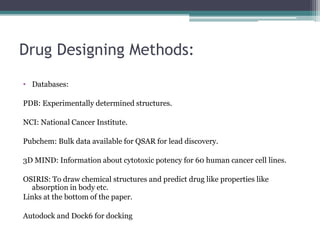


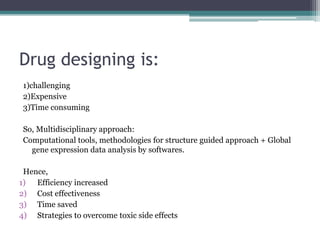
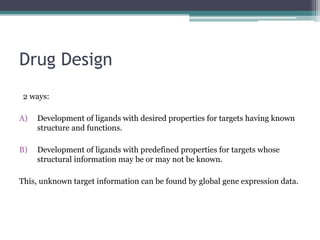
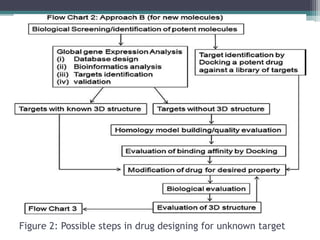
Rational drug design involves developing compounds that target specific biomolecules involved in disease processes through protein-protein or protein-nucleic acid interactions. Protein targets can be identified through techniques like X-ray crystallography and NMR. Computational tools and global gene expression analysis help increase the efficiency and cost-effectiveness of the drug design process by aiding in structure-guided approaches and target identification. Drug design can involve developing ligands for targets with known structures or developing ligands with predefined properties for unknown targets identified through gene expression data. Combination therapies and overcoming toxic side effects are important challenges in developing improved anti-cancer drugs.


