Revocable Trust Chapter 28
Tools & Techniques of
Estate Planning
1
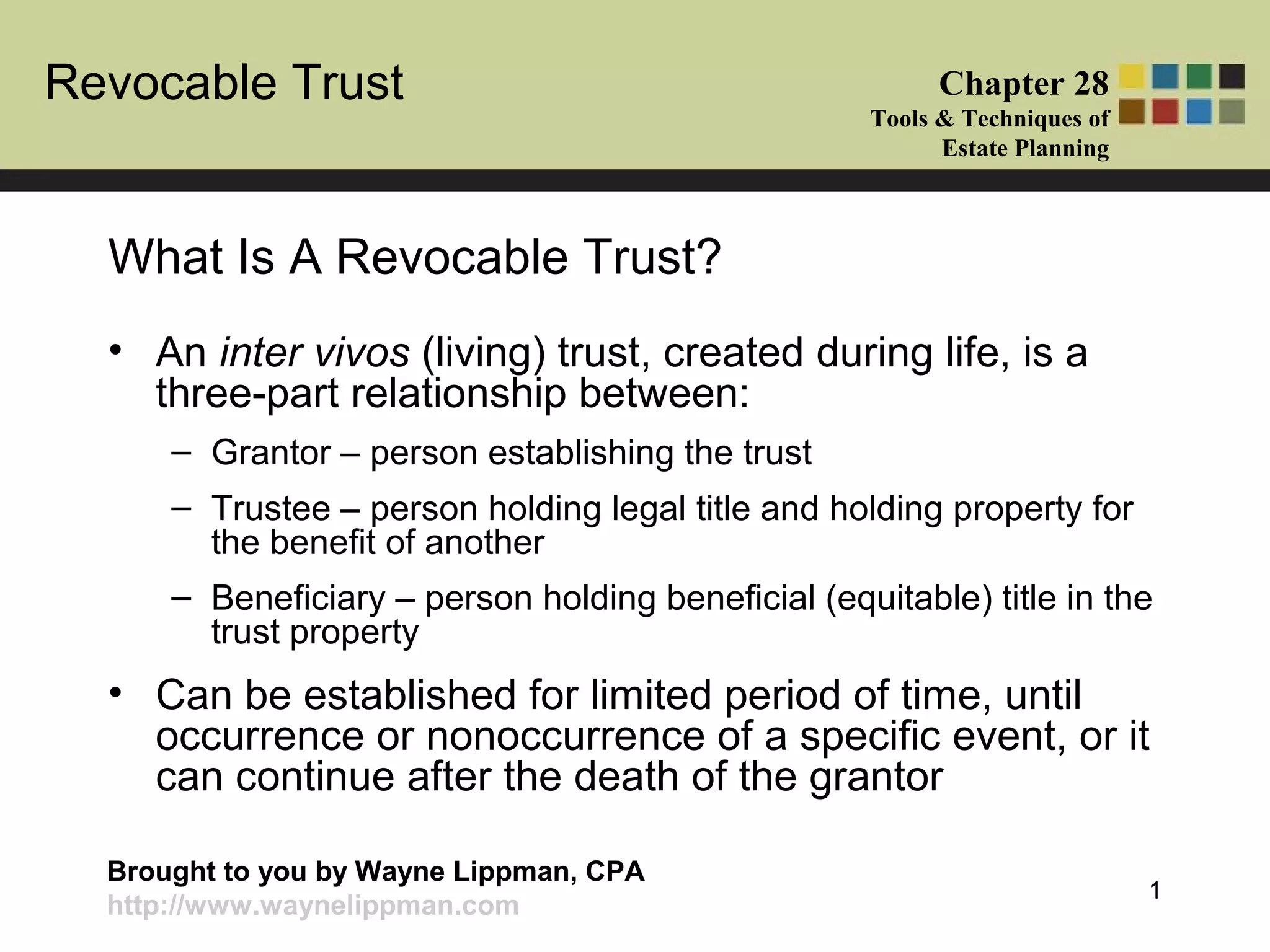
• An inter vivos (living) trust, created during life, is a
three-part relationship between:
– Grantor – person establishing the trust
– Trustee – person holding legal title and holding property for
the benefit of another
– Beneficiary – person holding beneficial (equitable) title in the
trust property
• Can be established for limited period of time, until
occurrence or nonoccurrence of a specific event, or it
can continue after the death of the grantor
What Is A Revocable Trust?
Brought to you by Wayne Lippman, CPA
http://www.waynelippman.com
Revocable Trust Chapter 28
Tools & Techniques of
Estate Planning
Copyright 2011, The National Underwriter Company 2
• The Grantor retains the right to:
– Revoke the trust,
– Change the trust terms, or
– Regain possession of trust property
• The trust becomes irrevocable at the earlier of the
Grantor:
– Dying
– Giving up all rights to revoke, amend, alter, or terminate the
trust and relinquishing title to the assets placed in the trust
What Is A Revocable Trust? (cont’d)
Revocable Trust Chapter 28
Tools & Techniques of
Estate Planning
Copyright 2011, The National Underwriter Company 3
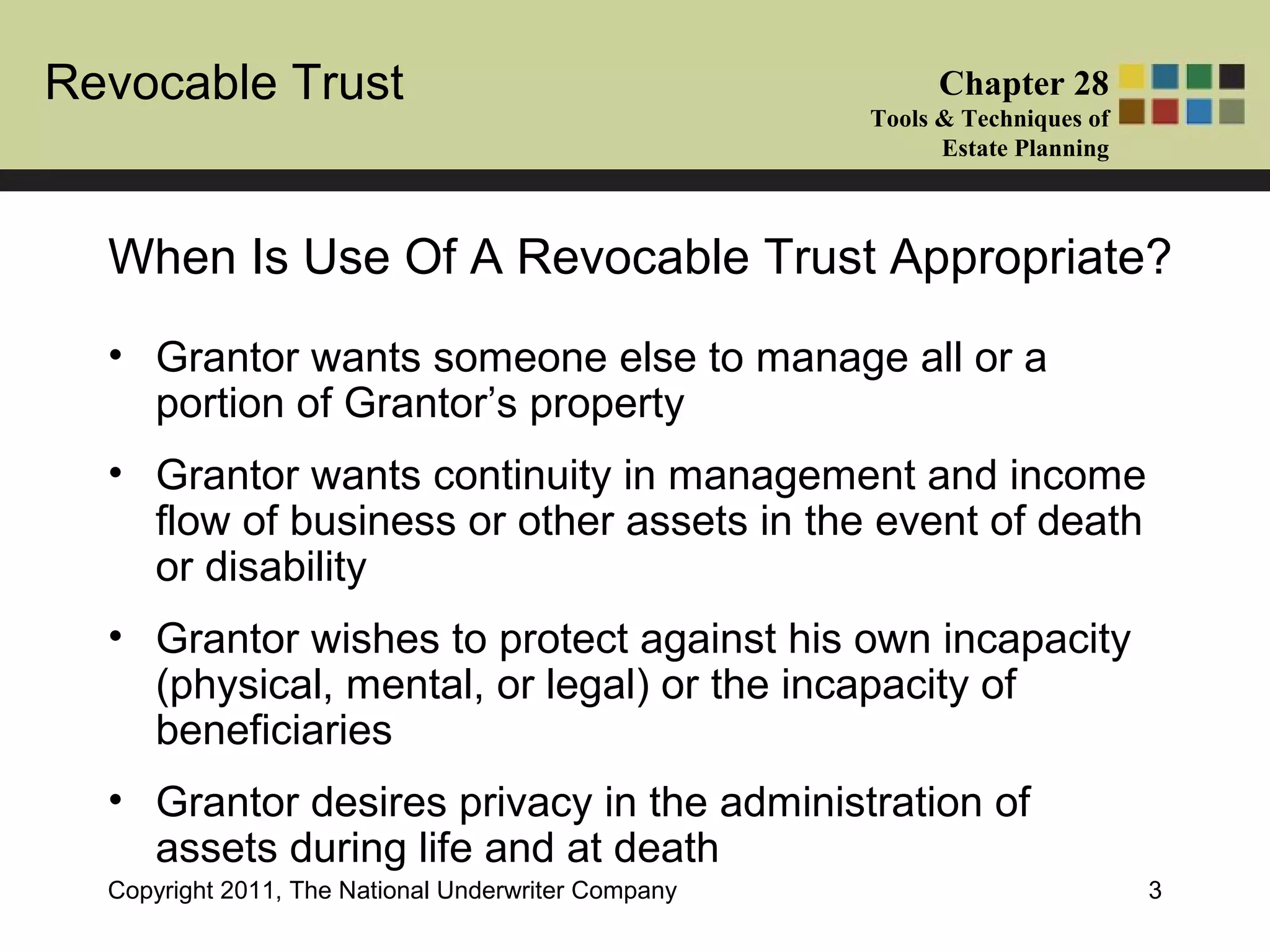
• Grantor wants someone else to manage all or a
portion of Grantor’s property
• Grantor wants continuity in management and income
flow of business or other assets in the event of death
or disability
• Grantor wishes to protect against his own incapacity
(physical, mental, or legal) or the incapacity of
beneficiaries
• Grantor desires privacy in the administration of
assets during life and at death
When Is Use Of A Revocable Trust Appropriate?
Revocable Trust Chapter 28
Tools & Techniques of
Estate Planning
Copyright 2011, The National Underwriter Company 4
• Grantor wants to minimize estate administration costs
and delay at death by avoiding probate
• Grantor wants to see the trust and trustee in
operation prior to death
• Grantor wishes to avoid ancillary probate and
administration of assets in other states
• Grantor wishes to reduce the potential for an election
against or contest of the will
• Grantor would like to select the state law governing
the trust
When Is Use Of A Revocable Trust Appropriate? (cont’d)
Revocable Trust Chapter 28
Tools & Techniques of
Estate Planning
Copyright 2011, The National Underwriter Company 5
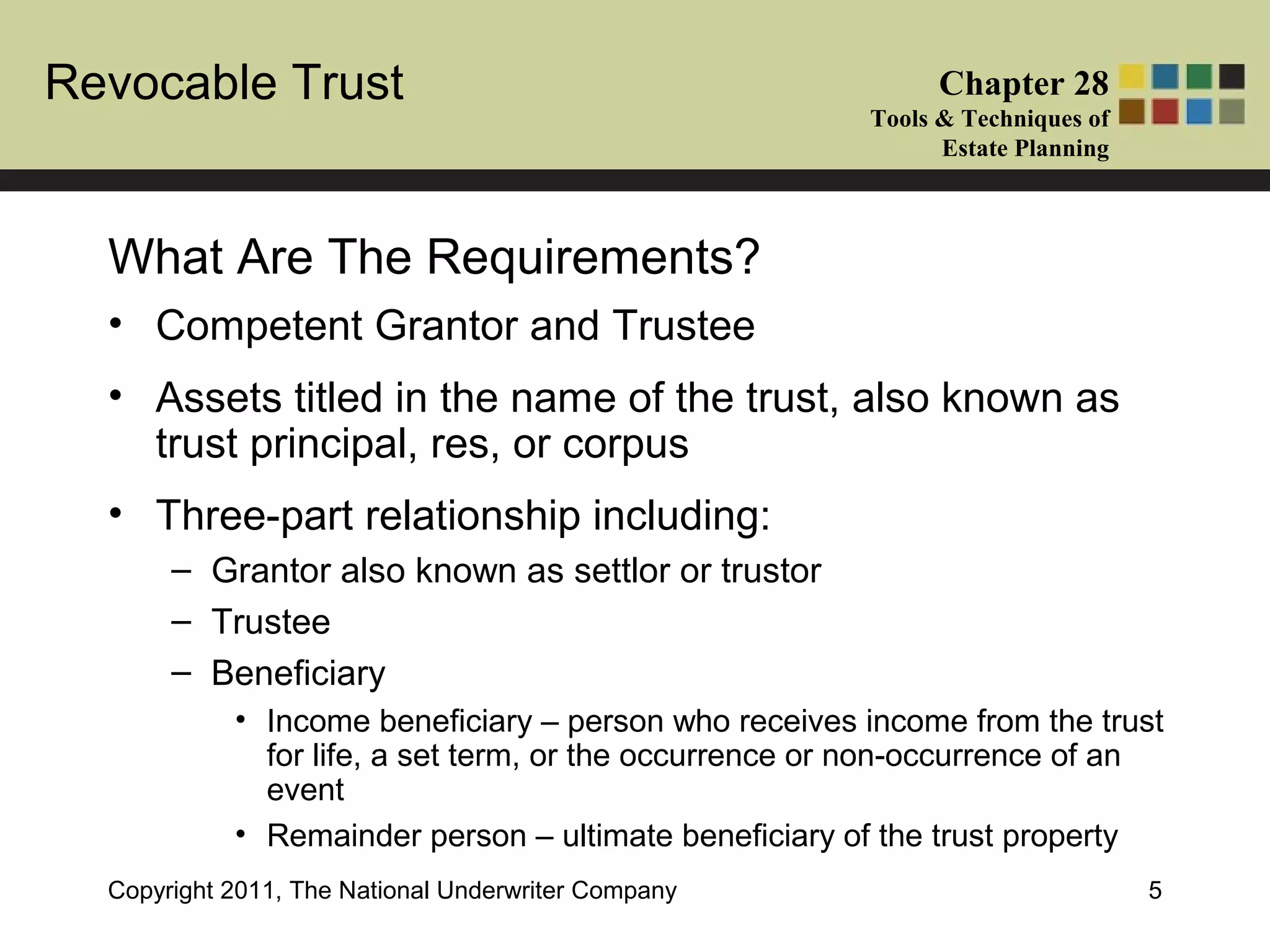
• Competent Grantor and Trustee
• Assets titled in the name of the trust, also known as
trust principal, res, or corpus
• Three-part relationship including:
– Grantor also known as settlor or trustor
– Trustee
– Beneficiary
• Income beneficiary – person who receives income from the trust
for life, a set term, or the occurrence or non-occurrence of an
event
• Remainder person – ultimate beneficiary of the trust property
What Are The Requirements?
Revocable Trust Chapter 28
Tools & Techniques of
Estate Planning
Copyright 2011, The National Underwriter Company 6
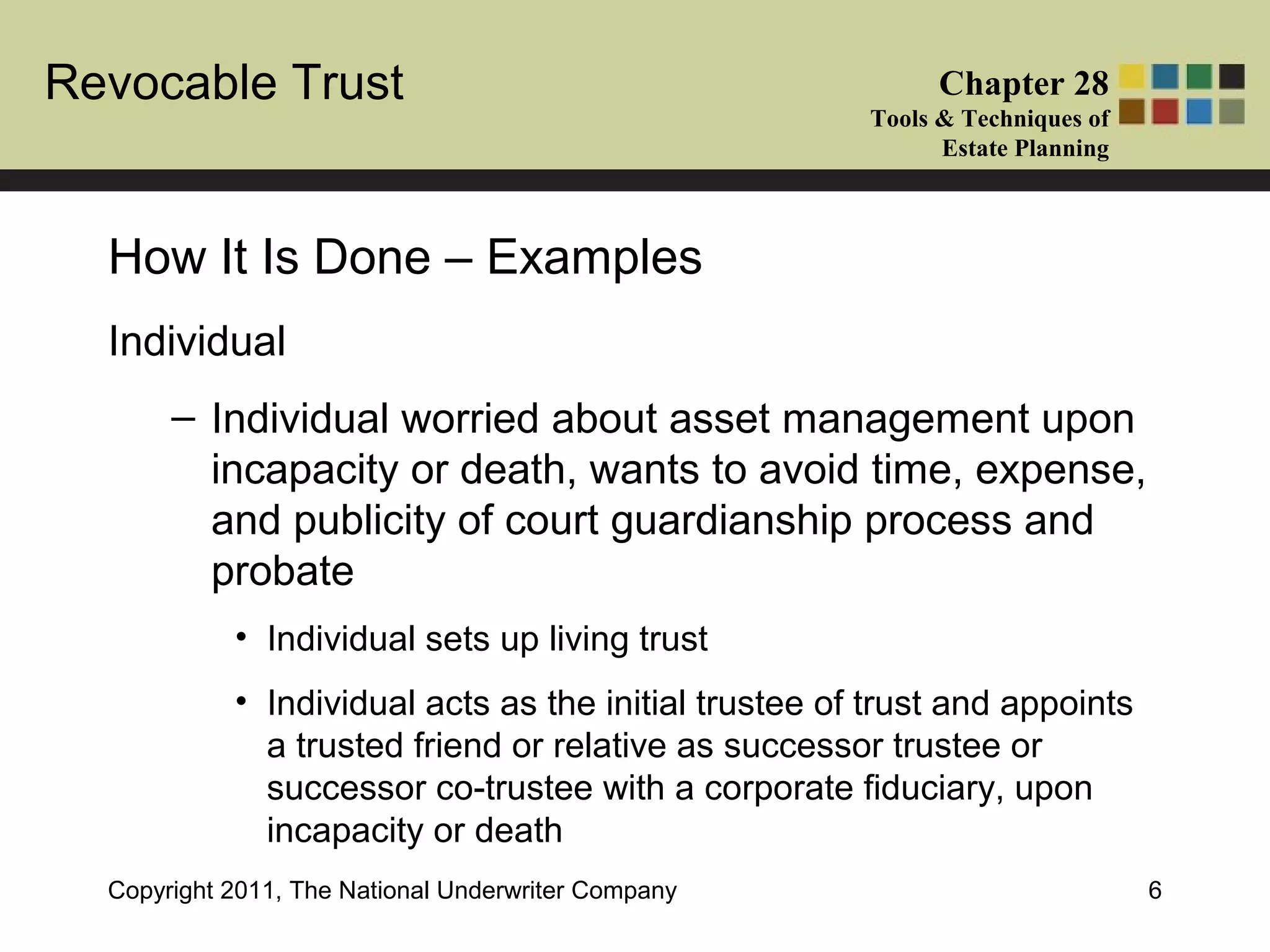
Individual
– Individual worried about asset management upon
incapacity or death, wants to avoid time, expense,
and publicity of court guardianship process and
probate
• Individual sets up living trust
• Individual acts as the initial trustee of trust and appoints
a trusted friend or relative as successor trustee or
successor co-trustee with a corporate fiduciary, upon
incapacity or death
How It Is Done – Examples
Revocable Trust Chapter 28
Tools & Techniques of
Estate Planning
Copyright 2011, The National Underwriter Company 7
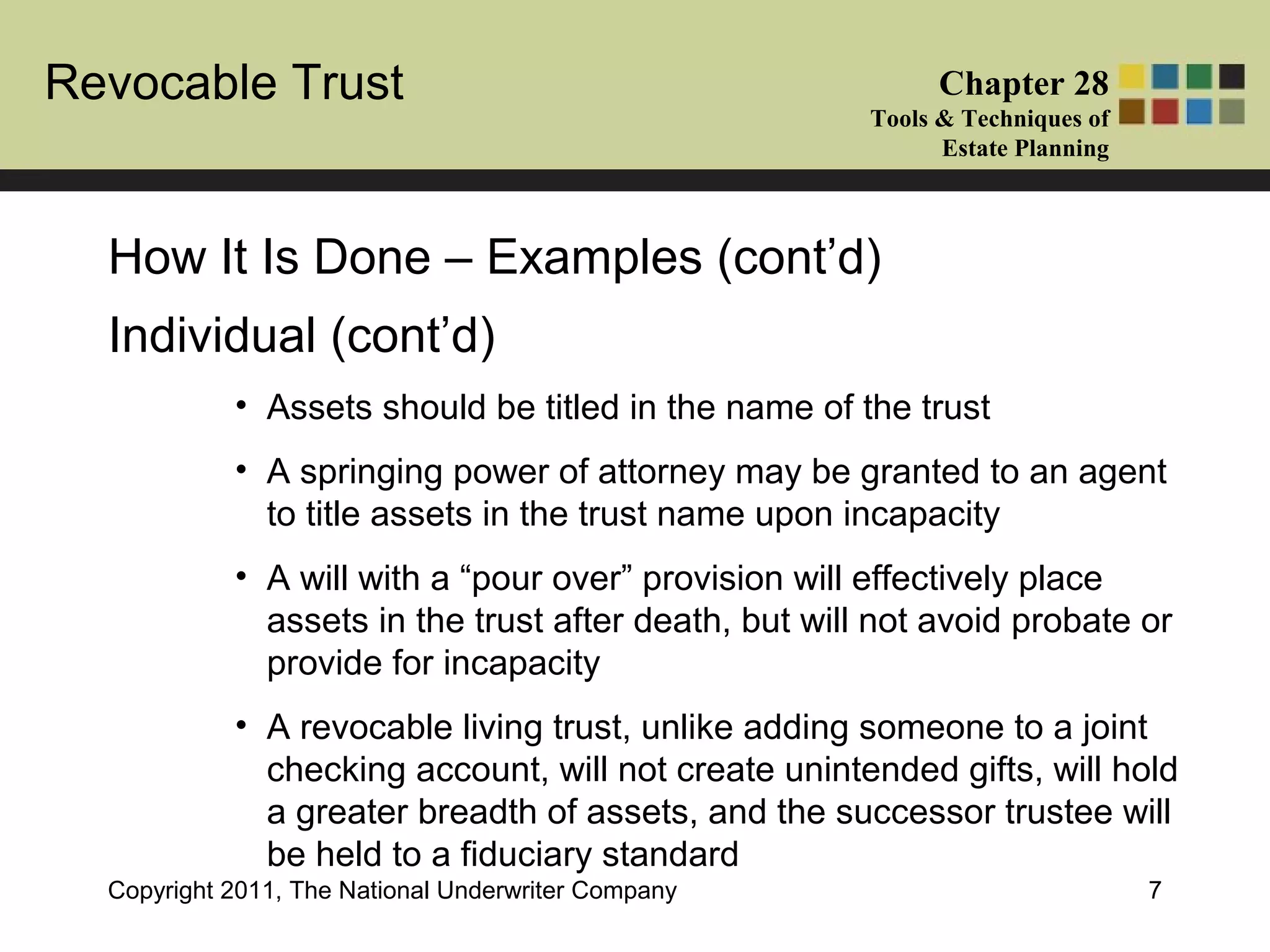
Individual (cont’d)
• Assets should be titled in the name of the trust
• A springing power of attorney may be granted to an agent
to title assets in the trust name upon incapacity
• A will with a “pour over” provision will effectively place
assets in the trust after death, but will not avoid probate or
provide for incapacity
• A revocable living trust, unlike adding someone to a joint
checking account, will not create unintended gifts, will hold
a greater breadth of assets, and the successor trustee will
be held to a fiduciary standard
How It Is Done – Examples (cont’d)
Revocable Trust Chapter 28
Tools & Techniques of
Estate Planning
Copyright 2011, The National Underwriter Company 8
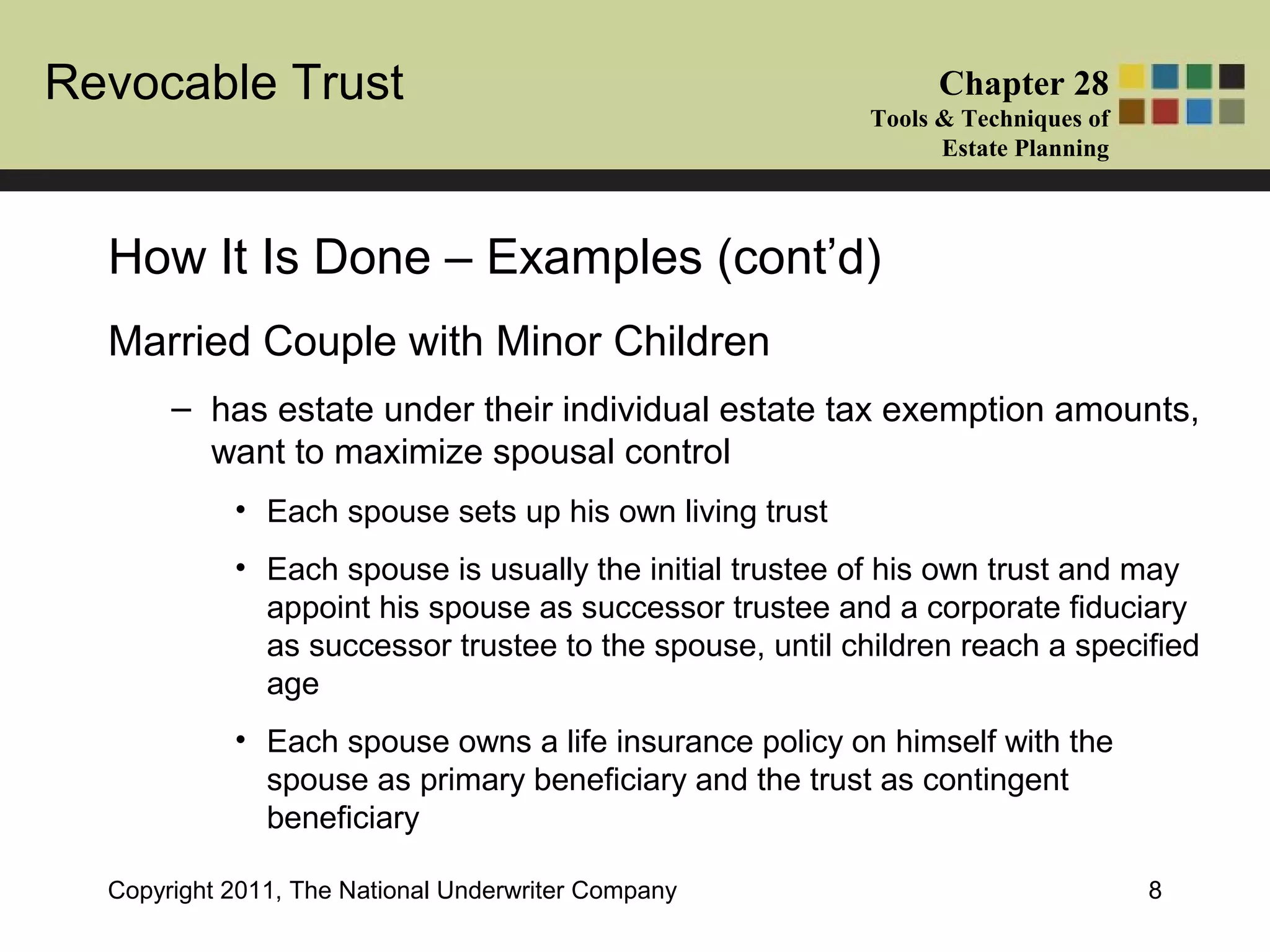
Married Couple with Minor Children
– has estate under their individual estate tax exemption amounts,
want to maximize spousal control
• Each spouse sets up his own living trust
• Each spouse is usually the initial trustee of his own trust and may
appoint his spouse as successor trustee and a corporate fiduciary
as successor trustee to the spouse, until children reach a specified
age
• Each spouse owns a life insurance policy on himself with the
spouse as primary beneficiary and the trust as contingent
beneficiary
How It Is Done – Examples (cont’d)
Revocable Trust Chapter 28
Tools & Techniques of
Estate Planning
Copyright 2011, The National Underwriter Company 9
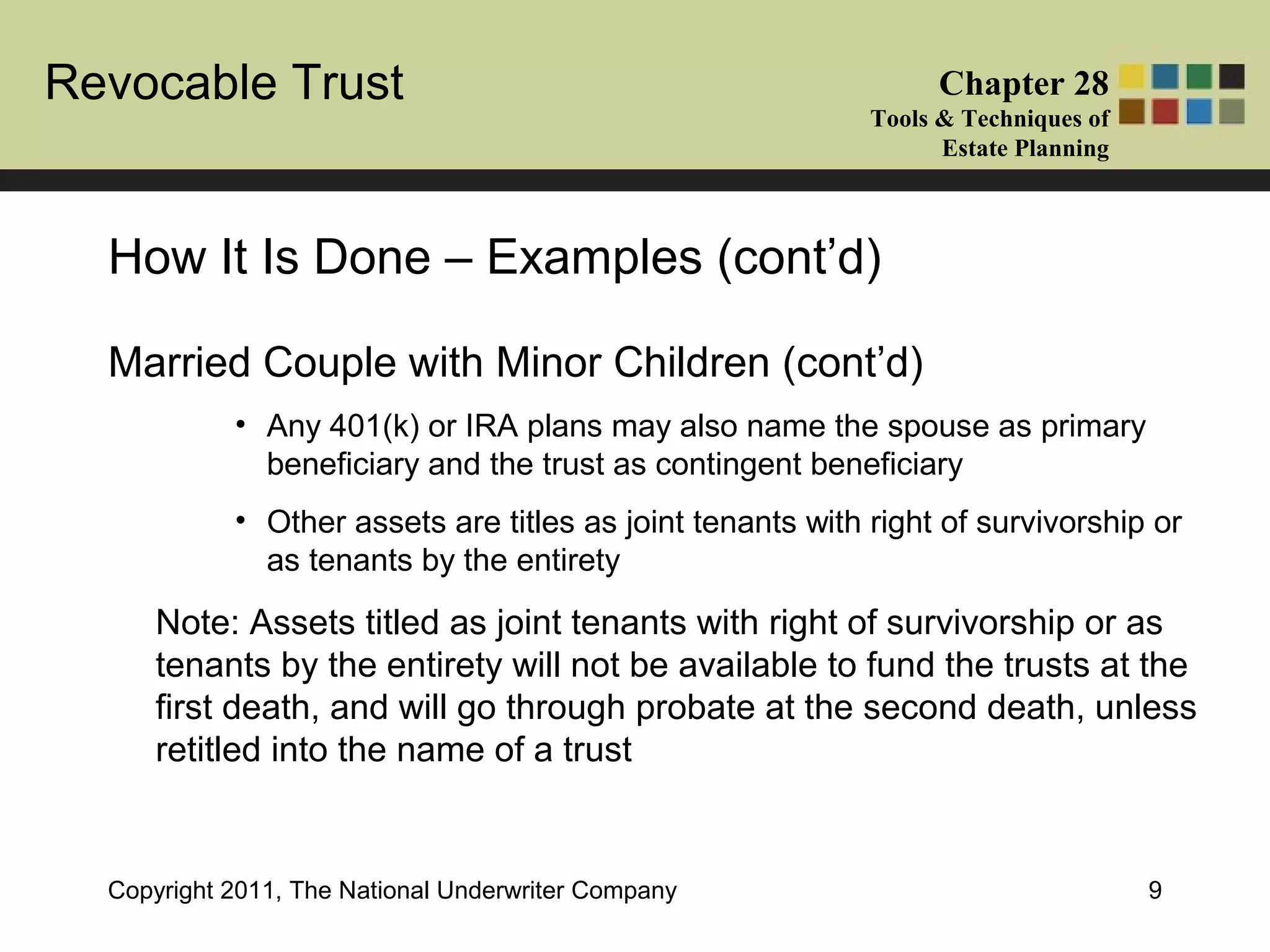
Married Couple with Minor Children (cont’d)
• Any 401(k) or IRA plans may also name the spouse as primary
beneficiary and the trust as contingent beneficiary
• Other assets are titles as joint tenants with right of survivorship or
as tenants by the entirety
Note: Assets titled as joint tenants with right of survivorship or as
tenants by the entirety will not be available to fund the trusts at the
first death, and will go through probate at the second death, unless
retitled into the name of a trust
How It Is Done – Examples (cont’d)
Revocable Trust Chapter 28
Tools & Techniques of
Estate Planning
Copyright 2011, The National Underwriter Company 10
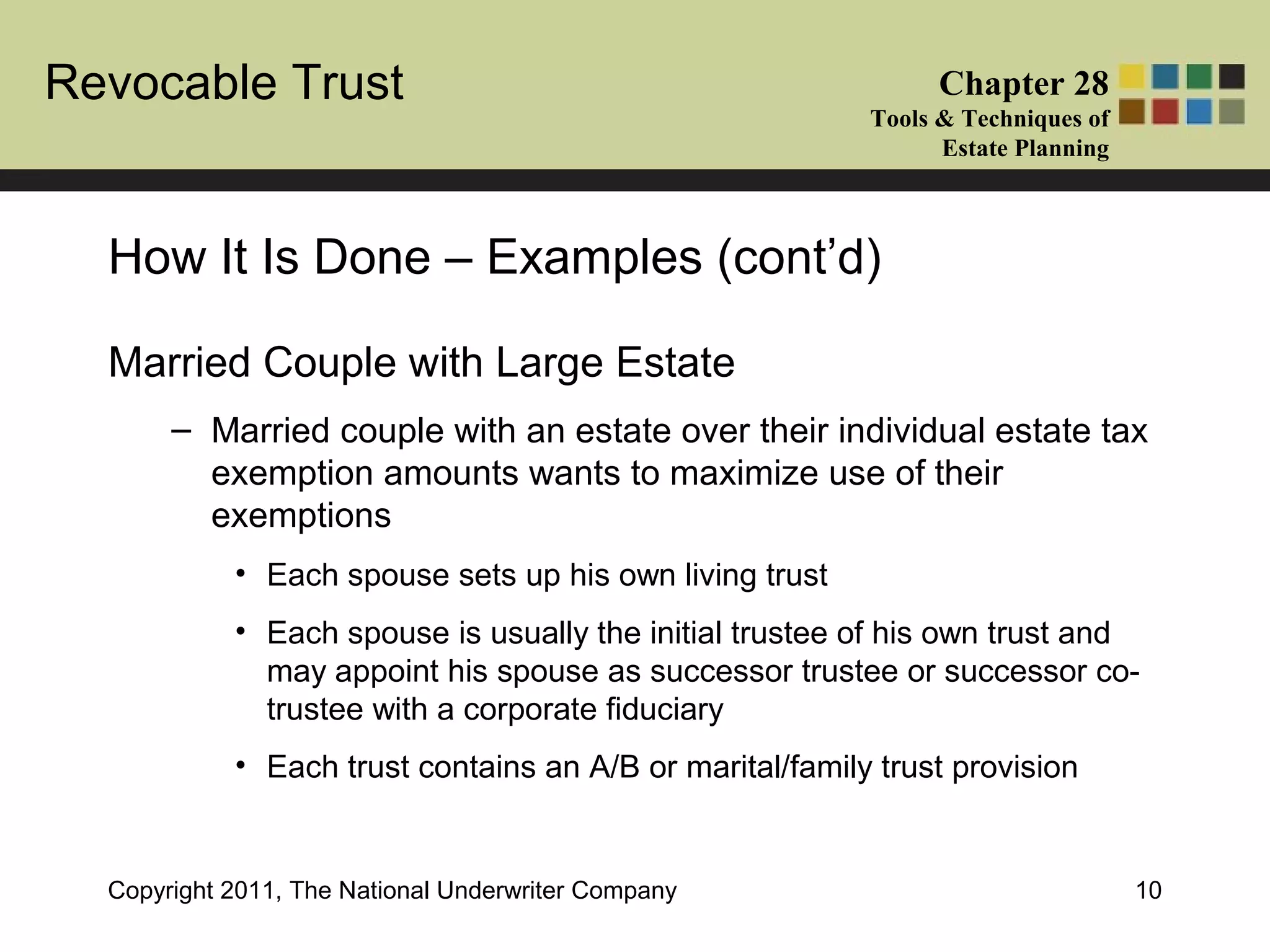
Married Couple with Large Estate
– Married couple with an estate over their individual estate tax
exemption amounts wants to maximize use of their
exemptions
• Each spouse sets up his own living trust
• Each spouse is usually the initial trustee of his own trust and
may appoint his spouse as successor trustee or successor co-
trustee with a corporate fiduciary
• Each trust contains an A/B or marital/family trust provision
How It Is Done – Examples (cont’d)
Revocable Trust Chapter 28
Tools & Techniques of
Estate Planning
Copyright 2011, The National Underwriter Company 11
Married Couple with Large Estate (cont’d)
• The trusts may also contain a QTIP provision if specific
remainder beneficiaries are desired
• The trusts may contain a reverse QTIP provision to
maximize the use of each spouse’s GST exemption
• KEY  Assets are divided and retitled into either the
husband’s living trust or the wife’s living trust
Note: Assets titled as joint tenants with right of
survivorship or as tenants by the entirety will not be
available to fund the trusts at death
How It Is Done – Examples (cont’d)
Revocable Trust Chapter 28
Tools & Techniques of
Estate Planning
Copyright 2011, The National Underwriter Company 12
• Federal Income Tax:
– All income taxed to the grantor at grantor’s tax rate
– Grantor considered owner of trust corpus
• Gift Tax:
– Not triggered upon establishing or funding
– Triggered when trust becomes irrevocable and the gift is
complete
• Federal Estate Tax:
– Entire trust corpus will be includable in the grantor’s estate
for federal estate tax purposes
Tax Implications
Revocable Trust Chapter 28
Tools & Techniques of
Estate Planning
Copyright 2011, The National Underwriter Company 13
• In community property states the revocable inter vivos
trust will have 2 grantors
• Be careful not to trigger accidental gifts between
spouses under state law
• To maintain the community character
– The transfer should be made from the husband and wife
directly to the trustee
– Each spouse should retain the right to revoke
– The instrument should specifically provide that the character
of the trust property remain community, both in the trust and
upon withdrawal
Issues In Community Property States
Revocable Trust Chapter 28
Tools & Techniques of
Estate Planning
Copyright 2011, The National Underwriter Company 14
• The only trusts eligible to hold S-Corp stock are:
– Voting trusts
– Trust receiving stock under a will (2 year limit)
– Grantor trusts, which include revocable living trusts
– Qualified subchapter S trust (QSST)
– Electing small business trust (ESBT)
– IRC Section 678 trust where person other than the grantor is
treated as owner
Revocable Trust With S Corp Stock
Revocable Trust Chapter 28
Tools & Techniques of
Estate Planning
Copyright 2011, The National Underwriter Company 15
A type of revocable inter vivos trust into which client
assets can be poured from a will, life insurance, pension
or profit sharing plan, or other employee benefit plan
Pour-Over Trust
Revocable Trust Chapter 28
Tools & Techniques of
Estate Planning
Copyright 2011, The National Underwriter Company 16
• A contingent or standby trust takes over management and
investment of assets when the grantor is no longer able to do so
• The trust is triggered by a specific occurrence of a grantor’s
physical, mental, or emotional incapacity as defined in the trust
• The trust is usually coupled with a durable power of attorney
• Usually the trust names a corporate trustee as successor or co-
successor with another person after the grantor becomes
incapacitated
Contingent Trust
Revocable Trust Chapter 28
Tools & Techniques of
Estate Planning
Copyright 2011, The National Underwriter Company 17
An administrative trust is simply the term for a revocable
trust immediately after the death of the grantor, where it
is to be further divided into separate trusts such as
Marital (A) and Bypass (B) trusts
Administrative Trust
Brought to you by Wayne Lippman, CPA
http://www.waynelippman.com

Estate planning revocable trust wayne lippman

  • 1.
    Revocable Trust Chapter28 Tools & Techniques of Estate Planning 1 • An inter vivos (living) trust, created during life, is a three-part relationship between: – Grantor – person establishing the trust – Trustee – person holding legal title and holding property for the benefit of another – Beneficiary – person holding beneficial (equitable) title in the trust property • Can be established for limited period of time, until occurrence or nonoccurrence of a specific event, or it can continue after the death of the grantor What Is A Revocable Trust? Brought to you by Wayne Lippman, CPA http://www.waynelippman.com
  • 2.
    Revocable Trust Chapter28 Tools & Techniques of Estate Planning Copyright 2011, The National Underwriter Company 2 • The Grantor retains the right to: – Revoke the trust, – Change the trust terms, or – Regain possession of trust property • The trust becomes irrevocable at the earlier of the Grantor: – Dying – Giving up all rights to revoke, amend, alter, or terminate the trust and relinquishing title to the assets placed in the trust What Is A Revocable Trust? (cont’d)
  • 3.
    Revocable Trust Chapter28 Tools & Techniques of Estate Planning Copyright 2011, The National Underwriter Company 3 • Grantor wants someone else to manage all or a portion of Grantor’s property • Grantor wants continuity in management and income flow of business or other assets in the event of death or disability • Grantor wishes to protect against his own incapacity (physical, mental, or legal) or the incapacity of beneficiaries • Grantor desires privacy in the administration of assets during life and at death When Is Use Of A Revocable Trust Appropriate?
  • 4.
    Revocable Trust Chapter28 Tools & Techniques of Estate Planning Copyright 2011, The National Underwriter Company 4 • Grantor wants to minimize estate administration costs and delay at death by avoiding probate • Grantor wants to see the trust and trustee in operation prior to death • Grantor wishes to avoid ancillary probate and administration of assets in other states • Grantor wishes to reduce the potential for an election against or contest of the will • Grantor would like to select the state law governing the trust When Is Use Of A Revocable Trust Appropriate? (cont’d)
  • 5.
    Revocable Trust Chapter28 Tools & Techniques of Estate Planning Copyright 2011, The National Underwriter Company 5 • Competent Grantor and Trustee • Assets titled in the name of the trust, also known as trust principal, res, or corpus • Three-part relationship including: – Grantor also known as settlor or trustor – Trustee – Beneficiary • Income beneficiary – person who receives income from the trust for life, a set term, or the occurrence or non-occurrence of an event • Remainder person – ultimate beneficiary of the trust property What Are The Requirements?
  • 6.
    Revocable Trust Chapter28 Tools & Techniques of Estate Planning Copyright 2011, The National Underwriter Company 6 Individual – Individual worried about asset management upon incapacity or death, wants to avoid time, expense, and publicity of court guardianship process and probate • Individual sets up living trust • Individual acts as the initial trustee of trust and appoints a trusted friend or relative as successor trustee or successor co-trustee with a corporate fiduciary, upon incapacity or death How It Is Done – Examples
  • 7.
    Revocable Trust Chapter28 Tools & Techniques of Estate Planning Copyright 2011, The National Underwriter Company 7 Individual (cont’d) • Assets should be titled in the name of the trust • A springing power of attorney may be granted to an agent to title assets in the trust name upon incapacity • A will with a “pour over” provision will effectively place assets in the trust after death, but will not avoid probate or provide for incapacity • A revocable living trust, unlike adding someone to a joint checking account, will not create unintended gifts, will hold a greater breadth of assets, and the successor trustee will be held to a fiduciary standard How It Is Done – Examples (cont’d)
  • 8.
    Revocable Trust Chapter28 Tools & Techniques of Estate Planning Copyright 2011, The National Underwriter Company 8 Married Couple with Minor Children – has estate under their individual estate tax exemption amounts, want to maximize spousal control • Each spouse sets up his own living trust • Each spouse is usually the initial trustee of his own trust and may appoint his spouse as successor trustee and a corporate fiduciary as successor trustee to the spouse, until children reach a specified age • Each spouse owns a life insurance policy on himself with the spouse as primary beneficiary and the trust as contingent beneficiary How It Is Done – Examples (cont’d)
  • 9.
    Revocable Trust Chapter28 Tools & Techniques of Estate Planning Copyright 2011, The National Underwriter Company 9 Married Couple with Minor Children (cont’d) • Any 401(k) or IRA plans may also name the spouse as primary beneficiary and the trust as contingent beneficiary • Other assets are titles as joint tenants with right of survivorship or as tenants by the entirety Note: Assets titled as joint tenants with right of survivorship or as tenants by the entirety will not be available to fund the trusts at the first death, and will go through probate at the second death, unless retitled into the name of a trust How It Is Done – Examples (cont’d)
  • 10.
    Revocable Trust Chapter28 Tools & Techniques of Estate Planning Copyright 2011, The National Underwriter Company 10 Married Couple with Large Estate – Married couple with an estate over their individual estate tax exemption amounts wants to maximize use of their exemptions • Each spouse sets up his own living trust • Each spouse is usually the initial trustee of his own trust and may appoint his spouse as successor trustee or successor co- trustee with a corporate fiduciary • Each trust contains an A/B or marital/family trust provision How It Is Done – Examples (cont’d)
  • 11.
    Revocable Trust Chapter28 Tools & Techniques of Estate Planning Copyright 2011, The National Underwriter Company 11 Married Couple with Large Estate (cont’d) • The trusts may also contain a QTIP provision if specific remainder beneficiaries are desired • The trusts may contain a reverse QTIP provision to maximize the use of each spouse’s GST exemption • KEY  Assets are divided and retitled into either the husband’s living trust or the wife’s living trust Note: Assets titled as joint tenants with right of survivorship or as tenants by the entirety will not be available to fund the trusts at death How It Is Done – Examples (cont’d)
  • 12.
    Revocable Trust Chapter28 Tools & Techniques of Estate Planning Copyright 2011, The National Underwriter Company 12 • Federal Income Tax: – All income taxed to the grantor at grantor’s tax rate – Grantor considered owner of trust corpus • Gift Tax: – Not triggered upon establishing or funding – Triggered when trust becomes irrevocable and the gift is complete • Federal Estate Tax: – Entire trust corpus will be includable in the grantor’s estate for federal estate tax purposes Tax Implications
  • 13.
    Revocable Trust Chapter28 Tools & Techniques of Estate Planning Copyright 2011, The National Underwriter Company 13 • In community property states the revocable inter vivos trust will have 2 grantors • Be careful not to trigger accidental gifts between spouses under state law • To maintain the community character – The transfer should be made from the husband and wife directly to the trustee – Each spouse should retain the right to revoke – The instrument should specifically provide that the character of the trust property remain community, both in the trust and upon withdrawal Issues In Community Property States
  • 14.
    Revocable Trust Chapter28 Tools & Techniques of Estate Planning Copyright 2011, The National Underwriter Company 14 • The only trusts eligible to hold S-Corp stock are: – Voting trusts – Trust receiving stock under a will (2 year limit) – Grantor trusts, which include revocable living trusts – Qualified subchapter S trust (QSST) – Electing small business trust (ESBT) – IRC Section 678 trust where person other than the grantor is treated as owner Revocable Trust With S Corp Stock
  • 15.
    Revocable Trust Chapter28 Tools & Techniques of Estate Planning Copyright 2011, The National Underwriter Company 15 A type of revocable inter vivos trust into which client assets can be poured from a will, life insurance, pension or profit sharing plan, or other employee benefit plan Pour-Over Trust
  • 16.
    Revocable Trust Chapter28 Tools & Techniques of Estate Planning Copyright 2011, The National Underwriter Company 16 • A contingent or standby trust takes over management and investment of assets when the grantor is no longer able to do so • The trust is triggered by a specific occurrence of a grantor’s physical, mental, or emotional incapacity as defined in the trust • The trust is usually coupled with a durable power of attorney • Usually the trust names a corporate trustee as successor or co- successor with another person after the grantor becomes incapacitated Contingent Trust
  • 17.
    Revocable Trust Chapter28 Tools & Techniques of Estate Planning Copyright 2011, The National Underwriter Company 17 An administrative trust is simply the term for a revocable trust immediately after the death of the grantor, where it is to be further divided into separate trusts such as Marital (A) and Bypass (B) trusts Administrative Trust Brought to you by Wayne Lippman, CPA http://www.waynelippman.com