What is FDI
The investing company may make its overseas investment in a
number of ways - either by setting up a subsidiary or associate
company in the foreign country, by acquiring shares of an
overseas company, or through a merger or joint venture
Strategy for FDI
• Firm-Specific Strategy
Offering new kind of product or differentiated product. When
product innovation fails to work, a firm may adopt product
differentiation strategy. This is done through putting trade mark
on the product or branding. Sometimes a firm may adopt
different brands for different markets to make them suitable for
local markets
• Cost –Economic Strategy
Done through lowering cost by moving the firm to the places
where there are cheap factors of production.
The cheapness of these factors of production reduces the cost
of production and maintains an edge over other firms.
Benefits of FDI
Availability of scarce factors of production.
Improvement in Balance of Payments through export and import
substitution.
Building of economic and social infrastructure.
Fostering of economic linkages.
Strengthening of the government budget.
Stimulation of national economy. Subsidiaries of Trans-National
Corporations (TNCs), which bring the vast portion of FDI, are
estimated to produce around a third of total global exports
(UNCTAD 1999).
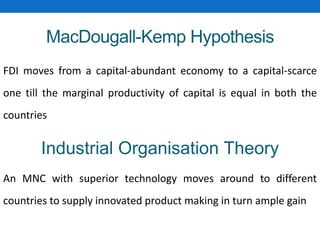
MacDougall-Kemp Hypothesis
FDI moves from a capital-abundant economy to a capital-scarce
one till the marginal productivity of capital is equal in both the
countries
Industrial Organisation Theory
An MNC with superior technology moves around to different
countries to supply innovated product making in turn ample gain
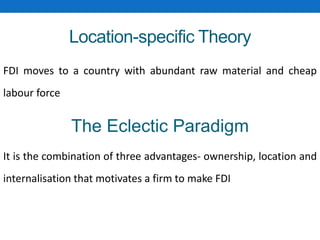
Location-specific Theory
FDI moves to a country with abundant raw material and cheap
labour force
The Eclectic Paradigm
It is the combination of three advantages- ownership, location and
internalisation that motivates a firm to make FDI
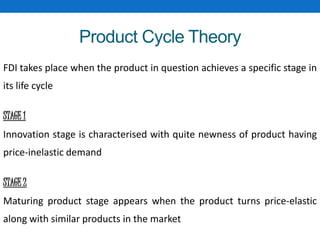
Product Cycle Theory
FDI takes place when the product in question achieves a specific stage in
its life cycle
STAGE 1
Innovation stage is characterised with quite newness of product having
price-inelastic demand
STAGE 2
Maturing product stage appears when the product turns price-elastic
along with similar products in the market
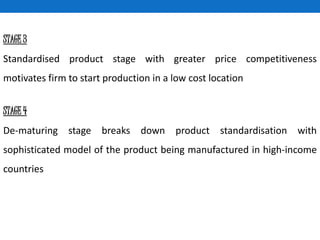
STAGE 3
Standardised product stage with greater price competitiveness
motivates firm to start production in a low cost location
STAGE 4
De-maturing stage breaks down product standardisation with
sophisticated model of the product being manufactured in high-income
countries
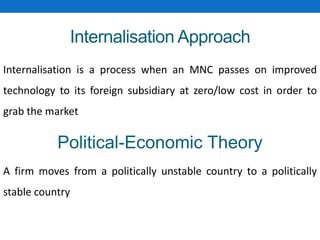
Internalisation Approach
Internalisation is a process when an MNC passes on improved
technology to its foreign subsidiary at zero/low cost in order to
grab the market
Political-Economic Theory
A firm moves from a politically unstable country to a politically
stable country
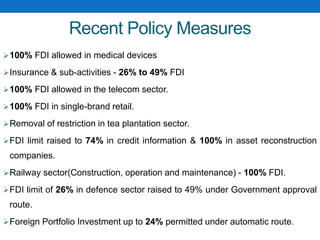
Recent Policy Measures
100% FDI allowed in medical devices
Insurance & sub-activities - 26% to 49% FDI
100% FDI allowed in the telecom sector.
100% FDI in single-brand retail.
Removal of restriction in tea plantation sector.
FDI limit raised to 74% in credit information & 100% in asset reconstruction
companies.
Railway sector(Construction, operation and maintenance) - 100% FDI.
FDI limit of 26% in defence sector raised to 49% under Government approval
route.
Foreign Portfolio Investment up to 24% permitted under automatic route.
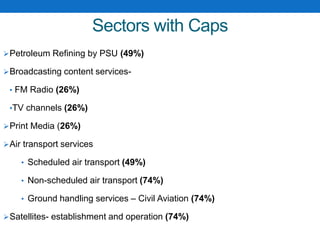
Sectors with Caps
Petroleum Refining by PSU (49%)
Broadcasting content services-
• FM Radio (26%)
•TV channels (26%)
Print Media (26%)
Air transport services
• Scheduled air transport (49%)
• Non-scheduled air transport (74%)
• Ground handling services – Civil Aviation (74%)
Satellites- establishment and operation (74%)
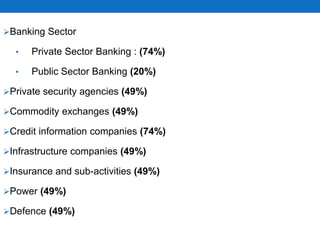
Banking Sector
• Private Sector Banking : (74%)
• Public Sector Banking (20%)
Private security agencies (49%)
Commodity exchanges (49%)
Credit information companies (74%)
Infrastructure companies (49%)
Insurance and sub-activities (49%)
Power (49%)
Defence (49%)
MEASURES OF CONTROL
The home Govt. can prohibit any investment in, or any technical
collaboration with a particular host country
It can design fiscal and monetary disincentives to deter any
outflow of investment
The home govt. can tighten the approval rules and regulations
ultimately restricting FDI outflow
The govt. can introduce extra territorially provisions and can
interfere with activities of its MNC’s foreign subsidiary
The home govt. can design the anti – trust law that can trim its
MNC’s wings to operate in foreign markets
CROSS
BORDER
ACQUISITIONS
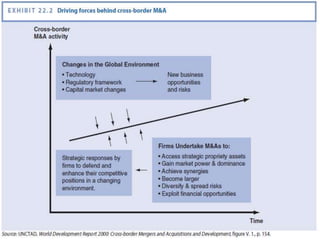
Objectives behind Cross Border Acquisitions
 Top priority is profit growth and companies.
 Increased opportunities and cheaper alternatives to building companies
internally.
 Increase company’s efficiency in production.
 Easing the process of joining operations in order to share technology
while also reducing costs.
 Creating economic value.
 Additional value comes from the “synergies” created by the
reconfiguration.
 Increasing economies of scale and expanding market reach.
 Releases capital for reinvestment.
Example: Acquisition between Walmart and South-African based Massmart
.
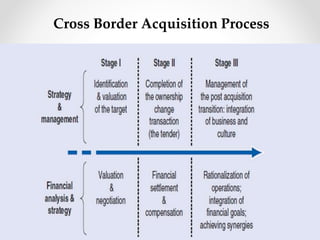
Cross Border Acquisition Process
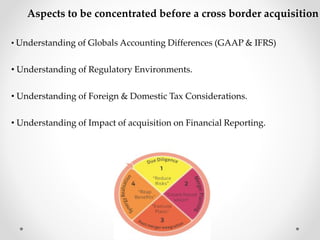
Aspects to be concentrated before a cross border acquisition
• Understanding of Globals Accounting Differences (GAAP & IFRS)
• Understanding of Regulatory Environments.
• Understanding of Foreign & Domestic Tax Considerations.
• Understanding of Impact of acquisition on Financial Reporting.
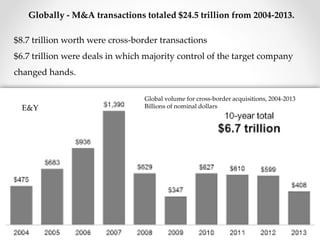
Globally - M&A transactions totaled $24.5 trillion from 2004-2013.
$8.7 trillion worth were cross-border transactions
$6.7 trillion were deals in which majority control of the target company
changed hands.
Global volume for cross-border acquisitions, 2004-2013
Billions of nominal dollarsE&Y
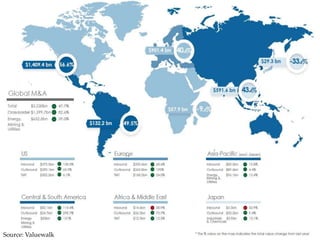
Source: Valuewalk
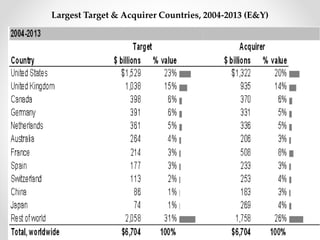
Largest Target & Acquirer Countries, 2004-2013 (E&Y)
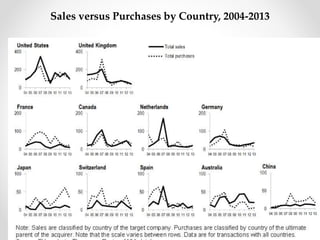
Sales versus Purchases by Country, 2004-2013
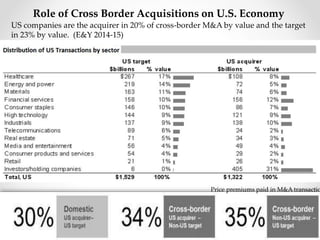
Role of Cross Border Acquisitions on U.S. Economy
US companies are the acquirer in 20% of cross-border M&A by value and the target
in 23% by value. (E&Y 2014-15)
Price premiums paid in M&A transactio
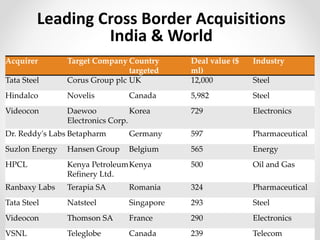
Acquirer Target Company Country
targeted
Deal value ($
ml)
Industry
Tata Steel Corus Group plc UK 12,000 Steel
Hindalco Novelis Canada 5,982 Steel
Videocon Daewoo
Electronics Corp.
Korea 729 Electronics
Dr. Reddy's Labs Betapharm Germany 597 Pharmaceutical
Suzlon Energy Hansen Group Belgium 565 Energy
HPCL Kenya Petroleum
Refinery Ltd.
Kenya 500 Oil and Gas
Ranbaxy Labs Terapia SA Romania 324 Pharmaceutical
Tata Steel Natsteel Singapore 293 Steel
Videocon Thomson SA France 290 Electronics
VSNL Teleglobe Canada 239 Telecom
Leading Cross Border Acquisitions
India & World

Foreign Direct Investment & Cross Border Acquisitions

  • 2.
    What is FDI Theinvesting company may make its overseas investment in a number of ways - either by setting up a subsidiary or associate company in the foreign country, by acquiring shares of an overseas company, or through a merger or joint venture
  • 3.
    Strategy for FDI •Firm-Specific Strategy Offering new kind of product or differentiated product. When product innovation fails to work, a firm may adopt product differentiation strategy. This is done through putting trade mark on the product or branding. Sometimes a firm may adopt different brands for different markets to make them suitable for local markets • Cost –Economic Strategy Done through lowering cost by moving the firm to the places where there are cheap factors of production. The cheapness of these factors of production reduces the cost of production and maintains an edge over other firms.
  • 4.
    Benefits of FDI Availabilityof scarce factors of production. Improvement in Balance of Payments through export and import substitution. Building of economic and social infrastructure. Fostering of economic linkages. Strengthening of the government budget. Stimulation of national economy. Subsidiaries of Trans-National Corporations (TNCs), which bring the vast portion of FDI, are estimated to produce around a third of total global exports (UNCTAD 1999).
  • 5.
    MacDougall-Kemp Hypothesis FDI movesfrom a capital-abundant economy to a capital-scarce one till the marginal productivity of capital is equal in both the countries Industrial Organisation Theory An MNC with superior technology moves around to different countries to supply innovated product making in turn ample gain
  • 6.
    Location-specific Theory FDI movesto a country with abundant raw material and cheap labour force The Eclectic Paradigm It is the combination of three advantages- ownership, location and internalisation that motivates a firm to make FDI
  • 7.
    Product Cycle Theory FDItakes place when the product in question achieves a specific stage in its life cycle STAGE 1 Innovation stage is characterised with quite newness of product having price-inelastic demand STAGE 2 Maturing product stage appears when the product turns price-elastic along with similar products in the market
  • 8.
    STAGE 3 Standardised productstage with greater price competitiveness motivates firm to start production in a low cost location STAGE 4 De-maturing stage breaks down product standardisation with sophisticated model of the product being manufactured in high-income countries
  • 9.
    Internalisation Approach Internalisation isa process when an MNC passes on improved technology to its foreign subsidiary at zero/low cost in order to grab the market Political-Economic Theory A firm moves from a politically unstable country to a politically stable country
  • 10.
    Recent Policy Measures 100%FDI allowed in medical devices Insurance & sub-activities - 26% to 49% FDI 100% FDI allowed in the telecom sector. 100% FDI in single-brand retail. Removal of restriction in tea plantation sector. FDI limit raised to 74% in credit information & 100% in asset reconstruction companies. Railway sector(Construction, operation and maintenance) - 100% FDI. FDI limit of 26% in defence sector raised to 49% under Government approval route. Foreign Portfolio Investment up to 24% permitted under automatic route.
  • 11.
    Sectors with Caps PetroleumRefining by PSU (49%) Broadcasting content services- • FM Radio (26%) •TV channels (26%) Print Media (26%) Air transport services • Scheduled air transport (49%) • Non-scheduled air transport (74%) • Ground handling services – Civil Aviation (74%) Satellites- establishment and operation (74%)
  • 12.
    Banking Sector • PrivateSector Banking : (74%) • Public Sector Banking (20%) Private security agencies (49%) Commodity exchanges (49%) Credit information companies (74%) Infrastructure companies (49%) Insurance and sub-activities (49%) Power (49%) Defence (49%)
  • 13.
    MEASURES OF CONTROL Thehome Govt. can prohibit any investment in, or any technical collaboration with a particular host country It can design fiscal and monetary disincentives to deter any outflow of investment The home govt. can tighten the approval rules and regulations ultimately restricting FDI outflow The govt. can introduce extra territorially provisions and can interfere with activities of its MNC’s foreign subsidiary The home govt. can design the anti – trust law that can trim its MNC’s wings to operate in foreign markets
  • 14.
  • 15.
    Objectives behind CrossBorder Acquisitions  Top priority is profit growth and companies.  Increased opportunities and cheaper alternatives to building companies internally.  Increase company’s efficiency in production.  Easing the process of joining operations in order to share technology while also reducing costs.  Creating economic value.  Additional value comes from the “synergies” created by the reconfiguration.  Increasing economies of scale and expanding market reach.  Releases capital for reinvestment. Example: Acquisition between Walmart and South-African based Massmart .
  • 16.
  • 17.
    Aspects to beconcentrated before a cross border acquisition • Understanding of Globals Accounting Differences (GAAP & IFRS) • Understanding of Regulatory Environments. • Understanding of Foreign & Domestic Tax Considerations. • Understanding of Impact of acquisition on Financial Reporting.
  • 19.
    Globally - M&Atransactions totaled $24.5 trillion from 2004-2013. $8.7 trillion worth were cross-border transactions $6.7 trillion were deals in which majority control of the target company changed hands. Global volume for cross-border acquisitions, 2004-2013 Billions of nominal dollarsE&Y
  • 20.
  • 21.
    Largest Target &Acquirer Countries, 2004-2013 (E&Y)
  • 22.
    Sales versus Purchasesby Country, 2004-2013
  • 23.
    Role of CrossBorder Acquisitions on U.S. Economy US companies are the acquirer in 20% of cross-border M&A by value and the target in 23% by value. (E&Y 2014-15) Price premiums paid in M&A transactio
  • 25.
    Acquirer Target CompanyCountry targeted Deal value ($ ml) Industry Tata Steel Corus Group plc UK 12,000 Steel Hindalco Novelis Canada 5,982 Steel Videocon Daewoo Electronics Corp. Korea 729 Electronics Dr. Reddy's Labs Betapharm Germany 597 Pharmaceutical Suzlon Energy Hansen Group Belgium 565 Energy HPCL Kenya Petroleum Refinery Ltd. Kenya 500 Oil and Gas Ranbaxy Labs Terapia SA Romania 324 Pharmaceutical Tata Steel Natsteel Singapore 293 Steel Videocon Thomson SA France 290 Electronics VSNL Teleglobe Canada 239 Telecom Leading Cross Border Acquisitions India & World

Editor's Notes

  • #16 Because of its sheer size, Walmart can often decrease its expenses by buying in bulk and producing large amount of goods in each production cycle. Expanding its business to South Africa has increased the demand of Walmart products and has also increased product supply. Thus, Walmart becomes more productive
  • #18 The United States has the highest statutory corporate income tax rate among developed nations and is the only developed country with both a high statutory corporate income tax rate and a worldwide system of taxation. These features of the US corporate income tax have disadvantaged US businesses in the global market for cross-border M&A.
  • #20 Of these, $8.7 trillion worth were cross-border transactions, meaning the ultimate parent of the acquirer was headquartered in a different country than the target company, and $6.7 trillion were deals in which majority control of the target company changed hands