© McGraw Hill 1
Chapter 3
Forecasting
Operations Management
FOURTEENTH EDITION
William J. Stevenson
© 2021 McGraw Hill. All rights reserved. Authorized only for instructor use in the
© McGraw Hill 2
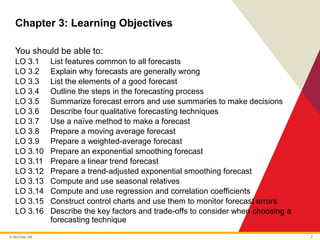
Chapter 3: Learning Objectives
You should be able to:
LO 3.1 List features common to all forecasts
LO 3.2 Explain why forecasts are generally wrong
LO 3.3 List the elements of a good forecast
LO 3.4 Outline the steps in the forecasting process
LO 3.5 Summarize forecast errors and use summaries to make decisions
LO 3.6 Describe four qualitative forecasting techniques
LO 3.7 Use a naïve method to make a forecast
LO 3.8 Prepare a moving average forecast
LO 3.9 Prepare a weighted-average forecast
LO 3.10 Prepare an exponential smoothing forecast
LO 3.11 Prepare a linear trend forecast
LO 3.12 Prepare a trend-adjusted exponential smoothing forecast
LO 3.13 Compute and use seasonal relatives
LO 3.14 Compute and use regression and correlation coefficients
LO 3.15 Construct control charts and use them to monitor forecast errors
LO 3.16 Describe the key factors and trade-offs to consider when choosing a
forecasting technique
© McGraw Hill 3
Forecast
LO 3.1
Forecast – a statement about the future value of a
variable of interest
We make forecasts about such things as weather, demand,
and resource availability
Forecasts are important to making informed decisions
© McGraw Hill 4
Two Important Aspects of Forecasts
LO 3.1
Expected level of demand
The level of demand may be a function of some structural
variation such as trend or seasonal variation
Accuracy
Related to the potential size of forecast error
© McGraw Hill 5
Forecasts in Business Organizations
LO 3.1
Accounting. New product/process cost estimates, profit projections,
cash management.
Finance. Equipment/equipment replacement needs, timing
and amount of funding/borrowing needs.
Human resources. Hiring activities, including recruitment,
interviewing, and training; layoff planning, including
outplacement counseling.
Marketing. Pricing and promotion, e-business strategies, global
competition strategies.
MIS. New/revised information systems, internet services.
Operations. Schedules, capacity planning, work assignments and
workloads, inventory planning, make-or-buy decisions, outsourcing,
project management.
Product/service design. Revision of current features, design of new
products or services.
© McGraw Hill 6
Forecast Uses
LO 3.1
Plan the system
Generally involves long-range plans related to:
• Types of products and services to offer
• Facility and equipment levels
• Facility location
Plan the use of the system
Generally involves short- and medium-range plans related to:
• Inventory management
• Workforce levels
• Purchasing
• Production
• Budgeting
• Scheduling
© McGraw Hill 7
Features Common to All Forecasts
LO 3.1
1. Techniques assume some underlying causal system that
existed in the past will persist into the future
2. Forecasts are not perfect
3. Forecasts for groups of items are more accurate than
those for individual items
4. Forecast accuracy decreases as the forecasting horizon
increases
© McGraw Hill 8
Forecasts Are Not Perfect
LO 3.2
Forecasts are not perfect:
• Because random variation is always present, there will
always be some residual error, even if all other factors
have been accounted for.
© McGraw Hill 9
Elements of a Good Forecast
LO 3.3
The forecast
• Should be timely
• Should be accurate
• Should be reliable
• Should be expressed in meaningful units
• Should be in writing
• Technique should be simple to understand and use
• Should be cost-effective
© McGraw Hill 10
Steps in the Forecasting Process
LO 3.4
1. Determine the purpose of the forecast
2. Establish a time horizon
3. Obtain, clean, and analyze appropriate data
4. Select a forecasting technique
5. Make the forecast
6. Monitor the forecast errors
© McGraw Hill 11
Forecasting Approaches
LO 3.6
Qualitative forecasting
Qualitative techniques permit the inclusion of soft information
such as:
• Human factors
• Personal opinions
• Hunches
These factors are difficult, or impossible, to quantify
Quantitative forecasting
These techniques rely on hard data
Quantitative techniques involve either the projection of
historical data or the development of associative methods
that attempt to use causal variables to make a forecast
© McGraw Hill 12
Qualitative Forecasts
LO 3.6
Forecasts that use subjective inputs such as opinions from consumer surveys,
sales staff, managers, executives, and experts
Executive opinions
• A small group of upper-level managers may meet and collectively develop a forecast
Salesforce opinions
• Members of the sales or customer service staff can be good sources of information
due to their direct contact with customers and may be aware of plans customers may
be considering for the future
Consumer surveys
• Since consumers ultimately determine demand, it makes sense to solicit input from
them
• Consumer surveys typically represent a sample of consumer opinions
Other approaches
• Managers may solicit opinions from other managers or staff people or outside
experts to help with developing a forecast
• The Delphi method is an iterative process intended to achieve a consensus
© McGraw Hill 13
Time-Series Forecasts
LO 3.6
Forecasts that project patterns identified in recent time-series
observations
Time-series – a time-ordered sequence of observations
taken at regular time intervals
Assume that future values of the time-series can be
estimated from past values of the time-series
© McGraw Hill 14
Time-Series Behaviors
LO 3.6
Trend
Seasonality
Cycles
Irregular variations
Random variation
© McGraw Hill 15
Trends and Seasonality
LO 3.6
Trend
A long-term upward or downward movement in data
• Population shifts
• Changing income
Seasonality
Short-term, fairly regular variations related to the calendar or
time of day
Restaurants, service call centers, and theaters all experience
seasonal demand
© McGraw Hill 16
Cycles and Variations
LO 3.6
Cycle
Wavelike variations lasting more than one year
• These are often related to a variety of economic, political, or even
agricultural conditions
Irregular variation
Due to unusual circumstances that do not reflect typical
behavior
• Labor strike
• Weather event
Random Variation
Residual variation that remains after all other behaviors have
been accounted for
© McGraw Hill 17
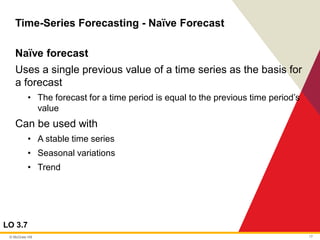
Time-Series Forecasting - Naïve Forecast
LO 3.7
Naïve forecast
Uses a single previous value of a time series as the basis for
a forecast
• The forecast for a time period is equal to the previous time period’s
value
Can be used with
• A stable time series
• Seasonal variations
• Trend
© McGraw Hill 18
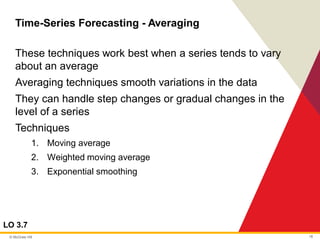
Time-Series Forecasting - Averaging
LO 3.7
These techniques work best when a series tends to vary
about an average
Averaging techniques smooth variations in the data
They can handle step changes or gradual changes in the
level of a series
Techniques
1. Moving average
2. Weighted moving average
3. Exponential smoothing
© McGraw Hill 19
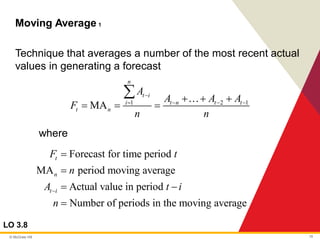
Moving Average 1
LO 3.8
Technique that averages a number of the most recent actual
values in generating a forecast
where
1 2 1
MA
n
t i
i t n t t
t n
A
A A A
F
n n
−
= − − −
+ + +
= = =

Forecast for time period
MA period moving average
Actual value in period
Number of periods in the moving average
t
n
t i
F t
n
A t i
n
−
=
=
= −
=
© McGraw Hill 20
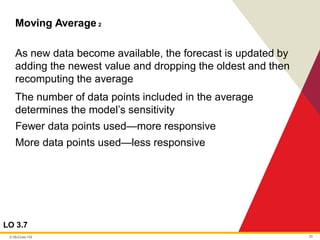
Moving Average 2
LO 3.7
As new data become available, the forecast is updated by
adding the newest value and dropping the oldest and then
recomputing the average
The number of data points included in the average
determines the model’s sensitivity
Fewer data points used—more responsive
More data points used—less responsive
© McGraw Hill 21
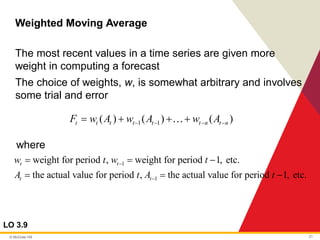
Weighted Moving Average
LO 3.9
The most recent values in a time series are given more
weight in computing a forecast
The choice of weights, w, is somewhat arbitrary and involves
some trial and error
where
1 1
( ) ( ) ( )
t t t t t t n t n
F w A w A w A
− − − −
= + + +
1
1
weight for period , weight for period 1, etc.
the actual value for period , the actual value for period 1, etc.
t t
t t
w t w t
A t A t
−
−
= = −
= = −
© McGraw Hill 22
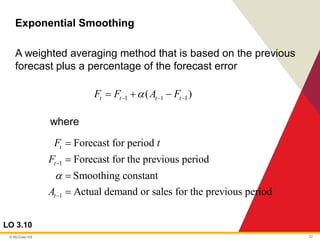
Exponential Smoothing
LO 3.10
A weighted averaging method that is based on the previous
forecast plus a percentage of the forecast error
where
1 1 1
( )
t t t t
F F A F

− − −
= + −
1
1
Forecast for period
Forecast for the previous period
Smoothing constant
Actual demand or sales for the previous period
t
t
t
F t
F
A

−
−
=
=
=
=
© McGraw Hill 23
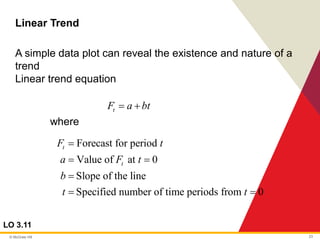
Linear Trend
LO 3.11
A simple data plot can reveal the existence and nature of a
trend
Linear trend equation
where
t
F a bt
= +
Forecast for period
Value of at 0
Slope of the line
Specified number of time periods from 0
t
t
F t
a F t
b
t t
=
= =
=
= =
© McGraw Hill 24
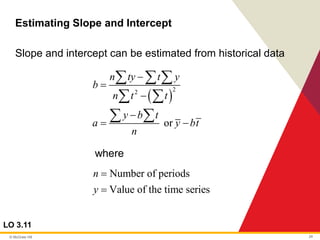
Estimating Slope and Intercept
LO 3.11
Slope and intercept can be estimated from historical data
where
( )
2
2
or
n ty t y
b
n t t
y b t
a y bt
n
−
=
−
−
= −
  
 
 
Number of periods
Value of the time series
n
y
=
=
© McGraw Hill 25
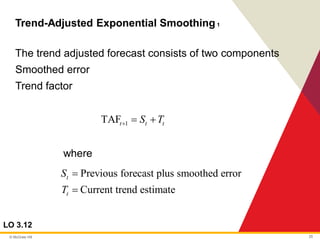
Trend-Adjusted Exponential Smoothing1
LO 3.12
The trend adjusted forecast consists of two components
Smoothed error
Trend factor
where
1
TAFt t t
S T
+ = +
Previous forecast plus smoothed error
Current trend estimate
t
t
S
T
=
=
© McGraw Hill 26
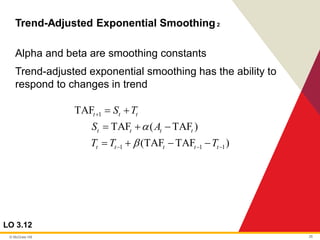
Trend-Adjusted Exponential Smoothing2
LO 3.12
Alpha and beta are smoothing constants
Trend-adjusted exponential smoothing has the ability to
respond to changes in trend
1
1 1 1
TAF
TAF ( TAF )
(TAF TAF )
t t t
t t t t
t t t t t
S T
S A
T T T


+
− − −
= +
= + −
= + − −
© McGraw Hill 27
Techniques for Seasonality
LO 3.12
Seasonality – regularly repeating movements in series
values that can be tied to recurring events
Expressed in terms of the amount that actual values deviate
from the average value of a series
Models of seasonality
• Additive
• Seasonality is expressed as a quantity that gets added to or subtracted
from the time-series average in order to incorporate seasonality
• Multiplicative
• Seasonality is expressed as a percentage of the average (or trend)
amount which is then used to multiply the value of a series in order to
incorporate seasonality
© McGraw Hill 28
Seasonal Relatives
LO 3.13
Seasonal relatives
The seasonal percentage used in the multiplicative
seasonally adjusted forecasting model
Using seasonal relatives
To deseasonalize data
• Done in order to get a clearer picture of the nonseasonal (for
example, trend) components of the data series
• Divide each data point by its seasonal relative
To incorporate seasonality in a forecast
1. Obtain trend estimates for desired periods using a trend equation
2. Add seasonality by multiplying these trend estimates by the
corresponding seasonal relative
© McGraw Hill 29
Associative Forecasting Techniques
LO 3.14
Associative techniques are based on the development of an
equation that summarizes the effects of predictor variables
Predictor variables – variables that can be used to predict
values of the variable of interest
• Home values may be related to such factors as home and property
size, location, number of bedrooms, and number of bathrooms
© McGraw Hill 30
Simple Linear Regression
LO 3.14
Regression – a technique for fitting a line to a set of data
points
Simple linear regression – the simplest form of regression
that involves a linear relationship between two variables
• The object of simple linear regression is to obtain an equation of a
straight line that minimizes the sum of squared vertical deviations
from the line (that is, the least squares criterion)
© McGraw Hill 31
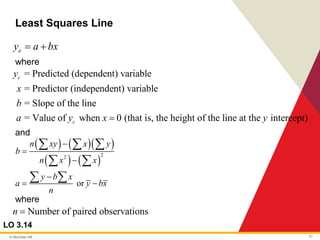
Least Squares Line
LO 3.14
where
and
where
e
y a bx
= +
= Predicted (dependent) variable
= Predictor (independent) variable
= Slope of the line
= Value of when 0 (that is, the height of the line at the intercept)
c
c
y
x
b
a y x y
=
( ) ( )( )
( ) ( )
2
2
or
n xy x y
b
n x x
y b x
a y bx
n
−
=
−
−
= −
  
 
 
Number of paired observations
n =
© McGraw Hill 32
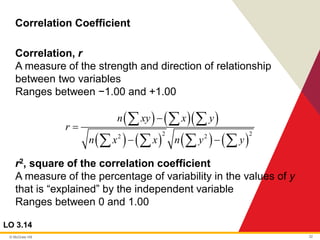
Correlation Coefficient
LO 3.14
Correlation, r
A measure of the strength and direction of relationship
between two variables
Ranges between −1.00 and +1.00
r2, square of the correlation coefficient
A measure of the percentage of variability in the values of y
that is “explained” by the independent variable
Ranges between 0 and 1.00
( ) ( )( )
( ) ( ) ( ) ( )
2 2
2 2
n xy x y
r
n x x n y y
−
=
− −
  
   
© McGraw Hill 33
Simple Linear Regression Assumptions
LO 3.14
1. Variations around the line are random
2. Deviations around the average value (the line) should be
normally distributed
3. Predictions are made only within the range of observed
values
© McGraw Hill 34
Issues to Consider:
LO 3.14
Always plot the line to verify that a linear relationship is
appropriate
The data may be time-dependent
If they are
• use analysis of time series
• use time as an independent variable in a multiple regression
analysis
A small correlation may indicate that other variables are
important
© McGraw Hill 35
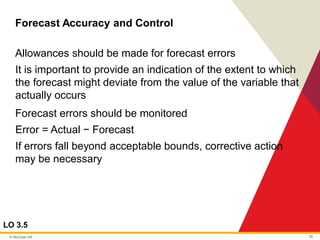
Forecast Accuracy and Control
LO 3.5
Allowances should be made for forecast errors
It is important to provide an indication of the extent to which
the forecast might deviate from the value of the variable that
actually occurs
Forecast errors should be monitored
Error = Actual − Forecast
If errors fall beyond acceptable bounds, corrective action
may be necessary
© McGraw Hill 36
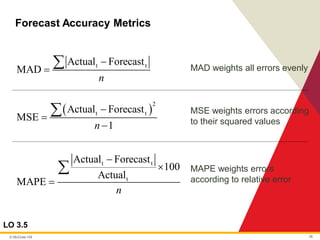
Forecast Accuracy Metrics
LO 3.5
MAD weights all errors evenly
MSE weights errors according
to their squared values
MAPE weights errors
according to relative error
t t
Actual Forecast
MAD
n
−
=

( )
2
t t
Actual Forecast
MSE
1
n
−
=
−

t t
t
Actual Forecast
100
Actual
MAPE
n
−

=

© McGraw Hill 37
Forecast Error Calculation
LO 3.5
Period
Actual
(A)
Forecast
(F)
(A − F)
Error |Error| Error2 [|Error|/Actual] × 100
1 107 110 −3 3 9 2.80%
2 125 121 4 4 16 3.20%
3 115 112 3 3 9 2.61%
4 118 120 −2 2 4 1.69%
5 108 109 1 1 1 0.93%
Sum 13 39 11.23%
n = 5 n − 1 = 4 n = 5
MAD MSE MAPE
= 2.6 = 9.75 = 2.25%
© McGraw Hill 38
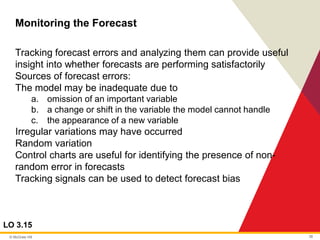
Monitoring the Forecast
LO 3.15
Tracking forecast errors and analyzing them can provide useful
insight into whether forecasts are performing satisfactorily
Sources of forecast errors:
The model may be inadequate due to
a. omission of an important variable
b. a change or shift in the variable the model cannot handle
c. the appearance of a new variable
Irregular variations may have occurred
Random variation
Control charts are useful for identifying the presence of non-
random error in forecasts
Tracking signals can be used to detect forecast bias
© McGraw Hill 39
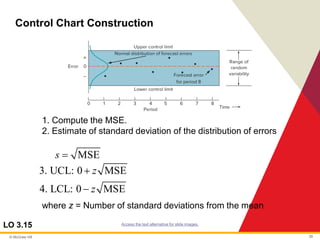
Control Chart Construction
LO 3.15
1. Compute the MSE.
2. Estimate of standard deviation of the distribution of errors
where z = Number of standard deviations from the mean
Access the text alternative for slide images.
MSE
s =
3. UCL: 0 MSE
4. LCL: 0 MSE
z
z
+
−
© McGraw Hill 40
Choosing a Forecasting Technique
LO 3.16
Factors to consider
Cost
Accuracy
Availability of historical data
Availability of forecasting software
Time needed to gather and analyze data and prepare a
forecast
Forecast horizon
© McGraw Hill 41
Operations Strategy
LO 3.16
The better forecasts are, the more able organizations will be
to take advantage of future opportunities and reduce
potential risks
A worthwhile strategy is to work to improve short-term forecasts
• Accurate up-to-date information can have a significant effect on
forecast accuracy:
• Prices
• Demand
• Other important variables
Reduce the time horizon forecasts have to cover
Sharing forecasts or demand data through the supply chain can
improve forecast quality
Because learning changes everything.®
www.mheducation.com
© 2021 McGraw Hill. All rights reserved. Authorized only for instructor use in the classroom.
No reproduction or further distribution permitted without the prior written consent of McGraw Hill.

Forecasting Operating Management Stevenson

  • 1.
    © McGraw Hill1 Chapter 3 Forecasting Operations Management FOURTEENTH EDITION William J. Stevenson © 2021 McGraw Hill. All rights reserved. Authorized only for instructor use in the
  • 2.
    © McGraw Hill2 Chapter 3: Learning Objectives You should be able to: LO 3.1 List features common to all forecasts LO 3.2 Explain why forecasts are generally wrong LO 3.3 List the elements of a good forecast LO 3.4 Outline the steps in the forecasting process LO 3.5 Summarize forecast errors and use summaries to make decisions LO 3.6 Describe four qualitative forecasting techniques LO 3.7 Use a naïve method to make a forecast LO 3.8 Prepare a moving average forecast LO 3.9 Prepare a weighted-average forecast LO 3.10 Prepare an exponential smoothing forecast LO 3.11 Prepare a linear trend forecast LO 3.12 Prepare a trend-adjusted exponential smoothing forecast LO 3.13 Compute and use seasonal relatives LO 3.14 Compute and use regression and correlation coefficients LO 3.15 Construct control charts and use them to monitor forecast errors LO 3.16 Describe the key factors and trade-offs to consider when choosing a forecasting technique
  • 3.
    © McGraw Hill3 Forecast LO 3.1 Forecast – a statement about the future value of a variable of interest We make forecasts about such things as weather, demand, and resource availability Forecasts are important to making informed decisions
  • 4.
    © McGraw Hill4 Two Important Aspects of Forecasts LO 3.1 Expected level of demand The level of demand may be a function of some structural variation such as trend or seasonal variation Accuracy Related to the potential size of forecast error
  • 5.
    © McGraw Hill5 Forecasts in Business Organizations LO 3.1 Accounting. New product/process cost estimates, profit projections, cash management. Finance. Equipment/equipment replacement needs, timing and amount of funding/borrowing needs. Human resources. Hiring activities, including recruitment, interviewing, and training; layoff planning, including outplacement counseling. Marketing. Pricing and promotion, e-business strategies, global competition strategies. MIS. New/revised information systems, internet services. Operations. Schedules, capacity planning, work assignments and workloads, inventory planning, make-or-buy decisions, outsourcing, project management. Product/service design. Revision of current features, design of new products or services.
  • 6.
    © McGraw Hill6 Forecast Uses LO 3.1 Plan the system Generally involves long-range plans related to: • Types of products and services to offer • Facility and equipment levels • Facility location Plan the use of the system Generally involves short- and medium-range plans related to: • Inventory management • Workforce levels • Purchasing • Production • Budgeting • Scheduling
  • 7.
    © McGraw Hill7 Features Common to All Forecasts LO 3.1 1. Techniques assume some underlying causal system that existed in the past will persist into the future 2. Forecasts are not perfect 3. Forecasts for groups of items are more accurate than those for individual items 4. Forecast accuracy decreases as the forecasting horizon increases
  • 8.
    © McGraw Hill8 Forecasts Are Not Perfect LO 3.2 Forecasts are not perfect: • Because random variation is always present, there will always be some residual error, even if all other factors have been accounted for.
  • 9.
    © McGraw Hill9 Elements of a Good Forecast LO 3.3 The forecast • Should be timely • Should be accurate • Should be reliable • Should be expressed in meaningful units • Should be in writing • Technique should be simple to understand and use • Should be cost-effective
  • 10.
    © McGraw Hill10 Steps in the Forecasting Process LO 3.4 1. Determine the purpose of the forecast 2. Establish a time horizon 3. Obtain, clean, and analyze appropriate data 4. Select a forecasting technique 5. Make the forecast 6. Monitor the forecast errors
  • 11.
    © McGraw Hill11 Forecasting Approaches LO 3.6 Qualitative forecasting Qualitative techniques permit the inclusion of soft information such as: • Human factors • Personal opinions • Hunches These factors are difficult, or impossible, to quantify Quantitative forecasting These techniques rely on hard data Quantitative techniques involve either the projection of historical data or the development of associative methods that attempt to use causal variables to make a forecast
  • 12.
    © McGraw Hill12 Qualitative Forecasts LO 3.6 Forecasts that use subjective inputs such as opinions from consumer surveys, sales staff, managers, executives, and experts Executive opinions • A small group of upper-level managers may meet and collectively develop a forecast Salesforce opinions • Members of the sales or customer service staff can be good sources of information due to their direct contact with customers and may be aware of plans customers may be considering for the future Consumer surveys • Since consumers ultimately determine demand, it makes sense to solicit input from them • Consumer surveys typically represent a sample of consumer opinions Other approaches • Managers may solicit opinions from other managers or staff people or outside experts to help with developing a forecast • The Delphi method is an iterative process intended to achieve a consensus
  • 13.
    © McGraw Hill13 Time-Series Forecasts LO 3.6 Forecasts that project patterns identified in recent time-series observations Time-series – a time-ordered sequence of observations taken at regular time intervals Assume that future values of the time-series can be estimated from past values of the time-series
  • 14.
    © McGraw Hill14 Time-Series Behaviors LO 3.6 Trend Seasonality Cycles Irregular variations Random variation
  • 15.
    © McGraw Hill15 Trends and Seasonality LO 3.6 Trend A long-term upward or downward movement in data • Population shifts • Changing income Seasonality Short-term, fairly regular variations related to the calendar or time of day Restaurants, service call centers, and theaters all experience seasonal demand
  • 16.
    © McGraw Hill16 Cycles and Variations LO 3.6 Cycle Wavelike variations lasting more than one year • These are often related to a variety of economic, political, or even agricultural conditions Irregular variation Due to unusual circumstances that do not reflect typical behavior • Labor strike • Weather event Random Variation Residual variation that remains after all other behaviors have been accounted for
  • 17.
    © McGraw Hill17 Time-Series Forecasting - Naïve Forecast LO 3.7 Naïve forecast Uses a single previous value of a time series as the basis for a forecast • The forecast for a time period is equal to the previous time period’s value Can be used with • A stable time series • Seasonal variations • Trend
  • 18.
    © McGraw Hill18 Time-Series Forecasting - Averaging LO 3.7 These techniques work best when a series tends to vary about an average Averaging techniques smooth variations in the data They can handle step changes or gradual changes in the level of a series Techniques 1. Moving average 2. Weighted moving average 3. Exponential smoothing
  • 19.
    © McGraw Hill19 Moving Average 1 LO 3.8 Technique that averages a number of the most recent actual values in generating a forecast where 1 2 1 MA n t i i t n t t t n A A A A F n n − = − − − + + + = = =  Forecast for time period MA period moving average Actual value in period Number of periods in the moving average t n t i F t n A t i n − = = = − =
  • 20.
    © McGraw Hill20 Moving Average 2 LO 3.7 As new data become available, the forecast is updated by adding the newest value and dropping the oldest and then recomputing the average The number of data points included in the average determines the model’s sensitivity Fewer data points used—more responsive More data points used—less responsive
  • 21.
    © McGraw Hill21 Weighted Moving Average LO 3.9 The most recent values in a time series are given more weight in computing a forecast The choice of weights, w, is somewhat arbitrary and involves some trial and error where 1 1 ( ) ( ) ( ) t t t t t t n t n F w A w A w A − − − − = + + + 1 1 weight for period , weight for period 1, etc. the actual value for period , the actual value for period 1, etc. t t t t w t w t A t A t − − = = − = = −
  • 22.
    © McGraw Hill22 Exponential Smoothing LO 3.10 A weighted averaging method that is based on the previous forecast plus a percentage of the forecast error where 1 1 1 ( ) t t t t F F A F  − − − = + − 1 1 Forecast for period Forecast for the previous period Smoothing constant Actual demand or sales for the previous period t t t F t F A  − − = = = =
  • 23.
    © McGraw Hill23 Linear Trend LO 3.11 A simple data plot can reveal the existence and nature of a trend Linear trend equation where t F a bt = + Forecast for period Value of at 0 Slope of the line Specified number of time periods from 0 t t F t a F t b t t = = = = = =
  • 24.
    © McGraw Hill24 Estimating Slope and Intercept LO 3.11 Slope and intercept can be estimated from historical data where ( ) 2 2 or n ty t y b n t t y b t a y bt n − = − − = −        Number of periods Value of the time series n y = =
  • 25.
    © McGraw Hill25 Trend-Adjusted Exponential Smoothing1 LO 3.12 The trend adjusted forecast consists of two components Smoothed error Trend factor where 1 TAFt t t S T + = + Previous forecast plus smoothed error Current trend estimate t t S T = =
  • 26.
    © McGraw Hill26 Trend-Adjusted Exponential Smoothing2 LO 3.12 Alpha and beta are smoothing constants Trend-adjusted exponential smoothing has the ability to respond to changes in trend 1 1 1 1 TAF TAF ( TAF ) (TAF TAF ) t t t t t t t t t t t t S T S A T T T   + − − − = + = + − = + − −
  • 27.
    © McGraw Hill27 Techniques for Seasonality LO 3.12 Seasonality – regularly repeating movements in series values that can be tied to recurring events Expressed in terms of the amount that actual values deviate from the average value of a series Models of seasonality • Additive • Seasonality is expressed as a quantity that gets added to or subtracted from the time-series average in order to incorporate seasonality • Multiplicative • Seasonality is expressed as a percentage of the average (or trend) amount which is then used to multiply the value of a series in order to incorporate seasonality
  • 28.
    © McGraw Hill28 Seasonal Relatives LO 3.13 Seasonal relatives The seasonal percentage used in the multiplicative seasonally adjusted forecasting model Using seasonal relatives To deseasonalize data • Done in order to get a clearer picture of the nonseasonal (for example, trend) components of the data series • Divide each data point by its seasonal relative To incorporate seasonality in a forecast 1. Obtain trend estimates for desired periods using a trend equation 2. Add seasonality by multiplying these trend estimates by the corresponding seasonal relative
  • 29.
    © McGraw Hill29 Associative Forecasting Techniques LO 3.14 Associative techniques are based on the development of an equation that summarizes the effects of predictor variables Predictor variables – variables that can be used to predict values of the variable of interest • Home values may be related to such factors as home and property size, location, number of bedrooms, and number of bathrooms
  • 30.
    © McGraw Hill30 Simple Linear Regression LO 3.14 Regression – a technique for fitting a line to a set of data points Simple linear regression – the simplest form of regression that involves a linear relationship between two variables • The object of simple linear regression is to obtain an equation of a straight line that minimizes the sum of squared vertical deviations from the line (that is, the least squares criterion)
  • 31.
    © McGraw Hill31 Least Squares Line LO 3.14 where and where e y a bx = + = Predicted (dependent) variable = Predictor (independent) variable = Slope of the line = Value of when 0 (that is, the height of the line at the intercept) c c y x b a y x y = ( ) ( )( ) ( ) ( ) 2 2 or n xy x y b n x x y b x a y bx n − = − − = −        Number of paired observations n =
  • 32.
    © McGraw Hill32 Correlation Coefficient LO 3.14 Correlation, r A measure of the strength and direction of relationship between two variables Ranges between −1.00 and +1.00 r2, square of the correlation coefficient A measure of the percentage of variability in the values of y that is “explained” by the independent variable Ranges between 0 and 1.00 ( ) ( )( ) ( ) ( ) ( ) ( ) 2 2 2 2 n xy x y r n x x n y y − = − −       
  • 33.
    © McGraw Hill33 Simple Linear Regression Assumptions LO 3.14 1. Variations around the line are random 2. Deviations around the average value (the line) should be normally distributed 3. Predictions are made only within the range of observed values
  • 34.
    © McGraw Hill34 Issues to Consider: LO 3.14 Always plot the line to verify that a linear relationship is appropriate The data may be time-dependent If they are • use analysis of time series • use time as an independent variable in a multiple regression analysis A small correlation may indicate that other variables are important
  • 35.
    © McGraw Hill35 Forecast Accuracy and Control LO 3.5 Allowances should be made for forecast errors It is important to provide an indication of the extent to which the forecast might deviate from the value of the variable that actually occurs Forecast errors should be monitored Error = Actual − Forecast If errors fall beyond acceptable bounds, corrective action may be necessary
  • 36.
    © McGraw Hill36 Forecast Accuracy Metrics LO 3.5 MAD weights all errors evenly MSE weights errors according to their squared values MAPE weights errors according to relative error t t Actual Forecast MAD n − =  ( ) 2 t t Actual Forecast MSE 1 n − = −  t t t Actual Forecast 100 Actual MAPE n −  = 
  • 37.
    © McGraw Hill37 Forecast Error Calculation LO 3.5 Period Actual (A) Forecast (F) (A − F) Error |Error| Error2 [|Error|/Actual] × 100 1 107 110 −3 3 9 2.80% 2 125 121 4 4 16 3.20% 3 115 112 3 3 9 2.61% 4 118 120 −2 2 4 1.69% 5 108 109 1 1 1 0.93% Sum 13 39 11.23% n = 5 n − 1 = 4 n = 5 MAD MSE MAPE = 2.6 = 9.75 = 2.25%
  • 38.
    © McGraw Hill38 Monitoring the Forecast LO 3.15 Tracking forecast errors and analyzing them can provide useful insight into whether forecasts are performing satisfactorily Sources of forecast errors: The model may be inadequate due to a. omission of an important variable b. a change or shift in the variable the model cannot handle c. the appearance of a new variable Irregular variations may have occurred Random variation Control charts are useful for identifying the presence of non- random error in forecasts Tracking signals can be used to detect forecast bias
  • 39.
    © McGraw Hill39 Control Chart Construction LO 3.15 1. Compute the MSE. 2. Estimate of standard deviation of the distribution of errors where z = Number of standard deviations from the mean Access the text alternative for slide images. MSE s = 3. UCL: 0 MSE 4. LCL: 0 MSE z z + −
  • 40.
    © McGraw Hill40 Choosing a Forecasting Technique LO 3.16 Factors to consider Cost Accuracy Availability of historical data Availability of forecasting software Time needed to gather and analyze data and prepare a forecast Forecast horizon
  • 41.
    © McGraw Hill41 Operations Strategy LO 3.16 The better forecasts are, the more able organizations will be to take advantage of future opportunities and reduce potential risks A worthwhile strategy is to work to improve short-term forecasts • Accurate up-to-date information can have a significant effect on forecast accuracy: • Prices • Demand • Other important variables Reduce the time horizon forecasts have to cover Sharing forecasts or demand data through the supply chain can improve forecast quality
  • 42.
    Because learning changeseverything.® www.mheducation.com © 2021 McGraw Hill. All rights reserved. Authorized only for instructor use in the classroom. No reproduction or further distribution permitted without the prior written consent of McGraw Hill.