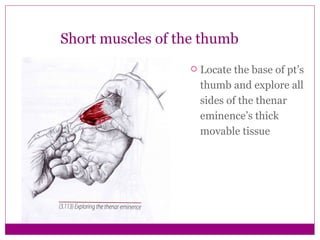
Short muscles of the thumb Locate the base of pt’s thumb and explore all sides of the thenar eminence’s thick movable tissue
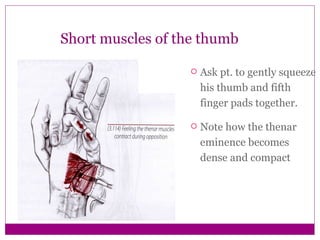
Short muscles of the thumb Ask pt. to gently squeeze his thumb and fifth finger pads together.  Note how the thenar eminence becomes dense and compact
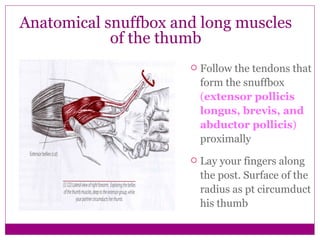
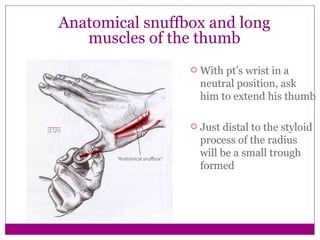
Anatomical snuffbox and long muscles of the thumb Follow the tendons that form the snuffbox  ( extensor pollicis longus, brevis, and abductor pollicis )  proximally Lay your fingers along the post. Surface of the radius as pt circumduct his thumb
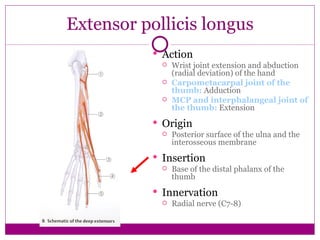
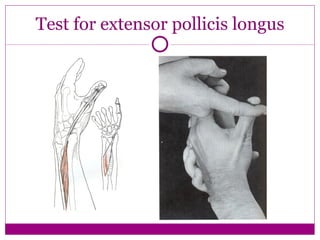
Extensor pollicis longus Action Wrist joint extension and abduction (radial deviation) of the hand Carpometacarpal joint of the thumb:  Adduction MCP and interphalangeal joint of the thumb:  Extension Origin Posterior surface of the ulna and the interosseous membrane Insertion Base of the distal phalanx of the thumb Innervation Radial nerve (C7-8)
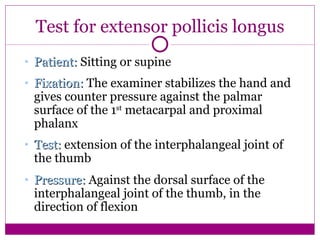
Test for extensor pollicis longus
Test for extensor pollicis longus Patient:  Sitting or supine Fixation:  The examiner stabilizes the hand and gives counter pressure against the palmar surface of the 1 st  metacarpal and proximal phalanx Test:  extension of the interphalangeal joint of the thumb Pressure:  Against the dorsal surface of the interphalangeal joint of the thumb, in the direction of flexion
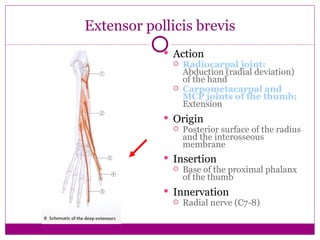
Extensor pollicis brevis Action Radiocarpal joint:  Abduction (radial deviation) of the hand Carpometacarpal and MCP joints of the thumb:  Extension Origin Posterior surface of the radius and the interosseous membrane Insertion Base of the proximal phalanx of the thumb Innervation Radial nerve (C7-8)
Test for extensor pollicis brevis
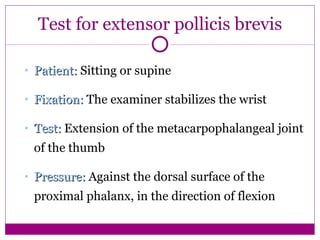
Test for extensor pollicis brevis Patient:  Sitting or supine Fixation:  The examiner stabilizes the wrist Test:  Extension of the metacarpophalangeal joint of the thumb Pressure:  Against the dorsal surface of the proximal phalanx, in the direction of flexion
Abductor pollicis longus Action Radiocarpal joint:  Abduction (radial deviation) of the hand Carpometacarpal joint of the thumb:  Abduction Origin Dorsal surface of the radius, ulna,and interosseous membrane Insertion Base of the first metacarpal Innervation Radial nerve (C7-8)
Test for abductor pollicis longus
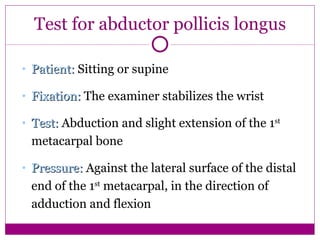
Test for abductor pollicis longus Patient:  Sitting or supine Fixation:  The examiner stabilizes the wrist Test:  Abduction and slight extension of the 1 st  metacarpal bone Pressure:  Against the lateral surface of the distal end of the 1 st  metacarpal, in the direction of adduction and flexion
Test for abductor pollicis brevis
Test for abductor pollicis brevis Patient:  Sitting or supine Fixation:  The examiner stabilizes the hand Test:  Abduction of the thumb ventrally from the palm Pressure:  Against the proximal phalanx, in the direction of adduction toward the palm
Anatomical snuffbox and long muscles of the thumb With pt’s wrist in a neutral position, ask him to extend his thumb Just distal to the styloid process of the radius will be a small trough formed
Other structures of  the forearm and hand
Radial collateral ligament Locate  lat. epicondyle  of the humerus and  head of radius
Annular ligament Place your thumb pad on the  head of radius While passively pronating and supinating the forearm, allow the head and neck of the radius to pivot under your thumb
Ulnar collateral ligament Locate  med. epicondyle  of humerus and the  med. aspect of the olecranon process
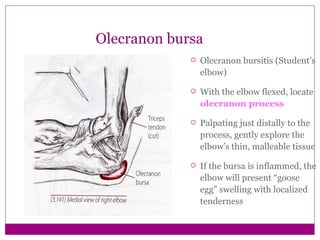
Olecranon bursa Olecranon bursitis (Student’s elbow) With the elbow flexed, locate  olecranon process Palpating just distally to the process, gently explore the elbow’s thin, malleable tissue If the bursa is inflammed, the elbow will present “goose egg” swelling with localized tenderness
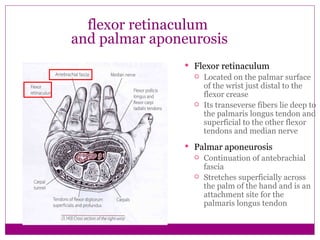
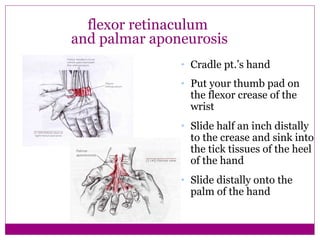
flexor retinaculum  and palmar aponeurosis Flexor retinaculum Located on the palmar surface of the wrist just distal to the flexor crease  Its transeverse fibers lie deep to the palmaris longus tendon and superficial to the other flexor tendons and median nerve Palmar aponeurosis Continuation of antebrachial fascia  Stretches superficially across the palm of the hand and is an attachment site for the palmaris longus tendon
flexor retinaculum  and palmar aponeurosis Cradle pt.’s hand Put your thumb pad on the flexor crease of the wrist Slide half an inch distally to the crease and sink into the tick tissues of the heel of the hand Slide distally onto the palm of the hand
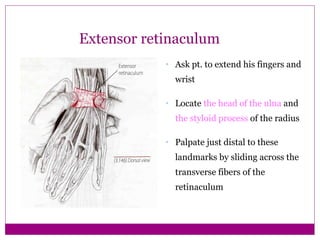
Extensor retinaculum Ask pt. to extend his fingers and wrist Locate  the head of the ulna   and  the styloid process   of the radius Palpate just distal to these landmarks by sliding across the transverse fibers of the retinaculum

Forearm And Hand 5

  • 1.
    Short muscles ofthe thumb Locate the base of pt’s thumb and explore all sides of the thenar eminence’s thick movable tissue
  • 2.
    Short muscles ofthe thumb Ask pt. to gently squeeze his thumb and fifth finger pads together. Note how the thenar eminence becomes dense and compact
  • 3.
    Anatomical snuffbox andlong muscles of the thumb Follow the tendons that form the snuffbox ( extensor pollicis longus, brevis, and abductor pollicis ) proximally Lay your fingers along the post. Surface of the radius as pt circumduct his thumb
  • 4.
    Extensor pollicis longusAction Wrist joint extension and abduction (radial deviation) of the hand Carpometacarpal joint of the thumb: Adduction MCP and interphalangeal joint of the thumb: Extension Origin Posterior surface of the ulna and the interosseous membrane Insertion Base of the distal phalanx of the thumb Innervation Radial nerve (C7-8)
  • 5.
    Test for extensorpollicis longus
  • 6.
    Test for extensorpollicis longus Patient: Sitting or supine Fixation: The examiner stabilizes the hand and gives counter pressure against the palmar surface of the 1 st metacarpal and proximal phalanx Test: extension of the interphalangeal joint of the thumb Pressure: Against the dorsal surface of the interphalangeal joint of the thumb, in the direction of flexion
  • 7.
    Extensor pollicis brevisAction Radiocarpal joint: Abduction (radial deviation) of the hand Carpometacarpal and MCP joints of the thumb: Extension Origin Posterior surface of the radius and the interosseous membrane Insertion Base of the proximal phalanx of the thumb Innervation Radial nerve (C7-8)
  • 8.
    Test for extensorpollicis brevis
  • 9.
    Test for extensorpollicis brevis Patient: Sitting or supine Fixation: The examiner stabilizes the wrist Test: Extension of the metacarpophalangeal joint of the thumb Pressure: Against the dorsal surface of the proximal phalanx, in the direction of flexion
  • 10.
    Abductor pollicis longusAction Radiocarpal joint: Abduction (radial deviation) of the hand Carpometacarpal joint of the thumb: Abduction Origin Dorsal surface of the radius, ulna,and interosseous membrane Insertion Base of the first metacarpal Innervation Radial nerve (C7-8)
  • 11.
    Test for abductorpollicis longus
  • 12.
    Test for abductorpollicis longus Patient: Sitting or supine Fixation: The examiner stabilizes the wrist Test: Abduction and slight extension of the 1 st metacarpal bone Pressure: Against the lateral surface of the distal end of the 1 st metacarpal, in the direction of adduction and flexion
  • 13.
    Test for abductorpollicis brevis
  • 14.
    Test for abductorpollicis brevis Patient: Sitting or supine Fixation: The examiner stabilizes the hand Test: Abduction of the thumb ventrally from the palm Pressure: Against the proximal phalanx, in the direction of adduction toward the palm
  • 15.
    Anatomical snuffbox andlong muscles of the thumb With pt’s wrist in a neutral position, ask him to extend his thumb Just distal to the styloid process of the radius will be a small trough formed
  • 16.
    Other structures of the forearm and hand
  • 17.
    Radial collateral ligamentLocate lat. epicondyle of the humerus and head of radius
  • 18.
    Annular ligament Placeyour thumb pad on the head of radius While passively pronating and supinating the forearm, allow the head and neck of the radius to pivot under your thumb
  • 19.
    Ulnar collateral ligamentLocate med. epicondyle of humerus and the med. aspect of the olecranon process
  • 20.
    Olecranon bursa Olecranonbursitis (Student’s elbow) With the elbow flexed, locate olecranon process Palpating just distally to the process, gently explore the elbow’s thin, malleable tissue If the bursa is inflammed, the elbow will present “goose egg” swelling with localized tenderness
  • 21.
    flexor retinaculum and palmar aponeurosis Flexor retinaculum Located on the palmar surface of the wrist just distal to the flexor crease Its transeverse fibers lie deep to the palmaris longus tendon and superficial to the other flexor tendons and median nerve Palmar aponeurosis Continuation of antebrachial fascia Stretches superficially across the palm of the hand and is an attachment site for the palmaris longus tendon
  • 22.
    flexor retinaculum and palmar aponeurosis Cradle pt.’s hand Put your thumb pad on the flexor crease of the wrist Slide half an inch distally to the crease and sink into the tick tissues of the heel of the hand Slide distally onto the palm of the hand
  • 23.
    Extensor retinaculum Askpt. to extend his fingers and wrist Locate the head of the ulna and the styloid process of the radius Palpate just distal to these landmarks by sliding across the transverse fibers of the retinaculum