STRATEGIC CHOICE
Introduction
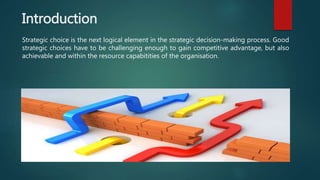
Strategic choice is the next logical element in the strategic decision-making process. Good
strategic choices have to be challenging enough to gain competitive advantage, but also
achievable and within the resource capabitities of the organisation.
Importance of Strategic Choices
Whether a business success or fails depends in large measure on the strategic choices made by
the owner.
The most successful companies can allocate scarce resources to the projects that have the
greatest positive impact on revenue growth or improvements in productivity and efficiency that
can increase profit margins.
Ansoff’s matrix
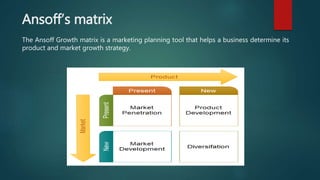
The Ansoff Growth matrix is a marketing planning tool that helps a business determine its
product and market growth strategy.
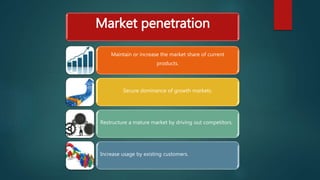
Market penetration
Maintain or increase the market share of current
products.
Secure dominance of growth markets.
Restructure a mature market by driving out competitors.
Increase usage by existing customers.
Market development
New geographical markets.
New product dimensions or packaging.
New distribution channels.
Different pricing policies to attract different customers or
create new market segments.
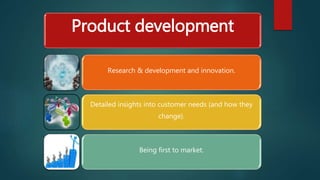
Product development
Research & development and innovation.
Detailed insights into customer needs (and how they
change).
Being first to market.
Diversification
Diversification is the name given to the growth strategy
where a business markets new products in new markets.
Evaluation of Ansoff’s matrix
The Ansoff matrix is one of the more popular analytical tools for business. It offers an easy way of
understanding a company's present position relative to its products and markets. At the same time, it also
enables an organization to chart its direction and determine what appropriate strategies for growth should
be taken. While it has its own limitations and inherent risks, these can be overcome by careful analysis and
with the help of the other analytical tools available
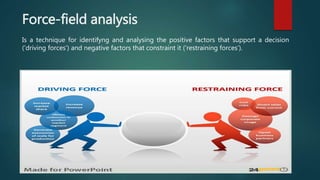
Force-field analysis
Is a technique for identifyng and analysing the positive factors that support a decision
(‘driving forces’) and negative factors that constraint it (‘restraining forces’).
Conducting a force-field analysis
Analyse the current situation
and the desired situation.
List all of the factors driving
change towards the desired
situation.
List all of the constraining
factors against change towards
the desired situation.
Allocate a numerical score to
each force.
Chart the forces on the
diagram.
Total the scores and establish
from this whether the change
is really viable.
Discuss how the succes of the change or proposed decisión can be
affected by decreasing the strength of the restraining forces and
increasing the strength of the driving forces.
Example of force-field analysis
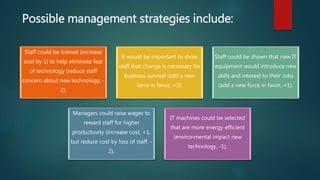
Possible management strategies include:
Staff could be trained (increase
cost by 1) to help eliminate fear
of technology (reduce staff
concern about new technology, -
2).
It would be important to show
staff that change is necessary for
business survival (add a new
force in favor, +2).
Staff could be shown that new IT
equipment would introduce new
skills and interest to their Jobs
(add a new force in favor, +1).
Managers could raise wages to
reward staff for higher
productuvity (increase cost, +1,
but reduce cost by loss of staff, -
2).
IT machines could be selected
that are more energy efficient
(environmental impact new
technology, -1).
Evaluation of force-field analysis
This technique is widely used in 'change situation' for the reasons given, yet it has two main
limitations as a strategic-choice method:
- Unskilled or inexperienced managers could fail to identify all of the relevant forces involved in
the change process.
- The allocation of numerical values to the driving and constraining forces is rather subjective.
For example, two managers independently undertaking the same force-field analysis could
arrive at rather different values for the forces and, consequently, propose different decisions
based on their assessments.

Strategic choice - Ansoff's matrix and Force-field analysis

  • 1.
  • 2.
    Introduction Strategic choice isthe next logical element in the strategic decision-making process. Good strategic choices have to be challenging enough to gain competitive advantage, but also achievable and within the resource capabitities of the organisation.
  • 3.
    Importance of StrategicChoices Whether a business success or fails depends in large measure on the strategic choices made by the owner. The most successful companies can allocate scarce resources to the projects that have the greatest positive impact on revenue growth or improvements in productivity and efficiency that can increase profit margins.
  • 4.
    Ansoff’s matrix The AnsoffGrowth matrix is a marketing planning tool that helps a business determine its product and market growth strategy.
  • 5.
    Market penetration Maintain orincrease the market share of current products. Secure dominance of growth markets. Restructure a mature market by driving out competitors. Increase usage by existing customers.
  • 6.
    Market development New geographicalmarkets. New product dimensions or packaging. New distribution channels. Different pricing policies to attract different customers or create new market segments.
  • 7.
    Product development Research &development and innovation. Detailed insights into customer needs (and how they change). Being first to market.
  • 8.
    Diversification Diversification is thename given to the growth strategy where a business markets new products in new markets.
  • 9.
    Evaluation of Ansoff’smatrix The Ansoff matrix is one of the more popular analytical tools for business. It offers an easy way of understanding a company's present position relative to its products and markets. At the same time, it also enables an organization to chart its direction and determine what appropriate strategies for growth should be taken. While it has its own limitations and inherent risks, these can be overcome by careful analysis and with the help of the other analytical tools available
  • 10.
    Force-field analysis Is atechnique for identifyng and analysing the positive factors that support a decision (‘driving forces’) and negative factors that constraint it (‘restraining forces’).
  • 11.
    Conducting a force-fieldanalysis Analyse the current situation and the desired situation. List all of the factors driving change towards the desired situation. List all of the constraining factors against change towards the desired situation. Allocate a numerical score to each force. Chart the forces on the diagram. Total the scores and establish from this whether the change is really viable. Discuss how the succes of the change or proposed decisión can be affected by decreasing the strength of the restraining forces and increasing the strength of the driving forces.
  • 12.
  • 13.
    Possible management strategiesinclude: Staff could be trained (increase cost by 1) to help eliminate fear of technology (reduce staff concern about new technology, - 2). It would be important to show staff that change is necessary for business survival (add a new force in favor, +2). Staff could be shown that new IT equipment would introduce new skills and interest to their Jobs (add a new force in favor, +1). Managers could raise wages to reward staff for higher productuvity (increase cost, +1, but reduce cost by loss of staff, - 2). IT machines could be selected that are more energy efficient (environmental impact new technology, -1).
  • 14.
    Evaluation of force-fieldanalysis This technique is widely used in 'change situation' for the reasons given, yet it has two main limitations as a strategic-choice method: - Unskilled or inexperienced managers could fail to identify all of the relevant forces involved in the change process. - The allocation of numerical values to the driving and constraining forces is rather subjective. For example, two managers independently undertaking the same force-field analysis could arrive at rather different values for the forces and, consequently, propose different decisions based on their assessments.