FORCE
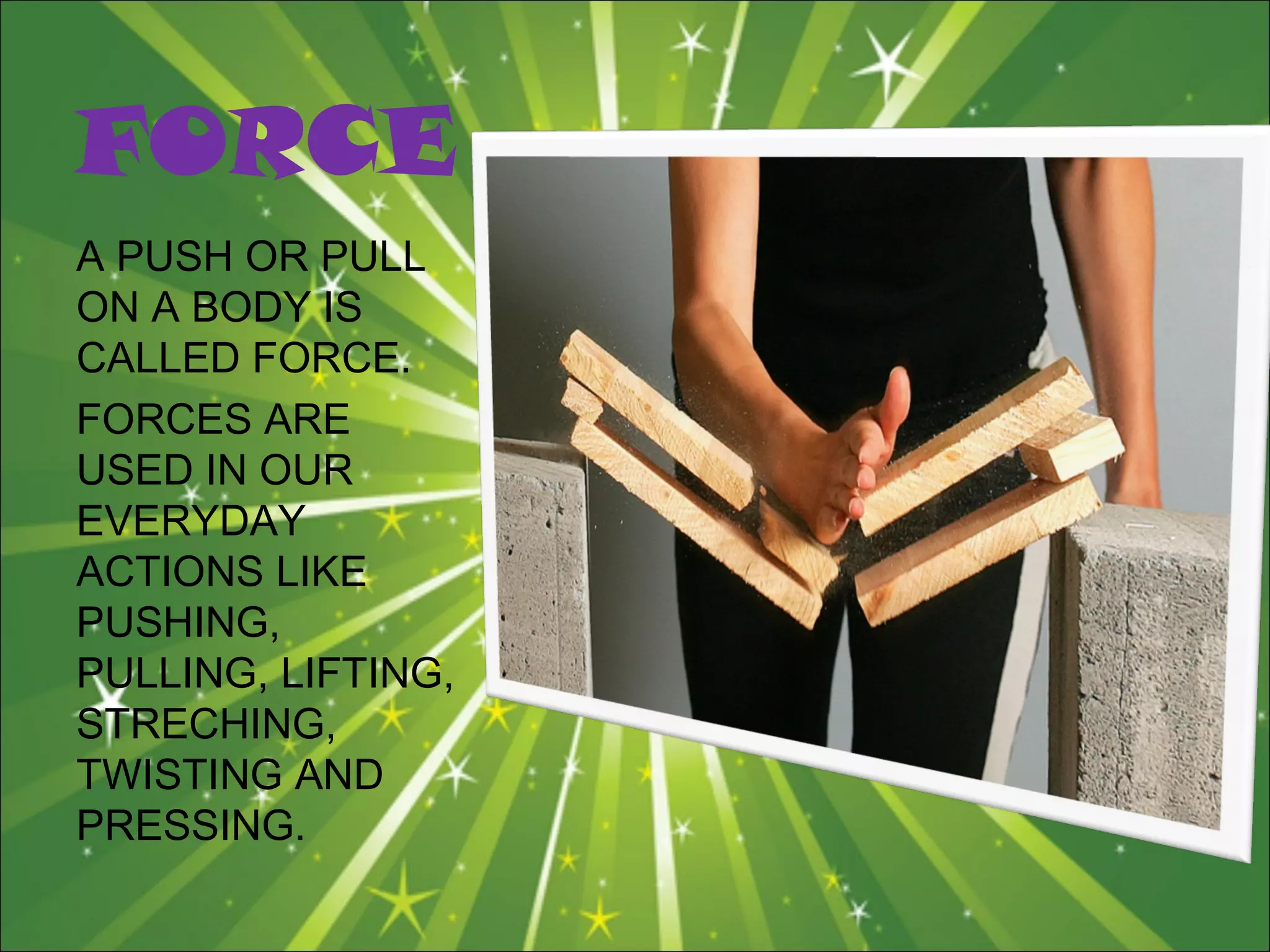
A PUSH OR PULL
ON A BODY IS
CALLED FORCE.
FORCES ARE
USED IN OUR
EVERYDAY
ACTIONS LIKE
PUSHING,
PULLING, LIFTING,
STRECHING,
TWISTING AND
PRESSING.
EFFECTS OF FORCE
• A force cannot be seen. A force can be
judged only by the effects which it can
produce in various bodies (or objects)
around us.
1.A force can move a stationary body.
2.A force can stop a moving body.
3.A force can change the speed of a moving
body.
4.A force can change the direction of a
moving body.
5.A force can change the shape and size of a
body.
BALANCED AND
UNBALANCED FORCE
• THERE ARE TWO KINDS OF FORCE:
• 1. BALANCED FORCE.
• 2. UNBALANCED FORCE.
BALANCED
FORCES
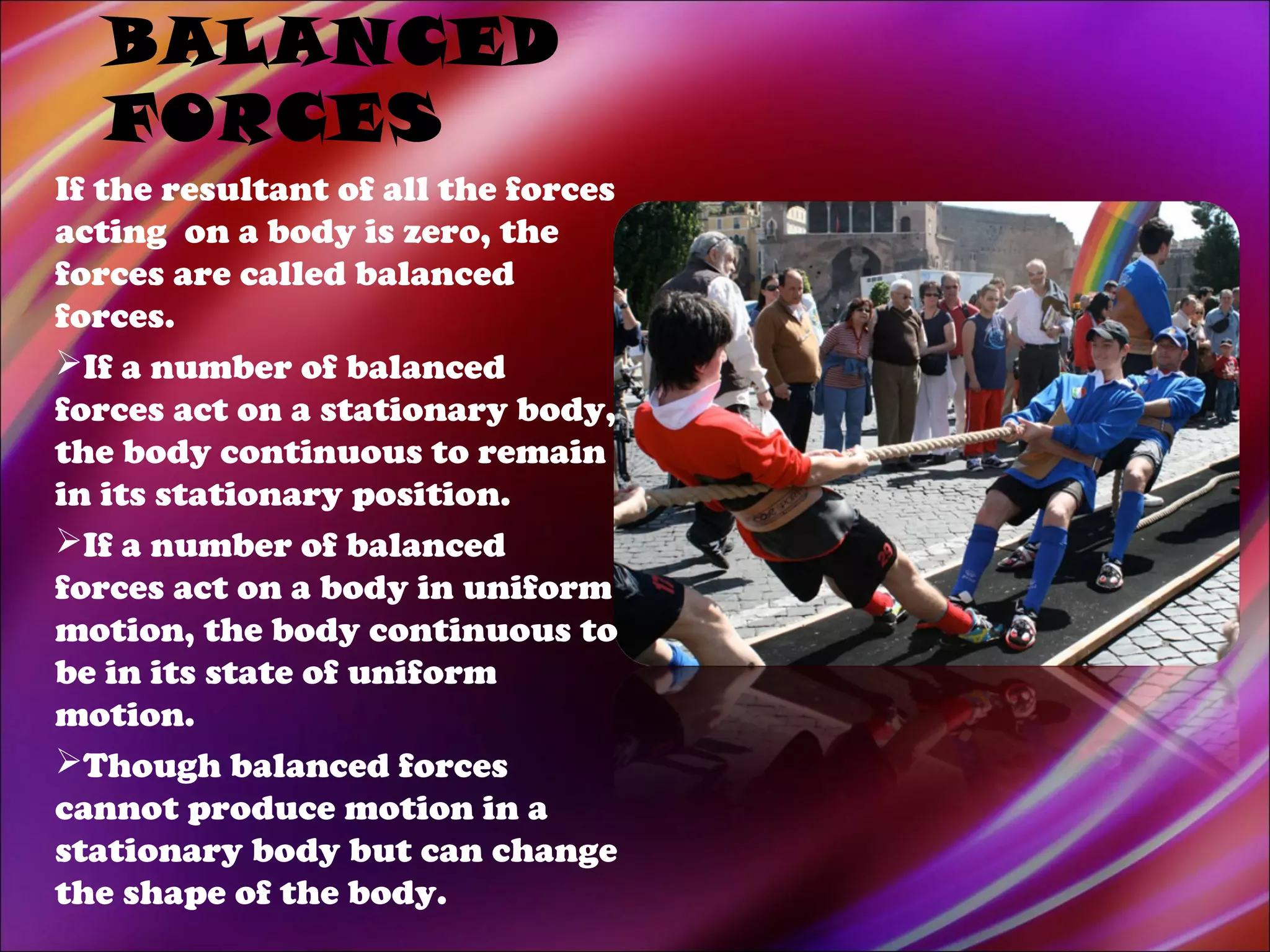
If the resultant of all the forces
acting on a body is zero, the
forces are called balanced
forces.
If a number of balanced
forces act on a stationary body,
the body continuous to remain
in its stationary position.
If a number of balanced
forces act on a body in uniform
motion, the body continuous to
be in its state of uniform
motion.
Though balanced forces
cannot produce motion in a
stationary body but can change
the shape of the body.
UNBALANCED
FORCE
If the resultant of all the
forces acting on a body is
not zero, the forces are
called unbalanced forces.
When an unbalanced
force acts on a body, it
produces motion in the
body. Also, an unbalanced
can stop a moving body.
If there were no
unbalanced force of
friction or air resistance, a
moving body would go on
for ever.
NEWTON’S LAW OF
MOTION
• NEWTON HAS GIVEN
THREE LAWS OF TO DEFINE
THE MOTION OF BODIES.
THESE LAWS ARE KNOWN
AS NEWTON’S LAWS OF
MOTION.
NEWTON’S FIRST
LAW OF MOTION
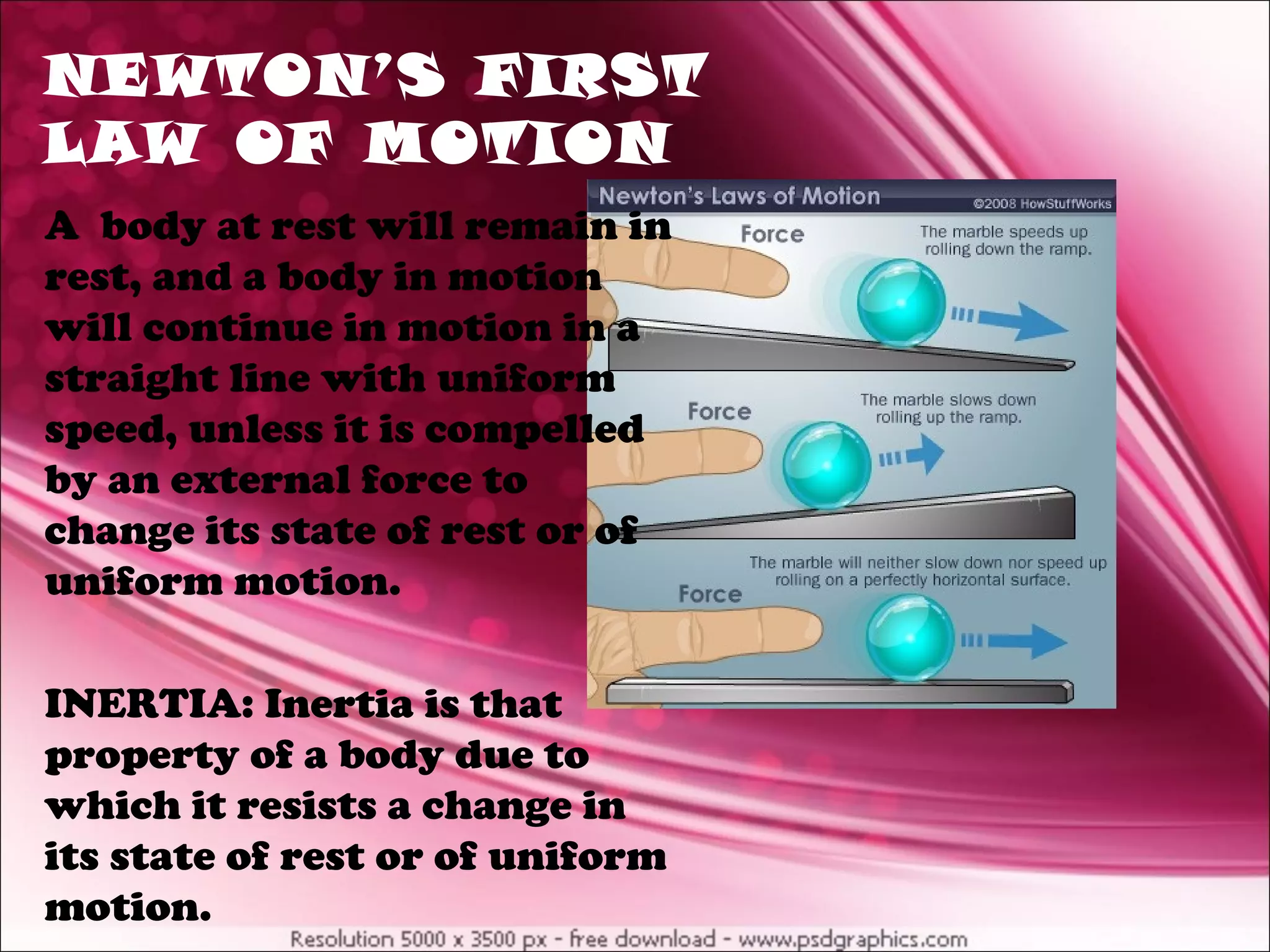
A body at rest will remain in
rest, and a body in motion
will continue in motion in a
straight line with uniform
speed, unless it is compelled
by an external force to
change its state of rest or of
uniform motion.
INERTIA: Inertia is that
property of a body due to
which it resists a change in
its state of rest or of uniform
motion.
MOMENTUM
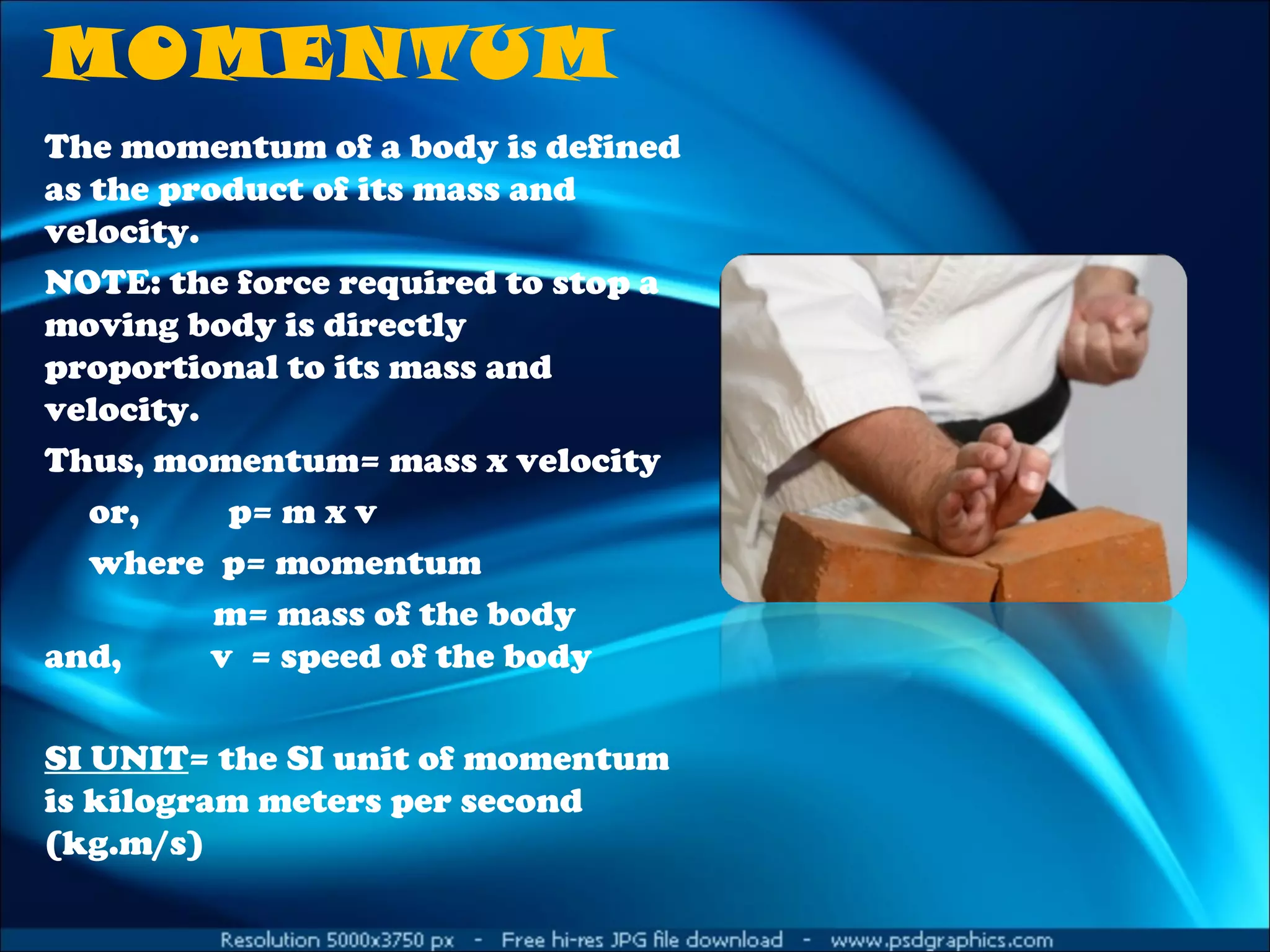
The momentum of a body is defined
as the product of its mass and
velocity.
NOTE: the force required to stop a
moving body is directly
proportional to its mass and
velocity.
Thus, momentum= mass x velocity
or, p= m x v
where p= momentum
m= mass of the body
and, v = speed of the body
SI UNIT= the SI unit of momentum
is kilogram meters per second
(kg.m/s)
NEWTON’S SECOND
LAW OF MOTION
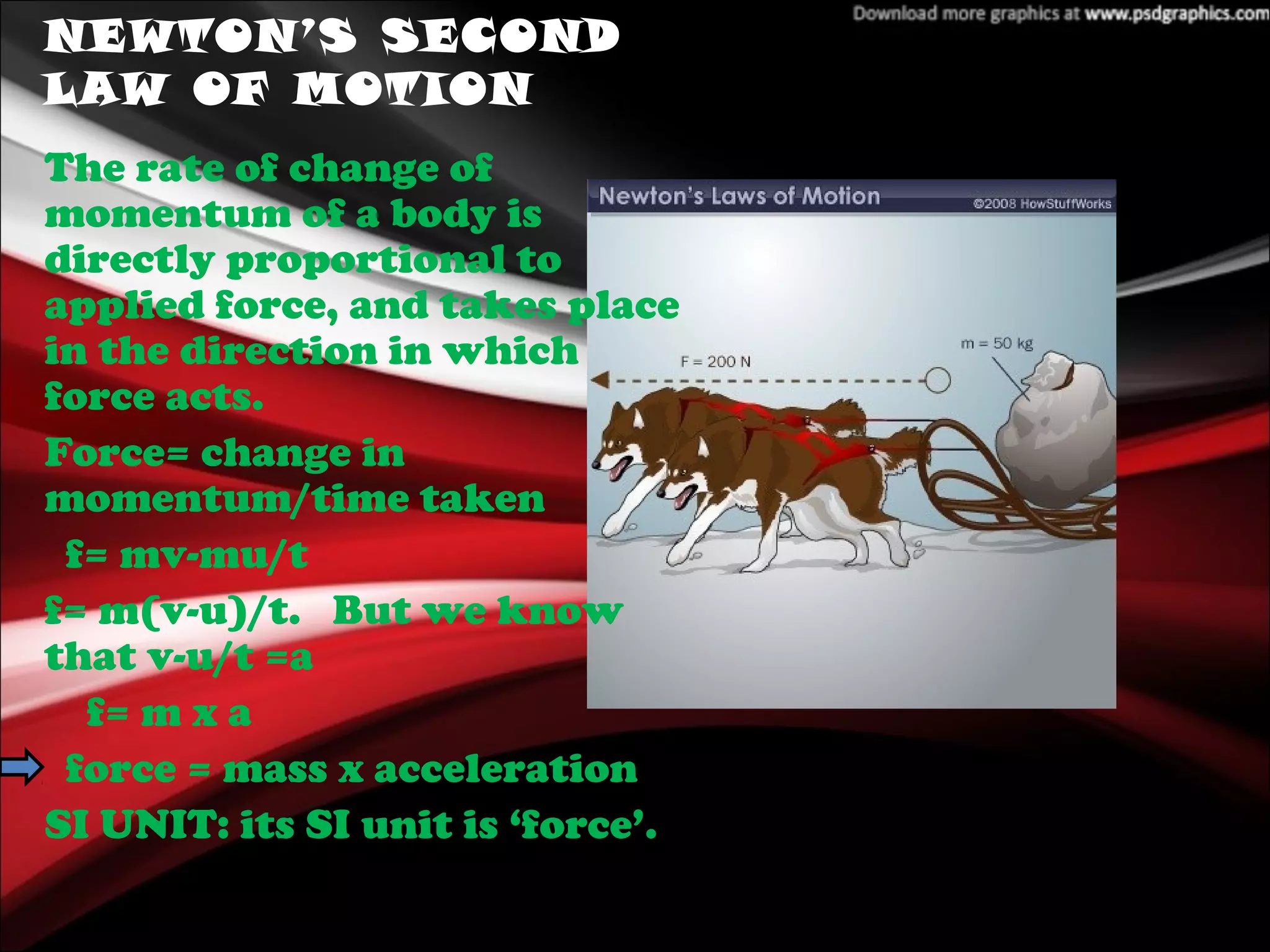
The rate of change of
momentum of a body is
directly proportional to
applied force, and takes place
in the direction in which
force acts.
Force= change in
momentum/time taken
f= mv-mu/t
f= m(v-u)/t. But we know
that v-u/t =a
f= m x a
force = mass x acceleration
SI UNIT: its SI unit is ‘force’.
NEWTON’S THIRD
LAW OF MOTION
Whenever one body exerts a force
on another body, the second body
exerts equal and opposite force to
the first body. OR,
To every action there is equal and
opposite reaction.
1.EX: the rocket works on the
principal of action and reaction.
2.When a bullet is fired from the
gun, a force sending the bullet
forward is equal to the force
sending the gun backward. But
due to high mass of the gun, it
moves only a little distance
backward and gives jerk.
CONSERVATION OF
MOMENTUM
When two or more bodies
act upon one another, their
total momentum remains
constant provided no
external forces are acting.
Momentum is neither
created nor destroyed.
Total momentum before
collision = total
momentum after collision
force and laws of motion

force and laws of motion

  • 2.
    FORCE A PUSH ORPULL ON A BODY IS CALLED FORCE. FORCES ARE USED IN OUR EVERYDAY ACTIONS LIKE PUSHING, PULLING, LIFTING, STRECHING, TWISTING AND PRESSING.
  • 3.
    EFFECTS OF FORCE •A force cannot be seen. A force can be judged only by the effects which it can produce in various bodies (or objects) around us. 1.A force can move a stationary body. 2.A force can stop a moving body. 3.A force can change the speed of a moving body. 4.A force can change the direction of a moving body. 5.A force can change the shape and size of a body.
  • 4.
    BALANCED AND UNBALANCED FORCE •THERE ARE TWO KINDS OF FORCE: • 1. BALANCED FORCE. • 2. UNBALANCED FORCE.
  • 5.
    BALANCED FORCES If the resultantof all the forces acting on a body is zero, the forces are called balanced forces. If a number of balanced forces act on a stationary body, the body continuous to remain in its stationary position. If a number of balanced forces act on a body in uniform motion, the body continuous to be in its state of uniform motion. Though balanced forces cannot produce motion in a stationary body but can change the shape of the body.
  • 6.
    UNBALANCED FORCE If the resultantof all the forces acting on a body is not zero, the forces are called unbalanced forces. When an unbalanced force acts on a body, it produces motion in the body. Also, an unbalanced can stop a moving body. If there were no unbalanced force of friction or air resistance, a moving body would go on for ever.
  • 7.
    NEWTON’S LAW OF MOTION •NEWTON HAS GIVEN THREE LAWS OF TO DEFINE THE MOTION OF BODIES. THESE LAWS ARE KNOWN AS NEWTON’S LAWS OF MOTION.
  • 8.
    NEWTON’S FIRST LAW OFMOTION A body at rest will remain in rest, and a body in motion will continue in motion in a straight line with uniform speed, unless it is compelled by an external force to change its state of rest or of uniform motion. INERTIA: Inertia is that property of a body due to which it resists a change in its state of rest or of uniform motion.
  • 9.
    MOMENTUM The momentum ofa body is defined as the product of its mass and velocity. NOTE: the force required to stop a moving body is directly proportional to its mass and velocity. Thus, momentum= mass x velocity or, p= m x v where p= momentum m= mass of the body and, v = speed of the body SI UNIT= the SI unit of momentum is kilogram meters per second (kg.m/s)
  • 10.
    NEWTON’S SECOND LAW OFMOTION The rate of change of momentum of a body is directly proportional to applied force, and takes place in the direction in which force acts. Force= change in momentum/time taken f= mv-mu/t f= m(v-u)/t. But we know that v-u/t =a f= m x a force = mass x acceleration SI UNIT: its SI unit is ‘force’.
  • 11.
    NEWTON’S THIRD LAW OFMOTION Whenever one body exerts a force on another body, the second body exerts equal and opposite force to the first body. OR, To every action there is equal and opposite reaction. 1.EX: the rocket works on the principal of action and reaction. 2.When a bullet is fired from the gun, a force sending the bullet forward is equal to the force sending the gun backward. But due to high mass of the gun, it moves only a little distance backward and gives jerk.
  • 12.
    CONSERVATION OF MOMENTUM When twoor more bodies act upon one another, their total momentum remains constant provided no external forces are acting. Momentum is neither created nor destroyed. Total momentum before collision = total momentum after collision