
Trainee of Trainer
PMKVY 2.0
Name – Shahzeb Alam
Master Trainer in Leather
Mobile Number- +919804965956
Trade
• Stitching Goods and Garments
Definition: A Stitcher, also called a ‘sewer’ is an important job-role
associated with Leather Goods and Garment sector. The primary
responsibility of a stitcher is to sew fabric, fur, leather or
synthetic materials to produce garments and other articles.
• Stitching Operator in Footwear
Definition: The primary responsibility of a Stitching Operator
(Footwear) is to perform stitching operations to the upper
components of the footwear as per the design instructions
given by the designing section. He/ She should be able to
stitch the footwear with leather and non-leather
components, using maximum accuracy. He/she should be
passionate about creating intricate products without
compromising on quality.
ABBREVIATION
• Full Form of some important Words
• Q.P = Qualification Pack
• NOS = National Occupational Standard
• OS = Occupational Standard
• NVEQF = National Vocational Education
Qualifications Framework.
• NVQF = National Vocational Qualifications
Framework
NOS
Stitching Operator in Footwear
1.Carry out stitching operation using different
machines
2.Contribute to achieving product quality in
stitching operation.
3.Maintain the work area, tools and machines.
4.Maintain health, safety and security at workplace
5.Comply with industry, regulatory and
organizational requirements.
NOS
• Stitching Goods and Garments
1.Carry out basic operations within leather goods
2. Stitch components to produce leather goods
3.Maintain the work area, tools and machines
4.Contribute to achieving product quality in stitching
operation.
5.Comply with health, safety and security
requirements at work.
6.Comply with industry, regulatory and
organizational requirements.
• Basically there are three types of Footwear
stitching Machines.
• 1. Flat Bed
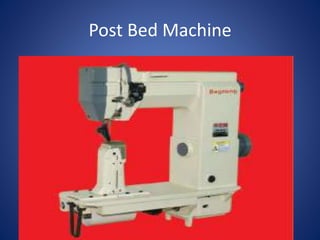
• 2. Post Bed
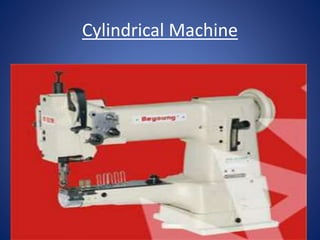
• 3. Cylindrical
Stitching Machine
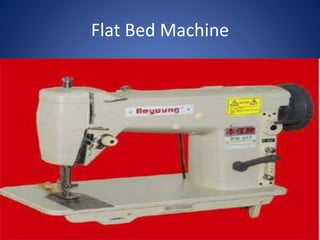
Flat Bed Machine
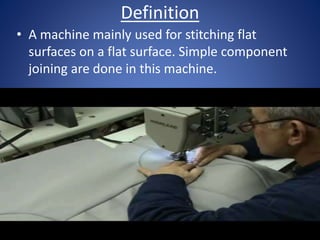
Definition
• A machine mainly used for stitching flat
surfaces on a flat surface. Simple component
joining are done in this machine.
Post Bed Machine
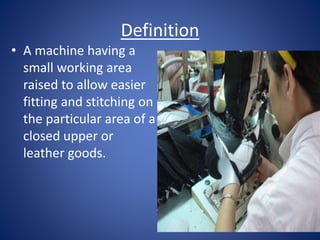
Definition
• A machine having a
small working area
raised to allow easier
fitting and stitching on
the particular area of a
closed upper or
leather goods.
Cylindrical Machine
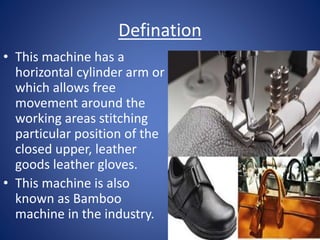
Defination
• This machine has a
horizontal cylinder arm or
which allows free
movement around the
working areas stitching
particular position of the
closed upper, leather
goods leather gloves.
• This machine is also
known as Bamboo
machine in the industry.
CYLINDERICAL MACHINE
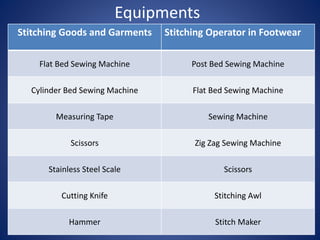
Equipments
Stitching Goods and Garments Stitching Operator in Footwear
Flat Bed Sewing Machine Post Bed Sewing Machine
Cylinder Bed Sewing Machine Flat Bed Sewing Machine
Measuring Tape Sewing Machine
Scissors Zig Zag Sewing Machine
Stainless Steel Scale Scissors
Cutting Knife Stitching Awl
Hammer Stitch Maker
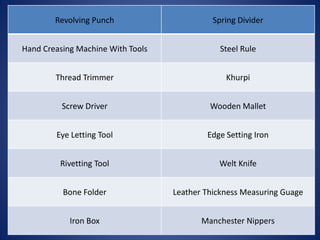
Revolving Punch Spring Divider
Hand Creasing Machine With Tools Steel Rule
Thread Trimmer Khurpi
Screw Driver Wooden Mallet
Eye Letting Tool Edge Setting Iron
Rivetting Tool Welt Knife
Bone Folder Leather Thickness Measuring Guage
Iron Box Manchester Nippers
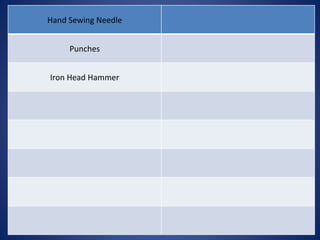
Hand Sewing Needle
Punches
Iron Head Hammer
STITCHING OPERATOR IN FOOTWEAR
• PC17. Perform back joining/quarter back joining using zigzag machine/flat bed
machine
• PC18. Perform seam rubbing by machine if back joining done by flat bed PC19.
Attach vamp with tongue using flat bed machine
• PC20. Apply adhesives on the components
• PC21. Fold the components by hand/machine
• PC22. Join upper and lining using flat/post bed machine
• PC23. Join quarter with vamp using post bed machine
• PC24. Perform edge trimming operation by machine/hand
• PC25. Perform eyeleting by machine/hand
• PC26. Perform eyelet punching, eyelet putting and eyelet setting by hand
• PC27. Do lacing on the uppers
• PC28. Visual inspection as per specifications in the job card
• PC29. Respond accordingly where stitched items do not meet production
specification
• PC30. Carry out basic maintenance of machinery and keep them clean after
use
Stitching Goods and Garments
• PC7. Select the correct component parts for the style being worked on
• PC8. Check that the materials to be used are free from faults
• PC9. Ensure the materials used meet the specification matching
• a. Within a product
• b. Between a pair of products where applicable
• PC10. Report faults in the materials
• PC11. Carry out operations at a rate which maintains work flow and meets production
targets
• PC12. Conform to company quality standards
• PC13. Report any damaged work to the responsible person
• PC14. Follow company reporting procedures about defective tools and machines which
affect work and report risks/ problems likely to affect services to the relevant person
promptly and accurately
• PC15. Seek feedback from team mates on work related performance
• PC16. Ask for help and information from your colleagues, when necessary, in a polite
manner
• PC17. Anticipate and respond to requests for assistance from colleagues willingly and
politely
• PC18. Follow and utilize opportunities for learning
•
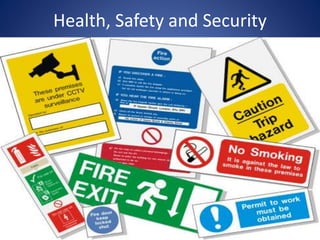
Health, Safety and Security
• 1. Hazards and Risks/ threats
• (a) Fire
• (b) Electric short circuit, electric shock and electrocution
• (c) Medical emergency
• (d) Inflammable & toxic chemicals/ gases
• (e) Accidents
• (f) Ventilation and suffocation
• (g) Improper use of safety gear and non-adherence to safety
norms
• (h) Hygiene and sanitation
• (i) Substance leaks (contamination, spillages or emissions)
• (j) Physical and Information Security related breaches
Health, Safety and Security
• 2. Organizational Procedures
• (a) Production line
• (b) Personal protective equipment (PPE)
• (c) Non-authorized / restricted areas
• (d) Protective safety requirements
• (e) Hazards and risks from machinery
• (f) Process related hazards and risks
• (g) Walkways and vehicle movement pathways
• (h) Storage and packaging areas
• 3. Training
• 4. Medical Emergencies
• 5. Evacuation process
Summary of ToT
Trade Definition
Abbreviation
Trade NOS
Different types of Stitching Machines
Equipments
Trade Related Theory part
Health, Safety and Security
Stitching process - Leather Goods & Garments

Stitching process - Leather Goods & Garments

  • 1.
    Trainee of Trainer PMKVY2.0 Name – Shahzeb Alam Master Trainer in Leather Mobile Number- +919804965956
  • 2.
    Trade • Stitching Goodsand Garments Definition: A Stitcher, also called a ‘sewer’ is an important job-role associated with Leather Goods and Garment sector. The primary responsibility of a stitcher is to sew fabric, fur, leather or synthetic materials to produce garments and other articles. • Stitching Operator in Footwear Definition: The primary responsibility of a Stitching Operator (Footwear) is to perform stitching operations to the upper components of the footwear as per the design instructions given by the designing section. He/ She should be able to stitch the footwear with leather and non-leather components, using maximum accuracy. He/she should be passionate about creating intricate products without compromising on quality.
  • 3.
    ABBREVIATION • Full Formof some important Words • Q.P = Qualification Pack • NOS = National Occupational Standard • OS = Occupational Standard • NVEQF = National Vocational Education Qualifications Framework. • NVQF = National Vocational Qualifications Framework
  • 4.
    NOS Stitching Operator inFootwear 1.Carry out stitching operation using different machines 2.Contribute to achieving product quality in stitching operation. 3.Maintain the work area, tools and machines. 4.Maintain health, safety and security at workplace 5.Comply with industry, regulatory and organizational requirements.
  • 5.
    NOS • Stitching Goodsand Garments 1.Carry out basic operations within leather goods 2. Stitch components to produce leather goods 3.Maintain the work area, tools and machines 4.Contribute to achieving product quality in stitching operation. 5.Comply with health, safety and security requirements at work. 6.Comply with industry, regulatory and organizational requirements.
  • 6.
    • Basically thereare three types of Footwear stitching Machines. • 1. Flat Bed • 2. Post Bed • 3. Cylindrical Stitching Machine
  • 7.
  • 8.
    Definition • A machinemainly used for stitching flat surfaces on a flat surface. Simple component joining are done in this machine.
  • 9.
  • 10.
    Definition • A machinehaving a small working area raised to allow easier fitting and stitching on the particular area of a closed upper or leather goods.
  • 11.
  • 12.
    Defination • This machinehas a horizontal cylinder arm or which allows free movement around the working areas stitching particular position of the closed upper, leather goods leather gloves. • This machine is also known as Bamboo machine in the industry.
  • 13.
  • 14.
    Equipments Stitching Goods andGarments Stitching Operator in Footwear Flat Bed Sewing Machine Post Bed Sewing Machine Cylinder Bed Sewing Machine Flat Bed Sewing Machine Measuring Tape Sewing Machine Scissors Zig Zag Sewing Machine Stainless Steel Scale Scissors Cutting Knife Stitching Awl Hammer Stitch Maker
  • 15.
    Revolving Punch SpringDivider Hand Creasing Machine With Tools Steel Rule Thread Trimmer Khurpi Screw Driver Wooden Mallet Eye Letting Tool Edge Setting Iron Rivetting Tool Welt Knife Bone Folder Leather Thickness Measuring Guage Iron Box Manchester Nippers
  • 16.
  • 17.
    STITCHING OPERATOR INFOOTWEAR • PC17. Perform back joining/quarter back joining using zigzag machine/flat bed machine • PC18. Perform seam rubbing by machine if back joining done by flat bed PC19. Attach vamp with tongue using flat bed machine • PC20. Apply adhesives on the components • PC21. Fold the components by hand/machine • PC22. Join upper and lining using flat/post bed machine • PC23. Join quarter with vamp using post bed machine • PC24. Perform edge trimming operation by machine/hand • PC25. Perform eyeleting by machine/hand • PC26. Perform eyelet punching, eyelet putting and eyelet setting by hand • PC27. Do lacing on the uppers • PC28. Visual inspection as per specifications in the job card • PC29. Respond accordingly where stitched items do not meet production specification • PC30. Carry out basic maintenance of machinery and keep them clean after use
  • 18.
    Stitching Goods andGarments • PC7. Select the correct component parts for the style being worked on • PC8. Check that the materials to be used are free from faults • PC9. Ensure the materials used meet the specification matching • a. Within a product • b. Between a pair of products where applicable • PC10. Report faults in the materials • PC11. Carry out operations at a rate which maintains work flow and meets production targets • PC12. Conform to company quality standards • PC13. Report any damaged work to the responsible person • PC14. Follow company reporting procedures about defective tools and machines which affect work and report risks/ problems likely to affect services to the relevant person promptly and accurately • PC15. Seek feedback from team mates on work related performance • PC16. Ask for help and information from your colleagues, when necessary, in a polite manner • PC17. Anticipate and respond to requests for assistance from colleagues willingly and politely • PC18. Follow and utilize opportunities for learning •
  • 19.
    Health, Safety andSecurity • 1. Hazards and Risks/ threats • (a) Fire • (b) Electric short circuit, electric shock and electrocution • (c) Medical emergency • (d) Inflammable & toxic chemicals/ gases • (e) Accidents • (f) Ventilation and suffocation • (g) Improper use of safety gear and non-adherence to safety norms • (h) Hygiene and sanitation • (i) Substance leaks (contamination, spillages or emissions) • (j) Physical and Information Security related breaches
  • 20.
  • 21.
    • 2. OrganizationalProcedures • (a) Production line • (b) Personal protective equipment (PPE) • (c) Non-authorized / restricted areas • (d) Protective safety requirements • (e) Hazards and risks from machinery • (f) Process related hazards and risks • (g) Walkways and vehicle movement pathways • (h) Storage and packaging areas • 3. Training • 4. Medical Emergencies • 5. Evacuation process
  • 22.
    Summary of ToT TradeDefinition Abbreviation Trade NOS Different types of Stitching Machines Equipments Trade Related Theory part Health, Safety and Security