Footer
FZHW52 PHFO
SRFHFO
SURF ZONE FORECAST
NATIONAL WEATHER SERVICE HONOLULU HI
400 AM HST SUN MAY 3 2015
OAHU-
400 AM HST SUN MAY 3 2015
Surf along east facing shores will be 3 to 5 feet today, lowering to 2 to 4 feet Monday.
Surf along north facing shores will be 1 to 3 feet through Monday.
Surf along west facing shores will be 1 to 3 feet through Monday.
Surf along south facing shores will be 1 to 3 feet through Monday.
Outlook through Saturday May 9: the rough east-shore surf will continue into next week as the trade
winds remain fresh to locally strong. A moderate long-period southerly swell will begin to fill in
through the day Tuesday, peak sometime Wednesday near advisory levels, then gradually subside
through the remainder of the week. A short period north swell may bring the surf up along north
facing shores Tuesday and Wednesday. A moderate northwest swell is expected to arrive late
Wednesday night into Thursday and continue into the weekend.
Surf heights are forecast heights of the face or front of waves. The surf forecast is based on the
significant wave height, the average height of the one third largest waves, in the zone of maximum
refraction. Some waves may be more than twice as high as the significant wave height. Expect to
encounter rip currents in or near any surf zone.
FXHW52 PHFO
SRDHFO
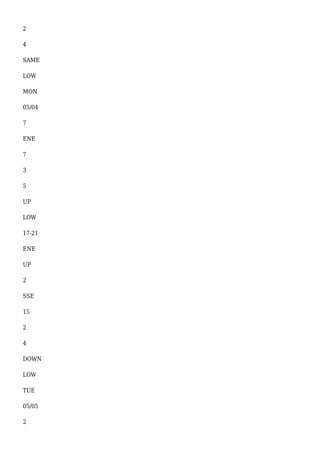
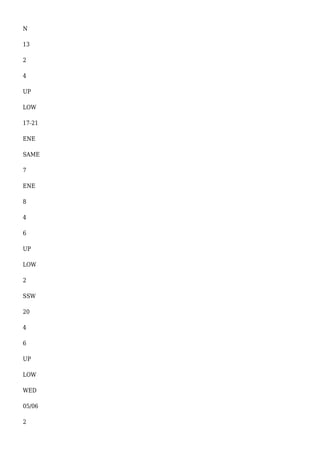
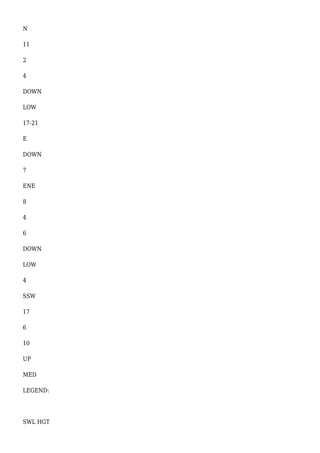
COLLABORATIVE NEARSHORE SWELL AND WIND FORECAST FOR OAHU
NWS/NCDDC HONOLULU HI
300 PM HST FRI MAY 1 2015
This collaborative forecast will be updated Monday through Friday at 300 pm when Pat Caldwell is
available.
FORECAST
DATE
SWL
HGT
DMNT
DIR
DMNT
PD
H
1/3
H
1/10
HGT
TEND
PROB
WIND
SPD
WIND
DIR
SPD
TEND
1PM
05/01
8
ENE
9
6
8
DOWN
13-19
ENE
DOWN
2
S
13
2
4
SAME
SAT
05/02
7
ENE
9
5
7
DOWN
MED
13-19
ENE
SAME
1
SSE
20
2
4
UP
LOW
SUN
05/03
6
ENE
9
4
6
DOWN
MED
13-19
ENE
SAME
1
SSE
18
2
4
SAME
LOW
MON
05/04
7
ENE
7
3
5
UP
LOW
17-21
ENE
UP
2
SSE
15
2
4
DOWN
LOW
TUE
05/05
2
N
13
2
4
UP
LOW
17-21
ENE
SAME
7
ENE
8
4
6
UP
LOW
2
SSW
20
4
6
UP
LOW
WED
05/06
2
N
11
2
4
DOWN
LOW
17-21
E
DOWN
7
ENE
8
4
6
DOWN
LOW
4
SSW
17
6
10
UP
MED
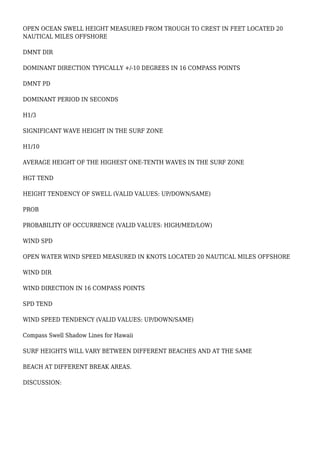
LEGEND:
SWL HGT
OPEN OCEAN SWELL HEIGHT MEASURED FROM TROUGH TO CREST IN FEET LOCATED 20
NAUTICAL MILES OFFSHORE
DMNT DIR
DOMINANT DIRECTION TYPICALLY +/-10 DEGREES IN 16 COMPASS POINTS
DMNT PD
DOMINANT PERIOD IN SECONDS
H1/3
SIGNIFICANT WAVE HEIGHT IN THE SURF ZONE
H1/10
AVERAGE HEIGHT OF THE HIGHEST ONE-TENTH WAVES IN THE SURF ZONE
HGT TEND
HEIGHT TENDENCY OF SWELL (VALID VALUES: UP/DOWN/SAME)
PROB
PROBABILITY OF OCCURRENCE (VALID VALUES: HIGH/MED/LOW)
WIND SPD
OPEN WATER WIND SPEED MEASURED IN KNOTS LOCATED 20 NAUTICAL MILES OFFSHORE
WIND DIR
WIND DIRECTION IN 16 COMPASS POINTS
SPD TEND
WIND SPEED TENDENCY (VALID VALUES: UP/DOWN/SAME)
Compass Swell Shadow Lines for Hawaii
SURF HEIGHTS WILL VARY BETWEEN DIFFERENT BEACHES AND AT THE SAME
BEACH AT DIFFERENT BREAK AREAS.
DISCUSSION:
Summary: spring pattern with mix of swell from north, east, and south.
Detailed: mid Friday on northern shores has small breakers for locations exposed to refracting
easterly windswell. More of the same is likely for Saturday.
A zonal jet stream at a northerly track near the Aleutians has kept surf sources to a minimum from
NW to N locally since 4/30, and should remain near nil 5/1-4. The jet track is shifting southward 5/1,
increasing odds for may-caliber surf next week.
A low pressure cell is deepening north of Hawaii near 50°N on 5/1. It is modelled to aim gales SE of
Hawaii as it moves east of the Hawaii swell window into the gulf of Alaska 5/2. A small episode is
expected on Tuesday from 350-010 degrees near the may average, which is 6 feet peak face for set
waves, or the h1/10, at top spots. This typical may event should be short-lived.
Mid Friday on eastern shores has surf out of 60-90 degrees above the trade windswell average. A
slow downward trend is expected Saturday.
Strong surface high pressure NNE of Hawaii 4/28-4/30 set up a long, wide fetch of fresh to strong
breezes over Oahu and out to the E to NE over 1000 nm. The late Thursday ascat satellite late
Thursday still showed large pockets of strong breezes aimed at Oahu within 800 nm. This should
keep the dominant wave period of the windswell on the long end of the spectrum through the
weekend, which in turn should keep breakers above average.
The surface high NNE of Hawaii 5/1 is weakening as upper level ridge north of the islands breaks
down and gives way to weak upper level troughs, associated with the southerly shift of the primary
jet over the central north Pacific. The morning ascat readings 5/1 show mostly fresh breezes ENE of
Hawaii out 800 nm. This quasi-minimum to the upstream source should coincide with surf dropping
to near the trade windswell average by late Sunday, holding about the same Monday, as the 8-10
second wave period band loses energy.
Models show the surface high nosing back towards the islands and increasing in strength on
Monday, then holding into Wednesday. It is not expected to be nearly as strong as the local event of
4/28-30, which kicked dominant wave periods up within 8-11 seconds, though at least back to fresh
speeds. This should trend the surf up Monday into Tuesday from 60-90 degrees, holding into mid
week with dominant periods of 7-8 seconds.
Mid Friday on southern shores has greatest size for locations receiving easterly windswell. There is
a mix of southern hemisphere low swell energy from within 150-220 degrees and 10-17 second
periods. The windswell should hold on Saturday, with SE exposures topping the heights as a long-
period SSE event fills in.
A huge, severe gale to hurricane-force low pressure cell tracked SW to S of Easter Island 4/24-27,
aiming highest seas at the Americas. Angular spreading could bring in low swell locally starting
Saturday 5/2 from 160-180 degrees. It should be long-lived.
Greater odds for surf from the common southerly swell region SE to E of New Zealand starting
locally Tuesday 5/5. A pattern similar to 4/13-17, which gave the above average SSW surf locally
4/21-23, occurred starting 4/29 just SE of New Zealand. The low center deepened to 964 mb on 4/29
as a cold front backed by gales to storm-force winds pushed NE to near 40s, or about 3800 nm away.
Seas grew over 30 feet into 4/30. The pattern is shifting east 5/1.
The new episode is expected to reach the pacioos/cdip american samoa buoy on Saturday. The long-
period forerunners are due locally on Tuesday 5/5. The onset day for remote events are usually
extra-inconsistent on the sets. The event should slowly build Tuesday, reaching above average by
Wednesday from 185-200 degrees.
Into the long range, the jet stream pattern 4/30-5/1 shows a meridional pattern E of New Zealand,
with a large, wide equatorward loop. A pair of short-waves is modelled to fill into the long wave
pattern from the SW. Each has an enhanced surface low pressure area, and in turn, new regions of
gales to storm-force winds. The first in the follow-up series is SE of New Zealand on 5/1. The second
is due 5/3. Both are aiming seas parallel to the Hawaii swell window, primarily to the east of Hawaii.
This makes for larger error bars for the local maximums. The net result should be overlapping
events keeping surf average to above average 5/5-12 from within 180-200 degrees, with local
maximums roughly 5/6, 5/8, and 5/10.
In the northern hemisphere, a cut-off jet level low is modelled near the dateline near 45°N 5/3-5,
with a marginal gale surface low. It is predicted to remain stationary 5/4 then slowly move east just
south of the Aleutians 5/6-7. It should bring surf above the may average starting locally Thursday
5/7, lasting into the weekend of 5/9 from 330-360 degrees.
Trades should remain near the fresh mark 5/7-9 with surf at average to above average levels from
60-90 degrees. A short-lived minimum to the trades within moderate to fresh speeds is predicted for
late Wednesday to early Thursday 5/6-7, associated with the eastward track of the Aleutian low over
the longitude of Hawaii north of 40°N.
Long range forecasts are subject to low confidence.
This collaborative forecast will resume on Monday, May 4.
This forecast was produced through the collaborative efforts of NWS and NCDDC. Please send
suggestions to w-hfo.webmaster@noaa.gov or call the Warning Coordination Meteorologist at 808-
973-5275.
Additional resources: see /in lowercase/ http://www.prh.noaa.gov/hnl/pages/marine.php.
NWS Forecaster and Pat Caldwell, Pacific/Hawaii Liaison Office, NCDDC
Additional Resources:
Latest North Pacific Surface Analysis
Upcoming tides for select Hawaii locations
Tides for Honolulu
Tide tables for Hawaii
http://www.prh.noaa.gov/hnl/pages/SRF.php#Footer

Footer

  • 1.
    Footer FZHW52 PHFO SRFHFO SURF ZONEFORECAST NATIONAL WEATHER SERVICE HONOLULU HI 400 AM HST SUN MAY 3 2015 OAHU- 400 AM HST SUN MAY 3 2015 Surf along east facing shores will be 3 to 5 feet today, lowering to 2 to 4 feet Monday. Surf along north facing shores will be 1 to 3 feet through Monday. Surf along west facing shores will be 1 to 3 feet through Monday. Surf along south facing shores will be 1 to 3 feet through Monday. Outlook through Saturday May 9: the rough east-shore surf will continue into next week as the trade winds remain fresh to locally strong. A moderate long-period southerly swell will begin to fill in through the day Tuesday, peak sometime Wednesday near advisory levels, then gradually subside through the remainder of the week. A short period north swell may bring the surf up along north facing shores Tuesday and Wednesday. A moderate northwest swell is expected to arrive late Wednesday night into Thursday and continue into the weekend. Surf heights are forecast heights of the face or front of waves. The surf forecast is based on the significant wave height, the average height of the one third largest waves, in the zone of maximum refraction. Some waves may be more than twice as high as the significant wave height. Expect to encounter rip currents in or near any surf zone. FXHW52 PHFO SRDHFO COLLABORATIVE NEARSHORE SWELL AND WIND FORECAST FOR OAHU NWS/NCDDC HONOLULU HI 300 PM HST FRI MAY 1 2015 This collaborative forecast will be updated Monday through Friday at 300 pm when Pat Caldwell is
  • 2.
  • 3.
  • 4.
  • 5.
  • 6.
  • 7.
  • 8.
    OPEN OCEAN SWELLHEIGHT MEASURED FROM TROUGH TO CREST IN FEET LOCATED 20 NAUTICAL MILES OFFSHORE DMNT DIR DOMINANT DIRECTION TYPICALLY +/-10 DEGREES IN 16 COMPASS POINTS DMNT PD DOMINANT PERIOD IN SECONDS H1/3 SIGNIFICANT WAVE HEIGHT IN THE SURF ZONE H1/10 AVERAGE HEIGHT OF THE HIGHEST ONE-TENTH WAVES IN THE SURF ZONE HGT TEND HEIGHT TENDENCY OF SWELL (VALID VALUES: UP/DOWN/SAME) PROB PROBABILITY OF OCCURRENCE (VALID VALUES: HIGH/MED/LOW) WIND SPD OPEN WATER WIND SPEED MEASURED IN KNOTS LOCATED 20 NAUTICAL MILES OFFSHORE WIND DIR WIND DIRECTION IN 16 COMPASS POINTS SPD TEND WIND SPEED TENDENCY (VALID VALUES: UP/DOWN/SAME) Compass Swell Shadow Lines for Hawaii SURF HEIGHTS WILL VARY BETWEEN DIFFERENT BEACHES AND AT THE SAME BEACH AT DIFFERENT BREAK AREAS. DISCUSSION:
  • 9.
    Summary: spring patternwith mix of swell from north, east, and south. Detailed: mid Friday on northern shores has small breakers for locations exposed to refracting easterly windswell. More of the same is likely for Saturday. A zonal jet stream at a northerly track near the Aleutians has kept surf sources to a minimum from NW to N locally since 4/30, and should remain near nil 5/1-4. The jet track is shifting southward 5/1, increasing odds for may-caliber surf next week. A low pressure cell is deepening north of Hawaii near 50°N on 5/1. It is modelled to aim gales SE of Hawaii as it moves east of the Hawaii swell window into the gulf of Alaska 5/2. A small episode is expected on Tuesday from 350-010 degrees near the may average, which is 6 feet peak face for set waves, or the h1/10, at top spots. This typical may event should be short-lived. Mid Friday on eastern shores has surf out of 60-90 degrees above the trade windswell average. A slow downward trend is expected Saturday. Strong surface high pressure NNE of Hawaii 4/28-4/30 set up a long, wide fetch of fresh to strong breezes over Oahu and out to the E to NE over 1000 nm. The late Thursday ascat satellite late Thursday still showed large pockets of strong breezes aimed at Oahu within 800 nm. This should keep the dominant wave period of the windswell on the long end of the spectrum through the weekend, which in turn should keep breakers above average. The surface high NNE of Hawaii 5/1 is weakening as upper level ridge north of the islands breaks down and gives way to weak upper level troughs, associated with the southerly shift of the primary jet over the central north Pacific. The morning ascat readings 5/1 show mostly fresh breezes ENE of Hawaii out 800 nm. This quasi-minimum to the upstream source should coincide with surf dropping to near the trade windswell average by late Sunday, holding about the same Monday, as the 8-10 second wave period band loses energy.
  • 10.
    Models show thesurface high nosing back towards the islands and increasing in strength on Monday, then holding into Wednesday. It is not expected to be nearly as strong as the local event of 4/28-30, which kicked dominant wave periods up within 8-11 seconds, though at least back to fresh speeds. This should trend the surf up Monday into Tuesday from 60-90 degrees, holding into mid week with dominant periods of 7-8 seconds. Mid Friday on southern shores has greatest size for locations receiving easterly windswell. There is a mix of southern hemisphere low swell energy from within 150-220 degrees and 10-17 second periods. The windswell should hold on Saturday, with SE exposures topping the heights as a long- period SSE event fills in. A huge, severe gale to hurricane-force low pressure cell tracked SW to S of Easter Island 4/24-27, aiming highest seas at the Americas. Angular spreading could bring in low swell locally starting Saturday 5/2 from 160-180 degrees. It should be long-lived. Greater odds for surf from the common southerly swell region SE to E of New Zealand starting locally Tuesday 5/5. A pattern similar to 4/13-17, which gave the above average SSW surf locally 4/21-23, occurred starting 4/29 just SE of New Zealand. The low center deepened to 964 mb on 4/29 as a cold front backed by gales to storm-force winds pushed NE to near 40s, or about 3800 nm away. Seas grew over 30 feet into 4/30. The pattern is shifting east 5/1. The new episode is expected to reach the pacioos/cdip american samoa buoy on Saturday. The long- period forerunners are due locally on Tuesday 5/5. The onset day for remote events are usually extra-inconsistent on the sets. The event should slowly build Tuesday, reaching above average by Wednesday from 185-200 degrees.
  • 11.
    Into the longrange, the jet stream pattern 4/30-5/1 shows a meridional pattern E of New Zealand, with a large, wide equatorward loop. A pair of short-waves is modelled to fill into the long wave pattern from the SW. Each has an enhanced surface low pressure area, and in turn, new regions of gales to storm-force winds. The first in the follow-up series is SE of New Zealand on 5/1. The second is due 5/3. Both are aiming seas parallel to the Hawaii swell window, primarily to the east of Hawaii. This makes for larger error bars for the local maximums. The net result should be overlapping events keeping surf average to above average 5/5-12 from within 180-200 degrees, with local maximums roughly 5/6, 5/8, and 5/10. In the northern hemisphere, a cut-off jet level low is modelled near the dateline near 45°N 5/3-5, with a marginal gale surface low. It is predicted to remain stationary 5/4 then slowly move east just south of the Aleutians 5/6-7. It should bring surf above the may average starting locally Thursday 5/7, lasting into the weekend of 5/9 from 330-360 degrees. Trades should remain near the fresh mark 5/7-9 with surf at average to above average levels from 60-90 degrees. A short-lived minimum to the trades within moderate to fresh speeds is predicted for late Wednesday to early Thursday 5/6-7, associated with the eastward track of the Aleutian low over the longitude of Hawaii north of 40°N. Long range forecasts are subject to low confidence. This collaborative forecast will resume on Monday, May 4. This forecast was produced through the collaborative efforts of NWS and NCDDC. Please send suggestions to w-hfo.webmaster@noaa.gov or call the Warning Coordination Meteorologist at 808- 973-5275. Additional resources: see /in lowercase/ http://www.prh.noaa.gov/hnl/pages/marine.php. NWS Forecaster and Pat Caldwell, Pacific/Hawaii Liaison Office, NCDDC Additional Resources: Latest North Pacific Surface Analysis Upcoming tides for select Hawaii locations Tides for Honolulu Tide tables for Hawaii http://www.prh.noaa.gov/hnl/pages/SRF.php#Footer