Food Value Chain Transformations in 
Developing Countries: 
Nutritional Implications 
Miguel I. Gómez and Katie Ricketts 
Dyson School of Applied Economics and Management 
Cornell University 
PREPARATORY TECHNICAL MEETING 
FAO Headquarters, Rome, Italy 
13-15 November 2013
Food Value Chain Transformations in 
Developing Countries: Nutritional 
Implications 
Miguel I. Gómez and Katie Ricketts 
Dyson School of Applied Economics and Management 
Cornell University 
Joint FAO/WHO Second International Conference on Nutrition (ICN2) 
PREPARATORY TECHNICAL MEETING 
FAO Headquarters, Rome, Italy 
13-15 November 2013
Objective and Approach 
• How transformation of food value chains (FVCs) influences 
the triple malnutrition burden in developing countries 
• Identify areas that require more attention from researchers 
and decision-makers 
• Develop a FVC typology that takes into account the 
participants, the target market, and the products offered 
• Propose selected hypotheses on the relationship between 
each FVC category and elements of the triple malnutrition 
burden
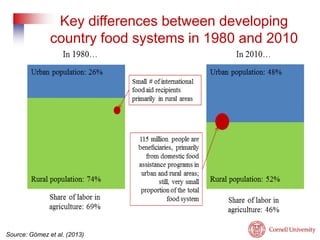
Key differences between developing 
country food systems in 1980 and 2010 
Source: Gómez et al. (2013)
Developing Country FVC Transformation 
 Share of food reaching consumers through longer FVCs has 
increased due to changes in food consumption patterns 
− rapid urbanization 
− income growth 
− expansion of modern retailers, processors and distributors. 
 Demand for products such as meats, dairy, fruits and 
vegetables is increasing 
 Market for processed/packaged food categories is expanding 
 Many rural residents depend on FVCs because most of them 
are net-food buyers and are employed in the food sector
Food Value Chain Typologies 
Type Description 
Traditional Traditional traders buy primarily from smallholder farmers, and sell 
to consumers and traditional retailers in wet, mostly local, markets. 
Modern Domestic and multinational food manufacturers procure primarily 
from commercial farms and sell through modern supermarket 
outlets. 
Modern-to-traditional 
Domestic and multinational food manufacturers sell through the 
network of traditional traders and retailers (e.g., ‘mom and pop’ 
stores). 
Traditional-to-modern 
Supermarkets and food manufacturers source food from 
smallholder farmers and traders.
Traditional FVCs
Fresh fruit and vegetable market share of 
modern and traditional FVC retail sales 
90 
60 
30 
0 
Modern FVC Retail Traditional FVC Retail 
Kenya 
(2009) 
Nicaragua 
(2007) 
Zambia 
(2009) 
Thailand 
(2006) 
Mexico 
(2007) 
Market share (%) 
Country 
Note: Countries arranged in order of GDP per capita (World Bank, 2008) 
Sources: Tschirley et al. (2009), Zambia and Kenya; Reardon et al. (2010), Mexico and Nicaragua; 
Gorton et al. (2011), Thailand.
Retail outlet choice for meat purchases in 
Ethiopia 
Percent of households within the income 
group 
Retail Outlet 
Total 
sample 
Low 
income 
Medium 
income 
High 
income 
Producers residence or local 
market 1 0 1 1 
c 
Butcher in a local wet market 90 60 94 74 
Supermarket 14 0 11 54 
Special butcher shop 60 73 57 18 
Source: Authors’ creation based on Jabbar and Admassu (2010). 
c
Factors facilitating food access in traditional 
FVCs (particularly for perishables) 
• Ability to offer products at lower prices than supermarket 
(Schipmann and Qaim 2010; Lippe et al. 2010) 
• Considerable flexibility in product standards (Lee et al. 
2010) 
• Product attributes valued by consumers are different relative 
to supermarkets (Minten 2008) 
• Convenience for consumers due to flexible retail market 
locations (Tschirley et al. 2009)
Factors affecting food access in traditional 
FVCs (particularly for perishables) 
• Lack of postharvest and distribution infrastructure imply higher 
price variability and limited year round availability (Gómez et 
al. 2011) 
• Post-harvest losses (in volume and in quality) are huge (Kader 
2005) 
• Seasonality in crop/livestock production affects 
disproportionally food retail prices in traditional FVCs (Kumar 
and Sharma, 2006)
Synthesis - Traditional FVCs and Nutrition 
• Food products rich in micronutrients, and staple foods rich in 
calories tend to be more affordable in traditional FVCs 
• Deliver nutritional benefits to rural residents who are largely 
missed by modern FVCs 
• Important nutritional benefits accrue to low income people in 
urban areas - FVC retailers enjoy cost and location advantages 
• More flexibility to target consumers willing to settle for lower 
perishable food standards. 
• Lack of access to adequate post-harvest/distribution 
infrastructure may limit year round availability and result in high 
intermediation costs
Modern FVCs
Supermarket Growth and Food Products 
• Rapid expansion of modern supermarkets (Neven and Reardon 
2009; Reardon and Berdegué 2002; Reardon et al. 2003) 
• Benefits from increased micronutrient intakes associated with the 
dietary diversity are unlikely to reach all consumers 
• Low income households buy processed foods in supermarkets, but 
not perishables (Cadilhon et al. 2006; Guarin 2011) 
• High standards make micronutrient-rich foods available in 
supermarkets less affordable the poor (Dolan and Humphrey 2000) 
• Lower income households engage in ‘cherry-picking’ food shopping 
behavior (Tschirley and Hichaambwa 2010; Cadilhon et al. 2006)
Supermarket share in processed/packaged 
100 
80 
60 
40 
20 
0 
foods and in perishable foods 
Produce and meat Pacakaged food 
Thailand Mexico China 
Market Share (%) 
Country 
Source: Euromonitor (2012a), Gorton et al. (2012), Goldman and Vanhonaker (2006).
Synthesis - Modern FVCs and Nutrition 
• Help alleviate micronutrient deficiencies by offering a wide 
assortment of products year-round for a diverse diet, but only 
for urban, relatively wealthy households 
• Increased market for processed/packaged foods… 
− Contribute to obesity/overweight malnutrition (among other 
factors) 
− low priced packaged/processed foods substitute for fresh 
produce and livestock products 
• Empirical evidence to examine causality between 
supermarkets and overweight malnutrition is needed
Modern-to-Traditional FVCs
Drivers and Links to Diets 
• Market for processed/packaged foods growing five times faster 
in developing countries 
• Much of this growth fueled sales to lower income consumers 
through traditional FVC retailers in urban and rural areas 
• Business models targeting the poor (bottom of the pyramid) 
and presence of economies of scale in food manufacturing 
• Processed/packaged foods sold through these FVCs may help 
alleviate (prevent) undernourishment in remote rural areas 
• Expansion through traditional retailers in urban centers may be 
associated with excess weight and obesity, (Wang et al. 2002; 
Mendez et al. 2005).
Public-private Partnerships with Nutritional Goals 
Partnership 
Goal 
Value Chain Focus 
Nutrition Impacts 
Examples 
Development of 
new products 
and processes 
Design modify existing food 
products to address specific 
micronutrient deficiencies 
 Vitamin-fortified yogurt from 
Grameen Danone Foods for the 
Asian market. 
Expansion of 
distribution 
networks 
Make existing micronutrient-fortified 
products available 
in remote areas 
 Scale UP Nutrition Network 
partners with food 
manufacturers with strong 
distribution networks 
Strengthen 
consumer 
demand 
Expand local and regional 
preferences for purchasing 
packaged foods rich in 
micronutrients 
• Future Fortified campaign by the 
Global Alliance for Improved 
Nutrition (GAIN) to encourage 
expectant mothers to consume 
nutrient packets
Synthesis: Modern-to-traditional FVCs 
and Nutrition 
• May have mixed influence on nutrition, depending on the 
population segment targeted 
− can assist help prevent or reduce undernourishment in some 
rural, remote areas… 
− but, they can also contribute over-nutrition in urban areas for 
patrons of traditional FVC retail outlets 
• Enthusiasm for public-private partnerships to address 
micronutrient deficiencies 
• Must evaluate the impact of partnerships to guide donor, 
government and food industry actions
Traditional-to-modern FVCs
Relevance to Nutrition 
• Developing country FVCs are primarily domestically oriented 
(Gómez et al. 2011) 
• Implications for smallholder farmers and traders in rural areas 
because most of them are net food buyers (Barrett 2008) 
• Farmers who participate in supermarket chains enjoy higher 
income opportunities (Bellemare 2012; Miyata et al. 2009)… 
• …but they are generally farmers with superior endowments 
(land, education, etc.)
Drivers and Links to Nutrition 
• The poorest farmers and traders may benefit indirectly by 
linking with modern FVCs (Maertens and Swinnen 2009) 
• Increased income opportunities reduce the risk of household 
food insufficient caloric intakes in rural areas (e.g., Ndhleve et 
al. 2012; Smith et al. 2005) 
• Little is known on income opportunities impacts on diet 
diversification and influence on micronutrient deficiencies
Concluding Comments 
• Difficult to generalize the influence of food value chain 
transformation on nutrition 
• Interventions to increase the efficiency of traditional FVCs can 
improve access to micronutrients (urban and rural poor) 
• Interactions between traditional and modern participants suggest 
the need for a more nuanced view of food chains 
• Opportunities for public-private to partnerships to use food 
fortification to reduce micronutrient deficiencies 
• Future research should address… 
1) links between FVC transformation and micronutrient deficiencies 
2) demand substitution effects between food groups
Thank You! 
Questions or Comments? 
Miguel I. Gómez 
Dyson School of Applied Economics and Management 
Cornell University 
340D Warren Hall 
Ithaca, NY 14853 
P: 607-255-8159 
E: mig7@cornell.edu

ICN2-Food Value Chain Transformations in Developing Countries: Nutritional Implications

  • 1.
    Food Value ChainTransformations in Developing Countries: Nutritional Implications Miguel I. Gómez and Katie Ricketts Dyson School of Applied Economics and Management Cornell University PREPARATORY TECHNICAL MEETING FAO Headquarters, Rome, Italy 13-15 November 2013
  • 2.
    Food Value ChainTransformations in Developing Countries: Nutritional Implications Miguel I. Gómez and Katie Ricketts Dyson School of Applied Economics and Management Cornell University Joint FAO/WHO Second International Conference on Nutrition (ICN2) PREPARATORY TECHNICAL MEETING FAO Headquarters, Rome, Italy 13-15 November 2013
  • 3.
    Objective and Approach • How transformation of food value chains (FVCs) influences the triple malnutrition burden in developing countries • Identify areas that require more attention from researchers and decision-makers • Develop a FVC typology that takes into account the participants, the target market, and the products offered • Propose selected hypotheses on the relationship between each FVC category and elements of the triple malnutrition burden
  • 4.
    Key differences betweendeveloping country food systems in 1980 and 2010 Source: Gómez et al. (2013)
  • 5.
    Developing Country FVCTransformation  Share of food reaching consumers through longer FVCs has increased due to changes in food consumption patterns − rapid urbanization − income growth − expansion of modern retailers, processors and distributors.  Demand for products such as meats, dairy, fruits and vegetables is increasing  Market for processed/packaged food categories is expanding  Many rural residents depend on FVCs because most of them are net-food buyers and are employed in the food sector
  • 6.
    Food Value ChainTypologies Type Description Traditional Traditional traders buy primarily from smallholder farmers, and sell to consumers and traditional retailers in wet, mostly local, markets. Modern Domestic and multinational food manufacturers procure primarily from commercial farms and sell through modern supermarket outlets. Modern-to-traditional Domestic and multinational food manufacturers sell through the network of traditional traders and retailers (e.g., ‘mom and pop’ stores). Traditional-to-modern Supermarkets and food manufacturers source food from smallholder farmers and traders.
  • 7.
  • 8.
    Fresh fruit andvegetable market share of modern and traditional FVC retail sales 90 60 30 0 Modern FVC Retail Traditional FVC Retail Kenya (2009) Nicaragua (2007) Zambia (2009) Thailand (2006) Mexico (2007) Market share (%) Country Note: Countries arranged in order of GDP per capita (World Bank, 2008) Sources: Tschirley et al. (2009), Zambia and Kenya; Reardon et al. (2010), Mexico and Nicaragua; Gorton et al. (2011), Thailand.
  • 9.
    Retail outlet choicefor meat purchases in Ethiopia Percent of households within the income group Retail Outlet Total sample Low income Medium income High income Producers residence or local market 1 0 1 1 c Butcher in a local wet market 90 60 94 74 Supermarket 14 0 11 54 Special butcher shop 60 73 57 18 Source: Authors’ creation based on Jabbar and Admassu (2010). c
  • 10.
    Factors facilitating foodaccess in traditional FVCs (particularly for perishables) • Ability to offer products at lower prices than supermarket (Schipmann and Qaim 2010; Lippe et al. 2010) • Considerable flexibility in product standards (Lee et al. 2010) • Product attributes valued by consumers are different relative to supermarkets (Minten 2008) • Convenience for consumers due to flexible retail market locations (Tschirley et al. 2009)
  • 11.
    Factors affecting foodaccess in traditional FVCs (particularly for perishables) • Lack of postharvest and distribution infrastructure imply higher price variability and limited year round availability (Gómez et al. 2011) • Post-harvest losses (in volume and in quality) are huge (Kader 2005) • Seasonality in crop/livestock production affects disproportionally food retail prices in traditional FVCs (Kumar and Sharma, 2006)
  • 12.
    Synthesis - TraditionalFVCs and Nutrition • Food products rich in micronutrients, and staple foods rich in calories tend to be more affordable in traditional FVCs • Deliver nutritional benefits to rural residents who are largely missed by modern FVCs • Important nutritional benefits accrue to low income people in urban areas - FVC retailers enjoy cost and location advantages • More flexibility to target consumers willing to settle for lower perishable food standards. • Lack of access to adequate post-harvest/distribution infrastructure may limit year round availability and result in high intermediation costs
  • 13.
  • 14.
    Supermarket Growth andFood Products • Rapid expansion of modern supermarkets (Neven and Reardon 2009; Reardon and Berdegué 2002; Reardon et al. 2003) • Benefits from increased micronutrient intakes associated with the dietary diversity are unlikely to reach all consumers • Low income households buy processed foods in supermarkets, but not perishables (Cadilhon et al. 2006; Guarin 2011) • High standards make micronutrient-rich foods available in supermarkets less affordable the poor (Dolan and Humphrey 2000) • Lower income households engage in ‘cherry-picking’ food shopping behavior (Tschirley and Hichaambwa 2010; Cadilhon et al. 2006)
  • 15.
    Supermarket share inprocessed/packaged 100 80 60 40 20 0 foods and in perishable foods Produce and meat Pacakaged food Thailand Mexico China Market Share (%) Country Source: Euromonitor (2012a), Gorton et al. (2012), Goldman and Vanhonaker (2006).
  • 16.
    Synthesis - ModernFVCs and Nutrition • Help alleviate micronutrient deficiencies by offering a wide assortment of products year-round for a diverse diet, but only for urban, relatively wealthy households • Increased market for processed/packaged foods… − Contribute to obesity/overweight malnutrition (among other factors) − low priced packaged/processed foods substitute for fresh produce and livestock products • Empirical evidence to examine causality between supermarkets and overweight malnutrition is needed
  • 17.
  • 18.
    Drivers and Linksto Diets • Market for processed/packaged foods growing five times faster in developing countries • Much of this growth fueled sales to lower income consumers through traditional FVC retailers in urban and rural areas • Business models targeting the poor (bottom of the pyramid) and presence of economies of scale in food manufacturing • Processed/packaged foods sold through these FVCs may help alleviate (prevent) undernourishment in remote rural areas • Expansion through traditional retailers in urban centers may be associated with excess weight and obesity, (Wang et al. 2002; Mendez et al. 2005).
  • 19.
    Public-private Partnerships withNutritional Goals Partnership Goal Value Chain Focus Nutrition Impacts Examples Development of new products and processes Design modify existing food products to address specific micronutrient deficiencies  Vitamin-fortified yogurt from Grameen Danone Foods for the Asian market. Expansion of distribution networks Make existing micronutrient-fortified products available in remote areas  Scale UP Nutrition Network partners with food manufacturers with strong distribution networks Strengthen consumer demand Expand local and regional preferences for purchasing packaged foods rich in micronutrients • Future Fortified campaign by the Global Alliance for Improved Nutrition (GAIN) to encourage expectant mothers to consume nutrient packets
  • 20.
    Synthesis: Modern-to-traditional FVCs and Nutrition • May have mixed influence on nutrition, depending on the population segment targeted − can assist help prevent or reduce undernourishment in some rural, remote areas… − but, they can also contribute over-nutrition in urban areas for patrons of traditional FVC retail outlets • Enthusiasm for public-private partnerships to address micronutrient deficiencies • Must evaluate the impact of partnerships to guide donor, government and food industry actions
  • 21.
  • 22.
    Relevance to Nutrition • Developing country FVCs are primarily domestically oriented (Gómez et al. 2011) • Implications for smallholder farmers and traders in rural areas because most of them are net food buyers (Barrett 2008) • Farmers who participate in supermarket chains enjoy higher income opportunities (Bellemare 2012; Miyata et al. 2009)… • …but they are generally farmers with superior endowments (land, education, etc.)
  • 23.
    Drivers and Linksto Nutrition • The poorest farmers and traders may benefit indirectly by linking with modern FVCs (Maertens and Swinnen 2009) • Increased income opportunities reduce the risk of household food insufficient caloric intakes in rural areas (e.g., Ndhleve et al. 2012; Smith et al. 2005) • Little is known on income opportunities impacts on diet diversification and influence on micronutrient deficiencies
  • 24.
    Concluding Comments •Difficult to generalize the influence of food value chain transformation on nutrition • Interventions to increase the efficiency of traditional FVCs can improve access to micronutrients (urban and rural poor) • Interactions between traditional and modern participants suggest the need for a more nuanced view of food chains • Opportunities for public-private to partnerships to use food fortification to reduce micronutrient deficiencies • Future research should address… 1) links between FVC transformation and micronutrient deficiencies 2) demand substitution effects between food groups
  • 25.
    Thank You! Questionsor Comments? Miguel I. Gómez Dyson School of Applied Economics and Management Cornell University 340D Warren Hall Ithaca, NY 14853 P: 607-255-8159 E: mig7@cornell.edu

Editor's Notes

  • #2 Food value chains (FVCs) comprise all activities necessary to bring farm products to consumers, including agricultural production, processing, storage, marketing, distribution, and consumption
  • #3 Food value chains (FVCs) comprise all activities necessary to bring farm products to consumers, including agricultural production, processing, storage, marketing, distribution, and consumption
  • #5 Driving forces: population and income growth, urbanization, and the expansion, globally and domestically, of modern food retailing, distribution, and wholesaling firms
  • #9 Despite the expansion of modern supermarkets, there is strong evidence that food categories that are important sources of micronutrients continue to be accessed primarily through traditional FVCs in developing countries (FAO 2005; Guarin 2011). For example, Figure 1 shows that over 90 percent of all fruits and vegetables are purchased in traditional FVC retail outlets in Kenya, Zambia and Nicaragua. Even in countries with high modern supermarket penetration, like Thailand and Mexico, the traditional FVC outlet share is high, reaching 63.2 and 72.5 percent, respectively.
  • #19 Driven by FDI