The Future of Farmers’ Markets and Their
Role in Expanding the Local Food Movement
Becca Jablonski
PhD Candidate, Cornell University
Doctoral Fellow, USDA’s National Institute of Food and Agriculture
Navigating the Local Food Scene
Farmers Market Managers Conference
Double Tree by Hilton, Binghamton, NY
February 27, 2014
Presentation overview
•  Overview of national statistics
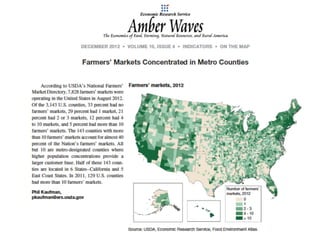
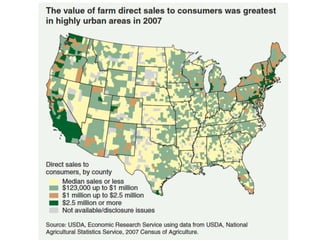
•  Demand for farmers’ markets – spatial variations
•  Changing buyer and consumer preferences
•  Future role of farmers’ markets
– sources for potential demand
Data challenges
•  Most USDA data collected by commodity not
market channel
•  USDA AMS Market manager survey ~4 yrs
– Only of existing markets
– No farm-level information
– Many markets have volunteer manager
•  USDA NASS
•  USDA ARMS
3
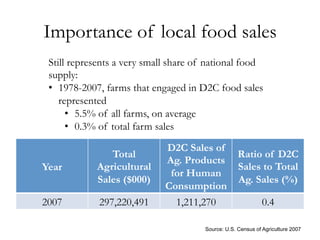
Importance of local food sales
Year
Total
Agricultural
Sales ($000)
D2C Sales of
Ag. Products
for Human
Consumption
Ratio of D2C
Sales to Total
Ag. Sales (%)
2007 297,220,491 1,211,270 0.4
Source: U.S. Census of Agriculture 2007
Still represents a very small share of national food
supply:
•  1978-2007, farms that engaged in D2C food sales
represented
•  5.5% of all farms, on average
•  0.3% of total farm sales
Demand?
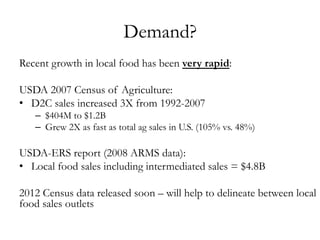
Recent growth in local food has been very rapid:
USDA 2007 Census of Agriculture:
•  D2C sales increased 3X from 1992-2007
–  $404M to $1.2B
–  Grew 2X as fast as total ag sales in U.S. (105% vs. 48%)
USDA-ERS report (2008 ARMS data):
•  Local food sales including intermediated sales = $4.8B
2012 Census data released soon – will help to delineate between local
food sales outlets
6
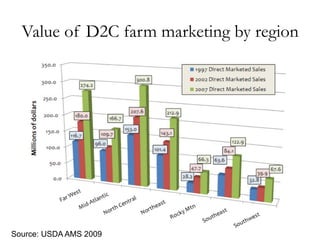
Value of D2C farm marketing by region
Source: USDA AMS 2009
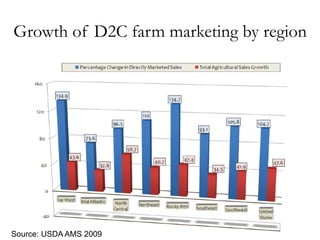
Growth of D2C farm marketing by region
Source: USDA AMS 2009
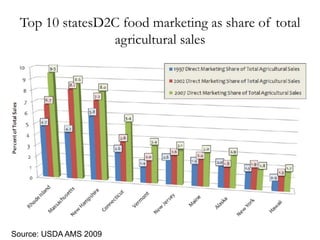
Top 10 statesD2C food marketing as share of total
agricultural sales
Source: USDA AMS 2009
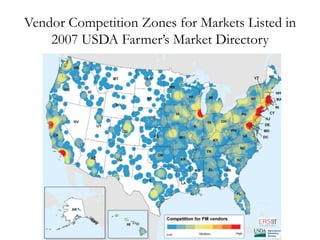
Vendor Competition Zones for Markets Listed in
2007 USDA Farmer’s Market Directory
Demand?
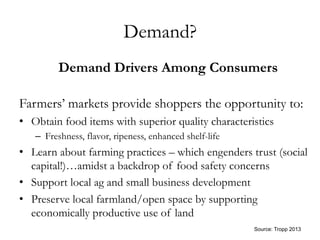
Demand Drivers Among Consumers
Farmers’ markets provide shoppers the opportunity to:
•  Obtain food items with superior quality characteristics
–  Freshness, flavor, ripeness, enhanced shelf-life
•  Learn about farming practices – which engenders trust (social
capital!)…amidst a backdrop of food safety concerns
•  Support local ag and small business development
•  Preserve local farmland/open space by supporting
economically productive use of land
Source: Tropp 2013
Demand?
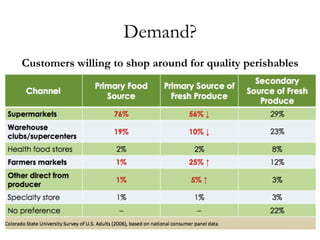
Customers willing to shop around for quality perishables
Demand?
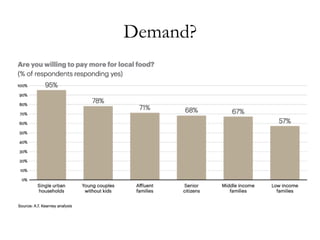
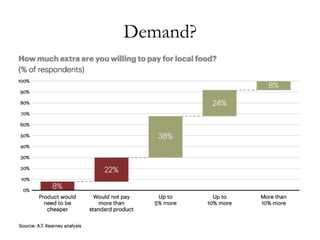
•  Farmers’ markets main source of local food
Source: Kearney 2013
Demand?
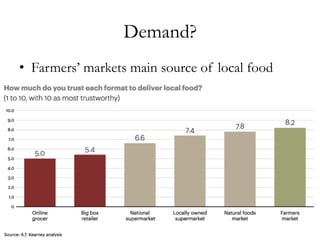
•  Farmers’ markets main source of local food
Source: Kearney 2013
Demand?
Demand?
Demand?
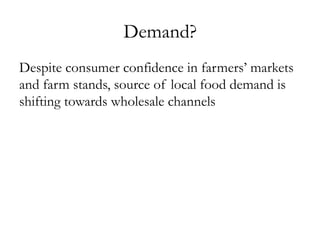
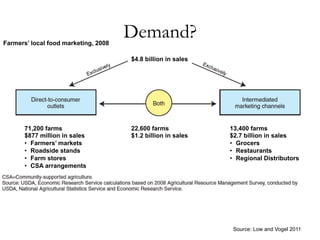
Despite consumer confidence in farmers’ markets
and farm stands, source of local food demand is
shifting towards wholesale channels
Source: Low and Vogel 2011
13,400 farms
$2.7 billion in sales
•  Grocers
•  Restaurants
•  Regional Distributors
71,200 farms
$877 million in sales
•  Farmers’ markets
•  Roadside stands
•  Farm stores
•  CSA arrangements
22,600 farms
$1.2 billion in sales
$4.8 billion in sales
Farmers’ local food marketing, 2008
Demand?
Demand?
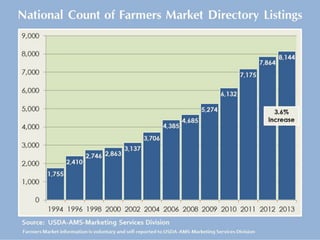
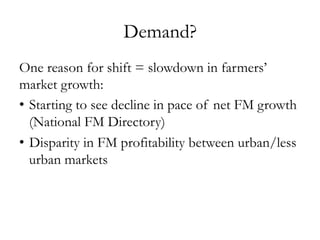
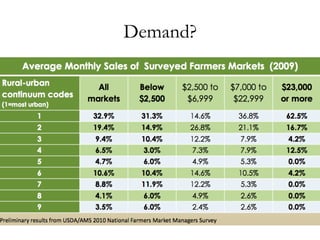
One reason for shift = slowdown in farmers’
market growth:
•  Starting to see decline in pace of net FM growth
(National FM Directory)
•  Disparity in FM profitability between urban/less
urban markets
Demand?
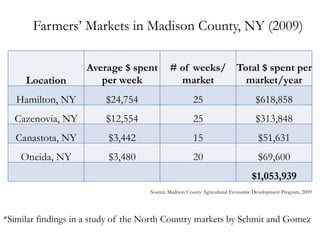
Farmers’ Markets in Madison County, NY (2009)
Location
Average $ spent
per week
# of weeks/
market
Total $ spent per
market/year
Hamilton, NY $24,754 25 $618,858
Cazenovia, NY $12,554 25 $313,848
Canastota, NY $3,442 15 $51,631
Oneida, NY $3,480 20 $69,600
$1,053,939
Source: Madison County Agricultural Economic Development Program, 2009
*Similar findings in a study of the North Country markets by Schmit and Gomez
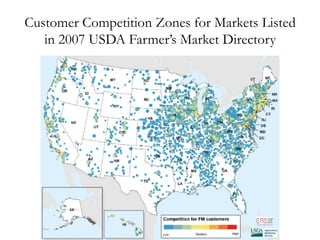
Customer Competition Zones for Markets Listed
in 2007 USDA Farmer’s Market Directory
Demand?
Many D2C outlets, including FMs, are labor-intensive, and not
very profitable for farmers:
•  Small farms (>$50,000 in gross annual sales) were more
likely to rely exclusively on D2C sales.
•  High price per unit/relatively small volume of sales
•  Farmers’ markets often most labor intensive market channel
(LeRoux et al. 2010, Hardesty and Leff 2010)
Source: Low and Vogel 2011
Demand?
Barriers for small and mid-scale farmers to access
larger-volume marketing channels
•  Individual farm operators often lack individual capacity to
meet buyer requirements for product volume, quality,
consistency, variety or extended availability
•  Farmers continue to be challenged by the lack of
distribution, processing, and marketing infrastructure
…one of the reasons FMs will continue to play important
roles as a point of entry for farmers
Potential Drivers of Future Demand
Likely to hinge on greater accessibility
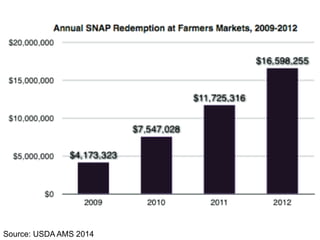
•  Nutrition Assistance Programs
–  Increases in SNAP participation by farmers markets and farm
stands, up from around 900 sites in 2009 to more than 3,200
in 2012
•  resulting from outreach by USDA Food and Nutrition Service +
AMS/FNS grants for EBT installation + rise of NGO-sponsored
subsidy programs
–  Preliminary research suggests:
•  Patronage continues after subsidies run out (USDA AMS 2013)
•  Price is not a barrier (Project for Public Spaces 2013)
–  Recent expansion of mobile farm markets to serve people
without transportation access
Source: USDA AMS 2014
Potential Drivers of Future Demand
•  Nutrition Assistance Programs
– MarketLink, a new way for farmers’ markets and
direct-marketing farmers to get authorized as SNAP
vendors and get the equipment they need to accept
SNAP benefits
Potential Drivers of Future Demand
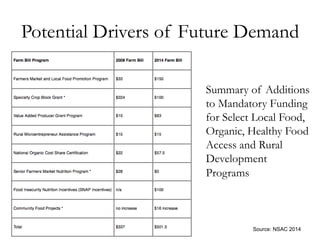
Summary of Additions
to Mandatory Funding
for Select Local Food,
Organic, Healthy Food
Access and Rural
Development
Programs
Source: NSAC 2014
Potential Drivers of Future Demand
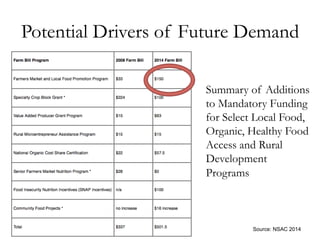
Summary of Additions
to Mandatory Funding
for Select Local Food,
Organic, Healthy Food
Access and Rural
Development
Programs
Source: NSAC 2014
Potential Drivers of Future Demand
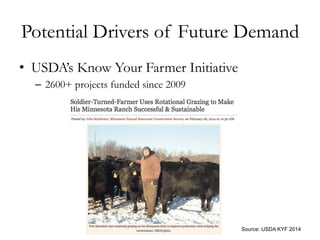
•  USDA’s Know Your Farmer Initiative
–  2600+ projects funded since 2009
Source: USDA KYF 2014
Potential Drivers of Future Demand
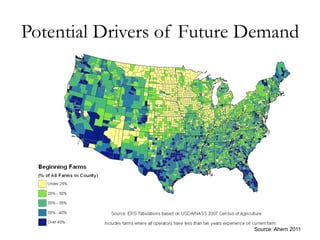
Source: Ahern 2011
Potential Drivers of Future Demand
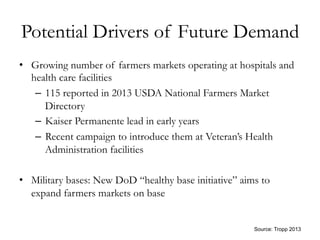
•  Growing number of farmers markets operating at hospitals and
health care facilities
–  115 reported in 2013 USDA National Farmers Market
Directory
–  Kaiser Permanente lead in early years
–  Recent campaign to introduce them at Veteran’s Health
Administration facilities
•  Military bases: New DoD “healthy base initiative” aims to
expand farmers markets on base
	
  
Source: Tropp 2013
Potential Drivers of Future Demand
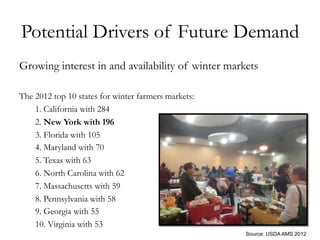
Growing interest in and availability of winter markets
The 2012 top 10 states for winter farmers markets:
1. California with 284
2. New York with 196
3. Florida with 105
4. Maryland with 70
5. Texas with 63
6. North Carolina with 62
7. Massachusetts with 59
8. Pennsylvania with 58
9. Georgia with 55
10. Virginia with 53
Source: USDA AMS 2012
Potential Drivers of Future Demand
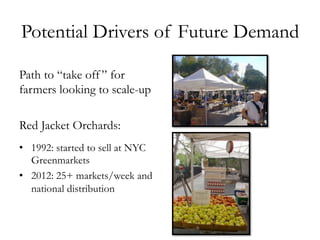
Path to “take off” for
farmers looking to scale-up
Red Jacket Orchards:
•  1992: started to sell at NYC
Greenmarkets
•  2012: 25+ markets/week and
national distribution
Potential Drivers of Future Demand
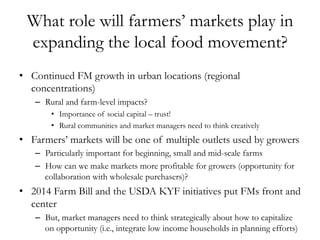
What role will farmers’ markets play in
expanding the local food movement?
•  Continued FM growth in urban locations (regional
concentrations)
–  Rural and farm-level impacts?
•  Importance of social capital – trust!
•  Rural communities and market managers need to think creatively
•  Farmers’ markets will be one of multiple outlets used by growers
–  Particularly important for beginning, small and mid-scale farms
–  How can we make markets more profitable for growers (opportunity for
collaboration with wholesale purchasers)?
•  2014 Farm Bill and the USDA KYF initiatives put FMs front and
center
–  But, market managers need to think strategically about how to capitalize
on opportunity (i.e., integrate low income households in planning efforts)
Thank You!
Becca B.R. Jablonski
314 W. Sibley Hall
Cornell University
Ithaca, NY 14853
215-817-2566
rb223@cornell.edu
beccajablonski.wordpress.com

The Future of Farmers Markets

  • 1.
    The Future ofFarmers’ Markets and Their Role in Expanding the Local Food Movement Becca Jablonski PhD Candidate, Cornell University Doctoral Fellow, USDA’s National Institute of Food and Agriculture Navigating the Local Food Scene Farmers Market Managers Conference Double Tree by Hilton, Binghamton, NY February 27, 2014
  • 2.
    Presentation overview •  Overviewof national statistics •  Demand for farmers’ markets – spatial variations •  Changing buyer and consumer preferences •  Future role of farmers’ markets – sources for potential demand
  • 3.
    Data challenges •  MostUSDA data collected by commodity not market channel •  USDA AMS Market manager survey ~4 yrs – Only of existing markets – No farm-level information – Many markets have volunteer manager •  USDA NASS •  USDA ARMS 3
  • 4.
    Importance of localfood sales Year Total Agricultural Sales ($000) D2C Sales of Ag. Products for Human Consumption Ratio of D2C Sales to Total Ag. Sales (%) 2007 297,220,491 1,211,270 0.4 Source: U.S. Census of Agriculture 2007 Still represents a very small share of national food supply: •  1978-2007, farms that engaged in D2C food sales represented •  5.5% of all farms, on average •  0.3% of total farm sales
  • 5.
    Demand? Recent growth inlocal food has been very rapid: USDA 2007 Census of Agriculture: •  D2C sales increased 3X from 1992-2007 –  $404M to $1.2B –  Grew 2X as fast as total ag sales in U.S. (105% vs. 48%) USDA-ERS report (2008 ARMS data): •  Local food sales including intermediated sales = $4.8B 2012 Census data released soon – will help to delineate between local food sales outlets
  • 6.
  • 7.
    Value of D2Cfarm marketing by region Source: USDA AMS 2009
  • 8.
    Growth of D2Cfarm marketing by region Source: USDA AMS 2009
  • 9.
    Top 10 statesD2Cfood marketing as share of total agricultural sales Source: USDA AMS 2009
  • 12.
    Vendor Competition Zonesfor Markets Listed in 2007 USDA Farmer’s Market Directory
  • 13.
    Demand? Demand Drivers AmongConsumers Farmers’ markets provide shoppers the opportunity to: •  Obtain food items with superior quality characteristics –  Freshness, flavor, ripeness, enhanced shelf-life •  Learn about farming practices – which engenders trust (social capital!)…amidst a backdrop of food safety concerns •  Support local ag and small business development •  Preserve local farmland/open space by supporting economically productive use of land Source: Tropp 2013
  • 14.
    Demand? Customers willing toshop around for quality perishables
  • 15.
    Demand? •  Farmers’ marketsmain source of local food Source: Kearney 2013
  • 16.
    Demand? •  Farmers’ marketsmain source of local food Source: Kearney 2013
  • 17.
  • 18.
  • 19.
    Demand? Despite consumer confidencein farmers’ markets and farm stands, source of local food demand is shifting towards wholesale channels
  • 20.
    Source: Low andVogel 2011 13,400 farms $2.7 billion in sales •  Grocers •  Restaurants •  Regional Distributors 71,200 farms $877 million in sales •  Farmers’ markets •  Roadside stands •  Farm stores •  CSA arrangements 22,600 farms $1.2 billion in sales $4.8 billion in sales Farmers’ local food marketing, 2008 Demand?
  • 21.
    Demand? One reason forshift = slowdown in farmers’ market growth: •  Starting to see decline in pace of net FM growth (National FM Directory) •  Disparity in FM profitability between urban/less urban markets
  • 22.
  • 23.
    Farmers’ Markets inMadison County, NY (2009) Location Average $ spent per week # of weeks/ market Total $ spent per market/year Hamilton, NY $24,754 25 $618,858 Cazenovia, NY $12,554 25 $313,848 Canastota, NY $3,442 15 $51,631 Oneida, NY $3,480 20 $69,600 $1,053,939 Source: Madison County Agricultural Economic Development Program, 2009 *Similar findings in a study of the North Country markets by Schmit and Gomez
  • 24.
    Customer Competition Zonesfor Markets Listed in 2007 USDA Farmer’s Market Directory
  • 25.
    Demand? Many D2C outlets,including FMs, are labor-intensive, and not very profitable for farmers: •  Small farms (>$50,000 in gross annual sales) were more likely to rely exclusively on D2C sales. •  High price per unit/relatively small volume of sales •  Farmers’ markets often most labor intensive market channel (LeRoux et al. 2010, Hardesty and Leff 2010) Source: Low and Vogel 2011
  • 26.
    Demand? Barriers for smalland mid-scale farmers to access larger-volume marketing channels •  Individual farm operators often lack individual capacity to meet buyer requirements for product volume, quality, consistency, variety or extended availability •  Farmers continue to be challenged by the lack of distribution, processing, and marketing infrastructure …one of the reasons FMs will continue to play important roles as a point of entry for farmers
  • 27.
    Potential Drivers ofFuture Demand Likely to hinge on greater accessibility •  Nutrition Assistance Programs –  Increases in SNAP participation by farmers markets and farm stands, up from around 900 sites in 2009 to more than 3,200 in 2012 •  resulting from outreach by USDA Food and Nutrition Service + AMS/FNS grants for EBT installation + rise of NGO-sponsored subsidy programs –  Preliminary research suggests: •  Patronage continues after subsidies run out (USDA AMS 2013) •  Price is not a barrier (Project for Public Spaces 2013) –  Recent expansion of mobile farm markets to serve people without transportation access
  • 28.
  • 29.
    Potential Drivers ofFuture Demand •  Nutrition Assistance Programs – MarketLink, a new way for farmers’ markets and direct-marketing farmers to get authorized as SNAP vendors and get the equipment they need to accept SNAP benefits
  • 30.
    Potential Drivers ofFuture Demand Summary of Additions to Mandatory Funding for Select Local Food, Organic, Healthy Food Access and Rural Development Programs Source: NSAC 2014
  • 31.
    Potential Drivers ofFuture Demand Summary of Additions to Mandatory Funding for Select Local Food, Organic, Healthy Food Access and Rural Development Programs Source: NSAC 2014
  • 32.
    Potential Drivers ofFuture Demand •  USDA’s Know Your Farmer Initiative –  2600+ projects funded since 2009 Source: USDA KYF 2014
  • 33.
    Potential Drivers ofFuture Demand Source: Ahern 2011
  • 34.
    Potential Drivers ofFuture Demand •  Growing number of farmers markets operating at hospitals and health care facilities –  115 reported in 2013 USDA National Farmers Market Directory –  Kaiser Permanente lead in early years –  Recent campaign to introduce them at Veteran’s Health Administration facilities •  Military bases: New DoD “healthy base initiative” aims to expand farmers markets on base   Source: Tropp 2013
  • 35.
    Potential Drivers ofFuture Demand Growing interest in and availability of winter markets The 2012 top 10 states for winter farmers markets: 1. California with 284 2. New York with 196 3. Florida with 105 4. Maryland with 70 5. Texas with 63 6. North Carolina with 62 7. Massachusetts with 59 8. Pennsylvania with 58 9. Georgia with 55 10. Virginia with 53 Source: USDA AMS 2012
  • 36.
    Potential Drivers ofFuture Demand Path to “take off” for farmers looking to scale-up Red Jacket Orchards: •  1992: started to sell at NYC Greenmarkets •  2012: 25+ markets/week and national distribution
  • 37.
    Potential Drivers ofFuture Demand
  • 38.
    What role willfarmers’ markets play in expanding the local food movement? •  Continued FM growth in urban locations (regional concentrations) –  Rural and farm-level impacts? •  Importance of social capital – trust! •  Rural communities and market managers need to think creatively •  Farmers’ markets will be one of multiple outlets used by growers –  Particularly important for beginning, small and mid-scale farms –  How can we make markets more profitable for growers (opportunity for collaboration with wholesale purchasers)? •  2014 Farm Bill and the USDA KYF initiatives put FMs front and center –  But, market managers need to think strategically about how to capitalize on opportunity (i.e., integrate low income households in planning efforts)
  • 39.
    Thank You! Becca B.R.Jablonski 314 W. Sibley Hall Cornell University Ithaca, NY 14853 215-817-2566 rb223@cornell.edu beccajablonski.wordpress.com