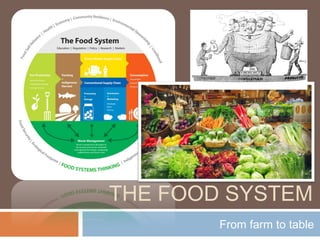
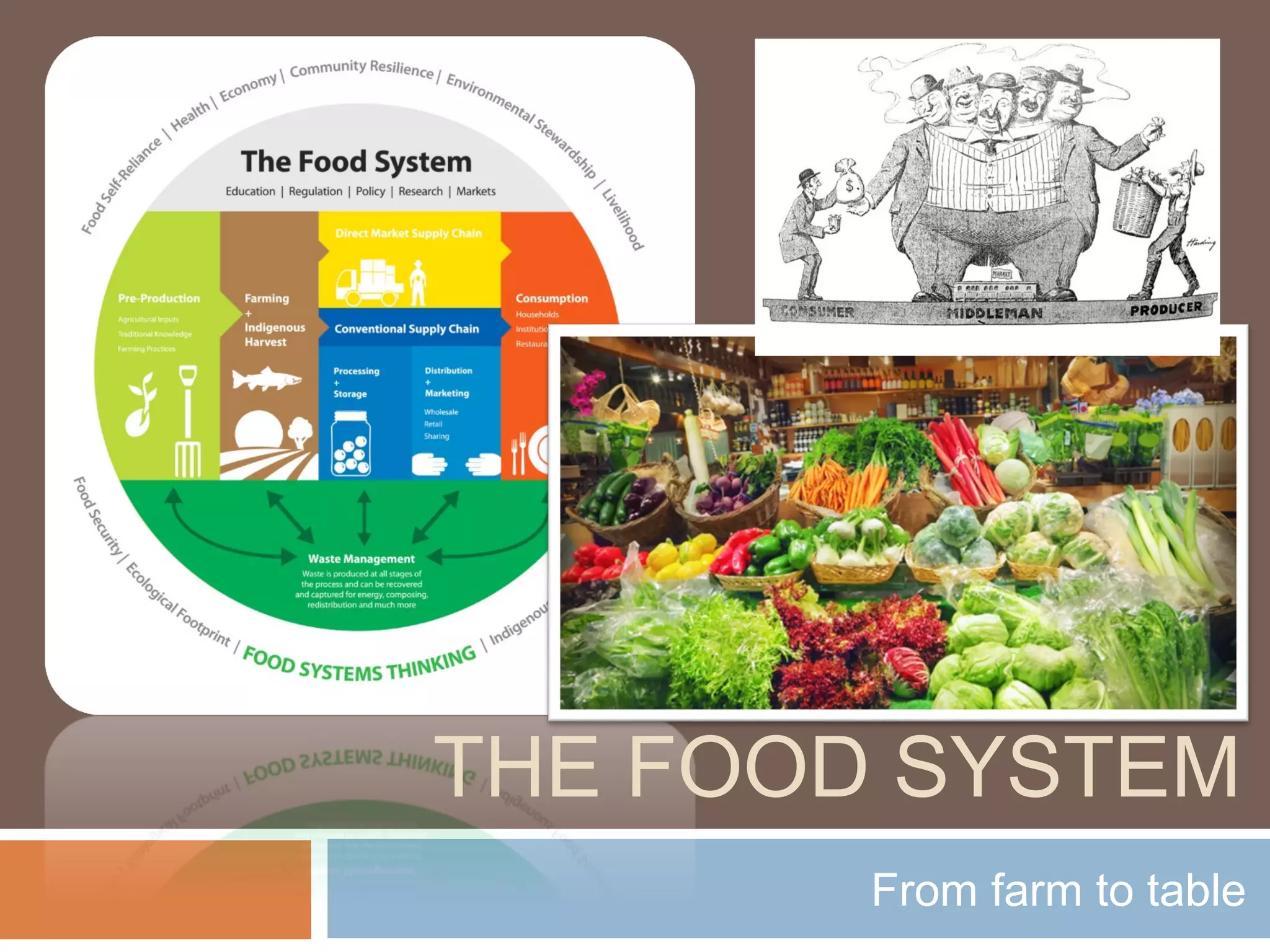
THE FOOD SYSTEM
From farm to table
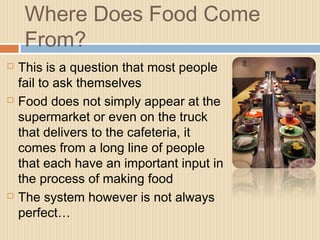
Where Does Food Come
From?
 This is a question that most people
fail to ask themselves
 Food does not simply appear at the
supermarket or even on the truck
that delivers to the cafeteria, it
comes from a long line of people
that each have an important input in
the process of making food
 The system however is not always
perfect…
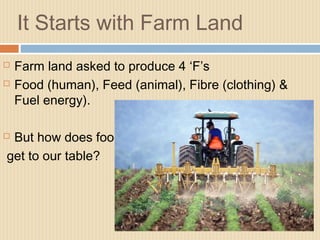
It Starts with Farm Land
 Farm land asked to produce 4 ‘F’s
 Food (human), Feed (animal), Fibre (clothing) &
Fuel energy).
 But how does food
get to our table?
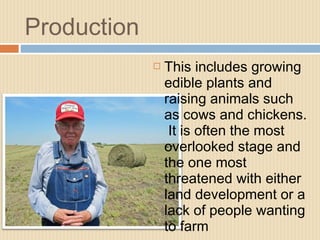
Production
 This includes growing
edible plants and
raising animals such
as cows and chickens.
It is often the most
overlooked stage and
the one most
threatened with either
land development or a
lack of people wanting
to farm
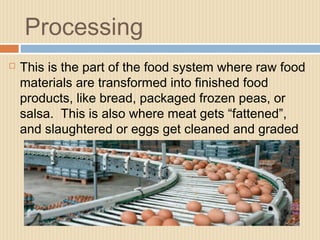
Processing
 This is the part of the food system where raw food
materials are transformed into finished food
products, like bread, packaged frozen peas, or
salsa. This is also where meat gets “fattened”,
and slaughtered or eggs get cleaned and graded
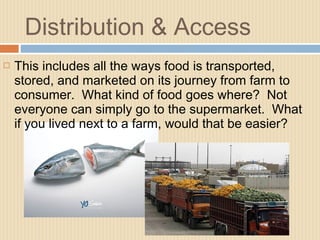
Distribution & Access
 This includes all the ways food is transported,
stored, and marketed on its journey from farm to
consumer. What kind of food goes where? Not
everyone can simply go to the supermarket. What
if you lived next to a farm, would that be easier?
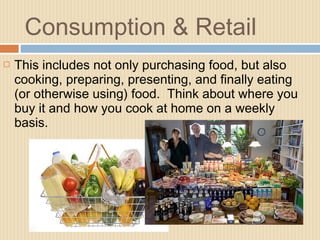
Consumption & Retail
 This includes not only purchasing food, but also
cooking, preparing, presenting, and finally eating
(or otherwise using) food. Think about where you
buy it and how you cook at home on a weekly
basis.
Waste & Recycling
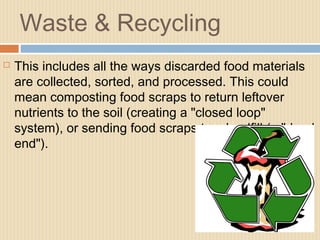
 This includes all the ways discarded food materials
are collected, sorted, and processed. This could
mean composting food scraps to return leftover
nutrients to the soil (creating a "closed loop"
system), or sending food scraps to a landfill (a "dead
end").
Current Food System
Problems...
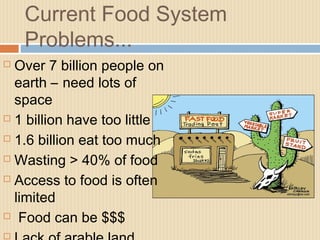
 Over 7 billion people on
earth – need lots of
space
 1 billion have too little
 1.6 billion eat too much
 Wasting > 40% of food
 Access to food is often
limited
 Food can be $$$

1.6 billion eat too much …
 Two-thirds of health-care costs can now be attributed
to chronic diseases associated with unhealthy eating.
 The average American consumes about 3747 kcal per
day (not including junk food) compared to the
recommended 2000 to 2500 kcal per day
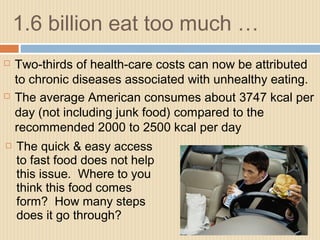
 The quick & easy access
to fast food does not help
this issue. Where to you
think this food comes
form? How many steps
does it go through?
From Waste to Quality?
 Households in Canada spend $140/wk on
food. Jonathan Bloom in American
Wasteland estimates 25% is wasted. Others
suggest closer to 40%.
 If we assume 30% of food wasted in
households, then the cost of tossing is
$42/wk.
 How much could food quality and
health improve if households used
that $42/wk, more effectively?
What are the Alternatives?
 Without people really understanding how our food
system works we are in danger of losing control of
it.
 Other systems like Lo calism allow people to create
their own food systems by buying as close to
home, directly from the farmer themselves
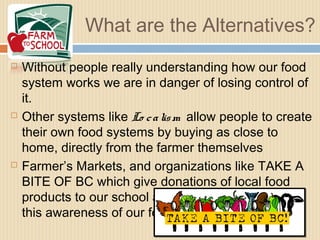
 Farmer’s Markets, and organizations like TAKE A
BITE OF BC which give donations of local food
products to our school and others, help promote
this awareness of our food systems in BC
Where Chefs fit in…
 Chefs have incredible buying power, think
about how much food your restaurant uses in
a day, a week, a month. Now think about how
many restaurants there are in the Lower
Mainland
 Many chefs around the world have already
begun to use more sustainable methods to
find their food. By having a relationship with
there producer, they get better quality product
and ensure the farmers survival

Food systems

  • 1.
    THE FOOD SYSTEM Fromfarm to table
  • 2.
    Where Does FoodCome From?  This is a question that most people fail to ask themselves  Food does not simply appear at the supermarket or even on the truck that delivers to the cafeteria, it comes from a long line of people that each have an important input in the process of making food  The system however is not always perfect…
  • 3.
    It Starts withFarm Land  Farm land asked to produce 4 ‘F’s  Food (human), Feed (animal), Fibre (clothing) & Fuel energy).  But how does food get to our table?
  • 4.
    Production  This includesgrowing edible plants and raising animals such as cows and chickens. It is often the most overlooked stage and the one most threatened with either land development or a lack of people wanting to farm
  • 5.
    Processing  This isthe part of the food system where raw food materials are transformed into finished food products, like bread, packaged frozen peas, or salsa. This is also where meat gets “fattened”, and slaughtered or eggs get cleaned and graded
  • 6.
    Distribution & Access This includes all the ways food is transported, stored, and marketed on its journey from farm to consumer. What kind of food goes where? Not everyone can simply go to the supermarket. What if you lived next to a farm, would that be easier?
  • 7.
    Consumption & Retail This includes not only purchasing food, but also cooking, preparing, presenting, and finally eating (or otherwise using) food. Think about where you buy it and how you cook at home on a weekly basis.
  • 8.
    Waste & Recycling This includes all the ways discarded food materials are collected, sorted, and processed. This could mean composting food scraps to return leftover nutrients to the soil (creating a "closed loop" system), or sending food scraps to a landfill (a "dead end").
  • 9.
    Current Food System Problems... Over 7 billion people on earth – need lots of space  1 billion have too little  1.6 billion eat too much  Wasting > 40% of food  Access to food is often limited  Food can be $$$ 
  • 10.
    1.6 billion eattoo much …  Two-thirds of health-care costs can now be attributed to chronic diseases associated with unhealthy eating.  The average American consumes about 3747 kcal per day (not including junk food) compared to the recommended 2000 to 2500 kcal per day  The quick & easy access to fast food does not help this issue. Where to you think this food comes form? How many steps does it go through?
  • 11.
    From Waste toQuality?  Households in Canada spend $140/wk on food. Jonathan Bloom in American Wasteland estimates 25% is wasted. Others suggest closer to 40%.  If we assume 30% of food wasted in households, then the cost of tossing is $42/wk.  How much could food quality and health improve if households used that $42/wk, more effectively?
  • 12.
    What are theAlternatives?  Without people really understanding how our food system works we are in danger of losing control of it.  Other systems like Lo calism allow people to create their own food systems by buying as close to home, directly from the farmer themselves  Farmer’s Markets, and organizations like TAKE A BITE OF BC which give donations of local food products to our school and others, help promote this awareness of our food systems in BC
  • 13.
    Where Chefs fitin…  Chefs have incredible buying power, think about how much food your restaurant uses in a day, a week, a month. Now think about how many restaurants there are in the Lower Mainland  Many chefs around the world have already begun to use more sustainable methods to find their food. By having a relationship with there producer, they get better quality product and ensure the farmers survival