Occupational
Health and
Safety in the
Kitchen
What is Occupational Health and
Safety in the Kitchen?
Occupational Health and Safety
• the anticipation, recognition,
evaluation, control and prevention
of hazards from work that may result
in injury, illness, or affect the well
being of workers.
• Means by which to control aspects
of work production that involve any
degree of risk or danger that may
cause injury or harm.
Reasons for Occupational Health
and Safety
- Eliminates possible danger.
- Safeguard employee productivity.
- Means to promote workplace
processes.
- Protect employee rights.
- Maintain worker health.
What is hazard?
A hazard is anything with potential
to cause injury, illness or damage.
Types of
Hazards
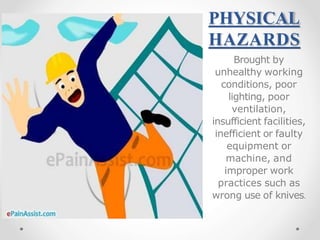
PHYSICAL
HAZARDS
Brought by
unhealthy working
conditions, poor
lighting, poor
ventilation,
insufficient facilities,
inefficient or faulty
equipment or
machine, and
improper work
practices such as
wrong use of knives.
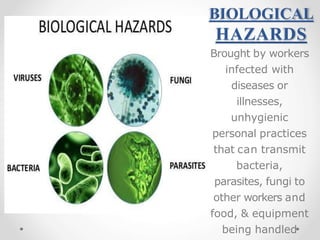
BIOLOGICAL
HAZARDS
Brought by workers
infected with
diseases or
illnesses,
unhygienic
personal practices
that can transmit
bacteria,
parasites, fungi to
other workers and
food, & equipment
being handled
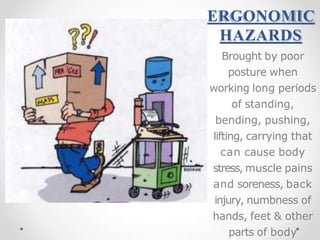
ERGONOMIC
HAZARDS
Brought by poor
posture when
working long periods
of standing,
bending, pushing,
lifting, carrying that
can cause body
stress, muscle pains
and soreness, back
injury, numbness of
hands, feet & other
parts of body
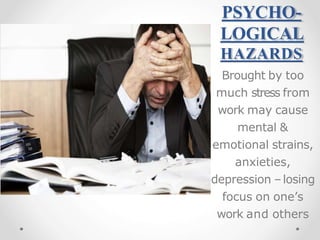
PSYCHO-
LOGICAL
HAZARDS
Brought by too
much stress from
work may cause
mental &
emotional strains,
anxieties,
depression –losing
focus on one’s
work and others
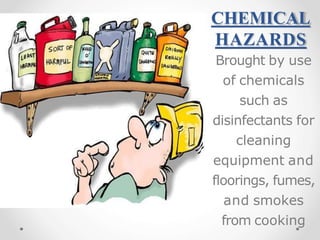
CHEMICAL
HAZARDS
Brought by use
of chemicals
such as
disinfectants for
cleaning
equipment and
floorings, fumes,
and smokes
from cooking
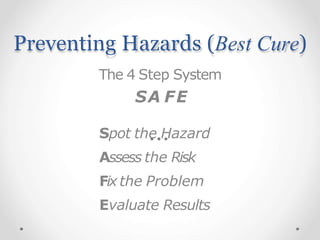
Preventing Hazards (Best Cure)
The 4 Step System
SA FE
Spot the Hazard
Assess the Risk
Fix the Problem
Evaluate Results
STRATEGIES IN IDENTIFYING
HAZARDS AND RISKS
✓ OBSERVATION–Observe your
workplace.
✓ RECORDS–Look into past
records of work-related injuries
and find the causes. ;Gather
information about the workplace
from other people.
✓ INTERVIEWS–Interview co-
workers of any complaints
CONTROLLING HAZARDS AND
RISKS IN THE WORKPLACE
Also known as riskcontrol.
Aim to remove a hazard completely. If
this is not possible a ‘hierarchy of control’ exist.
1. Eliminate completely the cause of the
hazard.
2. Substitute with a less hazardous one.
3. Improving an equipment to increase its
efficiency minimize wastage ( engineering
control)
4. Administration control
5. Wear personal protective equipment
Evaluating Results
How effective are changes made to fix
the problem.
Talk to workers & their response.
⮚Are changes making a difference?
⮚Workers opinion on change.
⮚Do solutions reduce risk?
⮚Do solutions create new hazards or
increase risk of existing ones?
Details to be Written in
Reporting Hazards or Risks
Forother incidents &near misses, a written
record mustbe made.
The Written Report must include:
⮚What:Description of Event / Injury / Damage.
⮚When: Time & Date of incident.
⮚Where: Location & Street Address.
⮚Who:Person, Witness, Workplace & Reporter.
⮚Why: Incident cause, Future action to prevent
it again.
SAFETY
PRACTICES IN
THE KITCHEN
To keep oneself clean
To keep tools and equipment clean
a) Wash hands thoroughly.
b) Keep fingernails short and clean.
c) Always wear PPE while at work.
d) Wear mask especially when a co-worker has
colds.
e) Remove all accessories before working.
Follow the correct procedures in washing, drying,
and storing kitchen tools and equipment
To keep the food clean
a. Never handle food when you have wounds, cuts,
and infections.
b. Itis best to work with clean and sanitized gloves at
all times to minimize hand contact with food.
c. Refrigerate food, especially perishable ones.
d. Keep food in clean containers with cover.
e. Wash fruits and vegetables thoroughly before use.
f. Check food and containers for any possible
contamination.
g. Clean the containers of ingredients regularly.
h. Follow the policy of first in, first out. Those stored
earlier should be used first before those stored later.
i. Label packages of food to determine information.
To keep the workplace clean
a. Do not do personal hygiene activities in the
workplace.
b. Do not eat, smoke or spit in the workplace.
c. Do not sit on equipment and worktables.
d. Keep the surroundings areas free from dirt and
disorganization.
e. Follow the Japanese philosophy of good
housekeeping –sort/seiri, set-in-order/seiton,
sweep/seiso, standardize/seiketsu, and
sustain/shitsuke.
SAFETY
REGULATIONS
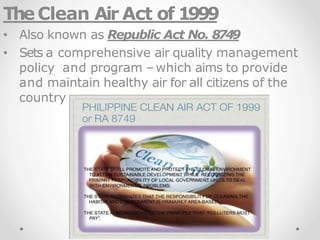
TheClean Air Act of 1999
• Also known as Republic Act No. 8749
• Sets a comprehensive air quality management
policy and program –which aims to provide
and maintain healthy air for all citizens of the
country
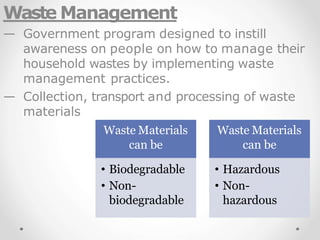
Waste Management
— Government program designed to instill
awareness on people on how to manage their
household wastes by implementing waste
management practices.
— Collection, transport and processing of waste
materials
Waste Materials
can be
• Biodegradable
• Non-
biodegradable
Waste Materials
can be
• Hazardous
• Non-
hazardous
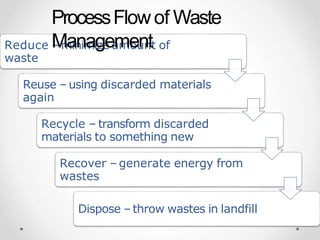
Reduce –minimize amount of
waste
Reuse – using discarded materials
again
Recycle – transform discarded
materials to something new
Recover – generate energy from
wastes
Dispose –throw wastes in landfill
ProcessFlowof Waste
Management
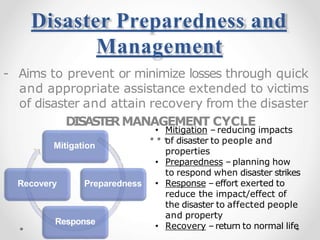
Disaster Preparedness and
Management
- Aims to prevent or minimize losses through quick
and appropriate assistance extended to victims
of disaster and attain recovery from the disaster
DISASTERMANAGEMENT CYCLE
Mitigation
Preparedness
Response
Recovery
• Mitigation – reducing impacts
of disaster to people and
properties
• Preparedness – planning how
to respond when disaster strikes
• Response –effort exerted to
reduce the impact/effect of
the disaster to affected people
and property
• Recovery –return to normal life
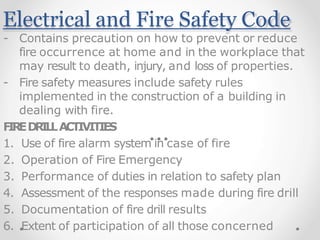
Electrical and Fire Safety Code
- Contains precaution on how to prevent or reduce
fire occurrence at home and in the workplace that
may result to death, injury, and loss of properties.
- Fire safety measures include safety rules
implemented in the construction of a building in
dealing with fire.
F
I
R
ED
R
I
L
LACTIVITIES
1. Use of fire alarm system in case of fire
2. Operation of Fire Emergency
3. Performance of duties in relation to safety plan
4. Assessment of the responses made during fire drill
5. Documentation of fire drill results
6. Extent of participation of all those concerned
Contingency Measures and
Procedures
A contingency plan is a written emergency plan. A
contingency plan includes the following:
1. Emergency
procedures in
response to disasters
2. Arrangement
between local police,
hospital & other
concerned agencies
3. List of those who can
help respond to the
emergency
4. Updated list of facilities
and equipment in the
building
5. Evacuation plan of
personnel and workers
Evacuation is the
immediate movement of
people away from the
hazard scene.

OHSP.ppt

  • 1.
  • 2.
    What is OccupationalHealth and Safety in the Kitchen? Occupational Health and Safety • the anticipation, recognition, evaluation, control and prevention of hazards from work that may result in injury, illness, or affect the well being of workers. • Means by which to control aspects of work production that involve any degree of risk or danger that may cause injury or harm.
  • 3.
    Reasons for OccupationalHealth and Safety - Eliminates possible danger. - Safeguard employee productivity. - Means to promote workplace processes. - Protect employee rights. - Maintain worker health.
  • 4.
    What is hazard? Ahazard is anything with potential to cause injury, illness or damage.
  • 5.
  • 6.
    PHYSICAL HAZARDS Brought by unhealthy working conditions,poor lighting, poor ventilation, insufficient facilities, inefficient or faulty equipment or machine, and improper work practices such as wrong use of knives.
  • 7.
    BIOLOGICAL HAZARDS Brought by workers infectedwith diseases or illnesses, unhygienic personal practices that can transmit bacteria, parasites, fungi to other workers and food, & equipment being handled
  • 8.
    ERGONOMIC HAZARDS Brought by poor posturewhen working long periods of standing, bending, pushing, lifting, carrying that can cause body stress, muscle pains and soreness, back injury, numbness of hands, feet & other parts of body
  • 9.
    PSYCHO- LOGICAL HAZARDS Brought by too muchstress from work may cause mental & emotional strains, anxieties, depression –losing focus on one’s work and others
  • 10.
    CHEMICAL HAZARDS Brought by use ofchemicals such as disinfectants for cleaning equipment and floorings, fumes, and smokes from cooking
  • 11.
    Preventing Hazards (BestCure) The 4 Step System SA FE Spot the Hazard Assess the Risk Fix the Problem Evaluate Results
  • 12.
    STRATEGIES IN IDENTIFYING HAZARDSAND RISKS ✓ OBSERVATION–Observe your workplace. ✓ RECORDS–Look into past records of work-related injuries and find the causes. ;Gather information about the workplace from other people. ✓ INTERVIEWS–Interview co- workers of any complaints
  • 13.
    CONTROLLING HAZARDS AND RISKSIN THE WORKPLACE Also known as riskcontrol. Aim to remove a hazard completely. If this is not possible a ‘hierarchy of control’ exist. 1. Eliminate completely the cause of the hazard. 2. Substitute with a less hazardous one. 3. Improving an equipment to increase its efficiency minimize wastage ( engineering control) 4. Administration control 5. Wear personal protective equipment
  • 14.
    Evaluating Results How effectiveare changes made to fix the problem. Talk to workers & their response. ⮚Are changes making a difference? ⮚Workers opinion on change. ⮚Do solutions reduce risk? ⮚Do solutions create new hazards or increase risk of existing ones?
  • 15.
    Details to beWritten in Reporting Hazards or Risks Forother incidents &near misses, a written record mustbe made. The Written Report must include: ⮚What:Description of Event / Injury / Damage. ⮚When: Time & Date of incident. ⮚Where: Location & Street Address. ⮚Who:Person, Witness, Workplace & Reporter. ⮚Why: Incident cause, Future action to prevent it again.
  • 16.
  • 17.
    To keep oneselfclean To keep tools and equipment clean a) Wash hands thoroughly. b) Keep fingernails short and clean. c) Always wear PPE while at work. d) Wear mask especially when a co-worker has colds. e) Remove all accessories before working. Follow the correct procedures in washing, drying, and storing kitchen tools and equipment
  • 18.
    To keep thefood clean a. Never handle food when you have wounds, cuts, and infections. b. Itis best to work with clean and sanitized gloves at all times to minimize hand contact with food. c. Refrigerate food, especially perishable ones. d. Keep food in clean containers with cover. e. Wash fruits and vegetables thoroughly before use. f. Check food and containers for any possible contamination. g. Clean the containers of ingredients regularly. h. Follow the policy of first in, first out. Those stored earlier should be used first before those stored later. i. Label packages of food to determine information.
  • 19.
    To keep theworkplace clean a. Do not do personal hygiene activities in the workplace. b. Do not eat, smoke or spit in the workplace. c. Do not sit on equipment and worktables. d. Keep the surroundings areas free from dirt and disorganization. e. Follow the Japanese philosophy of good housekeeping –sort/seiri, set-in-order/seiton, sweep/seiso, standardize/seiketsu, and sustain/shitsuke.
  • 20.
  • 21.
    TheClean Air Actof 1999 • Also known as Republic Act No. 8749 • Sets a comprehensive air quality management policy and program –which aims to provide and maintain healthy air for all citizens of the country
  • 22.
    Waste Management — Governmentprogram designed to instill awareness on people on how to manage their household wastes by implementing waste management practices. — Collection, transport and processing of waste materials Waste Materials can be • Biodegradable • Non- biodegradable Waste Materials can be • Hazardous • Non- hazardous
  • 23.
    Reduce –minimize amountof waste Reuse – using discarded materials again Recycle – transform discarded materials to something new Recover – generate energy from wastes Dispose –throw wastes in landfill ProcessFlowof Waste Management
  • 24.
    Disaster Preparedness and Management -Aims to prevent or minimize losses through quick and appropriate assistance extended to victims of disaster and attain recovery from the disaster DISASTERMANAGEMENT CYCLE Mitigation Preparedness Response Recovery • Mitigation – reducing impacts of disaster to people and properties • Preparedness – planning how to respond when disaster strikes • Response –effort exerted to reduce the impact/effect of the disaster to affected people and property • Recovery –return to normal life
  • 25.
    Electrical and FireSafety Code - Contains precaution on how to prevent or reduce fire occurrence at home and in the workplace that may result to death, injury, and loss of properties. - Fire safety measures include safety rules implemented in the construction of a building in dealing with fire. F I R ED R I L LACTIVITIES 1. Use of fire alarm system in case of fire 2. Operation of Fire Emergency 3. Performance of duties in relation to safety plan 4. Assessment of the responses made during fire drill 5. Documentation of fire drill results 6. Extent of participation of all those concerned
  • 26.
    Contingency Measures and Procedures Acontingency plan is a written emergency plan. A contingency plan includes the following: 1. Emergency procedures in response to disasters 2. Arrangement between local police, hospital & other concerned agencies 3. List of those who can help respond to the emergency 4. Updated list of facilities and equipment in the building 5. Evacuation plan of personnel and workers Evacuation is the immediate movement of people away from the hazard scene.