Food Labelling
Pooja Pandey
Be a smart consumer
• To judge the nutritional value of a
food product donot rely on
advertisement or attractive
packaging.
• Read the labels carefully.
What is Food Labelling
• FAO promotes Food Labelling as an
effective tool to protect consumer
health in terms of food safety and
nutrition.
• Food labels convey information
about the product’s identity and
contents, and on how to handle,
prepare and consume it safely.
• With the increase in global trade
and a shift away from the
traditional face-to-face food
producer and buyer relationship,
there is a greater need to create
food labels that are clear and can
be trusted.
• A food label, the information
presented on food product, is
one of the most important
and direct means of
communicating information
to the consumer.
• Food label is any tag, brand,
mark, pictorial or other
descriptive matter, written,
printed, marked, embossed or
impressed on, or attached to,
a container of food or food
product.
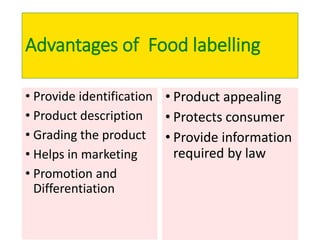
Advantages of Food labelling
• Provide identification
• Product description
• Grading the product
• Helps in marketing
• Promotion and
Differentiation
• Product appealing
• Protects consumer
• Provide information
required by law
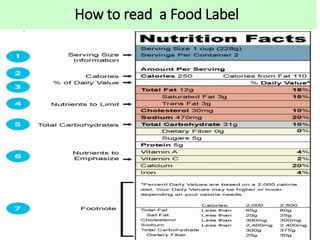
How to read a Food Label
NUTRITION LABELLING
• One of the main drivers for nutrition labelling is the increased
prevalence of diet-related non-communicable diseases.
• These labels can be effective instruments in helping consumers to
make healthful food choices.
• To maximise the potential of nutrition labels and health claims to
improve public health, awareness campaigns and education
programmes should be provided on an ongoing basis to help
consumers to understand and use labels appropriately.
• The Codex Alimentarius guidelines recommend the following
types of nutrition labelling: Nutrient Declaration, Nutrient
Reference Values, Quantitative declaration on ingredients (QUID),
Nutrition Claims and Health Claims.
• FOOD LABELLING TO REDUCE FOOD
WASTE:-
• The Codex Alimentarius provides
guidance on two key date marks
“Best before date” or “Best quality
before date” and ”Use-by-Date” or
“Expiration date”.
• FOOD FRAUD:-
• One of the main aims of a
labelling policy is to prevent
food sellers from deliberately
misleading consumers through
false representations on a
package.
• International Food Labelling Standards:-
• FAO works in partnership with WHO to advise the Codex
Alimentarius Commission on technical and policy matters
related to food labelling.
• The Codex Committee on Food Labelling (CCFL) is the Codex
subsidiary body responsible for setting standards and
guidelines on labelling that is applicable to all foods

Food Labelling.pptx

  • 1.
  • 2.
    Be a smartconsumer • To judge the nutritional value of a food product donot rely on advertisement or attractive packaging. • Read the labels carefully.
  • 3.
    What is FoodLabelling • FAO promotes Food Labelling as an effective tool to protect consumer health in terms of food safety and nutrition. • Food labels convey information about the product’s identity and contents, and on how to handle, prepare and consume it safely. • With the increase in global trade and a shift away from the traditional face-to-face food producer and buyer relationship, there is a greater need to create food labels that are clear and can be trusted. • A food label, the information presented on food product, is one of the most important and direct means of communicating information to the consumer. • Food label is any tag, brand, mark, pictorial or other descriptive matter, written, printed, marked, embossed or impressed on, or attached to, a container of food or food product.
  • 5.
    Advantages of Foodlabelling • Provide identification • Product description • Grading the product • Helps in marketing • Promotion and Differentiation • Product appealing • Protects consumer • Provide information required by law
  • 7.
    How to reada Food Label
  • 8.
    NUTRITION LABELLING • Oneof the main drivers for nutrition labelling is the increased prevalence of diet-related non-communicable diseases. • These labels can be effective instruments in helping consumers to make healthful food choices. • To maximise the potential of nutrition labels and health claims to improve public health, awareness campaigns and education programmes should be provided on an ongoing basis to help consumers to understand and use labels appropriately. • The Codex Alimentarius guidelines recommend the following types of nutrition labelling: Nutrient Declaration, Nutrient Reference Values, Quantitative declaration on ingredients (QUID), Nutrition Claims and Health Claims.
  • 9.
    • FOOD LABELLINGTO REDUCE FOOD WASTE:- • The Codex Alimentarius provides guidance on two key date marks “Best before date” or “Best quality before date” and ”Use-by-Date” or “Expiration date”. • FOOD FRAUD:- • One of the main aims of a labelling policy is to prevent food sellers from deliberately misleading consumers through false representations on a package. • International Food Labelling Standards:- • FAO works in partnership with WHO to advise the Codex Alimentarius Commission on technical and policy matters related to food labelling. • The Codex Committee on Food Labelling (CCFL) is the Codex subsidiary body responsible for setting standards and guidelines on labelling that is applicable to all foods