Solutions
      When an industry has problems
         JDA has the solutions…


Solutions
Food Safety Industry
            Safety Management Systems (SMS)
               and Safety Risk Management
                       May 5, 2010


Solutions
Agenda
            •   Introductions
            •   About JDA
            •   Food Safety and Aviation
            •   Comparative Data
            •   System Complexity Impact
            •   Heinrich Safety Triangle
            •   Building Safer Food Supply System
            •   SMS
            •   Safety Culture
            •   Benefits
            •   Getting Started

Solutions
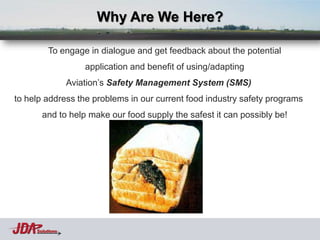
Why Are We Here?

          To engage in dialogue and get feedback about the potential
                     application and benefit of using/adapting
                 Aviation’s Safety Management System (SMS)
to help address the problems in our current food industry safety programs
       and to help make our food supply the safest it can possibly be!


     Solutions
Solutions   5
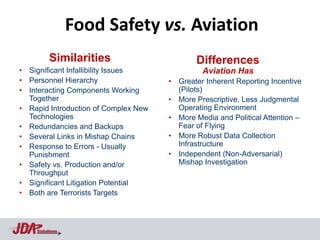
Food Safety vs. Aviation
         Similarities                        Differences
• Significant Infallibility Issues             Aviation Has
• Personnel Hierarchy                 • Greater Inherent Reporting Incentive
• Interacting Components Working        (Pilots)
  Together                            • More Prescriptive, Less Judgmental
• Rapid Introduction of Complex New     Operating Environment
  Technologies                        • More Media and Political Attention –
• Redundancies and Backups              Fear of Flying
• Several Links in Mishap Chains      • More Robust Data Collection
• Response to Errors - Usually          Infrastructure
  Punishment                          • Independent (Non-Adversarial)
• Safety vs. Production and/or          Mishap Investigation
  Throughput
• Significant Litigation Potential
• Both are Terrorists Targets


    Solutions
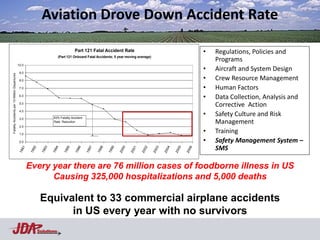
Aviation Drove Down Accident Rate

                                                                                  Part 121 Fatal Accident Rate                                          •   Regulations, Policies and
                                                                        (Part 121 Onboard Fatal Accidents; 5 year moving average)
                                                                                                                                                            Programs
                                               10.0

                                                9.0
                                                                                                                                                        •   Aircraft and System Design
Fatality Accidents per 10 Million Departures


                                                8.0                                                                                                     •   Crew Resource Management
                                                7.0                                                                                                     •   Human Factors
                                                6.0
                                                                                                                                                        •   Data Collection, Analysis and
                                                5.0
                                                                                                                                                            Corrective Action
                                                                                                                                                        •
                                                4.0

                                                                   83% Fatality Accident
                                                                                                                                                            Safety Culture and Risk
                                                3.0
                                                                   Rate Reduction                                                                           Management
                                                2.0

                                                1.0
                                                                                                                                                        •   Training
                                                0.0                                                                                                     •   Safety Management System –
                                                                                                                                                            SMS
                                                 91


                                                       92


                                                              93


                                                                   94


                                                                            95


                                                                                   96


                                                                                           97


                                                                                                 98


                                                                                                       99


                                                                                                              00


                                                                                                                     01


                                                                                                                            02


                                                                                                                                    03


                                                                                                                                         04


                                                                                                                                              05


                                                                                                                                                   06
                                               19


                                                      19


                                                             19


                                                                   19


                                                                           19


                                                                                  19


                                                                                           19


                                                                                                19


                                                                                                      19


                                                                                                             20


                                                                                                                    20


                                                                                                                           20


                                                                                                                                    20


                                                                                                                                         20


                                                                                                                                              20


                                                                                                                                                   20
                                                      Every year there are 76 million cases of foodborne illness in US
                                                            Causing 325,000 hospitalizations and 5,000 deaths

                                                             Equivalent to 33 commercial airplane accidents
                                                                   in US every year with no survivors
                                                            Solutions
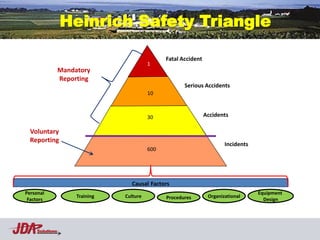
Heinrich Safety Triangle

                                                Fatal Accident
                                          1
                Mandatory
                Reporting
                                                       Serious Accidents
                                          10


                                          30                     Accidents

                                      Human Error
  Voluntary
  Reporting
                                                                         Incidents
                                          600


                                  Causal Factors
Personal                                                                             Equipment
                     Training   Culture         Procedures        Organizational
 Factors                                                                               Design


    Solutions
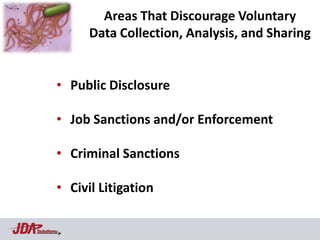
Areas That Discourage Voluntary
              Data Collection, Analysis, and Sharing


        • Public Disclosure

        • Job Sanctions and/or Enforcement

        • Criminal Sanctions

        • Civil Litigation

Solutions
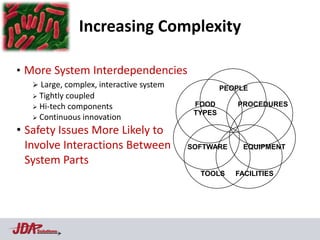
Increasing Complexity

• More System Interdependencies
    Large, complex, interactive system            PEOPLE
    Tightly coupled
    Hi-tech components                    FOOD       PROCEDURES
                                           TYPES
    Continuous innovation

• Safety Issues More Likely to
  Involve Interactions Between            SOFTWARE      EQUIPMENT

  System Parts
                                            TOOLS     FACILITIES


    Solutions
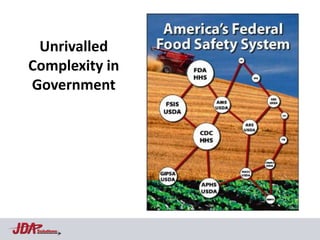
Unrivalled
Complexity in
Government


 Solutions
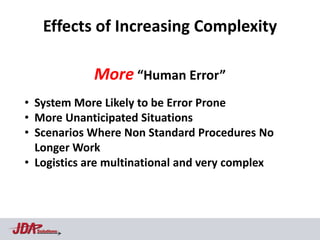
Effects of Increasing Complexity

              More “Human Error”
• System More Likely to be Error Prone
• More Unanticipated Situations
• Scenarios Where Non Standard Procedures No
  Longer Work
• Logistics are multinational and very complex


  Solutions
“If you keep doing what
            you’re doing…you’re going
             to keep getting what you
                        got!”
                     Yogi Berra


Solutions
Building Safer Food Supply System
"The history of government regulation of food safety
 is one of government watchdogs chasing the horse
              after it's out of the barn.“

             David A. Kessler, M.D. (FDA Commissioner)

  Current Food Safety System Insures barn
  door is locked with horse safely inside…


 Solutions
Challenges for
                  Food Control Authorities
                      as Defined by
                       FAO & WHO:

• Increasing burden of foodborne illness and new and emerging foodborne
  hazards;
• Rapidly changing technologies in food production, processing and
  marketing;
• Developing science-based food control systems with focus on consumer
  protection;
• International food trade and need for harmonization of food safety and
  quality standards;
• Changes in lifestyles, including rapid urbanization; and
• Growing consumer awareness of food safety and quality issues and
  increasing demand for better information.


      Solutions
Guidelines from the FAO and WHO
Globally, the incidence of foodborne diseases is
increasing and international food trade is disrupted by
frequent disputes over food safety and quality
requirements. Many food control systems need to be
revised and strengthened if improvements are to be
realized. It has never been more important for
developing countries to implement and enforce a food
control system based on the modern concept of risk
assessment. These Guidelines provide important
information on the principles and practices of food
control and the trend away from a merely punitive to a
preventive approach to food control.

 Solutions
Guidelines from the FAO and WHO (cont)

Responsibility for food control in most countries is shared
between different agencies or ministries. The roles and
responsibilities of these agencies may be quite different
and duplication of regulatory activity, fragmented
surveillance and a lack of coordination are common.
There may also be wide variations in expertise and
resources between the different agencies, and the
responsibility for protecting public health may conflict with
obligations to facilitate trade or develop an industry or
sector.


  Solutions
Guidelines from the FAO and WHO (cont)

These Guidelines provide information for government
agencies to assist in the development of national food
control systems and to promote effective collaboration
between all sectors involved in the management and
control of food safety and quality. They highlight the
importance of developing effective relationships and
mutual support among government agencies and
institutions involved in food control and other
stakeholders, particularly the food industry and
consumer groups.


Solutions
Safety Management System (SMS)


1. Systematic and comprehensive process for
   proactive management of safety risks.
2. Integrates operations, technical services with
   financial and human resource management.
3. Top management priority.
4. Company wide safety culture and management
   commitment is key to it’s success!
5. Comprehensive commitment to making all food
   safe.

   Solutions
Implementing SMS

1. Provides :
   •      Deal with events so valuable lessons are applied to
          improve safety and efficiency.
   •      Capacity to anticipate and address safety issues before
          they are incidents or accidents.
2. Instills inter-dependent culture among employees
   and management.
3. Reduces losses and improves productivity.


  Solutions
SMS Pillars

            1. Safety Policy & Objectives
            2. Safety Risk Management
            3. Safety Assurance
            4. Safety Promotion


Solutions
SMS Pillar 1
                  Safety Policy & Objectives
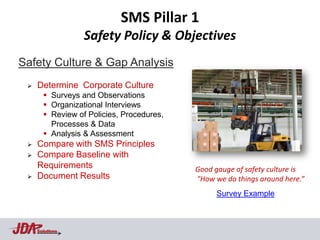
Safety Culture & Gap Analysis
    Determine Corporate Culture
        Surveys and Observations
        Organizational Interviews
        Review of Policies, Procedures,
         Processes & Data
        Analysis & Assessment
    Compare with SMS Principles
    Compare Baseline with
     Requirements                          Good gauge of safety culture is
    Document Results                      "How we do things around here.”
                                                 Survey Example


     Solutions
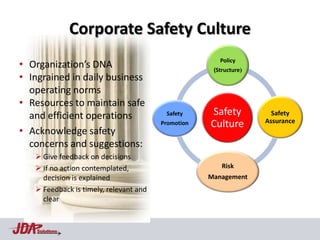
Corporate Safety Culture
                                                       Policy
• Organization’s DNA                                 (Structure)
• Ingrained in daily business
  operating norms
• Resources to maintain safe
  and efficient operations               Safety     Safety           Safety
                                                                   Assurance
                                        Promotion   Culture
• Acknowledge safety
  concerns and suggestions:
    Give feedback on decisions
    If no action contemplated,                         Risk
     decision is explained                          Management
    Feedback is timely, relevant and
     clear


    Solutions
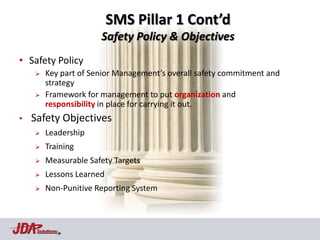
SMS Pillar 1 Cont’d
                      Safety Policy & Objectives
• Safety Policy
       Key part of Senior Management’s overall safety commitment and
        strategy
       Framework for management to put organization and
        responsibility in place for carrying it out.
•   Safety Objectives
       Leadership
       Training
       Measurable Safety Targets
       Lessons Learned
       Non-Punitive Reporting System


     Solutions
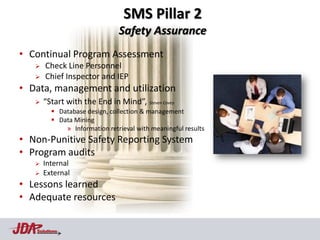
SMS Pillar 2
                               Safety Assurance
• Continual Program Assessment
      Check Line Personnel
      Chief Inspector and IEP
• Data, management and utilization
      “Start with the End in Mind”, Steven Covey
          Database design, collection & management
          Data Mining
             » Information retrieval with meaningful results
• Non-Punitive Safety Reporting System
• Program audits
      Internal
      External
• Lessons learned
• Adequate resources


   Solutions
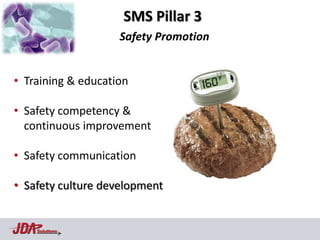
SMS Pillar 3
                    Safety Promotion


• Training & education

• Safety competency &
  continuous improvement

• Safety communication

• Safety culture development


    Solutions
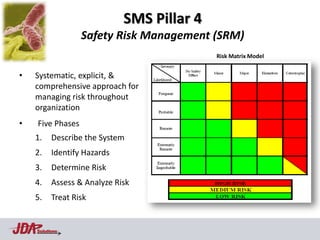
SMS Pillar 4
                  Safety Risk Management (SRM)
                                            Risk Matrix Model


•   Systematic, explicit, &
    comprehensive approach for
    managing risk throughout
    organization
•   Five Phases
    1.    Describe the System
    2.    Identify Hazards
    3.    Determine Risk
    4.    Assess & Analyze Risk
    5.    Treat Risk


    Solutions
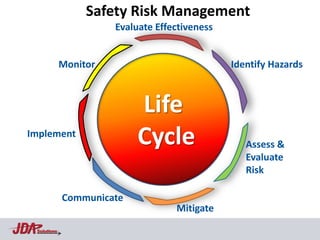
Safety Risk Management
                       Evaluate Effectiveness


             Monitor                            Identify Hazards


                            Life
Implement
                            Cycle                  Assess &
                                                   Evaluate
                                                   Risk

             Communicate
                                    Mitigate
 Solutions
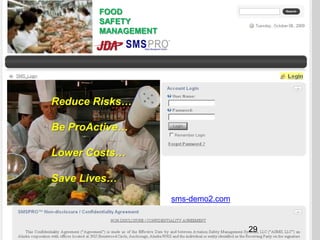
FOOD
              SAFETY
              MANAGEMENT


      Reduce Risks…

      Be ProActive…

      Lower Costs…

      Save Lives…
                           sms-demo2.com


Solutions                                  29
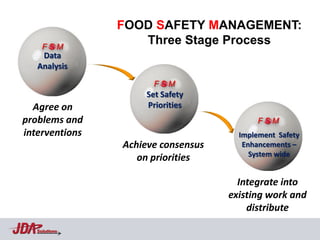
FOOD SAFETY MANAGEMENT:
     FSM
                   Three Stage Process
    Data
   Analysis
                      FSM
                    Set Safety
  Agree on          Priorities
problems and                              FSM
interventions                         Implement Safety
                Achieve consensus      Enhancements –
                                         System wide
                   on priorities

                                      Integrate into
                                    existing work and
                                        distribute

   Solutions
Success Stories in the Airline Industry when
               Implementing SMS
• Conair - Occupational Health and Safety costs:
         Went from +30% to –30% of industry average
         Saved $1,000 per employee year one
         Insurance Premiums stayed constant did not rise like their
          competition

• Air Transat saving over $1 million per month
• Skyservice saved $5 million in 1st year


      Solutions
SMS Will…
•   Establish meaningful safety policies, goals and objectives
•   Create individual accountability for safety
•   Demonstrate leadership regarding safety principles
•   Launch processes for risk measurement, hazard
    identification and mitigation
•   Develop collegial interactive teams & improved
    communications process
•   Implement non-punitive reporting; encourage “lessons
    learned”
•   Lower sickness and deaths from food contamination
    incidents
•   Reduce injury and damage claims costs; better productivity
•   Lower Operating Costs

Solutions
SMS First Steps
            • Determine Safety Culture
                  Top Management Commitment
                  Communicate purpose/objective
                  Survey staff/employees
                  Interview representative set of employees
                  Collect, analyze and report results
            • Conduct Safety Gap Analysis
                  Already in place vs. SMS
                  Identify strengths and shortfalls
            • Compile and Report Results
            • Develop SMS Plan


Solutions
WHAT ELSE ARE WE
   ADDING TO OUR
    SANDWICH?


Solutions
Solutions


            4720 Montgomery Lane
                  Suite 950
             Bethesda, MD 20814
            www.jdasolutions.aero
                301-941-1460


Solutions

Food Industry Safety

  • 1.
    Solutions When an industry has problems JDA has the solutions… Solutions
  • 2.
    Food Safety Industry Safety Management Systems (SMS) and Safety Risk Management May 5, 2010 Solutions
  • 3.
    Agenda • Introductions • About JDA • Food Safety and Aviation • Comparative Data • System Complexity Impact • Heinrich Safety Triangle • Building Safer Food Supply System • SMS • Safety Culture • Benefits • Getting Started Solutions
  • 4.
    Why Are WeHere? To engage in dialogue and get feedback about the potential application and benefit of using/adapting Aviation’s Safety Management System (SMS) to help address the problems in our current food industry safety programs and to help make our food supply the safest it can possibly be! Solutions
  • 5.
  • 6.
    Food Safety vs.Aviation Similarities Differences • Significant Infallibility Issues Aviation Has • Personnel Hierarchy • Greater Inherent Reporting Incentive • Interacting Components Working (Pilots) Together • More Prescriptive, Less Judgmental • Rapid Introduction of Complex New Operating Environment Technologies • More Media and Political Attention – • Redundancies and Backups Fear of Flying • Several Links in Mishap Chains • More Robust Data Collection • Response to Errors - Usually Infrastructure Punishment • Independent (Non-Adversarial) • Safety vs. Production and/or Mishap Investigation Throughput • Significant Litigation Potential • Both are Terrorists Targets Solutions
  • 7.
    Aviation Drove DownAccident Rate Part 121 Fatal Accident Rate • Regulations, Policies and (Part 121 Onboard Fatal Accidents; 5 year moving average) Programs 10.0 9.0 • Aircraft and System Design Fatality Accidents per 10 Million Departures 8.0 • Crew Resource Management 7.0 • Human Factors 6.0 • Data Collection, Analysis and 5.0 Corrective Action • 4.0 83% Fatality Accident Safety Culture and Risk 3.0 Rate Reduction Management 2.0 1.0 • Training 0.0 • Safety Management System – SMS 91 92 93 94 95 96 97 98 99 00 01 02 03 04 05 06 19 19 19 19 19 19 19 19 19 20 20 20 20 20 20 20 Every year there are 76 million cases of foodborne illness in US Causing 325,000 hospitalizations and 5,000 deaths Equivalent to 33 commercial airplane accidents in US every year with no survivors Solutions
  • 8.
    Heinrich Safety Triangle Fatal Accident 1 Mandatory Reporting Serious Accidents 10 30 Accidents Human Error Voluntary Reporting Incidents 600 Causal Factors Personal Equipment Training Culture Procedures Organizational Factors Design Solutions
  • 9.
    Areas That DiscourageVoluntary Data Collection, Analysis, and Sharing • Public Disclosure • Job Sanctions and/or Enforcement • Criminal Sanctions • Civil Litigation Solutions
  • 10.
    Increasing Complexity • MoreSystem Interdependencies  Large, complex, interactive system PEOPLE  Tightly coupled  Hi-tech components FOOD PROCEDURES TYPES  Continuous innovation • Safety Issues More Likely to Involve Interactions Between SOFTWARE EQUIPMENT System Parts TOOLS FACILITIES Solutions
  • 11.
  • 12.
    Effects of IncreasingComplexity More “Human Error” • System More Likely to be Error Prone • More Unanticipated Situations • Scenarios Where Non Standard Procedures No Longer Work • Logistics are multinational and very complex Solutions
  • 13.
    “If you keepdoing what you’re doing…you’re going to keep getting what you got!” Yogi Berra Solutions
  • 14.
    Building Safer FoodSupply System "The history of government regulation of food safety is one of government watchdogs chasing the horse after it's out of the barn.“ David A. Kessler, M.D. (FDA Commissioner) Current Food Safety System Insures barn door is locked with horse safely inside… Solutions
  • 15.
    Challenges for Food Control Authorities as Defined by FAO & WHO: • Increasing burden of foodborne illness and new and emerging foodborne hazards; • Rapidly changing technologies in food production, processing and marketing; • Developing science-based food control systems with focus on consumer protection; • International food trade and need for harmonization of food safety and quality standards; • Changes in lifestyles, including rapid urbanization; and • Growing consumer awareness of food safety and quality issues and increasing demand for better information. Solutions
  • 16.
    Guidelines from theFAO and WHO Globally, the incidence of foodborne diseases is increasing and international food trade is disrupted by frequent disputes over food safety and quality requirements. Many food control systems need to be revised and strengthened if improvements are to be realized. It has never been more important for developing countries to implement and enforce a food control system based on the modern concept of risk assessment. These Guidelines provide important information on the principles and practices of food control and the trend away from a merely punitive to a preventive approach to food control. Solutions
  • 17.
    Guidelines from theFAO and WHO (cont) Responsibility for food control in most countries is shared between different agencies or ministries. The roles and responsibilities of these agencies may be quite different and duplication of regulatory activity, fragmented surveillance and a lack of coordination are common. There may also be wide variations in expertise and resources between the different agencies, and the responsibility for protecting public health may conflict with obligations to facilitate trade or develop an industry or sector. Solutions
  • 18.
    Guidelines from theFAO and WHO (cont) These Guidelines provide information for government agencies to assist in the development of national food control systems and to promote effective collaboration between all sectors involved in the management and control of food safety and quality. They highlight the importance of developing effective relationships and mutual support among government agencies and institutions involved in food control and other stakeholders, particularly the food industry and consumer groups. Solutions
  • 19.
    Safety Management System(SMS) 1. Systematic and comprehensive process for proactive management of safety risks. 2. Integrates operations, technical services with financial and human resource management. 3. Top management priority. 4. Company wide safety culture and management commitment is key to it’s success! 5. Comprehensive commitment to making all food safe. Solutions
  • 20.
    Implementing SMS 1. Provides: • Deal with events so valuable lessons are applied to improve safety and efficiency. • Capacity to anticipate and address safety issues before they are incidents or accidents. 2. Instills inter-dependent culture among employees and management. 3. Reduces losses and improves productivity. Solutions
  • 21.
    SMS Pillars 1. Safety Policy & Objectives 2. Safety Risk Management 3. Safety Assurance 4. Safety Promotion Solutions
  • 22.
    SMS Pillar 1 Safety Policy & Objectives Safety Culture & Gap Analysis  Determine Corporate Culture  Surveys and Observations  Organizational Interviews  Review of Policies, Procedures, Processes & Data  Analysis & Assessment  Compare with SMS Principles  Compare Baseline with Requirements Good gauge of safety culture is  Document Results "How we do things around here.” Survey Example Solutions
  • 23.
    Corporate Safety Culture Policy • Organization’s DNA (Structure) • Ingrained in daily business operating norms • Resources to maintain safe and efficient operations Safety Safety Safety Assurance Promotion Culture • Acknowledge safety concerns and suggestions:  Give feedback on decisions  If no action contemplated, Risk decision is explained Management  Feedback is timely, relevant and clear Solutions
  • 24.
    SMS Pillar 1Cont’d Safety Policy & Objectives • Safety Policy  Key part of Senior Management’s overall safety commitment and strategy  Framework for management to put organization and responsibility in place for carrying it out. • Safety Objectives  Leadership  Training  Measurable Safety Targets  Lessons Learned  Non-Punitive Reporting System Solutions
  • 25.
    SMS Pillar 2 Safety Assurance • Continual Program Assessment  Check Line Personnel  Chief Inspector and IEP • Data, management and utilization  “Start with the End in Mind”, Steven Covey  Database design, collection & management  Data Mining » Information retrieval with meaningful results • Non-Punitive Safety Reporting System • Program audits  Internal  External • Lessons learned • Adequate resources Solutions
  • 26.
    SMS Pillar 3 Safety Promotion • Training & education • Safety competency & continuous improvement • Safety communication • Safety culture development Solutions
  • 27.
    SMS Pillar 4 Safety Risk Management (SRM) Risk Matrix Model • Systematic, explicit, & comprehensive approach for managing risk throughout organization • Five Phases 1. Describe the System 2. Identify Hazards 3. Determine Risk 4. Assess & Analyze Risk 5. Treat Risk Solutions
  • 28.
    Safety Risk Management Evaluate Effectiveness Monitor Identify Hazards Life Implement Cycle Assess & Evaluate Risk Communicate Mitigate Solutions
  • 29.
    FOOD SAFETY MANAGEMENT Reduce Risks… Be ProActive… Lower Costs… Save Lives… sms-demo2.com Solutions 29
  • 30.
    FOOD SAFETY MANAGEMENT: FSM Three Stage Process Data Analysis FSM Set Safety Agree on Priorities problems and FSM interventions Implement Safety Achieve consensus Enhancements – System wide on priorities Integrate into existing work and distribute Solutions
  • 31.
    Success Stories inthe Airline Industry when Implementing SMS • Conair - Occupational Health and Safety costs:  Went from +30% to –30% of industry average  Saved $1,000 per employee year one  Insurance Premiums stayed constant did not rise like their competition • Air Transat saving over $1 million per month • Skyservice saved $5 million in 1st year Solutions
  • 32.
    SMS Will… • Establish meaningful safety policies, goals and objectives • Create individual accountability for safety • Demonstrate leadership regarding safety principles • Launch processes for risk measurement, hazard identification and mitigation • Develop collegial interactive teams & improved communications process • Implement non-punitive reporting; encourage “lessons learned” • Lower sickness and deaths from food contamination incidents • Reduce injury and damage claims costs; better productivity • Lower Operating Costs Solutions
  • 33.
    SMS First Steps • Determine Safety Culture  Top Management Commitment  Communicate purpose/objective  Survey staff/employees  Interview representative set of employees  Collect, analyze and report results • Conduct Safety Gap Analysis  Already in place vs. SMS  Identify strengths and shortfalls • Compile and Report Results • Develop SMS Plan Solutions
  • 34.
    WHAT ELSE AREWE ADDING TO OUR SANDWICH? Solutions
  • 35.
    Solutions 4720 Montgomery Lane Suite 950 Bethesda, MD 20814 www.jdasolutions.aero 301-941-1460 Solutions